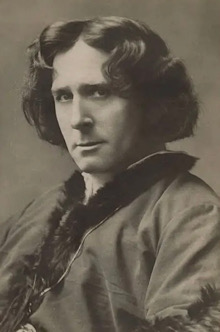
Doran tours with Benson and other managements, and plays in the West End before setting up his own company in 1920. He leads it for eleven years, before leaving Britain to work in India. On his return he works on stage and makes occasional television appearances.
Doran is the son of Charles Jenkins Doran. He is educated in Cork and privately. In 1899, he makes his stage debut as a member of Frank Benson’s touring company, in Julius Caesar at the Theatre Royal, Belfast. He remains with Benson for two and a half years, during which he makes his London debut, as Captain MacMorris in Henry V at the Lyceum Theatre.
In October 1910, returning to England, Doran plays La Tribe in Count Hannibal at the New Theatre, after which he is Pistol in The Merry Wives of Windsor at the Garrick Theatre to the Falstaff of Asche. For the next ten years he plays in new, ephemeral works, interspersed with classics. Among his roles in the latter are Constantine Levin in Anna Karenina (1913), Douglas in Henry IV, Part 1and the Constable of France in Henry V (1914) in London, and a variety of Shakespeare parts at the Memorial Theatre, Stratford-upon-Avon (1919).
In February 1920, Doran begins touring with his own Shakespearean company, playing Hamlet, Shylock in The Merchant of Venice, Brutus in Julius Caesar, Malvolio in Twelfth Night, Prospero in The Tempest, Petruchio in The Taming of the Shrew, Macbeth, Falstaff, Henry V, and Jaques in As You Like It. He has a keen eye for rising talent, and among his recruits are Noel Streatfeild, Cecil Parker, Ralph Richardson, Edith Sharpe, Norman Shelley, Abraham Sofaer, Francis L. Sullivan and Donald Wolfit.
In 1931, Doran goes to India as director of Shakespeare’s plays at the State Theatre in Jhalawar and then on to Bombay where he performs primarily in Shakespeare on the radio. He returns to England in 1937. His last London appearance is in Song of Norway (1949). His last Shakespearean role in the theatre is Time in The Winter’s Tale (1951). He continues to act on stage in other parts until 1954. He appears on BBC Television as a senator in Othello in 1950 and Adabashev, the tragedian in Curtain Down in 1952.
Doran dies in Folkestone on the south coast of England on April 5, 1964, at the age of 87. An article on him published by Emory University in 2003 sums up his career thus:
On stage in one role or another, Doran’s fifty-seven years in the theatre made him a major force in the profession, particularly in his productions of Shakespeare. Such was his energy and enthusiasm that he kept alive for a few more years the actor-manager system when the major talents, men like Tree, Benson, and Irving, had dissolved their companies. Doran was indeed the last of his theatrical breed.
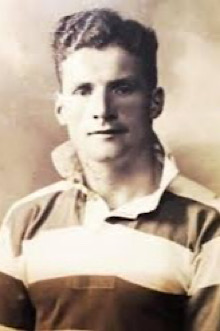
In 1934, aged 16, McAlinden is playing for Glentoran Reserves, when after a game against their reserves, he is offered a professional contract by Belfast Celtic. Together with Jackie Vernon, Tommy Breen, Billy McMillan and Charlie Tully, he subsequently becomes a prominent member of the Celtic team managed by Elisha Scott. This team dominates the Irish League in the era before and during World War II. Among his most notable contributions is scoring in the 2–1 win against Bangor in the 1938 Irish Cup final.
In December 1938, McAlinden signs for Portsmouth for a fee of £7.500. He makes his debut for the club against Chelsea and goes on to become a regular in the side. Within six months of his arrival at the club, he helps them win the 1939 FA Cup final, beating Wolverhampton Wanderers 4–1. After the outbreak of World War II, he plays three times for Portsmouth in wartime regional leagues, but his first spell with the club ends when he then returns to Belfast Celtic in 1939. He returns to Portsmouth for a second stint in 1946. In September 1947, he leaves Portsmouth once again and joins Stoke City for a fee of £7,000.
Following the end of his second stint with Belfast Celtic and before he rejoins Portsmouth, McAlinden signs for Shamrock Rovers in September 1945. He makes his debut against Shelbourne at Glenmalure Park on September 16. While playing for Rovers his teammates include Paddy Coad, Peter Farrell and Tommy Eglington. During his one season with Rovers, he helps the club reach the 1946 FAI Cup final. However Rovers lose 3–1 to Drumcondra.
McAlinden joins Stoke City in September 1947 for a then club record fee of £7,000. He becomes regular inside forward under manager Bob McGrory in 1947–48, playing in 33 matches scoring just twice against Aston Villa and Huddersfield Town. His lack of goals sees him fall out of favour at the Victoria Ground and he is sold to Third Division South side Southend United in October 1948.
In 1948, Southend United signs McAlinden from Stoke City for a fee of £8,000. He continues to play for United until 1954 and during his time with the club he serves as club captain. He also becomes something of a cult hero among the club’s fans and is remembered as being possibly the best player ever to play for the club. In 1950, he is caught up in controversy after it is alleged that he received illegal payments during his second spell with Portsmouth. As a result, he is suspended for the first two months of the 1950–51 season. In April 1954, he makes his last home appearance for United in a 4–1 win over Queens Park Rangers.
When McAlinden begins his international career in 1937 there are in effect, two Ireland teams, chosen by two rival associations. Both associations, the Northern Ireland–based Irish Football Association (IFA) and the Irish Free State–based Football Association of Ireland (FAI), claim jurisdiction over the whole of Ireland and select players from the whole island. As a result, several notable Irish players from this era, including McAlinden play for both teams.
Between 1937 and 1948, McAlinden makes five appearances for the IFA XI, making his international debut in a 1–1 draw with Scotland at Pittodrie Stadium on November 10, 1937. His IFA XI appearances also include the 8–4 defeat against a Combined Services XI at Windsor Park on September 9, 1944. This team is basically a Great Britain XI and features, among others, Matt Busby, Stanley Matthews, Tommy Lawton and Stan Mortensen. He also plays against England in 7–2 defeat at Windsor Park on September 9, 1946. He makes his last appearance for the IFA XI on October 10, 1948, in a 6–2 defeat to England at Windsor Park. He makes his first three appearances for the IFA XI while with Belfast Celtic, his fourth while at Portsmouth and his fifth while at Southend United.
In 1946, while with Portsmouth, McAlinden also makes two appearances for the FAI XI. He is one of several players born in Northern Ireland who benefits from the FAI’s attempts to establish their all-Ireland influence. In June 1946, when the FAI organises an Iberian tour, he, together with Jackie Vernon, Billy McMillan and Paddy Sloan, is one of four Northern Irish players called up. He subsequently plays in both the 3–1 defeat to Portugal on June 16 and then helps Ireland gain a surprise 1–0 victory against Spain on June 23, 1946.
In 1955, McAlinden becomes player/manager of Glenavon. He continues playing for an additional year before finally retiring as a player to concentrate on management. During a thirteen-year stint with Glenavon, he guides them two Irish League titles, three Irish Cup victories and one Gold Cup. After leaving Glenavon, works as a full-time scout for Coventry City before taking charge at Lisburn Distillery in 1969. He subsequently guides a Distillery team that includes a young Martin O’Neill to a win in the 1971 Irish Cup. Later in his first season with Drogheda United, he guides them to the 1976 FAI Cup final, only to lose 1–0 to Bohemian.
McAlinden dies at the age of 75 on November 15, 1993.
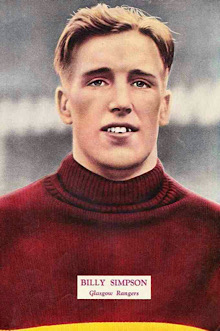
Simpson signs for Rangers from Linfield for a sum of £11,500 in 1950. He spends nine years (1950–59) at Rangers making 239 appearances and scoring 163 goals. He wins three championship medals and a Scottish Cup winners medal with Rangers to add to the two Northern Ireland Football League and two Irish Cups he wins with Linfield. He leaves Ibrox Stadium in 1959 and spends the last couple of years of his career with Stirling Albion, Partick Thistle and (then non-league) Oxford United.
As an illustration of his popularity, in the fictional song “A Trip to Ibrox,” Simpson is credited with scoring twice in a “Ne’erday” Old Firm Derby at Ibrox. Whereby Rangers are 1-0 down at halftime, and Simpson inspires his team to a second half comeback after Willie Waddell has scored an equaliser.
In recognition of his service to that club, Simpson is made a member of the Rangers F.C. Hall of Fame.
Simpson makes his debut for Northern Ireland in 1951 against Wales, scoring in the process. He represents his country twelve times in total between 1951 and 1958, scoring five goals. He is selected in Northern Ireland’s squad for the 1958 FIFA World Cup in Sweden but a late injury ensures he does not play at all during the finals.
In April 2015, the feature-length documentarySpirit of ’58 is screened as part of the Belfast Film Festival. It features Simpson prominently alongside the other surviving players (Billy Bingham, Peter McParland, Jimmy McIlroy and Harry Gregg) as it tells the story of Northern Ireland’s journey throughout the 1950s under the managership of Peter Doherty, culminating in the 1958 World Cup.
Marrinan becomes ill with infantile paralysis at the age of five, and as a result is tutored privately. He has no formal training in art but is largely influenced by his reading matter, particularly the American comic strips of Bud Fisher. The variety of facial expressions that Fisher can achieve, with only a pencil, intrigues and inspires him. Likewise, the images evoked by Celtic mythology and religious art also contributes to his visual language, and many hours are spent in the Belfast Museum and Art Gallery studying the paintings in their collection.
Marrinan exhibits with the Ulster Academy of Arts from an address at 524 Donegall Road, Belfast, entering “The Wee Gate, Earl Street, Belfast” (1931) and “The Painter’s Father” and the “Apache” (1934), which is judged “picture of the year.” He last exhibits with a landscape, “Connemara,” along with four other works in 1949.
Marrinan paints and sketches portraits of many notable Irish figures, among which is the charcoal drawing of northern Fenian Robert Johnston (1934; National Gallery of Ireland) and a sketch of the Donegal storyteller Niall Duffy (University College Dublin). His literary portraits include one of Brian Friel. He holds a one-man show in 1951 at 55a Donegall Place, Belfast, where he exhibits a bust of John McLaverty. He takes an interest in sculpture although painting and drawing remain his preferred form of expression. Important commissions are for a memorial portrait (completed 1952) of Éamonn Ceannt for Ceannt Barracks officers’ mess, Curragh Camp, County Kildare, and for a portrait of Vice-brigadier Peadar Clancy for Clancy Barracks, Dublin. He paints two memorial portraits of PresidentJohn F. Kennedy, one of which is in the Irish Club, London.
Marrinan is an honorary member of the Royal Ulster Academy and exhibits with them every year from 1950 onward, showing a portrait of Mrs. Padraig Marrinan in 1967 (no other details of his marriage are known). He is preparing for an exhibition to be held at the Irish Club, London, in 1974, but dies on October 25, 1973, at Tyrone County Hospital in Omagh. He is then living at James Street, Omagh.
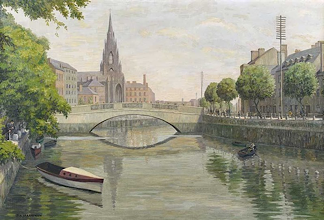
(From: “Marrinan, Padraig H.” by Ruth Devine, Dictionary of Irish Biography, http://www.dib.ie, October 2009 | Pictured: “The River Lee, Cork City, Ireland” by Padraig Marrinan, oil on canvas)
Blanchflower is born on February 10, 1926, in the Bloomfield district of Belfast, the first of five children born to John and Selina Blanchflower. He is educated at Ravenscroft public elementary school and is awarded a scholarship to Belfast College of Technology. He leaves school early to become an apprentice electrician at Gallaher’s cigarette factory in Belfast. He also joins the Air Raid Precautions (ARP) and, in 1943, joins the Royal Air Force after lying about his age. By 1946, after a trainee navigator course at the University of St. Andrews in Scotland and further training in Canada, he is back at Gallaher’s in Belfast and building a reputation as an outstanding footballer.
Blanchflower signs with Glentoran F.C. in 1946 before crossing the Irish Sea and signing with Barnsley F.C. for £6000 in 1949 at the age of 23. He transfers from Barnsley to Aston Villa F.C. for a fee of £15,000 and makes his First Division debut in March 1951. He makes 155 senior appearances for Villa before being bought by Tottenham Hotspur F.C. in 1954 for a fee of £30,000. During his ten years playing at White Hart Lane he makes 337 League appearances and 382 total appearances.
The highlight of Blanchflower’s time with the Spurs comes in the 1960–61 season, while serving as captain, the Spurs win their first 11 games and eventually win the league by 8 points. They beat Leicester City F.C. in the final of the FA Cup, becoming the first team in the 20th century to win the League and Cup double and a feat not achieved since Aston Villa in 1897.
In 1962, Blanchflower again captains the Spurs team to victory in the FA Cup in 1962, narrowly missing out on a second double when they finish a close third in the league behind Ipswich Town F.C. and Burnley F.C. In 1963, he captains the team to victory over Atlético Madrid in the final of the European Cup Winners’ Cup, making Spurs the first English team to win a European trophy.
Between 1949 and 1963, Blanchflower earns 56 caps for Northern Ireland, often playing alongside his brother Jackie until the younger Blanchflower’s playing career is cut short as a result of injuries sustained in the Munich air disaster of February 1958. In 1958, he captains his country when they reached the quarter-finals of the FIFA World Cup.
On December 4, 1957, Blanchflower captains the Northern Ireland team against Italy in Belfast in a bad tempered game that comes to be known as the “Battle of Belfast.” He attempts to keep the peace as the game turns nasty.
Blanchflower announces his retirement as a player on April 5, 1964, having played nearly 400 games in all competitions for the Spurs and captains them to four major trophies.
Following his retirement as a player, Blanchflower coachs for the Spurs for a number of years. Manager Bill Nicholson intends for Blanchflower to be his successor but, when Nicholson resigns in 1974, Blanchflower is passed over in favour of Terry Neill. He leaves the Spurs and becomes manager of Northern Ireland for a brief spell in 1978 before being appointed boss of Chelsea F.C. The team wins only three of fifteen games under his charge and he leaves the team in September 1979.
On May 1, 1990, Tottenham holds a testimonial match for Blanchflower at White Hart Lane, but at this point he is in the early stages of what is later diagnosed as Alzheimer’s disease and Parkinson’s disease. He is eventually placed in a nursing home in Staines-upon-Thames where he dies as a result of pneumonia on December 9, 1993, at the age of 67.
Blanchflower’s hometown of Belfast has honoured him with an Ulster History Circle plaque, located at his childhood home at 49 Grace Avenue, recognising the late sportsman as one of the greatest players in the history of Tottenham Hotspur FC.
Hammond is the son of Leslie Hammond, a tram driver, and his wife Annie (née Lamont). His parents are not city people; his mother grew up near Ballybogy in the Ballymoney area of County Antrim, and his father, though from a family with roots in south County Londonderry, had lived in Ballymoney as a boy, and had been apprenticed to a blacksmith there. Both have a strong sense of their rural identity and maintain the Ulster Scots dialect of their childhood. They are never quite at home in the Belfast suburb of Cregagh, and in particular do not share the sectarian attitudes that are much more present in 1930s Belfast than they had been in north Antrim, one of the last strongholds of Presbyterian radicalism. Even as a boy, Hammond is interested in the old songs that his mother sang and realises that the traditions in which his parents had been nurtured are disappearing quickly in an increasingly urbanising and modernising world. When he encounters the work of Emyr Estyn Evans in the early 1940s, he is encouraged to document both rural tradition and the street life of the city, and he and a couple of friends, though still just teenagers, ride off on their bicycles to look for folklore in the hinterland of Belfast.
After primary school, Hammond wins a scholarship in 1941 to Methodist College Belfast, where he does well in examinations, and then goes to Stranmillis University College to train as a teacher. In his first job, in Harding Memorial primary school in east Belfast, he proves to be a popular, idealistic teacher, and is remembered by his pupils fifty years later as a fine singer and a teller of ghost stories, who had taken the class on memorable youth-hosteling trips to the Mourne Mountains. Youth hosteling and folklore collecting increases his awareness and understanding of the rich traditions of the whole community in the north of Ireland, and he is never constrained by political or religious barriers. His early career mirrors closely that of James Hawthorne, and their paths are to cross in later life.
Hammond is friendly with many others active in the cultural life of Northern Ireland and makes a name for himself as a song collector and eventually as an expert on all aspects of traditional singing. In 1956, he is awarded a scholarship to travel in the United States to meet the important pioneers of folk-music collecting and performance there. He records his first LP record of Ulster songs, I Am The Wee Falorie Man (1958), in the United States, and becomes friends with Pete Seeger, the Appalachian singer Jean Ritchie, with old blues singers, and notably with Liam Clancy, one of the three Clancy brothers who as a quartet with Tommy Makem are to popularise Irish folk music in the United States and elsewhere.
On returning to Belfast, Hammond takes a job in 1958 in Orangefield secondary school in the east of the city, where the highly regarded headmaster John Malone encourages new approaches to education. Among his pupils at Orangefield is George Ivan “Van” Morrison, who credits him with inspiring his interest in Irish traditional music. Hammond enjoys teaching but is increasingly drawn to folk-song performance and recording. He appears regularly on radio programmes of the BBC and Radio Éireann, and in 1964 joins the school’s department in BBC Northern Ireland. There, with colleagues like Sam Hanna Bell, James Hawthorne and others, he works on programmes such as Today and Yesterday in Northern Ireland, which for the first time introduces pupils (and many adults) to local history and to aspects of tradition. In 1968, with two friends, the poets Seamus Heaney and Michael Longley, he puts on poetry and traditional music events in schools all over the province. The Arts Council funds the Room to Rhyme project, which is immensely influential and inspiring, and is still talked about many years later by those who attended as children.
Hammond is creatively involved with hundreds of hours of broadcasting, in television as well as radio, and eventually for adults as well as children. He writes scripts, produces documentary series such as Ulster in Focusand Explorations, and brings an artistic sensibility to filming, as well as working sympathetically with traditional singers and craftspeople. Dusty Bluebells, a sensitively made film of Belfast children’s street games, wins the prestigious Golden Harp award in 1972. After he leaves the BBC to work as a freelance, and founds Flying Fox Films in 1986, he continues making documentaries on many aspects of Ulster life and heritage. His film called Steel Chest, Nail in the Boot and the Barking Dog (1986), about working in the Belfast shipyards, also wins a Golden Harp award. A companion book of the same name is published. Another book is Belfast, City of Song(1989), with Maurice Leyden. In 1979, he edits a volume of the songs of Thomas Moore. His documentary programmes include films about singers from Boho, County Fermanagh, and about the big houses of the gentry in Ireland. The Magic Fiddle (1991/2) examines the role of the instrument in the folk music of Ireland, Scandinavia, Canada, and the American south, while Another Kind of Freedom (1993) is about the experiences of a former Orangefield pupil, the Beirut hostage Brian Keenan. He also produces and directs the films Something to Write Home About (1998), Where Are You Now? (1999), and Bogland (1999), all of which explore Seamus Heaney’s home region and experiences.
The first poem in Heaney’s collection Wintering Out (1972) is entitled “For David Hammond and Michael Longley.” Their lifelong friendship leads to several other creative collaborations. In particular, after a distressing evening in 1972 when Hammond, affected by the despair and terror unleashed by Irish Republican Army (IRA) bombing of his city, is for once unable to sing, Heaney meditates on the experience in an essay and in an important poem, “The singer’s house” (subsequently included in his 1979 Field Work collection). The poem urges the singer to keep singing, to defend the values of art and friendship in a hostile time. Hammond collaborates with Dónal Lunny and other traditional musicians to bring out an LP also called The Singer’s House(1978), which includes Heaney’s poem on the album sleeve, and features some of the songs that he had made famous, such as “My Aunt Jane” and “Bonny Woodgreen,” from his vast repertoire of songs from Ulster. The album is reissued in 1980.
In 1995, Hammond is one of Heaney’s personal guests at the award of his Nobel prize in Stockholm, characteristically wearing his usual, mustard-yellow, cattle-dealer boots with evening dress. On another formal occasion, when he is awarded an honorary doctorate by Dublin City University in November 2003, he surprises the audience by standing up in his academic robes to sing “My Lagan love,” instead of giving an address. His unique, light mellow voice is an ideal vehicle for the traditional ballads which he knows so well. He records a number of records in the 1960s, including Belfast Street Songs, and publishes the book Songs of Belfast (1978). He also encourages traditional musicians like Arty McGlynn, and collaborates with them on various recording projects. He is well known for live and often impromptu performances at festivals and venues in Ireland and the United States. He also performs at the John F. Kennedy Center for the Performing Arts in Washington, D.C.
Hammond is also a notable collaborator with poets and dramatists, especially in the important Field Day Theatre Company project, of which he is a director, along with Seamus Heaney, Tom Paulin, Seamus Deane, Thomas Kilroy, and the project’s founders, Brian Friel and Stephen Rea. He supports the Field Day search for a “fifth province,” where history and community and culture can intersect, believing that to speak unthinkingly of “two traditions” is to perpetuate superficial political divisions. As he says in an interview in The Irish Times on July 4, 1998, songs can “take you out of yourself” and become bridges to unite people.
Hammond receives many honours. In 1994, he receives the Estyn Evans award for his contribution to mutual understanding, and his work is featured in several major events in his honour: in the University of North Florida (1999), in the Celtic Film Festival in Belfast (2003), and in Belfast’s Linen Hall Library (2005). A Time to Dream, a film about his life and work, is broadcast on BBC Northern Ireland in December 2008.
Hammond dies in hospital in Belfast, after a long illness, on August 25, 2008, survived by his wife Eileen (née Hambleton), whom he marries on July 19, 1954, and by their son and three daughters. His funeral in St. Finnian’s Church is a major cultural event, where friends sing, play and speak in his honour.
In Seamus Heaney’s last collection of poetry, Human Chain (2010), he includes a poignant farewell to Hammond. The poet imagines (or perhaps dreams) of another visit to the singer’s house, but this time “The door was open, and the house was dark.”
(From: “Hammond, David Andrew (‘Davy’)” by Linde Lunney, Dictionary of Irish Biography, http://www.dib.ie, December 2014)
McCann is educated at primary level at St. Gall’s Primary School, Belfast, and at St. Mary’s Grammar School, Belfast. He does not finish his education as he is arrested after becoming involved in rioting. He is charged and convicted of “riotous behaviour” and sentenced to six months in prison. Later that year he joins the Provisional IRA. He is later convicted and sentenced to two years imprisonment for the possession of explosives.
In 1988, McCann and Savage, along with Mairead Farrell, another IRA member, are sent to the British overseas territory of Gibraltar to plant a bomb in the town area, targeting a British Army band which parades weekly in connection with the changing of the guard in front of The Convent, the official residence of the governor of Gibraltar.
The British Government knows in advance about the operation, and specially dispatches to Gibraltar a British Army detachment to intercept the IRA team. While McCann, Savage and Farrell are engaged on March 6, 1988, on a reconnaissance trip in Gibraltar before driving in a car bomb, soldiers from the Special Air Service (SAS) regiment wearing civilian clothes confronts them in the streets of the town. McCann is shot five times at close range, the SAS soldiers later claiming that he had made an “aggressive move” when approached. Farrell, who is with McCann, is also shot dead. Savage is walking separately behind McCann and Farrell within eyesight distance, and seeing them ahead being confronted and fired upon, flees, running several hundred yards back into Gibraltar town closely pursued on foot by another SAS soldier, who catches up with him and shoots him dead also. All three IRA members are subsequently found to be unarmed.
A car bomb created by McCann, Savage and Farrell and ready to be driven into Gibraltar is found 36 miles away in Spain by the Spanish Police two days after their deaths, containing 140 lbs. (64 kg) of Semtex with a device timed to go off during the changing of the guard in Gibraltar.
A documentary entitled Death on the Rock, is produced and broadcast on British television about the failed IRA operation in Gibraltar shortly after it takes place, detailing the British and Spanish Government’s actions and that of the IRA team, in an operation that the British Government code-names Operation Flavius. The documentary also interviews civilian eyewitnesses to the shooting of the Provisional IRA members, raising questions about the veracity of the British Government and its involved soldiers’ accounts of it, focusing on whether the three IRA members had been offered the chance to surrender by the soldiers confronting them before they had been fired upon. It also questions whether the violence used had been proportionate, in line with ongoing rumours in the British media of a purported “Shoot to Kill” policy that the British Government is pursuing against the Provisional IRA during The Troubles.
At an IRA-sponsored collective funeral on March 16, 1988, for McCann along with Savage and Farrell at the IRA plot in Milltown Cemetery in West Belfast, as the bodies are being lowered into the ground, the funeral party comes under a hand grenadeattack from a lone Loyalist paramilitary. The funeral immediately descends into chaotic scenes, as a running fight occurs between the lone gunman firing a handgun and throwing more grenades at a group of mourners, as they pursue him through the cemetery’s grounds. Three mourners are killed and scores wounded in the incident.
John McCredy McAlery, an Irish association football pioneer, is born in Rathfriland, County Down, on November 29, 1848. His accomplishments include organizing the first ever properly organized football match in the history of Irish football in 1878, founding the first Irish football club in 1879, helping found the Irish Football Association in 1880, and wearing the captain‘s armband in Ireland‘s first ever international match in 1882. He is known as the “father of Irish association football.”
McAlery moves to Belfast to learn the drapery business and soon becomes very successful, opening the Irish Tweed House gentleman’s outfitters on Royal Avenue. A talented cricketer in his youth, his first involvement in the Belfast sport scene is helping in the formation of the Cliftonville Cricket Club in 1870, later serving as club treasurer. In 1878, during his honeymoon in Scotland, he witnesses his first ever association football match, and enjoys it so much he decides to introduce the sport back home.
The first match of organized association football on Irish soil is played on October 24, 1878, between Caledonian and Queen’s Park. McAlery invites the Scottish sides to play in the exhibition match at the Ulster Cricket Ground in an attempt to showcase the game to the Belfast crowd. Queen’s Park achieves a 3–2 victory, and more importantly, the demonstration is well received by the locals.
On September 20, 1879, less than a year later, McAlery places an advertisement in both the News Letter and the Northern Whig soliciting for individuals interested in becoming members of the Cliftonville Association Football Club.
The newly formed Cliftonville F.C. side plays their first match just nine days later, losing 2–1 to a team of rugby players called Quidnunces. They achieve their first victory on November 1 with a 2–0 defeat of Knock F.C., a team of former lacrosse players.
On November 18, 1880, McAlery organizes a meeting at the Queen’s Hotel in Belfast between the seven Irish football clubs that have been established at the time: Alexander, Avoniel, Cliftonville, Lisburn Distillery, Knock, Moyola Park and Oldpark. These teams become the founding members of the Irish Football Association (IFA), with Lord Spencer Chichester serving as its president and McAlery as secretary. In an appendix to the minutes of the meeting, McAlery writes: “If the spirit which pervaded from those present be acted upon the result will be a strong Association for promoting the game which we have espoused.”
The meeting also provides for Ireland’s first official football competition, the Irish FA Cup. In the first Cup final of the inaugural competition, played on April 9, 1881, Cliftonville is defeated by Moyola Park. They suffer the same fate the following year, losing to Queen’s Island in the final of the 1881–82 edition. McAlery, who captains Cliftonville while playing at fullback, wins his first trophy on his third try, as his club defeats Ulster to win the 1882–83 Irish Cup.
McAlery does not play much after this, deciding to focus on his administrative role in Irish football. He referees international matches until 1887, and remains the Irish FA secretary until 1888.
McAlery captains Ireland’s first ever international match on February 18, 1882, playing at right back. On a “bittery cold” Belfast night with occasional rain and hail, Ireland loses to the far more experienced England team by a score of 13–0. A week later, he makes his second and final international appearance, captaining his team again as they lose 7–1 to Wales in Wrexham.
Moore is the eldest son of Queen Victoria‘s honorary physician in Ireland, Dr. William Moore of Rosnashane, Ballymoney, and Sidney Blanche Fuller. His ancestors came to Ulster during the Plantation of Ulster, settling at Ballymoney, at which time they were Quakers. The Moore Lodge estate is inherited from a relative. The family owns several other houses: Moore’s Grove and Moore’s Fort. He goes on to become a Deputy Lieutenant for County Antrim and a Justice of the Peace.
In 1903, Moore is one of the first landowners of Ireland to sell off their estates under the land acts. By the early 1920s he owns a Belfastpied-à-terre called “Glassnabreedon,” in the village of Whitehouse, four miles north of Belfast. This house is once owned by the son of Nicholas Grimshaw, Ireland’s first cotton pioneer.
Moore becomes a member of the General Synod of the Church of Ireland and is a founder member of the Ulster Council. He is a passionate Orangeman: his vehemence in defending Ulster’s right to oppose Irish Home Rule is said to alarm even those who share his views. Speaking in England on March 10, 1913, he makes his feelings clear on the possibility of Irish Home Rule: “I have no doubt, if Home Rule is carried, its baptism in Ireland will be a baptism in blood.” He shows little respect for English politicians, and has nothing but contempt for Southern Unionists. The eventual political settlement in 1921 meets with his approval.
Moore dies at his home, Moore Lodge, in Ballymoney on November 28, 1944, less than a week after his 80th birthday. He is buried in the family burial ground, “Lamb’s Fold,” two days later.
Norman Derek Mahon, Irish poet, is born in Belfast, Northern Ireland, on November 23, 1941, but lives in a number of cities around the world. At his death it is noted that his “influence in the Irish poetry community, literary world and society at large, and his legacy, is immense.” President of IrelandMichael D. Higgins says of Mahon, “he shared with his northern peers the capacity to link the classical and the contemporary but he brought also an edge that was unsparing of cruelty and wickedness.”
At Inst Mahon encounters fellow students who share his interest in literature and poetry. The school produces a magazine in which he produces some of his early poems. According to the critic Hugh Haughton, his early poems are highly fluent and extraordinary for a person so young. His parents cannot see the point of poetry, but he sets out to prove them wrong after he wins his school’s Forrest Reid Memorial Prize for the poem ”The power that gives the water breath.”
At times expressing anti-establishment values, Mahon describes himself as an “aesthete” with a penchant “for left-wingery […] to which, perhaps naively, I adhere.”
In March 2020, at the beginning of the COVID-19 pandemic, RTÉ News ends its evening broadcast with Mahon reading his poem Everything Is Going to Be All Right.
Mahon dies in Cork, County Cork, on October 1, 2020, after a short illness, aged 78. He is survived by his partner, Sarah Iremonger, and his three children, Rory, Katy, and Maisie. His papers are held at Emory University.
Mahon features on the Irish Leaving Certificate course with ten of his poems (Grandfather, Day Trip to Donegal, Ecclesiastes, After the Titanic, As It Should Be, A Disused Shed in Co. Wexford, Rathlin, The Chinese Restaurant in Portrush, Kinsale and Antarctica)


 seamus dubhghaill