seamus dubhghaill

Promoting Irish Culture and History from Little Rock, Arkansas, USA


Leave a comment

Death of Saint Columbanus

saint-columbanus

Columbanus, Irish missionary notable for founding a number of monasteries on the European continent from around 590 in the Frankish and Lombard kingdoms, dies on November 21, 615. He is one of the earliest identifiable Hiberno-Latin writers.

Columbanus is born in 543 in the Kingdom of Meath, now part of Leinster. Well-born, handsome and educated, he is torn between a desire for God and easy access to the pleasures of the world. Acting on advice of a holy anchoress, he decides to withdraw from the world. His family opposes the choice, his mother going so far as to block the door. He leaves home and studies Scripture extensively under Sinell, Abbot of Cluaninis in Lough Erne. He then moves to Bangor Abbey on the coast of Down, where Saint Comgall is serving as the abbot. He stays at Bangor until his fortieth year, when he receives Comgall’s permission to travel to the continent.

In middle age, Columbanus feels a call to missionary life. With twelve companions (Saint Attala, Columbanus the Younger, Cummain, Deicolus, Eogain, Eunan, Saint Gall, Gurgano, Libran, Lua, Sigisbert and Waldoleno) he travels to Scotland, England, and then to France in 585. The area, though nominally Christian, has fallen far from the faith, but are ready for missionaries, and they have some success. They are warmly greeted at the court of King Gontram of Burgundy, and the king invites the band to stay. They choose the half-ruined Roman fortress of Annegray in the Vosges Mountains for their new home with Columbanus as their abbot.

The simple lives and obvious holiness of the group draws disciples to join them and the sick to be healed by their prayers. Columbanus, to find solitude for prayer, often lives for long periods in a cave seven miles from the monastery, using a messenger to stay in touch with his brothers. When the number of new monks over-crowds the old fortress, King Gontram gives them the Gallo-Roman castle called Luxovium in present-day Luxeuil-les-Bains, some eight miles from Annegray, in 590. Soon after, a third house called Ad-fontanas is founded at present-day Fontaine-lès-Luxeuil. Columbanus serves as master of them all, and writes a Rule for them. It incorporates many Celtic practices, is approved by the Council of Mâcon in 627, but is superseded by the Benedictine.

Problems arise early in the 7th century. Many Frankish bishops object to a foreign missionary with so much influence, to the Celtic practices he brought, especially those related to Easter, and his independence from them. In 602 he is summoned to appear before them for judgment. Instead of appearing, he sends a letter advising them to hold more synods and to concern themselves with more important things than which rite he uses to celebrate Easter. The dispute over Easter continues for years, with Columbanus appealing to multiple popes for help. It is only settled when Columbanus abandons the Celtic calender when he moves to Italy.

In addition to his problems with the bishops, Columbanus speaks out against vice and corruption in the royal household and court, which is in the midst of a series of complex power grabs. Brunhilda of Austrasia stirs up the bishops and nobilty against the abbot. Theuderic II orders him to conform to the local ways and shut up. Columbanus refuses and is briefly imprisoned at Besançon, but he escapes and returns to Luxeuil. Theuderic II and Brunhilda send an armed force to force him and his foreign monks back to Ireland. As soon as his ship sets sail, a storm drives them back to shore. The captain takes it as a sign and sets the monks free.

They make their way to King Chlothar II at Soissons, Neustria and then the court of King Theudebert II of Austrasia in 611. Columbanus travels to Metz, France, then Mainz, Germany, where he sails up the Rhine to the lands of the Suebi and Alamanni, and finally Lake Zurich. Their evangelization work there is unsuccessful and the group passes on to Arbon, then Bregenz on Lake Constance. Saint Gall, who knows the local language best, takes the lead in this region. Many are converted to the faith and the group founds a new monastery as their home and base. However, a year later political upheaval causes Columbanus to cross the Alps into Italy, arriving in Milan in 612. The Christian royal family treats him well, and he preaches and writes against Arianism and Nestorianism. In gratitude, King Agilulf, the king of the Lombards, gives him a tract of land called Bobbio between Milan and Genoa in Italy. There he rebuilds a half-ruined church of Saint Peter, and around it he founds an abbey that is to be the source for evangelization throughout northern Italy for centuries to come.

Columbanus always enjoys being in the forests and caves, and as he walks through the woods, birds and squirrels ride on his shoulders. Toward the end of his life comes word that his old enemies are dead and his brothers want him to come back north, but he declines. Knowing that his time is almost done, he retires to his cave on the mountainside overlooking the Trebbia River. Columbanus dies of natural causes at Bobbio, Italy on November 21, 615.

Columbanus’ influence continues for centuries as those he converted hand on the faith, the brothers he taught evangelize untold numbers more, and his brother monks found over one hundred monasteries to protect learning and spread the faith.

(Pictured: Saint Columbanus stained glass window, Bobbio Abbey crypt)


Leave a comment

Death of John Redmond, Politician & Barrister

john-edward-redmond

John Edward Redmond, Irish nationalist politician, barrister, and Member of Parliament (MP) in the House of Commons of the United Kingdom, dies on March 6, 1918, in London, England. He is best known as leader of the moderate Irish Parliamentary Party (IPP) from 1900 until his death. He is also leader of the paramilitary organisation the National Volunteers.

Redmond is born to an old prominent Catholic family in Kilrane, County Wexford on September 1, 1856. Several relatives are politicians. He takes over control of the minority IPP faction loyal to Charles Stewart Parnell after Parnell dies in 1891. He is a conciliatory politician who achieves the two main objectives of his political life: party unity and, in September 1914, the passing of the Irish Home Rule Act.

The Irish Home Rule Act grants limited self-government to Ireland, within the United Kingdom. However, implementation of Home Rule is suspended by the outbreak of the World War I. Redmond calls on the National Volunteers to join Irish regiments of the New British Army and support the British and Allied war effort to restore the “freedom of small nations” on the European continent, thereby to also ensure the implementation of Home Rule after a war that is expected to be of short duration. However, after the Easter Rising of 1916, Irish public opinion shifts in favour of militant republicanism and full Irish independence, resulting in his party losing its dominance in Irish politics.

In sharp contrast to Parnell, Redmond lacks charisma. He works well in small committees but has little success in arousing large audiences. Parnell had always chosen the nominees to Parliament. Now they are selected by the local party organisations, giving Redmond numerous weak MPs over whom he has little control. He is an excellent representative of the old Ireland but grows increasingly old-fashioned because he pays little attention to the new forces attracting younger Irishmen, such as Sinn Féin in politics, the Gaelic Athletic Association in sports, and the Gaelic League in cultural affairs.

Redmond never tries to understand the unionist forces emerging in Ulster. He is further weakened in 1914 by the formation of the Irish Volunteers by Sinn Féin members. His enthusiastic support for the British war effort alienates many Irish nationalists. His party has been increasingly hollowed out, and a major crisis, notably the Easter Rising, is enough to destroy it.

Redmond is increasingly eclipsed by ill-health after 1916. An operation in March 1918 to remove an intestinal obstruction appears to progress well initially, but he then suffers heart failure. He dies a few hours later at a London nursing home on March 6, 1918.

Condolences and expressions of sympathy are widely expressed. After a funeral service in Westminster Cathedral his remains are interred, as requested in a manner characteristic of the man, in the family vault at the old Knights Templars‘ chapel yard of Saint John’s Cemetery, Wexford, amongst his own people rather than in the traditional burial place for Irish statesmen and heroes in Glasnevin Cemetery. The small, neglected cemetery near the town centre is kept locked to the public. His vault, which has been in a dilapidated state, has been only partially restored by Wexford County Council.


Leave a comment

UK Foot-and-Mouth Disease Outbreak

banbury-foot-and-mouth-notice

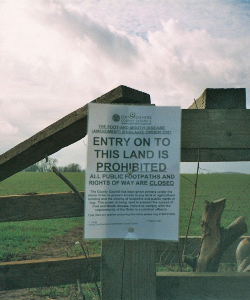
On February 21, 2001, Ireland’s multi-billion-pound livestock industry goes on full alert for signs of foot-and-mouth disease after the first outbreak in the United Kingdom in twenty years is confirmed in pigs. This epizootic sees 2,026 cases of the disease in farms across most of the British countryside. Over 6 million cows and sheep are killed in an attempt to halt the disease. By the time the disease is halted in October 2001, the crisis is estimated to have cost the United Kingdom £8bn (US$16bn).

The first case of the disease to be detected is at Cheale Meats abattoir in Little Warley, Essex on February 19, 2001, on pigs from Buckinghamshire and the Isle of Wight. Over the next four days, several more cases are announced in Essex. On February 23, a case is confirmed in Heddon-on-the-Wall, Northumberland, from where the pig in the first case had come. This farm is later confirmed as the source of the outbreak and the owner, Bobby Waugh of Pallion, is convicted of failing to inform the authorities of a notifiable disease, and later of feeding his pigs “untreated waste.”

Several cases of foot-and-mouth are reported in Ireland and mainland Europe, following unknowing transportation of infected animals from the UK. The cases spark fears of a continent-wide pandemic, but these fears prove unfounded.

Ireland suffers one case in a flock of sheep in Jenkinstown, County Louth in March 2001. A cull of healthy livestock around the farm is ordered. Irish special forces snipe wild animals such as deer capable of bearing the disease in the area.

The outbreak greatly affects the Irish food and tourism industry. The 2001 Saint Patrick’s Day festival is cancelled, but later rescheduled two months later in May. Severe precautionary measures are put into place throughout Ireland since the outbreak of the disease in the UK, with most public events and gatherings cancelled, controls on farm access, and measures such as disinfectant mats at railway stations, public buildings and university campuses. The 2001 Oireachtas Rince naa Cruinne, or Irish Dance World Championships, is cancelled as a result of these measures. Causeway 2001, an Irish Scouting Jamboree is also cancelled. Three matches involving the Ireland national rugby union team in the 2001 Six Nations Championship are postponed until the autumn.


Leave a comment

Charles Haughey Acquitted of Conspiring in the Arms Crisis

Charles Haughey, former Minister for Finance, and three others including former Minister for Agriculture Neil Blaney, are acquitted on October 23, 1970, of charges that they had conspired to illegally import arms and ammunition into Ireland for the Irish Republican Army (IRA), an incident known as the Arms Crisis.

The Garda Special Branch informs the Minister for Justice Micheál Ó Móráin and Taoiseach Jack Lynch that a plot to import arms exists and includes government members, however Lynch takes no action until the Special Branch makes opposition leader Liam Cosgrave aware of the plot. Cosgrave tells Lynch he is aware of the plot and will announce it in the Dáil the next day if he does not act. Lynch subsequently requests that Haughey and Blaney resign from the Cabinet. Both men refuse, saying they had done nothing illegal. Lynch then asks President Éamon de Valera to terminate their appointments as members of the government, a request that de Valera is required to grant by convention. Haughey and Blaney are subsequently tried in court along with Captain James Kelly, a former intelligence captain in the Irish Army, and Albert Luykx, a former Flemish Nationalist and businessman, who allegedly used his contacts to buy the arms.

The verdict, reached by jury after two hours and 10 minutes of deliberation, leads to political repercussions for the Government of Taoiseach Jack Lynch. Lynch had dismissed the Haughey from his Cabinet post the previous May on the allegation of illegal gunrunning.

Witnesses declare during the 14‐day trial that the arms, imported from the Continental Europe, were ultimately destined for the Roman Catholic minority in Northern Ireland. However, the defense contends that the arms had been brought in with the knowledge and approval of the current Minister for Agriculture, Jim Gibbons, who was serving as Minister for Defence at the time.

The jury rules that the prosecution had failed to prove its case.  Haughey is carried from the High Court after the acquittal, as are the three other defendants.

Although cleared of wrongdoing, it appears as if Haughey’s political career is finished. Blaney eventually resigns from Fianna Fáil but Haughey remains. He spends his years on the backbenches building support within the grassroots of the party. During this time, he remains loyal to the party and serves the leader but after the debacle of the Arms Crisis neither man trusts the other.

(Pictured: Charles Haughey with Neil Blaney at the 1970 at the Arms Trial)


Leave a comment

Death of Statesman Edmund Burke

Edmund Burke, statesman born in Dublin, dies on July 9, 1797, in Beaconsfield, Buckinghamshire, England. He is also known as an author, orator, political theorist, and philosopher who, after moving to London, served as a member of parliament (MP) for many years in the House of Commons with the Whig Party.

Burke receives his early education at a Quaker school in Ballitore, County Kildare. In 1744, he enters Trinity College, Dublin, a Protestant establishment, which up until 1793, did not permit Catholics to take degrees. He graduates from Trinity in 1748. Burke’s father wants him to read Law, and with this in mind he goes to London in 1750, where he enters the Middle Temple, before soon giving up legal study to travel in Continental Europe. After eschewing the Law, he pursues a livelihood through writing.

Burke criticizes British treatment of the American colonies, including through its taxation policies. He also supports the American Revolution, believing both that it could not affect British or European stability and would be an innovative experiment in political development since the Americas are so far away from Europe and thus could have little impact on England.

Burke is remembered for his support for Catholic emancipation, the impeachment of Warren Hastings from the East India Company, and for his later opposition to the French Revolution. In his Reflections on the Revolution in France, he claims that the revolution is destroying the fabric of good society and condemned the persecution of the Catholic Church that results from it. This leads to his becoming the leading figure within the conservative faction of the Whig Party, which he dubs the “Old Whigs,” as opposed to the pro–French Revolution “New Whigs” led by Charles James Fox.

For more than a year prior to his death, Burke realizes that his “stomach” is “irrecoverably ruind.” Edmund Burke dies in Beaconsfield, Buckinghamshire, on July 9, 1797, and is buried there alongside his son and brother. His wife, Mary Jane Nugent, survives him by nearly fifteen years.

In the nineteenth century Burke is praised by both conservatives and liberals. Subsequently, in the twentieth century, he becomes widely regarded as the philosophical founder of modern conservatism.


Leave a comment

The Siege of Limerick

cittie-of-limerick

Siege of Limerick commences on August 9, 1690, when William of Orange and his army of 25,000 men reach Limerick and occupy Ireton’s fort and Cromwell’s fort outside the city. His siege cannons are still making their way from Dublin with a light escort so all he has available is his field artillery. The siege train is intercepted by Patrick Sarsfield’s cavalry at Ballyneety in County Limerick and destroyed, along with the Williamites‘ siege guns and ammunition. This forces William to wait another ten days before he can start bombarding Limerick in earnest while another siege train is brought up from Waterford.

By this time, it is late August. Winter is approaching and William wants to finish the war in Ireland so he can return to the Netherlands and proceed with the main business of the War of the Grand Alliance against the French. For this reason, he decides on an all-out assault on Limerick.

His siege guns blast a breach in the walls of the “Irish town” section of the city and William launches his assault on August 27. The breach is stormed by Danish grenadiers, but the Jacobite’s French officer Boisseleau has built an earthwork or coupure inside the walls and has erected barricades in the streets, impeding the attackers. The Danish grenadiers, and the eight regiments who follow them into the breach, suffer terribly from musketry and cannon fire at point blank range. Jacobite soldiers without arms and the civilian population, including women, line the walls and throw stones and bottles at the attackers. A regiment of Jacobite dragoons also make a sortie and attack the Williamites in the breach from the outside. After three and a half hours of fighting, William finally calls off the assault.

William’s men suffer about 3,000 casualties, including many of their best Dutch, Danish, German, and Huguenot troops. The Jacobites lose only 400 men in the battle. Due to the worsening weather, William calls off the siege and puts his troops into winter quarters, where another 2,000 of them die of disease. William himself leaves Ireland shortly afterwards, returning to London. He subsequently leaves London to take command of Allied forces fighting in Flanders and leaves Godert de Ginkell to command in Ireland. The following year Ginkell wins a significant victory at the Battle of Aughrim.

Limerick is to remain a Jacobite stronghold until it surrenders after another Williamite siege the following year. Following the loss of this last major stronghold, Patrick Sarsfield leads the army into exile in the Flight of the Wild Geese to the Continent, where they continue to serve the cause of James II and his successors.


Leave a comment

Death of Francis McCloskey, First Fatality of “The Troubles”

the-troubles

Francis McCloskey, a 67-year-old Catholic civilian, dies on July 14, 1969, one day after being hit on the head with a baton by an officer of the Royal Ulster Constabulary (RUC) during street disturbances in Dungiven, County Derry. McCloskey is sometimes considered to be the first fatality of The Troubles.

McCloskey is found unconscious on July 13 near the Dungiven Orange Hall following a police baton charge against a crowd who had been throwing stones at the hall. Witnesses later say they had seen police beating a figure with batons in the doorway where McCloskey is found, although police claim he had been unconscious before the baton charge and may have been hit with a stone.

The Troubles is the common name for the ethno-nationalist conflict in Northern Ireland that begins in the late 1960s and is deemed by most to end with the Good Friday Agreement of 1998. Although the Troubles mainly take place in Northern Ireland, violence spills over at times into parts of the Republic of Ireland, England, and mainland Europe.

The conflict is primarily political, but it also has an ethnic or sectarian dimension, although it is not a religious conflict. A key issue is the constitutional status of Northern Ireland. Unionists and loyalists, who are mostly Protestants and consider themselves British, generally want Northern Ireland to remain within the United Kingdom. Irish nationalists and republicans, who are mostly Catholic and consider themselves Irish, generally want it to leave the United Kingdom and join a united Ireland. The conflict begins amid a campaign to end discrimination against the Catholic/nationalist minority by the Protestant/unionist government and police force in 1968. The campaign is met with violence, eventually leading to the deployment of British troops and subsequent warfare.

The main participants in the Troubles are republican paramilitaries such as the Provisional Irish Republican Army (IRA) and Irish National Liberation Army (INLA), loyalist paramilitaries such as the Ulster Volunteer Force (UVF) and Ulster Defence Association (UDA), the British Army and Royal Ulster Constabulary (RUC), and political activists and politicians. The security forces of the Republic of Ireland play a smaller role. More than 3,500 people are killed in the conflict, of whom 52% were civilians, 32% are members of the British security forces, and 16% are members of paramilitary groups. There has been sporadic violence since the signing of the Good Friday Agreement, including a campaign by anti-ceasefire republicans.


Leave a comment

The Death of James Augustine Aloysius Joyce

james-joyce

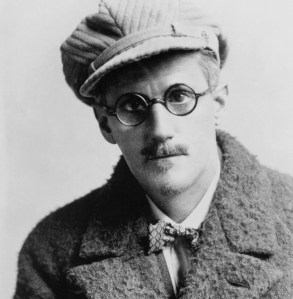
James Augustine Aloysius Joyce, considered to be one of the most influential writers in the modernist avant-garde of the early 20th century, dies in Zurich, Switzerland, following surgery for a perforated ulcer on January 13, 1941.

Joyce is born on February 2, 1882, in the wealthy Rathgar suburb of Dublin. The family is initially well off as Dublin merchants with bloodlines that connected them to old Irish nobility in the country. James’ father, John Stanislaus Joyce, is a fierce Irish Catholic patriot and his political and religious influences are most evident in Joyce’s two key works A Portrait of the Artist as a Young Man (1916) and Ulysses (1922).

The Joyce family is repeatedly forced to move to more modest residences due to their steadily diminishing wealth and income. John Joyce’s habitual unemployment as well as his drinking and spending habits make it difficult for the Joyces to retain their social standing. As a young man, Joyce is sent away to the renowned Clongowes Wood College in County Kildare in 1888, a Jesuit institution regarded as the best preparatory school in Ireland. The Clongowes school figures prominently in Joyce’s work, specifically in the story of his recurring character Stephen Dedalus. Joyce earns high marks both at the Clongowes School and at Belvedere College in Dublin where he continues his education. At this point in his life, it seems evident that Joyce is to enter the priesthood, a decision that would please his parents. However, as Joyce makes contact with various members of the Irish Literary Renaissance, his interest in the priesthood wanes. Joyce becomes increasingly critical of Ireland and its conservative elements, especially the Church.

Against his mother’s wishes, Joyce leaves Ireland in 1902 to pursue a medical education in Paris and does not return until the following year upon receiving news of his mother’s debilitation and imminent death. After burying his mother, Joyce continues to stay in Ireland, working as a schoolteacher at a boys’ school, another autobiographical detail that recurs in the story of Stephen Dedalus. After barely spending a year in Dublin, Joyce returns to the Continent, drifting in and out of medical school in Paris before taking up residence in Zurich. It is during this period that Joyce begins writing professionally.

In 1905, Joyce completes a collection of eight stories entitled Dubliners, although it is not actually printed until 1913. During these frustrating and impoverished years, Joyce heavily relies upon the emotional support of Nora Barnacle, his unmarried Irish lover, as well as the financial support of his younger brother, Stanislaus Joyce. Both Nora and Stanislaus remain as protective, supporting figures for the duration of Joyce’s life. During the eight years between Dubliners‘ completion and publication, Joyce and Barnacle have two children, a son named Giorgio, and a daughter named Lucia.

Joyce’s next major work, A Portrait of the Artist as a Young Man, appears in serialized form in 1914 and 1915. Joyce is “discovered” by Ezra Pound and the complete text is printed in New York City in 1916, and in London in 1917. It is with the assistance of Pound, a prominent literary figure of the time, that Joyce comes into contact with Harriet Shaw Weaver, who serves as both editor and patron while Joyce writes Ulysses.

When Ulysses is published in Paris in 1922, many immediately hail the work as genius. With his inventive narrative style and engagement with multiple philosophical themes, Joyce has established himself as a leading Modernist. The novel charts the passage of one day, June 16, 1904, as depicted in the life of an Irish Jew named Leopold Bloom, who plays the role of a Ulysses by wandering through the streets of Dublin. Despite the fact that Joyce is writing in self-imposed exile, living in Paris, Zurich, and Trieste while writing Ulysses, the novel is noted for the incredible amount of accuracy and detail regarding the physical and geographical features of Dublin.

Similar in theme to Joyce’s previous works, Ulysses examines the relationship between the modern man and his myth and history, focusing on contemporary questions of Irish political and cultural independence, the effects of organized religion on the soul, and the cultural and moral decay produced by economic development and heightened urbanization. While Joyce is writing it, there is serious doubt as to whether Ulysses will be completed. Midway through his writing, Joyce undergoes the first of eleven eye operations to salvage his ever-worsening eyesight. At one point, a disappointed Joyce casts the bulk of his manuscript into the fire, but Nora Barnacle immediately rescues it.

While Ulysses is hailed by some, the novel is banned in both the United Kingdom and the United States on obscenity charges. It is not until 1934 that Random House wins a court battle that grants permission to print and distribute Ulysses in the United States. The novel is legalized in Britain two years later.

By this time, Joyce is approaching the end of his public career and has concluded work on his final novel, Finnegan’s Wake (1939). Considered to be far more baffling and convoluted than Ulysses, Finnegan’s Wake is a critical failure. At the outbreak of World War II, Joyce remains in Paris until he is forced to move, first to Vichy, and then to Switzerland. On January 13, 1941, Joyce dies of a stomach ulcer at the age of 58 and is buried in Zurich’s Fluntern Cemetery.