The Provisional IRA had been attacking British Army patrols and convoys with land mines and roadside bombs since the beginning of its campaign in the early 1970s. The deadliest attack was the Warrenpoint ambush of August 1979, when 18 soldiers were killed by two large roadside bombs near Warrenpoint, County Down. In July 1983, four soldiers of the local Ulster Defence Regiment (UDR) were killed when their vehicle struck an IRA land mine near Ballygawley, County Tyrone. It was the UDR’s biggest loss of life up until then.
On the morning of April 9, 1990, two UDR armoured landrovers are traveling from Abercorn Barracks to Downpatrick. An IRA unit has planted a 1,000-pound improvised land mine in a culvert under the Ballydugan Road, just outside the town. The unit waits in woodland overlooking the road, about 350 feet away. As the landrovers drive over the culvert, the IRA detonates the bomb by command wire. The huge blast blows the vehicle into a field and gouges a large crater in the road, 50 feet wide and 15 feet deep. A witness describes “a scene of utter carnage.” Four soldiers are killed: Michael Adams (23), John Birch (28), John Bradley (25), and Steven Smart (23). It is the biggest loss of life suffered by the UDR since the 1983 Ballygawley land mine attack. The soldiers in the other landrover suffer severe shock and are airlifted to hospital. According to police, a civilian driver also suffers shock, and another receives cuts and bruises.
The bombers escape on a motorcycle which had been stolen in Newry a week earlier, and is later found abandoned in Downpatrick. The IRA issues a statement saying the attack was carried out by members of its South Down Brigade.
A 23 year-old man is later sentenced to 15 years in prison for the attack. He had driven a scout car for the bombers when it was planted the day before the attack.
Reid is the son of the Rev. Thomas Mayne Reid, a Presbyterian minister and later a senior clerk of the General Assembly of the Presbyterian Church in Ireland, and his wife, a daughter of the Rev. Samuel Rutherford. Educated at the Royal Belfast Academical Institution, he rebels against his father’s plans for him and decides not to pursue a career in the church. He briefly runs a school at Ballyroney before emigrating to the United States in 1839. Arriving in New Orleans, Louisiana, he finds a job as a corn factor’s clerk in the corn market. After six months he leaves because he refuses to whip slaves. Travelling across America, he works as a teacher, a clerk and an Indian-fighter, and anonymously publishes his first poem in August 1843. Later that year he meets Edgar Allan Poe in Philadelphia and the two become close friends. Poe later admits that Reid was ‘a colossal but most picturesque liar,’ but was impressed by his brilliant story-telling abilities.
With the outbreak of the Mexican-American War in 1846 Reid enlists in the 1st New York Infantry Regiment and is commissioned second lieutenant. Contributing a series of reports from the front under the pseudonym ‘Ecolier,’ he performs with great bravery in the Battle of Chapultepac on September 13, 1847. Wounded during the battle, he is promoted to first lieutenant three days later. Following his discharge from the army in 1848 he claims to have reached the rank of captain, but this is another of his inventions.
Reid’s first play, Love’s Martyr, is staged at the Walnut Street Theatre, Philadelphia, for five nights in October 1848, and the following year he publishes an embellished account of his experiences in Mexico entitled War Life. All of his works are published under the name ‘Captain Mayne Reid.’ In July 1849 he sails to England with a group of Hungarian radicals but decides against accompanying them to the Continent. Returning briefly to Ireland, he settles in London in 1850 and writes a novel, The Rifle Rangers. It is an immediate success and is followed quickly by The Scalp Hunters (1851), The Desert Home (1852), and The Boy Hunters (1853). While in England in 1851 he meets and falls in love with a 13-year-old girl, Elizabeth Hyde, daughter of his publisher, G. W. Hyde, an English aristocrat. When he discovers her age, he tells her that she is ‘getting old enough to have a lover, and you must have me.’ Two years later he continues with his suit, and this time is successful as they marry in 1853. He is immensely proud of his young bride, and later writes a semi-autobiographical novel The Child Wife (1868), based on their relationship.
Establishing a reputation as one of the most popular novelists of his generation, Reid does much to enhance the romantic image of the American West. His internationally successful books include The White Chief (1855), Bush Boys (1856), Oceola (1859), and The Headless Horseman (1865), and his novel about miscegenation, The Quadroon (1856), is later plagiarised by Dion Boucicault for The Octoroon (1859). A champion croquet player, he writes a treatise on the subject in 1863.
Disaster strikes in November 1866 when Reid is declared bankrupt. He had squandered all his money on the construction of ‘The Ranche,’ a Mexican-style hacienda in England. To raise money, he returns to the United States and embarks on a successful lecturing tour. Settling at Newport, Rhode Island, he writes another novel, The Helpless Hand (1868), which is a huge success and alleviates some of his difficulties. His wife hates America, however, and after he is briefly hospitalised in 1870, they decide to return to England.
Ill health, artistic doubts, and financial insecurity plagued Reid’s final years. Diagnosed with acute depression, he is unable to recapture his earlier audience and, despite a pension from the U.S. government, he struggles for money. He dies at Ross in Herefordshire on October 22, 1883, and is buried at Kensal Green Cemetery in London.
Although not regarded as an important novelist, Reid none the less has a significant influence on subsequent writers. The young Vladimir Nabokov is deeply impressed by his adventure stories, and one of his own first works is a poetic recreation of The Headless Horseman in French alexandrine. Both Robert Louis Stevenson and Arthur Conan Doyle are admirers, and politicians as diverse as Theodore Roosevelt and Leon Trotsky also make reference to his varied output. In total, Reid publishes over sixty novels, which are printed in ten languages.
Brontë is the first of ten children born to Hugh Brunty, a farm labourer, and Alice McClory. At one point in his adult life, he formally changes the spelling of his name from Brunty to Brontë. He spends most of his adult life in England.
In 1809, Brontë becomes assistant curate at Wellington, Shropshire, and in 1810 his first published poem, Winter Evening Thoughts, appears in a local newspaper, followed in 1811 by a collection of moral verses, Cottage Poems. He moves to the West Riding of Yorkshire in 1811 as assistant curate at Hartshead, where he serves until 1815. In the meantime he is appointed a school examiner at a Wesleyan academy, Woodhouse Grove School, near Guiseley. In 1815 he moves again on becoming perpetual curate of Thornton. At Guiseley, Brontë meets Maria Branwell, whom he marries on December 29, 1812.
Brontë is offered the perpetual curacy of St. Michael and All Angels’ Church, Haworth in June 1819, and he takes the family there in April 1820. His sister-in-law Elizabeth Branwell, who had lived with the family at Thornton in 1815, joins the household in 1821 to help to look after the children and to care for Maria Brontë, who is suffering the final stages of uterine cancer. She decides to move permanently to Haworth to act as housekeeper.
After several attempts to seek a new spouse, Brontë comes to terms with widowhood at the age of 47, and spends his time visiting the sick and the poor, giving sermons, communion, and extreme unction, leaving his children alone with their aunt and a maid, Tabitha Aykroyd (Tabby), who tirelessly recounts local legends in her Yorkshire dialect while preparing the meals.
Brontë is responsible for the building of a Sunday school in Haworth, which he opens in 1832. He remains active in local causes into his old age, and between 1849 and 1850 organises action to procure a clean water supply for the village, which is eventually achieved in 1856.
In August 1846, Brontë travels to Manchester, accompanied by Charlotte, to undergo surgery on his eyes. On August 28 he is operated upon, without anaesthetic, to remove cataracts. Surgeons do not yet know how to use stitches to hold the incision in the eye together and as a consequence the patient is required to lie quietly in a darkened room for weeks after the operation. Charlotte uses her time in Manchester to begin writing Jane Eyre, the book which is to make her famous.
Following the death of his last surviving child, Charlotte, nine months after her marriage, he co-operates with Elizabeth Gaskell on the biography of his daughter. He is also responsible for the posthumous publication of Charlotte’s first novel, The Professor, in 1857. Charlotte’s husband, Arthur Bell Nicholls, who had been Brontë’s curate, stays in the household until he returns to Ireland after Patrick Brontë’s death, at the age of 84, on June 7, 1861 in Haworth, Yorkshire, England. Brontë outlives not only his wife (by 40 years) but all six of his children.
Shawcross studies at Bolton College of Art from 1955 to 1958, and Lancaster College of Art from 1958 to 1960, before moving to Belfast in 1962 to take up a part-time lecturer’s post at the Belfast College of Art, becoming full-time in 1968. He continues to lecture there until his retirement in 2004.
Shawcross has exhibited nationally, with one-man shows in London, Manchester, Dublin and Belfast, and internationally in Hong Kong and the United States, and his work is found in many private and corporate collections.
Shawcross is elected an Associate of the Royal Ulster Academy of Art in 1975, and is made a full Academician in 1977. He wins the Academy’s Conor Award in 1975, its gold medal in 1978, 1982, 1987, 1994, 1997 and 2001, and its James Adam Prize in 1998. He is also a member of the Royal Hibernian Academy (RHA). He is awarded the Gallaher Portrait Prize in 1966.
In 2010, the Merrion Hotel, Dublin, hosts a private collection of the works of Shawcross. In 2015, he exhibits a collection of six foot tall book covers inspired by original Penguin paperbacks at the National Opera House in Wexford, County Wexford. In 2018, he donates to Belfast City Council a collection of 36 paintings dedicated to ‘Writers of Belfast’ in a show of appreciation to his adopted home city. A major retrospective of his works are exhibited at the F.E. McWilliam Gallery and Studio, Banbridge, County Down, in the same year.
Shawcross is a Patron of the charity YouthAction Northern Ireland. He lives in Hillsborough, County Down, Northern Ireland.
Mitchel is born in Camnish, near Dungiven, County Derry on November 3, 1815, the son of a Presbyterian minister. At the age of four, he is sent to a classical school, run by an old minister named Moor, nicknamed “Gospel Moor” by the students. He reads books from a very early age. When a little over five years old, he is introduced to Latin grammar by his teacher and makes quick progress. In 1830, not yet 15 years old, he enters Trinity College, Dublin and obtains a law degree in 1834. In the spring of 1836 he meets Jane Verner, the only daughter of Captain James Verner. Though both families are opposed to the relationship, they become engaged in the autumn and are married on February 3, 1837, by the Rev. David Babington in Drumcree Church, the parish church of Drumcree.
Mitchel works in a law office in Banbridge, County Down, where he eventually comes into conflict with the local Orange Order. He meets Thomas Davis and Charles Gavan Duffy during visits to Dublin. He joins the Young Ireland movement and begins to write for The Nation. Deeply affected by the misery and death caused by the Great Famine, he becomes convinced that nothing will ever come of the constitutional efforts to gain Irish freedom. He then forms his own paper, United Irishmen, to advocate passive resistance by Ireland’s starving masses.
In May 1848, the British tire of Mitchel’s open defiance. Ever the legal innovators in Ireland, they invent a crime especially for the Young Irelanders – felony-treason. They arrest him for violating this new law and close down his paper. A rigged jury convicts him, and he is deported first to Bermuda and then to Australia. However, in June 1853, he escapes to the United States.
Mitchel works as a journalist in New York City and then moves to the South. When the American Civil War erupts, he is a strong supporter of the Southern cause, seeing parallels with the position of the Irish. His family fully backs his commitment to the Southern cause. He loses two sons in the war, one at the Battle of Gettysburg in 1863 and another at the Battle of Fort Sumter in 1864, and another son loses an arm. His outspoken support of the Confederacy causes him to be jailed for a time at Fort Monroe, where one of his fellow prisoners is Confederate PresidentJefferson Davis.
In 1874, the British allow Mitchel to return to Ireland and in 1875 he is elected in a by-election to be a member of the Parliament of the United Kingdom representing the Tipperary constituency. However, his election is invalidated on the grounds that he is a convicted felon. He contests the seat again in the resulting by-election and is again elected, this time with an increased vote.
Unfortunately, Mitchel, one of the staunchest enemies to English rule of Ireland in history, dies eight days later in Newry on March 20, 1875, and is buried there. Thirty-eight years later, his grandson, John Purroy Mitchel, is elected Mayor of New York City.
In the early 1970s, after the onset of the Troubles, the Provisional IRA launches a campaign aimed at forcing the British to withdraw from Northern Ireland.
The IRA, particularly its South Armagh Brigade, has repeatedly attacked the British Army and RUC with home-made mortars, but with limited success. Between 1973 and early 1978 a total of 71 mortar attacks are recorded, but none cause direct British Army or RUC deaths. There are only two deadly mortar attacks before 1985. The first is on March 19, 1979, when Private Peter Woolmore of the Queen’s Regiment is killed in a mortar attack on Newtownhamilton British Army base. The second is on November 12, 1983, when a RUC officer is killed and several hurt in a mortar attack on Carrickmore RUC base.
The attack is jointly planned by members of the South Armagh Brigade and an IRA unit in Newry. The homemade mortar launcher, dubbed the ‘Mark 10,’ is bolted onto the back of a Fordlorry that had been hijacked in Crossmaglen.
Shortly after 6:30 PM on February 28, nine shells are launched from the lorry, which had been parked on Monaghan Street, about 250 yards from the base. At least one 50-lb. shell lands on a portacabin containing a canteen, where many officers are having their evening tea break. Nine police officers are killed and 37 people are hurt, including 25 civilian police employees, the highest death toll inflicted on the RUC in its history. The nine dead officers range in age from 19 to 41, seven male and two female, seven Protestants and two Catholics. Another shell hits the observation tower, while the rest land inside and outside the perimeter of the base.
The day is dubbed “Bloody Thursday” by the British press. British prime ministerMargaret Thatcher calls the attack “barbaric,” while Ireland’s Taoiseach, Garret FitzGerald, says it is “cruel and cynical,” and pledges the help of the Irish security forces to catch those responsible. Although not involved in the attack, Newry IRA member Eamon Collins is arrested shortly afterwards and interrogated. After five days of questioning, Collins breaks under interrogation and turns supergrass, leading to more than a dozen arrests of other IRA members. The attack prompts calls from unionist politicians to “increase security,” and the British government launches a multi-million pound programme of construction to protect bases from similar attacks. This involves installing reinforced roofs and building blast-deflecting walls around the base of buildings.
After the successful attack in Newry, the IRA carries out a further nine mortar attacks in 1985. On September 4, an RUC training centre in Enniskillen is attacked. Thirty cadets narrowly escape death due to poor intelligence-gathering by the IRA unit responsible. The cadets are expected to be in bed sleeping, but are instead eating breakfast when the bombs land. In November 1986, the IRA launches another attack on the RUC base in Newry, but the bombs fall short of their target and land on houses. A four-year-old Catholic girl is badly wounded and another 38 people are hurt, prompting the IRA to admit that “this incident left us open to justified criticism.”
Beginning in the 1990s, operations at the Corry Square base are progressively shifted to a new facility on the outskirts of Newry. The base is closed in 2002, and a park occupies the site today.
(Pictured: Destroyed cars and remains of the Newry RUC Corry Square police Station in Catherine Street taken the day after the attack by the Provisional IRA using homemade mortar bombs)
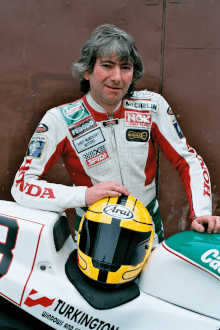
Dunlop marries on September 22, 1972 at the Ballymoney register office. He is the proprietor of a pub in Ballymoney and is highly superstitious, always wearing a red T-shirt and his yellow crash helmet when racing. He is presented with the Freedom of the Borough by Ballymoney Council in 1993.
Dunlop helps orphans in the Balkans, driving a van loaded with supplies to orphanages in Romania, Albania and Bosnia-Herzegovina before the annual racing season begins. In 1996, he receives an OBE for his humanitarian work.
On the night of May 23, 1985, Dunlop is traveling from Northern Ireland to the Isle of Man for the annual TT races by sea, onboard the Tornamona, a former fishing boat. The vessel departs from Strangford, County Down with Dunlop, other riders, racing bikes and equipment onboard. Strong currents into Strangford Lough push the Tornamona onto St. Patrick’s Rock where her rudder breaks off in a crevice. The boat sinks and all 13 passengers and crew are rescued by the PortaferryLifeboat. The bikes are later recovered by divers.
In 1986, Dunlop wins a fifth consecutive TT Formula One world title. Initially based on one race at the Isle of Man TT after the loss of World Championship status from 1977-onwards and organised by the Auto-Cycle Union, the title is eventually expanded to take in more rounds in other countries.
Dunlop is awarded the MBE in 1986 for his services to the sport. He is featured in three documentary films regarding his career: V Four Victory (1983), Joey – The Man Who Conquered the TT (2013) and Road (2014).
Dunlop wins his third hat trick at the Isle of Man TT in 2000 and sets his fastest lap on the course of 123.87 mph in the Senior race, in which he finishes third.
Dunlop dies in Tallinn, Estonia, on July 2, 2000 while leading a 125cc race on the Pirita-Kose-Kloostrimetsa Circuit. He appears to lose control of his bike in the wet conditions and dies instantly on impact with trees. As a mark of respect, the Estonian government’s official website is replaced with a tribute to Dunlop within hours of his death. Northern Ireland television carries live coverage of his funeral. Fifty thousand mourners, including bikers from all parts of Britain and Ireland and people from all backgrounds in Northern Ireland, attend the funeral procession to Garryduff Presbyterian church and his burial in the adjoining graveyard.
Following Dunlop’s death, the Leisure Centre in his hometown of Ballymoney is renamed from the Riada Centre to the Joey Dunlop Leisure Centre. Also, a memorial statue is erected in his hometown. The Joey Dunlop Foundation is initiated, a charity that provides appropriate accommodation for disabled visitors to the Isle of Man. In 2001, the Joey Dunlop Memorial Garden is established in the Dunlop family’s hometown, and in 2010 the tribute is extended to include the Robert Dunlop Memorial Garden to honour Joey’s late brother, Robert Dunlop.
The most successful overall rider at the annual TT races is awarded the “Joey Dunlop Cup.” On the Isle of Man, a statue of Dunlop astride a Honda overlooks the Bungalow Bend at Snaefell and the 26th Milestone area of the TT course is named “Joey’s.” A memorial stone is installed at the crash site in Tallinn as well. Irish publishers the O’Brien Press produces a full-colour pictorial tribute to Dunlop following his death. Northern Ireland band Therapy? records a song in memory of Dunlop called “Joey.” It appears on the album Shameless, released in 2001.
On January 30, 2015, Dunlop is voted Northern Ireland’s greatest sports star by readers of the Belfast Telegraph newspaper. In 2016 he is voted through Motorcycle News as the fifth greatest motorcycling icon ever, behind Valentino Rossi.
Eleven people are injured when a car bomb rocks the centre of Moira, County Down, on the evening of February 20, 1998. The injured include seven Royal Ulster Constabulary (RUC) officers, one a policewoman, and four civilians. The RUC Chief Constable, Ronnie Flanagan, who visits the scene the following morning, says that a warning was issued by a man with a “southern” accent in calls to the Maze and Maghaberry prisons. He adds that a vehicle, possibly the getaway car, was discovered on the southern route of the M1 motorway, suggesting that the attack may have come from south of the Border.
The car bomb, estimated at 500 lbs., is planted outside the local RUC station and explodes at approximately 11:40 PM, about ten minutes after the warnings are issued. Houses and pubs in the vicinity of the RUC station are evacuated. Local people described the explosion as “huge” and “massive.”
The attack comes just hours after Sinn Féin is expelled from the talks about the future of the province by the British Government because of recent IRA killings. By the following morning, no organisation has admitted responsibility for the bombing.
There are reports of the explosion being heard 20 miles away from Moira, which is a picturesque village about 20 miles west of Belfast.
The injured are rushed to Craigavon Area Hospital. None of the injuries are believed to be critical. Flanagan says the damage caused to the local RUC station is significant. A number of nearby houses are also extensively damaged. “One house was virtually demolished in the explosion,” says a police source.
The Democratic Unionist Party (DUP) justice spokesman, Ian Paisley, Jr., who lives nearby, believes that the bomb is initially intended for a specific target in the nearby town of Lisburn, but because of heavy policing the bombers set off the device instead in Moira. “I lay the blame completely at the door of the Provisional IRA,” he says.
In December 2013, a 43-year-old man is arrested in Moy, County Tyrone, and questioned about the attack, but is later released unconditionally. A 47-year-old man is arrested in Dungannon, County Tyrone, on May 7, 2014. He is taken to Antrim police station for questioning but is also released unconditionally.
(From: “11 injured in bomb blast in Co Down,” by Gerry Moriarty, The Irish Times, http://www.irishtimes.com, February 21, 1998)
Faulkner is the elder of two sons of James, owner of the Belfast Collar Company, and Nora Faulkner. His younger brother is Colonel Sir Dennis Faulkner. He is educated initially at Elm Park preparatory school, Killylea, County Armagh, but at 14, preferring to stay in Ireland, is sent to the Church of Ireland-affiliated St. Columba’s College at Whitechurch, County Dublin, although he is Presbyterian. His best friend at the school is Michael Yeats, son of W. B. Yeats. He enters Queen’s University Belfast in 1939 to study law, but, with the advent of World War II, he quits his studies to work full-time in the family shirt-making business. He is the only Prime Minister of Northern Ireland to have been educated in the Irish Free State and one of only two to have been educated in Ireland.
Faulkner becomes involved in unionist politics, the first of his family to do so, and is elected to the Parliament of Northern Ireland as the Ulster Unionist Party (UUP) Member of Parliament (MP) for the constituency of East Down in 1949. His vociferous traditional unionist approach to politics ensures him a prominent backbench position. He is, at the time, the youngest ever MP in the Northern Irish Parliament. He is also the first Chairman of the Ulster Young Unionist Council in 1949. In 1956 he is offered and accepts the job of Parliamentary Secretary to the Ministry of Finance, or Government Chief Whip.
When Terence O’Neill becomes Prime Minister in 1963, he appoints Faulkner, his chief rival for the job, as Minister of Commerce. He resigns in 1969 over the technicalities of how and when to bring in the local government reforms which the British Labour government is pushing for. This is a factor in the resignation of O’Neill, who resigns as Prime Minister in the aftermath of his failure to achieve a good enough result in the 1969 Northern Ireland general election.
In the ensuing leadership contest, Faulkner loses out again when O’Neill gives his casting vote to his cousin, James Chichester-Clark. In 1970, he becomes the Father of the House. He comes back into government as Minister of Development under Chichester-Clark and in a sharp turn-around, begins the implementation of the political reforms that were the main cause of his resignation from O’Neill’s cabinet. Chichester-Clark himself resigns in 1971 as the political and security situation and the more intensive British interest proves difficult.
Faulkner is elected leader of the Ulster Unionist Party and Prime Minister. In his initial innovative approach to government, he gives a non-unionist, David Bleakley, a former Northern Ireland Labour Party (NILP) MP, a position in his cabinet as Minister for Community Relations. In June 1971, he proposes three new powerful committees at Stormont which would give the opposition salaried chairmanships of two of them.
However, this initiative (radical at the time) is overtaken by events. A shooting by soldiers of two nationalist youths in Derry causes the Social Democratic and Labour Party (SDLP), the main opposition, to boycott the Stormont parliament. The political climate deteriorates further when, in answer to a worsening security situation, Faulkner introduces internment on August 9, 1971. This is a disaster and causes the situation to worsen.
Despite this, Faulkner continues his radical approach to Northern Irish politics and, following Bleakley’s resignation in September 1971 over the internment issue, appointes Dr. G. B. Newe, a prominent lay Catholic, as Minister of State in the Cabinet Office. His administration staggers on through the rest of 1971, insisting that security is the paramount issue.
In January 1972, an incident occurs during a Northern Ireland Civil Rights Association march in Derry, during which paratroopers shoot and killed thirteen unarmed civilians. A fourteenth civilian dies later. What history has come to know as Bloody Sunday is, in essence, the end of Faulkner’s government. In March 1972, he refuses to maintain a government without security powers which the British government under Edward Heath decides to take back. The Stormont parliament is subsequently prorogued, initially for a period of one year, and following the appointment of a Secretary of State for Northern Ireland, William Whitelaw, direct rule is introduced.
In June 1973, elections are held to a new devolved parliament, the Northern Ireland Assembly. The elections split the UUP. Faulkner becomes chief executive in a power-sharing executive with the SDLP and the centre-ground Alliance Party, a political alliance cemented at the Sunningdale Conference that year. The power-sharing Executive lasts only six months and is brought down by a loyalistUlster Workers’ Council strike in May 1974. In 1974, he loses the leadership of the UUP to anti-Sunningdale elements led by Harry West. He subsequently resigns from the Ulster Unionist Party and forms the Unionist Party of Northern Ireland (UPNI).
The UPNI fares badly in the Northern Ireland Constitutional Convention elections of 1975, winning only five out of the 78 seats contested. Faulkner wins the final seat. In 1976 he announces that he is quitting active politics. He is elevated to the House of Lords in the 1977 New Year Honours list, being created Baron Faulkner of Downpatrick on February 7, 1977.
Faulkner, a keen huntsman, dies on March 3, 1977, following a riding accident while hunting with the County Down Staghounds at the Ballyagherty/Station Road junction near Saintfield, County Down. He is riding at full gallop along a narrow country road when his horse slips, throwing him off and killing him instantly. He is laid to rest at Magherahamlet Presbyterian Church near Spa, County Down where he had been a regular member of the congregation. His twenty-four-day life peerage is thus the shortest-lived until the death of Lord Heywood of Whitehall in 2018 just nine days after ennoblement.
Hope is born in Templepatrick, County Antrim, on August 25, 1764 to a Presbyterian family originally of Covenanter stock. He is apprenticed as a linen weaver but attends night school in his spare time. Influenced by the American Revolution, he joins the Irish Volunteers, but upon the demise of that organisation and further influenced by the French Revolution, he joins the Society of the United Irishmen in 1795.
Hope quickly establishes himself as a prominent organiser and is elected to the central committee in Belfast, becoming close to leaders such as Samuel Neilson, Thomas Russell, and Henry Joy McCracken. He is almost alone among the United Irish leaders in targeting manufacturers as well as landowners as the enemies of all radicals. In 1796, he is sent to Dublin to assist the United Irish organisation there to mobilise support among the working classes, and he is successful in establishing several branches throughout the city and especially in The Liberties area. He also travels to counties in Ulster and Connacht, disseminating literature and organizing localities.
Upon the outbreak of the 1798 rebellion in Leinster, Hope is sent on a failed mission to Belfast by Henry Joy McCracken to brief the leader of the County Down United Irishmen, Rev. William Steel Dickson, with news of the planned rising in County Antrim, unaware that Dickson had been arrested only a couple of days before. He manages to escape from Belfast in time to take part in the Battle of Antrim where he plays a skillful and courageous role with his “Spartan Band,” in covering the retreat of the fleeing rebels after their defeat.
Hope manages to rejoin McCracken and his remaining forces after the battle at their camp upon Slemish mountain, but the camp gradually disperses, and the dwindling band of insurgents are then forced to go on the run. He successfully eludes capture, but his friend McCracken is captured and executed on July 17. Upon the collapse of the general rising, he refuses to avail of the terms of an amnesty offered by Charles Cornwallis, 1st Marquess Cornwallis on the grounds that to do so would be “not only a recantation of one’s principles, but a tacit acquiescence in the justice of the punishment which had been inflicted on thousands of my unfortunate associates.”
Hope lives the years following 1798 on the move between counties Dublin, Meath and Westmeath but is finally forced to flee Dublin following the failure of Robert Emmet‘s rebellion in 1803. He returns to the north and evades the authorities attentions in the ensuing repression by securing employment with a sympathetic friend from England. He is today regarded as the most egalitarian and socialist of all the United Irish leadership.
After suffering poor health for some years, Hope dies on February 10, 1847 at his son Henry’s home, 1 Lancaster St., Belfast. He is buried in the Mallusk Cemetery, Newtownabbey, County Antrim. The headstone is raised by his friends, Henry Joy McCracken’s sister Mary Ann, and the Shankill Road United Irishman Isreal Milliken. The historian Richard Robert Madden, who had encouraged Hope to write his memoirs, supplies the inscription. The headstone features the outline of a large dog, which supposedly brought provisions to him and his compatriots when they were hiding following the Battle of Antrim.






 seamus dubhghaill