seamus dubhghaill

Promoting Irish Culture and History from Little Rock, Arkansas, USA


Leave a comment

Birth of Ernesto “Che” Guevara, Revolutionary, Physician, Writer & Diplomat

Ernesto “Che” Guevara, an Argentine Marxist revolutionary, physician, writer, guerrilla leader, diplomat, and military theorist of Spanish-Irish descent, is born on June 14, 1928, in Rosario, Santa FeArgentina. After his execution by the Bolivian army, he is regarded as a martyred hero by generations of leftists worldwide, and his image becomes an icon of leftist radicalism and anti-imperialism.

Guevara is the eldest of five children in a middle-class family of Spanish-Irish descent and leftist leanings. Although suffering from asthma, he excels as an athlete and a scholar, completing his medical studies in 1953. He spends many of his holidays traveling in Latin America, and his observations of the great poverty of the masses contributes to his eventual conclusion that the only solution lay in violent revolution. He comes to look upon Latin America not as a collection of separate nations but as a cultural and economic entity, the liberation of which would require an intercontinental strategy.

In particular, Guevara’s worldview is changed by a nine-month journey he begins in December 1951, while on hiatus from medical school, with his friend Alberto Granado. That trip, which begins on a motorcycle they call “the Powerful” (which breaks down and is abandoned early in the journey), takes them from Argentina through ChilePeruColombia, and on to Venezuela, from which Guevara travels alone on to Miami, returning to Argentina by plane. During the trip he keeps a journal that is posthumously published under his family’s guidance as The Motorcycle Diaries: Notes on a Latin American Journey (2003) and adapted to film as The Motorcycle Diaries (2004).

In 1953 Guevara goes to Guatemala, where Jacobo Árbenz heads a progressive regime that is attempting to bring about a social revolution. It is about this time he acquires his nickname, from a verbal mannerism of Argentines who punctuate their speech with the interjection “che.” The overthrow of the Árbenz regime in 1954 in a coup supported by the United States Central Intelligence Agency (CIA) persuades him that the United States will always oppose progressive leftist governments. This becomes the cornerstone of his plans to bring about socialism by means of a worldwide revolution. It is in Guatemala that he becomes a dedicated Marxist.

Guevara leaves Guatemala for Mexico, where he meets the Cuban brothers Fidel and Raúl Castro, political exiles who are preparing an attempt to overthrow the dictatorship of Fulgencio Batista in Cuba. He joins Fidel Castro’s 26th of July Movement, which lands a force of 81 men (including Guevara) in the Cuban Oriente Province on December 2, 1956. Immediately detected by Batista’s army, they are almost wiped out. The few survivors, including the wounded Guevara, reach the Sierra Maestra, where they become the nucleus of a guerrilla army. The rebels slowly gain in strength, seizing weapons from Batista’s forces and winning support and new recruits. Guevara had initially come along as the force’s doctor, but he has also trained in weapons use, and he becomes one of Castro’s most-trusted aides. Indeed, the complex Guevara, though trained as a healer, also, on occasion, acts as the executioner (or orders the execution) of suspected traitors and deserters.

After Castro’s victorious troops enter Havana on January 8, 1959, Guevara serves for several months at La Cabaña prison, where he oversees the executions of individuals deemed to be enemies of the revolution. He becomes a Cuban citizen, as prominent in the newly established Marxist government as he had been in the revolutionary army, representing Cuba on many commercial missions. He also becomes well known in the West for his opposition to all forms of imperialism and neocolonialism and for his attacks on U.S. foreign policy. He serves as chief of the Industrial Department of the National Institute of Agrarian Reform, president of the National Bank of Cuba (famously demonstrating his disdain for capitalism by signing currency simply “Che”), and Minister of Industries.

During the early 1960s, Guevara defines Cuba’s policies and his own views in many speeches and writings, notably “El socialismo y el hombre en Cuba” (1965; “Man and Socialism in Cuba,” 1967), an examination of Cuba’s new brand of communism, and a highly influential manual, La guerra de guerrillas (1960; Guerrilla Warfare, 1961). The last book includes his delineation of his foco theory (foquismo), a doctrine of revolution in Latin America drawn from the experience of the Cuban Revolution and predicated on three main tenets: 1) guerrilla forces are capable of defeating the army; 2) all the conditions for making a revolution do not have to be in place to begin a revolution, because the rebellion itself can bring them about; and 3) the countryside of underdeveloped Latin America is suited for armed combat.

Guevara expounds a vision of a new socialist citizen who would work for the good of society rather than for personal profit, a notion he embodies through his own hard work. Often he sleeps in his office, and, in support of the volunteer labour program he had organized, he spends his day off working in a sugarcane field. He grows increasingly disheartened, however, as Cuba becomes a client state of the Soviet Union, and he feels betrayed by the Soviets when they remove their missiles from the island without consulting the Cuban leadership during the Cuban Missile Crisis of 1962. He begins looking to the People’s Republic of China and its leader Mao Zedong for support and as an example.

In December 1964 Guevara travels to New York City, where he condemns U.S. intervention in Cuban affairs and incursions into Cuban airspace in an address to the United Nations General Assembly. Back in Cuba, increasingly disillusioned with the direction of the Cuban social experiment and its reliance on the Soviets, he begins focusing his attention on fostering revolution elsewhere. After April 1965 he drops out of public life. His movements and whereabouts for the next two years remain secret. It is later learned that he had traveled to what is now the Democratic Republic of the Congo with other Cuban guerrilla fighters in what proved to be a futile attempt to help the Patrice Lumumba battalion, which was fighting a civil war there. During that period he resigns his ministerial position in the Cuban government and renounces his Cuban citizenship. After the failure of his efforts in the Congo, he flees first to Tanzania and then to a safe house in a village near Prague.

In the autumn of 1966 Guevara goes to Bolivia, incognito (beardless and bald), to create and lead a guerrilla group in the region of Santa Cruz. After some initial combat successes, he and his guerrilla band find themselves constantly on the run from the Bolivian army. On October 9, 1967, the group is almost annihilated by a special detachment of the Bolivian army aided by CIA advisers. Guevara, who is wounded in the attack, is captured and shot. Before his body disappears to be secretly buried, his hands are cut off. They are preserved in formaldehyde so that his fingerprints can be used to confirm his identity.

In 1995 one of Guevara’s biographers, Jon Lee Anderson, announces that he had learned that Guevara and several of his comrades had been buried in a mass grave near the town of Vallegrande in central Bolivia. In 1997 a skeleton that is believed be that of the revolutionary and the remains of his six comrades are disinterred and transported to Cuba to be interred in a massive memorial and monument in Santa Clara on the 30th anniversary of Guevara’s death. In 2007, a French and a Spanish journalist make a case that the body brought to Cuba is not actually Guevara’s. The Cuban government refutes the claim, citing scientific evidence from 1997 that, it says, proves that the remains are those of Guevara.

Guevara would live on as a powerful symbol, bigger in some ways in death than in life. He is almost always referenced simply as Che — like Elvis Presley, so popular an icon that his first name alone is identifier enough. Many on the political right condemn him as brutal, cruel, murderous, and all too willing to employ violence to reach revolutionary ends. On the other hand, his romanticized image as a revolutionary looms especially large for the generation of young leftist radicals in Western Europe and North America in the turbulent 1960s. Almost from the time of his death, his whiskered face adorns T-shirts and posters. Framed by a red-star-studded beret and long hair, his face frozen in a resolute expression, the iconic image is derived from a photo taken by Cuban photographer Alberto Korda on March 5, 1960, at a ceremony for those killed when a ship that had brought arms to Havana exploded. At first the image of Che is worn as a statement of rebellion, then as the epitome of radical chic, and, with the passage of time, as a kind of abstract logo whose original significance may even have been lost on its wearer, though for some he remains an enduring inspiration for revolutionary action.


Leave a comment

Death of Richard Robert Madden, Abolitionist & United Irishmen Historian

Richard Robert Madden, Irish doctor, writer, abolitionist and historian of the United Irishmen, dies at his home in Booterstown, a coastal suburb of Dublin, on February 5, 1886. He takes an active role in trying to impose anti-slavery rules in Jamaica on behalf of the British government.

Madden is born at Wormwood Gate, Dublin, on August 22, 1798, to Edward Madden, a silk manufacturer, and his wife Elizabeth (née Corey). His father marries twice and fathers twenty-one children.

Madden attends private schools and is found a medical apprenticeship in Athboy, County Meath. He studies medicine in Paris, Italy, and St. George’s Hospital, London. While in Naples he becomes acquainted with Marguerite Gardiner, Countess of Blessington, and her circle. From 1824 to 1827 he is in the Levant as a journalist and later publishes accounts of his travels.

In 1828, Madden marries Harriet Elmslie, daughter of John Elmslie of Jamaica, a slave-owner. He then practises medicine in Mayfair, London, for the next five years.

Madden becomes a recruit to the abolitionist cause. The transatlantic slave trade has been illegal in the British Empire since 1807, but slavery itself remains legal.

From 1833, Madden is employed in the British civil service, first as a justice of the peace in Jamaica, where he is one of six Special Magistrates sent to oversee the eventual liberation of Jamaica’s slave population, according to the terms of the Slavery Abolition Act 1833. From 1835 he is Superintendent of the freed Africans in Havana, Cuba. In 1839 he leaves Cuba for New York, where he provides important evidence for the defense of the former slaves who had taken over the slave ship La Amistad.

In 1840 Madden becomes Her Majesty’s Special Commissioner of Inquiry into the British Settlements on the West Coast of Africa. His task is to investigate how the slave trade is continuing to operate on the west coast of Africa, despite the shipping of African slaves across the Atlantic Ocean now being illegal. He finds that London-based merchants (including Whig MP Matthew Forster) are actively helping the slave traders, and that crudely disguised forms of slavery exist in all the coast settlements. He particularly condemns the actions of George Maclean, the Governor of Gold Coast.

In 1847 Madden becomes the Colonial Secretary of Western Australia and arrives in the colony in 1848. After receiving news of their oldest son’s death back in Ireland, he and Harriet return to Dublin in 1849. In 1850 he is named secretary of the Office for Loan Funds in Dublin.

Madden also campaigns against slavery in Cuba, speaking to the General Anti-Slavery Convention in London on the topic of slavery in Cuba.

Madden dies at his home in Booterstown, just south of Dublin, on February 5, 1886, and is interred in Donnybrook Cemetery.

Besides several travel diaries (Travels in Turkey, Egypt etc. in 1824–27, 1829, and others (1833)), his works include the historically significant book The United Irishmen, their lives and times (1842-1860, 11 Vols.), which contains numerous details on the Irish Rebellion of 1798, including testimonies collected from veteran rebels and from family members of deceased United Irishmen.


Leave a comment

Éamon de Valera’s Trip to the United States Ends

Éamon de Valera returns to Ireland on December 23, 1920, ending his trip to the United States.

In June 1919, de Valera arrives in the United States for what is to be an 18-month visit. He has recently escaped from Lincoln Gaol in England in sensational fashion, after a duplicate key is smuggled into the jail in a cake and he escapes dressed as a woman. A few months later he is a stowaway aboard the SS Lapland from Liverpool bound for America.

De Valera’s plan is to secure recognition for the emerging Irish nation, tap into the huge Irish American community for funds, and to pressurize the U.S. government to take a stance on Irish independence. Playing on his mind is the upcoming Versailles conference where the nascent League of Nations is preparing to guarantee “existing international borders” – a provision that will imply Ireland remaining within the United Kingdom.

De Valera also has a challenge in winning over President Woodrow Wilson, who is less than sympathetic to Ireland’s cause.

De Valera’s interest in America is of course personal. He is born in New York City on October 14, 1882, and his U.S. citizenship is one of the reasons he is spared execution after the 1916 Easter Rising.

At first de Valera keeps a low profile in America. Though he is greeted by Harry Boland and others when he docks in New York City, he first goes to Philadelphia and stays with Joseph McGarrity, the County Tyrone-born leader of Clan na Gael and a well-known figure in Irish America. He also quietly pays a visit to his mother in Rochester, New York.

De Valera’s first major engagement is on June 23, 1919, when he is unveiled to the American public at a press conference in the Waldorf-Astoria hotel in New York City. Crowds throng the streets around the hotel, and de Valera proclaims, “I am in America as the official head of the Republic established by the will of the Irish people in accordance with the principle of self-determination.”

De Valera then embarks upon a tour across America. Vast crowds turn out to see the self-proclaimed “president of the Irish republic.” In Boston an estimated crowd of 70,000 people hear him talk in Fenway Park. In San Francisco he unveils a statute of Irish revolutionary hero Robert Emmet in Golden Gate Park.

Later in the year, de Valera holds a huge rally in Philadelphia, where he is welcomed by the mayor at Independence Hall. He also visits smaller towns and cities across the United States, and his trip garners huge press coverage – an invaluable boon for his campaign to heighten awareness of the Irish issue in America.

But difficulties soon emerged during de Valera’s visit. He becomes embroiled in a bitter split among Irish Americans. He finds himself at odds with Judge Daniel Cohalan and John Devoy, central figures in the Friends of Irish Freedom (FOIF) association. Part of the dispute centers around money. De Valera had settled on an idea for a bond sale as a way of raising money for the cause – investors would be given bond certificates that would be exchangeable for bonds of the Irish Republic once it gets international recognition. But Cohalan and Devoy, who have already raised thousands through the Friends of Irish Freedom, are opposed, concerned about the scheme’s legality for one.

De Valera’s claim in an interview that Irish-British relations can be analogous to the relationship between Cuba and America also enrages the Cohalan-Devoy camp, who accuse him of surrendering the idea of full Irish sovereignty.

De Valera’s increasingly acrimonious relationship with Cohalan and Devoy spills over into the 1920 Republican and Democratic conventions. Against the advice of Cohalan and Devoy, he advances a resolution about Irish independence which is rejected 12-1 at the Republican convention in June of that year. A rival resolution by Cohalan squeezes through but ultimately is overturned. Similarly, he fails to secure the inclusion of the Irish issue in the Democratic Party’s policy platform during the Democrats’ convention in San Francisco.

De Valera leaves the United States in December 1920 with mixed results. Though he has raised millions of dollars through the bond sale, he has made little progress in co-opting official America to Ireland’s cause. Much as division is to characterise the next chapter of his political career in Ireland, de Valera’s sojourn in America leaves Irish America more divided than it has ever been.

(From: “Éamon de Valera’s US trip that left Irish America divided” by Suzanne Lynch, The Irish Times, http://www.irishtimes.com, June 1, 2019 | Pictured: Éamon de Valera (center) in New York with Friends of Irish Freedom’s Judge Daniel Cohalan and John Devoy in July 1919, Topical Press Agency/Getty)


Leave a comment

Death of Ernesto “Che” Guevara, Revolutionary, Physician, Writer & Diplomat

Ernesto “Che” Guevara, an Argentine Marxist revolutionary, physician, writer, guerrilla leader, diplomat, and military theorist of Spanish-Irish descent, dies in La Higuera, Vallegrande, Bolivia, on October 9, 1967. After his execution by the Bolivian army, he is regarded as a martyred hero by generations of leftists worldwide, and his image becomes an icon of leftist radicalism and anti-imperialism.

Guevara is born on June 14, 1928, in Rosario, Santa Fe, Argentina, the eldest of five children in a middle-class family of Spanish-Irish descent and leftist leanings. Although suffering from asthma, he excels as an athlete and a scholar, completing his medical studies in 1953. He spends many of his holidays traveling in Latin America, and his observations of the great poverty of the masses contributes to his eventual conclusion that the only solution lay in violent revolution. He comes to look upon Latin America not as a collection of separate nations but as a cultural and economic entity, the liberation of which would require an intercontinental strategy.

In particular, Guevara’s worldview is changed by a nine-month journey he begins in December 1951, while on hiatus from medical school, with his friend Alberto Granado. That trip, which begins on a motorcycle they call “the Powerful” (which breaks down and is abandoned early in the journey), takes them from Argentina through Chile, Peru, Colombia, and on to Venezuela, from which Guevara travels alone on to Miami, returning to Argentina by plane. During the trip he keeps a journal that is posthumously published under his family’s guidance as The Motorcycle Diaries: Notes on a Latin American Journey (2003) and adapted to film as The Motorcycle Diaries (2004).

In 1953 Guevara goes to Guatemala, where Jacobo Árbenz heads a progressive regime that is attempting to bring about a social revolution. It is about this time he acquires his nickname, from a verbal mannerism of Argentines who punctuate their speech with the interjection “che.” The overthrow of the Árbenz regime in 1954 in a coup supported by the United States Central Intelligence Agency (CIA) persuades him that the United States will always oppose progressive leftist governments. This becomes the cornerstone of his plans to bring about socialism by means of a worldwide revolution. It is in Guatemala that he becomes a dedicated Marxist.

Guevara leaves Guatemala for Mexico, where he meets the Cuban brothers Fidel and Raúl Castro, political exiles who are preparing an attempt to overthrow the dictatorship of Fulgencio Batista in Cuba. He joins Fidel Castro’s 26th of July Movement, which lands a force of 81 men (including Guevara) in the Cuban Oriente Province on December 2, 1956. Immediately detected by Batista’s army, they are almost wiped out. The few survivors, including the wounded Guevara, reach the Sierra Maestra, where they become the nucleus of a guerrilla army. The rebels slowly gain in strength, seizing weapons from Batista’s forces and winning support and new recruits. Guevara had initially come along as the force’s doctor, but he has also trained in weapons use, and he becomes one of Castro’s most-trusted aides. Indeed, the complex Guevara, though trained as a healer, also, on occasion, acts as the executioner (or orders the execution) of suspected traitors and deserters.

After Castro’s victorious troops enter Havana on January 8, 1959, Guevara serves for several months at La Cabaña prison, where he oversees the executions of individuals deemed to be enemies of the revolution. He becomes a Cuban citizen, as prominent in the newly established Marxist government as he had been in the revolutionary army, representing Cuba on many commercial missions. He also becomes well known in the West for his opposition to all forms of imperialism and neocolonialism and for his attacks on U.S. foreign policy. He serves as chief of the Industrial Department of the National Institute of Agrarian Reform, president of the National Bank of Cuba (famously demonstrating his disdain for capitalism by signing currency simply “Che”), and Minister of Industries.

During the early 1960s, Guevara defines Cuba’s policies and his own views in many speeches and writings, notably “El socialismo y el hombre en Cuba” (1965; “Man and Socialism in Cuba,” 1967), an examination of Cuba’s new brand of communism, and a highly influential manual, La guerra de guerrillas (1960; Guerrilla Warfare, 1961). The last book includes his delineation of his foco theory (foquismo), a doctrine of revolution in Latin America drawn from the experience of the Cuban Revolution and predicated on three main tenets: 1) guerrilla forces are capable of defeating the army; 2) all the conditions for making a revolution do not have to be in place to begin a revolution, because the rebellion itself can bring them about; and 3) the countryside of underdeveloped Latin America is suited for armed combat.

Guevara expounds a vision of a new socialist citizen who would work for the good of society rather than for personal profit, a notion he embodies through his own hard work. Often he sleeps in his office, and, in support of the volunteer labour program he had organized, he spends his day off working in a sugarcane field. He grows increasingly disheartened, however, as Cuba becomes a client state of the Soviet Union, and he feels betrayed by the Soviets when they remove their missiles from the island without consulting the Cuban leadership during the Cuban Missile Crisis of 1962. He begins looking to the People’s Republic of China and its leader Mao Zedong for support and as an example.

In December 1964 Guevara travels to New York City, where he condemns U.S. intervention in Cuban affairs and incursions into Cuban airspace in an address to the United Nations General Assembly. Back in Cuba, increasingly disillusioned with the direction of the Cuban social experiment and its reliance on the Soviets, he begins focusing his attention on fostering revolution elsewhere. After April 1965 he drops out of public life. His movements and whereabouts for the next two years remain secret. It is later learned that he had traveled to what is now the Democratic Republic of the Congo with other Cuban guerrilla fighters in what proved to be a futile attempt to help the Patrice Lumumba battalion, which was fighting a civil war there. During that period he resigns his ministerial position in the Cuban government and renounces his Cuban citizenship. After the failure of his efforts in the Congo, he flees first to Tanzania and then to a safe house in a village near Prague.

In the autumn of 1966 Guevara goes to Bolivia, incognito (beardless and bald), to create and lead a guerrilla group in the region of Santa Cruz. After some initial combat successes, he and his guerrilla band find themselves constantly on the run from the Bolivian army. On October 9, 1967, the group is almost annihilated by a special detachment of the Bolivian army aided by CIA advisers. Guevara, who is wounded in the attack, is captured and shot. Before his body disappears to be secretly buried, his hands are cut off. They are preserved in formaldehyde so that his fingerprints can be used to confirm his identity.

In 1995 one of Guevara’s biographers, Jon Lee Anderson, announces that he had learned that Guevara and several of his comrades had been buried in a mass grave near the town of Vallegrande in central Bolivia. In 1997 a skeleton that is believed be that of the revolutionary and the remains of his six comrades are disinterred and transported to Cuba to be interred in a massive memorial and monument in Santa Clara on the 30th anniversary of Guevara’s death. In 2007 a French and a Spanish journalist make a case that the body brought to Cuba is not actually Guevara’s. The Cuban government refutes the claim, citing scientific evidence from 1997 that, it says, proves that the remains are those of Guevara.

Guevara would live on as a powerful symbol, bigger in some ways in death than in life. He is almost always referenced simply as Che — like Elvis Presley, so popular an icon that his first name alone is identifier enough. Many on the political right condemn him as brutal, cruel, murderous, and all too willing to employ violence to reach revolutionary ends. On the other hand, his romanticized image as a revolutionary looms especially large for the generation of young leftist radicals in Western Europe and North America in the turbulent 1960s. Almost from the time of his death, his whiskered face adorns T-shirts and posters. Framed by a red-star-studded beret and long hair, his face frozen in a resolute expression, the iconic image is derived from a photo taken by Cuban photographer Alberto Korda on March 5, 1960, at a ceremony for those killed when a ship that had brought arms to Havana exploded. At first the image of Che is worn as a statement of rebellion, then as the epitome of radical chic, and, with the passage of time, as a kind of abstract logo whose original significance may even have been lost on its wearer, though for some he remains an enduring inspiration for revolutionary action.


Leave a comment

Birth of Michael Carruth, Olympic Boxing Gold Medalist

Michael Carruth, a southpaw Irish Olympic boxer, is born in Dublin on July 9, 1967. He is best known for winning the welterweight gold medal at the 1992 Summer Olympics in Barcelona, Spain. He turns Pro in 1994 but retires in 2000.

Boxing as a lightweight at the 1988 Summer Olympics in Seoul, South Korea, following a bye in the first round, Carruth defeats Satoru Higashi of Japan before being defeated by George Scott of Sweden.

In the 1992 Summer Olympics in Barcelona, Carruth steps up to the welterweight class. Following a bye in the round of 32, he defeats Mikaele Masoe of American Samoa on points in the round of 16. He defeats Andreas Otto of Germany on points in the quarterfinals and Arkhom Chenglai of Thailand in the semi-final. In the final he defeats Juan Hernández Sierra of Cuba on points.

Carruth’s medal is Ireland’s first ever gold medal in boxing, only a couple of hours after teammate Wayne McCullough has to settle for the silver in bantamweight. It is also the first Olympic gold medal for Ireland since Ron Delany won the Men’s 1500m event at the 1956 Summer Olympics in Melbourne, Australia.

Within a few days of Carruth winning his Olympic medal the Government of Ireland announces that he has been instantly promoted to sergeant within the Irish Army in recognition of his achievement at the Olympics. And, on the day of his return to Ireland, local pubs drop the price of beer to that of 1956.

Carruth turns pro in 1994 after taking leave from his job as a soldier in the Irish Army. He is trained by former Irish boxing great Steve Collins. He has limited success as a pro, losing in both of his defining pro bouts: in 1997 against Mihai Leu for the World Boxing Organization (WBO) Welterweight title and in 2000 against Adrian Stone for the International Boxing Organization (IBO) Light Middleweight title. He retires in 2000, after the loss to Stone, with a career professional record of 18-3-0.

In 2006, Carruth competes on the TV series Celebrity Jigs ‘n’ Reels. He serves as an expert boxing analyst for RTÉ‘s Olympic coverage in 2008, 2012 and 2016. In 2020, he appears in the fourth season of the Irish edition of Dancing with the Stars. He and his professional partner, Karen Byrne, are eliminated on February 3, 2020.

During his short spell as senior Westmeath county football team manager, Brendan Hackett appoints Carruth as masseur in 2009.


Leave a comment

Birth of Anne Bonny, Irish Pirate

Anne Bonny, Irish pirate operating in the Caribbean and one of a few female pirates in recorded history, is said to be born in Old Head of Kinsale, near Cork, Kingdom of Ireland on March 8, 1697.

Bonny is the daughter of servant woman Mary Brennan and Brennan’s employer, lawyer William Cormac. Official records and contemporary letters dealing with her life are scarce, and most modern knowledge stems from Captain Charles Johnson‘s A General History of the Robberies and Murders of the most notorious Pyrates.

Bonny’s father, William Cormac, first moves to London to get away from his wife’s family, and he begins dressing his daughter as a boy and calling her “Andy.” When Cormac’s wife discovers William has taken in his illegitimate daughter and is bringing her up to be a lawyer’s clerk and dressing her as a boy, she stops giving him an allowance. Cormac then moves to the Province of Carolina, taking along his former serving girl, the mother of Bonny. At first, the family has a rough start in their new home, but Cormac’s knowledge of law and ability to buy and sell goods soon finances a townhouse and eventually a plantation just out of town. Bonny’s mother dies when she is 12. Her father attempts to establish himself as an attorney but does not do well. Eventually, he joins the more profitable merchant business and accumulates a substantial fortune.

It is recorded that Bonny has red hair and is considered a “good catch” but may have have a fiery temper as, at age 13, she supposedly stabs a servant girl with a knife. She marries a poor sailor and small-time pirate named James Bonny. He hopes to win possession of his father-in-law’s estate, but Bonny is disowned by her father. He does not approve of James Bonny as a husband for his daughter, and he kicks Anne out of their house. There is a story that Bonny sets fire to her father’s plantation in retaliation, but no evidence exists in support.

Sometime between 1714 and 1718, Bonny and her husband move to Nassau, on the island of New Providence, known as a sanctuary for English pirates called the Republic of Pirates. Many inhabitants receive a King’s Pardon or otherwise evade the law. It is also recorded that, after the arrival of Governor Woodes Rogers in the summer of 1718, James Bonny becomes an informant for the governor. He reports to Governor Rogers about the pirates in the area, which results in a multitude of these pirates being arrested. Bonny dislikes the work her husband does for Governor Rogers.

While in the Bahamas, Bonny begins mingling with pirates in the taverns. She meets John “Calico Jack” Rackham, and he becomes her lover. He offers money to her husband if he would divorce her, but her husband refuses and apparently threatens to beat Rackham. She and Rackham escape the island together, and she becomes a member of Rackham’s crew. She disguises herself as a man on the ship, and only Rackham and Mary Read are aware that she is a woman until it becomes clear that she is pregnant. Rackham then lands her at Cuba where she gives birth to a son. She then rejoins Rackham and continues the pirate life, having divorced her husband and married Rackham while at sea. Bonny, Rackham, and Read steal the ship William, then at anchor in Nassau harbor, and put out to sea. Rackham and the two women recruit a new crew. Their crew spends years in Jamaica and the surrounding area. Bonny takes part in combat alongside the men, and Governor Rogers names her in a “Wanted Pirates” circular published in The Boston News-Letter.

In October 1720, Rackham and his crew are attacked by a sloop captained by Jonathan Barnet under a commission from Nicholas Lawes, Governor of Jamaica. Most of Rackham’s pirates put up little resistance, as many of them are too drunk to fight. They are taken to Jamaica where they are convicted and sentenced by Governor Lawes to be hanged. According to Johnson, Bonny’s last words to Rackham are: “Had you fought like a man, you need not have been hang’d like a dog.”

Read and Bonny both “pleaded their bellies“, asking for mercy because they are pregnant, and the court grants them a stay of execution until after they give birth. Read dies in prison, most likely from a fever from childbirth. A ledger from a church in Jamaica lists her burial on April 28, 1721, “Mary Read, pirate.”

There is no record of Bonny’s release, and this has fed speculation as to her fate. A ledger lists the burial of an “Ann Bonny” on December 29, 1733, in the same town in Jamaica where she was tried. Charles Johnson writes in his book: “She was continued in Prison, to the Time of her lying in, and afterwards reprieved from Time to Time; but what is become of her since, we cannot tell; only this we know, that she was not executed.”

Other sources have stated that she may have returned to the United States after her imprisonment, dying in South Carolina in April 1782.


Leave a comment

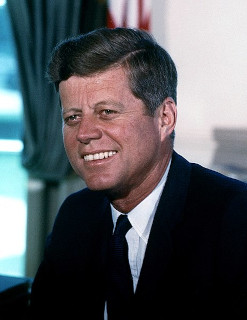
Birth of John F. Kennedy, 35th President of the United States

John Fitzgerald Kennedy, Irish American politician who serves as the 35th president of the United States, is born in Brookline, Massachusetts on May 29, 1917. He serves from 1961 until his assassination in 1963 during the height of the Cold War, with the majority of his work as president concerning relations with the Soviet Union and Cuba.

Kennedy is born into the wealthy, political Kennedy family, the son of Joseph P. Kennedy Sr., a businessman and politician, and Rose Kennedy (née Fitzgerald), a philanthropist and socialite. All four of his grandparents are children of Irish immigrants. He graduates from Harvard University in 1940, before joining the United States Naval Reserve the following year. During World War II, he commands a series of PT boats in the Pacific theater and earns the Navy and Marine Corps Medal for his service.

Following a brief stint in journalism, Kennedy, a Democrat, represents a working-class Boston district in the U.S. House of Representatives from 1947 to 1953. He is subsequently elected to the U.S. Senate and serves as the junior senator for Massachusetts from 1953 to 1960. While in the Senate, Kennedy publishes his book, Profiles in Courage, which wins a Pulitzer Prize.

Kennedy meets his future wife, Jacqueline Lee “Jackie” Bouvier (1929–1994), while he is a congressman. Charles L. Bartlett, a journalist, introduces the pair at a dinner party. They are married a year after he is elected senator, on September 12, 1953. Following a miscarriage in 1955 and a stillbirth in 1956, they produce three children, Caroline, John, Jr., and Patrick, who dies of complications two days after birth.

In the 1960 presidential election, Kennedy narrowly defeats Republican opponent Richard Nixon, who is the incumbent vice president. His humor, charm, and youth in addition to his father’s money and contacts are great assets in the campaign. His campaign gains momentum after the first televised presidential debates in American history. He is the first Catholic elected president of the United States.

Kennedy’s administration includes high tensions with communist states in the Cold War. As a result, he increases the number of American military advisors in South Vietnam. The Strategic Hamlet Program begins in Vietnam during his presidency. In April 1961, he authorizes an attempt to overthrow the Cuban government of Fidel Castro in the failed Bay of Pigs Invasion. He authorizes the Cuban Project, also known as Operation Mongoose, in November 1961. He rejects Operation Northwoods, plans for false flag attacks to gain approval for a war against Cuba, in March 1962. However, his administration continues to plan for an invasion of Cuba in the summer of 1962.

In October 1962, U.S. spy planes discover Soviet missile bases have been deployed in Cuba. The resulting period of tensions, termed the Cuban Missile Crisis, nearly results in the breakout of a global thermonuclear conflict. He also signs the first nuclear weapons treaty in October 1963.

Kennedy presides over the establishment of the Peace Corps, Alliance for Progress with Latin America, and the continuation of the Apollo space program with the goal of landing a man on the Moon. He also supports the civil rights movement but is only somewhat successful in passing his New Frontier domestic policies.

On November 22, 1963, Kennedy is assassinated in Dallas, Texas. Vice President Lyndon B. Johnson assumes the presidency upon Kennedy’s death. Marxist and former U.S. Marine Lee Harvey Oswald is arrested for the state crime but is shot and killed by Jack Ruby two days later. The FBI and the Warren Commission both conclude Oswald had acted alone in the assassination, but various groups contest the Warren Report and believe that Kennedy was the victim of a conspiracy.

After Kennedy’s death, Congress enacts many of his proposals, including the Civil Rights Act of 1964 and the Revenue Act of 1964. Despite his truncated presidency, he ranks highly in polls of U.S. presidents with historians and the general public. His personal life has also been the focus of considerable sustained interest following public revelations in the 1970s of his chronic health ailments and extramarital affairs. He is the last U.S. President to have been assassinated as well as the last U.S. president to die in office.

(Pictured: John F. Kennedy, photograph in the Oval Office, July 11, 1963)


Leave a comment

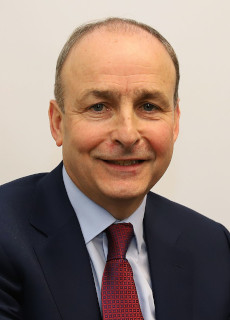
Micheál Martin Elected Leader of Fianna Fáil

Micheál Martin is elected leader of Fianna Fáil on January 26, 2011. He beats the competition of finance minister Brian Lenihan Jnr, tourism minister Mary Hanafin, and social protection minister Éamon Ó Cuív. He replaces Brian Cowan who stepped down on January 22. During his acceptance speech, the new leader apologises for mistakes he and the Government made in managing the economy but says the most important thing is to learn from these mistakes.

Martin has been a Teachta Dála (TD) for the Cork South-Central constituency since 1989. He previously serves as Minister for Education and Science and Lord Mayor of Cork from 1992 to 1993, Minister for Health and Children from 2000 to 2004, Minister for Enterprise, Trade and Employment from 2004 to 2008, Minister for Foreign Affairs from 2008 to 2011, and Leader of the Opposition in Ireland from 2011 to 2020.

While Martin is Minister for Health and Children in 2004, he introduces a ban on tobacco smoking in all Irish workplaces and establishes the Health Service Executive (HSE). Ireland is the first country to introduce a full workplace smoking ban. As Foreign Minister, in 2009, he travels to Latin America for the first time and makes the first official visit to Cuba by an Irish Minister. That same year, he travels to Khartoum following the kidnapping of Sharon Commins and Hilda Kawuki. In 2010, he becomes the first Western foreign minister to visit Gaza since Hamas took control there in 2007.

In January 2011, Martin resigns as Minister for Foreign Affairs and is subsequently elected as the eighth leader of Fianna Fáil following Cowen’s resignation as party leader. In the 2011 Irish general election, he leads the party to its worst showing in its 85-year history, with a loss of 57 seats and a drop in its share of the popular vote to 17.4%. In the 2016 Irish general election, Fianna Fáil’s performance improves significantly, more than doubling their Dáil representation from 20 to 44 seats. In the 2020 Irish general election, Fianna Fáil becomes the largest party, attaining the most seats at 38, one seat ahead of Sinn Féin with 37 seats. He is appointed Taoiseach on June 27, 2020, leading a grand coalition with longtime rival Fine Gael and the Green Party as part of a historic deal. Under the terms of the agreement, Martin’s predecessor, Leo Varadkar, becomes Tánaiste, and will swap roles with Martin in December 2022.


Leave a comment

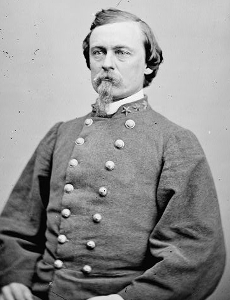
Birth of Joseph Finegan, Confederate General

Joseph Finegan, Irish-born American businessman and brigadier general for the Confederate States Army during the American Civil War, is born on November 17, 1814, at Clones, County Monaghan. From 1862 to 1864 he commands Confederate forces operating in middle and east Florida, ultimately leading the Confederate victory at the Battle of Olustee, the state’s only major battle.

Finegan comes to Florida in the 1830s, first establishing a sawmill at Jacksonville and later a law practice at Fernandina, where he becomes the business partner of David Levy Yulee and begins construction of the Florida Railroad to speed transportation of goods and people from the new state’s east coast to the Gulf of Mexico.

Finegan’s successes are perhaps attributable to his first marriage on July 28, 1842, to the widow Rebecca Smith Travers. Her sister, Mary Martha Smith, is the wife of Florida’s territorial governor, Robert Raymond Reid, an appointee of President Martin Van Buren. In 1852, he is a member of the Committee of Vigilance and Safety of Jacksonville, Florida.

By the outbreak of the American Civil War, Finegan had built his family a forty-room mansion in Fernandina on the site of the modern Atlantic Elementary School. At Florida’s secession convention, he represents Nassau County alongside James G. Cooper.

In April 1862, Finegan assumes command of the District of Middle and Eastern Florida from Brigadier General James H. Trapier. Soon thereafter, he suffers some embarrassment surrounding the wreck of the blockade runner Kate at Mosquito Inlet (the modern Ponce de Leon Inlet). Her cargo of rifles, ammunition, medical supplies, blankets, and shoes is plundered by civilians. Attempts to recover these items takes months before he issues a public appeal. Eventually, most of the rifles are found, but the other supplies are never recovered. Also in 1862, recognizing the importance of Florida beef to the Confederate cause, he gives cattle baron Jacob Summerlin permission to select thirty men from the state troops under his command to assist in rounding up herds to drive north.

At this time, the principal Confederate military post in east Florida is dubbed “Camp Finegan” to honor the state’s highest-ranking officer. It is about seven miles west of Jacksonville, south of the rail line near modern Marietta.

In 1863, Finegan complains of the large quantity of rum making its way from the West Indies into Florida. Smugglers are buying it in Cuba for a mere seventeen cents per gallon, only to sell it in the blockaded state for twenty-five dollars per gallon. He urges Governor John Milton to confiscate the “vile article” and destroy it before it can impact army and civilian morals.

In February 1864, General P. G. T. Beauregard begins rushing reinforcements to Finegan after Confederate officials become aware of a build-up of Union Army troops in the occupied city of Jacksonville. As Florida is a vital supply route and source of beef to the other southern states, they cannot allow it to fall completely into Union hands.

On February 20, 1864, Finegan stops a Union Army advance from Jacksonville under General Truman Seymour that is intent upon capturing the state capitol at Tallahassee. Their two armies clash at the Battle of Olustee, where Finegan’s men defeat the Union Army and force them to flee back beyond the St. Johns River. Critics have faulted Finegan for failing to exploit his victory by pursuing his retreating enemy, contenting himself by salvaging their arms and ammunition from the battlefield. His victory, however, is one rare bright spot in an otherwise gloomy year for the dying Confederacy.

Some Finegan detractors believe he did little more to contribute to the Confederate victory at Olustee than to shuttle troops forward to General Alfred H. Colquitt of Georgia, whom they credit for thwarting the Union Army advance. They point out that Finegan was quickly relieved of his command over the state troops, replaced by Major General James Patton Anderson. But this change in command is necessary as Finegan is ordered to lead the “Florida Brigade” in the Army of Northern Virginia, where he serves effectively until near the end of the war.

Finegan returns to Fernandina after the war to discover his mansion has been seized by the Freedmen’s Bureau for use as an orphanage and school for black children. It takes some legal wrangling, but he is eventually able to recover this property. He has to sell most of his lands along Lake Monroe to Henry Shelton Sanford for $18,200 to pay his attorneys and other creditors. He does retain a home site at Silver Lake. Adding to his sorrows is the untimely death of his son Rutledge on April 4, 1871, precipitating a move to Savannah, Georgia. There, he feels at home with the large Irish population and works as a cotton broker.

It is while living in Savannah that Finegan marries his second wife, the widow Lucy C. Alexander, a Tennessee belle. They eventually settle on a large orange grove in Orange County, Florida. Finegan dies on October 29, 1885, at Rutledge, Florida. According to the Florida Union, his death is the result of “severe cold, inducing chills, to which he succumbed after brief illness.” The paper describes him as “hearty, unaffected, jovial, clear-headed, and keen-witted.” He is buried at the Old City Cemetery in Jacksonville.


Leave a comment

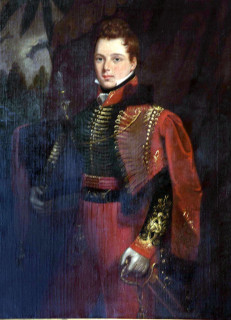
Birth of Morgan O’Connell, Soldier & Politician

Morgan O’Connell, soldier, politician and son of the Irish Nationalist leader Daniel O’Connell, the Liberator of Ireland, is born in Dublin on October 31, 1804. He serves in the Irish South American legion and the Imperial Austrian Army. He is MP for Meath from 1832 until 1840 and afterwards assistant registrar of deeds for Ireland from 1840 until 1868.

O’Connell, one of seven children (and the second of four sons) of Daniel and Mary O’Connell, is born at 30 Merrion Square, Dublin. His brothers Maurice, John and Daniel are also MPs.

In 1819, self-styled General John Devereux comes to Dublin to enlist military aid for Simón Bolívar‘s army to liberate Venezuela from Spanish rule. He succeeds in forming an Irish Legion, to be part of Bolivar’s British Legions. O’Connell, encouraged by his father, is one of the officers who purchases a commission in it even though he is only 15 years old. The enterprise is mismanaged; there is no commissariat organisation on board the ships, and a part of the force die on the voyage. The remainder are disembarked on the Spanish Main at Margarita Island, where many deaths take place from starvation eight days after the Irish mutineers leave for Jamaica.

Bolivar, who had noted his pleasure at the departure of “these vile mercenaries,” is too astute a diplomat to offend the son of his Irish counterpart. O’Connell is accorded the appropriate privileges of his rank, and toasts are drunk to the health of his father, the “most enlightened man in all Europe.” A portion of the expedition, under Francis O’ Connor, effects an alliance with Bolivar, and to the energy of these allies the republican successes are chiefly due.

Bolivar makes sure that the untrained Irish lad stays out of danger. “I have numberless hardships to go through,” said Bolivar, “which I would not bring him into, for the character of his father is well known to me.” But ceremonial duties soon bore the restless young Irishman. After a year at Bolivar’s headquarters Morgan leaves for Ireland.

If South America did not satisfy O’Connell’s taste for adventure, he has more than his fill on the return journey. He survives a bout of tropical fever and is shipwrecked twice in succession, ending up stranded in Cuba. A schooner captain, who turns out to be a long-lost Irish cousin, rescues him. After the captain is killed in a fight with his boatswain, he hitches a ride to Jamaica on a Danish ship commanded by a skipper from Cork. From Jamaica, another Irish officer offers Morgan passage home.

Arriving in January 1822, O’Connell is greeted by his proud father as a prodigal son returned. His South American adventure, declares Daniel O’Connell, has made a man of Morgan. Otherwise, said O’Connell, “it would have been difficult to tame him down to the sobriety of business.” After his return to Ireland, he again seeks foreign service in the Austrian army.

On December 19, 1832, O’Connell enters parliament in the Liberal interest, as one of the members for Meath, and continues to represent that constituency until January 1840, when he is appointed first assistant-registrar of deeds for Ireland, at a salary of £1,200 a year, a position he holds until 1868. In politics he is never in perfect accord with his father, and his retirement from parliament is probably caused by his inability to accept the Repeal movement.

During his parliamentary career O’Connell fights a duel with Lord William Arden, 2nd Baron Alvanley, a captain in the British Army, at Chalk Farm, on May 4, 1835. A challenge had been sent by Alvanley to O’Connell’s father, who, in accordance with a vow he had made after shooting John D’Esterre, declines the meeting. The younger O’Connell thereupon takes up the challenge on his father’s account. Two shots each are exchanged, but no one is hurt. Afterwards, in December 1835, he receives a challenge from Benjamin Disraeli, in consequence of an attack made on Disraeli by O’Connell’s father. He declines to meet Disraeli.

On July 23, 1840, O’Connell marries Kate Mary, youngest daughter of Michael Balfe of South Park, County Roscommon.

Morgan O’Connell dies at 12 St. Stephen’s Green, Dublin, on January 20, 1885. He is buried in Glasnevin Cemetery in Dublin on January 23.

(Pictured: Morgan O’Connell, oil on canvas, artist unknown, c. 1819/20)