Milligan is brought up as a Methodist, the daughter of the writer Seaton Milligan, antiquarian and member of the Royal Irish Academy (RIA). She is one of eleven children, including music collector Charlotte Milligan Fox, and from 1877 to 1887 attends Methodist College Belfast (MCB), after which she completes a teacher-training course. Together with her father she writes a political travelogue of the north of Ireland in 1888, Glimpses of Erin. She writes her first novel, A Royal Democrat, in 1890.
After the death of Charles Stewart Parnell, Milligan becomes an ardent nationalist. In 1894 with Jenny Armour, she founds branches of the Irish Women’s Association in Belfast and other places and becomes its first president. With Ethna Carbery she founds two nationalist publications in the 1890s, The Northern Patriot, and later The Shan Van Vocht, a monthly literary magazine published in Belfast from 1896 to 1899.
Alice Milligan dies in Omagh in April 1953 and is buried in Blackford Municipal Cemetery, County Tyrone. On her headstone is inscribed “She loved no other place than Ireland.”
During 2010/2011 the Ulster History Circle mounts plaques for famous Ulster figures. Charlotte Milligan Fox and Alice Milligan have a plaque mounted on Omagh Library, 1 Spillar’s Place, Omagh, County Tyrone.
St. Patrick’s Cathedral is dedicated on March 17, 1191. With its 141-foot spire, it is the tallest church (not cathedral) in Ireland and the largest.
St. Patrick’s Cathedral is founded on the spot where St. Patrick himself is believed to have baptized the first Irish believers into the Christian faith. The sacred well which St. Patrick used has been lost, but the Cathedral is built in the area where the conversions are believed to have taken place.
The first church is constructed here in the 5th century but St. Patrick’s as it stands now is built between 1191 and 1270. In 1311, the Medieval University of Dublin is founded here, and the church begins a place of higher education as well as a place of worship.
Repairs to the cathedral begin in the 1660s and continued in phases over the following decades to save it from falling into complete ruin.
As its status grows, St. Patrick’s begins to rival Christ Church Cathedral in importance. This is where the history of St. Patrick’s Cathedral takes a bit of a complicated turn in term of church definitions. The current cathedral building is often hailed as one of the best examples of medieval architecture in Dublin, however, it is only fair to point out that the structure went through a massive rebuild in the 1860s, mainly financed by money from Benjamin Guinness.
As one of Dublin’s two Church of Ireland cathedrals, St. Patrick’s is actually designated as the “National Cathedral of Ireland.” However, it lacks the one thing that usually makes a church a cathedral – a bishop. The Archbishop of Dublin actually has his seat at Christ Church Cathedral, which is designated as the local cathedral of the Diocese of Dublin and Glendalough. St. Patrick’s is instead headed by a dean who is the ordinary for the cathedral. This office has existed since 1219 with its most famous office holder being Jonathan Swift.
Today St. Patrick’s Cathedral plays host to a number of public national ceremonies. Ireland’s Remembrance Day ceremonies, hosted by the Royal British Legion and attended by the President of Ireland, take place there every November. Its carol service (the Service of Nine Lessons and Carols), celebrated twice in December, including every December 24, is a colourful feature of Dublin life. On Saturdays in autumn the cathedral hosts the graduation ceremonies of Technological University Dublin.
The funerals of two Irish presidents, Douglas Hyde and Erskine Childers, take place in St. Patrick’s Cathedral in 1949 and 1974 respectively. In 2006, the cathedral’s national prominence is used by a group of 18 Afghan migrants seeking asylum, who occupied it for several days before being persuaded to leave without trouble.
Childers is educated at Gresham’s School, Holt, and the University of Cambridge, hence his striking British upper-class accent. On November 24, 1922, when he is sixteen, his father, Robert Erskine Childers, is executed by the new Irish Free State on politically inspired charges of gun-possession. The pistol he had been found with had been given to him by Michael Collins. Before his execution, in a spirit of reconciliation, the elder Childers obtains a promise from his son to seek out and shake the hand of every man who had signed his death warrant.
Following his father’s funeral, he returns to Gresham’s, then two years later he goes on to Trinity College, Cambridge. He returns to Ireland in 1932 and becomes advertising manager of The Irish Press, the newly founded newspaper owned by the family of Éamon de Valera.
Childers is nominated as the presidential candidate of Fianna Fáil at the behest of de Valera, who pressures Jack Lynch in the selection of the presidential candidate. He is a controversial nominee, owing not only to his British birth and upbringing but to his Protestantism. However, on the campaign trail his personal popularity proved enormous, and in a political upset at the 1973 Irish presidential election, he is elected the fourth President of Ireland on May 30, 1973, defeating Tom O’Higgins by 635,867 (52%) votes to 578,771 (48%). He becomes the second Protestant to hold the office, the first being Douglas Hyde (1938–1945).
Prevented from transforming the presidency as he desires, Childers instead throws his energy into a busy schedule of official visits and speeches, which is physically taxing.
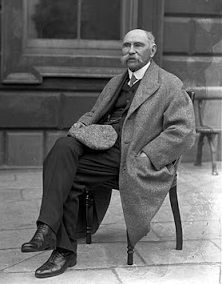
Hyde is born at Longford House in Castlerea, County Roscommon, on January 17, 1860. In 1867, his father is appointed prebendary and rector of Tibohine, and the family moves to neighbouring Frenchpark, in County Roscommon. He is home schooled by his father and his aunt due to a childhood illness. While a young man, he becomes fascinated with hearing the old people in the locality speak the Irish language.
Rejecting family pressure to follow previous generations with a career in the Church, Hyde instead becomes an academic. He enters Trinity College, Dublin, where he gains a great facility for languages, learning Latin, Greek, Hebrew, French, and German, but his great passion in life is the preservation of the Irish language.
After spending a year teaching modern languages in Canada, Hyde returns to Ireland. For much of the rest of his life he writes and collects hundreds of stories, poems, and folktales in Irish, and translates others. His work in Irish helps to inspire many other literary writers, such as W.B. Yeats and Lady Gregory.
In 1892, Hyde helps establish the Gaelic Journal and in November of that year writes a manifesto called The necessity for de-anglicising the Irish nation, arguing that Ireland should follow her own traditions in language, literature, and even in dress.
In 1893, Hyde founds the Gaelic League (Conradh na Gaeilge) along with Eoin MacNeill and Fr. Eugene O’Growney and serves as its first president. Many of the new generation of Irish leaders who play a central role in the fight for Irish independence in the early twentieth century, including Patrick Pearse, Éamon de Valera, Michael Collins, and Ernest Blythe first become politicised and passionate about Irish independence through their involvement in the Gaelic League. Hyde does not want the Gaelic League to be a political entity, so when the surge of Irish nationalism that the Gaelic League helps to foster begins to take control of many in the League and politicize it in 1915, Hyde resigns as president.
In 1938, Hyde is unanimously elected to the newly created position of President of Ireland, a post he holds until 1945. He is inaugurated on June 26, 1938, in the first inaugural ceremony in the nation’s history. He sets a precedent by reciting the Presidential Declaration of Office in Irish. His recitation, in Roscommon Irish, is one of a few recordings of a dialect of which Hyde is one of the last speakers. Upon inauguration, he moves into the long vacant Viceregal Lodge in Phoenix Park, since known as Áras an Uachtaráin.
Despite being placed in a position to shape the office of the presidency via precedent, Hyde by and large opts for a quiet, conservative interpretation of the office.
In April 1940 Hyde suffers a massive stroke and plans are made for his lying-in-state and state funeral, but to the surprise of everyone he survives, albeit paralysed and confined to a wheelchair. One of Hyde’s last presidential acts is a visit to the German ambassador Eduard Hempel on May 3, 1945, to offer his condolences on the death of Adolf Hitler, a visit which remains a secret until 2005.
Hyde leaves office on June 25, 1945, opting not to nominate himself for a second term. He opts not return to his Roscommon home due to his ill-health but rather moves into the former Secretary to the Lord Lieutenant’s residence in the grounds of Áras an Uachtaráin, where he lived out the remaining four years of his life.
Hyde dies in Dublin on July 12, 1949, at age 89. As a former President of Ireland, he is accorded a state funeral which, as a member of the Church of Ireland, takes place in Dublin’s Church of Ireland St. Patrick’s Cathedral. Since contemporary rules of the Roman Catholic Church in Ireland at the time prohibit Roman Catholics from attending services in non-Catholic churches, all but one member of the Catholic cabinet remains outside the cathedral grounds while Hyde’s funeral takes place. Hyde is buried in Frenchpark, County Roscommon at Portahard Church.
This involves helping to ship weapons to be used in an Irish uprising from Germany into Ireland. Together with Molly Childers, she raises £2,000 towards the purchase of 900 Mauser rifles from Germany, many of which are used in the 1916 Easter Rising. She sails on the Asgard to collect the guns and helps to unload them in Ireland.
Con Collins stays with Spring Rice regularly. She helps train local women as nurses to tend to wounded nationalists and acts as an IRA message carrier between Limerick and Dublin. Throughout this time, she maintains her aristocratic façade and society connections, inviting senior Liberal Party politicians to Mount Trenchard to pressure them to support Irish independence.
Spring Rice starts to suffer from tuberculosis in 1923, and dies unmarried in a sanatorium in Clwyd, Wales, on December 1, 1924. She is buried in Ireland, where her coffin is draped in the Irish tricolour and escorted by an IRA guard of honour.
(Pictured: Mary Ellen Spring-Rice and Molly Childers with the German guns on board Asgard, 1914.)
The Royal University of Ireland is founded by Royal Charter on April 27, 1880, in accordance with the University Education (Ireland) Act 1879 as an examining and degree-awarding university based on the model of the University of London. The first chancellor is the Irish chemist, Robert Kane.
The university becomes the first university in Ireland that can grant degrees to women on a par with those granted to men, granting its first degree to a woman on October 22, 1882. In 1888 Letitia Alice Walkington has the distinction of becoming the first woman in Great Britain or Ireland to receive a degree of Bachelor of Laws. Among the honorary degree recipients of the university is Douglas Hyde, founder of the Gaelic League and later President of Ireland, who is awarded a DLitt in 1906.
The Royal University of Ireland is the successor to the Queen’s University of Ireland, dissolved in 1882, and the graduates, professors, students and colleges of that predecessor are transferred to the new university. In addition to the Queen’s Colleges, Magee College, University College Dublin, Cecillia St. Medical School, St. Patrick’s College, Maynooth and Blackrock College present students for examinations as well, and no special status is accorded to the colleges of the former Queen’s University. After the 1880 reforms Catholic Colleges such as St. Patrick’s, Carlow College, Holy Cross College and Blackrock College come under the Catholic University, and with a number of other seminaries present students for examination by the RUI.
External students not of approved colleges can sit examinations of the Royal University although they are seen as being at a disadvantage to those of designated colleges whose professors are part of the university. In fact, many schools, including convent schools prepare students for the examinations of the Royal University.
Like the Queen’s University, the Royal University is entitled to grant any degree, similar to that of any other university in the United Kingdom of Great Britain and Ireland, except in theology. The colleges themselves award degrees in theology and divinity.
The professorships and Senate of the Royal University are shared equally between Roman Catholics and Protestants. However, colleges of the university maintain full independence except in the awarding of degrees, and the compilation and enforcement of academic regulations and standards.
The Gaelic League (Irish: Conradh na Gaeilge), a social and cultural organisation which promotes the Irish language in Ireland and worldwide is founded in Dublin on July 31, 1893.
The League encourages female participation from the start and a number of women play a prominent role. They are not restricted to subordinate roles, but play an active part in leadership, although males are in the overwhelming majority. Local notables, such as Lady Gregory in Galway, Lady Esmonde in County Wexford, and Mary Spring Rice in County Limerick, and others such as Norma Borthwick, found and lead branches in their communities. At the annual national convention in 1906 women are elected to seven of the forty-five positions on the Gaelic League executive. Executive members include Máire Ní Chinnéide, Úna Ní Fhaircheallaigh (who writes pamphlets on behalf of the League), Bean an Doc Uí Choisdealbha, Máire Ní hAodáin, Máire de Buitléir, Nellie O’Brien, Eibhlín Ní Dhonnabháin, and Eibhlín Nic Néill.
Though apolitical, the organisation attracts many Irish nationalists of different persuasions, much like the Gaelic Athletic Association. It is through the League that many future political leaders and rebels first meet, laying the foundation for groups such as the Irish Volunteers. However, Conradh na Gaeilge does not commit itself entirely to the national movement until 1915, causing the resignation of Douglas Hyde, who feels that the culture of language should be above politics. Most of the signatories of the 1916 Proclamation are members. It still continues to attract many Irish Republicans. Seán Mac Stíofáin, the first chief of staff of the Provisional IRA was a prominent member in his later life.
After the foundation of the Irish Free State in 1922, the organisation has a less prominent role in public life as Irish is made a compulsory subject in state-funded schools. It does unexpectedly bad in the Irish Seanad election of 1925, when all the candidates it endorses are defeated, including Hyde.
There are two main motivations for replacing the constitution in 1937. Firstly, the Irish Free State constitution of 1922 is, in the eyes of many, associated with the controversial Anglo-Irish Treaty. The second motive for replacing the original constitution is primarily symbolic. De Valera wants to put an Irish stamp on the institutions of government and chooses to do this in particular through the use of Irish nomenclature.
The framers of the 1937 Constitution decide that it will be enacted not by an elected body but by the people themselves by means of a plebiscite. The preamble to the 1937 Constitution is thus written in the name not of the legislature but of “We, the people of Éire.” On June 2, 1937, the Oireachtas passes the Plebiscite (Draft Constitution) Act 1937, which mandates the holding of a plebiscite on the draft constitution on the same date as the next general election. The Dáil is dissolved on June 14, 1937, as soon as it has approved the draft constitution. The ensuing general election is held on July 1, 1937, and the plebiscite is held in parallel. The question put to voters is simply “Do you approve of the Draft Constitution which is the subject of this plebiscite?” It is passed by a plurality – 56% of voters are in favour, comprising 38.6% of the entire electorate.
Neither the Dáil resolution approving the draft Constitution nor the Plebiscite (Draft Constitution) Act 1937 provide for the plebiscite establish how the Constitution would come into force. It is the Constitution itself which states that this will occur 180 days after its approval, and that the 1922 Constitution will simultaneously be repealed. This happens on December 29, 1937, one hundred eighty days after the July 1 plebiscite.
Consequential acts are passed between July and December to provide for the establishment of, and holding elections for, the new Seanad and the Presidency, as well as for other adaptations. The Presidential Establishment Act, 1938 is passed after the Constitution has come into effect but before the first President, Douglas Hyde, takes office.
The Gore-Booths are known as model landlords in County Sligo as they provide free food for the tenants on their estate. Perhaps being raised in this atmosphere of concern for the common man has something to do with the way Constance and her younger sister, Eva, conduct their later lives.
Gore-Booth decides to train as a painter and, in 1892, she enters the Slade School of Art in London because, at the time, only one art school in Dublin accepts female students. While in school in London Gore-Booth first becomes politically active and joins the National Union of Women’s Suffrage Societies.
She later moves to Paris and enrolls at the prestigious Académie Julian where she meets her future husband, Count Casimir Markievicz. They are married in London on September 29, 1900, making her Countess Markievicz. The Markieviczes relocate to Dublin in 1903 and move in artistic and literary circles, with Constance being instrumental in founding the United Artists Club.
In 1908, Markievicz becomes actively involved in nationalist politics in Ireland and joins Sinn Féin and Inghinidhe na hÉireann (Daughters of Ireland), a revolutionary women’s movement founded by Maud Gonne. In the same year, Markievicz plays a dramatic role in the women’s suffrage campaigners’ tactic of opposing Winston Churchill‘s election to Parliament during the Manchester North West by-election. Churchill ultimately loses the election to Conservative candidate William Joynson-Hicks.
In 1909, Markievicz founds Fianna Éireann, a para-military nationalist scouts organisation that instructs teenage boys and girls in the use of firearms. Patrick Pearse says that the creation of Fianna Éireann is as important as the creation of the Irish Volunteers in 1913. She is jailed for the first time in 1911 for speaking at an Irish Republican Brotherhood demonstration organised to protest against George V’s visit to Ireland.
As a member of the Irish Citizen Army, Markievicz takes part in the 1916 Easter Rising. Under Michael Mallin and Christopher Poole, she supervises the erection of barricades as the Rising begins and is in the middle of the fighting all around Stephen’s Green. Mallin and Poole and their men and women, including Markievicz, hold out for six days, ending the engagement when the British bring them a copy of Patrick Pearse’s surrender order.
They are taken to Dublin Castle and Markievicz is transported to Kilmainham Gaol, where she is the only one of 70 women prisoners who is put into solitary confinement. At her court martial on May 4, 1916, Markievicz is sentenced to death, but General Maxwell commutes this to life in prison on “account of the prisoner’s sex.” It is widely reported that she tells the court, “I do wish your lot had the decency to shoot me.” Markievicz is transferred to Mountjoy Prison and then to Aylesbury Prison in England in July 1916. She is released from prison in 1917, along with others involved in the Rising.
In the 1918 general election, Markievicz is elected for the constituency of Dublin St Patrick’s, making her the first woman elected to the British House of Commons. However, in line with Sinn Féin abstentionist policy, she does not take her seat in the House of Commons. She is re-elected to the Second Dáil in the elections of 1921. Markievicz serves as Minister for Labour from April 1919 to January 1922, holding cabinet rank from April to August 1919, becoming both the first Irish female Cabinet Minister and only the second female government minister in Europe.
Markievicz leaves government in January 1922 along with Éamon de Valera and others in opposition to the Anglo-Irish Treaty. She fights actively for the Republican cause in the Irish Civil War. She is returned in the 1923 general election for the Dublin South constituency but again, in common with other Republican candidates, she does not take her seat.
She joins Fianna Fáil on its foundation in 1926, chairing the inaugural meeting of the new party in La Scala Theatre. In the June 1927 general election, she is re-elected to the 5th Dáil as a candidate for the new Fianna Fáil party, which is pledged to return to Dáil Éireann.
Before she can take up her seat, Markievicz dies at the age of 59 on July 15, 1927, in a public ward “among the poor where she wanted to be” of complications related to appendicitis. One of the doctors attending her is her revolutionary colleague, Kathleen Lynn. Also at her bedside are Casimir and Stanislas Markievicz, Éamon de Valera, and Hanna Sheehy-Skeffington. Refused a state funeral by the Free State government, Markievicz is buried at Glasnevin Cemetery, Dublin, and de Valera gives the funeral oration.




 seamus dubhghaill