Mitchell is the younger son of David William Mitchell, owner of a Dublin ironmongery and furniture business, and Francis Elizabeth Mitchell (née Kirby). His elder brother David becomes president of the Royal College of Physicians of Ireland (RCPI) and his sister Lillias is a noted weaver and teacher. He is educated at The High School, Dublin, and Trinity College Dublin (TCD), where he is a scholar in 1933 and receives a gold medal the following year. In 1934 he is appointed assistant to the professor of geology at TCD, and later is lecturer in geology (1940), reader in Irish archaeology (1959) and professor of Quaternary studies – a personal chair (1965). He is an efficient administrator and serves TCD successively as registrar, senior lecturer, and tutor, and after retirement is briefly a pro-chancellor of the university.
Mitchell’s major research focuses on the evolution of Ireland during the last two million years, particularly during the Quaternary since the retreat of the glacial ice over Ireland, and the effect man has had on this landscape. His interest in Quaternary studies begins in 1934, when he is appointed by the Royal Irish Academy (RIA) as an assistant to the Danish botanist and Quaternary geologistKnud Jessen, who uses the distribution of ancient pollen grains to reconstruct vegetational history. From 1940 he publishes a series of papers on topics such as the distribution of Irish giant deer and reindeer remains in Ireland, lacustrine deposits in County Meath, interglacial deposits in southeast Ireland, the palynology of Irish raised bogs, cave deposits, fossil pingos in County Wexford, bog flows, and the deposits of the older Pleistocene period in Ireland. His major study in this field is the documentation (1965) of the vegetational history of Littleton bog, County Tipperary, which has given its name to the present interglacial – the Littletonian warm stage.
Mitchell does not confine his studies to Ireland but also carries out work in Glasgow, Cornwall, and the Isle of Man. In 1957, he helps organise the British Association for the Advancement of Science meeting in Dublin and is later chairman of the Geological Society of London sub-commission on British and Irish Quaternary stratigraphy, which produces a comprehensive report in 1973. He is a frequent broadcaster on radio and a prolific author of academic papers, and in later life writes several acclaimed books, including The Irish Landscape (1976), which goes through two further editions as Reading the Irish Landscape (1986, 1997), and a volume of semi-autobiography, The Way That I Followed (1990).
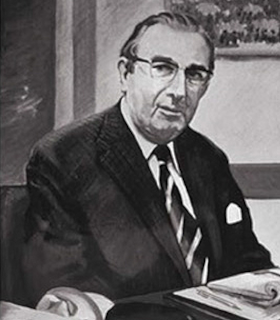
In 1940, Mitchell marries Lucy Margaret (‘Pic’) (1911–87), daughter of E. J. Gwynn, provost of TCD. They have two daughters. For many years they live at Townley Hall, near Drogheda, County Louth, which had been TCD’s agricultural facility. A 1985 portrait by David Hone is displayed at Trinity College Dublin.
(From: “Mitchell, George Francis (‘Frank’)” by Patrick N. Wyse Jackson, Dictionary of Irish Biography, http://www.dib.ie, October 2009)
Dunne is born as Bernard Dunn in the village of Rostrevor, County Down, on May 19, 1908. He is the eldest son and second among three children of Barney Dunn, a businessman, and Margaret (née Byrne). His father inherits the Woodside Restaurant Temperance Refreshment Rooms and an auctioneering firm, and his mother runs a drapery business and later a shipping agency. He attends St. Mary’s School in Rostrevor until he is fourteen years old. While still in school he takes on a number of jobs, including repairing bicycles, rearing sheep, and working as a boot-boy at the home of Sir John Foster George Ross of Bladensburg. He is convinced not to emigrate to the United States by a family friend, Edward Whitaker.
Dunne moves to Drogheda in the newly established Irish Free State in 1926. He is employed as an apprentice first in Anderson’s of West Street, Drogheda, and later in Cameron’s Drapery store in Longford. It is after his move to Longford that he adds an “e” to his surname. In the mid-1930s, he moves to Cork, where he works as a buyer for Roches Stores in the menswear department. In 1944, he leaves Roches Stores to open a drapery shop with his friend, Des Darrer, across the road from Roches Stores on St. Patrick’s Street. A high-profile advertising campaign, combined with low prices, launches the venture successfully.
A second store opens on North Main Street, Cork, in 1947, which is followed by stores in Waterford and Mallow. Dunne and Darrer remain in partnership until 1952, when it is dissolved and Darrer takes ownership of the Waterford Dunnes Stores, renaming it Darrers.
The tenth store, in Wexford, opens in 1955, and the first store in Dublin opens in 1958. In 1960, Dunne launches the store’s first own-brand product, a lady’s jacket under the label St. Bernard. By 1964, Dunnes Stores has expanded into grocery and has an annual turnover of £6 million. He purchases two other Dublin stores, Bolger’s and Cassidy’s, in 1972, which have eleven shops across Dublin combined. Dunnes Stores opens its first branch in Northern Ireland in 1976.
Dunne meets his wife, Nora Maloney, while working at Roches Stores. They are married in September 1939 and have six children, including Margaret (Dunne) Heffernan, Frank, Elizabeth (Dunne) McMahon, Therese, and Ben Junior. Ben and later Margaret go on to work in the family business.
The family lives in Douglas, Cork, at Brownington Park, and in Blackrock, Cork, at Barnstead and at Ringmahon House. Following the establishment of the Dunnes Stores headquarters in Dublin in the early 1970s, the family moves to Jury’s Hotel, Dame Street. He and Nora later move to the Shelbourne Hotel, where they live until his death on April 14, 1983.
Ahern is urged by Paisley to ensure that criminals who flee across the Irish border are arrested. The Democratic Unionist leader makes the proposal during a cordial one-and-a-half-hour meeting at Farmleigh in Phoenix Park, where the two leaders exchange their first public handshake.
Afterwards Paisley, who receives an invitation from the taoiseach to visit the Battle of the Boyne site later in the year, says that they had also discussed the need for the new administrations in Northern Ireland and in the Republic of Ireland to work for each other’s best interests. “We can confidently state that we are making progress to ensure our two countries can develop and grow side by side in the spirit of generous cooperation,” he declares. “I trust that old barriers and threats will be removed in my day. Business opportunities are flourishing. Genuine respect for the understanding of each other’s differences and, for that matter, similarities is now developing.”
Earlier the DUP leader, who becomes the First Minister of the new power-sharing government on May 8 alongside Sinn Féin‘s Martin McGuinness as deputy First Minister, firmly shakes the hand of Ahern in public for the first time. As he arrives at Farmleigh, he quips, “I better shake the hands of this man. I’ll give him a firm handshake.”
Paisley, who is accompanied by his son, Ian Paisley, Jr., affectionately grabs the taoiseach by the shoulder. There is another handshake after the meeting at Farmleigh is finished.
Paisley says, “Mr. Ahern has come to understand me as an Ulsterman of plain speech. He didn’t ever need a dictionary to find out what I was saying. We engaged in clear and plain speech about our hopes and our aspirations for the people we both serve. The prime minister kindly congratulated me on my election victory.”
Paisley says that he had raised a number of issues crucial to unionists. “I have taken the opportunity to raise with the prime minister a number of key matters including ensuring that fugitives from justice who seek to use the border to their advantage are quickly apprehended and returned without protracted legal wrangle.” He adds, “I raised other legal issues of interests to unionists, and we discussed cooperation of an economic nature that will be to our mutual benefit.” He also says he had raised the issue of bringing Northern Ireland’s corporation tax into line with that of Ireland.
Regarding the invitation to visit the site of the Battle of the Boyne, Paisley says, “We both look forward to the visit to the battle site at the Boyne… Not to refight it, because that would be unfair, for he would have the home advantage. No Ulsterman ever gives his opponents an advantage. He adds, “Such a visit would help to demonstrate how far we have come when we can celebrate and learn from the past, so the next generation more clearly understands.”
Ahern pays tribute to the leadership shown by Paisley in helping to deliver a better future for the people of Northern Ireland. As Northern Ireland’s politicians continue at great pace to prepare for the return of power sharing, the taoiseach says that the progress has been very encouraging. “At this important time in our history, we must do our best to put behind us the terrible wounds of our past and work together to build a new relationship between our two traditions,” he says. “That new relationship can only be built on a basis of open dialogue and mutual respect. I fervently believe that we move on from here in a new spirit of friendship. The future for this island has never been brighter. I believe that this is a future of peace, reconciliation and rising prosperity for all. We stand ready to work with the new executive. We promise sincere friendship and assured cooperation. I believe that we can and will work together in the interests of everyone on this island.”
Ahern says he believes that the Battle of the Boyne site can be a symbol of the new beginning in the relationship between governments in Belfast and Dublin. “I believe that this site can become a valuable and welcome expression of our shared history and a new point of departure for an island, north and south, which is at ease with itself and respectful of its past and all its traditions,” he declared.
The Battle of the Boyne was fought in 1690 between the followers of England‘s King William of Orange, a Protestant, and the deposed King James, a Catholic, in Drogheda, eastern Ireland. Ireland was at that point under English rule. The battle is commemorated by many Northern Irish loyalists on July 12 each year.
Ministerial posts within the new devolved Stormont government have yet to be finalised. Already Sinn Féin has announced that MPs Michelle Gildernew and Conor Murphy and assembly members Gerry Kelly and Caitríona Ruane will be members of the government. However, the party has not yet indicated which of the four will take the three senior cabinet posts in education, agriculture and regional development and which one will be the junior minister in the Office of First and Deputy First Minister.
The DUP has also yet to name its ministers, but it has chosen finance, economy, environment and culture arts and leisure as the government departments it will head. The DUP’s deputy leader, Peter Robinson, and Nigel Dodds, the Belfast North MP, who both served in the last devolved government, are tipped to be the finance and economy ministers.
The Ulster Unionist Party (UUP) has yet to declare who their two ministers will be at the Departments of Health and Employment and Learning.
(From: “Upbeat Paisley shares first handshake with Irish PM” by Hélène Mulholland and agencies, The Guardian, http://www.theguardian.com, April 4, 2007)
Sir Rory O’Moore (Irish: Ruaidhrí Ó Mórdha), Irish politician and landowner also known Sir Roger O’Moore or O’More or Sir Roger Moore, dies in obscurity on February 16, 1655. He is most notable for being one of the four principal organizers of the Irish Rebellion of 1641.
O’Moore’s uncle, Rory O’More, Lord of Laois, had fought against the English during the Tudor conquest of Ireland. In 1556, Queen Mary I confiscates the O’Mores’ lands and creates “Queens County” (modern-day County Laois). Over 180 family members, who are peaceful and have taken no part in any rebellion, are murdered with virtually all of the leaders of Laois and Offaly by the English at a feast at Mullaghmast, County Kildare, in 1577. Rory Óg and his wife Maighréad O’Byrne, sister of Fiach MacHugh O’Byrne, are hunted down and killed soon afterwards. This leads to the political downfall of the O’Moore family as their estates are given to English settlers.
Given the causes of the rebellion and the Crown’s weakness during the Bishops’ Wars into 1641, O’Moore plans a bloodless coup to overthrow the English government in Ireland. With Connor Maguire, 2nd Baron of Enniskillen, he plans to seize Dublin Castle, which is held by a small garrison, on October 23, 1641. Allies in Ulster led by Sir Phelim O’Neill are to seize forts and towns there. The leaders are to assume the governing of their own country and with this provision offer allegiance to King Charles. They are betrayed, and the plan is discovered on October 22 and the rising fails in its first objective. O’Neill has some success, and O’Moore quickly succeeds in creating an alliance between the Ulster Gaelic clans and the Old English gentry in Leinster.
In November 1641, the Irish forces besiege Drogheda, and a royalist force comes north from Dublin to oppose them. O’Moore is one of the leaders of the rebel army that intercepts and defeats the relief force at the Battle of Julianstown on November 29.
The Irish historian Charles Gavan Duffy writes: “Then a private gentleman, with no resources beyond his intellect and his courage, this Rory, when Ireland was weakened by defeat and confiscation, and guarded with a jealous care constantly increasing in strictness and severity, conceived the vast design of rescuing the country from England, and even accomplished it; for, in three years, England did not retain a city in Ireland but Dublin and Drogheda, and for eight years the land was possessed and the supreme authority exercised by the Confederation created by O’Moore. History contains no stricter instance of the influence of an individual mind.”
Bishop Michael Comerford writes that after O’Moore’s defeat at the Battle of Kilrush in April 1642 he retires and dies in Kilkenny city in the winter of 1642–43, having co-founded the Irish Catholic Confederation there a few months earlier. However, this ignores his contacts with Inchiquin and Ormonde in 1647–48.
In 1652, O’Moore goes to Inishbofin off the coast of Galway, one of the last Catholic strongholds, but as the parliamentary forces approach, he makes arrangements to flee. Walter Lynch, Bishop of Clonfert, sails in the last ship to leave the island without waiting for O’Moore, who is forced to make his own way. He finally escapes into Ulster but dies in obscurity on February 16, 1655. He is buried at Steryne churchyard, in the parish of Magilligan, County Londonderry.
St. Colman’s Church on the island once bears a tablet with the inscription: “In memory of many valiant Irishmen who were exiled to this Holy Island and in particular Rory O’More a brave chieftain of Leix, who after fighting for Faith and Fatherland, disguised as a fisherman escaped from his island to a place of safety. He died shortly afterwards, a martyr to his Religion and his County, about 1653. He was esteemed and loved by his countrymen, who celebrated his many deeds of valour and kindness in their songs and reverenced his memory, so that it was a common expression among them; ‘God and Our Lady be our help and Rory O’More’.”
The Balyna estate is inherited from Calvagh O’More by Rory’s brother Lewis. Balyna is passed down to Lewis’s last surviving O’More descendant, Letitia, who is also descended from Rory O’More because her grandfather married a second cousin. Letitia marries a Richard Farrell in 1751. This Farrell family henceforth takes the surname More O’Ferrall.
McGlinchey is one of eleven siblings born into a staunchly republican home in Ballyscullion Road, Bellaghy, in rural south County Londonderry, Northern Ireland. His father owns a garage and some of his father’s police customers later die at McGlinchey’s hands. His mother Monica is a devout Catholic. He is educated at the local school. When he was sixteen, he begins an apprenticeship in his father’s garage. About this time, he is joining the numerous civil rights marches that are taking place in the county. His precise reasons for doing so are unclear, but speculation is that he is reacting to events around him and the idea of participating in marches offers glamour and a close identification with his own community.
In 1971, McGlinchey is interned without charge for ten months in Long Kesh Detention Centre. Not long after his release the following year, he is imprisoned again on arms charges. On July 5, 1975, during his imprisonment, he marries Mary O’Neil, daughter of Patrick O’Neil from Toomebridge. Together they have three children.
Following his release, McGlinchey joins Ian Milne and future Provisional IRA hunger strikersFrancis Hughes and Thomas McElwee and wages a campaign of shooting and bombing throughout the county and beyond. Together, they later join the Provisional IRA. The gang spends the late 1970s on the run, carrying out operations and evading both the British Army and the Garda Síochána. Following a mailvan robbery, the latter force arrests McGlinchey in County Monaghan in 1977 for carjacking a Garda patrol vehicle and threatening the officer with a pistol, although he claims that the gun is actually a wheel brace. He fails to make bail at Dublin‘s Special Criminal Court after a Garda Superintendent argues that McGlinchey would fail to attend court if bailed. He is convicted and sent to the maximum-security Portlaoise Prison. In 1982, while serving his prison sentence, he clashes with the prison’s IRA leadership and is either expelled by them for indiscipline or leaves the organisation due to strategic differences.
Following his departure from the IRA and his release from prison, McGlinchey joins the INLA. Due to his experience, he rises through the ranks, becoming chief of staff by 1982. Under his leadership, the INLA, which had previously had a reputation for disorganisation, becomes extremely active in cross-borderassassinations and bombings. These include many individual assassinations and woundings, but also massacres such as the Droppin Well bombing of 1982 in which both civilians and soldiers die. There are some failed operations, and McGlinchey, who believes this is the result of an informer within the ranks, devotes much time and energy to finding the cause. Those suspected of betraying the organisation are treated brutally, often by McGlinchey personally. As a result of this resurgence of activity and his high profile, the press nicknames him “Mad Dog.” Under his tenure the Darkley massacre is carried out, ostensibly by another group but using a weapon supplied by McGlinchey. In late 1983, while still on the run, he gives an interview with the Sunday Tribune newspaper in which he condemns the Darkley killings but also lays out his political philosophy and plans for the future.
By 1984, McGlinchey has fallen out with members of a powerful Republican family from South Armagh over what he considers missing funds. Men loyal to this family are subsequently killed by McGlinchey’s unit, which includes his wife. In March of the same year, he is captured in Newmarket-on-Fergus, County Clare, following a gunfight with the Gardaí. At this time, he is wanted in Northern Ireland for the shooting of an elderly woman, but republicans have traditionally been able to avoid extradition by claiming their offences were political. The bloody war in the north is leading the Republic of Ireland to re-evaluate its position, however, and he becomes the first republican to be extradited to Northern Ireland. Although convicted and sentenced there to life imprisonment, this is overturned in 1985. As a result, he is returned to the Republic, where he is sentenced to ten years’ imprisonment on firearms charges. While he is incarcerated, his wife is shot dead at her Dundalk home.
McGlinchey is released in March 1993 and claiming to have no further involvement with the INLA, moves to Drogheda. He survives an assassination attempt soon after his release from prison, but in February 1994, his enemies catch up with him. At around 9:30 on the evening of Thursday, February 10, 1994, he visits and dines with friends of his in Duleek Road, near his home. He leaves about forty minutes later, intending to take a video back to a shop in Brookville, on the north side of town. At around 11:00 p.m. he and his 16-year-old son Dominic are returning home, when he pulls up to make a phone call from a public kiosk on Hardman’s Gardens, near Our Lady of Lourdes Hospital. Almost immediately and despite the presence of four witnesses, a red Mazda pulls up alongside him. While his son watches from the car, three men get out and beat McGlinchey. Once he is on the ground the men, who are armed with three pump action shotguns and a pistol, fire into him fourteen times. The attack finishes with a coup de grâce to the head, although he is already dead. His last words are reputed to be “Jesus, Mary help me.” His son yells for an ambulance.
The following day, an autopsy is carried out in Our Lady of Lourdes Hospital, which indicates McGlinchey had been hit in the neck, skull, the left upper chest, the left arm, and both legs. His inquest is held in Drogheda two weeks later, suspended and then reopened in November 1996. Gardaí forensic officers tell the coroner that they had compared the shell casings they had found with the database, but no matches have been made to other known weapons. The officer notes that no such information has been received from the Royal Ulster Constabulary (RUC). The shotguns used are impossible to trace ballistically, but it is ascertained that the Mazda was registered in the north. His and his wife’s killers have never been found.
McGlinchey’s funeral is held on February 13, 1994, in Bellaghy, with no republican accoutrements. There is no INLA colour guard, and only an Irish tricolor draped over the coffin. Over 1,500 people attend and are watched closely by 200 RUC. Police armoured vans are held on the perimeter. He is buried alongside his wife and their young daughter Máire. His coffin is carried from the McGlinchey family home to St. Mary’s Church by pallbearers who are swapped out from the crowd every 40-yards or so. Martin McGuinness is among them, as is Bernadette McAliskey and her daughter Róisín. His sons carry the coffin for the final yards.
McGlinchey’s posthumous reputation ranges from being a “psycho” to his enemies to being an inspiration to those who followed him. Commentators have speculated on what he would have contributed to Irish politics had he lived. Some have suggested that he would have contributed to the Northern Ireland peace process, while others have argued that dissident republicans, opposed to that process, would have found him a willing rallying point. He remains an influence on Irish fiction and music, with both Edna O’Brien and Martin McDonagh producing acclaimed pieces based on his life and career. He is also featured in popular songs.
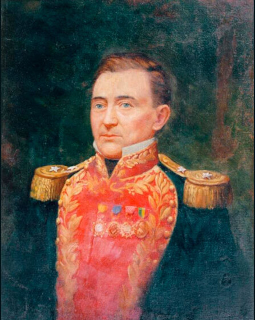
Wright is born to Joseph Wright and Mary Montgomery. At the age of eleven, he is sent to the Royal Naval College at Portsmouth, regarded at the time as the finest in the world, where he is educated to become an officer.
At the age of fourteen, following his junior officer training, Wright embarks on a sea voyage on board HMS Newcastle under the captaincy of Lord George Stuart. On this vessel he sails to the east coast of the United States where he is engaged in blockading activities in the squadron of Admiral John Borlase Warren. In 1817 he returns to England, having attained the junior officer’s rank of midshipman.
Although Wright passes the lieutenant‘s examination, promotional opportunities are diminishing in the Royal Navy, and he is not given a commission like many young junior officers in Britain. Collectively, he and others decide to enlist in Simón Bolívar’s revolutionary army and sail for South America in support of the uprisings against Spanish colonial rule. In November 1817, he enlists as an officer in the British Legions of Simón Bolívar, under the patronage of Luis Lopez Mendez, Bolivar’s agent in London. Originally setting off from the River Thames in November 1817, several snags delay the departure until January 2, 1818. They depart from Fowey harbor and sail on a brigantine named Dowson, under naval commander Captain Dormer, with 200 other volunteers armed with valuable weapons and ammunition. They land in the Saint Thomas Island after several weeks. Admiral Luis Brión arrives with his squadron on the Island of St Thomas and Pigott and the Rifle Corps are shipped on Patriot vessels to Margarita Island off the coast of Venezuela, arriving on April 21, 1818.
They are sent to Guayana and then to Angostura, beginning the campaign in the Apure. At Angostura (present-day Ciudad Bolívar), Wright first meets Simón Bolívar, for whom he develops a deep admiration. Bolívar opens the liberating campaign in Apure. During 1818–1819, one of the earliest battles with Wright partaking as an officer is at Trapiche de Gamarra on March 27, 1819. These encounters inspire Bolívar to begin his New Granada campaign and the march 1,500 miles over the Andes Mountains. Wright accompanies Bolívar on the legendary crossing on which 25% of the British/Irish troops die.
Wright takes part in the entire land campaign to liberate the northern countries of South America, and fights in numerous land battles with Bolívar’s army. He plays leading roles in the Battle of Vargas Swamp, and later in the victory at the Battle of Boyacá in August 1819, after which he is promoted to captain. In 1820, he returns with his Rifles regiment to the coastal plains to campaign in the jungles east of the Magdalena against the Spanish based on Santa Marta. The Rifles Corp are then transported by sea to Maracaibo, and on June 21, 1821, take part in Simon Bolívar’s decisive victory in the Battle of Carabobo. Cartagena is also seized, and the Rifles are brought in boats up the Magdalena River en route to Popayán. They form part of the forces led by Bolívar in the second of his famed Andean campaigns. After the successful battle at Bomboná on 7 April 7, 1822, Wright is twice mentioned in Bolívar’s order of the day for his exceptional skill and courage. Again, he is promoted and from February 1822 he is an acting lieutenant colonel.
In early 1824, Bolívar realizes that, despite the Patriot Army success on land, unless the South American revolutionary armies can control the seas off their coasts, they will forever be under sea blockade from imperial Spain. He appoints Wright to the newly fledged United Pacific Naval Squadron.
After Guayaquil seizes independence, John Illingworth Hunt is appointed as Commanding General of the Maritime Department. Immediately he takes care of organizing everything concerning the Navy. Thus, in 1823, the first Ecuadorian naval force is formed.
Wright, who in February 1824 is promoted to captain, becomes Commodore of the South Squadron, and embarks on the brig Chimborazo, and conducts patrols along the Peruvian coast with seven transports properly equipped and ready to assist in the transfer of troops, when Bolívar’s army would require it. Following Bolivar’s defeat of the royalist forces at the Battle of Junín on August 6, 1824, Wright is instructed to proceed to Callao with a squadron of five ships and is placed under the orders of Admiral Martin Guisse, head of the United Squadron. The Gran Colombian units, forming this squadron, participate in some naval actions against the royalists and also in the blockade of Callao, the last Spanish stronghold in South America.
Bolívar installs Wright as a Commodore of the Pacific Southern Squadron. He is appointed to command a small fleet of ships in support of Admiral Martin Guisse and joins the Patriotic naval force blockading off Callao. Along with Admiral Guisse and a handful of other former Royal Navy officers, they spearhead the blockade of Callao that successfully fights the Spanish naval squadron sent to lift the blockade of the besieged city. The blockade holds and Callao capitulates in early 1826, ending Spanish rule in South America.
The revolutionary independence struggles end with the unfolding liberation of South America countries, and Wright settles in Ecuador where he helps establish the Ecuadorian Navy and helps create the Ecuadorian naval school that is named in his honor.
The downfall and expulsion of the Spanish colonial power leads to land disputes and new wars among the South American home nations that once were united against Spain. In 1827, Peruvian PresidentJosé de la Mar invades Bolivia and then invades Ecuador. Wright takes up the cause of defending his new adopted homeland. His navy fights two battles with the Peruvians in the Gulf of Guayaquil.
Ecuador declares itself a republic in 1830, though the region is completely unsettled with Peru and Colombia both claiming parts of Ecuador as part of their territory. At this time Wright goes back in the Navy with his own flag officer’s pendant. He is also appointed to the army with the rank of General of Brigade in 1830. Two unconstitutional presidents, Vincente Rocafuerte and Valdivieso, declare themselves in office. Wright and Flores lead Rocafuerte’s army into a decisive battle that takes place at Minarica in 1835. This action is decisive, and they defeat General Barriga, who is Valdivieso’s appointed General. The victory guarantees the stability and future of Ecuador, with Rocafuerte becoming Ecuador’s president.
In 1835, Wright is Comandante del Apostadero, later changed to Comandancia General de la Marina (Commander-in-Chief of the Navy) for many years. He does not found the Ecuadorian Naval School, as often incorrectly cited. The college is named in his honor. He is the commanding officer of the Ecuadorian Naval Squadron before Ecuador becomes a Republic, as such he is considered a founding father of the Ecuadorian Navy. In this year he is also promoted to Army General of Division.
In 1843, Wright becomes the Governor of Guayaquil. This is the premier military position in the city.
In 1845, a military coup plot overthrows the liberal government supported by Wright and he goes into exile for fifteen years in Chile and Peru. In Chorrillos, Peru, he befriends the Ecuadorian exile Eloy Alfaro and exerts a massive influence on him as a mentor. Alfaro later becomes President of Ecuador from 1897 to 1913. Wright returns from exile in 1860 and opposes Gabriel García Moreno until his death in 1868.
A rally of twelve to fifteen thousand Peace People from both north and south takes place at the new bridge over the River Boyne at Drogheda, County Louth, on December 5, 1976. In general, the Peace People’s goals are the dissolution of the Irish Republican Army (IRA) and an end to violence in Northern Ireland. The implicit goals of the Peace People rallies are delegitimization of violence, increasing solidarity, and gaining momentum for peace.
In the 1960s, Northern Ireland begins a period of ethno-political conflict called the Troubles. Through a series of social and political injustices, Northern Ireland has become a religiously divided society between historically mainland Protestants and Irish Catholics. Furthermore, the Irish people have become a fragmented body over a range of issues, identities, circumstances and loyalties. The conflict between Protestants and Catholics spills over into violence, marked by riots and targeted killings between the groups beginning in 1968. In addition, paramilitary groups, including the prominent IRA, launch attacks to advance their political agendas.
The violence continues to escalate. On August 10, 1976, Anne Maguire and her children are walking along Finaghy Road North in Belfast. Suddenly, a Ford Cortina slams into them. The car is being driven by Danny Lennon, who moments before had been shot dead by pursuing soldiers. The mother is the only survivor. The collision kills three of her four children, Joanne (8), John (2), and Andrew (6 months). Joanne and Andrew die instantly while John is injured critically.
The next day, immediately following John’s death, fifty women from the Republican neighborhoods of Andersonstown and Stewartstown protest Republican violence by marching with baby carriages. That evening, Mairead Corrigan, Anne Maguire’s sister, appears on television pleading for an end to the violence. She becomes the first leader of the Peace People to speak publicly.
However, she was not the only one to initiate action. As soon as she hears Mairead speak on the television, Betty Williams begins petitioning door-to-door for an end to sectarian violence. She garners 6,000 signatures of support within a few days. This support leads directly into the first unofficial action of the Peace People. On 14 August, only four days after the incident, 10,000 women, both Protestant and Catholic, march with banners along Finaghy Road North, the place of the children’s death, to Milltown Cemetery, their burial site. This march mostly includes women along with a few public figures and men. The marchers proceed in almost utter silence, only broken by short bouts of singing from the nuns in the crowd and verbal and physical attacks by Republican opposition.
The following day, the three who become leaders of the Peace People – Mairead Corrigan, Betty Williams, and journalist Ciaran McKeown – come together for their first official meeting. During these initial meetings they establish the ideological basis of nonviolence and goals for the campaign. The essential goals for the movement are the dissolution of the IRA and an end to the violence in Northern Ireland. The goals of the campaign implicit in their declaration are awareness, solidarity, and momentum. Peace People’s declaration:
“We have a simple message to the world from this movement for Peace. We want to live and love and build a just and peaceful society. We want for our children, as we want for ourselves, our lives at home, at work, and at play to be lives of joy and peace. We recognise that to build such a society demands dedication, hard work, and courage. We recognise that there are many problems in our society which are a source of conflict and violence. We recognise that every bullet fired, and every exploding bomb make that work more difficult. We reject the use of the bomb and the bullet and all the techniques of violence. We dedicate ourselves to working with our neighbours, near and far, day in and day out, to build that peaceful society in which the tragedies we have known are a bad memory and a continuing warning.”
During the four-month campaign, Peace People and partners organize and participate in 26 marches in Northern Ireland, Britain, and the Republic of Ireland. In order to organize these marches effectively they establish their main headquarters in Belfast.
After the initial Finaghy Road March, the Peace People, both Protestants and Catholics, rally in Ormeau Park on August 21. The official Declaration of the Peace People is first read at this rally, the largest rally of the entire campaign. The group numbers over 50,000. The rally even includes some activists from the Republic of Ireland, most notably Judy Hayes from the Glencree Centre of Reconciliation near Dublin. After the rally, she and her colleagues return to the south to organize solidarity demonstrations.
In the few days before the next march, the organization “Women Together” request Peace People to call off the march, disapproving of Catholics and Protestants participating in a joint march. The Peace People are not dissuaded. The next Saturday, 27,000 people march along Shankill Road, the loyalist/Protestant neighborhood.
In the next three months, Peace People organize and participate in a rally every Saturday; some weeks even have two. Some of the most notable marches include the Derry/Londonderry double-march, the Falls march, the London march, and the Boyne march.
The Saturday following the Shankill march marks the Derry/Londonderry double-march. At this march, Catholics march on one side of the River Foyle and Protestants on the other. The groups meet on the Craigavon Bridge. Simultaneously, 50,000 people march in solidarity in Dublin.
On October 23, marchers meet in the Falls, Belfast, in the pouring rain on the same Northumberland street corner where the Shankill March had started. The Falls Road rally is memorable for the fear and violence that ensues. During this rally Sinn Féin supporters throw stones and bottles at the marchers. The attackers escalate the violence as the marchers near Falls Park. The marchers are informed by others that more attackers await them at the entrance to the park, inciting fear within the body of the rally. The leaders decide that this is an important moment of conflict in the rally and that they must push on. They continue verbally encouraging the marchers through the cloud of bottles, bricks, and stones.
The leaders plan to escalate the campaign momentum for the last two major symbolic rallies in London and Boyne, Drogheda. A week before the rallies, on November 20-21, they plan a membership drive. Over 105,000 people sign within two days.
The symbolic week of the culminating rallies begins on November 27 at the glamorous London Rally. They begin to march at Hyde Park, cut through Westminster Abbey, and end at Trafalgar Square. Some groups sing “Troops Out,” and others resound with civil rights songs.
On December 5, Peace People holds its final march of the campaign, along the River Boyne. The Northern and Southern Ireland contingents met at the Peace Bridge. This is an important point in the legacy of the Peace People movement. Now that the enthusiastic rallies are over, the people are responsible for the tedious local work and continuing the momentum and solidarity that the rallies have inspired. The shape of the Peace People is changing.
After the planned marches are over, the rally portion of the campaign fades and the Peace People take a new shape. Corrigan, Williams, and McKeown stop planning marches, but continue to be involved in action that takes the form of conferences and traveling overseas. However, the leaders begin doing more separated work. Ciaran McKeown increases his focus on radical political restructuring.
In 1977, Betty Williams and Mairead Corrigan receive the Nobel Peace Prize. Issues regarding the use of the monetary award impact the two leaders’ relationships in an irreconcilable manner.
Due to the fact that many people, unlike McKeown, are less interested in the political side of the equation, the People continue actions along the lines of rallies and social work. Actions continue through the People’s initiative in the form of Peace Committees that each does separate work in local areas.
The Peace People makes a substantial impact. They help to de-legitimize violence, increase solidarity across sectarian lines, and develop momentum for peace. Although the violence does not fully subside until 1998 with the negotiation of political change, Ireland sees in 1976 one of its most dramatic decreases in political violence, accompanying the Peace People’s marches and rallies. The campaign dramatizes how tired the people are of bloodshed, their desperate desire for peace, and the clear possibility of alternatives.
(From: “Peace People march against violence in Northern Ireland, 1976” by Hannah Lehmann, Global Nonviolent Action Database, https://nvdatabase.swarthmore.edu/, 2011 | Pictured: The Peace People organisation rally in Drogheda, County Louth, December 5, 1976)
Waterford is a Catholic city and like most other towns in southeast Ireland, the populace has supported the Confederate Catholic cause since the Irish Rebellion of 1641. Late in 1641, Protestant refugees, displaced by the insurgents, begin to arrive in the town, creating tension among the Catholic townspeople. The city’s mayor wants to protect the refugees, but the recorder and several of the aldermen on the city council want to strip them of their property and let in the rebels, who arrive outside the walls in early 1642. At first, the Mayor’s faction is successful in refusing to admit rebel forces, but by March 1642, the faction in the municipal government sympathetic to the rebellion prevails. The Protestants in Waterford are expelled, in most cases put on ships to England, sometimes after having their property looted by the city mob. In 1645, Confederate troops under Thomas Preston besiege and capture nearby Duncannon from its English garrison, thus removing the threat to shipping coming to and from Waterford.
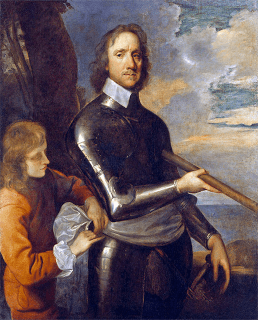
Waterford’s political community is noted for its intransigent Catholic politics. In 1646, a synod of Catholic Bishops, based in Waterford, excommunicate any Catholic who supports a treaty between the Confederates and English Royalists, which does not allow for the free practice of the Catholic religion. The Confederates finally agree to a treaty with Charles I of England in 1648, in order to join forces with the Royalists against their common enemy, the English Parliament, which is both anti-Catholic and hostile to the King. The Parliamentarians land a major expeditionary force in Ireland at Dublin, under Cromwell in August 1649.
The English Parliamentarian New Model Army arrives to besiege Waterford in October 1649. One of the stated aims of Cromwell’s invasion of Ireland is to punish the Irish for the mistreatment of Protestants in 1641. Given Waterford’s history of partisan Catholic politics, this provokes great fear amongst the townspeople. This fear is accentuated by the fate of Drogheda and nearby Wexford which had recently been taken and sacked by Cromwell’s forces and their garrisons massacred.
Waterford is very important strategically in the war in Ireland. Its port allows for the importation of arms and supplies from continental Europe and its geographical position commands the entrance of the rivers Suir and Barrow.
Before besieging Waterford, Cromwell has to take the surrounding garrisons held by Royalist and Confederate troops in order to secure his lines of communication and supply. Duncannon, whose fort commands the sea passage into Waterford, is besieged by Parliamentarians under Ireton from October 15 to November 5. However, due to a stubborn defence, the garrison there under Edward Wogan holds out. This means that heavy siege artillery cannot be brought up to Waterford by sea.
New Ross surrenders to Cromwell on October 19 and Carrick-on-Suir is taken on November 19. A counterattack on Carrick by Irish troops from Ulster under a Major Geoghegan is repulsed on November 24, leaving 500 of the Ulstermen dead.
Having isolated Waterford from the east and north, Cromwell arrives before the city on November 24. However, Waterford still has access to reinforcements from the west and up to 3,000 Irish soldiers from the Confederate’s Ulster Army under Richard O’Farrell are fed into the city in the course of a week. O’Farrell, having been a successful officer in the Spanish Army, is highly trained and experienced in siege warfare from battles in Flanders. Cromwell has come up against a superior minded soldier and commander. The weather is extremely cold and wet, and the Parliamentarian troops suffer heavily from disease. Out of 6,500 English Parliamentarian soldiers who besiege Waterford in 1649, only 3,000 or so are still fit by the time the siege is called off. Added to this, Cromwell is able to make little headway in taking the city. The capture of a fort at Passage East enables him to bring up siege guns by sea, but the wet weather means that it is all but impossible to transport them close enough to Waterford’s walls to use them. Farrell proves tactically superior in defending Waterford and repels Cromwell’s attempts. Eventually Cromwell has to call off the siege on December 2 and go into winter quarters at Dungarvan. Among his casualties is his commander Michael Jones, who dies of disease.
Murphy is an active Irish republican paramilitary from his late teens. In March 1972, he is arrested in Dundalk regarding an assault and is sentenced to two years in prison after the Garda Síochána find a loaded revolver in his car. He is imprisoned in the Curragh Camp but escapes in October 1972 and is not recaptured until May 1973. In June 1976, he is imprisoned again, receiving a three-year sentence for firearms offences and a one-year sentence for Provisional Irish Republican Army membership, both sentences to run concurrently. In July 1983, he is arrested in the United States after attempting to buy a consignment of M60 machine guns to be shipped to Ireland for use by the Irish National Liberation Army (INLA). He receives a five-year prison sentence but returns to Ireland in December 1985 after being released early.
In the late 1980s, Murphy begins investing in property and forms a company named Emerald Enterprises in 1990. He purchases the Emerald Bar public house in Dundalk for IR£100,000, and it later becomes a meeting place for dissident republicans. Other investments included 30 acres of land in Drogheda bought for IR£52,000 in 1995, and his company wins contracts for an IR£11 million development at Dublin City University (DCU) and the multi-million-pound International Financial Services Centre in the Dublin Docklands.
Murphy is arrested by the Gardaí on February 21, 1999, for questioning under anti-terrorist legislation. On February 24, he becomes the first person to be charged in connection with the Omagh bombing, when he appears before Dublin‘s Special Criminal Court and is charged with conspiring to cause an explosion under the terms of Ireland’s Offences Against the State Act, between August 13-16, 1998. He is also charged with membership in an illegal organisation, the Real Irish Republican Army (RIRA).
On October 10, 2000, the BBC television show Panorama names Murphy as one of four people connected with the Omagh bombing, along with Seamus Daly and Liam Campbell. In 2001, he undertakes legal action against the BBC and Daily Mail publishers Associated Newspapers for contempt of court. The action against Associated Newspapers is settled on July 31, 2001, and the newspaper releases a statement saying Murphy is entitled to be presumed innocent of the charges against him until proven guilty.
Murphy’s trial begins at Special Criminal Court in Dublin on October 12, 2001. The court hears that Murphy had supplied two mobile phones which were used during the bombing. One witness, Murphy’s second cousin, retracts his evidence and the judge calls the conduct of two detectives outrageous, saying they had persistently lied under cross-examination. Despite this, on January 22, 2002, he is convicted of conspiring to cause the Omagh bombing, and on January 25 is sentenced to 14 years imprisonment with the judge describing him as a long-time republican extremist.
On January 21, 2005, Murphy’s conviction is overturned and a new trial ordered, due to the invasion of Murphy’s presumption of innocence, and alteration of Gardaí interview notes and evidence presented by two officers. A week later, his legal case against the BBC is resolved, with the BBC issuing a statement that Murphy “was fully entitled to maintain his innocence of the charges against him and to test the evidence against him at his trial.”
On October 23, 2006, two Gardaí officers are found not guilty of perjuring themselves during Murphy’s trial. On May 23, 2007, it is announced that Murphy is suffering from short-term memory loss resulting from a car accident in 1988. His lawyers attempt to prevent a retrial taking place, on the grounds that his condition interferes with his right to a fair hearing. The Court of Criminal Appeal is scheduled to hear his case again in October 2008. Following a retrial held in January 2010, he is acquitted on February 24, 2010.
In 2009, Murphy is one of four men found by a civil court to be liable for the Omagh bombing in a case taken by relatives of the victims. On July 7, 2011, in Belfast High Court, Lord Justice Malachy Higgins directs a retrial of the civil claims against Murphy. He questions evidence surrounding emails from U.S. undercover agent David Rupert while overturning the judgment on Murphy. The paucity of the email evidence, the lack of consistency in the emails or at least ambiguity, the possibility of initials referring to someone other than Murphy and the fact that they refer on occasions to double hearsay considerably weaken the emails as evidence, he says. Following a civil retrial on March 20, 2013, Murphy and Seamus Daly are found liable for involvement in the bombing.
Máire Nic Shiubhlaigh, Irish actress and republican activist, is born Mary Elizabeth Walker in Charlemont Street, Dublin, on May 8, 1883. She starts acting in her teens and appears in the first Irish language play performed in Ireland. She is a founder-member of the Abbey Theatre and is leading lady on its opening night in 1904, when she plays the title role in W. B. Yeats‘s Cathleen ni Houlihan. She later joins the Theatre of Ireland, which she helps to found.
Nic Shiubhlaigh is born into a nationalist and Irish-speaking family. Her father, Matthew, comes from County Carlow and is a printer and publisher who becomes proprietor of the Gaelic Press. Her mother, Mary, is a dressmaker from Dublin. She grows up in 56 High Street in the Dublin Liberties.
Nic Shiubhlaigh joins the Gaelic League about 1898 and comes into contact with Arthur Griffith and William Rooney. She joins the cultural and revolutionary women’s group Inghinidhe na hÉireann in 1900. With the help of drama enthusiasts William and Frank Fay, she starts acting with the drama group of Inghinidhe na hÉireann. In 1901, the drama group takes part in a feis with two plays, Tobar Draoidheachta by Patrick S. Dinneen and Red Hugh by Alice Milligan. George Russell and W.B. Yeats, who are in attendance at the performance, are moved by the dedication of the amateur players. Russell, who had already offered the Fays his mythic play Deirdre, persuades Yeats to offer them his patriotic play, Cathleen ni Houlihan.
In 1902, Nic Shiubhlaigh joins W. G. Fay’s Irish National Dramatic Company, along with others such as Maire Quinn, Brian Callender, Charles Caulfield, James H. Cousins, P. J. Kelly, Dudley Digges and Frederick Ryan. Their first production of the two one-act plays, Cathleen ni Houlihan, with Maud Gonne in the lead role, and Deirdre, is on April 2, 1902. The company, which has no funds to speak of, acquires a couple of bare rooms at 34 Lower Camden Street, which with the help of friends from Irish-revival societies, they turn into a tiny theatre. They rehearse at the Coffee Palace and also use the Molesworth Hall for productions. In March 1903, with other members of her family, she appears in the first production of Yeats’ morality play, The Hour-Glass, in which she plays the part of the Angel.
In 1903, the playwrights and most of the actors and staff from these productions go on to form the Irish National Theatre Society, which has its registered offices in the Camden Street theatre. Nic Shiubhlaigh is a founder member and on the management committee of the society. Yeats is president, while Russell, Maud Gonne and Douglas Hyde are vice-presidents. William Fay is stage manager. The society founds the Abbey Theatre.
Nic Shiubhlaigh acts in the Abbey Theatre from the time of its founding. On its opening night on December 27, 1904, she plays the name part in Cathleen ni Houlihan. Her portrait is painted by John Butler Yeats for the occasion and hangs in the vestibule. She is the principal actress of the company after Máire Quinn’s departure to the United States, and when she leaves, the burden of the chief women’s rôles falls upon Sara Allgood.
In September 1905, the Abbey administrator and financial backer, an English theatre impresario called Annie Horniman, in hopes of improving the artistic quality of the productions at the Abbey, offers to guarantee salaries (a sum of £500 per year) for the actors and for Willie Fay as producer. To her mind, this will allow the actors and Fay to dispense with their day jobs and concentrate wholly upon their acting. The more nationally-minded members of the staff disagree. Nic Shiubhlaigh writes, “It was pointed out that the old Irish National Theatre Society had been founded in 1902 on the understanding that its independence as a national movement was to be secured only through the efforts of its members. It would be contrary to these ideals to accept a subsidy from an independent source.” For them it would mean a choice between a national theatre and an artistic theatre. At a meeting of the society, supported by Yeats, Gregory and Synge, the motion to accept Miss Horniman’s proposition is passed by a majority of shareholdings rather than a majority of votes. Nic Shiubhlaigh along with others resign, but they agree to remain until the end of the year, as part of an upcoming tour of England.
Nic Shiubhlaigh remains with the Abbey until December 1905, when along with Honor Lavelle (also known as Helen Laird), Emma Vernon, Máire Garvey, Frank Walker, Seumas O’Sullivan, Padraic Colum and George Roberts, she leaves. She joins the Theatre of Ireland, which she helps to found. This is formed in June 1906 with aims similar to the Irish National Theatre Society. She returns to the Abbey in 1910.
At the time of the 1916 Easter Rising, Nic Shiubhlaigh is living in Glasthule, a suburb of Dublin. She cycles into the city and, along with other members of Cumann na mBan, makes her way to Jacob’s Biscuit Factory, whose garrison under the command of Thomas MacDonagh guards the city against the troops of Portobello Barracks, and acts as an information and supplies hub for other garrisons around the city. She commands the women of the garrison. They remain there until the surrender, cooking and rendering first aid to the garrison, and bringing despatches through the city.
Nic Shiubhlaigh had retired from professional acting in 1912, and seldom works in professional theatre again. In 1929, she marries former IRA Director of Organisation, Major General Eamon “Bob” Price, and they move to Laytown, County Meath.
Nic Shiubhlaigh’s last stage appearance, alongside her sister Gypsy, is in a production of Gaol Gate at the Olympia Theatre, Dublin, on November 21, 1948, staged to mark the 150th anniversary of the death of Theobald Wolfe Tone.
Nic Shiubhlaigh dies on September 9, 1958, in the Drogheda cottage hospital.
Her book, The Splendid Years, written with the help of her nephew Edward Kenny, recalls the years of the national revival and the Easter Rising.