Clancy graduates in 1904 and finds a position teaching the Irish language at Clongowes Wood College and is active in the Gaelic Athletic Association. Due to ill health he has to return to his home at Grange. In 1908 he comes to Limerick to teach Irish. In 1913 he joins the Irish Volunteers. In 1915 he marries Máire Killeen, a teacher. After the 1916 Easter Rising, he is arrested and imprisoned in Cork, but is released before he comes to trial following a hunger strike.
Clancy helps in Éamon de Valera‘s election campaign in East Clare. He nearly dies of Spanish flu during the 1918 epidemic but recovers and, in January 1921, he is elected Sinn Féin Mayor of Limerick.
On the night of March 6, 1921, three Auxiliaries come to Clancy’s house and one of them shoots him, injuring him fatally. His wife is also injured in the attack. The previous Mayor, Michael O’Callaghan, is also murdered on the same night by the same group.
Suspicion immediately falls upon members of the Black and Tans, but a British inquiry into the murder, like most such inquiries through the years, absolve Crown forces of any blame. One of Clancy’s killers is later said to be George Nathan who dies in the Spanish Civil War in July 1937.
Gifford is the second youngest of 12 children born to Frederick Gifford, a solicitor and a Roman Catholic, and Isabella Julia Burton Gifford, a Protestant. The boys are baptised as Catholics and the girls as Protestant, but effectively the children are all raised as Protestants with the girls attending Alexandra College in Earlsfort Terrace.
Gifford returns to Dublin in 1908 and, with great difficulty, tries to earn a living as a caricaturist, publishing her cartoons in The Shanachie, Irish Life, Meadowstreet and The Irish Review, which is edited from 1913 by Joseph Plunkett. She considers emigrating but gives up the idea. Nora Dryhurst, a journalist from London, brings her to the opening of the new bilingual school Scoil Éanna in Ranelagh, Dublin. It is here that she meets Plunkett for the first time. He is a friend of her brother-in-law, another of the future leaders of the 1916 Easter Rising, Thomas MacDonagh, who is married to her sister Muriel.
Gifford’s growing interest in the Roman Catholic religion leads to the deepening of Gifford and Plunkett’s relationship as she begins to discuss Catholic mystical ideas with him. Plunkett proposes to her in 1915, and she accepts and takes formal instruction in Catholic doctrine. She is received into the Catholic Church in April 1916. The couple plans to marry on Easter Sunday that year, in a double wedding with his sister and her fiancé.
After the Rising, Gifford’s brother-in-law Thomas MacDonagh is shot with Patrick Pearse and Thomas Clarke by firing squad on May 3. That day, she hears that Plunkett is to be shot at dawn. She purchases a ring in a jeweler’s shop in Dublin and, with the help of a priest, persuades the military authorities to allow them to marry. She and Joseph are married on the night of May 3 in the chapel of Kilmainham Gaol, a few hours before he is executed.
Grace Plunkett decides to devote herself through her art to the promotion of Sinn Féin policies and resumes her commercial work to earn a living. She is elected to the Sinn Féin executive in 1917.
During the Irish Civil War, Plunkett is arrested with many others in February 1923 and interned at Kilmainham Gaol for three months. She paints pictures on the walls of her cell, including one of the Blessed Virgin and the Christ Child. She is released in May 1923.
When the Civil War ends, Plunkett has no home of her own and little money. Like many Anti-Treaty Republicans, she is the target of social ostracism and has difficulty finding work. Her talent as an artist is her only real asset and her cartoons are published in various newspapers and magazines. She moves from one apartment to another and eats in the city-centre restaurants but has no wish to remarry. Her material circumstances improve in 1932 when she receives a Civil List pension from Éamon de Valera‘s Fianna Fáil government. She lives for many years in a flat in Nassau Street with a balcony overlooking the sports ground of Trinity College.
Plunkett’s in-laws refuse to honour her husband’s will, in which he leaves everything to his widow. Legally, the will is invalid because there is only one witness, rather than the required two, and the marriage takes place after the will is made, automatically revoking it. For years she receives nothing, so she begins legal proceedings against her in-laws in 1934. The Count and Countess Plunkett settle out of court, and she is paid £700, plus costs.
At around this time Plunkett joins the Old Dublin Society, where she meets the noted Irish harpsichord maker Cathal Gannon. When Cathal marries, she gives him and his wife Margaret a present of two single beds and a picture. From the late 1940s onwards, her health declines. In 1950 she is brought to St. Vincent’s Hospital. She convalesces in a nursing home, which she does not like, mainly because it restricts her freedom.
Grace Gifford Plunkett dies suddenly on December 13, 1955, in her apartment in South Richmond Street, Portobello. Her body is removed to St. Kevin’s Church, Harrington Street and among the attendees at her funeral is PresidentSeán T. O’Kelly. She is buried with full military honours close to the republican plot in Glasnevin Cemetery.
The policy of Irish neutrality during World War II is adopted by the Oireachtas at the instigation of De Valera upon the outbreak of World War II in Europe. It is maintained throughout the conflict, in spite of several Germanairstrikes by aircraft that miss their intended British targets and attacks on Ireland’s shipping fleet by Allies and Axis alike. De Valera refrains from joining either the Allies or Axis powers. While the possibilities of not only a German but also a British invasion are discussed in Dáil Éireann, and either eventuality is prepared for, with the most detailed preparations being done in tandem with the Allies under Plan W, De Valera’s ruling party, Fianna Fáil, supports his neutral policy for the duration of the war.
This period is known in the Republic of Ireland as “The Emergency“, owing to the wording of the constitutional article employed to suspend normal government of the country.
Pursuing a policy of neutrality requires attaining a balance between the strict observance of non-alignment and the taking of practical steps to repel or discourage an invasion from either of the two concerned parties.
Ireland maintains a public stance of neutrality to the end, although this policy leads to a considerable delay in Ireland’s membership of the United Nations (UN). Ireland’s applications for membership are vetoed by the Soviet Union, a permanent member of the United Nations Security Council, from 1946 to December 1955. Seán MacBride considers that the UN boycott of Ireland had been originally agreed upon at the 1945 Yalta Conference by Winston Churchill and Joseph Stalin. Ireland’s acceptance into the UN is finally announced by John A. Costello on December 15, 1955.
Despite the official position of neutrality, there are many unpublicised contraventions of this, such as permitting the use of the Donegal Corridor to Allied military aircraft, and extensive co-operation between Allied and Irish intelligence, including exchanges of information, such as detailed weather reports of the Atlantic Ocean. For example, the decision to go ahead with the Normandy landings is decided by a weather report from Blacksod Bay, County Mayo.
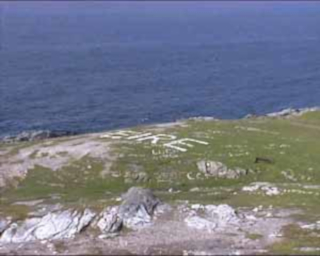
(Pictured: Markings to alert aircraft to neutral Ireland during World War II on Malin Head, County Donegal)
Mitchel is one of the great propagandists of his day, although the causes he espouses often place him on the wrong side, he is loved and loathed in equal measure. He is one of the few Irishmen to have incurred the wrath of the British government and of the Federal administration of the United States.
Inflamed by the suffering he witnesses on a trip to Galway, it is Mitchel, more than any other writer or politician, who shapes the nationalist perception of an Gorta Mór (Great Famine):
“I could see, in front of the cottages, little children leaning against a fence when the sun shone out for they could not stand, their limbs fleshless, their bodies half-naked, their faces bloated yet wrinkled, and of a pale, greenish hue… I saw Trevelyan’s claw in the vitals of those children: his red tape would draw them to death: in his government laboratory he had prepared for them the typhus poison.”
Responding to such writing, Ireland simmers, angry and ready for rebellion. Fearful of Mitchel’s power, London’s Punch magazine emphasises his international standing by portraying him as an Irish monkey challenging the Great British Lion. The Times thunders against him. When Mitchel produces his own republican newspaper, The United Irishman, which, in its inaugural edition, claims that “the world was weary of Old Ireland and also of Young Ireland” thus attacking both Daniel O’Connell and his younger antagonists with the same broadsword. He aims to be an equal opportunities offender and succeeds admirably.
The United Irishman sells out and is shut down by the British authorities after a mere sixteen issues. In order to silence Mitchel, to rob him of his heroic status and his possible martyrdom, the British government passes the Treason Felony Act 1848, which seeks to treat treason as a common crime. He is later tried before an elegantly and efficiently packed jury, found guilty of treason-felony, and deported to Van Diemen’s Land (Tasmania). The result is one of the greatest works of Irish political history, The Jail Journal, in which Mitchel writes about his own experience of deportation and advocates a far more militaristic approach to Ireland’s “English problem” than would have been popular heretofore.
Mitchel is acclaimed by Patrick Pearse, who declares The Jail Journal to be “the last of the four gospels of the New Testament of Irish nationality, the last and the fieriest and the most sublime.” Éamon de Valera reveres Mitchel, and when in 1943 he imagines Ireland as “the home of a people who valued material wealth only as a basis for right living, of a people who, satisfied with frugal comfort, devoted their leisure to the things of the spirit,” he too is delving into The Jail Journal for his inspiration.
(From: #OTD in 1848 – John Mitchel Publishes First United Irishman, Stair na hÉireann | History of Ireland)
Under the Irish Republic‘s Dáil Constitution adopted in 1919, Dáil Éireann continues to exist after it has ratified the Anglo-Irish Treaty. In protest at the ratification, Éamon de Valera resigns the presidency of the Dáil then seeks re-election from among its members in order to clarify his mandate, but Arthur Griffith defeats him in the vote and assumes the presidency.
The Provisional Government takes office two days later on January 16, 1922, when British administration hands over Dublin Castle to Collins in person. At this time, Westminster has not formally appointed the new Irish ministers or conferred their government with any powers.
The handover of Dublin Castle to the Provisional Government is one of the earliest and most remarkable events in the short life of the Provisional Government. For centuries Dublin Castle is the symbol, as well as the citadel, of British rule in Ireland. The transfer of its Castle administration to the representatives of the Irish people is greatly welcomed in Dublin. It is regarded as a significant outward and visible sign that British rule is ending.
By mid-1922, Collins in effect lays down his responsibilities as Chairman of the Provisional Government to become Commander-in-Chief of the Irish Army, a formal structured uniformed army that forms around the pro-Treaty Irish Republican Army (IRA). As part of those duties, he travels to his native County Cork. En route home on August 22, 1922, at Béal na Bláth, he is killed in an ambush. Arthur Griffith dies of a cerebral haemorrhage ten days prior to Collins’ assassination. After Collins’ and Griffith’s deaths in August 1922, W. T. Cosgrave becomes both Chairman of the Provisional Government and President of Dáil Éireann, and the distinction between the two posts becomes irrelevant.
(Pictured: The Provisional Government of Ireland with President Arthur Griffith (front row center) and his cabinet and party includng Michael Collins (to Griffith’s right) likely taken at the Mansion House in February 1922)
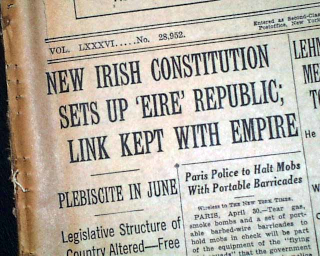
The Constitution of Ireland, the second constitution of the Irish state since independence, comes into force on December 29, 1937, following a statewide plebiscite held on July 1, 1937, replacing the 1922 Constitution of the Irish Free State. It asserts the national sovereignty of the Irish people. The constitution falls broadly within the tradition of liberal democracy, being based on a system of representative democracy. It guarantees certain fundamental rights, along with a popularly elected non-executive president, a bicameral parliament based on the Westminster system, a separation of powers and judicial review. The Constitution may be amended solely by a national referendum.
The Constitution of Ireland replaces the Constitution of the Irish Free State which had been in effect since the independence, as a dominion, of the Irish state from the United Kingdom on December 6, 1922. There are two main motivations for replacing the constitution in 1937. Firstly, the Statute of Westminster 1931 grants parliamentary autonomy to the six British Dominions (now known as Commonwealth realms) within a British Commonwealth of Nations. This has the effect of making the dominions sovereign nations in their own right. The Irish Free State constitution of 1922 is, in the eyes of many, associated with the controversial Anglo-Irish Treaty. The anti-treaty faction, who oppose the treaty initially by force of arms, is so opposed to the institutions of the new Irish Free State that it initially takes an abstentionist line toward them, boycotting them altogether. However, the largest element of this faction becomes convinced that abstentionism cannot be maintained forever. This element, led by Éamon de Valera, forms the Fianna Fáil party in 1926, which enters into government following the 1932 Irish general election.
After 1932, under the provisions of the Statute of Westminster, some of the articles of the original Constitution which were required by the Anglo-Irish Treaty are dismantled by acts of the Oireachtas of the Irish Free State. Such amendments remove references to the Oath of Allegiance, appeals to the United Kingdom’s Judicial Committee of the Privy Council, the British Crown and the Governor-General of the Irish Free State. The sudden abdication of Edward VIII in December 1936 is quickly used to redefine the Royal connection. Nevertheless, the Fianna Fáil government still desires to replace the constitutional document they see as having been imposed by the British government in 1922.
The second motive for replacing the original constitution is primarily symbolic. De Valera wants to put an Irish stamp on the institutions of government and chooses to do this in particular through the use of Irish Gaelic nomenclature.
The text of the draft constitution, with minor amendments, is approved on June 14, 1937, by Dáil Éireann, then the sole house of parliament as the Seanad had been abolished the previous year.
The draft constitution is then put to a plebiscite on July 1, 1937, the same day as the 1937 Irish general election, when it is passed by a plurality of 56% of the voters, comprising 38.6% of the whole electorate. The constitution formally comes into force on December 29, 1937.
Among the groups who oppose the constitution are supporters of Fine Gael and the Labour Party, Unionists, and some independents and feminists. The Seal of the President of Ireland is also adopted in the same year. Ireland does not become a republic until 1948.
(Pictured: Headline from The New York Times, May 1, 1937)
Childers is educated at Gresham’s School, Holt, and the University of Cambridge, hence his striking British upper-class accent. On November 24, 1922, when he is sixteen, his father, Robert Erskine Childers, is executed by the new Irish Free State on politically inspired charges of gun-possession. The pistol he had been found with had been given to him by Michael Collins. Before his execution, in a spirit of reconciliation, the elder Childers obtains a promise from his son to seek out and shake the hand of every man who had signed his death warrant.
Following his father’s funeral, he returns to Gresham’s, then two years later he goes on to Trinity College, Cambridge. He returns to Ireland in 1932 and becomes advertising manager of The Irish Press, the newly founded newspaper owned by the family of Éamon de Valera.
Childers is nominated as the presidential candidate of Fianna Fáil at the behest of de Valera, who pressures Jack Lynch in the selection of the presidential candidate. He is a controversial nominee, owing not only to his British birth and upbringing but to his Protestantism. However, on the campaign trail his personal popularity proved enormous, and in a political upset at the 1973 Irish presidential election, he is elected the fourth President of Ireland on May 30, 1973, defeating Tom O’Higgins by 635,867 (52%) votes to 578,771 (48%). He becomes the second Protestant to hold the office, the first being Douglas Hyde (1938–1945).
Prevented from transforming the presidency as he desires, Childers instead throws his energy into a busy schedule of official visits and speeches, which is physically taxing.
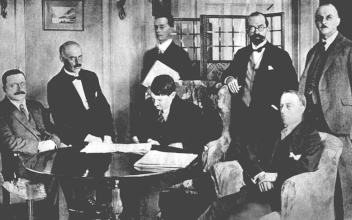
The Anglo-Irish Treaty, commonly known as The Treaty and officially the Articles of Agreement for a Treaty Between Great Britain and Ireland, is signed in the early morning hours of December 6, 1921 by representatives of the Irish government appointed by PresidentÉamon de Valera and those negotiating for the government of the United Kingdom of Great Britain and Ireland, ending the Irish War of Independence against Great Britain. It is then, and remains, one of the most debated moments in Irish history.
The Treaty provides for the establishment of the Irish Free State within a year as a self-governing dominion within the “community of nations known as the British Empire“, a status “the same as that of the Dominion of Canada.” It also provides Northern Ireland, which had been created by the Government of Ireland Act 1920, an option to opt out of the Irish Free State, which it exercises.
The agreement is signed in London by representatives of the British government, which includes Winston Churchill and Prime MinisterDavid Lloyd George, who are old masters at the game of politics, and by representatives of the Irish Republic including Michael Collins and Arthur Griffith, who have nowhere near the political acumen of the British delegation. De Valera, a shrewd, experienced politician, may have been the only man in all of Ireland who might have matched them, but he refuses to join the negotiations.
The Irish representatives have plenipotentiary status acting on behalf of the Irish Republic, though the British government declines to recognise that status. As required by its terms, the Treaty is approved by “a meeting” of the members elected to sit in the House of Commons of Southern Ireland and separately by the British Parliament. In reality, Dáil Éireann, the legislative assembly for the de facto Irish Republic, first debates then approves the treaty. Members then proceed with the “meeting.” Though the Treaty is narrowly approved, the split leads to the Irish Civil War, which is won by the pro-treaty side.
The Irish Free State as contemplated by the Treaty comes into existence when its constitution becomes law on December 6, 1922 by a royal proclamation.
(Pictured: Michael Collins signs the Anglo-Irish Treaty on December 6, 1921)
Carney is educated at St. Patrick’s Christian Brothers School in Donegall Street in Belfast, later teaching at the school. She enrolls at Hughes Commercial Academy around 1910, where she qualifies as a secretary and shorthand typist, one of the first women in Belfast to do so. However, from the start she is looking towards doing more than just secretarial work.
In 1912 Carney is in charge of the women’s section of the Northern Ireland Textile Workers’ Union in Belfast, which she founds with Delia Larkin in 1912. During this period, she meets James Connolly and becomes his personal secretary. She becomes Connolly’s friend and confidant as they work together to improve the conditions for female labourers in Belfast. Carney then joins Cumann na mBan, the women’s auxiliary of the Irish Volunteers, and attends its first meeting in 1914.
Carney is present with Connolly in Dublin‘s General Post Office (GPO) during the Easter Rising in 1916. She is the only woman present during the initial occupation of the building. While not a combatant, she is given the rank of adjutant and is among the final group to leave the GPO. After Connolly is wounded, she refuses to leave his side despite direct orders from Patrick Pearse and Connolly. She leaves the GPO with the rest of the rebels when the building becomes engulfed in flames. They make their new headquarters in nearby Moore Street before Pearse surrenders.
After her capture, Carney is held in Kilmainham Gaol before being moved to Mountjoy Prison and finally to an English prison. By August 1916 she is imprisoned in HM Prison Aylesbury alongside Nell Ryan and Helena Molony. The three request that their internee status be revoked so that they could be held as normal prisoners with Countess Markievicz. Their request is denied, however Carney and Molony are released two days before Christmas 1916.
Following the Irish Civil War, Carney becomes much more disillusioned with politics. She is very critical and outspoken of Éamon de Valera and his governments.
In 1928 she marries George McBride, a Protestant Orangeman and former member of the Ulster Volunteers. Ironically, the formation of the Ulster Volunteers prompts the formation of the Irish Volunteers, of which Carney was a member. She alienates anyone in her life that does not support her marriage to McBride.
A number of serious health problems limit Carney’s political activities in the late 1930s. She dies in Belfast on November 21, 1943, and is buried in Milltown Cemetery. Her resting place is located years later, and a headstone is erected by the National Graves Association, Belfast. Because she married a Protestant and former Orangeman, she is not allowed to have his name on her gravestone due to the religious differences.
In 2013, the Seventieth Anniversary of Carney’s death is remembered by the Socialist Republican Party. Almost one hundred people attend as a short parade follows, marking and commemorating the work she did for the cause. She is placed in high esteem among the other hundreds of radical women, who stand up for what they believe in, regardless of the consequences they face.
Pearse is born on August 24, 1878, at 27 Great Brunswick Street (now Pearse Street) in Dublin, the eldest child of James Pearse and Margaret Pearse (née Brady), who serves as a Teachta Dála (TD) in the 1920s. She is educated at the Holy Faith Convent in Glasnevin. After leaving school, she trains as a teacher. She helps to found St. Enda’s School with her brothers Patrick and Willie. Following the executions of her brothers in the aftermath of the Easter Rising, she continues to run St. Enda’s, along with Fergus De Búrca, until 1933.
Illness forces Pearse into the Linden Convalescent Home in Blackrock, County Dublin when she is in her 80s. In 1967, when she is 89 years old, her condition is described to be deteriorating. However, in 1968 during the months leading up to her 90th birthday, she leaves the Linden Convalescent Home for a short while in order to spend her birthday at St. Endas in Rathfarnham. The president of Ireland at the time, Éamon de Valera, visits her at St. Endas to congratulate her on her upcoming 90th birthday.
Margaret Pearse dies, unmarried, at the Linden Convalescent Home in Blackrock, County Dublin, on November 7, 1968, and is given a state funeral. President de Valera, the church and the state all pay tribute to her at the funeral. She is buried beside her parents and sister at Glasnevin Cemetery. The Taoiseach, Jack Lynch, says that Margaret Mary Pearse is the last remaining member of the noble Pearse family. He says her life, like her patriotic brothers, was dedicated to Ireland.
As per her mother’s wishes, Pearse bequeaths St. Enda’s to the people of Ireland as a memorial to her brother’s sacrifice. The school is now home to the Pearse Museum.





 The
The 

 seamus dubhghaill