The party is small throughout its existence. According to the ISRP historian David Lynch, the party never has more than 80 members. Upon its founding one journalist comments that the party has more syllables than members. Nevertheless, the ISRP is regarded by many Irish historians as a party of seminal importance in the early history of Irish socialism and republicanism. It is often described as the first socialist and republican party in Ireland, and the first organisation to espouse the ideology of socialist republicanism on the island. During its lifespan it only has one really active branch, the Dublin branch. There are several attempts to create branches in Cork, Belfast, Limerick, Naas, and even in northern England but they never come to much. The party establishes links with feminist and revolutionary Maud Gonne who approves of the party.
The party produces the first regular socialist paper in Ireland, the Workers’ Republic, runs candidates in local elections, represents Ireland at the Second International, and agitates over issues such as the Boer War and the commemorations of the Irish Rebellion of 1798. Politically the ISRP is before its time, putting the call for an independent “Republic” at the centre of its propaganda before Sinn Féin or other political organizations.
A public meeting held by the party is described in Irish socialist playwrightSean O’Casey‘s autobiography Drums under the Window.
Connolly, who is the full-time paid organiser for the party, subsequently leaves Ireland for the United States in 1903 following internal conflict. In fact, it seems that a combination of the petty infighting and his own poverty that causes Connolly to abandon Ireland (he returns in 1910). Connolly clashes with the party’s other leading light, E. W. Stewart, over trade union and electoral strategy. A small number of members around Stewart establish an anti-Connolly micro organisation called the Irish Socialist Labour Party. In 1904, this merges with the remains of the ISRP to form the Socialist Party of Ireland.
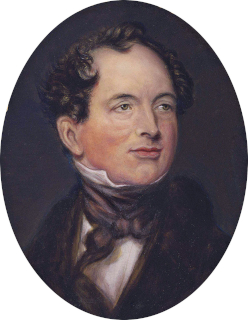
The son of a Roman Catholic wine merchant, Moore graduates from Trinity College, Dublin, in 1799 and then studies law in London. His major poetic work, Irish Melodies (1807–34), earns him an income of £500 annually for a quarter of a century. It contains such titles as “The Last Rose of Summer” and “Oft in the Stilly Night.” The Melodies, a group of 130 poems set to the music of Moore and of Sir John Stevenson and performed for London’s aristocracy, arouses sympathy and support for the Irish nationalists, among whom Moore is a popular hero.
Lalla-Rookh (1817), a narrative poem set in an atmosphere of Oriental splendour, gives Moore a reputation among his contemporaries rivaling that of Byron and Sir Walter Scott. It is perhaps the most translated poem of its time, and it earns what was until then the highest price paid by an English publisher for a poem (£3,000). His many satirical works, such as The Fudge Family in Paris (1818), portray the politics and manners of the Regency era.
In 1824 Moore becomes a participant in one of the most celebrated episodes of the Romantic era. He is the recipient of Byron’s memoirs, but he and the publisher John Murray burn them, presumably to protect Byron. He later brings out the Letters and Journals of Lord Byron (1830), in which he includes a life of the poet. His lifelong espousal of the Catholic cause leads him to produce such brilliant works as his parody of agrarian insurgency, The Memoirs of Captain Rock (1824), and his courageous biography of the revolutionary leader of the 1798 rebellion, The Life and Death of Lord Edward Fitzgerald (1831).
Moore’s personal life is dogged by tragedy including the deaths of all five of his children within his lifetime and a stroke in later life, which disables him from performances, the activity for which he is most renowned. Moore dies while being cared for by his wife, Elizabeth (nee Dyke), at Sloperton Cottage, Bromham, Wiltshire, England on February 26, 1852. His remains are in a vault at St. Nicholas churchyard, Bromham, within view of his cottage-home and beside his daughter Anastasia.
(Pictured: Thomas Moore, after a painting by Thomas Lawrence)
Edgeworth is born at Black Bourton, Oxfordshire, England on January 1, 1768. She is the second child of Richard Lovell Edgeworth and Anna Maria Edgeworth (née Elers). She spends her early years with her mother’s family in England, until her mother’s death when Maria is five. When her father marries his second wife Honora Sneyd in 1773, she goes with him to his estate, Edgeworthstown, in County Longford. There, she assists her father in managing his estate. In this way she acquires the knowledge of rural economy and of the Irish peasantry that is to become the backbone of her novels.
Domestic life at Edgeworthstown is busy and happy. Encouraged by her father, Edgeworth begins her writing in the common sitting room, where the 21 other children in the family provide material and audience for her stories. She publishes them in 1796 as The Parent’s Assistant. Even the intrusive moralizing, attributed to her father’s editing, does not wholly suppress their vitality, and the children who appear in them, especially the impetuous Rosamond, are the first real children in English literature since William Shakespeare.
Her first novel, Castle Rackrent (1800), written without her father’s interference, reveals her gift for social observation, character sketch, and authentic dialogue and is free from lengthy lecturing. It establishes the genre of the “regional novel,” and its influence is enormous. Sir Walter Scott acknowledges his debt to Edgeworth in writing Waverley. Her next work, Belinda (1801), a society novel unfortunately marred by her father’s insistence on a happy ending, is particularly admired by Jane Austen.
Edgeworth never marries. She has a wide acquaintance in literary and scientific circles. Between 1809 and 1812 she publishes her Tales of Fashionable Life in six volumes. They include one of her best novels, The Absentee, which focuses attention on a great contemporary abuse in Irish society: absentee English landowning.
Before her father’s death in 1817 she publishes three more novels, two of them, Patronage (1814) and Ormond (1817), of considerable power. After 1817 she writes less. She completes her father’s Memoirs (1820) and devotes herself to the estate. She enjoys a European reputation and exchanges cordial visits with Scott. Her last years are saddened by the Irish famine of 1846, during which she works for the relief of stricken peasants.
After a visit to see her relations in Trim, Maria, now in her eighties, begins to feel heart pains and dies suddenly of a heart attack in Edgeworthstown on May 22, 1849. She is laid to rest in a vault at Edgeworthstown Church.
The feminist movement of the 1960s leads to the reprinting of her Moral Tales for Young People, 5 vol. (1801) and Letters for Literary Ladies (1795) in the 1970s. Her novels continue to be regularly reprinted in the 21st century.
Corr, the youngest of four children, is born to Gerry Corr, a manager of the payroll department of the Irish Electricity Supply Board (ESB), and his wife, Jean, a housewife. Gerry and Jean have their own band, Sound Affair, which plays songs by ABBA and the Eagles in local pubs in Dundalk where they would often bring along their children.
With the encouragement of her parents, Corr takes up the tin whistle and is taught the piano by her father. Throughout their teenage years, she and her siblings often practise in her brother Jim‘s bedroom at a house he had rented. She sings lead vocals; her sister Sharon plays the violin and sister Caroline and Jim both play keyboards. She takes part in school plays at her school, Dundalk’s Dún Lughaidh Convent.
Corr debuts in 1990 as the lead singer of the Celticfolk rock and pop rock group The Corrs along with her three siblings. Aside from singing lead vocals she plays the tin whistle, the ukulele, and the piano.
With the others, Corr releases six studio albums, two compilation albums, one remix album and two live albums. She also pursues a solo career, releasing her debut album, Ten Feet High, in 2007. The album moves away from the sound of the Corrs and features a dance-pop sound. Her next album, released on May 30, 2011, is entirely made up of covers of songs that were important to her when younger.
The Restoration of the monarchy begins in 1660. The Commonwealth of England, Scotland and Ireland (1649–60) result from the Wars of the Three Kingdoms but collapse in 1659. Politicians such as General George Monck try to ensure a peaceful transition of government from the “Commonwealth” republic back to monarchy. From May 1, 1660 the English, Scottish and Irish monarchies are all restored under King Charles II. The term Restoration may apply both to the actual event by which the monarchy was restored, and to the period immediately before and after the event.
With the collapse of The Protectorate in England during May 1659 the republic which had been forced upon Ireland by Oliver Cromwell quickly begins to unravel.
Royalists plan an uprising in Ireland and seek to turn Henry Cromwell and Lord Broghill, who is in contact with the King’s court in the summer of 1659, towards the cause but the plan comes to aught. Henry Cromwell leaves Ireland in June 1659. Broghill shows reluctance to declare for the King, but nevertheless republicans are suspicious of him following George Booth‘s revolt in England in 1659.
Sir Theophilus Jones, a former soldier under Charles I of Ireland and governor of Dublin during the republic, seizes Dublin Castle with a group of officers and declares for Parliament. Acting in Charles II’s interest, Sir Charles Coote seizes Galway while Lord Broghill holds firm in Munster. On January 9, 1660 a council of officers declare Edmund Ludlow a traitor and he flees to England. The regicideHardress Waller re-takes Dublin Castle in February 1660 but with little support he surrenders to Sir Charles Coote. Waller along with fellow regicide John Cook is arrested and sent to England. The officers in Dublin support General Monck.
The army is purged of radicals and a Convention Parliament is called. Coote seeks to move the Convention Parliament towards restoration, but his rival Broghill does not openly declare for the King until May 1660.
In February 1660 Coote sends a representative to King Charles II in the Netherlands and invites him to make an attempt on Ireland, but the King regards it as inexpedient to try to reclaim Ireland before England. At the same time Broghill sends his brother to invite the King to land at Cork. In March 1660 a document is published asking for the King’s return, “begged for his forgiveness, but stipulated for a general indemnity and the payment of army arrears.”
Following events in England, Charles is proclaimed King of Ireland in Dublin on May 14 without any dissent. The Irish Royal Army is reestablished.
After 1660, the commonwealth parliamentary union is treated as null and void. As in England the republic is deemed constitutionally never to have occurred. The Convention Parliament is dissolved by Charles II in January 1661, and he summons his first parliament in Ireland in May 1661.
(Pictured: Charles II in Garter robes by John Michael Wright or studio, c. 1660–1665)
Margaret Anna Cusack, founder of the first Poor Clares convent in the west of Ireland and a talented writer who publishes on the issues of social injustice, is born to an aristocratic family of English origin in Coolock, County Dublin on May 6, 1829. Her writings and actions focus on advocacy of women’s rights including equal pay, equal opportunity for education, and legal reform to give women control of their own property.
Cusack is raised in the Anglican church tradition until her conversion to Catholicism in 1858. She enters the Irish Poor Clare Sisters and is among the first group of Sisters sent to found the convent at Kenmare, County Kerry.
During the next 21 years, Cusack, now known as Sister Francis Clare, dedicates herself to writing. Her writings include a wide range of concerns including lives of the saints, local histories, biographies, books and pamphlets on social issues and letters to the press. As the “Nun of Kenmare” she writes on behalf of the liberation of women and children who are victims of oppression. Income from her books and from her famine relief fund is distributed throughout Ireland. While doing all she can to feed the hungry, at the same time she campaigns vigorously against the abuse of absentee landlords, lack of education for the poor and against a whole system of laws which degrade and oppress a section of society.
To broaden the scope of her work Cusack moves to Knock, County Mayo in 1881 with the idea of expanding the ministry of the Poor Clares. She starts an industrial school for young women and evening classes for daytime land-workers. Several women are attracted by this work and in 1884 she decides to found her own community, The Sisters of St. Joseph of Peace.
Later, Cusack travels to the United States to continue her work with immigrant Irish women but is immediately rebuked by ArchbishopMichael Corrigan of New York. Just at that time, New Jersey stretches out a hand of welcome and encouragement as Bishop Winand Wigger of the Archdiocese of Newark invites her to establish homes for young Irish working women there. Within a few years, however, she claims that because of Archbishop Corrigan’s criticism of her among bishops throughout the United States, the work of her new community cannot continue as long as she remains with them.
Physically exhausted, sick and disillusioned with a patriarchal Church, Cusack withdraws from the Sisters of St. Joseph of Peace and leaves behind the sisters she so dearly loved. She eventually returns to her friends in the Church of England. In later years, she keeps in contact with the Sisters and expresses a loving concern for them. She dies on June 5, 1899, and is buried in the cemetery reserved for the Church of England at Leamington Spa, Warwickshire, England.
Cusack passes into obscurity for a long time until, as a result of the Second Vatican Council, religious orders are encouraged to review their roots and the intent of their founders. Since then, there have been a number a studies on Cusack, such as Philomena McCarthy’s The Nun of Kenmare: The True Facts. With the rediscovery of the life and times of Cusack, she has been hailed as a feminist and a social reformer ahead of her time.
Edward is the second of five sons of Robert de Brus, 6th Lord of Annandale and Marjorie, Countess of Carrick. His date of birth, believed to be around 1280, is unknown but King Robert is obviously the firstborn. He has eleven siblings, of whom nine survive childhood. One of his older sisters, Lady Christina Bruce, also plays an active role in the wars of independence against England.
By 1307 Edward fights alongside Robert throughout his struggle for the Scottish throne and accompanies him during his flight from Scotland and subsequent guerilla campaign against the English. The three younger Bruce brothers Nigel, Thomas, and Alexander are all captured and executed by the English during this period. Some time between 1309 and 1313, Edward is created Earl of Carrick, a title previously held by his maternal grandfather Niall of Carrick, his mother and his elder brother.
As the Scots become more dominant, Edward commands a number of successful sieges of English-held castles across the country. By November 1313 he commands the siege of the last remaining English outpost in Scotland, Stirling Castle. Without Robert’s knowledge, he makes a deal with the English Constable of the castle that should an English army not arrive to relieve it by June 24, 1314, the castle will surrender, so making an aggressive siege unnecessary. Robert is deeply unhappy, but has little choice but to confront the English army sent by Edward II to relieve Stirling in June 1314. The armies meet at the Battle of Bannockburn, and the result is a decisive victory for the Scots which leaves Robert in fairly unopposed control of Scotland.
Robert decides to open a second front against the English and dispatches an army of 6,000 men under the command of Edward to Ireland. The aim is to challenge English dominance of the British Isles by drawing together Scottish and Irish interests. Scottish and Irish forces are initially successful in defeating the English and on May 2, 1316 Edward is appointed High King of Ireland.
A famine in 1317 proves a setback to Edward and greatly reduces his popularity. This allowed time for an English army under John de Bermingham to be assembled. The English army meets the Scots-Irish army under King Edward Bruce at the Battle of Faughart on October 14, 1318. The Scots-Irish army is badly defeated by de Bermingham’s forces. Edward is killed, his body being quartered and sent to various towns in Ireland, and his head being delivered to King Edward II.
Edward Bruce is the last High King of Ireland.
(Pictured: Grave of King Edward De Bruce, located in Faughart Cemetery)
Joe Heaney, traditional Irish singer also known as Joe Éinniú or Seosamh Ó hÉanaí, dies in Seattle, Washington on May 1, 1984. He spends most of his adult life abroad, living in England, Scotland and New York City, in the course of which he records hundreds of songs.
Heaney is born Carna, a remote village in the Irish-speaking district of Connemara, County Galway, along the west coast of Ireland on October 15, 1919. He starts singing at the age of five, but his shyness keeps him from singing in public until he is 20. He learns English at school in Carna. When he is 16 years old, he wins a scholarship to attend school in Dublin. While there he wins first and second prizes at a national singing competition. Most of his repertoire, estimated to exceed 500 songs, is learned while growing up in Carna.
In 1949, Heaney goes to London where he works on building sites and becomes involved in the folk-music scene. He records for the Topic Records and Gael Linn Records labels. He is married for six years until his wife dies of tuberculosis.
Heaney is recorded by Pádraic Ó Raghallaigh for Raidió Teilifís Éireann, and by Peter Kennedy for the BBC in 1959. The BBC recordings are assembled on a BBC LP, not commercially issued, as BBC LP 22570.
Joe Heaney dies of emphysema in Seattle on May 1, 1984. The Joe Heaney Collection of the University of Washington Ethnomusicology Archives is established after his death. The Féile Chomórtha Joe Éinniú (Joe Heaney Commemorative Festival) is held every year in Carna. An Irish-language biography of him has been written by Liam Mac Con Iomaire, and a biography that discusses his work in the larger context of Ireland and the United States was published in 2011 by Sean Williams and Lillis Ó Laoire.
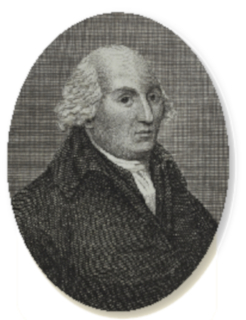
Jackson was born in Newtownards, County Down, in 1737. Much is unclear about his early life. He studies at Oxford and becomes an Anglicancurate. In the 1760s, he moves to London, where he preaches at the Tavistock Chapel and St. Mary-le-Strand. Although he gains some popularity as a preacher, he remains unbeneficed and eventually turns to journalism to support himself.
In 1766, Jackson becomes the editor of The Public Ledger. Under his editorship, the London paper becomes increasingly strident and oppositional in its politics. He is forced to flee to France in April 1777 to avoid a trial for libel that the popular actor and playwright Samuel Foote had initiated. He does not have to stay long in exile because Foote dies on October 21 of that same year.
After Foote’s death, Jackson returns to England. He resumes his political activities by publishing The Constitutions of the Several Independent States of America in 1783, with a dedication to the opposition leader, William Bentinck, 4th Duke of Portland. But the following year, he is secretly hired by the Prime Minister, William Pitt the Younger, to support the government in The Morning Post. Publishing anonymously, he attacks his former allies with his usual vehemence until he is discovered and is soundly damned for his apostasy and finds himself generally excluded from English politics.
Jackson’s next appearance in the public results in yet another scandal. In 1787 he joins forces with “Gentleman” John Palmer. Their goal is to build a new theatre in London. Jackson and Palmer persuade investors to sink more than eighteen thousand pounds into the construction of the Royalty Theatre. However, while there is no law against building a theatre in London, there is a law against operating one without the Lord Chamberlain‘s authorisation. Jackson and Palmer have no such authorisation so the theatre is shut down after just one night. The duped investors initiated legal action. Jackson again flees to France, where he arrives on the eve of revolution.
During his stay in Paris, Jackson is swept up in the revolutionary fervour and becomes involved with the radical British expatriate set there. Swept up in the general arrest of British subjects in 1793, he is released from prison on the strength of his radical commitments. Upon his release, he becomes inspector of horses for Meaux and later in 1793 is commissioned as a spy for the French. Nicholas Madgett, an Irishman who works in the Marine Ministry, recruits Jackson to go to England and Ireland to assess the public’s inclination towards armed revolution.
Jackson arrives in London in early 1794 and becomes reacquainted with John Cockayne, a lawyer he had met two decades earlier. He reveals his mission to Cockayne, who promptly reveals it to the Prime Minister out of fear of being tried for treason himself. When Jackson leaves London for Dublin, he is accompanied by Cockayne. In Ireland they meet with several radical leaders of the Society of United Irishmen, including Theobald Wolfe Tone, James Reynolds and Archibald Hamilton Rowan. Hamilton Rowan, in particular, is tempted by Jackson’s talk of French assistance, and persuades Tone to write up a report for the French, indicating Irish willingness to rise up. Jackson makes the fatal mistake of placing Tone’s report and other letters in the public mail, where they are seized by the authorities. This seizure leads to Jackson’s arrest on April 28, 1794.
Jackson remains in prison for a year before his trial takes place. The delays are at his request, allowing him time to assemble a defence and procure witnesses. During his imprisonment, he writes his last work, Observations in Answer to Mr. Paine’s Age of Reason (1795). His trial takes place in Dublin on April 23, 1795, and he is found guilty. One week later, on the morning of his sentencing hearing Jackson steps into the dock looking terribly ill. As his lawyers make drawn out speeches, hoping to avoid judgment on the technicality of an improperly filed indictment, Jackson’s condition steadily worsens. The judges order that a chair be provided for him and ask that a doctor attend him. He then collapses and dies. An autopsy finds that Jackson had ingested a large quantity of a “metallic poison.” This is likely administered by his second wife, but the inquest pointedly refuses to assign blame.
The effect of Jackson’s suicide is that he had not actually been pronounced guilty of treason by the court, and so his family can inherit his goods and a pension.
The British become aware of Conyngham’s plans and manage to maneuver him out of his ship with the help of the Dutch. After the loss of his ship, he heads back to France, hoping to connect with an ally to the United States. It is there he meets Benjamin Franklin, who helps him in his adventures many times in the future. They form a lasting relationship, and Conyngham eventually awards Franklin the nickname “the Philosopher” for his intellectual fortitude and resourcefulness. Franklin is entrusted with several commissions of the Continental Navy, and on March 1, 1777, Conyngham is appointed Captain of the luggerSurprise.
Conyngham scores a first victory that would warm the heart of any Irishmen, capturing the British merchant shipPrince of Orange on May 3, 1777. Later that year he is commissioned a captain in the Continental Navy and given command of the USS Revenge. He begins a series of highly successful raids into British waters from the port of Dunkirk, thus earning his sobriquet “The Dunkirk Pirate.”
In 1778 Conyngham sets sail for the West Indies and terrorizes British vessels there before finally returning to Philadelphia on February 21, 1779. He and his men had claimed 60 prize vessels in just 18 months. When he sets sail again his luck runs out and his ship is captured by the British vessel HMS Galatea on April 27, 1779. Conyngham was taken to prison in England and treated harshly by his British captors.
After two failed escape attempts, Conyngham tunnels his way out of Mill Prison in Plymouth and manages to make his way to the continent. He joins John Paul Jones on a cruise on the Alliance before returning to the United States. He is captured by the British again in March 1780 and spends another year in Mill Prison.
After the war Conyngham fails in his efforts to continue his naval career or to gain recognition from the United States Congress for his service during the war. He had lost the commission papers given to him by colonial representatives in Paris in 1777. It is said that he assists in the defense of Philadelphia against his old British foes during the War of 1812.
Gustavus Conyngham dies in Philadelphia seven years later on November 27, 1819. Nearly a century later, John Sanford Barnes, a retired navy captain and naval historian, acquires a cache of autographs and documents from a sale by Charavay of Paris. In the collection is Conyngham’s commission from Benjamin Franklin. Barnes publishes his discovery in September 1902, proving that the “Dunkirk Pirate” had never been a pirate at all, but one of the first heroes of the United States Navy.
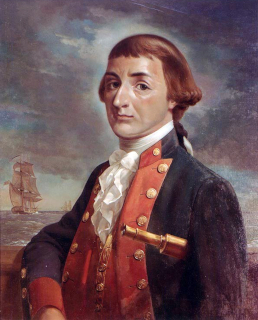
(Pictured: Captain Gustavus Conyngham, Continental Navy. Painting by V. Zveg, 1976, based on a miniature by Louis Marie Sicardi. Courtesy of the U.S. Navy Art Collection, Washington, D.C. U.S. Naval Historical Center Photograph.)




 seamus dubhghaill