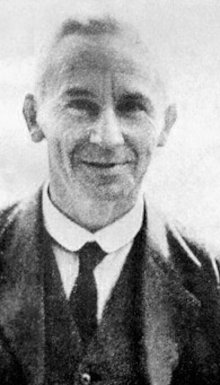
Donnelly is the son of Timothy Donnelly, a master plumber, and Mary Brennan. He is the sixth of eight surviving children. The 1911 Census lists him living with his family at 34 Wexford Street. Apprenticed as a plumber, he becomes involved in the Irish Volunteers. During the Easter Rising of 1916 he is the commander of C Company of Éamon de Valera‘s command in Boland’s Mill.
Donnelly is Vice-Commandant of the 3rd Battalion of the Dublin Brigade of the IRA during the Irish War of Independence. On February 10, 1921, he is arrested. Four days later he escapes from Kilmainham Gaol along with Ernie O’Malley and Frank Teeling. Returning to his command in the IRA, he is appointed chief of the Irish Republican Police (IRP) in mid-1921 as part of an attempt to enforce law and order in those areas of the country where the Royal Irish Constabulary (RIC) have been forced out.
Donnelly founds the National Association of the Old IRA in an attempt to mend some of the rifts in the Republican Movement. He is a member of the provisional National Executive of the Republican Prisoners’ Release Association.
On March 2, 1940, Donnelly is one of the founders of Córas na Poblachta and serves as its president. He becomes a founding member of Clann na Poblachta in 1946.
As one of the most senior surviving veterans of the Easter Rising, Donnelly plays a prominent role in the 50th anniversary commemorations in 1966. He dies in Dublin on December 7 of that year.
Whelan is the sixth of thirteen children born to farmer John Whelan and Bridget Price. He attends national school at Beleek and Clifden, before leaving school at the age of 15 to work on his father’s farm. He moves to Dublin at the age of 18, where he finds work as a railway man, and joins the Irish Volunteers as a member of ‘A’ Company, 3rd Battalion, Dublin Brigade. He lives at Barrow Street, Ringsend, Dublin, and works at a train depot.
Whelan is arrested on November 23, 1920, and, on February 1, 1921, is charged with the shooting death of Captain G.T. Baggallay, an army prosecutor who had been a member of courts that sentenced Volunteers to death under the Restoration of Order in Ireland Act on Bloody Sunday (1920).
Whelan is defended at his court-martial by Michael Noyk, through whom he protests his innocence of the charges. As in the case of Patrick Moran, there is eyewitness evidence that Whelan had been at Mass at the time the shooting had taken place.
The prosecution casts doubt on the reliability of the eyewitnesses, arguing that as Catholics they are not neutral. The defence complains that it is unfair to suggest the witnesses “were prepared to come up and perjure themselves on behalf of the prisoner” because “they belonged to a certain class and might hold certain political opinions.”
The military court does, however, trust the evidence of an army officer who lives in the same house as Baggallay and who has identified Whelan as the man covering him with a revolver during the raid. There is also testimony by a soldier who had passed by the house when he heard shots fired. This witness says he saw Whelan outside, attempting to start his motorcycle. Whelan is found guilty of murder and sentenced to death.
In Mountjoy Prison, Whelan is imprisoned with the writer and activist Ernie O’Malley, who describes him as “… smooth-faced, quiet and brown eyed with wavy hair; he smiled quietly and steadily. His voice was soft and when he laughed with the others one knew that the fibre was not as hard and that there was a shade of wistfulness about him.”
Whelan is quoted just before being hanged, “Give the boys my love. Tell them to follow on and never surrender. Tell them I am proud to die for Ireland.”
Whelan is hanged at 6:00 a.m. along with Patrick Moran, the first of six men to be executed in pairs that day. A crowd estimated at 40,000 gathers outside the prison to pray as the executions take place. His mother, Bridget, sees him before his execution and waits outside with the praying crowd holding candles. She tells a reporter that she had left her son “so happy and cheerful you would almost imagine he was going to see a football match.” He is 22 years old at the time of his death.
Following the Two for One policy that decrees the assassination of two members of the Royal Irish Constabulary (RIC) in retaliation for every executed Irish Volunteer, the Irish Republican Army (IRA) in Whelan’s native Clifden ambushes and fatally shoots RIC Constables Charles Reynolds and Thomas Sweeney at Eddie King’s Corner on March 16, 1921. In response to the RIC’s request for assistance over the wireless, a trainload of Black and Tans arrive in Clifden from Galway in the early hours of Saint Patrick’s Day, March 17, 1921, and proceed to “burn, plunder and murder.” During what is now called “The Burning of Clifden,” the Black and Tans kill one local civilian (John McDonnell), seriously injure another, burn down fourteen houses, and damaged several others.
Whelan is one of a group of men hanged in Mountjoy Prison in the period 1920-1921 who are commonly referred to as the Forgotten Ten. In 2001, he and the other nine, including Kevin Barry, are exhumed from their graves in Mountjoy Prison and given a full state funeral. He is now buried in Glasnevin Cemetery, Dublin. An annual commemoration is still held in Clifden in his honor.
(Pictured: Patrick Moran (left) and Thomas Whelan (right) before their executions, Mountjoy Prison, Dublin, March 14, 1921, courtesy of Kilmainham Gaol Museum.)
In September 1919, the Commander-in-Chief, Ireland, Sir Frederick Shaw, suggests that the police force in Ireland be expanded via the recruitment of a special force of volunteer British ex-servicemen. During a Cabinet meeting on May 11, 1920, the Secretary of State for War, Winston Churchill, suggests the formation of a “Special Emergency Gendarmerie, which would become a branch of the Royal Irish Constabulary.” Churchill’s proposal is referred to a committee chaired by General Sir Nevil Macready, Commander-in-Chief of the British forces in Ireland. Macready’s committee rejects Churchill’s proposal, but it is revived two months later, in July, by the Police Adviser to the Dublin Castle administration in Ireland, Major-General Henry Hugh Tudor. In a memo dated July 6, 1920, Tudor justifies the scheme on the grounds that it will take too long to reinforce the Royal Irish Constabulary (RIC) with ordinary recruits. Tudor’s new “Auxiliary Force” is to be strictly temporary with its members enlisting for a year. Their pay is to be £7 per week (twice what a constable is paid), plus a sergeant’s allowances, and are to be known as “Temporary Cadets.” At that time, one of high unemployment, a London advertisement for ex-officers to manage coffee stalls at two pounds ten shillings a week receives five thousand applicants.
The Auxiliary Division is recruited in Great Britain from among ex-officers who had served in World War I, especially those who had served in the British Army (including the Royal Flying Corps). Most recruits are from Britain, although some are from Ireland, and others come from other parts of the British Empire. Many have been highly decorated in the war and three, James Leach, James Johnson, and George Onions, have been awarded the Victoria Cross (VC). Enlisted men who had been commissioned as officers during the war often find it difficult to adjust to their loss of status and pay in civilian life, and some historians have concluded that the Auxiliary Division recruited large numbers of these “temporary gentlemen.”
Piaras Béaslaí, a former senior member of the Irish Republican Army (IRA) who supports the Anglo-Irish Treaty, while paying tribute to the bravery of the Auxiliaries, notes that the force is not composed exclusively of ex-officers but contains “criminal elements,” some of whom robbed people on the streets of Dublin and in their homes.
Recruiting began in July 1920, and by November 1921, the division is 1,900 strong. The Auxiliaries are nominally part of the RIC, but actually operate more or less independently in rural areas. Divided into companies, each about one hundred strong, heavily armed and highly mobile, they operate in ten counties, mostly in the south and west, where IRA activity is greatest. They wear either RIC uniforms or their old army uniforms with appropriate police badges, along with distinctive tam o’ shanter caps. They are commanded by Brigadier-General Frank Percy Crozier.
The elite ex-officer division proves to be much more effective than the Black and Tans especially in the key area of gathering intelligence. Auxiliary companies are intended as mobile striking and raiding forces, and they score some notable successes against the IRA. On November 20, the night before Bloody Sunday, they capture Dick McKee and Peadar Clancy, the commandant and vice-commandant of the IRA’s Dublin Brigade, and murder them in Dublin Castle. That same night, they catch Liam Pilkington, commandant of the Sligo IRA, in a separate raid. A month later, in December, they catch Ernie O’Malley completely by surprise in County Kilkenny. He is reading in his room when a Temporary Cadet opens the door and walks in. “He was as unexpected as death,” says O’Malley. In his memoirs, the commandant of the Clare IRA, Michael Brennan, describes how the Auxiliaries nearly capture him three nights in a row.
IRA commanders become concerned about the morale of their units as to many Volunteers the Auxiliaries seem to be “super fighters and all but invincible.” Those victories which are won over the Auxiliaries are among the most celebrated in the Irish War of Independence. On November 28, 1920, for example, a platoon of Auxiliaries is ambushed and wiped out in the Kilmichael Ambush by Tom Barry and the 3rd Cork Brigade. A little more than two months later, on February 2, 1921, another platoon of Auxiliaries is ambushed by Seán Mac Eoin and the North Longford Flying Column in the Clonfin Ambush. On March 19, 1921, the 3rd Cork Brigade of the IRA defeats a large-scale attempt by the British Army and Auxiliary Division to encircle and trap them at Crossbarry. On April 15, 1921, Captain Roy Mackinnon, commanding officer of H Company of the Auxiliary Division, is assassinated by the Kerry IRA.
Successes require reliable intelligence and raids often bring no result — or sometimes worse. In one case, they arrest a Castle official, Law Adviser W. E. Wylie, by mistake. In another, more notorious case, on April 19, 1921, they raid the Shannon Hotel in Castleconnell, County Limerick, on a tip that there are suspicious characters drinking therein. The “suspicious characters” turn out to be three off-duty members of the RIC. Both sides mistake the other for insurgents and open fire. Three people, an RIC man, an Auxiliary Cadet and a civilian, are killed in the shootout that follows.
The Auxiliary Division is disbanded along with the RIC in 1922. Although the 1921 Anglo-Irish Treaty requires the Irish Free State to assume responsibility for the pensions of RIC members, the Auxiliaries are explicitly excluded from this provision. Following their disbandment, many of its former personnel join the Palestine Police Force in the British-controlled territory.
The anti-insurgency activities of the Auxiliaries Division have become interchangeable with those conducted by the Black and Tans, leading to many atrocities committed by them being attributed to the Black and Tans. Nevertheless, both British units remain equally reviled in Ireland.
Ernest Bernard (Ernie) O’Malley, Irish republican revolutionary and writer, is born on May 26, 1897, in Ellison Street, Castlebar, County Mayo, the second child among nine sons and two daughters of Luke Malley, solicitor’s clerk, of County Mayo, and Marion Malley (née Kearney) of County Roscommon. Christened Ernest Bernard Malley, his adoption of variations on this name reflects his enthusiasm for a distinctively Irish identity – an enthusiasm that lay at the heart of his republican career and outlook.
In 1906, O’Malley’s family moves to Dublin, where he attends the Christian Brothers‘ School, North Richmond Street. In 1915, he begins to study medicine at University College Dublin (UCD). Having initially intended to follow his older brother into the British Army, he rather joins the Irish Volunteers in the wake of the 1916 Easter Rising, as a member of F Company, 1st Battalion, Dublin Brigade. He becomes a leading figure in the Irish Republican Army (IRA) during the Irish War of Independence which the Easter Rising helps to occasion. In 1918, having twice failed his second-year university examination, he leaves home to commit himself to the republican cause. He is initially a Volunteer organiser with the rank of second lieutenant, under the instruction of Richard Mulcahy, operating in Counties Tyrone, Offaly, Roscommon, and Donegal. His work in 1918 involves the reorganisation, or new establishment, of Volunteer groups in the localities.
In August 1918, O’Malley is sent to London by Michael Collins to buy arms. During 1919 he works as an IRA staff captain attached to General Headquarters (GHQ) in Dublin, and also trains and organises Volunteers in Counties Clare, Tipperary, and Dublin. He has a notable military record with the IRA during the Irish War of Independence and is a leading figure in attacks on Hollyford barracks in County Tipperary (May 1920), Drangan barracks in County Kilkenny (June 1920), and Rearcross barracks in County Tipperary (July 1920). His IRA days thus involve him with comrades such as Dan Breen, Séumas Robinson, and Seán Treacy. In December 1920, he is captured in County Kilkenny by Crown forces. He escapes from Dublin’s Kilmainham Gaol in February 1921, to take command of the IRA’s 2nd Southern Division, holding the rank of commandant-general.
O’Malley’s republican commitment has political roots in his conviction that Ireland should properly be fully independent of Britain, and that violence is a necessary means to achieve this end. But the causes underlying his revolutionism are layered. Family expectations of respectable, professional employment combined with a religious background and an enthusiasm for soldiering provide some of the foundations for his IRA career. As an IRA officer he enjoys professional, military expression for a visceral CatholicIrish nationalism. He also finds excitement, liberation from the frequent dullness of his life at home, defiant rebellion against his non-republican parents, an alternative to his stalled undergraduate career, and, in political and cultural Irish separatism, a decisive resolution of the profound tension between his anglocentrism and his anglophobia.
O’Malley rejects the 1921 Anglo–Irish Treaty as an unacceptable compromise. He spends the 1921 truce period training IRA officers in his divisional area, in preparation for a possible renewal of fighting. He is, in the event, to be a leading anti-treatyite in the 1922–23 Irish Civil War. In the Four Courts in 1922, at the start of the latter conflict, he is captured on the republicans’ capitulation on June 30 but then manages to escape from captivity. Subsequently he is appointed assistant Chief of Staff of the anti-Treaty IRA and also becomes part of a five-man anti-Treaty army council, along with Liam Lynch, Liam Deasy, Frank Aiken and Thomas Derrig.
O’Malley is dramatically captured and badly wounded by Free State forces in Dublin in November 1922. Imprisoned until July 1924, he is during the period of his incarceration elected as a TD for Dublin North in the 1923 Irish general election and is also a forty-one-day participant in the republican hunger strike later that year. Following release from prison, he returns home to live with his parents in Dublin. He decides not to focus his post-revolutionary energy on a political career. During 1926–28 and 1935–37 he unsuccessfully tries to complete his medical degree at UCD, but increasingly his post-1924 efforts are directed toward life as a Bohemian traveler and writer. He spends much of 1924–26 on a recuperative journey through France, Spain, and Italy; and 1928–35 traveling widely in North America. During 1929–32 he spends time in New Mexico and Mexico City. In Taos, New Mexico, he mixes with, and is influenced by, writers and artists as he works on what are to become classic autobiographies of the Irish revolution: On Another Man’s Wound (1936) and The Singing Flame (1978).
O’Malley meets Helen Hooker, daughter of Elon and Blanche Hooker, in Connecticut in 1933. They marry in London in 1935, each rejecting something of their prior lives in the process: he, his Irish republicanism, through marriage to somebody entirely unconnected with that world; she, her wealthy and respectable upbringing, through liaison with a Catholic, Irish, unemployed, bohemian ex-revolutionary. They settle first in Dublin then, from 1938 onward, primarily in County Mayo. Burrishoole Lodge, near Newport, is his main base until 1954, when he moves to Dublin. Three children are born to the O’Malleys: Cahal (1936), Etáin (1940), and Cormac (1942). Sharing enthusiasm for the arts, he and Helen enjoy several years of intimacy. However, by the mid-1940s their relationship has frayed. In 1950, Helen kidnaps (the word is used by both parents and by all three children) the couple’s elder two children and takes them to the United States. From there she divorces O’Malley in 1952. Cormac remains with his father.
O’Malley’s post-American years are devoted to a number of projects. He writes extensively, including work for The Bell and Horizon. He is involved with the film director John Ford in the making of his Irish films, including The Quiet Man (1952). He gives radio broadcasts on Mexican painting for BBC Third Programme (1947), and on his IRA adventures for Radio Éireann (1953). In the latter year he suffers a heart attack, and his remaining years are scarred by ill health. He dies of heart failure on March 25, 1957, in Howth, County Dublin, at the house of his sister Kathleen. Two days later he is given a state funeral with full military honours. He is buried in the Malley family plot in Glasnevin Cemetery, Dublin.
O’Malley exemplifies some important themes in modern Irish political and intellectual history. His powerful memoirs form part of a tradition of writing absorbedly about Ireland, while under idiosyncratic emigrant influences which lend the writing much of its distinctiveness. His aggressive republicanism exemplifies a persistent but ultimately unrealisable tradition of uncompromising IRA politics. His unflinching single-mindedness is the condition for much courageous and striking activity, but also lay behind his infliction and his suffering of much pain. Literary, intellectual, and defiantly dissident, he is the classic bohemian revolutionary. His historical significance lies in his having been both a leading Irish revolutionary and the author of compelling autobiographical accounts of those years. His memoirs are distinguished from their rivals on the shelf by subtlety, self-consciousness, and literary ambition. In particular, his preparedness to identify motives for Irish revolutionary action, beyond the terms of ostensible republican purpose, renders his writing of great value to historians. Similarly, the large body of archival material left in his name (especially, perhaps, the papers held in UCD archives, and those in the private possession of his children) leaves scholars in his debt. The most striking and evocative visual images of O’Malley are, arguably, the set of photographic portraits taken in 1929 by Edward Weston and held at the University of Arizona‘s Center for Creative Photography (CCP). These capture with precision his reflective concentration, his piercing earnestness, and his troubled intensity.
(From: “O’Malley, Ernest Bernard (‘Ernie’)” by Richard English, Dictionary of Irish Biography, http://www.dib.ie, October 2009 | Pictured: Photograph of Ernie O’Malley taken by Helen Hooker, New York City, 1934)
O’Hegarty comes from a family with strong nationalist roots. His parents are John, a plasterer and stucco worker, and Katherine (née Hallahan) Hegarty. His elder brother is Patrick Sarsfield O’Hegarty, the writer. His parents’ families emigrated to the United States after the Great Famine, and his parents married in Boston. His father is a member of the Irish Republican Brotherhood (IRB). In 1888, his father dies of tuberculosis at the age of 42, and his mother has to work to support the family.
O’Hegarty is educated at the Christian BrothersNorth Monastery school in Cork. By 1902, he has left school to work as a sorter in the local post office, rising to post office clerk. He is a supporter of the Gaelic revival, Irish traditional music, and Gaelic games. A committed sportsman, in his twenties he is captain of the Post Office HQ’s hurling team. He follows his brother Patrick into Conradh na Gaeilge and eventually the Irish Volunteers and the Irish Republican Brotherhood. He is a member of the Celtic Literary Society by 1905 and founds the Growney branch of Conradh na Gaeilge in 1907. A puritanical character by nature, he is a non-smoker and never drinks.
O’Hegarty is a founder of the local branch of the Irish Volunteers in Cork in December 1913. In June of the following year, he is appointed to the Cork section of the Volunteer Executive, and then to the Military Council. In October, the Dublin government discovers his illegal activities, and he is dismissed. Excluded from Cork under the Defence of the Realm Act (DORA) regulations, he moves to Ballingeary, where he works as a labourer. From there he moves to Enniscorthy, County Wexford, where he lives with Larry de Lacy. On February 24, 1915, he is arrested and tried under the Defence of the Realm Act for putting up seditious posters. But for this and a second charge of “possession of explosives” he is discharged. The explosives belonged to de Lacy.
The Volunteers appoint O’Hegarty as Commandant of Ballingeary and Bandon. During the Easter Rising, he is stationed in Ballingeary when visited by Michael McCarthy of Dunmanway to propose an attack on a Royal Irish Constabulary (RIC) post at Macroom. But their strength is fatally weakened and, having no reserves, they call off the attempt. In 1917, he becomes Vice-commandant of No.1 Cork Brigade. He works as a storekeeper at the workhouse but is intimidating, and clashes with the Poor Law Guardians.
During the Irish War of Independence, O’Hegarty is one of the most active in County Cork. Like others, he is exasperated with Tomás Mac Curtain’s inactivity and refusal to be more bellicose. One such is battalion commander Richard Langford, who joins with O’Hegarty’s unit to make an unauthorized raid on the RIC post at Macroom. Langford is court-martialed, but O’Hegarty continues to rise in the ranks. When a RIC Inspector is murdered, Mac Curtain condemns the shootings and calls for their end. On March 19, 1920, Mac Curtain is shot and killed in his home in Cork. The coroner blames the British establishment in Dublin, but the police never make any attempt to investigate the killings. Shortly after these events General Hugh Tudor begins the policy of official reprisals.
In January 1920, an inquiry is held into corruption alleged against “Hegarty’s Mob” or “Hegarty’s Crowd” running Cork City. O’Hegarty blames the former mayors for the charges of incompetence but remains on good terms with them.
In a raid on Cork City Hall on August 12, 1920, the British manage to net all the top brass of the IRA in Cork. In an incredible failure of intelligence, they do not identify the leadership as their prisoners. They are all released, including Liam Lynch, and O’Hegarty. Only Terence MacSwiney, the new Lord Mayor of Cork, is kept in custody and sent to England.
On February 25, 1921, the Coolavokig ambush is carried out by the 1st Cork Brigade under O’Hegarty at Ballyvourney village, on the road between Macroom and Ballyvourney. The IRA suffers no casualties; however, the number of British casualties has been disputed to this day.
The brigade commanders in the southern division retain a residual lingering resentment of Dublin GHQ’s lack of leadership and supplies. Seán Moylan, commandant of No. 2 Cork Brigade, thinks good communications with No.1 Brigade are to be vital, but little of this is seen via the organizer, Ernie O’Malley, at GHQ. At a meeting set up for April 26, 1921, when the manual of Infantry Training 1914 is produced, the document raises great anger. The meeting ends in uproar when O’Hegarty, who is “a master of invective, tore the communication and its authors to ribbons.”
O’Malley and Liam Lynch, the general, meet with O’Hegarty in the mountains of West Cork, near a deserted farmhouse, just off the main road. In the retreat that follows, the Irish take heavy casualties and leave their wounded to the good care of the British. These are the “Round-ups” in which the Irish sleep outside in order to avoid being at home when the Army calls. They are told by the Brigade to learn the national anthem of England to avoid arrest.
In East Cork brigade, O’Hegarty uncovers a spy ring. He is ruthless in the treatment of Georgina Lindsay and her chauffeur, who give away information to the Catholic clergy, but is remarkably lenient on brigade traitors within. He is allegedly not too bothered about evidence but is reminded that all executions of a traitor have to be approved by Dublin first.
O’Hegarty becomes more and more aggressive toward the establishment, using tough language to impose his will over the area. He attempts to force the civilian Teachtai Dála (TDs) for Cork to stand down, to give way to military candidates, telling the Dáil in December 1921, that any TD voting for the treaty will be guilty of treason. But Éamon de Valera is decided and overrules any interference with the Civil Government. Like the commanders, de Valera rejects the treaty but has already been defeated in the Dáil on a vote by W. T. Cosgrave‘s majority.
On February 1, 1922, O’Hegarty marries Maghdalen Ni Laoghaire, a prominent member of Cumann na mBan.
O’Hegarty is on the IRA’s Executive Council, but when there is a meeting on April 9, 1922, it is proposed that the Army should oppose the elections by force. As a result, Florence O’Donoghue and Tom Hales join him in resigning. In May, he and Dan Breen enter into negotiations with Free Stater Richard Mulcahy. A statement is published in the press asking for unity and acceptance of the Treaty. During this time, the republicans become very demoralized and ill-disciplined, but they have to gain strength before announcing independence from Dublin. The debate amongst the anti-Treaty IRA command is increasingly rancorous.
The bitter divisions split the anti-treatyites into two camps. Two motions are debated at the Army Convention on June 18, 1922. At first, the motion to oppose the treaty by force is passed. These men include Tom Barry, Liam Mellows, and Rory O’Connor, who are all in favour of continuing the fight until the British are driven out of Ireland altogether. However, one brigade’s votes have to be recounted, and then the motion is narrowly defeated. Joe McKelvey is appointed the new chief of staff, but the IRA is in chaos. While he strongly opposes the Anglo-Irish Treaty, O’Hegarty takes a neutral role in the Irish Civil War and tries to avert hostilities breaking out into full-scale civil war. He emerges as a leader of the “Neutral IRA” with O’Donoghue. This is a “loose” confederation of 20,000 men who have taken part in the pre-truce wars but have remained neutral during the Civil War from January 1923. Over 150 persons attend its convention in Dublin on February 4, 1923. By April 1923, O’Malley is imprisoned in Mountjoy Prison. In a letter to Seamus O’Donovan on April 7, he blames Hegarty for all this compromise and “peace talk.”
It has been alleged by the author Gerard Murphy that O’Hegarty had a role in the assassination of the Commander-in-Chief, Michael Collins, in August 1922, along with Florrie O’Donoghue and Joe O’Connor. It is alleged that as members of the 1st Southern Division Cork, they are actually feigning claims of neutrality but remain part of the IRB in order to set up talks towards peace and the cessation of hostilities at the start of the Irish Civil War.
Although probably an atheist during the Irish War of Independence, O’Hegarty returns to the Catholic church later in life. On forming the Neutral Group of the IRA in December 1922, he tries to unify differences in the volunteers between Republicans and the Free Staters. He communicates with the Papal Nuncio during the inter-war years in an attempt to have Bishop of CorkDaniel Cohalan‘s excommunication bill lifted. Instead, he turns to commemoration as a way to earn favour in Rome, with the dedication of a Catholic church at St. Finbarr’s Cemetery. After his wife’s passing, he becomes a close friend with Florence O’Donoghue until his own death.
Fuller is born on January 1, 1900, in Kilflynn, County Kerry. He is the son of Daniel Fuller and Ellie Quinlan. His family is from Fahavane, in the parish of Kilflynn.
Fuller serves in the Kilflynn Irish Republican Army (IRA) flying column during the Irish War of Independence. He is First Lieutenant in the Kerry No.1 Brigade, 2nd Battalion. He opposes the Anglo-Irish Treaty and continues to fight with the anti-Treaty IRA during the Irish Civil War. Military records from the 1930s show, in his own hand, that he is in communication with Dublin regarding confirmation of membership in July 1922 and therefore eligible for war pensions. He becomes the most senior Kilflynn member upon the death of Captain George O’Shea.
In 1923, Fuller is captured by Free State troops and imprisoned in Ballymullen Barracks in Tralee by the Dublin Guard who had landed in County Kerry shortly before. On March 6, 1923, five Free State soldiers are blown up by a booby-trapped bomb at Baranarigh Wood, Knocknagoshel, north Kerry, including long-standing colleagues of Major General Paddy Daly, GOC Kerry Command. Prisoners receive beatings after the killings and Daly orders that republican prisoners be used to remove mines.
On March 7, nine prisoners from Ballymullen Barracks, six from the jail and three from the workhouse, are chosen with a broad geographical provenance and no well-known connections. They are taken lying down in a lorry to Ballyseedy Cross. There they are secured by the hands and legs and to each other in a circle around a land mine. Fuller is among them. His Kilflynn parish comrade Tim Tuomey is initially stopped from praying until all prisoners are tied up. As he and other prisoners then say their prayers and goodbyes, Fuller continues to watch the retreating Dublin Guard soldiers, an act which he later says saved him. The mine is detonated, and he lands in a ditch, suffering burns and scars. He crosses the River Lee and hides in Ballyseedy woods. He is missed amongst the carnage as disabled survivors are bombed and shot dead with automatic fire. Most collected body parts are distributed between nine coffins that had been prepared. The explosions and gunfire are witnessed by Rita O’Donnell who lives nearby and who sees human remains spread about the next day. Similar reprisal killings by the Dublin Guard follow soon after Ballyseedy.
Fuller crawls away to the friendly home of the Currans nearby. They take him to the home of Charlie Daly the following day. His injuries are treated by a local doctor, Edmond Shanahan, who finds him in a dugout. He moves often in the coming months, including to the Burke and Boyle families, and stays in a dugout that had been prepared at the Herlihys for seven months.
A cover-up begins almost immediately. Paddy Daly’s communication to Dublin about returning the bodies to relatives differs significantly from Cumann na mBan statements, which Daly complains about as simple propaganda, and later that of Bill Bailey, a local who had joined the Dublin Guard, who tells Ernie O’Malley that the bodies were handed over in condemned coffins as a band played jolly music. Fuller is named amongst the dead in newspaper reports before it is realised that he had escaped. Daly then sends a communication to GHQ that Fuller is reported as having become “insane.” The Dublin Guard scours the countryside for Fuller. The official investigation into the killings is presided over by Daly himself, with Major General Eamon Price of GHQ and Colonel J. McGuinness of Kerry Command. It blames Irregulars for planting the explosives and exonerates the Irish Army soldiers, and this is read out in the Dáil by the Minister for Defence, Richard Mulcahy.
Contrary statements to the Irish Army’s submissions are effectively ignored. Lieutenant Niall Harrington of the Dublin Guard, describes the evidence to the court and the findings as “totally untrue,” explaining that the actions were devised and executed by officers of the Dublin Guard. He contacts Kevin O’Higgins, Minister for Justice and Vice-President, a family friend, to deplore the findings. O’Higgins speaks to Richard Mulcahy, who does nothing. In a separate incident, Free State Lieutenant W.McCarthy, who had been in charge of about twenty prisoners, says that five of them had been removed in the night. They were reportedly shot in the legs then blown up by, in his words, “…a Free State mine, laid by themselves.” He resigns in protest. A Garda Síochána report into the events is also dismissed and is not made public for over 80 years.
Fuller leaves the IRA after the Civil War and follows a career as a farmer in Kerry. He joins Fianna Fáil, the political party founded by Republican leader Éamon de Valera in 1926 after a split from Sinn Féin. He is elected to the 9th Dáil on his first attempt, representing Fianna Fáil at the 1937 Irish general election, as the last of three Fianna Fáil TDs to be elected to the four seat Kerry North constituency. He is re-elected to the 10th Dáil at the 1938 Irish general election, when Fianna Fáil again wins three out of four seats, but loses his seat at the 1943 Irish general election to the independent candidate Patrick Finucane. He returns to farming thereafter.
Fuller never once mentions the Ballyseedy incident from a political platform and states later that he bore no ill-will towards his captors or those who were involved in his attempted extrajudicial killing. He does not want the ill feeling passed on to the next generation. He speaks publicly about the events in 1980, a few years before his death, on Robert Kee‘s groundbreaking BBC series Ireland: A Television History.
Fuller dies in Edenburn Nursing Home, Tralee, on February 23, 1984. He is buried near the Republican plot in Kilflynn where colleagues O’Shea, Tuomey and Timothy ‘Aero’ Lyons are buried.
Fuller’s son Paudie establishes the Stephen Fuller Memorial Cup for dogs of all ages, contested annually on the family farm.
Fuller’s fame largely rests on one night at Ballyseedy. To trace him through the rural society from which he and his fellow Volunteers originated and in which his life was spent, however, gives a fuller understanding of the devastating effects of the conflicts of 1916–23 on a tightly knit rural and small-town society, dominated by extended families of farmers and their service-industry relatives, and of how that society remembered and forgot those traumas.
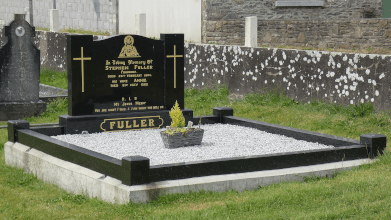
(Pictured: Stephen Fuller’s grave in Kilflynn, by St. Columba’s Heritage Centre)
McGarry is born at 17 Pembroke Cottages, Dundrum, Dublin, on August 2, 1886. An active member of the Irish Republican Brotherhood, he is a close friend of Bulmer Hobson and is frequently arrested or imprisoned by British authorities for his activities with the IRB during the early 1900s. He participates in the 1916 Easter Rising as an aide-de-camp to Tom Clarke and is sentenced to eight years penal servitude for his role in the failed rebellion.
McGarry is sent to Frongoch internment camp in Wales but is eventually released. He assists Michael Collins in his efforts to reorganise the Irish Republican Brotherhood and, at the Volunteer Executive Meeting held in late 1917, he is elected General Secretary of the Irish Volunteers.
On the night of May 17, 1918, McGarry is arrested, along with seventy-three other Irish nationalist leaders, and deported to England, where they are held in custody without charge. The day following their arrest, he and the others are charged with conspiring “to enter into, and have entered into, treasonable communication with the German enemy.” In his absence, Harry Boland is selected for the Supreme Council and becomes his successor as president of the IRB.
McGarry is only imprisoned a short time when he takes part in the famous escape from Lincoln Jail with Seán Milroy and Éamon de Valera on February 3, 1919. He and Milroy manage to smuggle out a postcard, a comical sketch of McGarry to his wife, allowing a copy of the key to their cell to be made. They are later assisted by Harry Boland and Michael Collins who await them outside the prison.
A month later, McGarry gives a dramatic speech at a Sinn Féin concert held at the Mansion House, Dublin, before going into hiding.
Throughout the Irish War of Independence, McGarry serves as a commander and is eventually elected to Second Dáil in the 1921 Irish elections as a Sinn Féin Teachta Dála (TD) representing Dublin Mid. He, like the majority of those in the Irish Republican Brotherhood, supports the Anglo-Irish Treaty and is involved in debates against de Valera during the controversy, most especially discussing the status of Sinn Féin as a political entity.
McGarry is re-elected as a Pro-Treaty Sinn Féin TD in the 1922 Irish general election, siding with the Free State government during the Irish Civil War. Liam Lynch and other members of the anti-Treaty Irish Republican Army plan the assassination of McGarry among other TDs supporting the Public Safety Bill. As one anti-Treaty volunteer tells Ernie O’Malley, “Seán McGarry was often drunk in Amiens Street and the boys wanted to shoot him and the Staters there, but I wouldn’t let them.”
On December 10, 1922, shortly before the first meeting of the Free State parliament, a fire is deliberately set by irregulars (anti-Treatyites) at McGarry’s family home. His seven-year-old son, Emmet, is badly burned and dies as a result. McGarry is one of four targeted by anti-Treatyites during the December Free State executions. De Valera publicly denounces the attack.
After retiring from politics, McGarry works for the Irish Hospitals Trust, writes articles for newspapers and journals, and engages in broadcasting. After residing from the mid-1920s at several addresses in Dún Laoghaire, from 1938 he lives at 25 Booterstown Avenue, Blackrock, Dublin. With his wife Tomasina he has two sons and one daughter. He dies suddenly on December 9, 1958, of a heart attack in his son’s home at 44 Richmond Avenue, Monkstown, County Dublin.
Lynch is born on November 9, 1893, in Barnagurraha, Anglesboro, County Limerick, the fifth child among six sons and a daughter of Jeremiah Lynch, farmer, and Mary Lynch (neé Kelly). The family is politically active. His father’s brother, John, had taken part in the Fenian Rising of 1867 and his mother had been joint secretary of the Ballylanders branch of the Ladies’ Land League.
Lynch attends Anglesboro national school (1898–1909). In 1910 he moves to Mitchelstown, County Cork, to take up a three-year apprenticeship in the hardware store of P. O’Neill on Baldwin Street. He remains there until the autumn of 1915. While in Mitchelstown he is a member of the Gaelic League and the Ancient Order of Hibernians. He also joins the Irish Volunteers. In 1914, when that organisation splits, he does not immediately join the militant rump. He then moves to Fermoy, County Cork, where he works in the store of Messrs J. Barry & Sons Ltd. His move coincides with a period of inactivity as neither Volunteer faction is very active nor is he known. Consequently, he does not take part in the 1916 Easter Rising, but it is a turning point for him. On May 2, 1916, he watches as the Kent family are led through Fermoy, having been captured by British soldiers. Richard Kent dies from a wound sustained that day and Thomas Kent is executed a week later. Lynch becomes a committed Volunteer at this point.
Once committed, Lynch’s enthusiasm and aptitude ensures that he quickly attains positions of responsibility. From early 1917 he is first lieutenant in the small Fermoy company. In September 1917, the Irish Volunteers in east Cork are reorganised. Nine local companies are formed into the Fermoy battalion, and he is elected adjutant. In April 1918, at the height of the conscription crisis, he briefly quits his job to concentrate on organising the Volunteers. In May he is lucky to escape arrest during the sweep that accompanies the “German plot.” When the immediate danger ends, he returns to Barry & Sons.
In January 1919, at the beginning of the Irish War of Independence, the Volunteer organisation in Cork undergoes a major restructuring. Three brigades are established, and Lynch becomes brigade commandant of Cork No. 2. In April he visits Irish Republican Army GHQ in Dublin to discuss plans and to seek arms. It is a frustrating experience as the GHQ has few guns and are cautious about action. Throughout the summer of 1919 he presses GHQ to authorise attacks on British targets as a method of acquiring arms and to prevent boredom and stagnation setting in among his men. Finally, GHQ sanctions attacks if the primary aim is the capture of arms. In response, on September 7, 1919, twenty-five men from the Fermoy company, led by Lynch, ambush fourteen British soldiers on their way to service in the Wesleyan church in Fermoy. Fifteen rifles are captured, one soldier killed, and three wounded. Lynch is shot in the shoulder, probably by one of his own men. As a result, he has to leave his job and hides out in Waterford for a time. A series of arrests follow, among those is Lynch’s close friend, Michael Fitzgerald, who dies on hunger strike in Cork County Gaol in 1920.
Lynch spends the early months of 1920 at GHQ in Dublin. During this time, he is offered the position of deputy chief of staff, but turns it down, preferring to return to Cork. Although not an articulate speaker, he impresses those he meets. His organisational talents, attention to detail, ability to inspire, and intolerance for those who waste meetings endlessly discussing side issues, are noted. He has a low tolerance for politicians and at all times considers the military wing of the movement to be of primary importance. He is engaged to Bridie Keyes, but marriage is postponed pending a final settlement of hostilities.
On June 26, 1920, Lynch, Seán Moylan, and two colleagues capture Major-GeneralCuthbert Lucas while he is fishing on the Munster Blackwater. He gives a false name when he is arrested on August 12, 1920, at City Hall, Cork, with Terence MacSwiney, Lord Mayor of Cork, and ten others. All but MacSwiney are released four days later. He then sets about organising a flying column within the brigade. Ernie O’Malley arrives from headquarters to train the men. This column achieves a major coup on September 28, 1920, when they briefly capture the British Army barracks at Mallow, leaving with a large booty of rifles, ammunition, and two machine guns. The British respond to this increase in activity and the war settles into a pattern of ambush and counter-ambush. The Mallow battalion suffers severe losses in February 1921 and Lynch himself narrowly escapes when four are killed during an encounter at Nadd in March 1921.
In early 1921 Lynch seeks to encourage greater cooperation between the various brigades in the south. Senior brigade officers meet on three occasions to discuss cooperation and a plan to import arms from Italy. The importation project fails, but the First Southern Division is formed on April 26, 1921, bringing eight brigades from Cork, Kerry, Waterford, and west Limerick together. He is elected divisional commandant, making him the most powerful officer outside GHQ. His influence is further increased by his appointment as Southern Divisional Centre and Supreme Council member of the clandestine Irish Republican Brotherhood (IRB) in March 1921.
Lynch is wary when the truce is called in July 1921. He works hard to maintain order in his division and to achieve a state of readiness in case the negotiations fail. For him the Anglo-Irish Treaty is a failure. When the Supreme Council of the IRB meets on December 10, 1921, he is the only voice against the agreement. He is among the officers who insist that an army convention should be called to discuss the treaty, effectively asserting that the army no longer accepts a position subordinate to the Dáil. The army, he believes, is the army of the Republic, and no civilian body can order it to abandon the Republic. The provisional government tries to ban this convention, but it goes ahead on March 26, 1922, and elects an army executive. Lynch is elected Chief of Staff. Between March and June, he works hard to prevent a civil war. He believes unity can be maintained, even under the Treaty, if a republican constitution can be enacted. He also cooperates with Michael Collins in promoting Irish Republican Army (IRA) activity in Ulster. In his adherence to the idea of a republic, the practicalities of politics have little impact on his consciousness, and he is dismissive of the popular support for the Treaty. He is horrified at the thought of civil war but fails to see that his position is leading almost inexorably in that direction. Distrusted as too moderate by Liam Mellows and Rory O’Connor, he is locked out of the Four Courts for a time.
When the Four Courts are attacked, Lynch immediately leaves his headquarters at the Clarence Hotel to travel south. He is briefly detained, before reaching Kingsbridge Station, and has a meeting with Eoin O’Duffy. He is disgusted when Free State figures later claim that he was released, having promised not to take arms against the government. The most plausible explanation of the incident appears to be that O’Duffy interpreted Lynch’s comments, merely indicating disappointment that a war had started, as constituting a statement of intent not to involve himself.
Lynch’s initial actions seem designed to avoid full-scale conflict. He does not order an attack on Dublin, nor does he attempt to seize Limerick. He chooses a containment strategy, seeking to hold a line from Limerick to Waterford for the republican forces. This fails, as the government sends troops in from the rear by sea. The republicans have no urban base when Lynch abandons Fermoy on August 11, 1922. He continues to meet individuals who seek a way to end the war, but intransigence has set in, and he insists that armed struggle will only end with a republic or absolute defeat. As early as August many republicans believe the war is lost and urge a reassessment of tactics, but Lynch rejects all such calls. Operating from secret headquarters in Santry, he orders the shooting of pro-Treaty politicians in retaliation for the execution of republican prisoners.
Under war conditions it is impossible for the army executive to meet regularly, and this leaves Lynch in almost complete control. As the pro-surrender lobby grows within the republican forces, he delays a meeting of the executive, claiming with some justification that it is too dangerous. He leaves Santry and attends a meeting of the Southern Division Council in the last days of February 1923. Sixteen of the eighteen officers there tell him that the military position is hopeless. This forces the calling of an executive meeting on March 6, 1923. No agreement is reached. He strongly favours fighting on, but a motion from Tom Barry, calling for an immediate end to hostilities, is barely rejected. Another meeting is arranged for April 10. On that morning a group, including Lynch and Frank Aiken, suddenly find themselves in danger of capture in a farmhouse on the slopes of the Knockmealdown Mountains in County Tipperary. They flee and are pursued. During the chase Lynch is shot in the abdomen. It seems clear that he is shot by the pursuing Free State soldiers, although Irish historian Meda Ryan has considered the theory that he may have been shot by one of his own in order to remove the major stumbling block to surrender. His colleagues are forced to abandon him, and he is captured. Initially the Free State troops believe they have caught Éamon de Valera. He is taken first to a public house in Newcastle, County Tipperary, and then to St. Joseph’s Hospital in Clonmel, but dies from his wound at 8:45 p.m. that evening. His last request is to be buried beside Michael Fitzgerald in Kilcrumper Cemetery, Fermoy, County Cork. On hearing of Lynch’s death, Ernie O’Malley writes, “You who were a living force are now a battle cry.” O’Malley is wrong, however, as the peace faction within republicanism is strengthened by his death and Aiken orders the suspension of activities on April 27.
In 1935, a massive memorial, consisting of a 60-foot-tall round tower, guarded by four bronze Irish Wolfhounds, is erected at Goatenbridge, County Tipperary, near the site of his capture. It is unveiled on April 7, 1935. Separate annual commemorations are held at Goatenbridge and Kilcrumper. Three biographies have been written and the Liam Lynch memorial pipe band is based in his native Anglesboro. The Lynch family possess a substantial collection of private correspondence.
James Stephens formally establishes the Irish Republican Brotherhood (IRB) in Peter Lanigan’s timber yard, Lombard Street, Dublin, on Saint Patrick’s Day, March 17, 1858. It is originally named the Irish Revolutionary Brotherhood, but soon comes to be known as the Irish Republican Brotherhood. At the same time, John O’Mahoney is founding the American branch of the revolutionary group. O’Mahoney gives the organization the better-known name Fenians, in honor of the Fianna, the soldiers led by Fionn mac Cumhaill, the heroic warrior of Irish legend.
The IRB is a small, secret, revolutionary body whose sole object is to “establish and maintain a free and independent Republican Government in Ireland.” Stephens is a Young Irelander and is a lieutenant to William Smith O’Brien at the Battle of Widow McCormack’s Cabbage Patch in Ballingary, County Tipperary, in August 1848. He is wounded three times and is smuggled onto a ship to England and then to France, where he spends the next eight years. Upon his return to Dublin in 1856, he determines to organise a revolutionary movement and that leads to the founding of the IRB.
The IRB becomes known as the Fenian movement in the 1850s and 1860s and is committed to the use of force to establish an independent Irish republic. After organising an abortive rising in March 1867, it suffers deep internal divisions over its leadership and strategy in both the United States and Ireland—whether it is best to strike at England, in Ireland or in Canada. The issue is resolved after a series of failed interventions in Canada in 1866, 1867 and 1871, and after bombings in England that do not lead Ireland closer to independence. The IRB is unable to exploit the weaknesses and divisions in the constitutional movement following Charles Stewart Parnell’s divorce scandal (1890–91).
The IRB is eventually rejuvenated in Ireland about 1907, led by Bulmer Hobson and Tom Clarke, thus preparing the way for all that follows.The governing body is the Supreme Council. Before 1916 this consists of eleven members, and after the 1917 reorganisation it contains fifteen members. When not in session, all powers of the Supreme Council, except for declaring war, devolve onto an executive of three: the president, secretary and treasurer.
The constitution provides for the establishment of a military council, subordinate to the Supreme Council. The seven signatories of the 1916 Proclamation of the Irish Republic constitute the entire military council at the time. The constitution is dedicated to the use of force against England at any favourable opportunity, but this is to be a democratic decision: “The IRB shall await the decision of the Irish Nation as expressed by a majority of the Irish people as to the fit hour of inaugurating a war against England and shall, pending such an emergency, lend its support to every movement calculated to advance the cause of Irish independence, consistent with the preservation of its own integrity,” a clause adopted in 1873 in response to the controversies arising from the 1867 Fenian Rising.
The IRB plans the 1916 Easter Rising but the Irish Volunteers and the Irish Citizen Army make it possible. The establishment of the Irish Volunteers gives the IRB the great opportunity to train and equip its members as a military body for the purpose of securing independence for Ireland by force of arms and securing the cooperation of all Irish military bodies in the accomplishment of its objectives. Numerically the IRB probably never exceeds 2,000 members, but they are all extremely loyal and well trained, and there is very tight security. The executions of 1916 just about wipe out the Supreme Council, and after the prisoners are released, the IRB has to reconstitute itself.
Following the Easter Rising some republicans—notably Éamon de Valera and Cathal Brugha—leave the organization, which they view as no longer necessary, since the Irish Volunteers now perform its function. The IRB, during the Irish War of Independence (1919-21), is under the control of Michael Collins, who is secretary, and subsequently president, of the Supreme Council. Volunteers such as Séumas Robinson say afterwards that the IRB by then is “moribund where not already dead,” but there is evidence that it is an important force during the war.
When the Anglo-Irish Treaty is signed on December 6, 1921, it is debated by the Supreme Council, which votes to accept it by eleven votes to four. Those on the Supreme Council who oppose the Treaty include former leader Harry Boland, Austin Stack and Liam Lynch. Anti-Treaty republicans like Ernie O’Malley, who fought during the Irish Civil War against the Treaty, sees the IRB as being used to undermine the Irish Republic. The IRB becomes quiescent during the Irish Civil War, which ends in May 1923, but it emerges again later that year as a faction within the National Army that supports Minister for Defence Richard Mulcahy against the “Old IRA,” which fought against the recruitment of ex-British Army personnel and the demobilization of old IRA men. This comes to a head with the Irish Army Mutiny of 1924, in the wake of which Mulcahy resigns and other IRB members of the army are dismissed by acting President of the Executive CouncilKevin O’Higgins. The IRB subsequently dissolves itself, although it is not known whether a formal decision is taken, or it simply ceases to function.
The Irish Citizen Army also becomes involved in the battle, supporting the anti-Treaty IRA in the O’Connell Street area. The fighting begins with an assault by Provisional Government forces on the Four Courts building and ends in a decisive victory for the Provisional Government.
On April 14, 1922, about 200 Anti-Treaty IRA militants, with Rory O’Connor as their spokesman, occupy the Four Courts in Dublin, resulting in a tense stand-off. They want to spark a new armed confrontation with the British, which they hope will bring down the Anglo-Irish Treaty, unite the two factions of the IRA against their former common enemy and restart the fight to create an all-Ireland Irish Republic. At the time the British Army still has thousands of soldiers concentrated in Dublin, awaiting evacuation.
Winston Churchill and the British cabinet have been applying pressure on the Provisional Government to dislodge the rebels in the Four Courts, as they consider their presence a violation of the Treaty. Such pressure falls heaviest on Michael Collins, President of the Provisional Government Cabinet and effective head of the regular National Army. Collins, a chief IRA strategist during the War of Independence from Britain, has resisted giving open battle to the anti-Treaty militants since they occupied Four Courts in April. His colleagues in the Provisional Government Cabinet, including Arthur Griffith, agree that Collins must mount decisive military action against them.
In June 1922 the Provisional Government engages in intense negotiations with the British Cabinet over a draft Constitution that seeks to avert the impending civil war. They particularly seek to remove the requirement of an oath to the British Crown by all members of the Dublin government, a key point of contention with anti-Treaty partisans. However, the conservative British Cabinet refuses to cooperate. The pro-treaty element of Sinn Féin wins the elections on June 16.
Following the assassination of Sir Henry Wilson in London on June 22, 1922, and the arrest by Four Courts troops of National Army Deputy Chief of Staff Gen. J. J. “Ginger” O’Connell, British pressure on the Provisional Government intensifies. The British now threaten to invade and re-occupy all of Ireland. On June 27 the Provisional Government Cabinet agrees on an ultimatum to the Four Courts garrison to evacuate or face immediate military action.
Churchill offers a loan of British artillery for use by the National Army, along with 200 shells from their store of 10,000 at Kilmainham, three miles away. It is possible that some British special troops are also covertly loaned. Two 18-pounder field guns are placed on Bridge Street and Winetavern Street, across the River Liffey from the Four Courts complex. After an ultimatum is delivered to the anti-Treaty garrison in the early hours of June 28, the National Army commences the bombardment of Four Courts.
No authoritative record exists regarding the order to commence bombardment. Historians tend to attribute the order to Collins, but some biographers dispute this. Anti-Treaty survivors allege that they are preparing for an 8:00 a.m. evacuation when the bombardment begins at 4:00 a.m.
Inside the building are 12 members of the Irish Republican Army Executive, including Chief of StaffJoe McKelvey, Director of Engineering Rory O’Connor, Quartermaster General Liam Mellows and Director of Operations Ernie O’Malley. The garrison consists of roughly 180 men drawn from the 1st and 2nd Battalions of the IRA’s 1st Dublin Brigade, commanded by Commandant Paddy O’Brien, armed for the most part only with small arms apart from one captured armoured car, which they name “The Mutineer.” The members of the IRA Army Executive are the political leaders of the garrison but serve as common soldiers under the command of O’Brien. The Anti-Treaty side fortifies the Four Courts to some extent, planting mines around the complex and barricading the doors and windows, but their leadership orders them not to fire first, in order to retain the moral high ground, and so the Free State troops are allowed to surround the Four Courts.
After the first day’s bombardment proves ineffective, the British give the Free State two more 18-pounder cannon and proffer 60-pounder howitzers along with an offer to bomb the Four Courts from the air. Collins turns down the latter two offers because of the risk of causing heavy civilian casualties. On June 29, Free State troops storm the eastern wing of the Four Courts, losing three killed and 14 wounded and taking 33 prisoners. The republicans’ armoured car is disabled and abandoned by its crew. Early the next day O’Brien is injured by shrapnel and O’Malley takes over military command in the Four Courts. By this time the shelling has caused the Four Courts to catch fire. In addition, orders arrive from Oscar Traynor, the anti-treaty IRA commander in Dublin, for the Four Courts garrison to surrender, as he cannot reach their position to help them. O’Malley rules this order invalid, as the Four Courts is a GHQ operation. However, in view of the rapidly deteriorating situation, at 3:30 p.m. on June 30, O’Malley surrenders the Four Courts to Brigadier GeneralPaddy Daly of the Free State’s Dublin Guard unit. Three of the republican garrison die in the siege.
Several hours before the surrender, the Public Record Office of Ireland (PRO) block located in the western block of the Four Courts, which is used as an ammunition store by the Four Courts garrison, is the centre of a huge explosion, destroying Irish state records going back to the Anglo-Norman conquest. Forty advancing Free State troops are badly injured. Assigning blame for the explosion remains controversial. It is alleged by the National Army Headquarters that the Anti-treaty forces deliberately booby-trapped the PRO to kill advancing Free State troops. Tim Healy, a government supporter, later claims that the explosion is the result of land mines laid before the surrender, which explode after the surrender. However, a study of the battle concludes that the explosion is caused by fires ignited by the shelling of the Four Courts, which eventually reach two truckloads of gelignite in the munitions factory. A towering mushroom cloud rises 200 feet over the Four Courts.
At this stage in the battle troops on each side still have a sense of kinship with the other, as most of them had fought together in the Irish Republican Army during the Irish War of Independence. By appealing to friends on the Free State side, several anti-Treaty leaders among the Four Courts garrison, notably Ernie O’Malley and Seán Lemass, escape from captivity to continue the fight.
Despite the Free State force’s success in taking the Four Courts, fighting continues in Dublin until July 5. On June 29 anti-Treaty IRA units from the Dublin Brigade led by Oscar Traynor have occupied O’Connell Street, part of Parnell Square, York Street and some of other locations to try to distract Free State attention from their attack on the Four Courts. Not all the IRA units in the capital are prepared to fight against the new Irish government, however, and their numbers are probably about 500 throughout the city. Their numbers are supplemented by about 150 Citizen Army men and women who bring with them arms and ammunition dumped since the insurrection of Easter 1916.
The republicans occupy the northeastern part of O’Connell Street, with their strong point at “the block,” a group of buildings that the Anti-Treatyites had connected by tunneling through the walls. They had also taken over the adjoining Gresham, Crown, Granville and Hammam hotels. Their only position on the western side of the street is in the YMCA building. Additionally, they have an outpost south of the River Liffey at the Swan Pub on Aungier Street. Oscar Traynor apparently hopes to receive reinforcements from the rest of the country, but only Anti-Treaty units in Belfast and Tipperary reply and both of them arrive too late to take part in the fighting.
The Provisional Government troops, commanded by General Tom Ennis, start by clearing out the outlying anti-treaty garrisons, which is accomplished by July 1. They then draw a tighter cordon around O’Connell Street. Artillery is used to drive the Anti-Treaty fighters out of positions on Parnell Street and Gardiner Street, which gives the Free State troops a clear field of fire down O’Connell Street.
The republican outpost in the YMCA is eliminated when Free State troops tunnel underneath it and detonate a bomb. Traynor’s men in “the block” hold out until artillery is brought up, under the cover of armored cars, to bombard them at point-blank range. Incendiary bombs are also planted in the buildings. Traynor and most of his force make their escape when the buildings they are occupying catch fire. They mingle with civilian crowds and make their way to Blessington.
Left behind is Republican leader Cathal Brugha and a rear guard of 15 men, who stay behind in the Hammam Hotel after Traynor, and most other IRA men have left. At 5:00 p.m. on July 5, when the fires make the hotel untenable, Brugha orderes his men to surrender. He, however, stays behind, only to emerge from the building alone, armed with a revolver. He is shot in the thigh by Free State troops and dies later from blood loss. There are some further sporadic incidents of fighting around the city as Free State troops disperse anti-treaty IRA groups.
Cathal Brugha is the last casualty in the Battle of Dublin, which costs the lives of at least 80 people (15 anti-Treaty IRA Volunteers, 29 National Army soldiers, one British Royal Air Force serviceman and 35 civilians) and over 280 wounded. In addition, the Free State takes over 450 Republican prisoners. The high civilian casualties are doubtless the result of the use of heavy weapons, especially artillery, in a densely populated urban area.
When the fighting in Dublin dies down, the Free State government is left firmly in control of the Irish capital and the anti-treaty forces disperse around the country. Roundups after the fighting result in more Republican prisoners and the death of prominent anti-Treaty activist Harry Boland who is shot dead in Skerries, Dublin, on July 31.
Oscar Traynor, Ernie O’Malley and the other anti-Treaty fighters who escape the fighting in Dublin regroup in Blessington, around 30 km southwest of the city. An anti-Treaty IRA force from County Tipperary had arrived there but too late to participate in the Dublin fighting. Instead, this force heads south and takes a string of towns, including Enniscorthy and Carlow, but quickly abandons them when faced with superior Free State forces. Most of the Republicans then retreat further south to the so-called Munster Republic, territory southwest of a line running from Limerick to Waterford. This in turn is taken by the Free State in an offensive from July to August 1922.
Four of the Republican leaders captured in the Four Courts, Rory O’Connor, Liam Mellows, Joe McKelvey and Richard Barrett, are later executed by the government in reprisal for the Anti-Treaty side’s killing of TDSeán Hales. The street where Cathal Brugha is killed is later renamed Cathal Brugha Street in his honour.





 seamus dubhghaill