seamus dubhghaill

Promoting Irish Culture and History from Little Rock, Arkansas, USA


Leave a comment

Death of Erskine Hamilton Childers, 4th President of Ireland

Erskine Hamilton Childers, Fianna Fáil politician who serves as the 4th President of Ireland, dies on November 17, 1974. He also serves as Tánaiste and Minister for Health from 1969 to 1973, Minister for Transport and Power from 1959 to 1969, Minister for Posts and Telegraphs from 1951 to 1954 and 1966 to 1969. He served as a Teachta Dála (TD) from 1938 to 1973.

Childers is born on December 11, 1905, in the Embankment Gardens, London, to a Protestant family originally from Glendalough, County Wicklow. He is educated at Gresham’s School, Holt, and the University of Cambridge. In 1922, when Childers is sixteen, his father, Robert Erskine Childers, is executed by the new Irish Free State on politically inspired charges of gun-possession. After attending his father’s funeral, Childers returns to Gresham’s, then two years later he goes on to Trinity College, Cambridge.

After finishing his education, Childers works for a period in a tourism board in Paris. In 1931, Éamon de Valera invites him to work for his recently founded newspaper, The Irish Press, where Childers becomes advertising manager. He becomes a naturalised Irish citizen in 1938. That same year, he is first elected as a Fianna Fáil Teachta Dála (TD) for Athlone–Longford. He remains in the Dáil Éireann until 1973, when he resigns to become President.

Childers joins the cabinet in 1951 as Minister for Posts and Telegraphs in the de Valera government. He then serves as Minister for Lands in de Valera’s 1957–59 cabinet, as Minister for Transport and Power under Seán Lemass, and, successively, as Transport Minister, Posts and Telegraphs Minister, and Health Minister under Jack Lynch. He becomes Tánaiste in 1969.

Fine Gael TD Tom O’Higgins, who had almost won the 1966 presidential election, is widely expected to win the 1973 election when he is again the Fine Gael nominee. Childers is nominated by Fianna Fáil at the behest of de Valera, who pressures Jack Lynch in the selection of the presidential candidate. He is a controversial nominee, owing not only to his British birth and upbringing but to his Protestantism. However, on the campaign trail his personal popularity proves enormous, and in a political upset, Childers is elected the fourth President of Ireland on May 30, 1973, defeating O’Higgins by 635,867 votes to 578,771.

Childers quickly gains a reputation as a vibrant, extremely hard-working president, and becomes highly popular and respected. However, he has a strained relationship with the incumbent government, led by Taoiseach Liam Cosgrave of Fine Gael. Childers had campaigned on a platform of making the presidency more open and hands-on, which Cosgrave views as a threat to his own agenda as head of government. Childers considers resigning from the presidency but is convinced to remain by Cosgrave’s Minister for Foreign Affairs and Trade, Garret FitzGerald.

Though frustrated about the lack of power he has in the office, Childers’ daughter Nessa believes that he plays an important behind-the-scenes role in easing the Northern Ireland conflict, reporting that former Prime Minister of Northern Ireland Terence O’Neill meets secretly with her father at Áras an Uachtaráin on at least one occasion.

Prevented from transforming the presidency as he desired, Childers instead throws his energy into a busy schedule of official visits and speeches, which is physically taxing. On November 17, 1974, just after making a speech to the Royal College of Physicians of Ireland in Dublin, Childers suffers a heart attack. He dies the same day at Mater Misericordiae University Hospital.

Childers’s state funeral in St. Patrick’s Cathedral, Dublin is attended by world leaders including the Louis Mountbatten, 1st Earl Mountbatten of Burma (representing Queen Elizabeth II), the Prime Minister of the United Kingdom and leader of the Opposition, and presidents and crowned heads of state from Europe and beyond. He is buried in the grounds of the Church of Ireland Derralossary church in Roundwood, County Wicklow.


Leave a comment

Death of Thomas “Buck” Whaley

Thomas Whaley, Irish gambler and member of the Irish House of Commons commonly known as Buck Whaley or Jerusalem Whaley, dies on November 2, 1800, in England.

Whaley is born in Dublin on December 15, 1766, the eldest surviving son of the landowner, magistrate and former Member of Parliament Richard Chapell Whaley. At the age of sixteen, he is sent to Europe on the Grand tour, accompanied by a tutor. He settles in Paris for some time, maintaining both a country residence and town house, but is forced to leave Paris when his cheque for the amount of £14,000, to settle gambling debts accrued in one night of gambling, is refused by his bankers. Following his return to Dublin, Whaley, at the age of eighteen, is elected to the Irish House of Commons in 1785 representing the constituency of Newcastle in County Dublin.

While dining with William FitzGerald, 2nd Duke of Leinster at Leinster House, wagers totaling £15,000 are offered that Whaley cannot travel to Jerusalem and back within two years and provide proof of his success. The reasoning of those offering the bets is based on the belief that, as the region was part of the Ottoman Empire and had a reputation for widespread banditry, it will be too dangerous for travelers, and it will be unlikely that Whaley can complete the journey.

Whaley embarks from Dublin on October 8, 1788. He sails first to Deal, Kent, where he is joined by a companion, a Captain Wilson, and then on to Gibraltar. In Gibraltar, his party is joined by another military officer, Captain Hugh Moore. The party sets sail for the port of Smyrna, although Wilson is prevented from travelling any further due to rheumatic fever. The remaining pair make an overland journey from there to Constantinople, arriving in December.

The British ambassador in Constantinople introduces Whaley to the Vizier Cezayirli Gazi Hasan Pasha. Taking a liking to Whaley, Hasan Pasha provides him with permits to visit Jerusalem. Whaley’s party leaves Constantinople on January 21, 1789, by ship and sail to Acre, Israel. He encounters the Wāli of Acre and Galillee, Ahmad Pasha al-Jazzar. Al-Jazzar, notoriously known as “The Butcher” in the region he rules, takes a liking to Whaley and, though he dismisses the documents issued in Constantinople as worthless, he permits Whaley to continue his journey.

Whaley and his companions make their way overland to Jerusalem, arriving on January 28. During his visit, he stays at a Franciscan monastery, the Convent of Terra Sancta. It is a signed certificate from the superior of this institution, along with detailed observations of the buildings of Jerusalem, that provide the proof needed to prove the success of his journey. They stay for little over a month before returning overland to Ireland.

Whaley arrives back in Dublin in the summer of 1789 to great celebrations and collects the winnings of the wager. The trip costs him a total of £8,000, leaving him a profit of £7,000.

Following his Jerusalem exploit, Whaley remains in Dublin for two years and later spends time in London and travelling in Europe, including Paris during the Revolutionary period. Due to mounting debts, he is forced to sell much of his estate in the early 1790s and these financial problems also lead to his departure from Dublin.

Thomas Whaley dies on November 2, 1800, in the Cheshire town of Knutsford, while travelling from Liverpool to London. The cause of death is attributed to rheumatic fever, although a popular story circulated in Ireland is that he is stabbed in a jealous rage by one of two sisters, both of whom are objects of his attentions.


Leave a comment

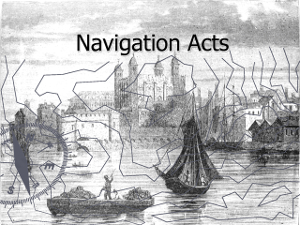
The Navigation Act 1651

The Navigation Act 1651 is passed on October 9, 1651, by the Rump Parliament led by Oliver Cromwell. It authorises the Commonwealth of England to regulate trade within the colonies. It reinforces a long-standing principle of government policy that English trade should be carried in English vessels. The Act is a reaction to the failure of the English diplomatic mission led by Oliver St. John and Walter Strickland to The Hague seeking a political union of the Commonwealth with the Republic of the Seven United Netherlands, after the States of Holland had made some cautious overtures to Cromwell to counter the monarchical aspirations of stadtholder William II, Prince of Orange.

The stadtholder dies suddenly, however, and the States are now embarrassed by Cromwell taking the idea too seriously. The English propose the joint conquest of all remaining Spanish and Portuguese possessions. England would take America and the Dutch would take Africa and Asia. But the Dutch have just ended their war with Spain and already taken over most Portuguese colonies in Asia, so they see little advantage in this grandiose scheme and propose a free trade agreement as an alternative to a full political union. This again is unacceptable to the British, who would be unable to compete on such a level playing field, and is seen by them as a deliberate affront.

The Act bans foreign ships from transporting goods from outside Europe to England or its colonies, and bans third-party countries’ ships from transporting goods from a country elsewhere in Europe to England. These rules specifically target the Dutch, who control much of Europe’s international trade and even much of England’s coastal shipping. It excludes the Dutch from essentially all trade with England, as the Dutch economy is competitive with, not complementary to the English, and the two countries therefore exchange few commodities. This Anglo-Dutch trade, however, constitutes only a small fraction of total Dutch trade flows.

The Act is often mentioned as a major cause of the First Anglo-Dutch War, though it is only part of a larger British policy to engage in war after the negotiations have failed. The English naval victories in 1653 (the Battle of Portland, the Battle of the Gabbard and the Battle of Scheveningen) show the supremacy of the Commonwealth navy in home waters. However, farther afield the Dutch predominate and are able to close down English commerce in the Baltic and the Mediterranean. Both countries hold each other in a stifling embrace.

The Treaty of Westminster (1654) ends the impasse. The Dutch fail to have the Act repealed or amended, but it seems to have had relatively little influence on their trade. The Act offers England only limited solace. It cannot limit the deterioration of England’s overseas trading position, except in the cases where England herself is the principal consumer, such as the Canary Islands wine trade and the trade in Puglian olive oil. In the trade with the West Indies, the Dutch keep up a flourishing “smuggling” trade, thanks to the preference of English planters for Dutch import goods and the better deal the Dutch offer in the sugar trade. The Dutch colony of New Netherland offers a loophole through intercolonial trade wide enough to drive a shipload of Virginia tobacco through.

The 1651 Act, like other laws of the Commonwealth period, is declared void on the Restoration of Charles II of England, having been passed by “usurping powers.” Parliament therefore passes new legislation. This is generally referred to as the “Navigation Acts,” and, with some amendments, remains in force for nearly two centuries.


Leave a comment

Birth of Sir Frederick Matthew Darley, Chief Justice of New South Wales

Sir Frederick Matthew Darley, the sixth Chief Justice of New South Wales, an eminent barrister, a member of the Parliament of New South Wales, Lieutenant-Governor of New South Wales, and a member of the Privy Council of the United Kingdom, is born in Bray, County Wicklow, on September 18, 1830.

Darley is educated at Dungannon College in County Tyrone. His uncle, the Reverend John Darley, is headmaster of the college. In July 1847 he commences studying at Trinity College, Dublin, and he graduates in July 1851 with a Bachelor of Arts (BA). He is called to the English bar at the King’s Inn in January 1853 but returns to Ireland and practises there for about nine years on the Munster circuit. He meets Sir Alfred Stephen when Stephen is on a visit to Europe and is told that there are good prospects for him in Australia.

Darley marries Lucy Forest Browne at Hunsdon, Hertfordshire, on December 13, 1860. Lucy is the sister of novelist Rolf Boldrewood (Thomas Alexander Browne) who is best known for the book Robbery Under Arms. They have two sons and four daughters.

Darley decides to emigrate to Australia and arrives in Sydney in 1862. He is admitted to the NSW Bar on June 2, 1862, and is later appointed a Queens Counsel (QC) in 1878. In September 1868 he is nominated to the New South Wales Legislative Council. In November 1881 he becomes vice-president of the executive council in the third Henry Parkes ministry. In November 1886 Darley is offered the position of Chief Justice of New South Wales in succession to Sir James Martin. He does not desire the office and to accept it would mean a considerable monetary sacrifice. As a barrister, he is likely earning more than twice the amount of the salary offered. He declines the position, and it is accepted by Julian Salomons who subsequently resigns a few days later.

Darley is again approached and this time he accepts the position. He is sworn in on December 7, 1886. He carries out his duties with great distinction, although he is not an exceptional jurist. On the retirement of Sir Alfred Stephen in November 1891, Darley is appointed Lieutenant-Governor of New South Wales, and he administers the government seven times in that capacity. When the position of Governor of New South Wales becomes vacant in 1901, there are many suggestions that Darley should be given the post, but it is given to Sir Harry Rawson.

Darley’s longest period administering the government is from November 1, 1900, to May 27, 1902, a significant period in Australia’s political history with the lead up to and the aftermath of federation of the then Australian colonies. But his anxiety for New South Wales’s supremacy possibly contributes to the “Hopetoun Blunder.” Darley’s private assessment in 1902 is that “Australian Federation is so far a pronounced failure.”

Darley is knighted in 1887, created a Knight Commander of the Order of St. Michael and St. George (KCMG) in 1897, and receives the Knight Grand Cross of the Order of St. Michael and St. George (GCMG) on May 15, 1901, in preparation of the forthcoming royal visit of the Duke and Duchess of Cornwall and York (later King George V and Queen Mary).

Darley visits England in 1902 and is appointed a member of the royal commission on the South African war. He is also appointed a member of the privy council in 1905. He dies in London on January 4, 1910.


Leave a comment

The Opening of Dublin Zoo

Dublin Zoo, located in Phoenix Park, Dublin, opens on September 1, 1831. It is the largest zoo in Ireland and one of Dublin’s most popular attractions. The zoo describes its role as conservation, study, and education. Its stated mission is to “work in partnership with zoos worldwide to make a significant contribution to the conservation of the endangered species on Earth.”

Covering over 28 hectares (69 acres) of Phoenix Park, the Dublin Zoo is divided into areas named Asian Forests, Orangutan Forest, The Kaziranga Forest Trail, Fringes of the Arctic, Sea Lion Cove, African Plains, Roberts House, House of Reptiles, City Farm and South American House.

The Royal Zoological Society of Ireland is established at a meeting held at the Rotunda Hospital on May 10, 1830. The zoo, then called the Zoological Gardens Dublin, initially opens to the public with 46 mammals and 72 birds, all donated by London Zoo.

The initial entry charge per person is sixpence, which is a sizable sum at the time and limits admission to relatively wealthy middle-class people. What makes Dublin Zoo very different from some of its contemporaries is a decision to reduce the charge to one penny on Sundays. This makes a day at the zoo something that nearly every Dubliner can afford once in a while and it becomes very popular.

In 1833, the original cottage-style entrance lodge to the zoo is built at a cost of £30. The thatch-roofed building is still visible to the right of the current entrance. In 1838, to celebrate Queen Victoria‘s coronation, the zoo holds an open day on which 20,000 people visit. This remains the highest number of visitors in one day. President of the United States Ulysses S. Grant, after leaving office, is among the celebrities who come to see Dublin’s world-famous lions in the 19th century. In 1844 the zoo receives its first giraffe, and in 1855 it purchases its first pair of lions.

In 2015, Dublin Zoo is the third most popular visitor attraction in Ireland with 1,105,005 visitors.

Dublin Zoo is part of a worldwide programme to breed endangered species. It is a member of the European Endangered Species Programme (EEP), which helps the conservation of endangered species in Europe. Each species supervised by the EEP has a single coordinator that is responsible for the building of breeding groups with the aim of obtaining a genetically balanced population.

Dublin Zoo manages the EEP for the golden lion tamarin and the Moluccan cockatoo. It also houses members of the species Goeldi’s monkey and the white-faced saki monkey which are part of EEPs coordinated by other zoos. The focus is on conservation, which includes breeding and protecting endangered species, as well as research, study and education.


Leave a comment

Birth of John Field, Pianist & Composer

John Field, pianist, composer, and teacher, is born in Dublin into a musical family on July 26, 1782. He is the eldest son of Irish parents who are members of the Church of Ireland. His father, Robert Field, earns his living by playing the violin in Dublin theatres.

Field first studies the piano under his grandfather, who is a professional organist, and later under Tommaso Giordani. He makes his debut at the age of nine, a performance that is well-received, on March 24, 1792 in Dublin. By late 1793, the Fields have settled in London, where the young pianist starts studying with Muzio Clementi.

Field continues giving public performances and soon becomes famous in London, attracting favourable comments from the press and the local musicians. Around 1795 his performance of a Jan Ladislav Dussek piano concerto is praised by Joseph Haydn. Field continues his studies with Clementi, also helping the Italian with the making and selling of instruments. He also takes up the violin, which he studies under Johann Peter Solomon. His first published compositions are issued by Clementi in 1795. The first historically important work, the Piano Concerto No. 1, H 27, is premiered by the composer in London on February 7, 1799, when he is 16 years old. Field’s first official opus is a set of three piano sonatas published by Clementi in 1801.

In summer 1802 Field and Clementi leave London and go to Paris on business. They soon travel to Vienna, where Field takes a brief course in counterpoint under Johann Georg Albrechtsberger, and in early winter arrive in Saint Petersburg. Field is inclined to stay, impressed by the artistic life of the city. Clementi leaves in June 1803, but not before securing Field a teaching post in Narva. After Clementi’s departure, Field has a busy concert season, eventually performing at the newly founded Saint Petersburg Philharmonia. In 1805 Field embarks on a concert tour of the Baltic states, staying in Saint Petersburg during the summer. The following year he gives his first concert in Moscow. He returns to Moscow in April 1807 and apparently does not revisit Saint Petersburg until 1811. In 1810 he marries Adelaide Percheron, a French pianist and former pupil.

In 1811 Field returns to Saint Petersburg where he spends the next decade of his life, more productive than ever before, publishing numerous new pieces and producing corrected editions of old ones. He is successful in establishing a fruitful collaboration with both H.J. Dalmas, the most prominent Russian publisher of the time, and Breitkopf & Härtel, one of the most important music publishing houses of Europe. By 1819 Field is sufficiently wealthy to be able to refuse the position of court pianist that is offered to him. His lifestyle and social behaviour are becoming more and more extravagant.

In 1818 Field revisits Moscow on business, prompted by his collaboration with the publisher Wenzel. He and his wife give a series of concerts in the city in 1821, the last of which marks their last appearance in public together. Adelaide leaves Field soon afterward and attempts a solo career, which is not particularly successful. Field stays in Moscow and continues performing and publishing his music. In 1822 he meets Johann Nepomuk Hummel and the two collaborate on a performance of Hummel’s Sonata for Piano 4-Hands, Op. 92.

Partly as a result of his extravagant lifestyle, Field’s health begins to deteriorate by the mid-1820s. From about 1823 his concert appearances started decreasing. By the late 1820s he is suffering from colorectal cancer. Field leaves for London to seek medical attention. He arrives in September 1831 and, after an operation, gives concerts there and in Manchester. He stays in England for some time, meeting distinguished figures such as Felix Mendelssohn and Ignaz Moscheles. After a series of concerts in various European cities, Field spends nine months in a Naples hospital. His Russian patrons rescue him. He briefly stays with Carl Czerny in Vienna, where he gives three recitals, and then returns to Moscow. He gives his last concert in March 1836 and dies in Moscow almost a year later, on January 23, 1837, from pneumonia. He is buried in the Vvedenskoye Cemetery.


Leave a comment

Death of Thomas Croke, Archbishop of Cashel & Emly

Thomas William Croke, the second Catholic Bishop of Auckland in New Zealand (1870–74) and later Archbishop of Cashel and Emly in Ireland, dies on July 22, 1902. He is important in the Irish nationalist movement especially as a Champion of the Irish National Land League in the 1880s. The main Gaelic Athletic Association stadium in Dublin is named Croke Park in his honour.

Croke is born in Castlecor, County Cork, on May 28, 1824. He is educated in Charleville, County Cork, the Irish College in Paris and the Pontifical Irish College in Rome, winning academic distinctions including a Doctor of Divinity with honours. He is ordained in May 1847. Returning to Ireland for a short time he is appointed a Professor in St. Patrick’s, Carlow College. The Irish radical William O’Brien says that Croke fought on the barricades in Paris during the French Revolution of 1848. Croke returns to Ireland and spends the next 23 years working there. In 1858 he becomes the first president of St. Colman’s College, Fermoy, County Cork and then serves as both parish priest of Doneraile and Vicar General of Cloyne diocese from 1866 to 1870. Croke attends the First Vatican Council as the theologian to the Bishop of Cloyne 1870.

Croke gains the good opinion of the Irish ecclesiastical authorities and is rewarded in 1870 by his promotion to Bishop of Auckland in New Zealand. His former professor, Paul Cullen, by then Cardinal Archbishop of Dublin, is largely responsible for filling the Australasian Catholic church with fellow Irishmen. His strong recommendations lead to Croke’s appointment. Croke arrives at Auckland on December 17, 1870, on the City of Melbourne. During his three years as bishop, he restores firm leadership to a diocese left in disarray by his predecessor, Bishop Jean Baptiste Pompallier. He devotes some of his considerable personal wealth to rebuilding diocesan finances and also takes advantage of Auckland’s economic growth following the development of the Thames goldfields to further his aims, ensuring that all surplus income from parishes at Thames and Coromandel is passed on to him, and he institutes a more rigorous system for the Sunday collection at St. Patrick’s Cathedral. He imports Irish clergy to serve the growing Catholic community, and with Patrick Moran, the first Catholic Bishop of the Diocese of Dunedin, he tries unsuccessfully to secure an Irish monopoly on future episcopal appointments in New Zealand. Croke supports separate Catholic schools and their right to state aid and voices his opposition to secular education as Auckland’s Catholic schools are threatened by the provincial council’s Education Act 1872, which helps to create a free, secular and compulsory education system. However, generally, Croke’s image is uncontroversial. On January 28, 1874, after barely three years in office, Croke departs for Europe, on what is ostensibly a 12-month holiday, and he does not return to New Zealand.

Croke becomes a member of the Irish hierarchy when he is translated to be Archbishop of Cashel, one of the four Catholic Irish archbishoprics in 1875. Archbishop Croke is a strong supporter of Irish nationalism, aligning himself with the Irish National Land League during the Land War, and with the chairman of the Irish Parliamentary Party, Charles Stewart Parnell. In an 1887 interview he explains that he had opposed the League’s “No rent manifesto” in 1881, preferring to stop payment of all taxes.

Croke also associates himself with the Temperance Movement of Fr. Theobald Mathew and Gaelic League from its foundation in 1893. Within Catholicism he is a supporter of Gallicanism, as opposed to the Ultramontanism favoured by the Archbishop of Dublin, Cardinal Cullen. His support of nationalism causes successive British governments and Lord Lieutenant of Ireland‘s governments in Dublin to be deeply suspicious of him, as are some less politically aligned Irish bishops.

Following the scandal that erupts over Parnell’s relationship with Katharine O’Shea, the separated wife of fellow MP Captain William O’Shea, Archbishop Croke withdraws from active participation in nationalist politics.

Thomas Croke, 78, dies at the Archbishop’s Palace in Thurles, County Tipperary on July 22, 1902. He is buried at the Cathedral of the Assumption in Thurles. In honour of Croke, his successors as Archbishop of Cashel and Emly traditionally are asked to throw in the ball at the minor Gaelic football and All-Ireland Senior Hurling Championship finals.


Leave a comment

Oscar Traynor Leads Anti-Treaty IRA Occupation of O’Connell Street

On June 29, 1922, during the Irish Civil War, Oscar Traynor leads Anti-Treaty members of the Irish Republican Army‘s (IRA) 1st Dublin Brigade to occupy O’Connell Street in order to help the Four Courts garrison. His men also take up positions in York Street, South Circular Road, Capel Street, Parnell Square, and Dolphin’s Barn.

Traynor is an Irish politician and republican born into a strongly nationalist family in Dublin on March 21, 1886. He serves in a number of cabinet positions, most notably as the country’s longest-serving Minister for Defence. He is educated by the Christian Brothers in Dublin. In 1899 he is apprenticed to John Long, a famous woodcarver. As a young man he is a noted footballer and tours Europe as a goalkeeper with Belfast Celtic F.C. whom he plays with from 1910 to 1912.

Traynor joins the Irish Volunteers and takes part in the Easter Rising in 1916, following which he is interned in Wales. During the Irish War of Independence, he is brigadier of the Dublin Brigade of the Irish Republican Army. He leads the attack on The Custom House in 1921 and an ambush on the West Kent Regiment at Claude Road, Drumcondra on June 16, 1921, when the Thompson submachine gun is fired for the first time in action. When the Irish Civil War breaks out in June 1922, Traynor takes the republican side.

The Dublin Brigade is split however, with many of its members following Michael Collins in taking the pro-Treaty side. On June 29, 1922, Traynor and his supporters occupy O’Connell Street in an attempt to help the republicans who have occupied the Four Courts but are under attack by Free State forces. Traynor and his men hold out for a week of street fighting before making their escape. He organises guerilla activity in south Dublin and County Wicklow, before being captured by Free State troops in September. He is then imprisoned for the remainder of the war.

On March 11, 1925, Traynor is elected to Dáil Éireann in a by-election as a Sinn Féin Teachta Dála (TD) for the Dublin North constituency, though he does not take his seat due to the abstentionist policy of Sinn Féin. He is re-elected as one of eight members for Dublin North in the June 1927 Irish general election but just one of six Sinn Féin TDs. Once again, he does not take his seat. He does not contest the second general election called that year but declares his support for Fianna Fáil. He stands again in the 1932 general election and is elected as a Fianna Fáil TD for Dublin North.

In 1936 Traynor is first appointed to the Cabinet as Minister for Posts and Telegraphs. In September 1939 he is appointed Minister for Defence and holds the portfolio until February 1948. In 1948 he becomes President of the Football Association of Ireland, a position he holds until his death. He serves as Minister for Defence in several Fianna Fáil governments and as Minister for Justice, where he is undermined by his junior minister, and later Taoiseach, Charles Haughey, before he retires in 1961.

Oscar Traynor dies on December 15, 1963, in Dublin at the age of seventy-seven. He has a road named in his memory on the Coolock to Santry stretch in North Dublin.

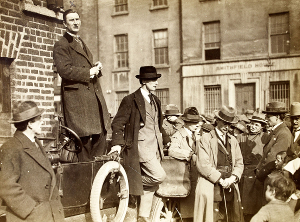
(Pictured: Oscar Traynor in Dublin in July 1922)


Leave a comment

Erskine Childers Elected Fourth President of Ireland

In a political upset, Erskine Hamilton Childers defeats Tom O’Higgins by a very narrow margin and is elected as the fourth President of Ireland on May 30, 1973.

Incumbent president Éamon de Valera is 90 years old and constitutionally barred from seeking a third term. His party, Fianna Fáil, seeks to get former Tánaiste Frank Aiken to run for the presidency, but he declines. Under pressure, former Tánaiste Erskine H. Childers agrees to run. The odds-on favourite is Fine Gael deputy leader, Tom O’Higgins, who had come within 1% of defeating Éamon de Valera in the 1966 presidential election.

Childers is a controversial nominee, owing not only to his British birth and upbringing but to his Protestantism. However, on the campaign trail his personal popularity proves enormous. In a political upset, Erskine H. Childers wins the presidency by 635,867 votes to 578,771.

Childers, though 67, quickly gains a reputation as a vibrant, extremely hard-working president, and becomes highly popular and respected. However, he has a strained relationship with the incumbent government, led by Taoiseach Liam Cosgrave of Fine Gael. Childers has campaigned on a platform of making the presidency more open and hands-on, which Cosgrave views as a threat to his own agenda as head of government. He refuses to co-operate with Childers’ first priority upon taking office, the establishment of a think tank within Áras an Uachtaráin to plan the country’s future. Childers considers resigning from the presidency, but is convinced to remain by Cosgrave’s Foreign MinisterGarret FitzGerald. However, Childers remains detached from the government. Whereas previously, presidents had been briefed by taoisigh once a month, Cosgrave briefs President Childers and his successor, Cearbhall Ó Dálaigh, on average once every six months.

Though frustrated about the lack of power he has in the office, Childers plays an important behind-the-scenes role in easing the Northern Ireland conflict as former Northern Ireland Prime Minister Terence O’Neill meets secretly with Childers at Áras an Uachtaráin on at least one occasion.

Prevented from transforming the presidency as he desires, Childers instead throws his energy into a busy schedule of official visits and speeches, which is physically taxing. On November 17, 1974, just after making a speech to the Royal College of Physicians in Dublin, Childers suffers a heart attack. He dies the same day at Mater Misericordiae University Hospital.

Childers’s state funeral in St. Patrick’s Cathedral, Dublin, is attended by world leaders including the Earl Mountbatten of Burma (representing Queen Elizabeth II), the Prime Minister of the United Kingdom and leader of the Opposition, and presidents and crowned heads of state from Europe and beyond. He is buried in the grounds of the Church of Ireland Derralossary church in RoundwoodCounty Wicklow.


Leave a comment

Birth of Michael Joseph O’Rahilly, Republican & Nationalist

Michael Joseph O’Rahilly, Irish republican and nationalist known as The O’Rahilly, is born in BallylongfordCounty Kerry, on April 22, 1875.

O’Rahilly is educated in Clongowes Wood College. As an adult, he becomes a republican and a language enthusiast. He joins the Gaelic League and becomes a member of An Coiste Gnotha, its governing body. He is well travelled, spending at least a decade in the United States and in Europe before settling in Dublin.

O’Rahilly is a founding member of the Irish Volunteers in 1913, which is organized to work for Irish independence and resist the proposed Home Rule. He serves as the IV Director of Arms. He personally directs the first major arming of the Irish Volunteers, the landing of 900 Mausers at the Howth gun-running on July 26, 1914.

O’Rahilly is not party to the plans for the Easter Rising, nor is he a member of the Irish Republican Brotherhood (IRB), but he is one of the main people who train the Irish Volunteers for the coming fight. The planners of the Rising go to great lengths to prevent those leaders of the Volunteers who are opposed to unprovoked, unilateral action from learning that a rising is imminent, including its Chief-of-Staff Eoin MacNeillBulmer Hobson, and O’Rahilly. When Hobson discovers that an insurrection is planned, he is kidnapped by the Military Council leadership.

Learning this, O’Rahilly goes to Patrick Pearse‘s school, Scoil Éanna, on Good Friday. He barges into Pearse’s study, brandishing his revolver as he announces, “Whoever kidnaps me will have to be a quicker shot!” Pearse calms O’Rahilly, assuring him that Hobson is unharmed, and will be released after the rising begins.

O’Rahilly takes instructions from MacNeill and spends the night driving throughout the country, informing Volunteer leaders in CorkKerryTipperary, and Limerick that they are not to mobilise their forces for planned manoeuvres on Sunday.

Arriving home, O’Rahilly learns that the Rising is about to begin in Dublin on the next day, Easter Monday, April 24, 1916. Despite his efforts to prevent such action which he feels can only lead to defeat, he sets out to Liberty Hall to join Pearse, James ConnollyThomas MacDonaghTom ClarkeJoseph PlunkettCountess MarkieviczSeán Mac DiarmadaEamonn Ceannt and their Irish Volunteers and Irish Citizen Army troops. Arriving in his De Dion-Bouton motorcar, he gives one of the most quoted lines of the rising, “Well, I’ve helped to wind up the clock — I might as well hear it strike!”

O’Rahilly fights with the General Post Office (GPO) garrison during Easter Week. On Friday, April 28, with the GPO on fire, O’Rahilly volunteers to lead a party of men along a route to Williams and Woods, a factory on Great Britain Street, now Parnell Street. A British machine-gun at the intersection of Great Britain and Moore streets cuts him and several of the others down. Wounded and bleeding badly, O’Rahilly slumps into a doorway on Moore Street, but hearing the English marking his position, makes a dash across the road to find shelter in Sackville Lane, now O’Rahilly Parade. He is wounded diagonally from shoulder to hip by sustained fire from the machine-gunner.

The specific timing of O’Rahilly’s death is very difficult to pin down but understanding can be gained from his final thoughts. Despite his obvious pain, he takes the time to write a message to his wife on the back of a letter he received from his son in the GPO. It is this last message to Nancy that artist Shane Cullen etches into his limestone and bronze sculpture. The text reads:

Written after I was shot. Darling Nancy I was shot leading a rush up Moore Street and took refuge in a doorway. While I was there, I heard the men pointing out where I was and made a bolt for the laneway I am in now. I got more [than] one bullet, I think. Tons and tons of love dearie to you and the boys and to Nell and Anna. It was a good fight anyhow. Please deliver this to Nannie O’ Rahilly, 40 Herbert Park, Dublin. Goodbye Darling.