seamus dubhghaill

Promoting Irish Culture and History from Little Rock, Arkansas, USA


Leave a comment

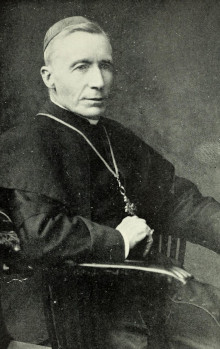
Birth of James Augustine Healy, Bishop of Portland, Maine

james-augustine-healy

James Augustine Healy, American Roman Catholic priest and the second bishop of Portland, Maine, is born on April 6, 1830, in Macon, Georgia to a multiracial slave mother and Irish immigrant father. He is the first bishop in the United States of any known African descent. When he is ordained in 1854, his multiracial ancestry is not widely known outside his mentors in the Catholic Church.

Healy is the eldest of ten siblings of Michael Morris Healy, an Irish immigrant planter from County Roscommon, and his common law wife Eliza Smith (sometimes recorded as Clark), a multiracial enslaved African American. He achieves many “firsts” in United States history. He is credited with greatly expanding the Catholic church in Maine at a time of increased Irish immigration. He also serves Abenaki people and many parishioners of French-Canadian descent who were traditionally Catholic. He speaks both English and French.

Beginning in 1837, like many other wealthy planters with mixed-race children, Michael Healy starts sending his sons to school in the North. James, along with brothers Hugh and Patrick, goes to Quaker schools in Flushing, New York, and Burlington, New Jersey. Later they each attend the newly opened College of the Holy Cross in Worcester, Massachusetts. He graduates as valedictorian of the college’s first graduating class in 1849.

Following graduation, Healy wishes to enter the priesthood. He cannot study at the Jesuit novitiate in Maryland, as it is a slave state. With the help of John Bernard Fitzpatrick, he enters a Sulpician seminary in Montreal. In 1852, he transfers to study at Saint-Sulpice Seminary in Paris, working toward a doctorate and a career as a seminary professor. After a change of heart, he decides to become a pastor. On June 10, 1854, he is ordained at Notre-Dame de Paris as a priest to serve in Boston, Massachusetts. He is the first African American to be ordained a Roman Catholic priest although at the time he identifies as and is accepted as white Irish Catholic.

When Healy returns to the United States, he becomes an assistant pastor in Boston. He serves the archbishop, who helps establish his standing in the church. In 1866 he becomes the pastor of St. James Church, the largest Catholic congregation in Boston. In 1874 when the Boston legislature is considering taxation of churches, he defends Catholic institutions as vital organizations that help the state both socially and financially. He also condemns certain laws that are generally enforced only on Catholic institutions. He founds several Catholic charitable institutions to care for the many poor Irish immigrants who had arrived during the Great Famine years.

Healy’s success in the public sphere leads to his appointment by Pope Pius IX to the position of second bishop of Portland, Maine. He is consecrated as Bishop of Portland on June 2, 1875, becoming the first African American to be consecrated a Catholic bishop. For 25 years he governs his large diocese, supervising also the founding of the Diocese of Manchester, New Hampshire, when it is split from Portland in 1885. During his time in Maine, which is a period of extensive immigration from Catholic countries, he oversees the establishment of 60 new churches, 68 missions, 18 convents, and 18 schools. During that period, he also serves his Abenaki and French-Canadian parishioners.

Healy is the only member of the American Catholic hierarchy to excommunicate men who joined the Knights of Labor, a national union, which reaches its peak of power in 1886.

Two months before his death on August 5, 1900, Healy is called as assistant to the Papal throne by Pope Leo XIII, a position in the Catholic hierarchy just below that of cardinal.


Leave a comment

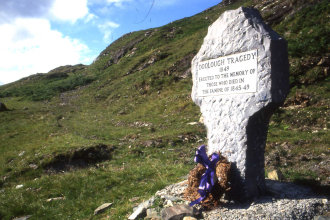
The Doolough Tragedy

doolough-tragedy-memorial

The Doolough Tragedy is an event that took place during the Great Famine close to Doo Lough in southwest County Mayo.

On Friday, March 30, 1849 two officials of the Westport Poor Law Union arrive in Louisburgh to inspect those people in receipt of outdoor relief to verify that they should continue to receive it. The inspection, for some reason, does not take place and the two officials go on to Delphi Lodge, a hunting lodge, 19 kilometres (12 miles) south of Louisburgh where they intend to spend the night. The people who had gathered for the inspection, or later did so, are consequently instructed to appear at Delphi Lodge at 7:00 the following morning if they wish to continue receiving relief. For much of the night and day that follows seemingly hundreds of destitute and starving people have to undertake what for them, given their existing state of debilitation, is an extremely fatiguing journey, in very bad weather.

A letter-writer to The Mayo Constitution reports shortly afterwards that the bodies of seven people, including women and children, are subsequently discovered on the roadside between Delphi and Louisburgh overlooking the shores of Doo Lough and that nine more never reach their homes. Local folklore maintains the total number that perished because of the ordeals they had to endure is far higher.

A cross and an annual Famine Walk between Louisburgh and Doolough commemorates this event. The monument in Doolough valley has an inscription from Mahatma Gandhi: “How can men feel themselves honoured by the humiliation of their fellow beings?”

(Pictured: The memorial to the victims in Doolough valley, photo by Felix O, June 2009, CC BY-SA 2.0)


Leave a comment

Publication of the First Issue of “The United Irishman”

john-mitchel

John Mitchel, Irish nationalist activist, author, and political journalist, publishes the first issue of The United Irishman on February 12, 1848.

Mitchel is one of the great propagandists of his day, although the causes he espouses often place him on the wrong side, he is loved and loathed in equal measure. He is one of the few Irishmen to have incurred the wrath of the British government and of the Federal administration of the United States.

Mitchel is born near Dungiven, County Derry in what is now Northern Ireland on November 3, 1815. The son of a Presbyterian clergyman, he creates his own pulpit in a series of journalistic enterprises in Dublin, Tennessee, Virginia and New York.

Mostly raised in Newry, County Down, Mitchel’s first political association is with the Young Ireland movement of the 1840s and the famous The Nation newspaper, founded by Charles Gavan Duffy, Thomas Davis and John Blake Dillon in 1842. But long before the abortive Young Ireland Rebellion of 1848 he has moved on, finding the editorial policies of The Nation rather too bland for his tastes.

Inflamed by the suffering he witnesses on a trip to Galway, it is Mitchel, more than any other writer or politician, who shapes the nationalist perception of an Gorta Mór (Great Famine):

“I could see, in front of the cottages, little children leaning against a fence when the sun shone out for they could not stand, their limbs fleshless, their bodies half-naked, their faces bloated yet wrinkled, and of a pale, greenish hue… I saw Trevelyan’s claw in the vitals of those children: his red tape would draw them to death: in his government laboratory he had prepared for them the typhus poison.”

Responding to such writing, Ireland simmers, angry and ready for rebellion. Fearful of Mitchel’s power, London’s Punch magazine emphasises his international standing by portraying him as an Irish monkey challenging the Great British Lion. The Times thunders against him. When Mitchel produces his own republican newspaper, The United Irishman, which, in its inaugural edition, claims that “the world was weary of Old Ireland and also of Young Ireland” thus attacking both Daniel O’Connell and his younger antagonists with the same broadsword. He aims to be an equal opportunities offender and succeeds admirably.

The United Irishman sells out and is shut down by the British authorities after a mere sixteen issues. In order to silence Mitchel, to rob him of his heroic status and his possible martyrdom, the British government passes the Treason Felony Act 1848, which seeks to treat treason as a common crime. He is later tried before an elegantly and efficiently packed jury, found guilty of treason-felony, and deported to Van Diemen’s Land (Tasmania). The result is one of the greatest works of Irish political history, The Jail Journal, in which Mitchel writes about his own experience of deportation and advocates a far more militaristic approach to Ireland’s “English problem” than would have been popular heretofore.

Mitchel is acclaimed by Patrick Pearse, who declares The Jail Journal to be “the last of the four gospels of the New Testament of Irish nationality, the last and the fieriest and the most sublime.” Éamon de Valera reveres Mitchel, and when in 1943 he imagines Ireland as “the home of a people who valued material wealth only as a basis for right living, of a people who, satisfied with frugal comfort, devoted their leisure to the things of the spirit,” he too is delving into The Jail Journal for his inspiration.

(From: #OTD in 1848 – John Mitchel Publishes First United Irishman, Stair na hÉireann | History of Ireland)


Leave a comment

Groundbreaking for the West Clare Railway

File source: http://commons.wikimedia.org/wiki/File:CIE_F502_(17156275240).jpg

Charles Stewart Parnell turns the first sod for the construction of the West Clare Railway (WCR) on January 27, 1885, although actual work on the line had begun in November 1884. The line is opened on July 2, 1887.

At the end of the Great Famine there is a new growth in local businesses. The British Government determines that an improved railway system is necessary to aid in the recovery of the West of Ireland. The West Clare Railway and the South Clare Railway are built by separate companies, but in practice the West Clare Railway operates the entire line. The lines meet at Milltown Malbay. In due course the entire line becomes known as the West Clare Railway.

The West Clare Railway originally operates in County Clare between 1887 and 1961. The 3-foot narrow gauge railway runs from the county town of Ennis, via numerous stopping points along the West Clare coast to two termini, at Kilrush and Kilkee, with the routes diverging at Moyasta Junction. The system is the last operating narrow gauge passenger system in Ireland and connects with the mainline rail system at Ennis, where a station still stands today for bus and train services to Limerick and Galway. Intermediate stops include Ennistymon, Lahinch and Milltown Malbay.

On 27 September 27, 1960, CIÉ gives notice of its intending closure with effect from February 1, 1961, despite the dieselisation of passenger services in 1952 and freight in 1953. CIÉ says that the West Clare is losing £23,000 per year, despite the considerable traffic it handles. In December 1960 it is announced that the line would close completely on January 1, 1961 although actual closure does not take place until January 31, 1961. CIÉ begins dismantling the line the following day.

A preservation society maintains a railway museum at Moyasta Junction station, and successfully re-opens a section of the railway as a passenger carrying heritage line with diesel traction in the 1990s, and with steam motive power from 2009.


Leave a comment

The Allihies Copper Mine Museum

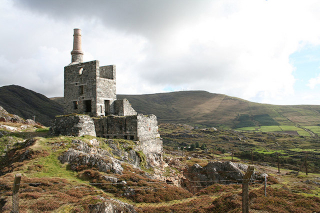
engine-house-allihies

On January 7, 2000, experts underline the important heritage value of a 19th Century relic that stands on the site of a disused copper mine. A conservation appeal is launched to safeguard a unique engine house at a mountain mine in the Beara peninsula. A rare surviving symbol of Cornish type mining technology, the structure is the primary surviving embodiment of a once thriving copper mining industry in Allihies, County Cork.

The industrial mines in Allihies date back to 1812, when they are first opened by John Puxley. Mining activity reaches its peak there in 1845, when the mines employ around 1,600 people, after which the mines suffer with the local area during the Great Famine. The mines are operational until 1962, when they are finally closed. Large Cornish engine houses are constructed around the mining site, ruins of which survive today. These are used to pump out water to allow for deeper mining, and to transport miners and equipment down shafts that go below sea level. The site still contains a number of engine houses, mining shafts and a church. These are constructed by and for the Cornish miners who are brought to the area in the 1800s to mine copper ore. Once the mine becomes unprofitable, many of the miners emigrate to Butte, Montana.

The Allihies Copper Mine Museum (ACMM) is housed in a renovated Methodist church dating from 1845. It is officially opened by President Mary McAleese on September 13, 2007, after ten years of work by the Allihies Mines Co-op, a group that is formed to preserve the history of the area and mining heritage in the Allihies area, supported by the Mining Heritage Trust of Ireland.

The exhibitions cover all aspects of the history of copper mining in the area, from prehistoric times all the way up to the nineteenth century and the Industrial Revolution. The displays also cover the local geology and the social history of the mining heritage. The collections contain examples of mining equipment and tools from the various eras of activity. The exhibition space is also used to display artworks, with local artists such as Charles Tyrrell, Cormac Boydell, Rachel Parry and Tim Goulding exhibiting there.

(Pictured: Engine House, Allihies by John Gibson, view of the 1862 house for the 36″-cylinder beam engine that powered the man-engine and winder on Mountain Mine)


Leave a comment

Birth of William Francis Butler, Army Officer & Writer

william-francis-butler

William Francis Butler, 19th-century British Army officer, writer, and adventurer, is born on October 31, 1838, at Ballyslatteen, Golden, County Tipperary.

Butler is the son of Richard and Ellen Butler. The great famine of 1847 and scenes of suffering and eviction are amongst his earliest recollections. He is educated chiefly by the Jesuits at Tullabeg College.

Butler enters the army as an ensign of the 69th Regiment of Foot at Fermoy Barracks in 1858, becoming captain in 1872 and major in 1874. He takes part with distinction in the Red River expedition (1870–71) and the Ashanti operations of 1873–1874 under Garnet Wolseley, 1st Viscount Wolseley and receives the Companion of the Order of the Bath in 1874.

On June 11, 1877, Butler marries Elizabeth Thompson, an accomplished painter of battle scenes, notably The Roll Call (1874), Quatre Bras (1875), Rorke’s Drift (1881), The Camel Corps (1891), and The Dawn of Waterloo (1895). They have six children. His daughter, Elizabeth Butler, marries Lt.-Col. Randolph Albert Fitzhardinge Kingscote (1867-1940) on July 24, 1903.

Butler again serves with General Wolseley in the Anglo-Zulu War, the Battle of Tell El Kebir (after which he is made an aide-de-camp to Queen Victoria) and the Sudan in 1884–1886, being employed as colonel on the staff in 1885 and brigadier general in 1885–1886. In the latter year, he is made a Knight Commander of the Order of the Bath. He serves as brigadier general on the staff in Egypt until 1892 when he is promoted to major general and stationed at Aldershot, subsequent to which he is given command of the South-Eastern District in March 1896.

In 1898 Butler succeeds General William Howley Goodenough as commander-in-chief in South Africa, with the local rank of lieutenant general. For a short period (December 1898 – February 1899), during the absence of Sir Alfred Milner in England, he acts as high commissioner, and as such, and subsequently in his military capacity, he expresses views on the subject of the probabilities of war which are not approved by the home government. He is consequently ordered home to command the Western District and holds this post until 1905. He also holds the Aldershot Command for a brief period from 1900 to 1901. He is promoted to lieutenant general in 1900 and continues to serve, finally leaving the King‘s service in 1905.

In October 1905, having reached the age limit of sixty-seven, Butler is placed on the retired list. The few years of life which remain to him he spends at Bansha Castle in Ireland, devoted chiefly to the cause of education. He is a frequent lecturer both in Dublin and the provinces on historical, social, and economic questions. He is known as a Home Ruler and an admirer of Charles Stewart Parnell. He is a member of the Senate of the National University of Ireland, and a commissioner of the Board of National Education. In June 1906, he is appointed Knight of the Grand Cross of the Order of the Bath, and in 1909 he is made a member of the Privy Council of Ireland.

William Butler dies at Bansha Castle in Bansha, County Tipperary, on June 10, 1910, and is buried at the cemetery of Killaldriffe, a few miles distant and not far from his ancestral home.

Butler had long been known as a descriptive writer, since his publication of The Great Lone Land (1872) and other works and he was the biographer (1899) of Sir George Pomeroy Colley. He had started work on his autobiography a few years before his death but died before it was completed. His youngest daughter, Eileen, Viscountess Gormanston, completes the work and has it published in 1911.

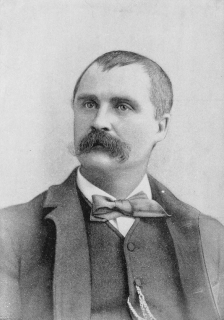
(Pictured: William Francis Butler, Source: Archives of Manitoba, Personalities – Butler, W. F. 1, N10492)


Leave a comment

First Issue of “The Nation” Published

the-nation-01-17-1852

The first issue of The Nation, an Irish nationalist weekly newspaper, is published on October 15, 1842. It is printed at 12 Trinity Street, Dublin until January 6, 1844. The paper is later published at 4 D’Olier Street from July 13, 1844, until July 28, 1848, when the issue for the following day is seized and the paper suppressed. It is published again in Middle Abbey Street on its revival in September 1849.

The founders of The Nation are three young men, Charles Gavan Duffy, its first editor, Thomas Davis and John Blake Dillon. All three are members of Daniel O’Connell‘s Repeal Association, which seeks repeal of the disastrous Acts of Union 1800 between Ireland and Britain. This association later becomes known as Young Ireland.

John Mitchel joins the staff of The Nation in the autumn of 1845. On Mitchel’s frequent trips from Banbridge, County Down to Dublin, he had come in contact with the Repeal members who gathered about The Nation office and in the spring of 1843, he becomes a member of the Repeal Association. For the next two years he writes political and historical articles and reviews for The Nation. He covers a wide range of subjects, including the Irish Potato Famine, on which he contributes some influential articles which attract significant attention.

Mitchel resigns his position as lead writer for The Nation in 1847 because he comes to regard as “absolutely necessary a more vigorous policy against the English Government than that which William Smith O’Brien, Charles Gavan Duffy and other Young Ireland leaders were willing to pursue.” Upon his resignation he starts his own paper, The United Irishman.

Women also write for The Nation and publish under pseudonyms such as Speranza (Jane Elgee, Lady Wilde, Oscar Wilde‘s mother), Eithne (Marie Thompson) and Eva (Mary Eva Kelly, who would marry Kevin Izod O’Doherty.

The role played by some of its key figures in the paper in the ill-fated Young Ireland Rebellion of 1848 cement the paper’s reputation as the voice of Irish radicalism. Dillon is a central figure in the revolt and is sentenced to death, the sentence later commuted. He flees Ireland, escaping first to France and, eventually, to the United States, where he serves the New York Bar.

Its triumvirate of founders follow differing paths. Davis dies at age 30 in 1845. Both Dillon and Duffy become MPs in the British House of Commons. Duffy emigrates to Australia where he becomes premier of the state of Victoria, later being knighted as a Knight Commander of St. Michael and St. George (KCMG). Dillon dies in 1866. His son, John Dillon, becomes leader of the Irish Parliamentary Party and his grandson, James Dillon, leader of Fine Gael.

The Nation continues to be published until 1900, when it merges with the Irish Weekly Independent. Later political figures associated with the paper included Timothy Daniel Sullivan and J.J. Clancy.


Leave a comment

Death of Dick Dowling, Confederate Commander

Southern Methodist University, Central University Libraries, DeGolyer Library

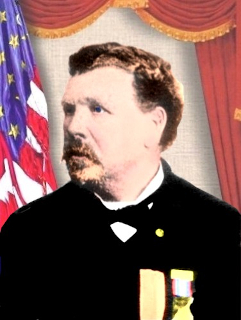
Richard William “Dick” Dowling, the victorious confederate commander at the Second Battle of Sabine Pass in the American Civil War, dies of yellow fever in Houston, Texas on September 23, 1867.

Dowling is born in the townland of Knockballyvishteal, Milltown, County Galway on January 14, 1837, the second of eight children, born to tenant farmer Patrick and Bridget Dowling (née Qualter). Following the eviction of his family from their home in 1845, the first year of the Great Famine, nine-year-old Dowling leaves Ireland in 1846 with his older sister Honora, bound for New Orleans in the United States.

As a teenager, Dowling displays his entrepreneurial skills by successfully running the Continental Coffeehouse, a saloon in the fashionable French Quarter. His parents and siblings follow from Ireland in 1851, but the joy of reunion is short-lived. In 1853, a yellow fever outbreak in New Orleans takes the lives of his parents and one of his younger brothers. With rising anti-Irish feeling growing in New Orleans, following local elections which see a landslide victory for the “Know Nothing” party, Dowling moves to Houston in 1857.

In 1857 Dowling marries Elizabeth Ann Odlum, daughter of Benjamin Digby Odlum, a Kildare-born Irishman, who had fought in the Texas Revolution, being captured at the Battle of Refugio in 1836.

By 1860, Dowling owns a number of saloons. His most successful is named the Bank of Bacchus, located on Courthouse Square in downtown Houston. “The Bank” as it is known locally becomes Houston’s most popular social gathering place in the 1860s and is renowned for its hospitality. He is also involved in setting up Houston’s first gaslight company and is first to have it installed in his home and “The Bank.” He is a founding member of Houston’s Hook and Ladder Company Number One fire department and is also involved in running the city’s first streetcar company.

Prior to the outbreak of the American Civil War, Dowling makes a name for himself as an able and successful entrepreneur. Among other things, he is involved with a predominantly Irish militia company which serves a more social than military role in Houston society. Upon Secession, this militia company is mustered straight into the Confederate States Army, with Dowling being elected First Lieutenant. The unit names themselves the “Jefferson Davis Guards” in honor of Confederate President Jefferson Davis. The Davis Guards are initially part of a Texas State Troops/Confederate expedition sent to take over Union Army forts and arsenals along the border with Mexico. The expedition is successfully completed without a shot being fired. They participate in the Battle of Galveston on New Year’s Day 1863, following which they are assigned to a newly constructed artillery post near the mouth of the Sabine River called Fort Sabine.

Sabine Pass was important as a point of arrival and departure for blockade runners. It is suspected that the Union Army will attempt an invasion of Texas via Sabine Pass because of its value as a harbor for blockade runners and its proximity 18 miles southeast of Beaumont, which lies on the railroad between Houston and the eastern part of the Confederacy.

To negotiate Sabine Pass all vessels except small boats take one of the two river channels. No seagoing ship can traverse the Pass without great risk of running aground should it stray from one of the channels. The inevitable course of any steam-powered warship, including shallow-draft gunboats then common to the U.S. Navy, would use one of the channels, both of which are within fair range of the fort’s six smoothbores.

Dowling spends the summer of 1863 at the earthen fort instructing his men in gunnery. On September 8, 1863, a Union Navy flotilla of some 22 gunboats and transports with 5,000 men accompanied by cavalry and artillery arrive off the mouth of Sabine Pass. The plan of invasion is sound, but monumentally mismanaged. Four of the flanking gunboats are to steam up the pass at speed and draw the fire of the fort, two in each channel, a tactic which had been used successfully in subduing the defensive fortifications of Mobile and New Orleans prior to this. This time, however, Dowling’s artillery drills pay off as the Confederates pour a rapid and withering fire onto the incoming gunboats, disabling and capturing two, while the others retreat in disarray. The rest of the flotilla retreats from the mouth of the pass and returns ignominiously to New Orleans, leaving the disabled ships with no option but to surrender to Dowling. With a command of just 47 men, Dowling had thwarted an attempted invasion of Texas, in the process capturing two gunboats, some 350 prisoners and a large quantity of supplies and munitions.

The Confederate government offers its gratitude and admiration to Dowling, now promoted to Major, and his unit, as a result of their battlefield prowess. In gratitude, the ladies of Houston present the unit with specially struck medals, which are actually Mexican eight reale coins with both faces sanded down and inscribed “Sabine Pass, 1864” on one side and a Maltese cross with the letters D and G on the other. Because of the official recognition given to the action, it is now accepted that these Davis Guard Medals are the only medals of honor issued by the Confederate government, and consequently are collector’s items today.

After the battle of Sabine Pass Dowling is elevated to hero status in his hometown of Houston. He subsequently serves as a recruiter for the Confederacy and is personally commended for his action at the battle by Jefferson Davis. After the war he returns to his saloon business and quickly becomes one of the city’s leading businessmen.

Dowling’s promising future is cut short by another yellow fever epidemic which devastates Houston in the late summer of 1867, and he dies on September 23, 1867. He is buried at St. Vincent’s Catholic Cemetery, the oldest Catholic cemetery in Houston.


Leave a comment

Birth of Michael Cusack, Founder of the Gaelic Athletic Association

michael-cusack

Michael Cusack, teacher and founder of the Gaelic Athletic Association, is born to Irish speaking parents on September 20, 1847 in the parish of Carran on the eastern fringe of the Burren, County Clare during the Great Famine.

Cusack becomes a national school teacher, and after teaching in various parts of Ireland becomes a professor in 1874 at Blackrock College, then known as the French College. In 1877, he establishes his own Civil Service Academy, Cusack’s Academy, in Dublin which proves successful in preparing pupils for the civil service examinations.

A romantic nationalist, Cusack is also “reputed” to have been associated with the Fenian movement. He is active in the Gaelic revival as a member of the Society for the Preservation of the Irish Language which is founded in 1876, and later the Conradh na Gaeilge who in 1879 breaks away from the Society. Also in 1879, he meets Pat Nally, who is a member of the Irish Republican Brotherhood and a leading nationalist and athlete. He finds that Nally’s views on the influence of British landlordism on Irish athletics are the same as his. He recalls how both Nally and himself while walking through the Phoenix Park in Dublin seeing only a handful of people playing sports in the park so depressed them that they agreed it was time to “make an effort to preserve the physical strength of [their] race.” Nally organises a National Athletics Sports meeting in County Mayo in September 1879 which is a success, with Cusack organising a similar event which is open to ‘artisans’ in Dublin the following April.

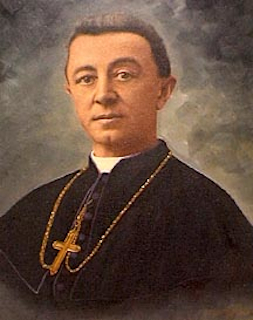
On November 1, 1884, Cusack, together with Maurice Davin of Carrick-on-Suir, County Tipperary, call a meeting in Hayes’ Commercial Hotel, Thurles, County Tipperary, and found the Gaelic Athletic Association (GAA). Davin is elected president and Cusack becomes its first secretary. Later, Archbishop Thomas William Croke (May 28, 1824 – July 22, 1902), Archbishop of Cashel & Emly, Michael Davitt and Charles Stewart Parnell become patrons. Cusack also becomes involved in the Irish language movement, founding The Celtic Times, a weekly newspaper which focuses on “native games” and Irish culture.

Michael Cusack dies in Dublin at the age of 59 on November 27, 1906.


Leave a comment

Birth of Isaac Butt, Barrister & Politician

File source: http://commons.wikimedia.org/wiki/File:Portrait_of_Isaac_Butt.jpg

Isaac Butt, barrister and politician, is born in Glenfin, County Donegal on September 6, 1813. If not the originator of the term Home Rule, he is the first to make it an effective political slogan. He is the founder (1870) and first chief of the Home Government Association and president (1873–77) of the Home Rule League of Great Britain, but he is superseded in 1878 as head of the Home Rule movement by the younger and more forceful Charles Stewart Parnell.

Butt is the son of a Church of Ireland rector and is descended from the O’Donnells of Tyrconnell, through the Ramsays. He receives his secondary school education at The Royal School in Raphoe, County Donegal, and at Midleton College in County Cork, before going to Trinity College Dublin at the age of fifteen, where he is elected a Scholar. While there he co-founds the Dublin University Magazine and edits it for four years. For much of his life he is a member of the Irish Conservative Party. He becomes Whately Chair of Political Economy at Trinity in 1836 and holds that position until 1841.

Butt is called to the Irish bar in 1838 and the English bar in 1859. Intermittently from 1852 he represents, successively, one English and two Irish constituencies in the House of Commons. In 1848 he undertakes the defense of the Young Ireland leaders, who are charged with high treason for their abortive insurrection that year. From 1865 to 1869 he is the principal defense counsel for the imprisoned leaders of the Fenians (Irish Republican, or Revolutionary, Brotherhood).

Despite his legal work for the Fenians, Butt, who is basically a conservative, fears the consequences of a successful Fenian revolt. Disillusioned, however, by the British government’s failure to relieve the Irish Great Famine of the late 1840s, he becomes convinced that a native parliament is required for Irish land reform and other needs. In May 1870 he calls for an Irish Parliament subordinate to the imperial Parliament at Westminster, and later that year he forms the Home Government Association. From 1871 he quickens the Irish nationalist agitation in the House of Commons but gradually loses his leadership, partly because he disapproves of Parnell’s tactics of obstructing routine parliamentary business.

Butt amasses debts and pursues romances. It is said that at meetings he is occasionally heckled by women with whom he had fathered children. He is also involved in a financial scandal when it is revealed that he had taken money from several Indian princes to represent their interests in parliament.

Isaac Butt dies on May 5, 1879, in Clonskeagh in Dublin. His remains are brought by train to Stranorlar, County Donegal, where he is buried in a corner of the Church of Ireland cemetery beneath a tree by which he used to sit and dream as a boy. His grave has been restored and the memorial now includes a wreath.

Despite his chaotic lifestyle and political limitations, Butt is capable of inspiring deep personal loyalty. Some of his friends, such as John Butler Yeats and the future Catholic Bishop of Limerick, Edward Thomas O’Dwyer, retain a lasting hostility towards Parnell for his role in Butt’s downfall.

In May 2010 the Church of Ireland parishes of Stranorlar, Meenglass and Kilteevogue instigate an annual memorial Service and Lecture in Butt’s honour, inviting members of the professions of law, politics and journalism to reflect aspects of his life. Speakers have included Dr. Joe Mulholland, Senator David Norris, Dr. Chris McGimpsey and Prof. Brian Walker.

(Pictured: Isaac Butt, portrait by John Butler Yeats)