Ervine is born into a Protestant working-class family in east Belfast on July 21, 1953. He leaves Orangefield High School at age 14 and joins the Orange Order at age 18, however his membership does not last long. The following year he joins the Ulster Volunteer Force (UVF), believing this to be the only way to ensure the defence of the Protestant community after the events of Bloody Friday.
Ervine is arrested in November 1974, while an active member of the UVF. He is driving a stolen car containing five pounds of commercial explosives, a detonator and fuse wire. After seven months on remand in Crumlin Road Gaol he is found guilty of possession of explosives with intent to endanger life. He is sentenced to 11 years and imprisoned in The Maze.
While in prison, Ervine comes under the influence of Gusty Spence who makes him question what his struggle is about and unquestionably changes Ervine’s direction. After much study and self-analysis, he emerges with the view that change through politics is the only option. He also becomes friends with Billy Hutchinson while in prison.
Ervine is released from prison in 1980 and takes up full-time politics several years later. He stands in local council elections as a Progressive Unionist Party (PUP) candidate in 1985 Northern Ireland local elections. In 1996 he is elected to the Northern Ireland Forum from the regional list, having been an unsuccessful candidate in the Belfast East constituency. In 1998, he is elected to the Northern Ireland Assembly to represent Belfast East and is re-elected in 2003. He is also a member of Belfast City Council from 1997.
Mowlam is a lecturer in the Political Science Department at the University of Wisconsin–Milwaukee in 1977 and at Florida State University in Tallahassee from 1977 to 1979. During her time in Tallahassee, someone breaks into her apartment. She suspects that it is Ted Bundy, the serial killer and rapist who is thought to have murdered at least 35 young women and attacked several others. She returns to England in 1979 to take up an appointment at the University of Newcastle upon Tyne.
Having failed to win selection for the 1983 general election, Mowlam is selected as Labour candidate for the safe seat of Redcar after James Tinn stands down. She takes the seat in the 1987 general election, becoming the Labour spokesperson on Northern Ireland later that year. Together with Shadow Chancellor John Smith, she is one of the architects of Labour’s “Prawn Cocktail Offensive” dedicated to reassuring the UK’s financial sector about Labour’s financial rectitude.
Mowlam joins the Shadow Cabinet when John Smith becomes leader of the Labour Party in 1992, holding the title of Shadow Secretary of State for National Heritage. During this time, she antagonises both monarchists and republicans by calling for Buckingham Palace to be demolished and replaced by a “modern” palace built at public expense. Later, her willingness to speak her mind, often without regard to the consequences, is seen as her greatest strength by her supporters.
Following Smith’s death in 1994, Mowlam, alongside Peter Kilfoyle, becomes a principal organiser of Tony Blair‘s campaign for the Labour leadership. After his victory, Blair makes her Shadow Secretary of State for Northern Ireland. She initially resists being appointed to the position, preferring an economic portfolio, but, after accepting it, she throws her weight into the job.
Mowlam oversees the negotiations which lead to the 1998 Good Friday Agreement. She is successful in helping to restore an Irish Republican Army (IRA) ceasefire and including Sinn Féin in multi-party talks about the future of Northern Ireland. In an attempt to persuade the Ulster loyalists to participate in the peace process, she pays an unprecedented and potentially dangerous visit to loyalist prisoners in HM Prison Maze, meeting convicted murderers face-to-face and unaccompanied.
Mowlam witnesses the Good Friday Agreement signing in 1998, which leads to the temporary establishment of a devolved power-sharing Northern Ireland Assembly. However, an increasingly difficult relationship with Unionist parties means her role in the talks is ultimately taken over by Tony Blair and his staff.
Mowlam’s deteriorating relationship with Unionists is the key reason she is replaced by Peter Mandelson as Northern Ireland Secretary in October 1999. Her move to the relatively lowly position of Minister for the Cabinet Office possibly involves other factors, notably her health and her popularity. On September 4, 2000, she announces her intention to retire from Parliament and relinquishes her seat at the 2001 general election.
Five months before the 1997 general election, Mowlam is diagnosed with a brain tumor, a fact that she tries to keep private. She appears to suffer from balance problems as a result of her radiotherapy. According to her husband, she falls on July 30, 2005, receiving head injuries and never regaining consciousness. Her living will, in which she asks not to be resuscitated, is honoured. On August 12, 2005, Mowlan is moved to Pilgrims Hospice in Canterbury, Kent, where she dies seven days later, on August 19, 2005, aged 55.
Mowlam is an atheist and is cremated in Sittingbourne on September 1, 2005 at a non-religious service conducted by Reverend Richard Coles, formerly of the 1980s band The Communards. Half of her ashes were scattered at Hillsborough Castle, the Secretary of State for Northern Ireland’s official residence, and the other half in her former parliamentary constituency of Redcar.
By 1975, the conflict in Northern Ireland known as “the Troubles” is more than six years old. On February 10, 1975, the Provisional IRA and the British government enter into a truce and restart negotiations. There is a rise in sectarian killings during the truce, which ‘officially’ lasts until early 1976. The truce, however, is interrupted in the early hours of July 31, 1975, by the Miami Showband killings at Buskhill outside Newry, County Down.
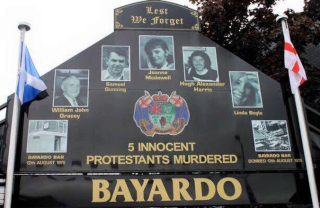
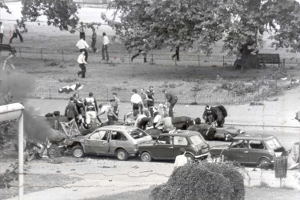
Two weeks later, on August 13, 1975, the Bayardo Bar is crowded with people of all ages. Shortly before closing time a stolen green Audi automobile, containing a three-man unit of the IRA’s Belfast Brigade, pulls up outside. It is driven by the unit’s leader Brendan “Bik” McFarlane, a 24-year-old volunteer from Ardoyne. Volunteers Seamus Clarke and Peter “Skeet” Hamilton get out and approach the pub’s side entrance on Aberdeen Street. One of them immediately opens fire with an ArmaLite, instantly killing doorman William Gracey and his brother-in-law Samuel Gunning, with whom he had been chatting outside. The other volunteer then enters the pub, where patrons are drinking and singing, and drops a duffel bag containing a ten-pound bomb at the entrance. Both men make their getaway back to the waiting car. As panicked customers run to the toilets for safety, the bomb explodes and brings down a section of the old brick-and-plaster building upon them. The bodies of civilian Joanne McDowell and UVF member Hugh Harris are later found beneath the rubble of fallen masonry. Seventeen-year-old civilian Linda Boyle is pulled out alive but dies of her injuries at the hospital on August 21. Over 50 people are injured in the attack.
A Belfast Telegraph article later claims that, as the IRA unit drives away down Agnes Street, they fire into a crowd of women and children queuing at a taxi rank although there are no fatalities. Within 20 minutes of the blast, the IRA unit is arrested after their car is stopped at a roadblock. The ArmaLite that had been used to kill Gracey and Gunning is found inside the car along with spent bullet casings and fingerprints belonging to the three IRA men.
The IRA does not initially claim responsibility, however, IRA members later state that the Bayardo was attacked because it was a pub where Ulster Volunteer Force (UVF) members met and planned terrorist assaults against nationalists. The pub is in the UVF-dominated middle Shankill Road area, and the Ulster Banner is displayed from its upper windows. A former IRA prisoner claims that fellow inmate Lenny Murphy told him he had left the Bayardo ten minutes before the attack and that the Brigade Staff had just finished holding a meeting there.
Loyalists, especially the UVF, respond with another wave of sectarian attacks against Catholics. Two days after the pub attack, a loyalist car bomb explodes without warning on the Falls Road, injuring 35 people. On 22 August, the UVF launches a gun and bomb attack on McGleenan’s Bar in Armagh. The attack is strikingly similar to that at Bayardo. One gunman opens fire while another plants the bomb, the explosion causing the building to collapse. Three Catholic civilians are killed and several more are wounded. That same night, another bomb wrecks a Catholic-owned pub in nearby Blackwatertown, although there are no injuries.
In May 1976, Brendan McFarlane, Seamus Clarke, and Peter Hamilton are convicted in a non-jury Diplock court and sentenced to life imprisonment inside the HM Prison Maze for carrying out the Bayardo murders. In 1983 McFarlane leads the Maze Prison escape, a mass break-out of 38 republican prisoners, including Clarke and Hamilton.
O’Hara joins Na Fianna Éireann in 1970 and, in 1971, his brother Sean is interned in Long Kesh Prison. In late 1971, at the age of 14, he is shot and wounded by a soldier while manning a barricade. Due to his injuries, he is unable to attend the civil rights march on Bloody Sunday but watches it go by him in the Brandywell Stadium, and the events of the day have a lasting effect on him.
In October 1974, O’Hara is interned in Long Kesh Prison, and upon his release in April 1975 he joins the Irish Republican Socialist Party (IRSP) and INLA. He is arrested in Derry in June 1975 and held on remand for six months. In September 1976, he is arrested again and once more held on remand for four months.
On May 10, 1978, O’Hara is arrested on O’Connell Street in Dublin under section 30 of the Offences Against the State Act and is released eighteen hours later. He returns to Derry in January 1979 and is active in the INLA. On May 14, 1979, he is arrested and is convicted of possessing a hand grenade. He is sentenced to eight years in prison in January 1980.
O’Hara becomes Officer Commanding of the INLA prisoners at the beginning of the first hunger strike in 1980, and he joins the 1981 strike on March 22.
On Thursday, May 21, 1981, at 11:29 PM, Patsy O’Hara dies after 61 days on hunger strike, at the age of 23. In accordance with his wishes, his parents do not get him the medical intervention needed to save his life. His corpse is found to be mysteriously disfigured prior to its departure from prison and before the funeral, including signs of his face being beaten, a broken nose, and cigarette burns on his body.
McDonnell is born on Slate Street in the lower Falls Road of Belfast, Northern Ireland on September 14, 1951, as one of ten children. He attends a nearby Roman Catholic school. He marries Goretti in 1970 and moves into her sister’s house in Lenadoon. There are only two Catholic houses in this predominantly Ulster Protestanthousing estate, and their house is attacked on numerous occasions.
McDonnell agrees with the goals of the Irish hunger strike, namely: the right not to wear a prison uniform; the right not to do prison work; the right of free association with other prisoners; the right to organise their own educational and recreational facilities and the right to one visit, one letter and one parcel per week.
Although McDonnell is not involved in the first hunger strike in 1980, he joins Bobby Sands and the others in the second hunger strike the following year. During the strike he fights the general election in the Republic of Ireland, and only narrowly misses election in the Sligo–Leitrim constituency. He goes 61 days without food before dying on July 8, 1981. He has two children. His wife takes an active part in the campaign in support of the hunger strikers.
McDonnell is buried in the grave next to Bobby Sands at Milltown Cemetery in west Belfast. John Joe McGirl, McDonnell’s election agent in Sligo–Leitrim, gives the oration at his funeral. Quoting Patrick Pearse, he states, “He may seem the fool who has given his all, by the wise men of the world; but it was the apparent fools who changed the course of Irish history.”
William Stephen “Billy” Wright, named after his grandfather, is born in Wolverhampton, England on July 7, 1960, to David Wright and Sarah McKinley, Ulster Protestants from Portadown, Northern Ireland. The family returns to Northern Ireland in 1964. While attending Markethill High School, Wright takes a part-time job as a farm labourer where he comes into contact with a number of staunchly unionist and loyalist farmers who serve with the Royal Ulster Constabulary (RUC) Reserve or the Ulster Defence Regiment (UDR). The conflict known as the Troubles has been raging across Northern Ireland for about five years by this stage, and many young men such as Wright are swept up in the maelstrom of violence as the Provisional Irish Republican Army ramps up its bombing campaign and sectarian killings of Catholics by loyalists continue to escalate. During this time his opinions move towards loyalism and soon he gets into trouble for writing the initials “UVF” on a local Catholic primary school wall. When he refuses to clean off the vandalism, he is transferred from the area and sent to live with an aunt in Portadown.
Wright joins the Ulster Volunteer Force (UVF) in 1975. After spending several years in prison and becoming a born-again Christian, he resumes his UVF activities and becomes commander of its Mid-Ulster Brigade in the early 1990s, taking over from Robin “the Jackal” Jackson. According to the Royal Ulster Constabulary, he is involved in the sectarian killings of up to 20 Catholics, although he is never convicted for any. It is alleged that Wright, like his predecessor, is an agent of the RUC Special Branch.
Wright attracts considerable media attention during the Drumcree standoff, when he supports the ProtestantOrange Order‘s desire to march its traditional route through the Catholic/Irish nationalist area of his hometown of Portadown. In 1994, the UVF and other paramilitary groups call ceasefires. However, in July 1996, Wright’s unit breaks the ceasefire and carries out a number of attacks, including a sectarian killing. For this, Wright and his Portadown unit of the Mid-Ulster Brigade are stood down by the UVF leadership. He is expelled from the UVF and threatened with execution if he does not leave Northern Ireland. He ignores the threats and, along with many of his followers, defiantly forms the breakaway Loyalist Volunteer Force (LVF), becoming its leader.
The LVF carries out a string of killings of Catholic civilians. In March 1997 Wright is sent to the HM Prison Maze for having threatened the life of a woman. While imprisoned, Wright continues to direct the LVF’s activities. On the morning of December 27, 1997, he is assassinated inside the prison by three INLA volunteers – Christopher “Crip” McWilliams, John “Sonny” Glennon and John Kennaway – armed with two smuggled pistols, a FEG PA-63 semi-automatic and a .22 Derringer. The LVF carries out a wave of sectarian attacks in retaliation. There is speculation that the authorities collude in his killing as he is a threat to the peace process. An inquiry finds no evidence of this but concludes there are serious failings by the prison authorities.
Owing to his uncompromising stance as an upholder of Ulster loyalism and opposition to the Northern Ireland peace process, Wright is regarded as a cult hero, icon, and martyr by hardline loyalists. His image adorns murals in loyalist housing estates and many of his devotees have tattoos bearing his likeness. His death is greeted with relief and no little satisfaction, however, from the Irish nationalist community.
The trial of Doherty and the other members of their four-man active service unit nicknamed the “M60 gang” begins in early May 1981, on charges including three counts of murder. On June 10, Doherty and seven other prisoners, including Angelo Fusco and the other members of the IRA unit, take a prison officer hostage at gunpoint in Crumlin Road Gaol and ultimately escape in waiting cars. Two days after the escape, Doherty is convicted in absentia and sentenced to life imprisonment with a minimum recommended term of thirty years.
Doherty escapes across the border into the Republic of Ireland, and then travels to the United States on a false passport. He lives with an American girlfriend in Brooklyn and New Jersey, working on construction sites and as a bartender at Clancy’s Bar in Manhattan, where he is arrested by the FBI on June 28, 1983. He is imprisoned in the Metropolitan Correctional Center in Manhattan, and a legal battle ensues with the British government seeking to extradite him back to Northern Ireland. Doherty claims he is immune from extradition as the killing of Royal Irish Constabulary Captain Herbert Westmacott was a political act. In 1985 federal judge John E. Sprizzo rules Doherty cannot be extradited as the killing is a “political offense.” Doherty’s legal battle continues as the United States Department of Justice then attempts to deport him for entering the country illegally.
Doherty remains in custody at the Metropolitan Correctional Center and attempts to claim political asylum, and on June 15, 1988, Attorney GeneralEdwin Meese overturns an earlier ruling by the Federal Board of Immigration Appeals that Doherty can be deported to the Republic of Ireland and orders his deportation to Northern Ireland. In February 1989 new Attorney General Dick Thornburgh chooses not to support the decision made by his predecessor and asks lawyers for Doherty and the Immigration and Naturalization Service to submit arguments for a review of the decision and Doherty’s claim for asylum. By this time Doherty’s case is a cause célèbre with his sympathisers including over 130 Congressmen and a son of then President of the United StatesGeorge H. W. Bush. In 1990 a street corner near the Metropolitan Correctional Center is named after him.
Doherty is returned to Crumlin Road Gaol before being transferred to HM Prison Maze. He is released from prison on November 6, 1998, under the terms of the Good Friday Agreement. After his release Doherty becomes a community worker specialising in helping disadvantaged young people. In 2006, he appears in the BBC television show Facing the Truth opposite the relatives of a soldier killed in the Warrenpoint ambush.
Collins grows up in a middle-class Irish family in Camlough, a small, staunchly Irish republican town in County Armagh. After completing his schooling, he works for a time in the Ministry of Defence in a clerical capacity in London before studying law at Queen’s University Belfast, where he becomes influenced by Marxist political ideology. He eventually drops out of university and, after working in a pub for a period, joins Her Majesty’s Customs & Excise Service, serving in Newry, and goes on to use this internal position within the administrative machinery of the British Government to support IRA operations against Crown Forces personnel.
Collins joins the Provisional IRA during the blanket protest by Long Kesh inmates in the late 1970s and he becomes involved in street demonstrations. He joins the South Down Brigade of the IRA, based around Newry, and is appointed its intelligence officer.
Collins becomes noted within IRA circles for his hard-line views on the continuance of armed campaign and later joins its Internal Security Unit. Around this time, he has a confrontation with Gerry Adams at the funeral of an IRA man killed in a failed bombing over how to deal with the funeral’s policing, where he accuses Adams a being a “Stick.”
Despite his militarist convictions at this time Collins finds the psychological strain caused by his involvement in the terrorist war increasingly difficult to address. His belief in the martial discipline of the IRA’s campaign is seriously undermined by the March 11, 1982, assassination of Norman Hanna, a 28-year-old Newry man, in front of his wife and young daughter. His uneasy state is further augmented by being arrested on two occasions under anti-terrorism laws, the second including a week of detention and intense interrogation.
Collins subsequently states that the strain of the interrogation merely exacerbates increasing doubts that he has already possessed about the moral justification of the IRA’s terrorist paramilitary campaign and his actions within it. These doubts are made worse by the organization’s senior leadership quietly deciding in the early 1980s that the war has failed and now slowly manoeuvering the movement away from a military campaign to allow its political wing, Sinn Féin, to pursue its purposes by another means in what would become the Northern Ireland peace process.
In 1987, after being charged with several counts of murder and attempted murder, Collins is acquitted as the statement in which he admits to involvement in these acts is ruled legally inadmissible by the court. On release from prison, he spends several weeks being counter-interrogated by the IRA’s Internal Security Unit, after which he is exiled by the organization from Ulster, being warned that if he is found north of Drogheda after a certain date he will be executed.
After his exile Collins moves to Dublin and squats for a while in a deserted flat in the impoverished Ballymun area of the city. After several years in Dublin, he subsequently moves to Edinburgh, Scotland for a period, where he runs a youth centre.
In 1995 Collins returns to Newry, a district known for the militancy of its communal support of the IRA, with numerous IRA members in its midst. The IRA order exiling him from Ulster has not been lifted, but with a formal ceasefire from the organization and renunciations of violence by all the paramilitary organizations in the province, he deems it safe to move back in with his wife and children who had never left the town.
Rather than maintaining a low-profile Collins decides to take a prominent role in the ongoing transition of Ulster’s post-war society, using his personal history as a platform in the media to analyze the adverse effects of terrorism. In May 1998 he gives evidence against leading republican Thomas “Slab” Murphy in a libel case Murphy has brought against The Sunday Times, over a 1985 article naming him as the IRA’s Northern Commander. Murphy denies IRA membership, but Collins takes the witness stand against him and testifies that from personal experience he knew that Murphy had been a key military leader in the organization. Murphy subsequently loses the libel case and sustains substantial financial losses in consequence. Collins and his family receive numerous threats after the trial.
Collins is beaten and stabbed to death by one or more unidentified assailants early in the morning of January 27, 1999, while walking his dogs near the Barcroft Park Estate in Newry along a quiet stretch of country lane at Doran’s Hill. His body also bears marks of having been struck by a car moving at speed. The subsequent police investigation and Coroner’s Inquest comment upon the extremity of weaponed violence to Collins’ head and face used during the attack.
Rumoured reasons behind the murder are that he had returned to Ulster in breach of the IRA’s banning order, and further he had detailed IRA activities and publicly criticized in the media a multiplicity of Irish terrorist paramilitary splinter groups that had appeared after the IRA’s 1994 ceasefire, and that he had testified in court against Murphy.
After a traditional Irish wake, with a closed coffin necessitated by the condition of his face, and a funeral service at St. Catherine’s Church in Newry, Collins’ body is buried at the town’s Monkshill Cemetery, not far from the grave of Albert White, a Catholic former Royal Ulster Constabulary Inspector, whose assassination he had helped to organize in 1982.
The Irish Republican Army (IRA) hunger strike is called off at Long Kesh prison – later known as HM Prison Maze – on October 3, 1981. While the IRA does not win immediate concessions, in some ways it is a Pyrrhic victory for Margaret Thatcher’s government. It galvanises support and membership for the IRA and generates huge sympathy for the strikers in the United States where fund-raising is a major priority. The death of the first hunger striker, Bobby Sands, creates a martyr and an iconic figure.
In January 1981, prison authorities begin to supply the prisoners with officially issued civilian clothing, whereas the prisoners demand the right to wear their own clothing. On February 4, the prisoners issue a statement saying that the British government has failed to resolve the crisis and declares their intention of a hunger strike. The hunger strike begins on March 1, when Bobby Sands, the IRA’s former officer commanding (OC) in the prison, refuses food. Unlike the first hunger strike the previous year, the prisoners join one at a time and at staggered intervals, which they believe would arouse maximum public support and exert maximum pressure on Prime Minister Margaret Thatcher.
The republican movement initially struggles to generate public support for the second hunger strike. The Sunday before Sands begins his strike, 3,500 people march through west Belfast. During the first hunger strike four months earlier, the marchers had numbered 10,000. Five days into the strike, Independent Republican MP for Fermanagh and South TyroneFrank Maguire dies, resulting in a by-election. There is debate among nationalists and republicans regarding who should contest the election. After negotiations they agree not to split the nationalist vote by contesting the election and Sands stands as an Anti H-Block candidate against Ulster Unionist Party candidate Harry West. Following a high-profile campaign, the election takes place on April 9, and Sands is elected to the British House of Commons with 30,492 votes to West’s 29,046.
Sands’ election victory raises hopes that a settlement can be negotiated, but Thatcher stands firm in refusing to give concessions to the hunger strikers. The world’s media descends on Belfast, and several intermediaries visit Sands in an attempt to negotiate an end to the hunger strike, including Síle de Valera, granddaughter of Éamon de Valera, Pope John Paul II‘s personal envoy John Magee, and European Commission of Human Rights officials. With Sands close to death, the government’s position remains unchanged.
On 5 May, Sands dies in the prison hospital on the 66th day of his hunger strike, prompting rioting in nationalist areas of Northern Ireland. More than 100,000 people line the route of his funeral, which is conducted with full IRA military honours. Margaret Thatcher shows no sympathy for his death.
In the two weeks following Sands’ death, hunger strikers Francis Hughes, Raymond McCreesh and Patsy O’Hara die. Following the deaths of Joe McDonnell and Martin Hurson, the families of some of the hunger strikers attend a meeting on July 28 with Catholic priest Father Denis Faul. The families express concern at the lack of a settlement to the priest, and a decision is made to meet with Gerry Adams later that day. The following day Adams holds a meeting with six of the hunger strikers to outline a proposed settlement on offer from the British government should the strike be brought to an end. The six men reject the settlement, believing that accepting anything less than the “Five Demands” would be a betrayal of the sacrifice made by Bobby Sands and the other hunger strikers who had died.
The hunger strike begins to break on July 31, when the mother of Paddy Quinn insists on medical intervention to save his life. The following day Kevin Lynch dies, followed by Kieran Doherty on August 2, Thomas McElwee on August 8 and Michael Devine on August 20. On September 6, the family of Laurence McKeown becomes the fourth family to intervene and asks for medical treatment to save his life, and Cahal Daly issues a statement calling on republican prisoners to end the hunger strike.
The strike is called off at 3:15 PM on October 3, 1981. Three days later, James Prior, the new Secretary of State for Northern Ireland, announces partial concessions to the prisoners including the right to wear their own clothes at all times. The only one of the “Five Demands” still outstanding is the right not to do prison work. Following sabotage by the prisoners and the Maze Prison escape in 1983, the prison workshops are closed, effectively granting all of the “Five Demands” but without any formal recognition of political status from the government.
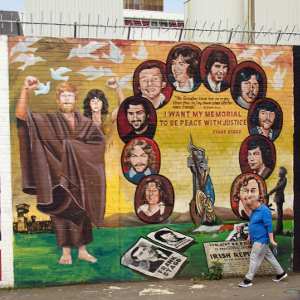
(Pictured: A Belfast mural of the Long Kesh hunger strikers)
At 10:40 AM, a nail bomb explodes in the boot of a blue Morris Marina parked on South Carriage Drive in Hyde Park. The bomb comprises 25 lbs. of gelignite and 30 lbs. of nails. It explodes as soldiers of the Household Cavalry, Queen Elizabeth II‘s official bodyguard regiment, are passing. They are taking part in their daily Changing of the Guard procession from their barracks in Knightsbridge to Horse Guards Parade. Three soldiers of the Blues & Royals are killed outright, and another, their standard-bearer, dies from his wounds three days later. The other soldiers in the procession are badly wounded, and a number of civilians were injured. Seven of the regiment’s horses are also killed or had to be euthanised because of their injuries. Explosives experts believe that the Hyde Park bomb is triggered by remote by an IRA member inside the park.
The second attack happens at about 12:55 PM, when a bomb explodes underneath a bandstand in Regent’s Park. Thirty Military bandsmen of the Royal Green Jackets are on the stand performing music from Oliver! to a crowd of 120 people. It is the first in a series of advertised lunchtime concerts there. Six of the bandsmen are killed outright and the rest are wounded. A seventh dies of his wounds on August 1. At least eight civilians are also injured. The bomb had been hidden under the stand some time before and triggered by a timer. Unlike the Hyde Park bomb, it contains no nails and seems to be designed to cause minimal harm to bystanders.
A total of 22 people are detained in hospital as a result of the blasts. The IRA claims responsibility for the attacks by deliberately mirroring Prime MinisterMargaret Thatcher‘s words a few months before when Britain entered the Falklands War. They proclaimed that “The Irish people have sovereign and national rights which no task or occupational force can put down.” Reacting to the bombing, Thatcher states, “These callous and cowardly crimes have been committed by evil, brutal men who know nothing of democracy. We shall not rest until they are brought to justice.” The bombings have a negative impact on public support in the United States for the Irish republican cause.
On May 19, 2013, 61-year-old John Anthony Downey, from County Donegal, is charged with murder in relation to the Hyde Park bomb and intending to cause an explosion likely to endanger life. He appears at the Old Bailey on January 24, 2014, for the beginning of his trial and enters a not guilty plea. On February 25, 2014, it is revealed that Downey’s trial has collapsed after the presiding judge has ruled upon a letter sent by the Police Service of Northern Ireland to Downey in 2007, assuring him that he would not face criminal charges over the attack. Although the assurance is made in error and the police realise the mistake, it is never withdrawn, and the judge rules that therefore the defendant has been misled and prosecuting him would be an abuse of executive power. Downey is one of 187 IRA suspects who receive secret on-the-run letters guaranteeing them unofficial immunity from prosecution.
A memorial marks the spot of the Hyde Park bombing and the troop honours it daily with an eyes-left and salute with drawn swords. A plaque commemorating the victims of the second attack also stands in Regent’s Park.





 seamus dubhghaill