In the House of Commons of the United Kingdom on November 5, Churchill bemoans the fact that the Irish ports had been returned to the Free State government in 1938:
“The fact that we cannot use the South and West Coasts of Ireland to refuel our flotillas and aircraft and thus protect the trade by which Ireland as well as Great Britain lives, is a most heavy and grievous burden and one which should never have been placed on our shoulders, broad though they be.”
De Valera responds to Churchill’s statement two days later, on November 7:
“I would have refrained from making any comment upon it were it not that it has been followed by an extensive Press campaign by Britain itself, and re-echoed in the United States of America, the purport of the campaign being that we should surrender or lease our ports to Britain for the conduct of the war…
We have chosen the policy of neutrality in this war because we believed that it was the right policy for our people. It is the policy which has been accepted, not merely by this House, but by our people as a whole, and nobody who realises what modern war means, and what it means particularly for those who have not sufficient air defences, will have the slightest doubt that that policy was the right one, apart altogether from any questions of sympathy on one side or the other…
There can be no question of the handing over of these ports so long as this State remains neutral. There can be no question of leasing these ports. They are ours. They are within our sovereignty, and there can be no question, as long as we remain neutral, of handing them over on any condition whatsoever. Any attempt to bring pressure to bear on us by any side—by any of the belligerents—by Britain—could only lead to bloodshed.”
Gillespie is educated locally and in Derry. She studies music at the Royal University of Ireland in Dublin, graduating in 1902, and becomes a teacher. As a student she meets the poet and literary critic James Cousins. They are married in 1903. The pair explore socialism, vegetarianism, and parapsychology together. In 1906, after attending a National Conference of Women (NCW) meeting in Manchester, Cousins joins the Irish branch of the NCW. In 1907 she and her husband attend the London convention of the Theosophical Society, and she makes contact with suffragettes, vegetarians, anti-vivisectionists, and occultists in London.
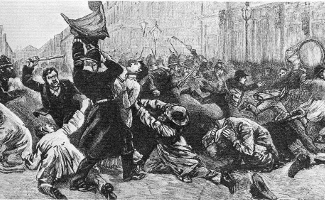
Cousins co-founds the Irish Women’s Franchise League with Hanna Sheehy-Skeffington in 1908, serving as its first treasurer. In 1910 she is one of six Dublin women attending the Parliament of Women, which attempt to march to the House of Commons to hand a resolution to the Prime Minister. After 119 women marching to the House of Commons have been arrested, fifty requiring medical treatment, the women decide to break the windows of the houses of Cabinet Ministers. Cousins is arrested and sentenced to a month in Holloway Prison.
In 1913, she and her husband move to Liverpool, where James Cousins works in a vegetarian food factory. In 1915 they move to India. James Cousins initially works for New India, the newspaper founded by Annie Besant. After Besant is forced to dismiss him for an article praising the 1916 Easter Rising, she appoints him Vice-Principal of the new Besant Theosophical College, where Margaret teaches English.
In 1916, Cousins becomes the first non-Indian member of the SNDT Women’s University at Poona. In 1917, Cousins co-founds the Women’s Indian Association (WIA) with Annie Besant and Dorothy Jinarajadasa. She edits the WIA’s journal, Stri Dharma. In 1919 Cousins becomes the first Head of the National Girls’ School at Mangalore. She is credited with composing the tune for the Indian national anthem Jana Gana Mana in February 1919, during Rabindranath Tagore’s visit to Besant Theosophical College. In 1922, she becomes the first woman magistrate in India. In 1927, she co-founds the All India Women’s Conference, serving as its President in 1936.
In 1932, she is arrested and jailed for speaking against the Emergency Measures. By the late 1930s she feels conscious of the need to give way to indigenous Indian feminists:
“I longed to be in the struggle, but I had the feeling that direct participation by me was no longer required, or even desired by the leaders of India womanhood who were now coming to the front.”
A stroke leaves Cousins paralysed from 1944 onwards. She receives financial support from the Madras government, and later Jawaharlal Nehru, in recognition of her services to India. She dies on March 11, 1954. Her manuscripts are dispersed in various collections across the world.
The Tenant Right League, an organisation which aims to secure reforms in the Irish land system, is founded in Dublin on August 9, 1850, at a meeting attended by representatives of the Tenant Protection Societies. Formed by Charles Gavan Duffy and Frederick Lucas, the League unites for a time Protestant and Catholic tenants, Duffy calling his movement The League of North and South.
The political background to the movement is the Encumbered Estates Act and the resultant change in land ownership at landlord level. In the North of Ireland, Protestant and Presbyterian ministers fear that the new landlords will destroy the “Ulster custom” of tenancy, which compensates tenants for any improvement undertaken. Concurrently, in the South of Ireland politically minded young Catholic priests are agitating for the adoption there of the Ulster custom as a measure of reform.
Support for the League initially comes from the Ulster Tenant Right Association led by William Sharman Crawford. The support is short-lived because of the involvement of Catholic clergymen from the south. As a constitutional movement, the League seeks to secure the adoption and enforcement of the Three Fs, namely fair rent, fixity of tenure, and free sale. All of these would aid Irish tenant farms, all of whom lack them.
For the larger tenant farmers fixity of tenure is the priority. On the other hand, the league never has the support of smaller tenants, whose prime concern is fair rents. The founders strive to establish a parliamentary party of Irish members who will oppose any government not prepared to grant “Tenant-right” also known as the Ulster Custom.
The League’s success is short lived and is ultimately destroyed and weakened when a number of prominent members break away and established the Catholic Defence Association. Supporters of the league are also intimidated by hostile landlords. The most serious blows to its success come when Lucas decides to take his complaint about the Archbishop of DublinPaul Cullen to Rome, which alienates clerical support. Lucas dies in October 1855 shortly after the failure of his mission, a month later Gavan Duffy emigrates to Australia.
The League finally dissolves in 1859, and the Independent Irish Party disappears by 1860. The demand for tenants’ rights is however continued by Bishop Thomas Nulty of County Meath and taken up again as a popular cause by the Irish National Land League in 1879, when the “Three Fs” are anchored in the Land Law (Ireland) Act 1881, previously pursued rigorously by Michael Davitt.
Redmond is born at Ballytrent House, his grandfather’s old family mansion, in Kilrane, County Wexford. As a student at Clongowes Wood College, he exhibits the seriousness that many soon come to associate with him. After finishing at Clongowes, Redmond attends Trinity College, Dublin to study law, but his father’s ill health leads him to abandon his studies before taking a degree and, in 1876, goes to live with him in London. As a clerk in the House of Commons he increasingly identifies himself with the fortunes of Charles Stewart Parnell, one of the founders of the Irish Land League.
Redmond first attends political meetings with Parnell in 1879. Upon the death of his father, a Member of Parliament for Wexford, in 1880, Redmond writes to Parnell asking for adoption as the Nationalist Party, which becomes the Irish Parliamentary Party in 1882, candidate in the by-election to fill the open seat, but is disappointed to learn that Parnell has already promised the next vacancy to his secretary Timothy Healy. When a vacancy arises in New Ross, he wins election unopposed as the Parnellite candidate for the seat. He served as MP for New Ross from 1881 to 1885, for North Wexford from 1885 to 1891 and finally for Waterford City from 1891 until his death in 1918.
In 1890, the Irish Parliamentary Party splits over Parnell’s leadership when his long-standing adultery with Katharine O’Shea is revealed in a spectacular divorce case. Redmond stands by Parnell and works to keep the minority faction active. When Parnell dies in 1891, Redmond takes over leadership of the Parnellite faction of the split party, called the Irish National League (INL). The larger anti-Parnellite group forms the Irish National Federation (INF) under John Dillon.
Through the initiative of William O’Brien and his United Irish League (UIL), the INL and the INF re-unite on February 6, 1900, within the Irish Parliamentary Party. Redmond is elected its chairman, a position he holds until his death in 1918, a longer period than any other nationalist leader with the exceptions of Éamon de Valera and Daniel O’Connell.
The achievement of Home Rule is his life’s goal, having strongly supported William Gladstone’s Home Rule bills of 1886 and 1893. His best opportunity arises when the Irish Parliamentary Party holds the balance of power under H. H. Asquith in the period from 1910 onwards. Opposition by the Ulster Unionists frustrates his plans, his main worry being that Home Rule will result in the permanent exclusion of at least some of the Ulster counties. He also fears that the activities of the Irish Volunteers might hinder the enactment of Home Rule. To guard against this eventuality, he secures the control of the organisation in June 1914. He welcomes the Government of Ireland Act, 1914 as the only measure of Home Rule then possible. Its suspension for the duration of the war postpones addressing the issue of partition.
To ensure the success of the war effort and the speedier implementation of Home Rule, Redmond offers the services of the Irish Volunteers for the defence of the country, an offer rejected by the government. By encouraging the Volunteers to join the British army, he splits the organisation. The vast majority, totaling 170,000 and thereafter known as the National Volunteers, follow Redmond, many of them enlisting in the British army. Those who aspire to an Irish republic or who have lost faith in Home Rule remain as the Irish Volunteers, their numbers now reduced to about 10,000.
Consequently, the 1916 Easter Rising takes him completely by surprise. Committed to keeping Ireland within the Union, he regards the Rising as treason and a “German intrigue.” He has no sympathy with the leaders or their objective of a republic. Nevertheless, he pleads for leniency in the House of Commons.
An operation in March 1918 to remove an intestinal obstruction appears to progress well at first, but then he suffers heart failure. He dies a few hours later at a London nursing home on March 6, 1918. One of the last things he says to the Jesuit Father who is with him to the end is, “Father, I am a broken-hearted man.”