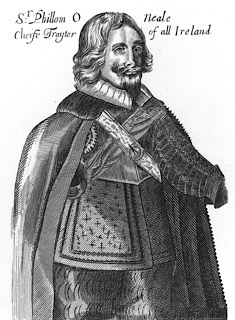
Alongside his older brother, Connor Maguire, Maguire is a prime mover in the conspiracy which leads to the outbreak of rebellion in Ireland on October 23, 1641. He is tasked with securing County Fermanagh for the rebels, but is only partially successful, with several key fortresses in the county, including Enniskillen Castle, remaining under Protestant settler control. His attempt to murder Sir William Cole immediately prior to the rising fails, but the landowner Arthur Champion is killed in one of the first actions of the rebellion. In November 1641, he joins Felim O’Neill of Kinard at Newry to issue a proclamation in which the rebels claim they are acting in defence of King Charles and Catholicism. In December 1641, the Fermanagh army under Maguire slaughters many of the garrison and refugees in Tully Castle, apparently in retaliation for the killing of the garrison of a Maguire castle which had been taken by assault some days previously. He also destroys Castle Archdale and its neighbouring settler village, and kills eight Protestant settlers at Monea Castle. In early 1642, he is expelled from the Irish Parliament and in the summer of the same year he is made a colonel in Owen Roe O’Neill‘s army in Ulster.
Maguire is appointed Governor of Fermanagh by the authorities of the newly established Confederate Ireland. He commands the rebel reserve in the Battle of Benburb in June 1646. He leads raids into Protestant-held areas in east Ulster, before joining O’Neill in his campaigns in Leinster in the autumn of 1646. Later that year, he raids lands in Connacht controlled by the Royalist commander, Ulick Burke, 1st Marquess of Clanricarde. In August 1647, O’Neill and Maguire move the army to Leinster, where Maguire quarrels so vigorously with O’Neill over the payment of troops that the general orders his arrest and court-martials him. After the court-martial, Maguire and his supporters, about five or six regiments, draw up their forces and threaten to desert. The mutiny soon dissipates and Maguire remains allied to O’Neill.
In 1648, Maguire joins O’Neill in opposing the truce between the Confederates and Royalists. He plays a prominent role in the skirmishes and evasive manoeuvrings that occur between the two sides in central Ireland. In the winter of 1648, Maguire withdraws north and on November 13 he is killed while leading an attack on a fortress near Jamestown, County Leitrim.
Following the trial and execution of the Lord Deputy of Ireland, Thomas Wentworth, 1st Earl of Strafford, in May 1641, Ireland is in a state of turmoil. There is growing tension between Catholics and Protestants (particularly those of a Puritan tendency) with the former generally sympathetic to King Charles while the latter supports the English Parliament and the ScottishCovenanters in the dispute that shortly leads to the outbreak of the English Civil War. This forms part of the wider War of the Three Kingdoms.
On October 23, a major uprising breaks out in Ulster organised by leading members of the Gaelic aristocracy. The rebels attack Protestant plantation settlements as well as native Irish Protestants and take garrison towns held by the Irish Army. Irish government authorities in Dublin struggle to contain the insurgency with the limited number of troops they have at their disposal. A last-minute warning saves Dublin Castle from a surprise attack, although O’Neill is clearly unaware of the failure of the Dublin plot when he issues his proclamation.
After seizing several key strategic points in Ulster over the previous twenty-four hours, O’Neill makes his proclamation in Dungannon, a town that has symbolic importance as the traditional capital of the O’Neill dynasty.
In support of his actions, O’Neill claims to have a document from King Charles commissioning him. The Commission is supposedly signed under the Great Seal of Scotland. By declaring their loyalty to the Crown and defence of the Catholic religion, O’Neill and his followers adopt a political stance which is taken up by the subsequent Irish Confederation which governs rebel-controlled territory in the name of the King from 1642 until 1649. The Proclamation encourages many Catholics to believe they can lawfully join the rising with the King’s blessing, while Protestants are left demoralised.
O’Neill’s second and more trenchant proclamation is made “from our camp at Newry” on November 4, 1641 alongside Rory Maguire. He also publishes the actual royal commission that gives authority for his earlier proclamation. It is subtly different, in that it empowers him to arrest and seize property from all of Charles’s English Protestant subjects living in Ireland, but exempts his Irish and Scottish subjects.
Until the late nineteenth century historians generally accept that the commission is genuine, or at the very least Charles had secretly encouraged the Irish Catholics to launch a rising. Since then, for a variety of reasons, it has been considered to be a forgery produced by O’Neill and his associates without the knowledge of the King. They may well have acquired a copy of the Great Seal of Scotland when they captured the garrison town of Charlemont on October 23.
The historian David Stevenson notes that it would be unlikely that the commission would have been addressed to O’Neill. Had it been genuine it would almost certainly have been issued to more senior Irish Royalists such as the James Butler, 1st Duke of Ormond, or the leading Catholic noble of Ulster, Randal MacDonnell, 1st Marquess of Antrim. It is also unlikely to have been issued at Edinburgh as O’Neill claimed. However, King Charles was in Edinburgh on October 1, dealing with Scottish political matters.
Forgery or not, King Charles publicly proclaims all the Irish rebels as traitors on January 1, 1642.
That the Commission is genuine is widely accepted in England and Scotland by the King’s opponents and even some of his own supporters. It seems to tie in with earlier rumours of an army plot which had suggested that Charles might bring over the New Irish Army, made up largely of Ulster Catholics, to impose his will on England and Scotland. Anger at the King’s alleged links with the insurgents grow – particularly as horror stories of atrocities committed, such as the Portadown Massacre, begin to filter across the Irish Sea. Tensions arising from news of the Irish rebellion is a factor in the English push to Civil War in early 1642.
The Scottish authorities dispatch an Army which quickly retakes much of Ulster from the insurgents. Once the English Civil War breaks out in October 1642, Charles’ emissaries begin negotiations with the Irish rebels for their support, which seems to present further evidence to his opponents of his links with the Catholic Ulster leaders. Many of these later dealings are exposed when Charles private letters are captured during the Battle of Naseby (1645) and published as King’s Cabinet Opened.
When O’Neill is captured in 1653 following the Cromwellian conquest of Ireland, he is put on trial for his life. The authorities offer to spare him if he will repeat his earlier claims that Charles had ordered the Catholics to rise in 1641. O’Neill now refuses to implicate the King, who had been executed four years earlier, and is put to death himself. Nonetheless, the English Republicans continue to use O’Neill’s earlier claims of the King’s involvement to justify their decision to commit regicide.
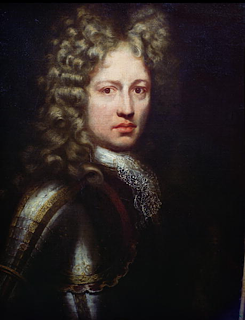
There are few surviving records of Sarsfield’s early life, although it is generally agreed he is brought up on the family estates at Tully. While some biographies claim he is educated at a French military college, there is no evidence for this.
Sarsfield fights at Entzheim, Turckheim and Altenheim. He and Hamilton are standing next to Turenne when he is killed by a chance shot at Salzbach in July 1675. He remains in France until the war ends in 1678, then returns to London to join a new regiment being recruited by Thomas Dongan, 2nd Earl of Limerick. However, the Popish Plot then results in Sarsfield and other Catholics being barred from serving in the military.
This leaves Sarsfield short of money, and he becomes involved in an expensive legal campaign to regain Lucan Manor from the heirs of his brother William, who dies in 1675. This ultimately proves unsuccessful amid allegations of forged documents, and in 1681 he returns to London, where he makes two separate attempts to abduct an heiress and is lucky to escape prosecution. When Charles’s Catholic brother James becomes king in 1685, Sarsfield rejoins the army and fights in the decisive Battle of Sedgemoor, which ends the Monmouth Rebellion. James is keen to promote Catholics, whom he views as more loyal, and by 1688 Sarsfield is colonel of a cavalry unit.
After Richard Talbot, 1st Earl of Tyrconnell, is appointed Lord Deputy of Ireland in 1687, he begins creating a Catholic-dominated Irish army and political establishment. Aware of preparations for invasion by his nephew and son-in-law William of Orange, James sends Sarsfield to Dublin in September to persuade Tyrconnell to provide him with Irish troops. This proves unsuccessful, and in November James is deposed by the Glorious Revolution. Sarsfield takes part in the Wincanton Skirmish, one of the few military actions during the invasion. He remains in England until January when he is allowed to join James in France.
Accompanied by French troops and English exiles, James lands in Ireland in March 1689, beginning the Williamite War in Ireland. Sarsfield is promoted brigadier, elected to the 1689 Irish Parliament for County Dublin, and commands cavalry units in the campaign in Ulster and Connacht. When an Irish brigade is sent to France in October, French ambassador Jean-Antoine de Mesmes proposes Sarsfield as its commander. He notes that while “not…of noble birth […], (he) has distinguished himself by his ability, and (his) reputation in this kingdom is greater than that of any man I know […] He is brave, but above all has a sense of honour and integrity in all that he does”.
James rejects this, stating that although unquestionably brave, Sarsfield is “very scantily supplied with brains.” His role at the Battle of the Boyne is peripheral, although the battle is less decisive than often assumed, Jacobite losses being around 2,000 from a force of 25,000. James returns to France, leaving Tyrconnell in control. He is the leader of the “Peace Party,” who want to negotiate a settlement preserving Catholic rights to land and public office. Sarsfield heads the “War Party,” who feel they can gain more by fighting on. It includes the Luttrell brothers, Nicholas Purcell and English Catholic William Dorrington, a former colleague from Monmouth’s Regiment.
The position of the War Party is strengthened by the Declaration of Finglas, which offers the rank and file amnesty but excludes senior officers. French victories in the Low Countries briefly increases hopes of a Stuart restoration, and the Jacobites establish a defensive line along the River Shannon. Sarsfield cements his reputation with an attack on the Williamite artillery train at Ballyneety, widely credited with forcing them to abandon the first siege of Limerick. The Jacobites also retain Athlone, offset by the loss of Kinsale and Cork, which make resupply from France extremely difficult.
With Tyrconnell absent in France, Sarsfield takes control and in December 1690, arrests several leaders of the peace faction. He then bypasses James by asking Louis XIV directly for French support, and requesting the removal of Tyrconnell and the army commander James FitzJames, 1st Duke of Berwick, James’ illegitimate son. The latter, who later describes Sarsfield as “a man […] without sense”, albeit “very good-natured,” leaves Limerick for France in February.
Tyrconnell returns in January 1691, carrying letters from James making Sarsfield Earl of Lucan, an attempt to placate an “increasingly influential and troublesome figure.” A large French convoy arrives at Limerick in May, along with Charles Chalmot de Saint-Ruhe, appointed military commander in an attempt to end the conflict between the factions. Saint-Ruhr and 7,000 others die at Aughrim in July 1691, reputedly the bloodiest battle ever on Irish soil. Sarsfield’s role is unclear: one account claims he quarrels with Saint-Ruhe and is sent to the rear with the cavalry reserves.
The remnants of the Jacobite army regroup at Limerick. Tyrconnell dies of a stroke in August, and in October, Sarsfield negotiates terms of surrender. He is criticised for this, having constantly attacked Tyrconnell for advocating the same thing, while it is suggested the Williamite army is weaker than he judged. However, the collapse of the Shannon line and surrender of Galway and Sligo leaves him little option. Without French supplies, the military position is hopeless, and defections mean his army is dissolving.
The military articles of the Treaty of Limerick preserve the Jacobite army by allowing its remaining troops to enter French service. About 19,000 officers and men, including Sarsfield, choose to leave in what is known as the Flight of the Wild Geese. Sarsfield’s handling of the civil articles is less successful. Most of its protections are ignored by the new regime, although Sarsfield possibly views it as temporary, hoping to resume the war.
On arrival in France, Sarsfield becomes Major-General in the army of exiles, an appointment James makes with great reluctance. In addition to other acts of perceived insubordination, Sarsfield allegedly tells William’s negotiators at Limerick “change but kings with us, and we will fight it over again.” After the planned invasion of England is abandoned in 1692, the exiles become part of the French army, and Sarsfield a French maréchal de camp.
Sarsfield fights at Steenkerque in August 1692, and is fatally wounded at the Battle of Landen in 1693, dying at Huy on August 21, 1693. Despite several searches, no grave or burial record has been found, although a plaque at St. Martin’s Church, Huy, has been set up in commemoration and an announcement in 2023 states that, pending exhumation and identification, his remains have been located. Like much else, his reputed last words, “Oh that this had been shed for Ireland!” are apocryphal.
Inheritance in traditional Irish law uses gavelkind, whereby an estate is divided equally among a dead man’s sons. In contrast, English common law uses male primogeniture, with the eldest son receiving the entire estate. The 1704 act enforces gavelkind for Catholics and primogeniture for Protestants.
Two separate bills “to prevent the further Growth of Popery” are introduced in the parliamentary session of 1703–04. One originates with the Privy Council of Ireland and is referred on July 4, 1703, to the Attorney-General for Ireland. The other is introduced as heads of a bill in the Irish House of Commons on September 28, 1703, and is sent to the Lord Lieutenant of Ireland on November 19. Under Poynings’ Law, both bills are transmitted to the Privy Council of England for approval. Formally, one bill is vetoed, and the other is returned to Dublin with amendments. A lack of surviving documentation makes it impossible to determine which of the two has which fate. The approved bill is engrossed on January 20, 1704, presented in the Commons on February 14, sent to the Irish House of Lords on February 25, and given royal assent on March 4.
Sir Theobald “Toby” Butler, the former Solicitor-General for Ireland, a Roman Catholic, makes a celebrated speech at the bar of the Commons denouncing the act as being “against the laws of God and man… against the rules of reason and justice.” Other eminent Catholic lawyers like Stephen Rice also denounce the measure but to no avail.
Charles Ivar McGrath says that while the Popery Act has “evident … negative effects,” specific research is lacking, and that it is intended more to prevent an increase in Catholic landholding than encourage further decrease. The Catholic share of land had already fallen from 60% before the Irish Rebellion of 1641 to 22% before the Williamite War in Ireland to 14% in 1704. The figure of 5% in 1776 given in Arthur Young‘s Tour in Ireland is probably an underestimate, although in 1778 only 1.5% of rent is paid to Catholics.
The act is “explained and amended” by a 1709 act, 8 Anne c. 3 (I), which specifies certain time limits left ambiguous by the original act, and closes some loopholes used by Catholics to remain beneficial owners of nominally Protestant property.
A 1719 act, 6 Geo. 1. c. 9 (I), indemnifies officials who have not hitherto subscribed to the oath required by the Popery Act. The time period for Dissenters subscribing to the oath is routinely extended, initially by an Indemnity Act at the start of each biennial parliamentary session. Similar acts are passed by the British parliament, and after the union the UK parliament continues the practice.
From the late 18th century Roman Catholic relief bills ease the Penal Laws, by explicit or implicit repeal and replacement. In 1772, Catholics are allowed to lease up to fifty Irish acres of bog-land for up to 61 years. The 1704 oath of allegiance for Catholics is replaced in 1774. Gardiner’s Act, the Leases for Lives Act 1777, implicitly repeals many other provisions of the 1704 act. Some are replaced with less onerous restrictions. The sacramental test is repealed for Dissenters in 1780. The Roman Catholic Relief Act 1782 repeals section 23 of the 1704 act. Another act of 1782 allows lay Catholics to be guardians of Protestants. Most restrictions on intermarriage are removed by the Roman Catholic Relief Act 1792. Many Penal Laws are repealed in general terms by the Roman Catholic Relief Act 1793. The sacramental test for Catholics is effectively replaced by the 1774 oath.
The Roman Catholic Relief Act 1829 abolishes the declaration against transubstantiation and specifies a new public oath for Catholics, explicitly permitting Catholics to hold Irish civil or military offices other than Lord Lieutenant and Lord Chancellor of Ireland, with the same oaths as required of non-Catholics (in addition to the new Catholic oath).
The Criminal Law Commission‘s 1845 report on oaths says sections 1, 3, and 6 of the 1704 act have fallen into disuse and should be repealed. The Religious Disabilities Act 1846, passed in consequence of the committee’s report, explicitly repeals provisions of sections 1, 3, and 4 of the 1704 act.
Ware is born on November 16, 1594, in Castle Street, Dublin, eldest surviving son among ten children of Sir James Ware, auditor general, and his wife Mary Bryden, sister of Sir Ambrose Briden of Maidstone, Kent, England, whose house provides Ware’s base in England. His father, a Yorkshireman, comes to Ireland in the train of Lord Deputy of Ireland Sir William FitzWilliam in 1588 and builds up a substantial landed estate. He enters Trinity College Dublin (TCD), where his father is the college auditor, as a fellow commoner in 1605 and is presented a silver standing bowl in 1609. His association with the college continues, as he particularly remembers the philosophy lectures of Anthony Martin, who becomes a fellow in 1611. He takes his MA on January 8, 1628, but by then he has already launched on his future course. His father procures him the reversion of his office in 1613, and by 1620 he already owns the Annals of Ulster and is taking notes from the Black Book of Christ Church. In 1621, he marries Elizabeth Newman, daughter of Jacob Newman, one of the six clerks in chancery. Newman becomes clerk of the rolls in 1629, which apparently facilitates Ware’s assiduous research in the Irish public records.
From Ware’s numerous surviving notebooks, it is possible to follow his scholarly tracks over the rest of his life. He is particularly concerned to trace the succession of the Irish bishops. The first fruits appear in print in 1626, Archiepiscoporum Cassiliensium et Tuamensium . . . adjicitur historia coenobiorum Cisterciensium Hiberniae, followed in 1628 by De presulibus Lageniae . . ., the whole to be rounded off in 1665 with De presulibus Hiberniae. . . . However, he has wide interests in Irish history and in 1633 edits Edmund Spenser‘s A View of the Present State of Irelande and the Irish histories of Edmund Campion, Meredith Hanmer, and Henry of Marlborough. The first Irish biographical dictionary follows in 1639, De scriptoribus Hiberniae. Both publications are dedicated to the viceroy, Thomas Wentworth. In public life he is a supporter, first of Wentworth, later of James Butler, 1st Duke of Ormond, rather than a leader, and always a stout royalist. He is knighted in 1630 and following his father’s death in 1632 he succeeds as auditor general. He is elected member of parliament for Dublin University in 1634, 1640, and 1661, but is not admitted to the Privy Council of Ireland until 1640.
Shortly after the outbreak of rebellion in October 1641, Ware is in England, and in London at the time of the passing of the Adventurers’ Act 1640, presumably on the council’s business. During Ormond’s prolonged negotiations with the confederates, he is sent to advise the king at Oxford in November 1645. While there he works in the Bodleian Library and is incorporated into the university as a Doctor of Civil Law. On his way back to Ireland in January 1646, he is captured at sea by a parliament ship and held prisoner in the Tower of London until October 1646.
When Ormond is arranging the surrender of Dublin to the parliament in the summer of 1647, Ware is sent to London as one of the hostages for his performance of the terms. Back in Dublin he has been replaced as auditor general but is able to carry on his work on the public records. In 1648 he publishes the catalogue of his manuscript library. As a leading royalist he is unwelcome to those governing the city for the parliament and is sent into exile in France on April 7, 1649, with his eldest son, also James, who already holds the reversion of the auditor generalship and eventually succeeds his father. He is allowed to live in London from October 1650, and from 1653, when hostilities end in Ireland, he is allowed brief visits there, perhaps taking up residence again in 1658.
Ware’s years in London are spent in the library of Archbishop of ArmaghJames Ussher, then in Lincoln’s Inn, and in the Royal, Cotton, Carew, and Dodsworth libraries. He publishes his De Hibernia et antiquitatibus ejus disquisitiones in 1654, lamenting the inaccessibility of his notes, then in Dublin. The second edition, published in 1658, also includes the annals of Henry VII. His Opuscula Sancto Patricio . . . adscripta . . . appears in 1656. In it he remarks that his knowledge of the Irish language is not expert enough for an edition of the ‘Lorica’. According to Roderick O’Flaherty, Ware can read and understand but not speak Irish. For the older language he employs Irish scholars, Dubhaltach Mac Fhirbhisigh being the last and most learned. The 1660 Stuart Restoration sees him back as auditor general and one of the commissioners for the Irish land settlement. He publishes annals of Henry VIII in 1662, and in 1664 annals for 1485–1558.
Ware dies in his house in Castle Street on December 1, 1666, and is buried in the family vault in St. Werburgh’s Church, Dublin. He has numerous friends among the scholars of the day, including Irish Franciscans, across the sectarian divide. While clergy lists are still partly dependent on his work, his notebooks and manuscripts remain of first importance for the study of medieval Ireland. Of his ten children, two boys and two girls survive him. His wife dies on June 9, 1651. The engraving by George Vertue prefixed to Harris’ edition of Ware’s Works is claimed to be based on a portrait in the possession of the family.
(From: “Ware, Sir James” by William O’Sullivan, Dictionary of Irish Biography, http://www.dib.ie, October 2009)
Sir Rory O’Moore (Irish: Ruaidhrí Ó Mórdha), Irish politician and landowner also known Sir Roger O’Moore or O’More or Sir Roger Moore, dies in obscurity on February 16, 1655. He is most notable for being one of the four principal organizers of the Irish Rebellion of 1641.
O’Moore’s uncle, Rory O’More, Lord of Laois, had fought against the English during the Tudor conquest of Ireland. In 1556, Queen Mary I confiscates the O’Mores’ lands and creates “Queens County” (modern-day County Laois). Over 180 family members, who are peaceful and have taken no part in any rebellion, are murdered with virtually all of the leaders of Laois and Offaly by the English at a feast at Mullaghmast, County Kildare, in 1577. Rory Óg and his wife Maighréad O’Byrne, sister of Fiach MacHugh O’Byrne, are hunted down and killed soon afterwards. This leads to the political downfall of the O’Moore family as their estates are given to English settlers.
Given the causes of the rebellion and the Crown’s weakness during the Bishops’ Wars into 1641, O’Moore plans a bloodless coup to overthrow the English government in Ireland. With Connor Maguire, 2nd Baron of Enniskillen, he plans to seize Dublin Castle, which is held by a small garrison, on October 23, 1641. Allies in Ulster led by Sir Phelim O’Neill are to seize forts and towns there. The leaders are to assume the governing of their own country and with this provision offer allegiance to King Charles. They are betrayed, and the plan is discovered on October 22 and the rising fails in its first objective. O’Neill has some success, and O’Moore quickly succeeds in creating an alliance between the Ulster Gaelic clans and the Old English gentry in Leinster.
In November 1641, the Irish forces besiege Drogheda, and a royalist force comes north from Dublin to oppose them. O’Moore is one of the leaders of the rebel army that intercepts and defeats the relief force at the Battle of Julianstown on November 29.
The Irish historian Charles Gavan Duffy writes: “Then a private gentleman, with no resources beyond his intellect and his courage, this Rory, when Ireland was weakened by defeat and confiscation, and guarded with a jealous care constantly increasing in strictness and severity, conceived the vast design of rescuing the country from England, and even accomplished it; for, in three years, England did not retain a city in Ireland but Dublin and Drogheda, and for eight years the land was possessed and the supreme authority exercised by the Confederation created by O’Moore. History contains no stricter instance of the influence of an individual mind.”
Bishop Michael Comerford writes that after O’Moore’s defeat at the Battle of Kilrush in April 1642 he retires and dies in Kilkenny city in the winter of 1642–43, having co-founded the Irish Catholic Confederation there a few months earlier. However, this ignores his contacts with Inchiquin and Ormonde in 1647–48.
In 1652, O’Moore goes to Inishbofin off the coast of Galway, one of the last Catholic strongholds, but as the parliamentary forces approach, he makes arrangements to flee. Walter Lynch, Bishop of Clonfert, sails in the last ship to leave the island without waiting for O’Moore, who is forced to make his own way. He finally escapes into Ulster but dies in obscurity on February 16, 1655. He is buried at Steryne churchyard, in the parish of Magilligan, County Londonderry.
St. Colman’s Church on the island once bears a tablet with the inscription: “In memory of many valiant Irishmen who were exiled to this Holy Island and in particular Rory O’More a brave chieftain of Leix, who after fighting for Faith and Fatherland, disguised as a fisherman escaped from his island to a place of safety. He died shortly afterwards, a martyr to his Religion and his County, about 1653. He was esteemed and loved by his countrymen, who celebrated his many deeds of valour and kindness in their songs and reverenced his memory, so that it was a common expression among them; ‘God and Our Lady be our help and Rory O’More’.”
The Balyna estate is inherited from Calvagh O’More by Rory’s brother Lewis. Balyna is passed down to Lewis’s last surviving O’More descendant, Letitia, who is also descended from Rory O’More because her grandfather married a second cousin. Letitia marries a Richard Farrell in 1751. This Farrell family henceforth takes the surname More O’Ferrall.
Waterford is a Catholic city and like most other towns in southeast Ireland, the populace has supported the Confederate Catholic cause since the Irish Rebellion of 1641. Late in 1641, Protestant refugees, displaced by the insurgents, begin to arrive in the town, creating tension among the Catholic townspeople. The city’s mayor wants to protect the refugees, but the recorder and several of the aldermen on the city council want to strip them of their property and let in the rebels, who arrive outside the walls in early 1642. At first, the Mayor’s faction is successful in refusing to admit rebel forces, but by March 1642, the faction in the municipal government sympathetic to the rebellion prevails. The Protestants in Waterford are expelled, in most cases put on ships to England, sometimes after having their property looted by the city mob. In 1645, Confederate troops under Thomas Preston besiege and capture nearby Duncannon from its English garrison, thus removing the threat to shipping coming to and from Waterford.
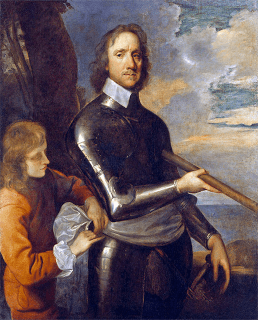
Waterford’s political community is noted for its intransigent Catholic politics. In 1646, a synod of Catholic Bishops, based in Waterford, excommunicate any Catholic who supports a treaty between the Confederates and English Royalists, which does not allow for the free practice of the Catholic religion. The Confederates finally agree to a treaty with Charles I of England in 1648, in order to join forces with the Royalists against their common enemy, the English Parliament, which is both anti-Catholic and hostile to the King. The Parliamentarians land a major expeditionary force in Ireland at Dublin, under Cromwell in August 1649.
The English Parliamentarian New Model Army arrives to besiege Waterford in October 1649. One of the stated aims of Cromwell’s invasion of Ireland is to punish the Irish for the mistreatment of Protestants in 1641. Given Waterford’s history of partisan Catholic politics, this provokes great fear amongst the townspeople. This fear is accentuated by the fate of Drogheda and nearby Wexford which had recently been taken and sacked by Cromwell’s forces and their garrisons massacred.
Waterford is very important strategically in the war in Ireland. Its port allows for the importation of arms and supplies from continental Europe and its geographical position commands the entrance of the rivers Suir and Barrow.
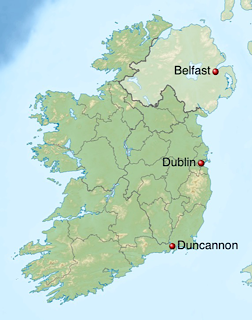
Before besieging Waterford, Cromwell has to take the surrounding garrisons held by Royalist and Confederate troops in order to secure his lines of communication and supply. Duncannon, whose fort commands the sea passage into Waterford, is besieged by Parliamentarians under Ireton from October 15 to November 5. However, due to a stubborn defence, the garrison there under Edward Wogan holds out. This means that heavy siege artillery cannot be brought up to Waterford by sea.
New Ross surrenders to Cromwell on October 19 and Carrick-on-Suir is taken on November 19. A counterattack on Carrick by Irish troops from Ulster under a Major Geoghegan is repulsed on November 24, leaving 500 of the Ulstermen dead.
Having isolated Waterford from the east and north, Cromwell arrives before the city on November 24. However, Waterford still has access to reinforcements from the west and up to 3,000 Irish soldiers from the Confederate’s Ulster Army under Richard O’Farrell are fed into the city in the course of a week. O’Farrell, having been a successful officer in the Spanish Army, is highly trained and experienced in siege warfare from battles in Flanders. Cromwell has come up against a superior minded soldier and commander. The weather is extremely cold and wet, and the Parliamentarian troops suffer heavily from disease. Out of 6,500 English Parliamentarian soldiers who besiege Waterford in 1649, only 3,000 or so are still fit by the time the siege is called off. Added to this, Cromwell is able to make little headway in taking the city. The capture of a fort at Passage East enables him to bring up siege guns by sea, but the wet weather means that it is all but impossible to transport them close enough to Waterford’s walls to use them. Farrell proves tactically superior in defending Waterford and repels Cromwell’s attempts. Eventually Cromwell has to call off the siege on December 2 and go into winter quarters at Dungarvan. Among his casualties is his commander Michael Jones, who dies of disease.
The Plantation of Ulster is the organised colonisation, or plantation, of the Irish province of Ulster by people from Great Britain during the reign of King James I. Most of the settlers, or planters, come from southern Scotland and northern England. Their culture differs from that of the native Irish. Small privately funded plantations by wealthy landowners begin in 1606, while the official plantation begins in 1609. Most of the colonised land had been confiscated from the native Gaelic chiefs, several of whom had fled Ireland for mainland Europe in 1607 following the Nine Years’ War against English rule. The official plantation comprises an estimated half a million acres of arable land in counties Armagh, Cavan, Fermanagh, Tyrone, Donegal, and Coleraine. Land in counties Antrim, Down, and Monaghan is privately colonised with the king’s support.
Among those involved in planning and overseeing the plantation are King James, the Lord Deputy of Ireland, Arthur Chichester, and the Attorney-General for Ireland, John Davies. They see the plantation as a means of controlling, anglicising, and “civilising” Ulster. The province is almost wholly Gaelic, Catholic, and rural and has been the region most resistant to English control. The plantation is also meant to sever Gaelic Ulster’s links with the Gaelic Highlands of Scotland. The colonists, or “British tenants,” are required to be English-speaking, Protestant and loyal to the king. Some of the undertakers and settlers, however, are Catholic. The Scottish settlers are mostly PresbyterianLowlanders and the English mostly Anglican Northerners. Although some “loyal” natives are granted land, the native Irish reaction to the plantation is generally hostile, and native writers bewail what they see as the decline of Gaelic society and the influx of foreigners.
The Plantation of Ulster is the biggest of the Plantations of Ireland. It leads to the founding of many of Ulster’s towns and creates a lasting Ulster Protestant community in the province with ties to Britain. It also results in many of the native Irish nobility losing their land and leads to centuries of ethnic and sectarian animosity, which at times spills into conflict, notably in the Irish Rebellion of 1641 and, more recently, the Troubles.
In September 1643, Ormond agrees to a truce, or ‘Cessation’, with the Confederation, freeing his troops for use in England against Parliament in the First English Civil War. Some Irish Protestants object, and switch sides, including Sir Charles Coote, who becomes Parliamentarian commander in Connacht. Charles surrenders in 1646, while a Covenanter/Royalist uprising is quickly suppressed in the 1648 Second English Civil War. On January 17, 1649, the Confederation allies with Ormond’s Royalists. Following the execution of Charles on January 30, they are joined by the Laggan Army and remaining Scots troops in Ulster.
There are various reasons for this. The Covenanter government, who provides support for Scottish settlers in Ulster, considers Oliver Cromwell and other leaders of the new Commonwealth of England dangerous political and religious radicals. As Scots, they object to the execution of their king by the English; as Presbyterians, they view monarchy as divinely ordained, making it also sacrilegious, and transfer their allegiance to his son, Charles II of England.
However, this is offset by a split within the Confederation, between Catholic landowners who want to preserve the position prevailing in 1641, and those like Ó Néill, whose estates had been confiscated in 1607. As a result, he agrees a truce with Coote, and refuses to join the Alliance, depriving them of their most effective fighting force in the north. Despite this, by late July, Ormond’s combined Royalist/Confederate army controls most of Ireland.
In Ulster, Derry is the only major town still held by forces loyal to the Commonwealth. The garrison is commanded by Coote, who is besieged by the Laggan Army under George Munro, Robert’s nephew. In July, Munro is forced to lift the siege by Ó Néill, an example of the impact of the truce between two unlikely allies.
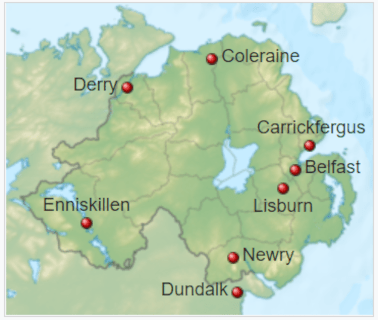
Ormond’s defeat at Rathmines on August 2 allows Cromwell and an army of 12,000 to land in Dublin unopposed. After capturing Drogheda on September 11, his main force heads south towards Wexford. Colonel Robert Venables is sent north with three regiments, or around 2,500 men, to take control of Ulster. Munro’s garrisons surrender with minimal resistance, and by the end of September, Venables has occupied Dundalk, Carlingford, Newry, and Belfast. These are accompanied by the mass expulsion of Scots settlers, as punishment for their defection. When Coote captures Coleraine on September 15, he massacres the largely Scottish garrison.
At the end of October, Coote joins Venables at Belfast. They spend November reducing remaining Royalist garrisons in the north, and in early December, assemble 3,000 men to attack Carrickfergus. After lifting the siege of Derry, Munro has retreated to Enniskillen with the remainder of the Laggan Army. Since the loss of Carrickfergus would effectively cut communications with Scotland, he is determined to prevent this if at all possible.
He combines forces with Royalist leader Lord Clandeboye, creating an army of around 5,000. However, it comprises remnants from many different regiments, its men are poorly equipped, and demoralised, while most have not been paid for over two years. As they march north, their numbers dwindle due to desertion.
Learning of their advance, Coote and Venables move to intercept Munro, and the two advance guards make contact outside Lisnagarvey, near Lisburn, on December 6. Despite superior numbers, the Royalists cannot hold their ground against their far more experienced opponents. When the main body of the Parliamentarian force appears, the retreat rapidly turns into a rout, the majority fleeing without firing a shot. In the pursuit that follows, they lose 1,500 men, killed or captured, along with their baggage train and supplies. Clandeboye and the remnants of his army surrender shortly afterwards, although Monro escapes to Enniskillen.
Lisnagarvey ends resistance by Scottish forces to the Parliamentarian army. Carrickfergus surrenders on December 13, and as with other towns, its Scottish settlers are expelled. Early in 1650, Monro agrees to evacuate Enniskillen for £500, and returns to Scotland, leaving Ó Néill’s army as the only remaining obstacle to Parliamentarian control of the north. However, his death in November 1649 proves a major blow to its morale and fighting ability. In June 1650, it is destroyed by Coote and Venables at Scarrifholis.
(Pictured: Map of key locations of the 1649 campaign in Ulster)
The Rebellion comes about because of the resentment felt by the Irish Catholics, both Gael and Old English, in regard to the loss of their lands to Protestant settlers from England and Scotland.
Irish Catholics are frightened by reports that the Covenanter army in Scotland is considering an invasion of Ireland in order to eradicate the Catholic religion. At the same time, there is also a threat of invasion by Oliver Cromwell’s Puritans who are at war against King Charles I. It is hoped that the King would redress the complaints of the Catholics and halt or even reverse the policy of plantation. It is not an act of rebellion against the Royal domain.
The uprising is led by Rory O’ Moore from Leix, with Sir Phelim Roe O’ Neill and his brother Turlough of Tyrone, the Maguires of Fermanagh, the Magennis, O’ Reilly and the MacMahons. They plan to begin the rebellion on October 23, 1641, with attacks on Dublin and various other British strongholds throughout the country. However, their plans are betrayed to the British by a native Irish convert to Protestantism, Owen O’ Connolly.
As a result of this betrayal, Dublin does not fall. However, the rebellion proceeds in the north with the towns of Dungannon, Newry, and Castleblayney, along with the fort at Charlemont falling to the rebels.
Most of the province of Ulster comes under the control of the rebel leaders. The rebel army, consisting of 30,000 men, has been instructed to take no life except in battle, to arrest the gentry and to spare the Scottish planters as they are considered kindred. For a week after the rebellion, these instructions are adhered to but many of the rebels have lost their lands to the Protestant planters, and they want revenge. They attack farms and settlements, killing and turning many people away, robbing and stripping them of all their goods.
Sir Phelim O’ Neill has been himself thought to have ordered the murder of Protestants in Tyrone and Armagh. It is believed that about 12,000 people are slaughtered although contemporary reports put the death toll as much higher. It is thought that up to 30% of the Ulster planters lost their lives while 10% is the figure for the whole of Ireland.
As the rebellion progresses in Ulster there are uprisings in Leinster by November and thereafter throughout the whole of Ireland. In Munster, where many English settlers are planted, the rebels do not shed much blood, but they do turn out these settlers, many of whom flee back to England.
In 1642 the Scottish Covenanters invade the North and they, in turn, take to killing Catholics in revenge for the deaths of Protestants. The Covenanter Clan Campbell of Argyll takes the opportunity to attack and slaughter the Catholic Rathlin Islanders who belong to ancient enemies, Clan Mac Donald. The Covenanters also slaughter the approximately 3,000 Catholics on Islandmagee. Catholic prisoners and traders in Newry are murdered.
This ruthless slaughtering of civilians, by both sides, is only brought under control when Owen Roe O’ Neill arrives back from exile in France to take control of the Confederate army and, with Major General Robert Monroe in charge of the Covenanter Army, continues the war under the code of conduct that they had both learned on the Continent. However, the effects of the rebellion last to the present day, especially in Ulster where sectarian divide remains strong during The Troubles.
(Pictured: Depiction of the massacre of Ulster Protestants during the 1641 rebellion, The LIFE Picture Collection via Getty Images)