Recriminations over his victory begin almost immediately. Unionist parties come under fire for not mounting an effective challenge. There is also sharp criticism of the failure of the moderate CatholicSocial Democratic and Labour Party (SDLP) to contest the seat. Many believe the absence of an alternative Catholic candidate ensures victory for Sands in a seat with a Catholic majority.
Sands’ election agent, Owen Carron, says the British Government has been sent a message. “The nationalist people have voted against Unionism and against the H-blocks. It is time Britain got out of Ireland and put an end to the torture of this country,” he says.
At the time of his election, Sands, 27, has served four years of a fourteen-year sentence for firearms possession. He began his hunger strike 41 days earlier to press the republican prisoners’ claim to be treated as prisoners of war.
The government has to decide how to respond to Sands’ victory. It can try to have him expelled on the grounds that he is an “unacceptable member.” However, unless he starts to eat again, he is not expected to live for more than another few weeks. He has already lost two stone and is too weak to leave his bed in the prison’s hospital wing.
Sand’s victory is the second time the voters of Fermanagh and South Tyrone have elected a republican prisoner as their MP. The first, Philip Clarke, in 1955, is disqualified because the law then does not allow convicts to take up political office.
In spite of attempts by the European Commission of Human Rights to mediate, Sands dies on May 5, 1981. He is the first of ten republican prisoners to die after hunger strikes. They attract international media attention and sympathy for the republicans.
The hunger strikes come to an end in October 1981. However, the Conservative Government of Margaret Thatcher grants the republicans only a few minor concessions.
(From: “1981: Hunger striker elected MP” on “On The Day 1950-2005,” BBC, news.bbc.co.uk)
McAleese marries Mary Leneghan in 1976. The couple resides in Scholarstown, Dublin, for a short period, and then for almost twelve years near Ratoath, County Meath. In 1980, he returns to full-time education at Trinity College Dublin (TCD), to study as a dentist, subsequently moving back, with his family, to Northern Ireland, where he practises as a dentist in Crossmaglen and Bessbrook, County Armagh.
While his wife serves as President of Ireland, McAleese initiates a series of meetings with senior Ulster loyalistparamilitary leaders to pursue peace negotiations. These actions do not take place without controversy, but are widely viewed as instrumental in bringing loyalist paramilitary groups to peace talks.
In May 2011, McAleese is appointed as a Senator by the Taoiseach Enda Kenny. In August 2011, he is appointed the Chancellor of Dublin City University, taking over from David Byrne.
On February 1, 2013, McAleese announces his intention to resign as a member of Seanad Éireann.
McAleese accepts an appointment as Chairman of the Inter-Departmental Committee which is set up by the Government of Ireland to investigate the Magdalene laundries. His findings have been criticised by some survivors and researchers from the Magdalene Names project.
On October 18-19, 2014, McAleese attends the One Young World Summit in Dublin as a keynote speaker. Here, he hosts a special session for the One Young World Peace and Conflict Resolution Project alongside former Ulster Defence Association (UDA) prisoner Jackie McDonald and former Irish Republican Army (IRA) prisoner Sean Murray. They address young people from 191 countries to share and develop ideas to strengthen efforts at conflict resolution in their own countries.
McAleese and his wife Mary have three children. The family moves to Rostrevor, County Down, in 1987, when he sets up practice in County Armagh.
Mitchell starts as a driver for Jacob’s but gets involved in robberies with associates of Martin Cahill.
In 1988, Mitchell is convicted of stealing a large amount of cattle drench and is jailed for five years. While in prison he becomes interested in the illegal drug trade and within a few years of his release he is the largest supplier of illicit drugs in the country.
In the 1990s Mitchell is arrested in Luton, Bedfordshire, England, by British police while in the possession of £575,000, a downpayment for drugs. The money is seized but he is released. In 1995, the Garda drug squad raids a house in Lucan, Dublin, and discovers an ecstasy processing plant believed to have been set up by Mitchell. In 1996, his associate, Johnny Doran, is caught with £500,000 worth of cannabis at M50 at Castleknock, Dublin. His gunman, Michael Boyle, is caught after a botched murder attempt in London, leaving him feeling vulnerable. Concerned that the Gardaí are focusing on him, he moves the centre of his operations to Amsterdam. Rumors surface that he had fled the country after being placed on an Irish Republican Army (IRA) death list, though this claim is later refuted.
Mitchell is arrested by Dutch police on March 5, 1998, after £5 million worth of computer equipment originating from Hewlett Packard in Kildare, County Kildare, is stolen from a lorry near Schiphol Airport. He is later sentenced to 30 months in prison after Dutch authorities rule he is the ringleader in the robbery. He claims in court that he is the victim of a “set up” by Irish police, who had tipped off Dutch authorities about the robbery, after he had refused to become an informant.
In 2015, Mitchell approaches Herman-Johan Xennt about setting up an encrypted phone business. He has known Xennt since at least 1998, when he was arrested for handling the stolen computer parts. Xennt had been accused of buying stolen computer parts from Mitchell. It is also claimed during a 2020 German court case that Mitchell loaned Xennt the equivalent of €700,000 in 1995 to buy a 20,000-square-foot former NATObunker on the outskirts of the southern Netherlands town of Kloetinge, which was then used to host the CyberBunkerInternet service provider (ISP).
Mernin is born in Clanbrassil Street, Dublin, on November 16, 1886. Her parents are John Mernin and Marianne “Mary” (née McGuire). She has one sister, May. Her father is a baker and confectioner of Dorset Street, Dublin. After his death when Mernin is young, the children are raised by his family in Dungarvan, County Waterford.
In the 1910s, Mernin works as a typist in a number of Dublin companies, and by 1914 she is a shorthand typist in Dublin Castle at the garrison adjutant’s office. She is a member of the Keating branch of the Gaelic League, and through this her cousin, Piaras Béaslaí, introduces her to Michael Collins in 1918. From 1919 she begins working for Collins as an intelligence agent. She uses her position in Dublin Castle to obtain important documents and, in 1920, intelligence on British intelligence officers and the auxiliary police.
Under the alias of “Little Gentleman” or “Lt. G.,” Mernin is one of Collins‘a most important agents, so much so that many believe the Little Gentleman is a British intelligence officer. One of the most important contributions she makes is identifying the homes of British intelligence officers who are later killed on Bloody Sunday, November 21, 1920, by Collins‘s Irish Republican Army (IRA) unit The Squad. She aids Frank Saurin and Tom Cullen in identifying senior British agents in Dublin, typing secret reports for Collins in a room in 19 Clonliffe Road.
In February 1922, Mernin is discharged from the British service, taking up a position as a typist in the Irish Army from July 1922 until February 1952, when she retires. She works primarily at Clancy Barracks. She is awarded a military pension for her service from 1918-1922, and her statement is held in the Bureau of Military History in the Military Archives.
Mernin never marries, although she gives birth to a son in London in June 1922, with some evidence suggesting Béaslaí is the father. She lives at 167 Mangerton Road, Drimnagh. She dies at the age of 70 on February 18, 1957, in Dublin.
Adams tells reporters, “I don’t intend to spend the rest of my life trying to shore up a process that is going to be in perpetual crisis.” His words are taken as those of an exhausted and deeply frustrated politician, angry that the bulk of the blame for the impasse has been directed at him and his colleagues.
They also raise, in a very stark way, the question of what effect the suspension of the new political institutions will have on Sinn Féin. In the days leading up to Adams’s announcement, the efforts of London and Dublin are primarily directed at saving David Trimble‘s leadership of his party. Peter Mandelson, MP for Hartlepool, emphasises the importance of this in the House of Commons on February 8. To abandon Trimble at this time would be seen as a betrayal that would even further harden political attitudes in the broad unionist community.
This leads to both governments putting a degree of pressure on the republican movement, Sinn Féin as well as the Irish Republican Army (IRA), which is having entirely predictable and dangerous results. The old, familiar sense of beleaguered isolation, summed up in the party’s name, is reasserting itself. Adams has told the British government that he believes his position as Sinn Féin’s president will very quickly become untenable if the political institutions are suspended. The most common reaction to this news is, “Well, he would, wouldn’t he?” The inference is that Adams is firing a warning shot across the bows of both governments, that there are two parties to this dispute and both need to be protected.
There is deep pessimism among republicans about what will happen if the Executive is suspended for any length of time. The fear is that it will be extremely difficult, probably impossible, to put it together again. Over a period of weeks and months, confidence in the political process, already pretty fragile at grass roots level, will likely ebb even further. Adams, Martin McGuinness, Mitchel McLauglin and others closely identified with the move to a political strategy will be seen to have failed.
One Sinn Féin source, a staunch supporter of the peace process, says, “Already there’s a widespread suspicion that we’ve been suckered into this by the British government, helped by Dublin. The long-term aim has always been to destroy Sinn Féin politically. There’s no pressure on the loyalists to disarm because they don’t represent a political threat. If Adams is seen to have misjudged this, what else can he do but resign?”
Many dismiss this as the old republican paranoia coming once again into play. But it is important to understand how this crisis appears to very many people within Sinn Féin. It is not just a matter of a hundred or so IRA activists seeing the hand-over of weapons as a surrender. There has always been a profound suspicion of politics, not only within the IRA, but at many other levels. Politics has always failed to deliver the holy grail of a united Ireland.
Some of these people believe that Gerry Adams and Martin McGuinness are cynical opportunists who have sold out for the rewards of office. Many more see them as sincere, but mistaken, in their strategy. They genuinely believe that they have been seduced by the British government, probably with the active co-operation of Dublin, by the promise of political progress. Now they are in a position where Sinn Féin is carrying all the opprobrium for the breakdown.
If, as seems likely, it is necessary to hold an election for a new assembly, Sinn Féin will be greatly weakened. The party’s hopes of taking Dáil seats will also be diminished. As Sinn Féin is seen to lose ground, there will almost certainly be a drift back to violence, sporadic at first, but gathering momentum.
This conspiracy theory, and the bleak scenario it predicts probably sounds utterly fanciful to many, those who lay the blame for this threat to the peace process squarely on the IRA. Possibly the republican movement is simply preparing itself for a retreat to the political trenches, and putting forward reasons to justify this. But there is also a danger that such an interpretation of what has happened could gain much wider credibility in the nationalist community in Northern Ireland.
There is a profound sense of disappointment that the Executive is about to be suspended. It is quite striking how many professional interest groups – doctors, teachers, farmers – express their satisfaction with local politicians and a reluctance to go back to dealing with “remote, ignorant, arrogant” British ministers.
For nationalists there has been the added satisfaction of seeing their own elected representatives taking up posts in government and performing well. For the first time, many of them feel that they are equal citizens in Northern Ireland. Now, it seems, that could be put at risk, to save David Trimble’s “pretty valuable” skin.
If this does prove to be the case, sympathy will swing back to Sinn Féin. Within his own community, Adams is not seen as having betrayed the peace process. On the contrary, along with John Hume, he is seen as one of its main architects. If Adams had decided to resign the leadership of his party, or had been forced to do so, it would have been seen by many nationalists as proving that politics, within the context of Northern Ireland, cannot work.
(From: “What future if Adams walks away from peace efforts now?” by Mary Holland, The Irish Times, http://www.irishtimes.com, February 10, 2000)
Hanna is born on February 25, 1821, near Dromara, County Down, the eldest among three sons and two (possibly three) daughters of Peter Hanna, of Dromara farming stock, and his wife Ellen (née Finiston), whose father served in the Black Watch regiment during the Napoleonic Wars. In the 1820s, leaving their children behind, his parents move to Belfast, where his father establishes a business turing out horse–cars. Hanna does not join them until the mid-1830s. His education reflects the modest nature of his upbringing. It is patchy and always combined with paid employment. In the 1830s he attends Bullick’s Academy, a privately run commercial college in Belfast. In the 1840s, seemingly with the intention of preparing for the Presbyterian ministry, he takes classes at Belfast Academical Institution. In 1847, he enters the general assembly’s newly established Theological College and, after some absences, obtains his licence to preach in 1851. During this time he works, first as a woolen draper‘s assistant in High Street and then, after 1844, as a teacher in the national school associated with Townsend Street Presbyterian Church, where he is a member. He resigns his teaching post in January 1852, only a month before being ordained to full-time ministry. On August 25, 1852, he marries Frances (‘Fanny’) Spence Rankin, daughter of James Rankin, a Belfast salesman. Together they have four daughters and two sons.
Hanna’s first, and only, pastorate is in a congregation that emerges out of the evangelistic efforts he and other Townsend Street members had conducted among the working people of north Belfast. In 1852, they begin meeting in the old Berry Street church and quickly grow from 75 to over 750 families. By 1869 a new building is essential and in 1870 the foundation stone for St. Enoch’s church is laid in Carlisle Circus, on property purchased from the Belfast Charitable Society. Opened in 1872 at a cost of nearly £10,000, it seats over 2,000 people and has two galleries. With 800 families and 2,500 Sunday-school scholars, it is one of the largest congregations in Belfast.
Hanna’s influence as the leader of such a large flock is not translated into advancement within the Presbyterian church. Although he serves as the Presbyterian chaplain to the Belfast garrison (1869–91) and as moderator of the presbytery (1879) and synod (1870–71) of Belfast, he does not achieve any position of note within the denomination as a whole. This is most likely because of his penchant for public controversy. Letters to the newspapers, calls for action in presbytery, and public platform debates over issues such as public-house licensing laws, Sabbath observance and property rights, brand him a destablising force. It is no doubt for this reason, rather than for his open-air preaching, of which he does very little, that he acquires his famous sobriquet, “Roaring Hugh.” His aggressive manner in debate is noted by the Belfast News Letter early in his career.
Hanna’s political views contribute to his reputation as an intolerant firebrand. He is part of a small group of Presbyterian clergy, led by the Rev. Henry Cooke, who are staunch defenders of the Protestant interest and active supporters of the conservative cause. He hosts ”anti-popery” lectures in his church and joins the Orange Order, serving briefly, in 1871, as the deputy grand chaplain for Belfast (County Grand Lodge). His determination to uphold the “right” of Protestants to preach in the open air sparks a series of violent sectarian riots and a government inquiry in Belfast in 1857. As the century progresses, and as the Presbyterian community’s political allegiances begin to shift, he becomes one of a group of prominent figures associated with two populist campaigns: opposition in the 1860s to the disestablishment of the Church of Ireland and subsequently to the introduction of home rule. In 1886, as one of the honorary secretaries of the Ulster Constitutional Club, he helps to found the Ulster Loyalist Anti-Repeal Union, a forerunner of what eventually becomes the Ulster Unionist Party.
Such activity overshadows Hanna’s impressive contribution to education. Within St. Enoch’s he establishes an enormous network of Sunday schools and evening classes, including a training institute for teachers. As a former teacher, and later as a commissioner of national education (1880–92), he is a firm advocate of the national system, and sets up six national schools in north and west Belfast.
Hanna receives only two honours: a Doctor of Divinity (DD) from the theological faculty of the Presbyterian Church in Ireland (1885) and a Doctor of Laws (LL.D.) from Galesville University in Galesville, Wisconsin (1888). In good health throughout his life, he dies suddenly of a heart attack on February 3, 1892. Buried with much fanfare in Balmoral Cemetery, Belfast, he is clearly held in high regard by surviving friends and colleagues. In 1892, the Orange Order approves the naming of LOL 1956 as the “Hanna Memorial,” and in 1894 a bronze statue depicting him in full ecclesiastical garb is erected in Carlisle Circus. Since then, his achievements have fallen on hard times. In March 1970, an Irish Republican Army bomb blast topples his statue from its plinth; several high-profile attempts to re-erect it fail. After an arson attack in 1985, and with falling numbers, the decision is taken in 1992 to demolish St. Enoch’s and unite with the neighbouring Duncairn church in a new, much smaller, building on the site.
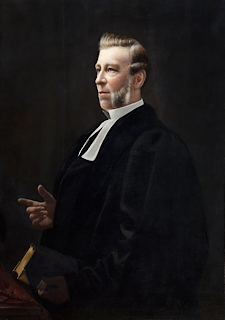
(From: “Hanna, Hugh” by Janice Holmes, Dictionary of Irish Biography, http://www.dib.ie, October 2009 | Pictured: Portrait of Reverend Hugh Hanna by Augustus George Whichelo in 1876, which is part of the collection owned by the National Museums Northern Ireland and is located in the Ulster Museum)
With a report due on Monday, January 31, and widely expected to state that the IRA is not ready to disarm, the Northern Ireland peace process appears headed for a fresh crisis. The report by Canadian Gen. John de Chastelain, head of the province’s independent commission overseeing the handing in of weapons, is expected to confirm that no arms have been turned in.
The Ireland on Sunday newspaper says de Chastelain will tell the British and Irish governments that the IRA has put most of its weapons into secret, sealed dumps in the Republic of Ireland. Such disclosures put enormous pressure on Adams, the leader of the Irish republican political party, Sinn Féin.
The UUP, the province’s main Protestant political group, has already threatened to pull out of Northern Ireland‘s fledgling power-sharing government if the IRA does not start disarming.
The UUP calls a top-level party meeting for February 12. A negative report from the decommissioning body will heighten fears that UUP leader David Trimble will make good on his threat to resign as leader of the new government, effectively allowing his party to shut down the province’s first government in 25 years.
Of Adams’s role in the disarmament process, Trimble says, “He asked us to create the circumstances to help him … we did that … we took the risk and created the situation he asked us to create. “Now we hope he now is able to demonstrate his good faith by responding.”
Adams says, “I am concerned at what appears to be an attempt by unionists to hijack the entire process, put up unilateral demands, perhaps in the course of that, tear down the institutions that are only two months in being. I understand why unionists want decommissioning. It is just not within my grasp to deliver it on their terms, and neither is it my responsibility.”
Adams says he can give no assurances that the IRA will hand over its weapons by May 22, the date set by the 1998 Good Friday Agreement for the completion of disarmament, although he stresses he is committed to decommissioning. “No, I can’t and it isn’t up to me,” Adams tells BBC Television when asked if he can guarantee disarmament by May.
Political insiders hint that the report will not be published until Monday (January 31) afternoon, suggesting the highly sensitive document is still being worked on by de Chastelain.
Any unionist pullout from the home-rule government on February 12 will create a political vacuum. Britain may intervene before that to suspend the fledgling executive, in the hope that it can be resurrected quickly if progress eventually is made on disarmament. Sinn Féin warns that either course of action could lead to the IRA breaking off contact with de Chastelain and the ending of disarmament prospects.
Meanwhile, on the eve of the report, thousands of Roman Catholics mark an event and day that symbolizes the province’s past troubles — Bloody Sunday.
Waving Irish flags, some 5,000 protesters retrace the steps of a civil rights march in Londonderry in 1972 that ended in bloodshed when British troops fired on unarmed protesters and killed thirteen people, mostly teenagers. A fourteenth man died later from his wounds. Victims’ relatives and local children carry fourteen white crosses, photos of the dead and a banner that reads, “Bloody Sunday, the day innocence died.” The march passes the scene of the killings and ends in front of Londonderry’s city hall — a spot where the 1972 march was supposed to have finished.
Organizers issue a message to British Prime MinisterTony Blair that they want a forthcoming inquiry not to end in the same way as a probe held within months of the killings, which exonerated the British soldiers by suggesting that some of the victims had handled weapons that day. “Twenty-eight years on from Bloody Sunday, there is still no recognition of the role the British government played in the premeditated attack on unarmed demonstrators,” Barbara de Brun, a top IRA official, tells the crowd.
Relatives of those killed are upset that soldiers who took part in the shootings would be allowed to remain anonymous during the new probe. They are also concerned about a newspaper report that the army recently destroyed thirteen of the rifles used by the soldiers, complicating any ballistics tests at the inquiry.
“Once again, the political and military establishment are up to their old tricks. We won’t accept a public relations exercise,” Alana Burke, who was injured by an armored car during the Bloody Sunday march, tells the crowd.
(From: “Hopes dim for IRA disarmament, peace accord” by Nic Robertson and Reuters, CNN, cnn.com, January 30, 2000)
This is a challenging time for the Catholic Church in Ireland, then led by Cardinal William Conway, as it adjusts to both the internal changes generated by the Second Vatican Council and the wider social changes. He is ill-suited to coping with these changes and in particular the violence in Northern Ireland. It is widely assumed that he sees to it that the more overtly nationalistTomás Ó Fiaich is appointed to Armagh in 1977 after the death of Cardinal Conway. The journalist and authorEd Moloney in his book on the Irish Republican Army (IRA) asserts that Alibrandi’s “sympathy for the IRA was a constant source of friction with the government in London.”
Alibrani plays a major role in the 1971 decision by the Vatican to accept the resignation of John Charles McQuaid as Archbishop of Dublin. This comes as a shock to McQuaid, who expected that he would be allowed to remain for some time after the normal retirement age of 75.
In many of the episcopal appointments made while Alibrandi is nuncio, he favours doctrinally “sound,” right-of-centre priests and in the case of the Archdiocese of Dublin picks two priests, Kevin McNamara and Desmond Connell, who are notably ill-suited. In a profile of the Archbishop at the time of his retirement, T. P. O’Mahony observes in The Tablet, “although he rarely gave interviews, and never overtly intervened in policy-making or in public controversies, it is beyond dispute that Archbishop Alibrandi wielded considerable influence behind the scenes.”
The respected academic and church historian Dermot Keogh assessing this period argues that “there was a general view that the best candidates had not been appointed…that a number were not up to the job, that most of the appointees shared a defensive attitude to matters of church and state.”
Alibrandi has “a very testy relationship with three Taoisigh – Jack Lynch, Liam Cosgrave and Garret FitzGerald.” After reaching the retirement age of 75, he returns to his home town in Sicily where he dies on July 3, 2003. His funeral Mass was celebrated on Saturday in Castiglione di Sicilia by Archbishop Paolo Romeo, Apostolic Nuncio to Italy. A memorial Mass for Archbishop Alibrandi will be celebrated by Archbishop Giuseppe Lazzarotto, Apostolic Nuncio to Ireland, on Friday, 11 July at 19.30 in the Church of Our Lady Help of Christians, Navan Road, Dublin.
It is reported in September 2012 during the second Dr. Garret FitzGerald Memorial Lecture at University College Cork (UCC) by Seán Donlon, former secretary general at the Department of Foreign Affairs, that “It came to our [Department of Foreign Affairs] attention that a substantial amount in three bank accounts in Dublin [held by the archbishop] were way in excess of what was needed to run the nunciature. The source [of the money] appeared to be South America.” Donlon goes on to say, “Because of its size, we thought it appropriate to ask if the funds belonged to the Holy See.” When contacted for an answer, Alibrandi “quickly answered ‘no’ and that they belonged to ‘family’. When it was pointed out to him that the money was then liable under Irish taxation law to DIRT, he said he would retire shortly and the accounts would be closed.”
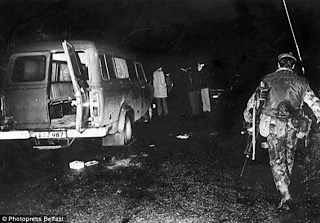
The Kingsmill massacre, also referred to as the Whitecross massacre, is a mass shooting that takes place on January 5, 1976, near the village of Whitecross in south County Armagh, Northern Ireland. Gunmen stop a minibus carrying eleven Protestant workmen, line them up alongside it and shoot them. Only one victim survives, despite having been shot 18 times. A Catholic man on the minibus is allowed to go free. A group calling itself the South Armagh Republican Action Force claims responsibility. It says the shooting is retaliation for a string of attacks on Catholic civilians in the area by Loyalists, particularly the killing of six Catholics the night before. The Kingsmill massacre is the climax of a string of tit for tat killings in the area during the mid-1970s, and is one of the deadliest mass shootings of the Troubles.
On January 5, 1976, just after 5:30 p.m., a red Ford Transit minibus is carrying sixteen textile workers home from their workplace in Glenanne. Five are Catholics and eleven are Protestants. Four of the Catholics get out at Whitecross and the bus continues along the rural road to Bessbrook. As the bus clears the rise of a hill, it is stopped by a man in combat uniform standing on the road and flashing a torch. The workers assume they are being stopped and searched by the British Army. As the bus stops, eleven gunmen in combat uniform and with blackened faces emerge from the hedges. A man “with a pronounced English accent” begins talking. He orders the workers to get out of the bus and to line up facing it with their hands on the roof. He then asks, “Who is the Catholic?” The only Catholic is Richard Hughes. His workmates, now fearing that the gunmen are loyalists who have come to kill him, try to stop him from identifying himself. However, when Hughes steps forward the gunman tell him to “get down the road and don’t look back.”
The lead gunman then says, “Right,” and the others immediately open fire on the workers. The eleven men are shot at very close range with automatic rifles, which includes Armalites, an M1 carbine and an M1 Garand. A total of 136 rounds are fired in less than a minute. The men are shot at waist height and fall to the ground, some falling on top of each other, either dead or wounded. When the initial burst of gunfire stops, the gunmen reload their weapons. The order is given to “Finish them off,” and another burst of gunfire is fired into the heaped bodies of the workmen. One of the gunmen also walks among the dying men and shoots them each in the head with a pistol as they lay on the ground. Ten of them die at the scene: John Bryans (46), Robert Chambers (19), Reginald Chapman (25), Walter Chapman (23), Robert Freeburn (50), Joseph Lemmon (46), John McConville (20), James McWhirter (58), Robert Walker (46) and Kenneth Worton (24). Alan Black (32) is the only one who survives. He had been shot eighteen times and one of the bullets had grazed his head. He says, “I didn’t even flinch because I knew if I moved there would be another one.”
After carrying out the shooting, the gunmen calmly walk away. Shortly after, a married couple comes upon the scene of the killings and begin praying beside the victims. They find the badly wounded Alan Black lying in a ditch. When an ambulance arrives, Black is taken to a hospital in Newry, where he is operated on and survives. The Catholic worker, Richard Hughes, manages to stop a car and is driven to Bessbrook Royal Ulster Constabulary (RUC) station, where he raises the alarm. One of the first police officers on the scene is Billy McCaughey, who had taken part in the Reavey killings. He says, “When we arrived it was utter carnage. Men were lying two or three together. Blood was flowing, mixed with water from the rain.” Some of the Reavey family also come upon the scene of the Kingsmill massacre while driving to hospital to collect the bodies of their relatives. Johnston Chapman, the uncle of victims Reginald and Walter Chapman, says the dead workmen were “just lying there like dogs, blood everywhere”. At least two of the victims are so badly mutilated by gunfire that immediate relatives are prevented from identifying them. One relative says the hospital mortuary “was like a butcher’s shop with bodies lying on the floor like slabs of meat.”
Nine of the dead are from the village of Bessbrook, while the bus driver, Robert Walker, is from Mountnorris. Four of the men are members of the Orange Order and two are former members of the security forces: Kenneth Worton is a former Ulster Defence Regiment (UDR) soldier while Joseph Lemmon is a former Ulster Special Constabulary (USC) officer. Alan Black is appointed a Member of the Order of the British Empire (MBE) in the 2021 New Year Honours, for his cross-community work since the massacre.
The next day, a telephone caller claims responsibility for the attack on behalf of the “South Armagh Republican Action Force” or “South Armagh Reaction Force.” He says that it was retaliation for the Reavey–O’Dowd killings the night before, and that there will be “no further action on our part” if loyalists stop their attacks. He adds that the group has no connection with the Irish Republican Army (IRA). The IRA denies responsibility for the killings as it is on a ceasefire at the time.
However, a 2011 report by the Historical Enquiries Team (HET) concludes that Provisional IRA members were responsible and that the event was planned before the Reavey and O’Dowd killings which had taken place the previous day, and that “South Armagh Republican Action Force” was a cover name. Responding to the report, Sinn Féin spokesman Mitchel McLaughlin says that he does “not dispute the sectarian nature of the killings” but continues to believe “the denials by the IRA that they were involved”. Social Democratic and Labour Party (SDLP) Assemblyman Dominic Bradley calls on Sinn Féin to “publicly accept that the HET’s forensic evidence on the firearms used puts Provisional responsibility beyond question” and to stop “deny[ing] that the Provisional IRA was in the business of organising sectarian killings on a large scale.”
The massacre is condemned by the British and Irish governments, the main political parties and Catholic and Protestant church leaders. Merlyn Rees, the British Secretary of State for Northern Ireland, condemns the massacre and forecasts that the violence will escalate, saying “This is the way it will go on unless someone in their right senses stops it, it will go on.”
The British government immediately declares County Armagh a “Special Emergency Area” and deploys hundreds of extra troops and police in the area. A battalion of the Ulster Defence Regiment (UDR) is called out and the Spearhead Battalion is sent into the area. Two days after the massacre, the British Prime MinisterHarold Wilson announces that the Special Air Service (SAS) is being sent into South Armagh. This is the first time that SAS operations in Northern Ireland are officially acknowledged. It is believed that some SAS personnel had already been in Northern Ireland for a few years. Units and personnel under SAS control are alleged to be involved in loyalist attacks.
The Kingsmill massacre is the last in the series of sectarian killings in South Armagh during the mid-1970s. According to Willie Frazer of Families Acting for Innocent Relatives (FAIR), this is a result of a deal between the local UVF and IRA groups.
(Pictured: The minibus carrying the textile factory workers is left peppered with bullet holes and blood stains the ground after the massacre, as detectives patrol the scene of the murders)
Ireland formally applies for European Economic Committee (EEC) membership in July 1961. Ó Móráin, as Minister for Lands and the Gaeltacht, delivers a widely reported address to the Castlebar Chamber of Commerce in 1962. In the speech, he argues that Ireland is “ready to subscribe to the political aims of the EEC” and that Ireland does not want to be seen as “committed” to its policy of neutrality. In the ensuing controversy, he and Lemass deny that there is any suggestion Ireland might or should abandon neutrality. Outside the country, foreign governments see this episode as a deliberately provoked debate to evaluate the government’s domestic room for manoeuvre on neutrality.
Ó Móráin is appointed Minister for Justice by Taoiseach Jack Lynch in 1968. It is in this role that he is most remembered. While he is still Minister, the Arms Crisis in Ireland erupts in 1970. This political scandal sees Government ministers Charles Haughey and Neil Blaney dismissed by the Taoiseach for alleged involvement in a conspiracy to smuggle arms to the Irish Republican Army (IRA) in Northern Ireland. Ó Móráin continually suffers from ill health, which is accentuated by his alcoholism. When the Arms Crisis erupts, Lynch comes to see him in a hospital in Galway and asks for his resignation. Ó Móráin is a witness at the subsequent Arms Trial. He testifies that he had passed on Garda intelligence reports about the involvement of ministers with the IRA to the Taoiseach before the arms were seized at Dublin Airport. Hus evidence at the trial has been described as “erratic.”
Ó Móráin loses his Dáil seat at the 1973 Irish general election and retires from politics. He dies at his home in Sutton, Dublin, in on May 6, 1983. With a Fianna Fáil guard of honour, he is buried in Castlebar. With his wife, Madge, he has one daughter, Sorcha, and two sons, John, and Michael, who dies in a road accident in 1972.

 seamus dubhghaill