Holohan is chairman of the Association of Irish Composers from 1987 to 1989 and is later appointed chairman of the Droichead Arts Centre in Drogheda, County Louth, where he has lived since 1983.
Holohan is elected to Aosdána in 1999 and later serves as a member and chair of its Toscaireacht, its ten-member steering body.
Holohan’s music has been performed and broadcast in Ireland and internationally. Career highlights in Drogheda include performances of Cromwell (1994), The Mass of Fire (1995) and No Sanctuary (1997).
Holohan’s work has been reviewed in Irish music journalism. Writing in The Journal of Music following a National Concert Hall composers’ showcase, Benedict Schlepper-Connolly describes The Dream of Aengus as demonstrating Holohan’s “orchestrational control,” and characterises Portrait of the Artist as “captivating,” while noting the influence of Irish traditional music within his choral writing.
Regional press coverage has also documented performances and recordings of his work, including reports on the release of the piano album Fields of Blue and Whiteand concerts of his music in Drogheda.
Best is born in Dublin on July 11, 1865, the youngest of fourteen children of Dublin merchant, Eldred Oldham, and Annie (née Alker). Two of her siblings are Alice Oldham, the first of nine women to graduate from university with a degree in either Great Britain or Ireland, and Charles Hubert Oldham, first professor of national economics at University College Dublin (UCD). She attends the Royal Irish Academy of Music (RIAM), studying under Margaret O’Hea and Robert Prescott Stewart. She wins the Lord O’Hagan’s prize in 1883. She is one of the first three candidates to win a scholarship to the Royal College of Music, London, in 1883, becoming an associate of the College by competitive examination in 1887. She is a close friend and confidante of the College’s director, Sir George Grove, to which his 514 letters to her from 1883 to 1899, now housed in the Royal College of Music library, testify.
Best returns to the RIAM as a piano teacher in 1887, remaining in that post until 1932. She is the first female teacher in the RIAM listed as holding a diploma in music. She is also an assistant to Michele Esposito as a local centre examiner. She is a founding member of the Feis Ceoil, undertaking large responsibility for its organisation, and it becomes an annual event under her leadership. In 1898, she describes the foundation of the Feis in a paper to the Incorporated Society of Musicians as being inspired to “ultimately do more for the art of music in Ireland than anything which has yet been attempted.” Along with Joseph Seymour and Edward Fournier she visits the Welsh Eisteddfod to compare it with the Feis, and hopes it will become as influential as the Welsh festival. She works with Eoin MacNeill and the Gaelic League to promote the Feis, and to organise prizes. Under her influence, the festival broadens its scope beyond purely Irish music. She serves as the honorary secretary of the Feis Ceoil Association from 1896 to 1905, and vice-president from 1905 to 1950. In 1897, Esposito dedicates his cantata Deirdre to her. She is a founding member of the Dublin Orchestral Society in 1899, and she succeeds Esposito as the director of music at Alexandra College, Dublin, in 1927. She is made an associate of the Royal Dublin Societyin 1892, and fellow of the RIAM in 1938.
Hammond is the son of Leslie Hammond, a tram driver, and his wife Annie (née Lamont). His parents are not city people; his mother grew up near Ballybogy in the Ballymoney area of County Antrim, and his father, though from a family with roots in south County Londonderry, had lived in Ballymoney as a boy, and had been apprenticed to a blacksmith there. Both have a strong sense of their rural identity and maintain the Ulster Scots dialect of their childhood. They are never quite at home in the Belfast suburb of Cregagh, and in particular do not share the sectarian attitudes that are much more present in 1930s Belfast than they had been in north Antrim, one of the last strongholds of Presbyterian radicalism. Even as a boy, Hammond is interested in the old songs that his mother sang and realises that the traditions in which his parents had been nurtured are disappearing quickly in an increasingly urbanising and modernising world. When he encounters the work of Emyr Estyn Evans in the early 1940s, he is encouraged to document both rural tradition and the street life of the city, and he and a couple of friends, though still just teenagers, ride off on their bicycles to look for folklore in the hinterland of Belfast.
After primary school, Hammond wins a scholarship in 1941 to Methodist College Belfast, where he does well in examinations, and then goes to Stranmillis University College to train as a teacher. In his first job, in Harding Memorial primary school in east Belfast, he proves to be a popular, idealistic teacher, and is remembered by his pupils fifty years later as a fine singer and a teller of ghost stories, who had taken the class on memorable youth-hosteling trips to the Mourne Mountains. Youth hosteling and folklore collecting increases his awareness and understanding of the rich traditions of the whole community in the north of Ireland, and he is never constrained by political or religious barriers. His early career mirrors closely that of James Hawthorne, and their paths are to cross in later life.
Hammond is friendly with many others active in the cultural life of Northern Ireland and makes a name for himself as a song collector and eventually as an expert on all aspects of traditional singing. In 1956, he is awarded a scholarship to travel in the United States to meet the important pioneers of folk-music collecting and performance there. He records his first LP record of Ulster songs, I Am The Wee Falorie Man (1958), in the United States, and becomes friends with Pete Seeger, the Appalachian singer Jean Ritchie, with old blues singers, and notably with Liam Clancy, one of the three Clancy brothers who as a quartet with Tommy Makem are to popularise Irish folk music in the United States and elsewhere.
On returning to Belfast, Hammond takes a job in 1958 in Orangefield secondary school in the east of the city, where the highly regarded headmaster John Malone encourages new approaches to education. Among his pupils at Orangefield is George Ivan “Van” Morrison, who credits him with inspiring his interest in Irish traditional music. Hammond enjoys teaching but is increasingly drawn to folk-song performance and recording. He appears regularly on radio programmes of the BBC and Radio Éireann, and in 1964 joins the school’s department in BBC Northern Ireland. There, with colleagues like Sam Hanna Bell, James Hawthorne and others, he works on programmes such as Today and Yesterday in Northern Ireland, which for the first time introduces pupils (and many adults) to local history and to aspects of tradition. In 1968, with two friends, the poets Seamus Heaney and Michael Longley, he puts on poetry and traditional music events in schools all over the province. The Arts Council funds the Room to Rhyme project, which is immensely influential and inspiring, and is still talked about many years later by those who attended as children.
Hammond is creatively involved with hundreds of hours of broadcasting, in television as well as radio, and eventually for adults as well as children. He writes scripts, produces documentary series such as Ulster in Focusand Explorations, and brings an artistic sensibility to filming, as well as working sympathetically with traditional singers and craftspeople. Dusty Bluebells, a sensitively made film of Belfast children’s street games, wins the prestigious Golden Harp award in 1972. After he leaves the BBC to work as a freelance, and founds Flying Fox Films in 1986, he continues making documentaries on many aspects of Ulster life and heritage. His film called Steel Chest, Nail in the Boot and the Barking Dog (1986), about working in the Belfast shipyards, also wins a Golden Harp award. A companion book of the same name is published. Another book is Belfast, City of Song(1989), with Maurice Leyden. In 1979, he edits a volume of the songs of Thomas Moore. His documentary programmes include films about singers from Boho, County Fermanagh, and about the big houses of the gentry in Ireland. The Magic Fiddle (1991/2) examines the role of the instrument in the folk music of Ireland, Scandinavia, Canada, and the American south, while Another Kind of Freedom (1993) is about the experiences of a former Orangefield pupil, the Beirut hostage Brian Keenan. He also produces and directs the films Something to Write Home About (1998), Where Are You Now? (1999), and Bogland (1999), all of which explore Seamus Heaney’s home region and experiences.
The first poem in Heaney’s collection Wintering Out (1972) is entitled “For David Hammond and Michael Longley.” Their lifelong friendship leads to several other creative collaborations. In particular, after a distressing evening in 1972 when Hammond, affected by the despair and terror unleashed by Irish Republican Army (IRA) bombing of his city, is for once unable to sing, Heaney meditates on the experience in an essay and in an important poem, “The singer’s house” (subsequently included in his 1979 Field Work collection). The poem urges the singer to keep singing, to defend the values of art and friendship in a hostile time. Hammond collaborates with Dónal Lunny and other traditional musicians to bring out an LP also called The Singer’s House(1978), which includes Heaney’s poem on the album sleeve, and features some of the songs that he had made famous, such as “My Aunt Jane” and “Bonny Woodgreen,” from his vast repertoire of songs from Ulster. The album is reissued in 1980.
In 1995, Hammond is one of Heaney’s personal guests at the award of his Nobel prize in Stockholm, characteristically wearing his usual, mustard-yellow, cattle-dealer boots with evening dress. On another formal occasion, when he is awarded an honorary doctorate by Dublin City University in November 2003, he surprises the audience by standing up in his academic robes to sing “My Lagan love,” instead of giving an address. His unique, light mellow voice is an ideal vehicle for the traditional ballads which he knows so well. He records a number of records in the 1960s, including Belfast Street Songs, and publishes the book Songs of Belfast (1978). He also encourages traditional musicians like Arty McGlynn, and collaborates with them on various recording projects. He is well known for live and often impromptu performances at festivals and venues in Ireland and the United States. He also performs at the John F. Kennedy Center for the Performing Arts in Washington, D.C.
Hammond is also a notable collaborator with poets and dramatists, especially in the important Field Day Theatre Company project, of which he is a director, along with Seamus Heaney, Tom Paulin, Seamus Deane, Thomas Kilroy, and the project’s founders, Brian Friel and Stephen Rea. He supports the Field Day search for a “fifth province,” where history and community and culture can intersect, believing that to speak unthinkingly of “two traditions” is to perpetuate superficial political divisions. As he says in an interview in The Irish Times on July 4, 1998, songs can “take you out of yourself” and become bridges to unite people.
Hammond receives many honours. In 1994, he receives the Estyn Evans award for his contribution to mutual understanding, and his work is featured in several major events in his honour: in the University of North Florida (1999), in the Celtic Film Festival in Belfast (2003), and in Belfast’s Linen Hall Library (2005). A Time to Dream, a film about his life and work, is broadcast on BBC Northern Ireland in December 2008.
Hammond dies in hospital in Belfast, after a long illness, on August 25, 2008, survived by his wife Eileen (née Hambleton), whom he marries on July 19, 1954, and by their son and three daughters. His funeral in St. Finnian’s Church is a major cultural event, where friends sing, play and speak in his honour.
In Seamus Heaney’s last collection of poetry, Human Chain (2010), he includes a poignant farewell to Hammond. The poet imagines (or perhaps dreams) of another visit to the singer’s house, but this time “The door was open, and the house was dark.”
(From: “Hammond, David Andrew (‘Davy’)” by Linde Lunney, Dictionary of Irish Biography, http://www.dib.ie, December 2014)
According to Sam Smyth in the Irish Independent, Mac Mathúna is “on a mission to collect songs and stories, music, poetry and dance before they were buried under the coming tsunami of pop music.”
Mac Mathúna presents the radio programme, Mo Cheol Thú, for 35 years. Upon his retirement in 2005, the managing director of RTÉ Radio, Adrian Moynes, describes him as “inseparable from RTÉ Radio.” Upon his death in 2009, the Irish Independent describes him as “a national treasure.”
After college Mac Mathúna works as a teacher and later at the Placenames Commission. In 1954, he joins Radio Éireann where his job is to record Irish traditional musicians playing in their own locales. This entails visiting such places as Sliabh Luachra, County Clare and County Sligo, and the resulting recordings feature in his radio programmes: Ceolta Tire, A Job of Journeywork and Humours of Donnybrook.
Mac Mathúna’s long-running Sunday morning radio series, Mo Cheol Thú (You are my music), begins in 1970 and continues until November 2005, when he retires from broadcasting. Each 45-minute programme offers a miscellany of archive music, poetry and folklore, mainly of Irish origin. It is one of radio’s longest running programmes. The last episode is broadcast on November 27, 2005, at 8:10 a.m.
Mac Mathúna wins two Jacob’s Awards, in 1969 and 1990, for his RTÉ Radio programmes promoting Irish traditional music. He receives the Freedom of Limerick city in June 2004. He is also awarded honorary doctorates by NUI Galway and the University of Limerick. In 2007, he receives the Musicians Award at the 10th annual TG4 Traditional Music Awards.
Joe Kennedy in the Sunday Independent in 2007 compares Mac Mathúna to “an amiable rock, rolling gently along, still picking up some moss and morsels of music that he may have missed.”
Mac Mathúna‘s wife, Dolly MacMahon (using the English version of her surname), is a singer of traditional songs. She comes from Galway and meets her husband in 1955. He has two sons named Padraic and Ciarán, one daughter named Déirdre, and four grandchildren at the time of his death: Eoin, Colm, Conor and Liam.
Musicians performing at the ceremony include Peadar Ó Riada, Cór Cúil Aodha and members of The Chieftains and Planxty. The corpse is then taken to Mount Jerome Crematorium. Journalist Kevin Myers says Mac Mathúna’s legacy will be the “rebirth of Irish music,” adding, “Well, if Ciarán Mac Mathúna can die, I suppose anyone can. Actually, I had always thought that he was immortal. He certainly appeared to have all the ingredients.”
Three years after moving to the United States, Moloney co-founds Green Fields of America, an ensemble of Irish musicians, singers, and dancers which tour across the country on several occasions. He also serves as the artistic director for several major arts tours. One of these is the 1985 festival in Manhattan titled “Cherish the Ladies” to highlight female musicians in the area of Irish traditional music, which had been dominated by men until that decade. He produces an album for the female group by the same name titled Irish Women Musicians in America. The group’s leader, Joanie Madden, is one of several future fellows of the National Endowment for the Arts (NEA) to be mentored by Moloney. He produces and performs on over 70 albums and serves as advisor for numerous festivals and concerts across America, with ethnomusicologist and musician Daniel T. Neely putting the figure as high as 125 albums.
In addition to music performance, Moloney writes Far from the Shamrock Shore: The Story of Irish American History Through Song, which is published by Crown Publications in February 2002 with a supplementary CD on Shanachie Records. He hosts three nationally syndicated series covering folk music on American Public Television (APT). He works as a consultant, performer, and interviewee on the RTÉ special Bringing It All Back Home, and is also a participant, consultant, and music arranger for Out of Ireland, a documentary film by PBS. He performs on the PBS special The Irish in America: Long Journey Home.
Moloney is married three times over the course of his life. His first marriage is to Miriam Murphy. His second marriage is to Philomena Murray. Together, they have one child but eventually divorce. His third marriage to Judy Sherman also ends in divorce. He is in a domestic partnership with Sangjan Chailungka at the time of his death. During his later years, he divides his time between Bangkok, where he resides with Chailungka, and his apartment in Greenwich Village. In Bangkok, he volunteers as a music therapist and teacher for abandoned children with HIV at the Mercy Center in the Khlong Toei district, which is founded by the Redemptorist priest Joseph H. Maier.
Moloney dies at the age of 77 on July 27, 2022, at his home in Manhattan, having played at the Maine Celtic Festival less than a week before. The cause of death is not announced.
Clancy is born on March 7, 1922, at Carrick-on-Suir, County Tipperary, one of eleven children and the eldest of four boys born to Johanna McGrath and Bob Clancy. During World War II he serves as a flight engineer in the Royal Air Force in India. After his demobilization, Clancy works as a baker in London. In 1947 he emigrates to Toronto, Canada with his brother Tom Clancy. The following year, the two brothers move to Cleveland, Ohio to stay with relatives. Later, they attempt to move to California, but their car breaks down and they relocate to the New York City area instead.
After moving to Greenwich Village in 1951, both Patrick and Tom devote themselves primarily to careers in the theater. In addition to appearing in various Off-Broadway productions and television shows, they produce and star in plays at the Cherry Lane Theatre in Greenwich Village and at a playhouse in Martha’s Vineyard. After losing money on some unsuccessful plays, the brothers begin singing concerts of folk songs after their evening acting jobs are over. They soon dub these concerts “Midnight Specials” and the “Swapping Song Fair.” Patrick and Tom are often joined by other prominent folk singers of the day, including Pete Seeger, Woody Guthrie, and Jean Ritchie.
In 1956 their younger brother, Liam Clancy, immigrates to New York, where he teams up with Tommy Makem, whom he had met while collecting folk songs in Ireland. The two begin singing together at Gerde’s Folk City, a club in Greenwich Village. Patrick and Tom sing with them on occasion, usually in informal folk “sing-songs” in the Village. Around the same time, Patrick founds Tradition Records with folk-song collector and heiress Diane Hamilton, and in 1956 the Clancy Brothers and Tommy Makem release their first album, The Rising of the Moon, with only Patrick’s harmonica as musical accompaniment. However, the Clancys and Makem do not become a permanent singing group until 1959.
In the late 1950s, Clancy with his brothers and Makem begin to take singing more seriously as a permanent career, and soon they record their second album, Come Fill Your Glass with Us. This album proves to be more successful than their debut album, and they begin receiving job offers as singers at important nightclubs, including the Gate of Horn in Chicago and the Blue Angel in New York City. The group garners nationwide fame in the United States after an appearance on The Ed Sullivan Show, which leads to a contract with Columbia Records in 1961. Over the course of the 1960s, the Clancy Brothers and Tommy Makem record approximately two albums a year for Columbia. By 1964, Billboard magazine reports that the group was outselling Elvis Presley in Ireland.
The group performs together on stage, recordings, and television to great acclaim in the United States, Ireland, the United Kingdom, Canada, and Australia until Tommy Makem leaves to pursue a solo career in 1969. They continue performing first with Bobby Clancy and then with Louis Killen until Liam leaves in 1976 also to pursue a solo career. In 1977 after a short hiatus, the group reforms with Patrick, Tom, and Bobby Clancy and their nephew Robbie O’Connell. Liam returns in 1990 after the death of Tom Clancy.
In 1968, after two decades in North America, Clancy returns to live in Carrick-on-Suir, where he purchases a dairy farm and breeds exotic cattle. When not on tour or working on his farm, he spends much of his time fishing, reading, and doing crossword puzzles. In the late 1990s, he is diagnosed with a brain tumor. The tumor is successfully removed, but he is also stricken with terminal lung cancer around the same time. He continues performing until his failing health prevents him from doing so any longer.
Patrick Clancy dies at home of lung cancer on November 11, 1998, at the age of 76. He is buried, wearing his trademark white cap, in the tiny village of Faugheen, near Carrick-on-Suir.
Thompson is the youngest child of the social historians and peace activists E. P. Thompson and Dorothy Towers. She has lived in Ireland since 1981 and many of her books are set there. She trains racehorses in the UK and United States and travels extensively in India before settling in 1984 in Inagh, County Clare, in the west of Ireland with her partner Conor Minogue. They have two daughters, Cliodhna and Dearbhla. She is an accomplished fiddler with an interest in Irish traditional music, which is reflected in The New Policeman (2005).
O’Flynn is acknowledged as Ireland’s foremost exponent of the uilleann pipes and brings the music of the instrument to a worldwide audience. In 2007, he is named TG4 Musician of the Year at the Gradam Ceoil TG4, considered to be the foremost recognition given to traditional Irish musicians.
O’Flynn is born to musical parents. His father, Liam, is a teacher and fiddle player. His mother, Maisie (née Scanlan), who comes from a family of musicians from County Clare, plays and teaches piano. From an early age, he shows musical talent, and is encouraged to pursue his interest in the uilleann pipes by the piper Tom Armstrong. At the age of 11, he begins taking classes with Leo Rowsome. He is also influenced by Willie Clancy and Séamus Ennis. In the 1960s, he begins to receive recognition of his talent, winning prizes at the Oireachtas na Gaeilge and the Fleadh Cheoil. During his early years, he is sometimes billed as Liam Óg Ó Flynn.
In 1972, O’Flynn co-founds the Irish traditional music group Planxty, alongside Christy Moore, Andy Irvine and Dónal Lunny and remains a member throughout the band’s various incarnations. While Seán Ó Riada and The Chieftains had reinvigorated Irish traditional instrumental music in an ensemble format during the 1960s, Planxty builds on that foundation and takes it one step further. They bring a punch and vitality to acoustic music that draws heavily on O’Flynn’s piping virtuosity.
As O’Flynn grows in his skill as a musician and as he begins to meet pipers like Willie Clancy and Séamus Ennis, he becomes acutely aware of his position in the tradition of piping. His subsequent close friendship with Ennis, which starts as a master/pupil relationship, teaches him that there is much more to being a piper than playing tunes. He notes, “Seamus Ennis gave me much more than a bag of notes.”
“When I’m playing, I’m certainly lost within it. The only way to describe it, is that it’s like looking inwards. I think when a performer engages with the audience, and vice versa, it’s like a spell is cast and a terrific passage of feelings moves from the musician to the audience and back again.”
Following the break-up of Planxty in 1983, O’Flynn finds work as a session musician with such prominent artists as The Everly Brothers, Enya, Kate Bush, Nigel Kennedy, Rita Connolly, and Mark Knopfler. He also works on film scores, including Kidnapped (1979) and A River Runs Through It (1992). He is adventurous enough to work with avant-garde composer John Cage, but his most natural alliance is with neo-romantic composer Shaun Davey.
The Bothy Band are natural successors to the original Planxty, and one of its members, Matt Molloy, who subsequently joins The Chieftains, plays with The Chieftains’ fiddler Seán Keane on O’Flynn’s album, The Piper’s Call, which is performed in the 1999 BBC Proms season at the Royal Albert Hall. He also works on projects with Seamus Heaney, mixing poetry with music.
O’Flynn’s name is mentioned in Christy Moore’s song “Lisdoonvarna.”
O’Flynn dies in a Dublin hospital on March 14, 2018, following a long illness. His cremated remains rest at Newlands Cross Cemetery and Crematorium in Dublin.
The Liam O’Flynn Award is awarded each year by the Arts Council and the National Concert Hall to recognise individual creativity in Traditional Irish music. Awardees include Úna Monaghan, Barry Kerr, Jack Talty, Louise Mulcahy and Strange Boy (aka Jordan Kelly).
Hammond is born on December 5, 1928, in Miss Kells’s nursing home on the Castlereagh Road in Belfast, the son of Leslie Hammond, a tram driver, and his wife Annie (née Lamont). His parents are not city people; his mother grew up near Ballybogy in the Ballymoney area of County Antrim, and his father, though from a family with roots in south County Londonderry, had lived in Ballymoney as a boy, and had been apprenticed to a blacksmith there. Both have a strong sense of their rural identity and maintain the Ulster Scots dialect of their childhood. They are never quite at home in the Belfast suburb of Cregagh, and in particular do not share the sectarian attitudes that are much more present in 1930s Belfast than they had been in north Antrim, one of the last strongholds of Presbyterian radicalism. Even as a boy, Hammond is interested in the old songs that his mother sang and realises that the traditions in which his parents had been nurtured are disappearing quickly in an increasingly urbanising and modernising world. When he encounters the work of Emyr Estyn Evans in the early 1940s, he is encouraged to document both rural tradition and the street life of the city, and he and a couple of friends, though still just teenagers, ride off on their bicycles to look for folklore in the hinterland of Belfast.
After primary school, Hammond wins a scholarship in 1941 to Methodist College Belfast, where he does well in examinations, and then goes to Stranmillis University College to train as a teacher. In his first job, in Harding Memorial primary school in east Belfast, he proves to be a popular, idealistic teacher, and is remembered by his pupils fifty years later as a fine singer and a teller of ghost stories, who had taken the class on memorable youth-hosteling trips to the Mourne Mountains. Youth hosteling and folklore collecting increases his awareness and understanding of the rich traditions of the whole community in the north of Ireland, and he is never constrained by political or religious barriers. His early career mirrors closely that of James Hawthorne, and their paths are to cross in later life.
Hammond is friendly with many others active in the cultural life of Northern Ireland and makes a name for himself as a song collector and eventually as an expert on all aspects of traditional singing. In 1956, he is awarded a scholarship to travel in the United States to meet the important pioneers of folk-music collecting and performance there. He records his first LP record of Ulster songs, I Am The Wee Falorie Man (1958), in the United States, and becomes friends with Pete Seeger, the Appalachian singer Jean Ritchie, with old blues singers, and notably with Liam Clancy, one of the three Clancy brothers who as a quartet with Tommy Makem are to popularise Irish folk music in the United States and elsewhere.
On returning to Belfast, Hammond takes a job in 1958 in Orangefield secondary school in the east of the city, where the highly regarded headmaster John Malone encourages new approaches to education. Among his pupils at Orangefield is George Ivan “Van” Morrison, who credits him with inspiring his interest in Irish traditional music. Hammond enjoys teaching but is increasingly drawn to folk-song performance and recording. He appears regularly on radio programmes of the BBC and Radio Éireann, and in 1964 joins the school’s department in BBC Northern Ireland. There, with colleagues like Sam Hanna Bell, James Hawthorne and others, he works on programmes such as Today and Yesterday in Northern Ireland, which for the first time introduces pupils (and many adults) to local history and to aspects of tradition. In 1968, with two friends, the poets Seamus Heaney and Michael Longley, he puts on poetry and traditional music events in schools all over the province. The Arts Council funds the Room to Rhyme project, which is immensely influential and inspiring, and is still talked about many years later by those who attended as children.
Hammond is creatively involved with hundreds of hours of broadcasting, in television as well as radio, and eventually for adults as well as children. He writes scripts, produces documentary series such as Ulster in Focus and Explorations, and brings an artistic sensibility to filming, as well as working sympathetically with traditional singers and craftspeople. Dusty Bluebells, a sensitively made film of Belfast children’s street games, wins the prestigious Golden Harp award in 1972. After he leaves the BBC to work as a freelance, and founds Flying Fox Films in 1986, he continues making documentaries on many aspects of Ulster life and heritage. His film called Steel Chest, Nail in the Boot and the Barking Dog (1986), about working in the Belfast shipyards, also wins a Golden Harp award. A companion book of the same name is published. Another book is Belfast, City of Song (1989), with Maurice Leyden. In 1979, he edits a volume of the songs of Thomas Moore. His documentary programmes include films about singers from Boho, County Fermanagh, and about the big houses of the gentry in Ireland. The Magic Fiddle (1991/2) examines the role of the instrument in the folk music of Ireland, Scandinavia, Canada, and the American south, while Another Kind of Freedom (1993) is about the experiences of a former Orangefield pupil, the Beirut hostage Brian Keenan. He also produces and directs the films Something to Write Home About (1998), Where Are You Now? (1999), and Bogland (1999), all of which explore Seamus Heaney’s home region and experiences.
The first poem in Heaney’s collection Wintering Out (1972) is entitled “For David Hammond and Michael Longley.” Their lifelong friendship leads to several other creative collaborations. In particular, after a distressing evening in 1972 when Hammond, affected by the despair and terror unleashed by Irish Republican Army (IRA) bombing of his city, is for once unable to sing, Heaney meditates on the experience in an essay and in an important poem, “The singer’s house” (subsequently included in his 1979 Field Work collection). The poem urges the singer to keep singing, to defend the values of art and friendship in a hostile time. Hammond collaborates with Dónal Lunny and other traditional musicians to bring out an LP also called The Singer’s House (1978), which includes Heaney’s poem on the album sleeve, and features some of the songs that he had made famous, such as “My Aunt Jane” and “Bonny Woodgreen,” from his vast repertoire of songs from Ulster. The album is reissued in 1980.
In 1995, Hammond is one of Heaney’s personal guests at the award of his Nobel prize in Stockholm, characteristically wearing his usual, mustard-yellow, cattle-dealer boots with evening dress. On another formal occasion, when he is awarded an honorary doctorate by Dublin City University in November 2003, he surprises the audience by standing up in his academic robes to sing “My Lagan love,” instead of giving an address. His unique, light mellow voice is an ideal vehicle for the traditional ballads which he knows so well. He records a number of records in the 1960s, including Belfast Street Songs, and publishes the book Songs of Belfast (1978). He also encourages traditional musicians like Arty McGlynn, and collaborates with them on various recording projects. He is well known for live and often impromptu performances at festivals and venues in Ireland and the United States. He also performs at the John F. Kennedy Center for the Performing Arts in Washington, D.C.
Hammond is also a notable collaborator with poets and dramatists, especially in the important Field Day Theatre Company project, of which he is a director, along with Seamus Heaney, Tom Paulin, Seamus Deane, Thomas Kilroy, and the project’s founders, Brian Friel and Stephen Rea. He supports the Field Day search for a “fifth province,” where history and community and culture can intersect, believing that to speak unthinkingly of “two traditions” is to perpetuate superficial political divisions. As he says in an interview in The Irish Times on July 4, 1998, songs can “take you out of yourself” and become bridges to unite people.
Hammond receives many honours. In 1994, he receives the Estyn Evans award for his contribution to mutual understanding, and his work is featured in several major events in his honour: in the University of North Florida (1999), in the Celtic Film Festival in Belfast (2003), and in Belfast’s Linen Hall Library (2005). A Time to Dream, a film about his life and work, is broadcast on BBC Northern Ireland in December 2008.
Hammond dies in hospital in Belfast, after a long illness, on August 25, 2008, survived by his wife Eileen (née Hambleton), whom he marries on July 19, 1954, and by their son and three daughters. His funeral in St Finnian’s church is a major cultural event, where friends sing, play and speak in his honour.
In Seamus Heaney’s last collection of poetry, Human Chain (2010), he includes a poignant farewell to Hammond. The poet imagines (or perhaps dreams) of another visit to the singer’s house, but this time “The door was open, and the house was dark.”
(From: “Hammond, David Andrew (‘Davy’)” by Linde Lunney, Dictionary of Irish Biography, http://www.dib.ie, December 2014)
John Havelock Nelson, composer and conductor, dies in Belfast, Northern Ireland, on August 5, 1996. He makes an immense contribution to the development of the cultural life of the province – and beyond – over the second half of the 20th century.
Nelson is born of middle-class parents in Cork, County Cork, on May 25, 1917, his distinctive forename being taken from a cousin of his mother who lost his life in World War I. Despite his birthplace, both his parents’ ancestral roots lie firmly in Northern Ireland.
Nelson’s father Robert comes from Larne, County Antrim, where he was raised. However, the early years of his mother Grace are quite eventful. She is born in the Belgian Congo on account of her father’s placement there as a missionary in the latter years of the 19th century (his family hail from Tobermore, County Londonderry). She is eventually sent home at an early age, due to the threat of malaria, and is raised in Belfast by an aunt and uncle who have no family of their own. It appears that Nelson inherits his musical genes from both parents. Although his father is trained as a chartered accountant, he is a capable baritone singer who studies in the early 1900s with C. J. Brennan, later to become the organist and choirmaster at St. Anne’s Cathedral, Belfast). Meanwhile, his mother shows talent as a pianist during her upbringing in her adopted city and by her early 20s is offering her services as an accompanist.
By chance, this is how his parents meet. They marry in 1916, shortly before their arrival in Cork where Robert takes up his first accountancy job. Within a month of Nelson’s birth, the family moves to Dublin where his father has secured a better post, eventually settling near Dún Laoghaire, just south of the capital city. From the age of five, now the eldest of four brothers born a year apart, he starts piano lessons and makes such rapid progress that, by the age of ten, he is able to play in a piano trio and to accompany his father in informal concerts. By the age of twelve, he wins a scholarship to the Royal Irish Academy of Music, Dublin, giving him the opportunity to study piano and theory and helping him to establish his core musical skills. Soon he adds conducting and organ lessons to his study programme.
As far as Nelson’s general education is concerned, this is completed at St. Andrew’s College, Dublin, where he excels in English, history and the sciences. By his late teens, he is determined to pursue a professional career as a musician. His father, however, exercises caution in this regard, advising him to take a science degree in the first instance. Consequently, he gains entry to Trinity College Dublin (TCD) in 1935 to read Natural Science, then makes a decision the following year to change to Medical Science. By 1939, he completes his primary degree in Medical Science, leading to doctoral research in bacteriology. At the same time, he begins a 4-year music degree at TCD while remaining musically active outside the university in relation to his piano studies, and also co-founds and conducts the Dublin Orchestral Players, a body that continues to provide an invaluable platform for amateur performers. He completes his university studies in 1943, graduating with a PhD in Medical Science and a primary Music degree. Seven years later he also completes a doctorate in Music from the same university.
His university career now behind him, like many fellow Irishmen, Nelson feels a desire to contribute to the World War II effort and applies for a commission in the medical branch of the Royal Air Force (RAF) in 1944. Eventually, he is called up and located at RAF Halton, Buckinghamshire, where he remains until after the end of the War, only returning to Dublin for his marriage in 1945. By nature, an outgoing, sociable person, he wastes no time in immersing himself in music-making activities when off duty, both inside and outside his RAF base. It is during this immediate post-war period that he becomes convinced that he wants to pursue a career in music. By chance, his attention is drawn to a BBC advertisement regarding a number of regional posts for staff accompanists, including Northern Ireland. His application is successful, and he reports for duty at BBC Northern Ireland in March 1947, where he remains for the next 30 years. In his new post, his main role is to play and accompany on the piano. To this end, he becomes involved in a number of new radio programmes, notably Children’s Hour. Elsewhere, he composes and arranges music for adult dramas and serials, the best known being The McCooeys. Another responsibility is to assist in auditioning local musicians for broadcasting opportunities, a process that uncovers much local talent, including a young James Galway. While his activities revolve around radio work in the 1950s, the next 20 years embrace opportunities arising from the new medium of television, including the popular Songs of Praise which involve him as conductor.
Nelson’s decision to retire from the BBC in 1977 enables him to focus fully on his free-lance career which had been running parallel, up until then, with his broadcasting work. In this capacity he is able to give full rein to his diverse range of musical skills as choral and orchestral conductor, chamber musician, music-festival adjudicator, composer and arranger. One should not overlook his role as animateur in founding the Studio Symphony Orchestra (1947) and the Studio Opera Group (1950). Both became integral parts of the local cultural scene during Nelson’s lifetime. His contribution as a festival adjudicator is an important activity, notably when undertaking tours abroad, including to Canada and the Caribbean. His visits to the latter area lead him to form the Trinidad and Tobago Opera Company shortly after his BBC retirement. In his busy lifestyle, he makes time to satisfy his creative energy as a composer and arranger. In total he publishes over 100 pieces, many inspired by his love of Irish traditional song and are of short duration and scored for a variety of vocal combinations. His enjoyment of his reputation as a piano accompanist of international standing is confirmed by his association with some of the leading Irish and British professional singers of the period, including Bernadette Greevy (soprano), Margaret Marshall (soprano), Peter Pears (tenor) and Ian Wallace (bass-baritone).
During his lifetime, Nelson’s outstanding services to music, both inside and outside the province, are recognised by a number of awards. The first of these is an OBE in 1966, followed in the latter part of his life by four honorary doctorates, three from local universities. A gifted and versatile musician, his personality is described by one colleague as “magnetic”- he has the unique ability to reach out to everybody irrespective of their age, status and position in life in whatever role he performs. In his best-known role as a conductor, a critic says of him that, “Dr. Nelson has a remarkable touch in getting people to do what he wants in the pleasantest way possible.” His vision and determination help to establish a vibrant music culture throughout Northern Ireland, an achievement that will remain his lasting legacy.
Nelson is survived by his three children and eight grandchildren; his wife Hazel having predeceased him in 1983.


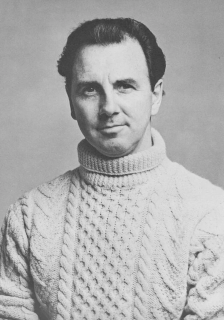


 seamus dubhghaill