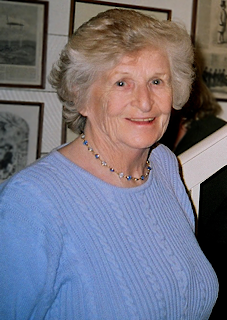
Ronnie Masterson, one of the best-known Irish stage actors of her generation from the 1940s to the 1970s, dies at the age of 87 in Rush, County Dublin, on February 10, 2014. Following her stage career she builds a solid film and television career with RTÉ, and independent directors including Peter Kosminsky, Alan Parker and Neil Jordan.
Masterson is born in Dublin on April 4, 1926. She trains at the Abbey Theatre and first appears on stage there in 1944. At the Abbey, she meets and then marries actor Ray McAnally in 1951, and they remain married until his death in 1989, although they reside in different homes; her husband with Irish actress Britta Smith. McAnally and Masterson have four children: Conor, Aonghus, Máire and Niamh.
Kennedy’s Children nearly bankrupts the company, having to be pulled early in a 14-week run, when playgoers in Dublin mistake its title as an adverse comment on the children of assassinated and revered U.S. presidentJohn F. Kennedy, whereas the play is actually a series of monologues exploratory of U.S. society in the Vietnam War era. They are rescued by two giants of Irish independent theatre, Phyllis Ryan of Gemini Productions – whose Eblana Theatre the couple had hired- and John B. Keane, who has just published Letters of a Matchmaker , a novel written as a series of letters between a rural matchmaker and his clients.
Masterson’s best film work is probably as a memorable Grandma Sheehan in Alan Parker’s screen version of Frank McCourt‘s Angela’s Ashesin 1999, where, in her own words in an interview with her grandson, Aonghus Óg McAnally, she says, “Without doubt I had the best script.”
Other notable film roles include Fools of Fortune, The Real Charlotte and Kosminsky’s dramatisation of the events which led to the Stalker inquiry in Northern Ireland, Shoot to Kill, where she plays Mrs. Tighe opposite her old Abbey colleague Peadar Lamb, as Mr. Tighe.
Speaking to The Irish Times , Lamb remarks how, as a young actor at the Abbey in 1949, Masterson had been a “striking” Kathleen Ní Houlihan in W. B. Yeats‘s play, her height, green eyes and vivid red hair perfect for the part.
Lamb, who serves for many years with Masterson on the committee of Irish Actors’ Equity Association, pays tribute also to her work for other actors: “She didn’t waste words, but spoke very strongly when she did speak.” RTÉ producer Laurence Foster also pays a tribute to this aspect of Masterson’s career on the SIPTU website.
In November 2005, Masterson is in the United States again, this time to take the lead role in The Sea Captain, a short film directed by her son, veteran television producer Conor McAnally.
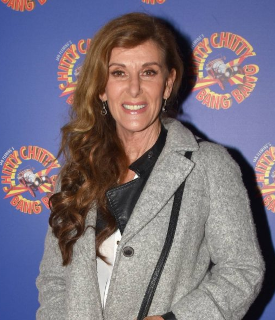
Linda Martin, Northern Irish singer and television presenter, is born in Belfast, Northern Ireland on March 27, 1952. She is best known as the winner of the 1992 Eurovision Song Contest during which she represents Ireland with the song “Why Me?,” the first of a record three consecutive wins by Ireland. She is also known within Ireland as a member of the band Chips.
Martin is of Irish, Scottish and Italian ancestry. Her father’s family’s surname is originally Martini. Her paternal great-grandfather, Francis Martini, is born in Dublin to immigrants from Saronno, north of Milan, Italy. Two of her maternal great-grandparents, William Green and Elizabeth Nangle, have a coal-mining background and transferred to Belfast from Larkhall, Scotland.
Martin begins her musical career when she joins the band Chips in Omagh in 1969. They quickly become one of the top bands in Ireland on the live circuit, and release hit singles “Love Matters,” “Twice a Week” and “Goodbye Goodbye” during the mid-to-late 1970s. In 1972, she leaves Chips to be a vocalist with the new group Lyttle People but rejoins her former bandmates the following year.
The group appears on Opportunity Knocks in 1974 and appears a number of times on British television promoting their singles, but never scores a UK hit. With multiple entries to the Irish National finals of the Eurovision Song Contest, the band carries on into the 1980s. They score a final Irish hit in 1982 with “David’s Song (Who’ll Come With Me),” after which Martin leaves when she wins the Castlebar Song Contest with “Edge of the Universe” in 1983. From this point, she concentrates on a solo career as well as occasional live appearances with Chips until they recruit a new lead singer, Valerie Roe, in the late 1980s.
Martin participates in the National Song Contest four times as a member of Chips; however, they do not score successfully. She participates another four times in the contest as a soloist and once more as part of the group “Linda Martin and Friends.” With nine participations, she has been the most frequent entrant in the National Song Contest’s history. She wins the contest twice, going on to represent Ireland twice at the Eurovision Song Contest.
The first of these victories is in 1984 with the song “Terminal 3,” written by Johnny Logan. The song comes in second in the final, being beaten by eight points. “Terminal 3” reaches No. 7 in the Irish charts. The second victory is in 1992 when her song “Why Me?,” also written by Logan, goes on to win the final in Sweden. This becomes Ireland’s fourth victory in the Eurovision Song Contest, and the song reaches No. 1 in the Irish chart as well as becoming a hit in many European countries.
Martin is, at the time, one of only three artists to finish both first and second at Eurovision, behind Lys Assia and Gigliola Cinquetti. Since then, only Elisabeth Andreassen and Dima Bilan have achieved this, raising the number to five.
Martin is one of the hosts on the RTÉquiz showThe Lyrics Board and also serves as one of Louis Walsh‘s behind-the-scenes team on the first series of ITV‘s The X Factor. She also serves as a judge on the first, second and fourth seasons of RTÉ’s You’re a Star and on Charity You’re a Star in 2005 and 2006. While she is dismissed from later seasons, speaking on Saturday Night with Miriam on RTÉ television on July 28, 2007, she says that she is “open” to being invited back to the show. She does not rule out a return to Eurovision following Ireland’s dismal performance in the 2007 contest, finishing last with only five points.
During the interval of Eurovision 2013, the host Petra Mede presents a light-hearted history of the contest, during which she explains to viewers that Johnny Logan had won the competition three times, in 1980, 1987 and 1992. Appearing alongside Linda Martin in some vintage footage she jokes that he had won the third time disguised as a woman, saying, “I recognise a drag queen when I see one.” The joke proves controversial, particularly in the Irish media. However, on June 1, 2013, during an appearance on RTÉ’s The Saturday Night Show Martin says that she has actually benefited from all the publicity. On the same show she performs a cover of the song “Get Lucky” by Daft Punk.
Martin also appears in pantomime, in Dublin. She stars in Cinderella as the Wicked Stepmother, Snow White as the Evil Queen and Robin Hood as herself, at the Olympia Theatre. She tours Menopause The Musical with Irish entertainer Twink. While on tour, Twink describes Martin as a “cunt” during a tirade in May 2010. The two had been friends for 30 years but both say afterwards that they have no plans to speak to each other again.
McGurk first joins RTÉ in 1972, as a news reporter, moving on to present Last House and First House on television. In 1972 he wins a Jacob’s Award for his RTÉ Radio documentaries on Ireland’s islands. For 20 years he is the presenter of RTÉ Sport‘s rugby coverage, most notable of the Six Nations Championship and Internationals with the panel of George Hook and Brent Pope. He also spends time in the 1980s and 1990s in the UK, working for BBC Radio 4‘s Start of the Week as a presenter on the regional ITV station for the North West of England, Granada Television. On his return to Ireland, he presents the Sunday Show on RTE Radio 1. He also guest presents Tonight with Vincent Browne, on TV3. He presents a drive-time radio show on 4FM when it launches in 2009.
Until 2019, McGurk is a columnist with The Sunday Business Post. He then writes for The Currency until 2020.
McGurk writes the script for the TV film Dear Sarah based on the letters from Sarah Conlon, campaigning for the release of her husband (Giuseppe Conlon), son (Gerry Conlon) and sister Anne Maguire, caught up in the Guildford Four miscarriage of justice.
Among his poems is “Big Ned” about a farmer from Brockagh, County Tyrone.
While working for 4FM, the Director of the National Women’s Council of Ireland, Susan McKay, speaks out against an “uncouth and objectionable” interview McGurk conducts with her. The National Women’s Council has since refrained from giving interviews to 4FM.
From 1983 to 1996 McGurk is married to the broadcaster Miriam O’Callaghan, with whom he has four daughters. In 2003 he marries PR consultant Caroline Kennedy.
On December 5, 2017, the Irish Revenue Commissioners list of tax defaulters reveal that McGurk had made a settlement of €76,000 with the Revenue for the underpayment of income tax.
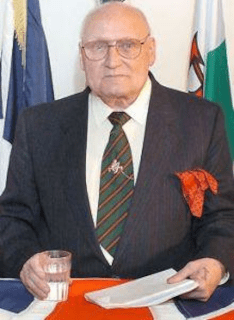
Spence, the sixth of seven children, is born and raised in the Shankill Road area of West Belfast in Northern Ireland, the son of William Edward Spence, a member of the Ulster Volunteers who fought in World War I, and Isabella “Bella” Hayes. The family home is 66 Joseph Street in an area of the lower Shankill known colloquially as “the Hammer.” He is educated at the Riddel School on Malvern Street and the Hemsworth Square school, finishing his education at the age of fourteen. He is also a member of the Church Lads’ Brigade, a Church of Ireland group, and the Junior Orange Order. His family has a long tradition of Orange Order membership.
Spence takes various manual jobs in the area until joining the British Army in 1957 as a member of the Royal Ulster Rifles. He rises to the rank of Provost Sergeant (battalion police). He is stationed in Cyprus and sees action fighting against the forces of Colonel Georgios Grivas. He serves until 1961 when ill-health forces him to leave. He then finds employment at the Harland & Wolff shipyard in Belfast, where he works as a stager (builder of the scaffolding in which the ships are constructed), a skilled job that commands respect among working class Protestants and ensures for him a higher status within the Shankill.
From an early age Spence is a member of the Prince Albert Temperance Loyal Orange Lodge, where fellow members include John McQuade. He is also a member of the Royal Black Institution and the Apprentice Boys of Derry. Due to his later involvement in a murder, he is expelled from the Orange Order and the Royal Black Institution. The Reverend Martin Smyth is influential in his being thrown out of the Orange Order.
Spence’s older brother Billy is a founding member of Ulster Protestant Action (UPA) in 1956, and he is also a member of the group. He is frequently involved in street fights with republicans and garners a reputation as a “hard man.” He is also associated loosely with prominent loyalists such as Ian Paisley and Desmond Boal and is advised by both men in 1959 when he launches a protest against Gerry Fitt at Belfast City Hall after Fitt had described Spence’s regiment as “murderers” over allegations that they had killed civilians in Cyprus. He, along with other Shankill Road loyalists, break from Paisley in 1965 when they side with James Kilfedder in a row that follows the latter’s campaigns in Belfast West. Paisley intimates that Kilfedder, a rival for the leadership of dissident unionism, is close to Fine Gael after learning that he had attended party meetings while a student at Trinity College Dublin (TCD). The Shankill loyalists support Kilfedder and following his election as MP send a letter to Paisley accusing him of treachery during the entire affair.
Spence claims that he is approached in 1965 by two men, one of whom was an Ulster Unionist Party MP, who tells him that the Ulster Volunteer Force is to be re-established and that he is to have responsibility for the Shankill. He is sworn in soon afterward in a ceremony held in secret near Pomeroy, County Tyrone. Because of his military experience, he is chosen as the military commander and public face of the UVF when the group is established. However, RUC Special Branch believes that his brother Billy, who keeps a much lower public profile, is the real leader of the group. Whatever the truth of this intelligence, Spence’s Shankill UVF team is made up of only around 12 men on its formation. Their base of operations is the Standard Bar, a pub on the Shankill Road frequented by Spence and his allies.
On May 7, 1966, a group of UVF men led by Spence petrol bomb a Catholic-owned pub on the Shankill Road. Fire also engulfs the house next door, killing the elderly Protestant widow, Matilda Gould (77), who lives there. On May 27, he orders four UVF men to kill an Irish Republican Army (IRA) member, Leo Martin, who lives on the Falls Road. Unable to find their target, the men drive around in search of any Catholic instead. They shoot dead John Scullion (28), a Catholic civilian, as he walks home. Spence later writes “at the time, the attitude was that if you couldn’t get an IRA man you should shoot a Taig, he’s your last resort.” On June 26, the same gang shoots dead Catholic civilian Peter Ward (18) and wounds two others as they leave a pub on Malvern Street in the lower Shankill. Two days later, the government of Northern Ireland uses the Special Powers Act to declare the UVF illegal. Shortly after, Spence and three others are arrested.
In October 1966, Spence is sentenced to life imprisonment for the murder of Ward, although he has always claimed his innocence. He is sent to Crumlin Road Prison. During its July 12, 1967, march, the Orange lodge to which he belongs stops outside the prison in tribute to him. This occurs despite him having been officially expelled from the Orange Order following his conviction. His involvement in the killings gives him legendary status among many young loyalists and he is claimed as an inspiration by the likes of Michael Stone. Tim Pat Coogan describes Spence as a “loyalist folk hero.” The murder of Ward is, however, repudiated by Paisley and condemned in his Protestant Telegraph, sealing the split between the two.
Spence appeals against his conviction and is the subject of a release petition organised by the Ulster Constitution Defence Committee, although nothing comes of either initiative. Despite the fact that control of the UVF lay with his closest ally, Samuel “Bo” McClelland, from prison he is often at odds with the group’s leadership, in particular with regards to the 1971 McGurk’s Bar bombing. Spence now argues that UVF members are soldiers and soldiers should not kill civilians, as had been the case at McGurk’s Bar. He respects some Irish republican paramilitaries, who he feels also live as soldiers, and to this end he writes a sympathetic letter to the widow of Official IRA leader Joe McCann after he is killed in 1972.
Spence is granted two days leave in early July 1972 to attend the wedding of his daughter Elizabeth to Winston Churchill “Winkie” Rea. The latter had formally asked Spence for his daughter’s hand in marriage during a prison visit. Met by two members of the Red Hand Commando upon his release, Spence is informed of the need for a restructuring within the UVF and told not to return to prison. He initially refuses and goes on to attend his daughter’s wedding. Afterward a plot is concocted where Jim Curry, a Red Hand Commando member, will drive Spence back to prison but the car is to be stopped and Spence “kidnapped.” As arranged, the car in which he is a passenger is stopped in Springmartin and he is taken away by UVF members. He remains at large for four months and during that time gives an interview to ITV‘s World in Action in which he calls for the UVF to take an increased role in the Northern Ireland conflict against the Provisional IRA. At the same time, he distances himself from any policy of random murders of Catholics. He also takes on responsibility for the restructuring, returning the UVF to the same command structure and organisational base that Edward Carson had utilised for the original UVF, with brigades, battalions, companies, platoons and sections. He also directs a significant restocking of the group’s arsenal, with guns mostly taken from the security forces. He gives his permission for UVF brigadier Billy Hanna to establish the UVF’s Mid-Ulster Brigade in Lurgan. His fugitive status earns him the short-lived nickname the “Orange Pimpernel.” He is arrested along with around thirty other men at a UVF drinking club in Brennan Street, but after giving a false name, he is released.
Spence’s time on the outside comes to an end on November 4 when he is captured by Colonel Derek Wilford of the Parachute Regiment, who identifies him by tattoos on his hands. He is sent directly to Long Kesh Detention Centre soon afterward, where he shares a cell with William “Plum” Smith, one of the Red Hand Commandos whom he had met upon his initial release and who had since been jailed for attempted murder.
Spence soon becomes the UVF commander within the Long Kesh Detention Centre. He runs his part of Long Kesh along military lines, drilling inmates and training them in weapons use while also expecting a maintenance of discipline. As the loyalist Long Kesh commander, he initially also has jurisdiction over the imprisoned members of the Ulster Defence Association (UDA), although this comes to an end in 1973 when, following a deterioration in relations between the two groups outside the prison walls, James Craig becomes the UDA’s Maze commander. By this time Spence polarises opinion within the UVF, with some members fiercely loyal to a man they see as a folk hero and others resenting his draconian leadership and increasing emphasis on politics, with one anonymous member even labelling him “a cunt in a cravat.”
Spence begins to move toward a position of using political means to advance one’s aims, and he persuades the UVF leadership to declare a temporary ceasefire in 1973. Following Merlyn Rees‘ decision to legalise the UVF in 1974, Spence encourages them to enter politics and support the establishment of the Volunteer Political Party (VPP). However, his ideas are abandoned as the UVF ceasefire falls apart that same year following the Ulster Workers’ Council strike and the Dublin and Monaghan bombings. The carnage of the latter shocks and horrifies Spence. Furthermore, the VPP suffers a heavy defeat in West Belfast in the October 1974 United Kingdom general election, when the DUP candidate, John McQuade, captures six times as many votes as the VPP’s Ken Gibson.
Spence is increasingly disillusioned with the UVF, and he imparts these views to fellow inmates at Long Kesh. According to Billy Mitchell, Spence quizzes him and others sent to Long Kesh about why they are there, seeking an ideological answer to his question. When the prisoner is unable to provide one, Spence then seeks to convince them of the wisdom of his more politicised path, something that he accomplishes with Mitchell. David Ervine and Billy Hutchinson are among the other UVF men imprisoned in the mid-1970s to become disciples of Spence. In 1977, he publicly condemns the use of violence for political gain, on the grounds that it is counterproductive. In 1978, he leaves the UVF altogether. His brother Bobby, also a UVF member, dies in October 1980 inside the Maze, a few months after the death of their brother Billy.
Released from prison in 1984, Spence soon becomes a leading member of the UVF-linked Progressive Unionist Party (PUP) and a central figure in the Northern Ireland peace process. He initially works solely for the PUP but eventually also sets up the Shankill Activity Centre, a government-supported scheme to provide training and leisure opportunities for unemployed youths.
Spence is entrusted by the Combined Loyalist Military Command (CLMC) to read out their October 13, 1994, statement that announces the loyalist ceasefire. Flanked by his PUP colleagues Jim McDonald and William Plum Smith, as well as Ulster Democratic Party (UDP) members Gary McMichael, John White and David Adams, he reads the statement from Fernhill, a former Cunningham family home on their former Glencairn estate in Belfast’s Glencairn area. This building had been an important training centre for members of Edward Carson’s original UVF. A few days after the announcement, he makes a trip to the United States along with the PUP’s David Ervine and Billy Hutchinson and the UDP’s McMichael, Adams and Joe English. Among their engagements is one as guests of honour of the National Committee on American Foreign Policy. He goes on to become a leading advocate for the Good Friday Agreement.
In August 2000, Spence is caught up in moves by Johnny Adair‘s “C” Company of the UDA to take control of the Shankill by forcing out the UVF and other opponents. Due to his involvement in the peace process and the eventual Good Friday Agreement, the authorities insist against his wishes to install additional security measures to the doors and windows. As a result, when Adair’s men try to force their way into Spence’s Shankill home, they only manage to push a long stick through a partially open window of the bungalow and dislodge a few of his military frames off the opposite wall. There is no other damage and other than that small disruption no one is able to gain any physical entry into the property. When Spence’s wife dies three years later, he says that C Company is responsible for her death, as the events had taken on her health.
On May 3, 2007, Spence reads out the statement by the UVF announcing that it will keep its weapons but put them beyond the reach of ordinary members. The statement also includes a warning that activities could “provoke another generation of loyalists toward armed resistance.” He does not specify what activities or what is being resisted.
Spence marries Louie Donaldson, a native of the city’s Grosvenor Road, on June 20, 1953, at Wellwood Street Mission, Sandy Row. The couple has three daughters, Elizabeth (born 1954), Sandra (1956) and Catherine (1960). Louie dies in 2003. Spence, a talented footballer in his youth with Old Lodge F.C., is a lifelong supporter of Linfield F.C.
Spence dies in a Belfast hospital at the age of 78 on September 25, 2011. He had been suffering from a long-term illness and was admitted to hospital 12 days prior to his death. He is praised by, among others, PUP leader Brian Ervine, who states that “his contribution to the peace is incalculable.” Sinn Féin‘s Gerry Kelly claims that while Spence had been central to the development of loyalist paramilitarism, “he will also be remembered as a major influence in drawing loyalism away from sectarian strife.”
However, a granddaughter of Matilda Gould, a 74-year-old Protestant widow who had died from burns sustained in the UVF’s attempted bombing of a Catholic bar next door to her home, objects to Spence being called a “peacemaker” and describes him as a “bad evil man.” The unnamed woman states, “When you go out and throw a petrol bomb through a widow’s window, you’re no peacemaker.”
Spence’s funeral service is held in St. Michael’s Church of Ireland on the Shankill Road. Notable mourners include Unionist politicians Dawn Purvis, Mike Nesbitt, Michael McGimpsey, Hugh Smyth and Brian Ervine, UVF chief John “Bunter” Graham and UDA South Belfast brigadier Jackie McDonald. In accordance with his wishes, there are no paramilitary trappings at the funeral or reference to his time in the UVF. Instead, his coffin is adorned with the beret and regimental flag of the Royal Ulster Rifles, his former regiment. He is buried in Bangor, County Down.
Allen is born on July 6, 1936, in a nursing home at 37 Lower Leeson Street, Dublin, the youngest of three sons of (Gerard John) Cullen Tynan Allen, journalist, manager of The Irish Times, and raconteur, and his wife Jean Ballantyne (née Archer), an English-born nurse. His paternal grandmother, Nora Tynan O’Mahony, is the first women’s features editor of the Freeman’s Journal, and the poet Katharine Tynan is his great-aunt. Allen loses half a finger on his left hand in a childhood accident which becomes a favourite theme (and occasional prop) in his shows.
After initially attending Beaumont convent school, Allen goes to Firhousenational school, County Dublin, near the family residence outside Templeogue. For a period during World War II, he lives with his mother and brothers at Keenagh, County Longford, where they had moved for fear that Dublin might be targeted by air raids. On returning to Dublin, he goes to Terenure College, run by the Carmelite fathers. His reminiscences in later life often centre on memories of frequent and sadistic corporal punishment, and warnings from priests that adolescent male sexuality is a device of Satan leading straight to hell. His resentment is formative in his lifelong and outspoken atheism.
Allen, who is close to his father, is severely affected emotionally by his death in 1948, after which his relations with the school deteriorate further. The discovery that his father’s drinking and gambling had left the family heavily indebted means that, notwithstanding assistance from journalistic friends, his elder brothers are obliged to leave school and work as journalists to support the family. Restless and even more discontented at school than previously, he often plays truant to visit museums and art galleries. Expelled from Terenure College, he briefly attends the Catholic University School before leaving school at the age of 16. After working as a clerk for the Irish Independent, in 1954 he becomes a journalist on the Drogheda Argus, reporting weddings and gymkhanas. He later attributes this career path to the contemporary tradition of following a family profession.
Moving to London but failing to secure a job on a Fleet Street newspaper, Allen follows his brother John by becoming a “redcoat” attendant at Butlin’s holiday camps in Filey (Yorkshire), Skegness, Margate, and Brighton, performing various functions and telling jokes and stories during intervals between stage acts. In the winters he sells educational toys in Sheffield. Acquiring an agent, he becomes a professional comedian, adopting the stage name Dave Allen. He initially works the declining club and variety circuit, later claiming that he had toured with the last old-style nude tableaux show. In 1959, he makes his first television appearance on the BBC talent show New Faces and realises that television is the medium of the future. He tours with pop singer Helen Shapiro in 1963 and 1964, joined in the latter year by an emerging support band, the Beatles. At this period, he models himself on American stand-up comedians such as Jerry Lewis, focusing his act on discrete gags leading up to a punchline.
While performing in support of the singer Helen Traubel in Australian nightclubs, Allen often reminisces to her off stage about his early life. Traubel suggests that he incorporate such material into his act. Such is the genesis of his mature style of rambling absurdist monologues, which he describes as influenced by the Irish storytelling tradition in general, and his father’s stories in particular. After appearing in Melbourne and Sydney, he becomes the host of a ninety-minute chat show, Tonight with Dave Allen, on Sydney-based Channel 9. Eighty-four episodes are recorded of what becomes one of Australian television’s most successful programmes ever, its popularity boosted by the rumour that he is having an affair with singer Eartha Kitt, his hilarious interviews with eccentrics, and the frequent deployment of dangerous animals onstage.
Allen marries the English actress Judith Stott in Australia on March 9, 1964, a divorcée with one son. They have two children, including the comedian Ed Allen (Edward James Allen). After separating in 1980, the couple divorces in 1983. Returning to England in December 1964 to be with his wife, he establishes a reputation there through well-received performances as a compère at the televised Sunday Night at the London Palladium (1967) and The Blackpool Show (1966). After a slot as resident comedian on The Val Doonican Show (1965–67), he obtains his first stand-alone show, Tonight with Dave Allen, in 1967 on ITV, a mixture of sketches with the monologues for which he becomes best known. He usually performs seated on a barstool, smoking a cigarette, and sipping from a presumed glass of whiskey (actually ginger ale), while musing on the oddities of life, often expressing his suspicion of authority figures. His signature farewell phrase is “Goodnight, and may your God go with you.”
On BBC television Allen headlines two programmes: The Dave Allen Show (1968–69), and Dave Allen at Large (1971–79). He writes much of his own material, compulsively scouring newspapers for items that he can work into his act. He resists suggestions that he should move to an early evening slot, as this would entail restrictions on his material. In the 1970s and 1980s he tours widely with a one-man stage show, “An evening with Dave Allen,” containing more “adult” material than would be allowed on television at the time. His stage performances are less well-received in the United States than elsewhere.
Allen’s treatment of sex and religion involves him in frequent controversies. Priests and the confessional are frequent targets. In 1975, he provokes widespread protests from Catholics over a sketch in which the pope, played by Allen himself, and his cardinals perform a striptease on the steps of St. Peter’s Basilica. In 1977, his shows are banned from RTÉ. In 1984, the British anti-indecency campaigner Mary Whitehouse formally complains about his televised act, with particular reference to a simulated post-coital conversation. As with many stage comedians, his angry and outspoken stage persona contrasts with a reserved offstage life. He keeps his stage persona distinct from his private life and does not allow his children to attend his shows.
Allen gives occasional straight performances, notably in Edna O’Brien‘s plays A Pagan Place (1972) and Flesh and Blood (1985); in the dual roles of Captain Hook and Mr. Darling in a production of Peter Pan (1973); and in Alan Bennett‘s television play One Fine Day (1979). He has a supporting role in the Australian comedy film Squeeze a Flower (1970). He also presents several documentaries, notably Dave Allen in the Melting Pot (1969); surveying life in New York City, he discusses racism and drug addiction and conducts one of the first television interviews with openly gay men. Other documentaries for ITV include Dave Allen in Search of the Great English Eccentric (1974), and Dave Allen (1978), which deals with American eccentrics. Long fascinated with ghost stories, he publishes an anthology of horror stories, A Little Night Reading (1974).
In the 1980s, Allen is regarded by many fans of the new, politically engaged “alternative comedians” as old-fashioned. His leisurely style contrasts with their quick-fire delivery, and some of his references to the Irish and other ethnic groups are seen as demeaning. He makes a partial television comeback with a six-part BBC One series, Dave Allen (1990), using considerably more outspoken material than he had previously deployed on television.
In 1993, Allen appears in a six-part series for the new ITV London franchise, Carlton Television. Thereafter he moves into semi-retirement, partly because of health problems, while continuing to make guest television appearances. At the British Comedy Awards he is named best comedy performer (1993) and is granted a lifetime achievement award (1996). He occasionally releases videos of older material “to keep myself in the style to which I had become accustomed – a bit of an Irish retirement, actually.” He maintains tight editorial control over his recordings, having been annoyed when his first television shows were chopped and changed when re-broadcast by American networks. They are released on DVD after his death. He presents a six-part BBC series based on his old material, The Unique Dave Allen (1998). After giving his last performance on BBC Radio 4 in 1999, he retires and devotes himself to his hobby as an amateur painter.
After a seventeen-year relationship, Allen marries secondly Karin Stark, a theatrical producer, on December 9, 2003. Their one son is born three weeks after Allen dies peacefully in his sleep as a result of sudden arrhythmic death syndrome on March 10, 2005, in Kensington, London.
A selection of his routines, edited by Graham McCann, is published as The Essential Dave Allen (2005). His obituarists see him as prefiguring the aggressive mocking of authority by the alternative comedians who had once criticised him, and as paving the way for such irreverent and anti-deferential satire of political and religious authority as Not the Nine O’Clock News and Father Ted. The widespread use of the monologue by Irish dramatists such as Conor McPherson in the first decade of the twenty-first century also owes something to his influence.
(From: “Allen, Dave” by Patrick Maume, Dictionary of Irish Biography, http://www.dib.ie, June 2011)
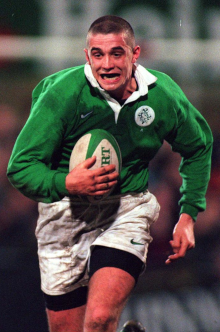
Quinlan is educated at Abbey CBS in Tipperary and works for a motor dealer after leaving school. He begins his rugby career with Clanwilliam F.C. He moves from Clanwilliam to join Shannon U20s in 1994. He captains the Irish Youth Team against Scotland in 1993. He normally plays as a blindside flanker, but he also plays openside, number eight and second row for Munster.
Quinlan begins playing for Munster in 1996 and captains the youths team before becoming a regular in the first team. In May 2006 he makes a comeback from a cruciate ligament injury earlier in the season to win both the AIB League Division 1 title with Shannon and the Heineken Cup with Munster after a late appearance from the bench in the Heineken Cup Final win over Biarritz in Cardiff. He captains the side from Number Eight in Munster’s upset victory over Ulster in Ravenhill Stadium in the 2007 Celtic League. He is voted Man of the Match as Munster beats Toulouse 16–13 on May 24, 2008 to win the Heineken Cup for a second time. He is part of the squad that wins the 2008–09 Celtic League. In total he holds five league medals with Shannon, as well as two Heineken Cup medals and a Celtic League Medal with Munster. He wins his 201st cap against Leinster, equaling Anthony Foley‘s club record for caps, on October 2, 2010. He becomes Munster’s most capped player ever on October 16, 2010, against Toulon in the Heineken Cup. In the 2009–10 season he represents Munster 21 times, including all eight of their 2010 Heineken Cup matches.
In April 2011, Quinlan officially announces his retirement from professional rugby, to be effective at the end of the 2010/11 season. He plays his last game for Munster on May 6, 2011, against Connacht in the Celtic League, scoring a try to mark the end of his remarkable career and going off to a standing ovation from the Munster and Connacht supporters. He joins the Munster team at the 2011 Celtic League Grand Final trophy presentation, celebrating Munster’s 19–9 victory over old rivals Leinster in Thomond Park.
Quinlan represents Ireland ‘A’ between 1998 and 2001 and makes his senior debut for the Irish national team in October 1999, as a replacement in a test against Romania. He plays his first Six Nations match against Italy in 2001. He is a part of Ireland’s squad at the 2003 Rugby World Cup in Australia and scores two tries in the tournament before dislocating his shoulder scoring a vital try against Argentina in the pool stages, which ends his involvement. He is named in Ireland’s 2007 Rugby World Cup squad but does not make any appearances. Ireland coach Eddie O’Sullivan is widely criticised afterwards for not using his bench. Quinlan takes his caps to a total of 27 by playing in the Autumn Internationals of 2008 against Canada and the All Blacks.
On April 21, 2009, Quinlan is named in the squad for the 2009 British & Irish Lions tour of South Africa. During Munster’s Heineken cup semi-final defeat to Leinster in May 2009, he is cited for making contact with the eye or eye area of Leinster captain Leo Cullen. The offence is deemed at the low range of seriousness and he receives a 12 playing week ban until September 9, 2009. As a result, he misses the Lions tour to South Africa.
Quinlan marries Irish model Ruth Griffin in Tipperary during the summer of 2008. They have one son named AJ who is born in January 2009. They later split up in June 2010. He releases an autobiography, Quinlan: Red Blooded, in 2010. He is a big golf fan and supports Liverpool.
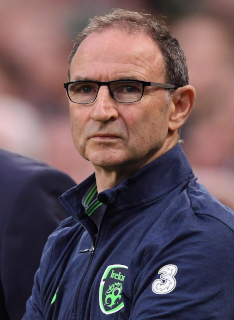
O’Neill becomes Republic of Ireland manager in 2013 and leads them to qualification for the 2016 UEFA European Football Championship for the third time in the nation’s history, beating the reigning world champions, Germany, in the process. He leaves the role with assistant Roy Keane by “mutual agreement” in November 2018. He is appointed as Nottingham Forest manager on January 15, 2019. He guides the club to a ninth-place finish in the Championship. However, he is sacked as manager on June 28, 2019, after reportedly falling out with some of the senior first team players.
In 2002, Norwich supporters voted O’Neill into the club’s Hall of Fame. He is awarded an OBE for services to sport in 2004. He is awarded the Nottingham Lifetime Achievement Award on November 3, 2013 for his services to football and achievements with Nottingham Forest.
Lawson appears in at least three films and in at least twenty television productions. He is probably best known for appearing as Jim McDonald in the ITV television soap opera Coronation Street. He first appears as Jim in 1989 and remains a regular character for eleven years, since which time his appearances have been few and far between.
In 2000, Lawson makes a programme for ITV Granada, Passion for Peace, which follows him back to Northern Ireland and reports on the creation of the Tim Parry Johnathan Ball Peace Centre in Warrington. In 2005 he appears in the TV documentary Titanic: Birth of a Legend. In 2009 he appears alongside an eight-foot Frankfurtersausage in a German television commercial, advertising hot dogs. His overdubbedcatchphrase in the commercial is Betrachten Sie die Größe meiner Wurst! (English: “Look at the size of my sausage!”).
In 2010, Lawson reveals that he is returning to Coronation Street for its fiftieth anniversary celebrations. He speculates that bosses may be planning to kill his character off, however, this never happens. He stays until April 2011. He then returns for a three-month stint on the soap between August and November 2014.
Lawson returns to Coronation Street in September 2018 with his supposed long-lost daughter from his relationship with Liz. On October 8, 2018, while portraying Inspector John Rebus in the play Long Shadows in Edinburgh, he suffers a minor stroke on stage but recovers shortly afterwards.
Lawson lives in Belfast with his partner, Debbie Stanley, having previously lived with her in Chester, Cheshire, for a number of years.
Hunniford starts as a BBC production assistant in Belfast and a local radio broadcaster. In the 1970s and 1980s, she is the presenter of Good Evening Ulster and on the ITV Network Sunday Sunday and We Love TV. She also appears on Lily Savage’s Blankety Blank and on Call My Bluff. She is a regular reporter on This Morning and The One Show.
From 1998 to 2003, Hunniford presents Open House with Gloria Hunniford for Channel 5. In August 2010, she appears as a panellist/presenter on the ITV daytime programme 3@Three. Since 2009, she has co-presented Rip Off Britain, a consumer complaints programme on BBC One with Angela Rippon and, for the first two series, Jennie Bond, and then, for the third series, with Julia Somerville replacing Bond. Together, the trio of Hunniford, Rippon and Somerville also present Charlie’s Consumer Angels.
In 2012, Hunniford presents the BBC One documentary series Doorstep Crime 999. From September 8, 2014, she is a presenter on ITV chat show Loose Women. She is previously a guest panelist in 2003. From September 2014 to July 2015, she appears on the panel in 31 episodes of the programme, three of which she anchors. As of April 6, 2017, she has appeared 93 times, four of which she anchors and two where she is a guest panelist.
In 2014, Hunniford presents the first series of the BBC One programme Home Away from Home. Gyles Brandreth presents the second series. She also presents three series of Food: Truth or Scare with Chris Bavin from 2016.
Hunniford makes a health and exercise video called Fit for Life and also appears on the UK music video of the Muppets cover to “She Drives me Crazy.” She has written an Irish Cookery Book with her sister Lena entitled Gloria Hunniford’s Family Cookbook.
On The Alan Titchmarsh Show on May 6, 2011, Hunniford reveals her support for David Cameron‘s Conservative-led coalition government, describing herself as “a bit of a David Cameron fan,” although she criticises the government’s decision to continue giving aid to Pakistan when it is making cuts in the UK.
In August 2014, Hunniford is one of 200 public figures who are signatories to a letter to The Guardian opposing Scottish independence in the run-up to September’s referendum on that issue.
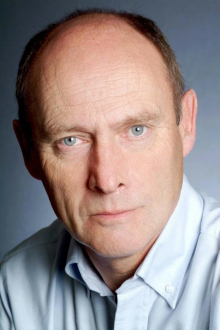
Duggan is the son of Irish immigrants. His mother works as a cook while his father is a school secretary. He was educated at Douai School, Woolhampton, Berkshire. He studies experimental psychology for two years at the University of Edinburgh but leaves school feeling unsatisfied and decides to try his hand at acting. Prior to making it as an actor, he sells bone china to U.S. soldiers stationed in Germany.
Duggan makes his television debut in 1976 in an episode of The Flight of the Heron, followed by single episodes of Sutherland’s Law and The New Avengers (1976) and ITV‘s Playhouse (1977). He then appears in an adaptation of The Eagle of the Ninth, and his first film is Sweeney 2 in the following year. In 1979 he begins a nine-year stint as Detective Sergeant Albert “Cheerful Charlie” Chisholm in the popular TV series Minder.





 seamus dubhghaill