seamus dubhghaill

Promoting Irish Culture and History from Little Rock, Arkansas, USA


Leave a comment

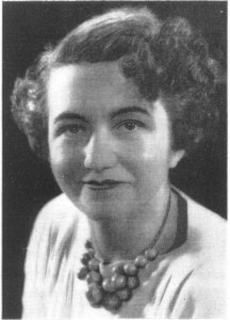
Death of Iseult Gonne

Iseult Lucille Germaine Gonne, the daughter of the Irish republican revolutionary Maud Gonne and the French politician and journalist Lucien Millevoye, dies on March 22, 1954. She marries the novelist Francis Stuart in 1920.

Maud Gonne conceives a child, Georges, with her French Boulangist lover Lucien Millevoye. When the baby dies, possibly by meningitis, she is distraught, and buries him in a large memorial chapel built for him with money she had inherited. She separates from Millevoye after Georges’ death, but in late 1893, she arranges to meet him at the mausoleum in Samois-sur-Seine and, next to the coffin, they have sex. Her purpose is to conceive a baby with the same father, to whom the soul of Georges would transmigrate in metempsychosis. Iseult is born in France as a result on August 6, 1894. She is educated at a Carmelite convent in Laval, France. When she returns to Ireland she is referred to as Maud’s niece or cousin rather than her daughter.

In 1903, Maud Gonne marries John MacBride. Iseult’s half-brother Seán MacBride is born in 1904. The couple separates in 1905. With Gonne fearing that Seán’s father will seize him from her, her family mostly lives in France until John MacBride’s death in the 1916 Easter Rising. In a separation settlement, MacBride is granted a month’s summer custody, however, he returns to Ireland and never sees his child again. Iseult’s relationship with her stepfather is tainted by an allegation by William Butler Yeats, who writes to Lady Gregory in January 1905, the month MacBride and Maud separate, that he had been told MacBride had molested Iseult, who at that time was ten years old. However, many critics have suggested that Yeats may have fabricated the event due to his hatred of MacBride over Maud’s rejection of him in favour of MacBride. The divorce papers submitted by Gonne make no mention of any such incident – the only charge against MacBride that is substantiated in court is that he was drunk on one occasion during the marriage and Iseult’s own writings make no mention of the allegation.

In 1913, Iseult meets Rabindranath Tagore. Inspired by his poetry, she begins to learn Bengali in 1914, tutored by Devabrata Mukerjea. Together, in France, they translate some of Tagore’s The Gardener into French directly from the Bengali. Tagore leaves it to Yeats’ discretion to decide the merit of the work, but Yeats does not feel sufficiently fluent in French to judge them. The translations are never published. Iseult is widely considered a great beauty, and temperate, able to speak her mind. She attracts the admiration of literary figures including Ezra Pound, Lennox Robinson and Liam O’Flaherty. Her most infamous association is with Yeats, who had long been in love with her mother. In 1916, in his fifties, Yeats proposes to the 22-year-old Iseult who refuses his advances. He had known her since she was four and often referred to her as his darling child. Many Dubliners suspected that Yeats is her father.

In 1920, Iseult elopes to London with 17-year-old Irish Australian Francis Stuart, who becomes a writer, and the couple later marries. Their first child, Dolores, dies in 1921 of spinal meningitis at three months old. The couple has two other children, Ian and Catherine.

Iseult makes headlines during World War II when she is brought to trial for harboring Hermann Görtz, a German parachutist, a crime to which she confesses but is acquitted.

Maud Gonne dies on April 27, 1953, and does not acknowledge Iseult in her will, possibly due to pressure from Séan who does not want to reveal Maud’s relation to Millevoye. Iseult dies at the age of 59 from heart disease less than a year later, on March 22, 1954. She is buried in Glendalough, County Wicklow.

(Pictured: Iseult Gonne, c. 1910)


Leave a comment

Death of Frank O’Connor, Poet & Novelist

Frank O’Connor, Irish writer of over 150 works and best known for his short stories and memoirs, dies of a heart attack in Dublin on March 10, 1966. The Frank O’Connor International Short Story Award is named in his honour.

O’Connor is born Michael Francis O’Donovan in Cork, County Cork, on September 17, 1903. The only child of Minnie (née O’Connor) and Michael O’Donovan, he attends Saint Patrick’s School on Gardiner’s Hill and North Monastery CBS. His early life is marked by his father’s alcoholism, debt, and ill-treatment of his mother. His childhood is shaped in part by his mother, who supplies much of the family’s income by cleaning houses, because his father is unable to keep steady employment due to his drunkenness. He adores his mother and is bitterly resentful of his father. In his memoirs, he recalls his childhood as “those terrible years,” and admits that he has never been able to forgive his father for his abuse of himself and his mother. When his mother is seventy, O’Connor is horrified to learn from his own doctor that she has suffered for years from chronic appendicitis, which she has endured with great stoicism, as she has never had the time nor the money to see a doctor.

In 1918 O’Connor joins the First Brigade of the Irish Republican Army (IRA) and serves in combat during the Irish War of Independence. He opposes the Anglo-Irish Treaty of 1921 and joins the Anti-Treaty IRA during the Irish Civil War, working in a small propaganda unit in Cork city. He is one of twelve thousand Anti-Treaty combatants who are interned by the government of the new Irish Free State. Between 1922 and 1923 he is imprisoned in Cork City Gaol and in Gormanston, County Meath.

Following his release, O’Connor takes various positions including that of teacher of the Irish language, theatre director, and librarian. He begins to move in literary circles and is befriended by George William Russell (Æ), through whom he comes to know most of the well-known Irish writers of the day, including William Butler Yeats, Lennox Robinson, F. R. Higgins and Lady Gregory. In his memoirs, he pays tribute to both Yeats and Russell for the help and encouragement they gave him.

In 1935, O’Connor becomes a member of the board of directors of the Abbey Theatre in Dublin, founded by Yeats and other members of the Irish National Theatre Society. In 1937, he becomes managing director of the Abbey. Following Yeats’s death in 1939, O’Connor’s long-standing conflict with other board members comes to a head and he leaves the Abbey later that year. In 1950, he accepts invitations to teach in the United States, where many of his short stories have been published in The New Yorker and have won great acclaim. He spends much of the 1950s in the United States, although it is always his intention to return eventually to Ireland.

From the 1930s to the 1960s O’Connor is a prolific writer of short stories, poems, plays, and novellas. His work as an Irish teacher complements his plethora of translations into English of Irish poetry, including his initially banned translation of Brian Merriman‘s Cúirt an Mheán Oíche (The Midnight Court). Many of his writings are based on his own life experiences – notably his well-known The Man of the House in which he reveals childhood details concerning his early life in County Cork. The Sullivan family in this short story, like his own boyhood family, is lacking a proper father figure.

O’Connor’s early years are recounted in An Only Child, a memoir published in 1961 which has the immediacy of a precocious diary. He continues his autobiography through his time with the Abbey Theatre in Dublin in his book My Father’s Son, which is published posthumously in 1968. It contains valuable character sketches of many of the leading Irish literary figures of the 1930s, in particular Yeats and Æ.

Frank O’Connor has a stroke while teaching at Stanford University in 1961, and he later dies from a heart attack in Dublin on March 10, 1966. He is buried in Deans Grange Cemetery two days later.


Leave a comment

Death of George Moore, Novelist, Poet & Critic

George Augustus Moore, novelist, short story writer, poet, art critic, memoirist, and dramatist, dies at his home in London on January 21, 1933. He is considered an innovator in fiction in his day.

Moore is born in Moore Hall, near Lough Carra, County Mayo on February 24, 1852. He comes from a distinguished Catholic family of Irish landholders. When he is 21, he leaves Ireland for Paris to become a painter. His Reminiscences of the Impressionist Painters (1906) vividly describes the Café Nouvelle-Athènes and the circle of Impressionist painters who frequent it. He is particularly friendly with Édouard Manet, who sketches three portraits of him. Another account of the years in Paris, in which he introduces the younger generation in England to his version of fin de siècle decadence, is his first autobiography, Confessions of a Young Man (1888).

Deciding that he has no talent for painting, Moore returns to London in 1882 to write. His first novels, A Modern Lover (1883) and A Mummer’s Wife (1885), introduce a new note of French Naturalism into the English scene, and he later adopts the realistic techniques of Gustave Flaubert and Honoré de Balzac. Esther Waters (1894), his best novel, deals with the plight of a servant girl who has a baby out of wedlock. It is a story of hardship and humiliation illumined by the novelist’s compassion. It is an immediate success, and he follows it with works in a similar vein: Evelyn Innes (1898) and Sister Teresa (1901).

In 1901 Moore moves to Dublin, partly because of his loathing for the South African War and partly because of the Irish Literary Revival spearheaded by his friend, the poet William Butler Yeats. In Dublin he contributes notably to the planning of the Abbey Theatre. He also produces The Untilled Field (1903), a volume of fine short stories reminiscent of Ivan Turgenev’s writing that focuses on the drudgery of Irish rural life, and a short poetic novel, The Lake (1905). The real fruits of his life in Ireland, however, come with the trilogy Hail and Farewell (Ave, 1911; Salve, 1912; Vale, 1914). Discursive, affectionate, and satirical by turns, it reads like a sustained monologue that is both a carefully studied piece of self-revelation and an acute, though not always reliable, portrait gallery of his Irish acquaintance, which included Yeats, George William Russell, and Lady Gregory. Above all it is a perfectly modulated display of the comic spirit.

The increasing narrowness of the Irish mind, politics, and clericalism sends Moore back to England in 1911. After Hail and Farewell, he makes another literary departure. Aiming at epic effect he produces The Brook Kerith (1916), an elaborate and stylish retelling of the Gospel story that is surprisingly effective despite some dull patches. He continues his attempts to find a prose style worthy of epic theme in Héloïse and Abélard (1921). His other works include A Story-Teller’s Holiday (1918), a blend of autobiography, anecdote, Irish legend, and satire, Conversations in Ebury Street (1924), autobiography, The Pastoral Loves of Daphnis and Chloe (1924) and Ulick and Soracha (1926), an Irish legendary romance.

George Moore dies at his home at Ebury Street in the London district of Belgravia on January 21, 1933, leaving a fortune of £70,000. He is cremated in London at a service attended by Ramsay MacDonald among others. An urn containing his ashes is interred on Castle Island in Lough Carra in view of the ruins of Moore Hall, which had been burned by anti-treaty forces in 1923, during the final months of the Irish Civil War.


Leave a comment

Founding of the Irish Literary Society

The Irish Literary Society is formally founded at the Caledonian Hotel, The Strand, London on May 12, 1892, with Sir Charles Gavan Duffy as President and Evelyn Gleeson as its first secretary. Among its founders are William Butler Yeats, T. W. Rolleston, Francis Fahy and Douglas Hyde as well as other leaders of the Irish literary revival. The Society succeeds the Southwark Irish Literary Club.

Stopford Brooke gives the inaugural lecture to the Society on “The Need and Use of Getting Irish Literature into the English Tongue.” The lecture is published by Bloomsbury House on March 11, 1893, its delivery delayed allowing for the start of the National Literary Society in Ireland. Although the business of the ILS has always been conducted in English, the Society is influential in nurturing the revival of the Irish language by programming language classes even before the Gaelic League was formed in 1893. It also sponsored the Petrie Collection of Irish Music and twelve-volume Irish library of history and literature published between 1893 and 1904.

A Book of Irish Verse, designed to publicise the new societies, is published in 1895, edited by Yeats and dedicated “To the Members of the National Literary Society of Dublin and the Irish Literary Society of London.” It features poetry by Rolleston, Hyde, Katharine Tynan, Lionel Johnson, George William Russell (Æ) and several others, with notes and an introduction by Yeats. In addition, the Society brings Irish actors to London in 1903 and 1904 to present plays by Lady Gregory, Yeats and others.

By 1910 the Society has grown to comprise nearly 400 members and helps to bring into existence the English Folk Dance and Song Society (EFDSS). The Society develops a proposal for a New Irish Library, a series of books to honor Irish culture, with Rolleston and Douglas Hyde as editors.

Its objects are ‘to afford a centre of social and literary intercourse for persons of Irish nationality, and to promote the study of the Irish language, Irish history, literature, music, and art.’ Honorary membership is originally available for those of other nationalities, today full membership is available to all.

Arthur Conan Doyle, of Irish descent, and with a keen interest in Ireland, chaired the Irish Literary Society’s dinner on February 13, 1897. He spoke on ‘The Irish Brigade.’

(From: The website of the Irish Literary Society, Cumman Éireannach na liteardhachta, irishlitsoc.org)


Leave a comment

Death of Ria Mooney, Stage & Screen Actress

Ria Mooney, Irish stage and screen actress, artistic director of the Abbey Theatre (1948-1963) and director of the Gaiety School of Acting, dies in Dublin on January 3, 1973. She is the first female producer at the Abbey Theatre.

Mooney is born in 1903 in Rathmines, a suburb of Dublin. She starts acting as a child, sings with the Rathmines and Rathgar Musical Society as a teenager, and studies art at the Dublin Metropolitan School of Art. She is invited to join the Abbey Theatre in 1924 and acts alongside some of the great names of the day, such as Cyril Cusack, Maire O’Neill and F. J. McCormick in numerous plays. She plays the part of Rosie Redmond in The Plough and the Stars on February 8, 1926, when the players are attacked during a riot in the theatre. She goes on to play prominent roles in the period’s most important Irish plays by Sean O’Casey, Teresa Deevy, Paul Vincent Carroll, George Shiels, Lennox Robinson, Lady Gregory and John Millington Synge.

After spells abroad and at the Gate Theatre, Mooney is put in charge of the new Peacock Theatre and the Abbey Experimental Theatre Company at the Abbey in 1937. Her memoirs allude to an affair with the poet F. R. Higgins who is on the board of the Abbey. Ria and Higgins discover they are related, as third cousins, due to a chance conversation when they are both travelling to the United States together. She is shocked at his sudden death of a heart attack on January 6, 1941.

After Higgins’ death Ernest Blythe is named managing director. Mooney leaves the Abbey in 1944 to direct the Gaiety School of Acting. In January 1948 she becomes resident producer at the Abbey. It is a difficult time for the Abbey, and she has to contend with Blythe, a demanding manager with whom she does not see eye-to-eye. An unexpected blow is the death of F. J. McCormick on April 24, 1947. On July 17, 1951, fire destroys the Abbey Theatre. The company leases the old Queen’s Theatre in September and continues in residence there until 1966. She takes the opportunity to employ younger actors, many of whom she knows from her time teaching at the Gaiety. Among them are Ronnie Masterson, Joan O’Hara, Ray McAnally, Philip O’Flynn, Angela Newman, Bill Foley and Doreen Madden. Between 1948 and 1963, seventy-five new plays are produced at the two Abbey locations, with most of these directed by Mooney, and most receive excellent reviews from the Dublin critics.

In 1947 Mooney helps with the setting up of the Radio Éireann Players.


Leave a comment

Birth of Joan O’Hara, Actress of Stage, Film & Television

Joan O’Hara, Irish stage, film and television actress, is born in Rosses Point, County Sligo, on October 10, 1930. She is one of Ireland’s most popular actresses and is, at the time of her death, recognisable to television viewers as Eunice Dunstan, a gossip in Fair City on RTÉ One.

O’Hara is born and raised in Rosses Point, the daughter of Major John Charles O’Hara, an officer in the British Corps of Royal Engineers and his wife, Mai (née Kirwan). One of her sisters, Mary (born 1935), is a soprano/harpist. Her brother Dermot (born 1934) now lives with his family in Canada. She attends the same Ursuline convent school as fellow actress and friend Pauline Flanagan.

O’Hara lives most of her life in Monkstown, County Dublin, with a stay in London, with her husband, the poet and architect Francis J. Barry. The couple has four children: Siubhan, Jane, Guy, and Sebastian, an author/playwright, whose works include The Steward of Christendom, and the Booker-shortlisted novels A Long Long Way and The Secret Scripture. She is also a year-round sea-swimmer.

O’Hara is a member of the renowned Abbey Players and performs in many plays in the Abbey Theatre in Dublin, including those by Seán O’Casey, Lady Gregory and W.B. Yeats. She appears as Maurya in the 1988 film The Dawning. She appears in a number of other films, including Ron Howard‘s Far and Away, Da, Footfalls, Home is the Hero and just before her death, How About You. In this her final film, she stars with Vanessa Redgrave and her friend Brenda Fricker. The strength of her performance and bravery in carrying it out is acknowledged by the cast and crew in a standing ovation.

More recently, O’Hara is best known for appearing in the popular Irish television soap opera Fair City, broadcast on RTÉ One. She joins the soap in 1994, portraying the character Eunice Dunstan until her death in 2007. Thus, she is described as both one of Ireland’s most popular actresses and as one of the finest actors of her generation on her death. She admires in particular Samuel Beckett, Federico García Lorca and Ingmar Bergman. While she takes a no-nonsense approach to her craft, famously giving the advice that when in doubt, one should relate to the fireplace, she is educated at the Abbey School of Acting and has a deep appreciation and knowledge of theoretical approaches to acting and is an admirer of the European and American avant-garde. As actor Alan Stanford said after her death, “She had the most amazing energy. She was in the truest sense one of the last of the greats.”

Joan O’Hara Barry (she keeps her maiden name as her stage name) dies in Dublin on July 23, 2007, of complications from heart disease, aged 76. Her death is announced on RTÉ News the following day.


Leave a comment

Birth of Gerald O’Donovan, Priest & Writer

CREATOR: gd-jpeg v1.0 (using IJG JPEG v62), default quality

Gerald O’Donovan, Irish priest and writer born Jeremiah Donovan, is born in Kilkeel, County Down on July 15, 1871.

O’Donovan is the son of a pier builder. He attends Ardnaree College in Killala and St. Patrick’s College, Maynooth. He leaves Maynooth after ordination for the Diocese of Clonfert in 1895 and is appointed as a Roman Catholic priest to Loughrea, County Galway between 1896 and 1904. He is an enthusiastic advocate of the Gaelic League and the Irish Cooperative Association and promotes his views in articles and lectures. His literary friends include Lady Gregory, W. B. Yeats and George Moore. He is in charge of decorating St. Brendan’s Cathedral, Loughrea in 1901, the financing provided by O’Donovan’s close friend Edward Martyn. He quit Loughrea in 1904 after the arrival of a new bishop, Thomas O’Dea.

O’Donovan moves to London but failing to find work as a priest, he leaves the Catholic priesthood in May 1908. He becomes a subwarden at Toynbee Hall in the East End in March 1910. In October that year, he marries Florence Emily Beryl Verschoyle (1886–1968), the daughter of an Irish Protestant colonel fifteen years his junior. They have three children, two daughters and a son.

In 1913, O’Donovan publishes his first and best-known novel, Father Ralph, which draws in large part on his own life. Around this time, he changes his first name from Jeremiah to Gerald. Another novel titled Waiting is published in 1914. He joins the war effort in 1915 and rises to become head of the Italian section at the Ministry of Information in 1918. There he meets his secretary and future lover, English novelist Rose Macaulay.

O’Donovan publishes a few more novels after the war: How They Did It (1920), Conquest (1920), Vocations (1921), and The Holy Tree (1922). The clandestine affair with Macaulay continues for nearly two decades. In 1939, the pair are on holiday in the Lake District when they meet with a motoring accident, which damages O’Donovan’s health. He dies of cancer in Albury, Surrey three years later, on July 26, 1942. His letters to Macaulay had been destroyed the previous year when her flat in Central London was bombed during the Blitz.

In her novel The Towers of Trebizond, Macaulay features a woman character (Laurie) torn between her attraction to Christianity and her adulterous love for a married man. This is considered to reflect the author’s relationship with O’Donovan.


Leave a comment

First Production of the Irish Literary Theatre

CREATOR: gd-jpeg v1.0 (using IJG JPEG v62), quality = 75

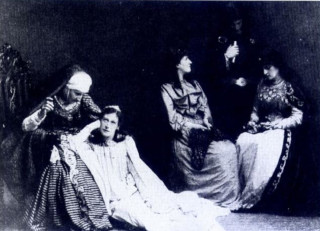
The first production of the Irish Literary Theatre, The Countess Cathleen, is performed on May 8, 1899. Like many of William Butler Yeats’ plays, it is inspired by Irish folklore. In a time of famine, demons sent by Satan come to Ireland to buy the souls of the starving people. The saintly Cathleen disposes of her vast estates and wealth in order to feed the peasants, yet the demons thwart her at every turn. At last, she sacrifices her own soul to save those of the poor.

Yeats, Lady Gregory and Edward Martyn publish a “Manifesto for Irish Literary Theatre” in 1897, in which they proclaim their intention of establishing a national theatre for Ireland. The Irish Literary Theatre is founded by Yeats, Lady Gregory, Martyn and George Moore in Dublin in 1899. It proposes to give performances in Dublin of Irish plays by Irish authors.

In 1899 Lady Gregory secures a temporary licence for a play to be given at the Antient Concert Rooms in Great Brunswick Street (now Pearse Street) in Dublin and so enables the Irish Literary Theatre to give its first production. The play chosen is The Countess Cathleen by Yeats. It is done by a very efficient London company that includes May Whitty (Dame May Webster) and Ben Webster. The next production given is Martyn’s play The Heather Field.

In the following year the Irish Literary Theatre produces three plays at the Gaiety Theatre in Dublin: Maeve by Edward Martyn, The Last Feast of Fianna by Alice Milligan and The Bending of the Bough by George Moore. The Bending of the Bough is staged during the Second Boer War which begins on October 11, 1899.

The Irish Literary Theatre project lasts until 1901, when it collapses due to lack of funding.

The use of non-Irish actors in these productions is perceived to be a failure, and a new group of Irish players is put together by the brothers William and Frank Fay, among others. These go on to form the Irish National Theatre Society, which leads to the founding of the Abbey Theatre in Dublin in 1904.


Leave a comment

Death of Padraic Colum, Poet & Novelist

padraic-colum

Padraic Colum, Irish-born American poet, novelist, biographer, playwright, and children’s author whose lyrics capture the traditions and folklore of rural Ireland, dies in Enfield, Connecticut on January 11, 1972. He is one of the leading figures of the Irish Literary Revival.

Colum was born on December 8, 1881, in Columcille, County Longford, the first of eight children born to Patrick and Susan Columb. In 1892, the family moves to Glasthule, near Dublin and he attends the local national school. He starts writing after he finishes school and meets a number of the leading Irish writers of the time, including W. B. Yeats, Lady Gregory and Æ. He also joins the Gaelic League and is a member of the first board of the Abbey Theatre. He becomes a regular user of the National Library of Ireland, where he meets James Joyce and the two become lifelong friends.

Influenced by the literary activity of the Celtic revival centered in Dublin at the turn of the century, Colum publishes the collection of poetry Wild Earth (1907). He co-founds The Irish Review in 1911, then three years later settles permanently in the United States. His varied literary output includes volumes of poetry including Dramatic Legends (1922) and Creatures (1927), plays such as Broken Soil (first performed 1903) and The Land (1905), novels, anthologies of folklore and children’s books. The reminiscence Our Friend James Joyce (1959) is written with his wife Mary (Maguire), a well-known literary critic.

The Colums spent the years from 1930 to 1933 living in Paris and Nice, where Padraic renews his friendship with James Joyce and becomes involved in the transcription of Finnegans Wake. After their time in France, the couple moves to New York City, where they do some teaching at Columbia University and City College of New York. He is a prolific author and publishes a total of 61 books, not counting his plays. While in New York, he writes the screenplay for the 1954 stop-motion animated film Hansel and Gretel: An Opera Fantasy. It is his only screenplay.

Mary dies in 1957, and Colum completes Our Friend James Joyce, which they had worked on together. It is published in 1958. He divides his later years between the United States and Ireland. In 1961 the Catholic Library Association awards him the Regina Medal.

Padraic Colum dies on January 11, 1972, at the age of 90, in Enfield, Connecticut. He is buried in St. Fintan’s Cemetery in Sutton, Dublin.


Leave a comment

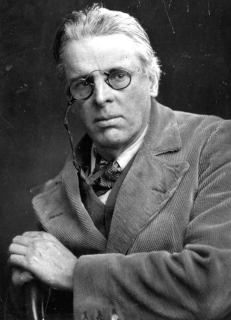
W.B. Yeats Receives Nobel Prize in Literature

william-butler-yeats-1

William Butler Yeats, Irish poet and one of the foremost figures of 20th century literature, receives Nobel Prize in Literature on December 10, 1923.

Yeats is born at Sandymount in County Dublin on June 13, 1865. His father, John Butler Yeats, is a lawyer and a well-known portrait painter. He is educated in London and in Dublin but spends his summers in the west of Ireland in the family’s summer house at Connacht. The young Yeats is very much part of the fin de siècle in London. At the same time, he is active in societies that attempt an Irish literary revival. His first volume of verse appears in 1887, but in his earlier period his dramatic production outweighs his poetry both in bulk and in import.

Together with Lady Gregory, Yeats founds the Irish Literary Theatre, which later becomes the Abbey Theatre, and serves as its chief playwright until the movement is joined by John Millington Synge. His plays usually treat Irish legends and also reflect his fascination with mysticism and spiritualism. The Countess Cathleen (1892), The Land of Heart’s Desire (1894), Cathleen ni Houlihan (1902), The King’s Threshold (1904), and Deirdre (1907) are among the best known.

After 1910, Yeats’s dramatic art takes a sharp turn toward a highly poetical, static, and esoteric style. His later plays are written for small audiences. They experiment with masks, dance, and music, and are profoundly influenced by the Japanese Noh plays. Although a convinced patriot, he deplores the hatred and the bigotry of the Nationalist movement, and his poetry is full of moving protests against it. He is appointed to the Irish Senate, Seanad Éireann, in 1922.

Yeats is one of the few writers whose greatest works are actually written after the award of the Nobel Prize. Whereas he receives the Prize chiefly for his dramatic works, his significance today rests on his lyric achievement. His poetry, especially the volumes The Wild Swans at Coole (1919), Michael Robartes and the Dancer (1921), The Tower (1928), The Winding Stair and Other Poems (1933), and Last Poems and Plays (1940), make him one of the outstanding and most influential twentieth-century poets writing in English. His recurrent themes are the contrast of art and life, masks, cyclical theories of life (the symbol of the winding stairs), and the ideal of beauty and ceremony contrasting with the hubbub of modern life.

Yeats dies at the age of 73 at the Hôtel Idéal Séjour, in Menton, France, on January 28, 1939. He is buried after a discreet and private funeral at Roquebrune-Cap-Martin. In September 1948, his body is moved to the churchyard of St. Columba’s Church, Drumcliff, County Sligo, on the Irish Naval Service corvette Macha.

(From Nobel Lectures, Literature 1901-1967, Editor Horst Frenz, Elsevier Publishing Company, Amsterdam, 1969)