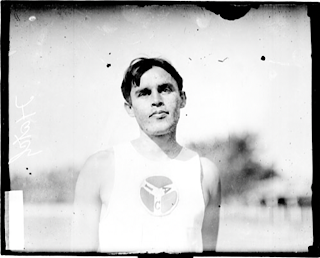
Hatch is also a well-known marathon runner. From 1904 through 1922 he runs more than 45 marathons with a score of victories including the Chicago Marathon in 1909 and the Yonkers Marathon in 1911, competing as a member of the Illinois State Gaelic Athletic Association (GAA). In 1910, he finishes in 5th place in the Yonkers Marathon, competing as a member of the Chicago Irish American Athletic Club.
Hatch never fails to finish a marathon. He is a six-time (1906, 1907, 1908, 1911, 1914, and 1915) winner of the Missouri Athletic Club‘s All Western Marathon in St. Louis including the 1908 marathon that qualifies him for the 1908 Summer Olympics in London. He competes in the marathon in two Olympics, placing 8th in 1904 at St. Louis and 14th in 1908 in London. He wins a silver medal in the 1904 Olympics Four-Mile team event.
On January 8, 1909, Hatch finishes third behind Matthew Maloney and James Crowley in an indoor marathon before 5,000 “wildly cheering” spectators held within the second Madison Square Garden with a time of 3:03:29.4. Maloney is reported to have set a new indoor record for the event (2:54:45.4).
On November 27, 1909, Hatch finishes sixth in the third edition of the Yonkers Marathon with a time of 3:00:24. In July of the same year, he wins a 100-mile race in Chicago, Illinois.
In March 1912, Hatch is one of “twenty of the best distance runners in the middle west” scheduled to participate in a 20-mile indoor marathon at Riverview Rink in Chicago. He also qualifies for the 1912 Summer Olympics but does not compete. He places in the top 10 in the Boston Marathon several times with a second-placed finish in 1917. He finishes third in the Boston Marathon in 1915 and 1916. In October 1916, he sets a record in the 96-mile Milwaukee to Chicago Run, completing the race in 14 hours, 50 minutes and 30 seconds.
Hatch serves as a U.S. Army messenger in World War I and is decorated for “extraordinary heroism” under fire near Brieulles, France, October 11, 1918. He is awarded the Purple Heart and Distinguished Service Cross as well as the French Croix de Guerre. After World War I, he returns to run two more Boston Marathons before retiring from marathon running. He is a letter carrier in River Forest, Illinois, from 1923 to 1953, retiring at age 70. He and Gertrude Morris are married in 1921 and have three children, Herbert, and twin girls June and Jane.
Hatch dies in Maywood, Illinois, on October 17, 1966. He is buried at the Chapel Hills Gardens West Cemetery, Oak Brook Terrace, Illinois.
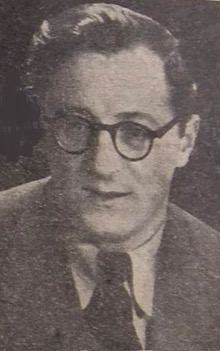
Born Leslie Yodaiken into a Russian–Jewish family in Portobello, Dublin, Daiken is the son of Samuel and Rosa Yodaiken. His father is a dealer in rubber and scrap metal, with premises in Dublin and Glasgow, and he is educated at two independent fee-paying schools, St. Andrew’s College and Wesley College, and then in 1930 he enters Trinity College Dublin. In his first year, one of his lecturers in French literature was Samuel Beckett. He is an active member of the Dublin University Socialist Society and a founding member of the college’s Gaelic Society.
In 1933, Daiken is present at the house of Charlotte Despard in Eccles Street, Dublin, also used as a Workers’ College, when it is attacked by a mob of Blueshirts. He leads the immediate defence of the building, which is saved on that occasion by the intervention of Irish Republican Army (IRA) men posing as the police.
In 1934, as Yodaiken, he graduates with a BA from Trinity in English and French Literature, with a Second Class degree. After graduating, Daiken works briefly as a schoolteacher in Dublin. In April 1935, his short story “Angela” is published in The New English Weekly under the pen name of Ned Kiernan. That year, he migrates to London.
Soon after his arrival in London, Daiken is one of the three founders of a duplicated publication called Irish Front, together with two other poets, Charles Donnelly and Ewart Milne.
In England, Daiken starts to shorten his surname from Yodaiken to Daiken, for his publications, but he does not make this change formally until doing so by deed poll in 1943.
In December 1935, The Irish Times reviews a production in Camden Town of Ireland Unfree, a stage version by Daiken of Patrick Pearse’s poem “The Rebel.” It states that “Mr. Daiken carries Pearse’s theme beyond his idealistic conclusion to the revolutionary viewpoint of the Irish workers.”
Daiken keeps up his links with leftist Irish writers and dissidents and edits the collection of working-class political verse Goodbye Twilight: songs of the struggle in Ireland (1936), illustrated by Harry Kernoff. The Irish Press describes this as “forty young poets with blazing eyes and clenched fists.” In another review, Louis MacNeice calls the book a “collection of proletarian poems – some communist, some Irish republican, and all written in a defiant spirit of opposition … a violent reaction against Yeats and all that he stood for.”
In 1939, Mairin Mitchell is highly critical of the Irish leftists, and in particular Daiken, for their views on the Molotov–Ribbentrop Pact, and writes to Desmond Ryan in September, “Brian O’Neill, Bloomsbury, and Daiken will sing Russia right or wrong.”
In October 1939, at the time of the wartime National Registration Act, Daiken is living in a studio at Old Castle Wharf, Twickenham, and describes himself as “Script-writer and advertising copywriter.”
During World War II, Daiken enlists in the Corps of Signals of the Irish Army, a neutral force, and also works for Reuters as a correspondent on education. In 1944, he edits They Go, the Irish, a collection of essays, including one from Seán O’Casey. In 1945, a collection of his verse is published under the title Signatures of All Things. In the summer of that year, Samuel Beckett gives Daiken his unpublished novel Watt, in the hope that he can find a publisher for it, but he fails to do so. They continue to write to each other and meet in London and Paris in the 1950s. He also keeps up with another friend from Trinity, Con Leventhal.
After he becomes a father in 1945, Daiken’s main interest moves on from political activism to children’s games and toys, and by 1951 the basement of his London home has become a toy museum. He writes on the subject and makes television and radio programmes for the BBC about it. His film One potato, two potato, a compilation of children’s street rhymes, wins the Festival Mondial du Film prize in 1958. His radio play The Circular Road is about a Jewish-Irish child.
In the 1950s Daiken founds the National Toy Museum and Institute of Play, today part of the Toy Collection at Hove Museum of Creativity.
Daiken returns to Ireland many times as a visitor. In the early 1960s he completes a radio play about the Jewish community of Dublin in the 1920s, which is broadcast on RTÉ.
In October 1963, Conor Cruise O’Brien, Vice Chancellor of the University of Ghana, recruits Daiken as a lecturer in education, and not long before his death he makes a film called The Piano about teaching white and black children in a school in Africa. He dies on August 15, 1964, while spending the summer vacation at home in London, leaving an estate valued at £3,865. He is cremated. His widow survives him until 1981.
In a tribute to Daiken, his 1930s communist associate Brian O’Neill writes, “He was always busy, always with a half dozen irons in the fire, always trying to give a hand to some Irish writer who needed it.”
In the early 1990s, Katrina Goldstone interviews Daiken’s brother, Aubrey Yodaiken, and later reports: “I was left with a faint sense of melancholy, as my interviewee had become distressed speaking about his brother, Leslie Daiken, and recalling his irrepressible and exasperating personality, his many projects, half-started novels…”
Aubrey Yodaiken is distressed by the lack of appreciation of his brother’s many cultural efforts and by the fact that his “scattershot literary endeavours” seem to have come to naught.
The National Library of Ireland holds a collection of Daiken’s papers, in particular his publications and correspondence, presented to it in 1995 by his elder daughter, by then Melanie Cuming, and his younger brother, Aubrey Yodaiken. The papers are mostly in English, French, German, Dutch, Italian, Hebrew, and Irish.
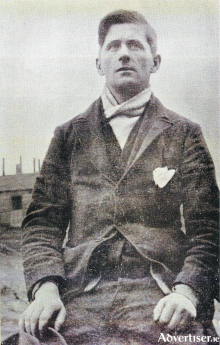
Christened as William O’Brien, Ó Briain is born at 10 Church Street, North Wall, Dublin, on September 16, 1888, the seventh child of Arthur O’Brien, clerk, and Mary O’Brien (née Christie), who is from County Meath. He takes an interest in the Irish language from an early age and begins learning Irish by himself from a grammar book, as it is not encouraged by his teachers at the Christian Brothers’ O’Connell School nor spoken by his parents. While still at the O’Connell School, he starts using the Irish version of his name. He also attends meetings of the Gaelic League, then attends University College Dublin (UCD) on a scholarship, where he studies French, English and Irish, receiving a BA (1909) and an MA (1910).
UCD decides to start awarding one annual scholarship for overseas travel in 1911, and Ó Briain wins the first one, using it to visit Germany and study under Kuno Meyer and Rudolf Thurneysen. After three years, he returns home, where he rejoins the Gaelic League and begins teaching French at UCD. He also joins the Irish Volunteers then, the following year, Seán T. O’Kelly convinces him to join the Irish Republican Brotherhood (IRB).
Around this time, Ó Briain joins Sinn Féin, and he stands unsuccessfully for the party in Mid Armagh at the 1918 United Kingdom general election in Ireland, taking 5,689 votes. His campaign leads, indirectly, to his arrest and three months in jail in Belfast. In 1920, following his release, he is appointed a judge in the then-illegal republican court system in Galway, and visits both France and Italy to try to source weapons for the Irish Republican Army (IRA). In November 1920, he is arrested in the UCG dining room by Black and Tans, and is imprisoned for thirteen months, first in Galway and then in the Curragh camp in County Kildare, thereby missing the conclusion of the Irish War of Independence. By the time he is released, the Anglo-Irish Treaty has been signed. He supports the treaty and takes no further part in militant activity.
In the newly independent Ireland, Ó Briain remains a professor at Galway. He also stands in the 1925 Seanad election, although he is not successful. He is the founding secretary of the Taibhdhearc na Gaillimhe theatre, also acting in many of its productions, and spends much time translating works from English and the Romance languages into Irish. He stands to become president of UCG in 1945, but is not elected, and in the 1940s and 1950s is best known for his many appearances on television and radio.
From his retirement in 1959, Ó Briain lives in Dublin. In 1974, the National University of Ireland (NUI) confers an honorary doctorate on him. He dies on August 12, 1974, at St. Gabriel’s Hospital, Cabinteely, County Dublin. His funeral to Glasnevin Cemetery is almost a state occasion, with a huge attendance of public figures, and a military firing party at the graveside, where the oration is given by Micheál Mac Líammóir and a lesson is read by Siobhán McKenna. For days after his death, the newspapers carry tributes to his many-sided career and personality. On the one hundredth anniversary of his birth, Proinsias Mac Aonghusa and Art Ó Beoláin write commemorative articles in Feasta.
On September 1, 1921, Ó Briain marries Helen Lawlor, of Dublin, who dies two years before him. The couple’s only child is Eibhlín Ní Bhriain, who is a journalist for The Irish Times and other periodicals.
Geddes is born on her maternal grandparent’s farm at Drumreilly Cottage in Leitrim, County Leitrim, on May 25, 1887. She is the eldest of four children, three girls and a boy, of William Geddes and his wife Eliza Jane Stafford. The family, who migrates to Ireland from Scotland, has mainly been farmers. Her father, a Methodist, who is born near his father’s farm at Tandragee, County Armagh, emigrates to the United States as a young man, working as a labourer for the railway construction business. This serves a useful purpose as he had worked as a site engineer at the Cavan, Leitrim and Roscommon Railway Company. When she is still an infant her parents move to their native home in Belfast, so her father can set up in business as a building contractor.
Geddes begins drawing subjects from life and nature from the age of four. She learns first how to draw from the school mistress in Ayrshire, where her father occasionally goes shooting. She begins her studies at Methodist College Belfast along with her three younger sisters. She later moves to the Belfast School of Art. She is encouraged by Rosamond Praeger, a sculptor from County Down, to continue with her studies. She is accepted as a student to study at the Belfast School of Art, Ulster University. This is where she adapts and improves her style and is introduced to a professional standard of art work.
While still studying at the Belfast School of Art, Geddes takes part in the Arts and Crafts Society of Ireland‘s fourth exhibition. For this exhibition, she contributes a glowingly coloured illustration of the book Cinderella Dressing the Ugly Sister (Dublin City Gallery), which she had created. It is at this exhibition that her work is spotted by Sarah Purser, a well established painter seeking newly trained students to introduce to stained glass artistry. Purser, who goes on to be her lifelong mentor, invites the young Geddes to join her in Dublin, working under the established stained glass artist William Orpen.
Geddes contributes a watercolour illustration of a Ballad Seller with the Belfast Art Society in 1907. She is elected as an Associate of the Belfast Art Society’s successor, the Ulster Academy of Arts, in 1933 before promotion to Honorary Academician in 1935. She shows five illustrations in the 1911 Oireachtas Exhibition. It is some twenty-one years before she returns to the Oireachtas when she exhibits three cartoons and three sketches for stained glass in 1932.
Geddes joins Purser at the acclaimed stained glass workshop called An Túr Gloine in 1910. The workshop is held in Dublin’s Metropolitan School of Art. It is here that she discovers her passion for the craftsmanship of stained glass artistry and creates her most important works.
During her early years at An Túr Gloine, Geddes’s originality shines, and important commissions come from St. Ann’s Church, Dawson Street, Dublin and the Presbyterian church in Rathgar. Dogged by illness, she returns to Belfast before 1916 and lives between there and Dublin until moving in 1925, as she has long wanted, to work in London at The Glass House, Fulham. While working at The Glass House, she instructs the Irish painter and stained glass artist Evie Hone.
Geddes’s work is considered pioneering and represents a rejection of the Late Victorian approach. She creates a new view of men in stained glass windows, portraying them with close-shaven crew cuts. The muscularity and tension of her portraiture is matched by the radical design of her constructions. Ambitious large-scale projects, as at the cathedral in Ypres, are equalled by the drama of smaller-scale work at Wallasey (Lancashire) and Wallsend (Northumberland), or war memorial windows in obscure country churches.
Despite the hardships of living in London during World War II, poverty, and ill health, Geddes designs seventeen full-scale stained glass masterpieces, sixteen of which she completes.
Geddes dies on August 10, 1955 in London of a pulmonary embolism. She is buried in CarnmoneyCemetery, County Antrim, along with her mother and sister Ethel. Even after moving to London, she claims that her native identity never wavered as she says she was always “a Belfast woman.”
Robbins advances to the finals in the 400 metres race at the 1908 Summer Olympics in London, winning his preliminary heat with a time of 50.4 seconds and his semifinal in 49.0 seconds. In the first running of the final race, he finishes in front. However, teammate John Carpenter is disqualified after being accused of obstructing British runner Wyndham Halswelle, and the race is ordered to be repeated without Carpenter. Robbins and fellow American John Taylor refuse to compete in the second final in protest of Carpenter’s disqualification. Halswelle runs the race alone and is presented with the Gold medal. This race is the only case of a walkover in Olympic history.
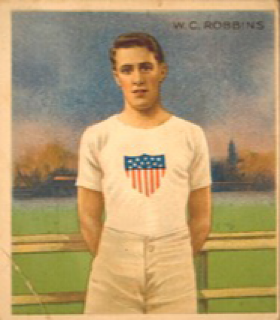
According to Robbins’ 1910 trading card, he is “one of the best quarter-milers in the United States. He was… (a) Cornell University student, and first came to prominence by the part he played in the 400-meter race held at London in 1908. ‘Yank,’ as he (was) called by his team mates, ran the first 300 yards at such a clip that it ‘pulled the great Halswell’s cork,’ the later finishing in third place. Robbins won the Metropolitan Amateur Athletic Union quarter-mile championship in September 1909, and two weeks later captured the Canadian quarter-mile title, running the distance in the great time of 48 4/5 seconds.”
At the Amateur Athletic Union metropolitan championships held at Travers Island in 1909, Robbins is part of the Irish American Athletic Club’s four-man relay team that breaks the world’s record for the one mile relay, with a time of 3 minutes 20 2/5 seconds. The other three men on the record-breaking team were C.S. Cassara, James Rosenberger, and Melvin Sheppard.
Robbins dies on July 30, 1962.
(Pictured: William C. Robbins, wearing the 1908 U.S. Olympic team shirt, from the 1910 Mecca Cigarettes Champion Athlete & Prize Fighter Series trading card)
Discontented with James Chichester-Clark and Brian Faulkner who come to government after O’Neill’s 1969 fall from power, Boal resigns from the UUP in 1971 and joins Ian Paisley in establishing the Democratic Unionist Party (DUP) in order to provide dissident unionist opinion with a viable political alternative. He works as the first chairman and one of the first public representatives of the DUP and continues to sit in Stormont during the years of 1971–1972. He later resumes his practice as a barrister.
While Boal’s interest in federalism diminishes after the 1970s, the federalist Boal scheme of January 1974 is again put forward by liberal protestants such as John Robb as late as 2007. His friendship with Paisley finally breaks when the DUP agrees to enter government with Sinn Féin in 2007. He tells Paisley, who takes the breach very hard, that he had betrayed everything he ever advocated.
Nationalist forces enter Newcastle West, County Limerick, on Monday, August 7, 1922, after a twelve-hour battle, in which twelve anti-Treaty Irish Republican Army (IRA) members, sometimes referred to as Irregulars, are killed. The casualties of the Nationalists are less than those of the Irregulars.
Taking little respite after Sunday’s labors, the Nationals advance from Rathkele on Monday morning, and by midday are in sight of their fresh objective. Armored cars enter the town and machine gun fire is directed against a party of Irregulars, causing many casualties.
When the artillery goes into action against the headquarters of the Irregulars, the Irregulars flee precipitately along Cord road.
Owing to the slow progress in the operations in Southern Ireland, the meeting of Dáil Éireann, scheduled to open Saturday, is postponed again.
The official army bulletin announces that the Nationals captured Castle Island on Saturday, August 5. It says that the counties of Cork and Kerry with a part of South Tipperary and a small area in County Waterford are the only districts held by the Irregulars with any degree of security.
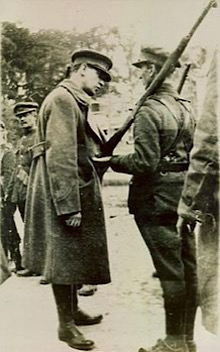
The streets of Dublin are lined with great crowds of people on Tuesday, August 8, for the military funeral of nine National Army soldiers who were killed in fighting the Republican Irregulars in County Kerry. Michael Collins, Chairman of the Provisional Government, and all the leading officers of the army in Dublin march beside the hearses. Each coffin is covered with the Republican tricolour. There are many clergymen and other civilians in the funeral procession.
Prominent Catholics of Dublin and Belfast are trying to effect a better understanding between the Ulster and Free State Governments, according to the Daily Mail. This newspaper further states that all efforts to this end, which have all been taken with the advice and approval of leading English Catholics, are without official character.
A message from Strabane, County Tyrone, received by the Exchange Telegraph Company on August 8 states that a settlement between the Ulster Government and the Free State authorities is imminent, the terms of agreement having been practically arranged in negotiations proceeding in London.
In Downing Street, however, all knowledge of any such Irish negotiations is disclaimed and a telegram from Belfast quotes Ulster Government officials as denying that a settlement with the Free State is imminent.
The Free State Government is also unaware of any negotiations for a settlement between the Ulster Government and the Free State authorities. It is further states that such negotiations are unlikely to take place.
(From: “Irish Irregulars Routed With Loss,” The New York Times, August 9, 1922 | Pictured: General Michael Collins inspects a soldier at Newcastle West, County Limerick, August 8, 1922)
Foley’s most recent work includes Cold Courage, a TV series thriller for Lionsgate, Viaplay and Luminoir shot in Europe in 2019 and The Man Who Died, a series for Elisa-Viaplay.
Foley writes, produces and directs The Riddle in 2006, starring Jones, Sir Derek Jacobi and Vanessa Redgrave. In September 2007, The Riddle becomes the world’s first feature film to be released as a DVD premiere by a national newspaper. The UK’s The Mail on Sunday buys UK DVD rights and distributes 2.6 million copies, making the film one of the most widely watched independent films in the UK.
During 2006–07, Foley writes and directs Assault of Darkness, a satirical horror film set in rural Ireland, starring Jones, Jason Barry and Nora-Jane Noone. It is released by Lionsgate in the United States on DVD in 2009. He co-creates and is a writer on Shelldon, a children’s environmental animated TV series on NBC (2010–12) and Byrdland (five seasons of animated TV series in Asia with GMM Grammy).
In 2015, Foley starts developing a new TV detective series for BBC Television, Farmoor (makers of The Fall) and Northern Ireland Screen (UK home of Game of Thrones) and, in 2016, he develops Tunnel Kings, a mini-series on World War IIPOW “escape-artists” for the Canadian Broadcasting Corporation and Dream Street, Canada. He completes pilot scripts for SOS, a new eco-thriller series by Finnish producers Luminoir, and Kvenland, set in the Dark Ages. Previously he writes the pilot for drama Dr. Feelgood for Monday TV (Denmark).
Cold Courage, described as a Nordic noir series involving Finnish characters in present-day London made by Finnish producers Luminoir for Lionsgate and Viaplay, shot in London, Dublin, Belgium and Finland in 2019. Actor John Simm tells Variety that he is attracted to the series by the quality of the writing and the fact that it is a pan-European thriller.
Foley has written books for U.S. and UK publishers. Under The Wire, a World War II POW escape drama, which he writes along with its subject, pilot William Ash, is published by Random House, London and St. Martin’s Press, New York, in 2005 and 2006. It becomes a best-seller, reaching number one on Amazon UK‘s history and biography charts. In 2018/19, a related TV series is developed as a future miniseries by CBC in Canada and Northern Ireland Screen.
Foley’s next book, Archerfield, a novel, published in 2015, covers 16,000 years of history in one square mile of Scotland.
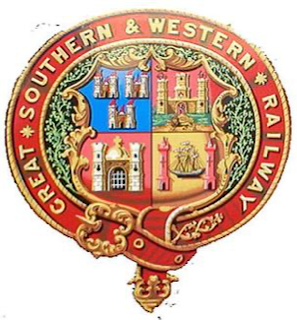
The GS&WR is an Irish gauge (1,600 mm (5 ft. 3 in.)) railway company that operates in Ireland from 1844 until 1924. The GS&WR grows by building lines and making a series of takeovers, until in the late 19th and early 20th centuries it is the largest of Ireland’s “Big Four” railway networks. At its peak the GS&WR has an 1,100-mile (1,800 km) network, of which 240 miles (390 km) are double track.
The core of the GS&WR is the Dublin Kingsbridge – Cork main line, Ireland’s “Premier Line,” and still one of her most important main line railways. The company’s headquarters are at Kingsbridge station. At its greatest extent, the GS&WR includes, in addition to the Dublin – Cork main line, the Dublin – Waterford and Mallow – Waterford lines and numerous branch lines.
There are earlier attempts to set up main line railways into the south of Ireland, but the 1840s efforts of Peter Purcell, a wealthy landowner and mail coach operator, and his associates ultimately prove successful with the implementation of a bill passed on August 6, 1844, for the GS&WR. Purcell is actively assisted by engineer John Benjamin Macneill, who has done surveys for the London and Birmingham Railway and has connections in London. The GS&WR’s vision to provide a single railway for most of the south of Ireland finds favour with United Kingdom Prime MinisterRobert Peel as having likely more profitably for wealthy investors and because a single company will be easier to control. These factors likely ease the passage of relevant legislation.
William Dargan, Ireland’s foremost railway contractor, builds much of the GS&WR’s main line and a number of its other routes.
The directors choose to begin by construction of the 32.5 mile (52.3 km) stretch of the Dublin – Cork main line as far as Cherryville Junction just west of Kildare and the 23.5 mile (37.8 km) branch to Carlow with contracts shared between McCormack and Dargan. Work begins in January 1845 with services commencing on August 4, 1846. Trains are scheduled to take about 2 hours, 35 minutes for the 56 mile (90 km) stretch to Carlow and coach connections are arranged to Kilkenny, Clonmel, Waterford and the evening mail coach for Cork.
In October 1849, the main line reaches the outskirts of Cork, where the GS&WR opens a temporary terminus at Blackpool. The final 1-mile (1.6 km) of line from Blackpool to the centre of Cork includes a 1,355-yard (1,239 m) tunnel and is not completed for another six years. Services through the tunnel begin in December 1855, running to and from a second temporary terminus beside the River Lee. Finally, the present Cork terminus in Glanmire Road opens in July 1856.
FitzGerald marries Charlotte Boyle Walsingham in London on August 3, 1791. Together they live at Boyle Farm, Thames Ditton. In 1806, his wife succeeds to the Baron de Ros, the premier baron in the Peerage of England, as 20th Baroness de Ros. The family then takes the surname FitzGerald-de Ros. The couple has 13 children in 21 years, of which nine survive to adulthood.


 seamus dubhghaill