Éamon De Valera and Michael Collins agree to a pact on May 20, 1922 whereby a national coalition panel of candidates will represent the pro- and anti-Treaty wings of Sinn Féin throughout Ireland in the forthcoming general election.
As in the Irish elections, 1921 in the south, Sinn Féin stands one candidate for every seat, except those for the University of Dublin and one other. The treaty has divided the party between 65 pro-treaty candidates, 57 anti-treaty and 1 nominally on both sides. Unlike the elections a year earlier, other parties stand in most constituencies forcing single transferable vote elections, with Sinn Féin losing 30 seats.
To avoid a deeper split de Valera and Collins work out a “pact” whereby it is agreed that the pro-treaty and anti-treaty factions will fight the general election jointly and form a coalition government afterwards. This pact prevents voters giving their opinions on the treaty itself, especially in uncontested seats. However, the draft constitution of the Irish Free State is then published on June 15, and so the anti-treaty Sinn Féin group’s 36 seats out of 128 seem to many to be a democratic endorsement of the pro-treaty Sinn Féin’s arrangements. Others argue that insufficient time is available to understand the draft constitution, but the main arguments have been made public in the Treaty Debates which end in January 1922.
Despite the Pact, the election starts the effective division of Sinn Féin into separate parties. Anti-Treaty members led by de Valera walk out, and pro- and anti-Treaty members take opposite sides just weeks later in the ensuing Irish Civil War.
Kenny is one of the founding members of the Irish Women’s Liberation Movement. Although the group has no formal structure of officials, she is often seen as the “ringleader” of the group. In March 1971, as part of an action by the IWLM, she walks out of Haddington Road church after the Archbishop of Dublin‘s pastoral is read out from the pulpit, confirming that “any contraceptive act is always wrong,” saying “this is Church dictatorship.” In a follow-up letter to The Irish Times she explains her actions by saying Ian Paisley was right, “Home Rule is Rome Rule.”
In 1973, Kenny is allegedly “disturbed in the arms of a former cabinet minister of President Obote of Uganda during a party,” which leads poet James Fenton to coin the euphemism “Ugandan discussions” to mean sexual intercourse. The phrase is first used by the magazine Private Eye on March 9, 1973, but has been widely used since then and is included by the BBC in a list of “The 10 most scandalous euphemisms” in 2013.
Although the Irish War of Independence officially ends in July 1921, the Irish Republican Army’s conflict with British and unionist forces continues in Northern Ireland and escalates in the first half of 1922. The Ulster IRA, with the tacit but covert assistance of Michael Collins, head of the new Irish Free State, continues to wage a guerrilla war in Northern Ireland. According to historian Alan Parkinson, despite “the IRA having some short-term successes … the main effect of this intensive campaign was to unleash a terrible backlash on the Catholic population in Belfast.” Only a week before the Arnon Street incident, policemen – either Royal Irish Constabulary (RIC) or Ulster Special Constabulary (USC) – kill six Catholic civilians in the McMahon murders.
On the evening of April 1, RIC constable George Turner is patrolling the Old Lodge Road when he is killed by a sniper.
About ten police officers in Brown Square Barracks, upon hearing of Turner’s murder, take a Lancia armoured car and begin touring nationalist areas. When they dismount their vehicle, witnesses hear them shouting “Cut the guts out of them for the murder of Turner.” Their first victim is John McRory who lives on Stanhope Street, just across the road from where Constable Turner had been shot. The police break into his house and shoot him dead in his kitchen. In Park Street, Bernard McKenna, father of seven, is killed while lying in bed. Finally, the police arrived at Arnon Street.
William Spallen, who lives at 16 Arnon Street, has just returned from the funeral of his wife who had also been killed in the conflict. His 12-year-old grandson, Gerald Tumelty, witnesses his death. “Two men came into the room, one was in the uniform of a policeman. They asked my grandfather his name and he said William Spallen. The man in plain clothes fired three shots at him. When I cried out, he said, ‘lie down or I will put a bullet into you.'” Tumelty says the killers then take £20 that his grandfather had to pay for his wife’s funeral.
The attackers then use a sledgehammer to break into the house next door, where they find Joseph Walsh in bed with his seven-year-old son Michael and his two-year-old daughter Bridget. Joseph Walsh is bludgeoned to death with the sledgehammer while Michael Walsh is shot and dies from his wounds the next day. Another son, Frank, is shot in the thigh but survives. Later that evening another Catholic, John Mallon, is shot dead in Skegoneill Avenue.
The unionist press, the Belfast News Letter and Belfast Telegraph, condemn the killings but do not identify the killers as police. The Dublin-based Irish Independent writes that “never even in the worst state of terror in the west and south has the state of affairs which now prevails in the Northern capital been experienced.” Michael Collins sends an angry telegram to Northern Ireland Prime MinisterJames Craig, demanding a joint inquiry into the killings. No such inquiry is set up.
As with the McMahon killings one week earlier, it is strongly suspected that an RIC Detective Inspector, Nixon, operating out of the Brown Street Police barracks, had organised the attack. Nixon and several other policemen fail to turn up at roll call at the barracks immediately after the killings.
Thomas Curtin is born at Ballyknockane, Mourne Abbey, County Cork, on March 20, 1884, the son of Patrick Curtin, a farmer, and Julia Sheehan. He attends Burnfort National School. In 1897 the family moves to Cork City, where he attends the North Monastery school.
Mac Curtain, as he later becomes known, is active in a number of cultural and political movements beginning around the turn of the 20th century. He joins the Blackpool, Cork branch of Conradh na Gaeilge, becoming its secretary in 1902. He has interests in music, poetry, history, archaeology and Irish history. He works in his early career as a clerk, and in his free time teaches Irish. In 1911 he joins Fianna Éireann and is a member of the Irish Volunteers.
He meets Elizabeth Walsh (Eibhlís Breathnach) at a Gaelic League meeting, and they marry on June 28, 1908. They have six children, five of whom survive into adulthood. The family lives over 40 Thomas Davis Street, where Mac Curtain runs a small clothing and rainwear factory.
In April 1916, at the outset of the Easter Rising, Mac Curtain commands a force of up to 1,000 men of the Irish Volunteers who assemble at various locations around County Cork. From the volunteer’s headquarters at Sheares Street in the city, Mac Curtain and his officers await orders from the volunteer leadership in Dublin, but conflicting instructions and confusion prevail and as a result the Cork volunteers never enter the fray. A tense stand-off develops when British forces surround the volunteer hall and continued for a week until a negotiated agreement leads to the surrender of the volunteers’ arms to the then Lord Mayor of Cork Thomas Butterfield on the understanding that they will be returned at a later date. This does not happen however, and Mac Curtain is jailed in Wakefield Prison, in the Frongoch internment camp in Wales, and in Reading Gaol. After the general amnesty of participants in the Rising 18 months later, Mac Curtain returns to active duty as a Commandant of what is now the Irish Republican Army.
By 1918 Mac Curtain is a brigade commander, the highest and most important rank in the IRA. During the Conscription Crisis of 1918, he actively encourages the hiring of the women of Cumann na mBan to cater for Volunteers. He is personally involved with Michael Collins‘ Squad that, along with a Cork battalion, attempt to assassinate Lord John French, whose car is missed as the convoy passes through the ambush positions. Despite the setback he remains brigadier of No.1 Cork when he is elected Lord Mayor. He is elected in the January 1920 council elections as the Sinn Féin councillor for NW Ward No. 3 of Cork and is chosen by his fellow councillors to be the Lord Mayor. He begins a process of political reform within the city.
In January 1919, the Irish War of Independence starts, and Mac Curtain becomes an officer in the IRA. On March 20, 1920, his 36th birthday, Mac Curtain is shot dead in front of his wife and son by a group of men with blackened faces, who are found to be members of the Auxilaries along with unknown members of the Royal Irish Constabulary (RIC) by the official inquest into the event. In the wake of the killing, which is in revenge for the shooting of a policeman, Mac Curtain’s house in Blackpool is ransacked.
The killing causes widespread public outrage. The coroner’s inquest passes a verdict of willful murder against British Prime MinisterDavid Lloyd George and against certain members of the RIC. Michael Collins later orders his squad of assassins to uncover and assassinate the police officers involved in the attack. RIC District Inspector Oswald Swanzy, who had ordered the attack, is fatally shot, with Mac Curtain’s own revolver, while leaving a Protestant church in Lisburn, County Antrim on August 22, 1920, sparking what is described by Tim Pat Coogan as a “pogrom” against the Catholic residents of the town.
Seán Connolly is an IRA activist from County Longford, but he is also used by IRA GHQ to organise the surrounding areas of County Roscommon and County Leitrim. When Michael Collins orders Connolly into the county, he warns that it is “the most treacherous county in Ireland.” As Connolly is running a training camp at Selton Hill in early 1921, his position is given to the RIC. The RIC District Inspector, Thomas Gore-Hickman, has been alerted to Connolly’s position by a local doctor who had served in the British Army. The doctor had reportedly been told of the training camp by a local member of the Orange Order.
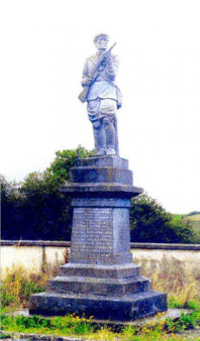
The events at Selton Hill take place one week after the Sheemore ambush, in which British troops from the Bedfordshire and Hertfordshire Regiment, based in Boyle suffer several casualties and at least one fatality. On March 11, at Selton Hill, a large force of RIC and Auxiliaires, based in Mohill and troops from the Bedfordshire and Hertfordshire Regiment surround and then attack the IRA camp. Six IRA volunteers are killed. The RIC suffers no losses. The IRA dead are Sean Connolly, Seamus Wrynne, Joseph O’Beirne, John Reilly, Joseph Reilly, and Capt. M.E. Baxter.
Ernie O’Malley later claims the volunteers’ bodies are “taken to Mohill by soldiers who shouted, “fresh meat!” as they were driving through the town.” He is also quoted as saying, “Men from the Bedfordshire Regiment were seen by a badly wounded IRA officer, Bernie Sweeney who survived, to use rifle butts on the skulls of two wounded men.” He also states that the location of the column was given to the local District Inspector of the RIC by a doctor who had been in the British Army, who received the information by a local Orangeman. The IRA officer who survives is Bernie Sweeney, from Ballinamore, who survives by hiding in a drain, where the cold water prevents him from bleeding to death. He is rescued and hidden from the Black and Tans and Auxiliaries by locals.
The IRA learn their position had been given away by the doctor and the Orangeman. The latter is later killed by the IRA. The doctor escapes to England and later dies in an accident.
The border country of the north midlands often proves to be a treacherous place for IRA training camps. On May 8, 1921, a camp of Belfast IRA volunteers based in the Lappanduff hills in neighbouring County Cavan, is also surprised. One volunteer is killed, thirteen captured, and arms and ammunition are seized by the British forces.
(Pictured: Selton Hill Ambush Memorial, south of the village of Fenagh, County Leitrim)
The First Dáil is convened from 1919–1921. It is the first meeting of the unicameral parliament of the revolutionary Irish Republic. In 1919 candidates who have been elected in the Westminster elections of 1918 refuse to recognise the Parliament of the United Kingdom and instead establish an independent legislature in Dublin called “Dáil Éireann.” The establishment of the First Dáil occurs on the same day as the outbreak of the Irish War of Independence.
Being the first and highly symbolic meeting, the proceedings of the Dáil are conducted for the only time entirely in the Irish language, except for previously drafted declarations that are repeated in other languages as well. The Dáil elects Cathal Brugha as its Ceann Comhairle (chairman). A number of short documents were then adopted. These are the:
The Declaration of Independence asserts that the Dáil is the parliament of a sovereign state called the “Irish Republic,” and so the Dáil establishes a cabinet called the Ministry or “Aireacht,” and an elected prime minister known both as the “Príomh Aire” and the “President of Dáil Éireann.” The first, temporary president is Cathal Brugha. He is succeeded in April by Éamon de Valera.
The membership of the Dáil was drawn from the Irish MPs elected to sit at the Westminster parliament, 105 in total, of which 27 are listed as being present for the first meeting. Of the remainder 34 are described as being “imprisoned by the foreigners” and three as being “deported by the foreigners.” Five Sinn Féin members are described as being “as láthair” (absent). The remaining 32 members who are invited but not present are six members of the Irish Parliamentary Party and 26 unionists, mainly from the northern six counties that would later form Northern Ireland. These include all MPs elected to sit for Belfast, Counties Down, Antrim, Armagh, and Londonderry, two out of three MPs for County Tyrone and one out of two MPs for County Fermanagh. For the portion of the country that would later become the Irish Free State, MPs do not sit for Waterford city or the Dublin University constituency, although members do attend for the National University of Ireland constituency.
The London-born son of a British scholar and an Irish mother, Childers is a lifelong Protestant, itself an anomaly since Irish nationalism maps strongly to Catholicism. In his early years his loyalty was with the British Empire. In his twenties, Childers volunteers for the Second Boer War, and he later says the rank savagery and underlying injustice of England’s war “changed the whole current of my life and made me a Liberal and a Nationalist.”
Laying down the sword, Childers takes up the pen and writes several books of military history. He also writes a novel, The Riddle of the Sands, that has a claim of being the first spy novel. The Riddle of the Sands has never gone out of print since it was published in 1903.
Both in fiction and nonfiction, Childers’ warnings against the German challenge to British hegemony are prophetic, but he is himself becoming a man divided. In 1914 he runs German guns to Irish nationalists aboard his yacht Asgard and then signs up for the royal navy when World War I erupts. The British crackdown on the Easter Rising during the war completes his radicalization. He moves to Dublin and turns his eloquence against the British.
After Collins’s assassination, emergency laws promulgate the death sentence for anyone caught armed without authorization. Childers is a writer, not a partisan, but he is arrested in early November with a small sidearm, a gift Collins had given him back when they were on the same side. It is a time of bloody justice, and they throw the book at him.
Childers knows as well as Collins had that the internecine conflict would have to end. He faces his execution with awe-inspiring forgiveness. Summoning his 16-year-old son to prison the night before his execution, Childers extracts a promise from the boy that he will find everyone who signed his death warrant and shake their hands. This son, young Erskine Hamilton Childers, eventually becomes President of Ireland.
Childers himself likewise shakes the hands of his own firing squad, one by one. His last words, reported in a number of slightly different variations, are lightheartedly addressed to them: “Take a step or two forwards, lads. It will be easier that way.”
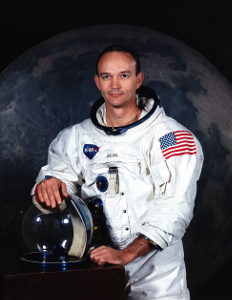
Collins makes the decision to become an astronaut after watching John Glenn‘s Mercury-Atlas 6 flight. He applies for the second group of astronauts that same year but is not accepted. Disappointed, but undaunted, Collins enters the USAF Aerospace Research Pilot School as the Air Force begins to research space. That year, NASA once again calls for astronaut applications, and Collins is more prepared than ever. In 1963 he is chosen by NASA to be part of the third group of astronauts.
Collins makes two spaceflights. The first, on July 18, 1966, is the Gemini 10 mission, where Collins performs a spacewalk. The second is the Apollo 11 mission on July 20, 1969, the first lunar landing in history. Collins, accompanied by Neil Armstrong and Edwin “Buzz” Aldrin, remains in the Command Module while his partners walk on the moon’s surface. Collins continues circling the moon until July 21, when Armstrong and Aldrin rejoin him. The next day, he and his fellow astronauts leave lunar orbit. They land in the Pacific Ocean on July 24. Collins, Armstrong and Aldrin are all awarded the Presidential Medal of Freedom by Richard Nixon. However, Aldrin and Armstrong end up receiving a majority of the public credit for the historic event, although Collins is also on the flight.
Collins leaves NASA in January 1970, and one year later, he joins the administrative staff of the Smithsonian Institution in Washington, D.C. In 1980, he enters the private sector, working as an aerospace consultant. In his spare time, Collins says he stays active and spends his days “worrying about the stock market” and “searching for a really good bottle of cabernet under ten dollars.”
Collins and his wife, Patricia Finnegan, have three children. The couple lived in both Marco Island, Florida, and Avon, North Carolina until her death in April 2014.
On April 28, 2021, Collins dies of cancer at his home in Naples, Florida, at the age of 90. Buzz Aldrin, who becomes the last survivor of Apollo 11, says that “wherever [Collins has] been or will be, you will always have the Fire to Carry us deftly to new heights and the future.”
O’Duffy does an apprenticeship as an engineer in Wexford before working as an engineer and architect in Monaghan. In 1919 he becomes an auctioneer. He is a leading member of the Gaelic Athletic Association in Ulster in the 1910s. In 1912 he is appointed secretary of the Ulster provincial council. He is also a member of Harps’ Gaelic Football Club.
Professionally, O’Duffy becomes the second Commissioner of the Garda Síochána, the police force of the new Irish Free State, after the Civic Guard Mutiny and the subsequent resignation of Michael Staines. He holds this post until 1933, when he is dismissed by Éamon de Valera. In his political life O’Duffy is an early member of Sinn Féin, founded by Arthur Griffith. He is elected as a Teachta Dála (TD) for his home county of Monaghan during the 1921 election.
After a split in 1923 he becomes associated with Cumann na nGaedheal and becomes head of a veteran’s group then known as the Army Comrades Association. O’Duffy changes its name to “National Guard” and begins to stage fascist-style rallies and adopts a fascist salute. Its members begin to wear blue uniform shirts and become known as the Blueshirts. When government opposition groups form Fine Gael in September 1933, he becomes its first president, reaching the apex of his political power.
Subsequently, the government bans O’Duffy’s National Guard, as well as the group he creates to replace it, the Young Ireland Association, which he in turn replaces with the League of Youth, but their blue shirts indicate its continued fascist ideology. Fine Gael’s other leaders soon tire of his inflammatory rhetoric and the frequent violent behavior of the Blueshirts but are still surprised when their opposition causes him to resign his party leadership in September 1934. He is then ousted as leader of the Blueshirts as well but does retain a small loyal following.
Eoin O’Duffy takes no further part in Irish politics and dies in Dublin on November 30, 1944. In spite of his later politics, he is given a state funeral for his earlier contributions to the Irish government. He is buried in Dublin’s Glasnevin Cemetery.
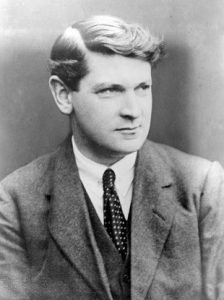
Michael Collins, soldier and politician who was a leading figure in the struggle for, and achievement of Irish independence in the early 20th century, is born near Clonakilty, County Cork, on October 16, 1890.
Michael Collins is born to a successful farmer, Michael John Collins, and Mary Anne O’Brien. When the couple marries, she is twenty-three years old, and he is sixty. The couple have eight children, with Michael being the youngest.
Raised in a beautiful but remote part of southwest Ireland, Collins is educated at local primary schools. At the Lisavair National School, Collins is inspired by his teacher, Denis Lyons, a member of a secret organization, the Irish Republican Brotherhood (IRB), whose aim is to gain Ireland’s independence from Great Britain. Collins is also influenced by the stories of local men who had taken part in the Irish Rebellion of 1798, a conflict that sparks a feud between the Irish Protestants and Catholics. From these stories Collins learns of Irish pride, rebellion, executions, and the general harsh treatment imposed on his country by the British.
In 1906 Collins goes to London to enter the civil service as a postal clerk. For ten years Collins lives in London, where he becomes active in various Irish organizations, including the Gaelic League, a society that promotes the use of the Irish language. Also, during this time, Collins is influenced by the writings of Arthur Griffith, an Irish nationalist who founded the Irish political party Sinn Féin. In 1909 Collins himself becomes a member of the IRB, and later becomes the IRB treasurer for the South of England.
Collins returns to Ireland in 1916 to take part in the Easter Rising, a rebellion against British rule. After the rebellion is crushed, Collins is interned in North Wales along with most of the other rebels from the IRB. When the internees are released in December 1916, he goes to Dublin, where his sharp intelligence and dynamic energy soon secure him a leadership position in the reviving revolutionary movement.
Collins plays the most important role in this struggle. As director of intelligence of the IRA, he cripples the British intelligence system in Ireland and replaces it with an effective Irish network. At the same time, he performs other important military functions, heads the IRB, and, as minister of finance in the Republican government, successfully raises and hands out large sums of money on behalf of the rebel cause. Despite constant efforts, the British are unable to capture Collins or stop his work. The “Big Fellow” becomes an idolized and near-legendary figure in Ireland, and he wins a reputation in Britain and abroad for ruthlessness, resourcefulness, and daring.
After the truce of July 1921, Collins reluctantly agrees to Irish president Éamon de Valera‘s request to serve on the peace-making talks headed by Arthur Griffith. During the autumn negotiations in London, the British government firmly rejects any settlement that involves recognition of the republic. Instead, its representatives offer Dominion status for Ireland with the right of exclusion for loyalistNorthern Ireland. Collins decides to accept these terms, in the belief that rejection would mean renewal of the war and quick defeat for Ireland, and that the proposed treaty will soon lead to unity and complete freedom for his country. Using these arguments, he and Griffith persuade their side to sign the treaty on December 6, 1921, and Dáil Éireann to approve it on January 7, 1922.
De Valera and many Republicans refuse to accept the agreement, however, believing that it means a betrayal of the republic and a continued domination by Britain. As the British evacuate southern Ireland, Collins and Griffith do their best to maintain order and enforce the treaty signed with the British. They find their efforts frustrated by the opposition of an armed Republican minority. Collins seeks desperately to satisfy the forces that oppose the treaty without abandoning the treaty altogether, but he finds it impossible to make a workable compromise.
In late June 1922, after the population had supported the settlement in an election, Collins agrees to use force against the opposition. This action sparks a civil war, a bitter conflict in which the forces of the infant Irish Free State eventually overcome the extreme Republicans in May 1923. However, Collins does not live to see the end of the war. He is killed in an ambush in West Cork on August 22, 1922, just ten days after the death of Arthur Griffith.
Much of Collins’s success as a revolutionary leader is due mainly to his realism and extraordinary efficiency. He also possesses an amazing vision and humanity in his character, however, which appeals to friend and foe alike. The treaty that costs him his life does not end the argument, as he had hoped, but it does make possible the peaceful gaining of full political freedom for most of Ireland.

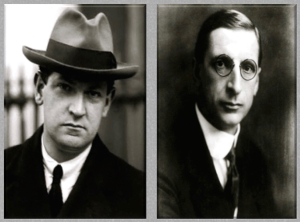 Éamon De Valera and Michael Collins agree to a pact on May 20, 1922 whereby a national coalition panel of candidates will represent the pro- and anti-Treaty wings of Sinn Féin throughout Ireland in the forthcoming general election.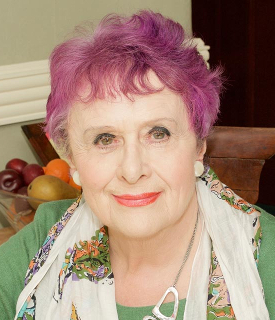





 seamus dubhghaill