seamus dubhghaill

Promoting Irish Culture and History from Little Rock, Arkansas, USA


Leave a comment

Birth of Eoin O’Duffy, Political Activist & Police Commissioner

Eoin O’Duffy, Irish political activist, soldier, police commissioner and organizer of the infamous Blueshirts, is born in Castleblayney, County Monaghan, on October 20, 1892.

O’Duffy does an apprenticeship as an engineer in Wexford before working as an engineer and architect in Monaghan. In 1919 he becomes an auctioneer. He is a leading member of the Gaelic Athletic Association in Ulster in the 1910s. In 1912 he is appointed secretary of the Ulster provincial council. He is also a member of Harps’ Gaelic Football Club.

O’Duffy joins the Irish Republican Army (IRA) in 1917 and is the leader of the Monaghan Brigade of the IRA during the Irish War of Independence and in this capacity becomes Chief of Staff of the IRA in 1922. He is one of the Irish activists who along with Michael Collins accepts the Anglo-Irish Treaty and fights as a general in the Irish Civil War on the pro-Treaty side.

Professionally, O’Duffy becomes the second Commissioner of the Garda Síochána, the police force of the new Irish Free State, after the Civic Guard Mutiny and the subsequent resignation of Michael Staines. He holds this post until 1933, when he is dismissed by Éamon de Valera. In his political life O’Duffy is an early member of Sinn Féin, founded by Arthur Griffith. He is elected as a Teachta Dála (TD) for his home county of Monaghan during the 1921 election.

After a split in 1923 he becomes associated with Cumann na nGaedheal and becomes head of a veteran’s group then known as the Army Comrades Association. O’Duffy changes its name to “National Guard” and begins to stage fascist-style rallies and adopts a fascist salute. Its members begin to wear blue uniform shirts and become known as the Blueshirts. When government opposition groups form Fine Gael in September 1933, he becomes its first president, reaching the apex of his political power.

Subsequently, the government bans O’Duffy’s National Guard, as well as the group he creates to replace it, the Young Ireland Association, which he in turn replaces with the League of Youth, but their blue shirts indicate its continued fascist ideology. Fine Gael’s other leaders soon tire of his inflammatory rhetoric and the frequent violent behavior of the Blueshirts but are still surprised when their opposition causes him to resign his party leadership in September 1934. He is then ousted as leader of the Blueshirts as well but does retain a small loyal following.

An anti-communist, O’Duffy is attracted to the various authoritarian nationalist movements on the Continent. In 1936, he raises the Irish Brigade to fight for Francisco Franco during the Spanish Civil War as an act of Catholic solidarity and is inspired by Benito Mussolini‘s Italy to found the National Corporate Party. He offers to Nazi Germany the prospect of raising an Irish Brigade to fight in Operation Barbarossa during World War II on the Eastern Front against the Soviet Union, but this is not taken up.

Eoin O’Duffy takes no further part in Irish politics and dies in Dublin on November 30, 1944. In spite of his later politics, he is given a state funeral for his earlier contributions to the Irish government. He is buried in Dublin’s Glasnevin Cemetery.


Leave a comment

Birth of Michael Collins, Revolutionary Leader & Politician

Michael Collins, soldier and politician who was a leading figure in the struggle for, and achievement of Irish independence in the early 20th century, is born near Clonakilty, County Cork, on October 16, 1890.

Michael Collins is born to a successful farmer, Michael John Collins, and Mary Anne O’Brien. When the couple marries, she is twenty-three years old, and he is sixty. The couple have eight children, with Michael being the youngest.

Raised in a beautiful but remote part of southwest Ireland, Collins is educated at local primary schools. At the Lisavair National School, Collins is inspired by his teacher, Denis Lyons, a member of a secret organization, the Irish Republican Brotherhood (IRB), whose aim is to gain Ireland’s independence from Great Britain. Collins is also influenced by the stories of local men who had taken part in the Irish Rebellion of 1798, a conflict that sparks a feud between the Irish Protestants and Catholics. From these stories Collins learns of Irish pride, rebellion, executions, and the general harsh treatment imposed on his country by the British.

In 1906 Collins goes to London to enter the civil service as a postal clerk. For ten years Collins lives in London, where he becomes active in various Irish organizations, including the Gaelic League, a society that promotes the use of the Irish language. Also, during this time, Collins is influenced by the writings of Arthur Griffith, an Irish nationalist who founded the Irish political party Sinn Féin. In 1909 Collins himself becomes a member of the IRB, and later becomes the IRB treasurer for the South of England.

Collins returns to Ireland in 1916 to take part in the Easter Rising, a rebellion against British rule. After the rebellion is crushed, Collins is interned in North Wales along with most of the other rebels from the IRB. When the internees are released in December 1916, he goes to Dublin, where his sharp intelligence and dynamic energy soon secure him a leadership position in the reviving revolutionary movement.

After their victory in the general election of December 1918, the revolutionaries establish an Irish parliament, Dáil Éireann, in January 1919. The Dáil officially announces an Irish Republic and sets up an executive to take over the government of the country. British attempts to crush the Republican movement are met with guerrilla warfare from the Irish Republican Army (IRA).

Collins plays the most important role in this struggle. As director of intelligence of the IRA, he cripples the British intelligence system in Ireland and replaces it with an effective Irish network. At the same time, he performs other important military functions, heads the IRB, and, as minister of finance in the Republican government, successfully raises and hands out large sums of money on behalf of the rebel cause. Despite constant efforts, the British are unable to capture Collins or stop his work. The “Big Fellow” becomes an idolized and near-legendary figure in Ireland, and he wins a reputation in Britain and abroad for ruthlessness, resourcefulness, and daring.

After the truce of July 1921, Collins reluctantly agrees to Irish president Éamon de Valera‘s request to serve on the peace-making talks headed by Arthur Griffith. During the autumn negotiations in London, the British government firmly rejects any settlement that involves recognition of the republic. Instead, its representatives offer Dominion status for Ireland with the right of exclusion for loyalist Northern Ireland. Collins decides to accept these terms, in the belief that rejection would mean renewal of the war and quick defeat for Ireland, and that the proposed treaty will soon lead to unity and complete freedom for his country. Using these arguments, he and Griffith persuade their side to sign the treaty on December 6, 1921, and Dáil Éireann to approve it on January 7, 1922.

De Valera and many Republicans refuse to accept the agreement, however, believing that it means a betrayal of the republic and a continued domination by Britain. As the British evacuate southern Ireland, Collins and Griffith do their best to maintain order and enforce the treaty signed with the British. They find their efforts frustrated by the opposition of an armed Republican minority. Collins seeks desperately to satisfy the forces that oppose the treaty without abandoning the treaty altogether, but he finds it impossible to make a workable compromise.

In late June 1922, after the population had supported the settlement in an election, Collins agrees to use force against the opposition. This action sparks a civil war, a bitter conflict in which the forces of the infant Irish Free State eventually overcome the extreme Republicans in May 1923. However, Collins does not live to see the end of the war. He is killed in an ambush in West Cork on August 22, 1922, just ten days after the death of Arthur Griffith.

Much of Collins’s success as a revolutionary leader is due mainly to his realism and extraordinary efficiency. He also possesses an amazing vision and humanity in his character, however, which appeals to friend and foe alike. The treaty that costs him his life does not end the argument, as he had hoped, but it does make possible the peaceful gaining of full political freedom for most of Ireland.


Leave a comment

Death of Hunger Striker Thomas Patrick Ashe

Thomas Patrick Ashe, a member of the Gaelic League, the Irish Republican Brotherhood (IRB), and a founding member of the Irish Volunteers, dies on September 25, 1917, at Mater Misericordiae Hospital in Dublin following a hunger strike.

Ashe is born in Lispole, County Kerry, on January 12, 1885. He enters De La Salle Training College, Waterford in 1905 and begins a teaching career as principal of Corduff National School, Lusk, County Dublin, in 1908.

Ashe plays a major part in the 1916 Easter Rising outside the capital city commanding the Fingal battalion of the Irish Volunteers. He is commandant of the 5th battalion of the Dublin brigade, a force of 60–70 men engaging British forces around north County Dublin during the rising. They are armed only with a few rounds, about a dozen service rifles, a dozen Mausers, and a dozen Martini carbines. Some of Ashe’s men are armed only with a shotgun against the well-equipped army regulars.

Ashe’s battalion wins a major victory in Ashbourne, County Meath, where they engage a much larger force. They capture a significant quantity of arms and up to twenty Royal Irish Constabulary (RIC) vehicles. Eleven RIC members, including County Inspector Alexander Gray, and two volunteers are killed during the 5-1/2-hour battle. Twenty-four hours after the rising collapses, Ashe’s battalion surrenders on the orders of Patrick Pearse. On May 8, 1916, Ashe and Éamon de Valera are court-martialled and sentenced to death. The sentences are commuted to penal servitude for life. Ashe is imprisoned in Frongoch internment camp and Lewes Prison in Lewes, East Sussex, England.

De Valera, Ashe, and Thomas Hunter lead a prisoner hunger strike on May 28, 1917. With accounts of prison mistreatment appearing in the Irish press and mounting protests in Ireland, Ashe and the remaining prisoners are freed on June 18, 1917, by David Lloyd George as part of a general amnesty.

Upon his release, Ashe returns to Ireland and begins a series of speaking engagements. In August 1917, he is arrested and charged with sedition for a speech that he makes in Ballinalee, County Longford, where Michael Collins is also speaking. He is detained at the Curragh but is then transferred to Mountjoy Prison in Dublin. He is convicted and sentenced to two years hard labour. Ashe and other prisoners, including Fionán Lynch and Austin Stack, demand prisoner of war status.

On September 20, 1917, Ashe again goes on hunger strike. He dies at Mater Misericordiae Hospital on September 25, 1917, after being force fed by prison authorities. At the inquest into his death, the jury condemns the staff at the prison for the “inhuman and dangerous operation performed on the prisoner, and other acts of unfeeling and barbaric conduct.” His body lies in state at Dublin City Hall and is buried in Glasnevin Cemetery in Dublin.

The Ashe Memorial Hall built in 1928, housing the Kerry County Museum, in Tralee is named after him while Nelson Street, also in Tralee, is renamed Ashe Street. Ashe is a relative of Catherine Ashe, the paternal grandmother of American actor Gregory Peck, who emigrates to the United States in the 19th century.


Leave a comment

The Funeral of Michael Collins

Michael Collins, soldier and politician who is a leading figure in the struggle for, and achievement of Irish independence in the early 20th century, is laid to rest in Dublin‘s Glasnevin Cemetery on August 28, 1922.

Collins is shot and killed by anti-Treaty ambushers as his Free State Army convoy approaches Béal na Bláth, an isolated crossroads in County Cork, on August 22, 1922, during the Irish Civil War.

Collins’s body is transported by sea from Cork to Dublin. He lay in state for three days in Dublin City Hall where tens of thousands of mourners filed past his coffin to pay their respects, including many British soldiers departing Ireland who had fought against him. His funeral mass on August 28, 1922, takes place at Dublin’s St. Mary’s Pro-Cathedral where a number of foreign and Irish dignitaries are in attendance. According to a report in The New York Times, the seven-mile journey from the cathedral to his final resting place in Glasnevin Cemetery is lined with half a million mourners, almost one fifth of the country’s population at the time, and many of whom likely differed with him on his Treaty vote.

No official inquiry is ever undertaken into Collins’s death and consequently there is no official version of what happened, nor are there any authoritative, detailed contemporary records.

In this vacuum, independent investigations and conspiracy theorists have put forward a number of suspects as having executed or ordered his death, including an anti-Treaty sharpshooter, members of his own escort, the British Secret Intelligence Service, or Éamon de Valera himself.

De Valera is alleged to have declared in 1966, “It is my considered opinion that in the fullness of time history will record the greatness of Michael Collins; and it will be recorded at my expense.”

An annual commemoration ceremony takes place each year in August at the ambush site at Béal na Bláth, organised by The Béal na mBláth Commemoration Committee. In 2009, former President of Ireland Mary Robinson gives the oration. In 2010, the Minister for Finance Brian Lenihan, Jnr. becomes the first Fianna Fáil person to give the oration. In 2012, on the 90th anniversary of the death of Collins, Taoiseach Enda Kenny gives the oration, the first serving head of government to do so. There is also a remembrance ceremony in Glasnevin Cemetery every year at Collins’s gravesite on the anniversary of his death.

RIP Big Fellow!


Leave a comment

Birth of Cathal Brugha, Revolutionary & Politician

Cathal Brugha, Irish revolutionary and politician, is born in Dublin on July 18, 1874. He is active in the Easter Rising, the Irish War of Independence, and the Irish Civil War and is the first Ceann Comhairle (chairman) of Dáil Éireann as well as the first President of Dáil Éireann, then the title of the chief of government.

Born Charles William St. John Burgess, Brugha is the tenth of fourteen children and is educated at the Jesuit Belvedere College but is forced to leave at the age of sixteen because of the failure of his father’s business.

In 1899 Brugha join the Gaelic League, and he subsequently changes his name from Charles Burgess to Cathal Brugha. He meets his future wife, Kathleen Kingston, at an Irish class in Birr, County Offaly and they marry in 1912. They have six children, five girls and one boy. Brugha becomes actively involved in the Irish Republican Brotherhood (IRB) and in 1913 he becomes a lieutenant in the Irish Volunteers. He leads a group of twenty Volunteers to receive the arms smuggled into Ireland in the Howth gun-running of 1914.

He is second-in-command at the South Dublin Union under Commandant Éamonn Ceannt in the Easter Rising of 1916. On the Thursday of Easter Week, being badly wounded, he is unable to leave when the retreat is ordered. Brugha, weak from loss of blood, continues to fire upon the enemy and is found by Eamonn Ceannt singing “God Save Ireland” with his pistol still in his hands. He is initially not considered likely to survive. He recovers over the next year but is left with a permanent limp.

Brugha is elected speaker of Dáil Éireann at its first meeting on January 21, 1919, and he reads out the Declaration of Independence in Irish, which ratifies “the establishment of the Irish Republic.” On the following day, he is appointed president of the ministry pro tempore. He retains this position until April 1, 1919, when Éamon de Valera takes his place.

In October 1917 Brugha becomes Chief of Staff of the Irish Republican Army and holds that post until March 1919. He is elected as a Sinn Féin MP for the County Waterford constituency at the 1918 general election. In January 1919, Sinn Féin MPs refuse to recognise the Parliament of the United Kingdom and instead assemble at the Mansion House in Dublin as a revolutionary parliament called Dáil Éireann. Due to the absence of Éamon de Valera and Arthur Griffith, Brugha presides over the first meeting of Dáil Éireann on January 21, 1919.

Brugha has differences with Michael Collins, who, although nominally only the IRA’s Director of Intelligence, has far more influence in the organisation as a result of his position as a high-ranking member of the Irish Republican Brotherhood, an organisation that Brugha sees as undermining the power of the Dáil and especially the Ministry for Defence. Brugha opposes the oath of allegiance required for membership of the IRB and, in 1919, his proposition that all Volunteers should swear allegiance to the Irish Republic and the Dáil is adopted.

At a top-level IRA meeting in August 1920, Brugha argues against ambushes of Crown forces unless there is first a call to surrender, but it is dismissed as unrealistic by the brigade commanders present. Brugha also has the idea of moving the front line of the war to England but is opposed by Collins.

On January 7, 1922, Brugha votes against the Anglo-Irish Treaty. During the Treaty debates, he points out that Collins has only a middling rank in the Department of Defence, which supervises the IRA even though Arthur Griffith hails him as “the man who had won the war.” He leaves the Dáil and is replaced as Minister for Defence by Richard Mulcahy.

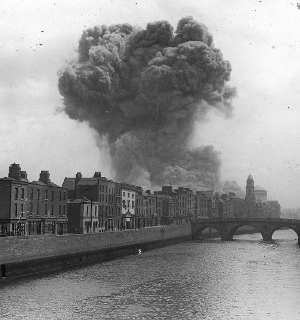
In the months between the Treaty debates and the outbreak of Civil War, Brugha attempts to dissuade his fellow anti-treaty army leaders including Rory O’Connor, Liam Mellows and Joe McKelvey from taking up arms against the Free State. When the IRA occupies the Four Courts, he and Oscar Traynor call on them to abandon their position. When they refuse, Traynor orders the occupation of the area around O’Connell Street in the hope of easing the pressure on the Four Courts and of forcing the Free State to negotiate.

On June 28, 1922, Brugha is appointed commandant of the forces in O’Connell Street. The outbreak of the Irish Civil War ensues in the first week of July when Free State forces commence shelling of the anti-treaty positions.

Most of the anti-Treaty fighters under Oscar Traynor escape from O’Connell Street when the buildings they are holding catch fire, leaving Brugha in command of a small rearguard. On July 5, he orders his men to surrender but refuses to do so himself. He then approaches the Free State troops, brandishing a revolver. He sustains a bullet wound to the leg which severs a major artery.

Cathal Brugha dies on July 7, 1922, eleven days before his 48th birthday. He has been re-elected as an anti-Treaty Teachta Dála (TD) at the 1922 Irish general election but dies before the Dáil assembles. He is buried in Glasnevin Cemetery.


Leave a comment

Oscar Traynor Leads Anti-Treaty IRA Occupation of O’Connell Street

On June 29, 1922, during the Irish Civil War, Oscar Traynor leads Anti-Treaty members of the Irish Republican Army‘s (IRA) 1st Dublin Brigade to occupy O’Connell Street in order to help the Four Courts garrison. His men also take up positions in York Street, South Circular Road, Capel Street, Parnell Square, and Dolphin’s Barn.

Traynor is an Irish politician and republican born into a strongly nationalist family in Dublin on March 21, 1886. He serves in a number of cabinet positions, most notably as the country’s longest-serving Minister for Defence. He is educated by the Christian Brothers in Dublin. In 1899 he is apprenticed to John Long, a famous woodcarver. As a young man he is a noted footballer and tours Europe as a goalkeeper with Belfast Celtic F.C. whom he plays with from 1910 to 1912.

Traynor joins the Irish Volunteers and takes part in the Easter Rising in 1916, following which he is interned in Wales. During the Irish War of Independence, he is brigadier of the Dublin Brigade of the Irish Republican Army. He leads the attack on The Custom House in 1921 and an ambush on the West Kent Regiment at Claude Road, Drumcondra on June 16, 1921, when the Thompson submachine gun is fired for the first time in action. When the Irish Civil War breaks out in June 1922, Traynor takes the republican side.

The Dublin Brigade is split however, with many of its members following Michael Collins in taking the pro-Treaty side. On June 29, 1922, Traynor and his supporters occupy O’Connell Street in an attempt to help the republicans who have occupied the Four Courts but are under attack by Free State forces. Traynor and his men hold out for a week of street fighting before making their escape. He organises guerilla activity in south Dublin and County Wicklow, before being captured by Free State troops in September. He is then imprisoned for the remainder of the war.

On March 11, 1925, Traynor is elected to Dáil Éireann in a by-election as a Sinn Féin Teachta Dála (TD) for the Dublin North constituency, though he does not take his seat due to the abstentionist policy of Sinn Féin. He is re-elected as one of eight members for Dublin North in the June 1927 Irish general election but just one of six Sinn Féin TDs. Once again, he does not take his seat. He does not contest the second general election called that year but declares his support for Fianna Fáil. He stands again in the 1932 general election and is elected as a Fianna Fáil TD for Dublin North.

In 1936 Traynor is first appointed to the Cabinet as Minister for Posts and Telegraphs. In September 1939 he is appointed Minister for Defence and holds the portfolio until February 1948. In 1948 he becomes President of the Football Association of Ireland, a position he holds until his death. He serves as Minister for Defence in several Fianna Fáil governments and as Minister for Justice, where he is undermined by his junior minister, and later Taoiseach, Charles Haughey, before he retires in 1961.

Oscar Traynor dies on December 15, 1963, in Dublin at the age of seventy-seven. He has a road named in his memory on the Coolock to Santry stretch in North Dublin.

(Pictured: Oscar Traynor in Dublin in July 1922)


Leave a comment

Birth of Robert Erskine Childers, Writer & Fenian

Robert Erskine Childers, British writer universally known as Erskine Childers and whose mother is from County Clare, is born on June 25, 1870, in Mayfair, London, England. His works include the influential novel The Riddle of the Sands. He is the second son of Robert Caesar Childers, a translator and oriental scholar from an ecclesiastical family, and Anna Mary Henrietta, née Barton, from an Anglo-Irish landowning family of Glendalough House, Annamoe, County Wicklow. He is also the cousin of Hugh Childers and Robert Barton, and the father of the fourth President of Ireland, Erskine Hamilton Childers.

Childers is raised at the home of family members at Glendalough, County Wicklow. At the recommendation of his grandfather, Canon Charles Childers, he is sent to Haileybury College. There he wins an exhibition to Trinity College, Cambridge, where he studies the classical tripos and then law. He distinguishes himself as the editor of Cambridge Review, the university magazine.

Childers’s first published work is some light detective stories he contributes to the Cambridge Review while he is editor. His first book is In the Ranks of the C. I. V., an account of his experiences in the Boer War, but he writes it without any thought of publication.

After serving in the British army during the Boer War he becomes an Irish nationalist. In 1914, Childers smuggles a cargo of 900 Mauser Model 1871 rifles and 29,000 black powder cartridges to the Irish Volunteers movement at the fishing village of Howth, County Dublin on his yacht, Asgard.

Though he serves as the principal secretary to Michael Collins and Arthur Griffith at the Anglo-Irish Treaty negotiations, Childers opposes the treaty, supporting the anti-treaty forces during the Irish Civil War. Childers is captured with a pistol by Free Staters in November 1922 shortly after the Free State has passed legislation making such possession a capital offence. Ironically, the revolver Childers possesses is a gift from former comrade Michael Collins, who led the Free State until his death in an ambush three months earlier.

Childers is put on trial by a military court on the charge of possessing a small Spanish-made Gaztanaga Destroyer .32 calibre semi-automatic pistol on his person in violation of the Emergency Powers Resolution. Childers is convicted by the military court and sentenced to death on November 20, 1922.

While his appeal against the sentence is still pending, Childers is executed on November 24, 1922, by firing squad at the Beggar’s Bush Barracks in Dublin. Before his execution he shakes hands with each member of the firing squad. He also obtains a promise from his then 16-year-old son, the future President Erskine Hamilton Childers, to seek out and shake the hand of every man who has signed his death sentence. His final words, spoken to the firing squad, are, “Take a step or two forward, lads, it will be easier that way.”

Robert Erskine Childers is buried at Beggar’s Bush Barracks until 1923, when his body is exhumed and reburied in the republican plot at Glasnevin Cemetery, Dublin.


Leave a comment

Birth of Actor Liam Neeson

Actor Liam John Neeson is born on June 7, 1952, in BallymenaCounty Antrim. Raised as a Roman Catholic, Neeson is named Liam after the local priest. He says growing up as a Catholic in a predominately Protestant town made him cautious. At age nine, he begins boxing lessons at the All-Saints Youth Club and later becomes Ulster’s amateur senior boxing champion.

Neeson first steps on stage at age eleven after his English teacher offers him the lead role in a school play, which he accepts because the girl he is attracted to is starring in it. He continues to act in school productions over the following years.

Neeson’s interest in acting and decision to become an actor is also influenced by minister Ian Paisley, into whose Free Presbyterian church Neeson would sneak. Neeson says of Paisley, “He had a magnificent presence, and it was incredible to watch him just Bible-thumping away… it was acting, but it was also great acting and stirring too.”

In 1971, Neeson is enrolled as a physics and computer science student at Queen’s University BelfastNorthern Ireland, before leaving to work for the Guinness Brewery. At Queen’s, he discovers a talent for football and is spotted by Seán Thomas at Bohemian F.C. There is a club trial in Dublin and Neeson plays one game as a substitute against Shamrock Rovers F.C. but is not offered a contract.

In 1976, Neeson joins the Lyric Players’ Theatre in Belfast for two years. He then acts in the Arthurian film, Excalibur (1981), alongside Helen Mirren. Between 1982 and 1987, he stars in five films, most notably alongside Mel Gibson and Anthony Hopkins in The Bounty (1984) and Robert De Niro and Jeremy Irons in The Mission (1986). He lands a leading role alongside Patrick Swayze in Next of Kin (1989).

Neeson rises to prominence when he stars in the title role in Steven Spielberg‘s 1993 Oscar winner Schindler’s List. He has since starred in other successful films, including the title role in the historical biopic Michael Collins (1996), the film adaptation of Victor Hugo‘s 1862 novel Les Misérables (1998), Star Wars: Episode I – The Phantom Menace as Qui-Gon Jinn (1999), the biographical drama Kinsey (2004), the superhero film Batman Begins as Ra’s al Ghul (2005), the action thriller series Taken (2008–2014), the fantasy adventure film Clash of the Titans (2010) as Zeus, the fantasy films in The Chronicles of Narnia series (2005–2010) as Aslan, and the thriller-survival film The Grey (2011). In 2016 he narrates the RTÉ One three-part documentary on the Easter Rising1916.

Neeson has been nominated for a number of awards, including an Academy Award for Best Actor, a BAFTA Award for Best Actor in a Leading Role and three Golden Globe Awards for Best Actor in a Motion Picture DramaEmpire magazine ranks Neeson among both the “100 Sexiest Stars in Film History” and “The Top 100 Movie Stars of All Time.”


Leave a comment

Birth of James Connolly, Republican & Socialist Leader

James ConnollyIrish republican and socialist leader, is born to Irish-born parents in the Cowgate area of EdinburghScotland, on June 5, 1868. He spoke with a Scottish accent throughout his life.

Connolly has an education up to the age of about ten in the local Catholic primary school. He then leaves and works in labouring jobs. Due to economic difficulties, he joins the British Army at age 14, falsifying his age and giving his name as Reid. He serves in Ireland with the 2nd Battalion of the Royal Scots Regiment for nearly seven years, during a turbulent period in rural areas known as the Land War.

Connolly develops a deep hatred for the British Army that lasts his entire life. Upon hearing that his regiment is being transferred to India, he deserts. He meets a young woman by the name of Lillie Reynolds, and they marry in April 1890, settling in Edinburgh. There, Connolly begins to get involved in the Scottish Socialist Federation, but with a young family to support, he needs a way to provide for them. He briefly establishes a cobbler‘s shop in 1895, but this fails after a few months.

By 1892 Connolly is involved in the Scottish Socialist Federation, acting as its secretary from 1895. During this time, he becomes involved with the Independent Labour Party which Keir Hardie had formed in 1893.

Connolly and his family move to Dublin, where he takes up the position of full-time secretary for the Dublin Socialist Club. At his instigation, the club quickly evolved into the Irish Socialist Republican Party (ISRP). The ISRP is regarded by many Irish historians as a party of pivotal importance in the early history of Irish socialism and republicanism.

While active as a socialist in Great Britain, Connolly is the founding editor of The Socialist newspaper and is among the founders of the Socialist Labour Party which splits from the Social Democratic Federation in 1903.

A combination of frustration with the progress of the ISRP and economic necessity causes Connolly to emigrate to the United States in September 1903. While in America he was a member of the Socialist Labor Party of America (1906), the Socialist Party of America (1909) and the Industrial Workers of the World, and founded the Irish Socialist Federation in New York City, 1907.

On his return to Ireland in 1910 he is right-hand man to fellow-syndicalist James Larkin in the Irish Transport and General Workers Union. In 1913, in response to the Great Dublin Lockout, he, along with an ex-British officer, Jack White, found the Irish Citizen Army (ICA), an armed and well-trained body of labour men whose aim is to defend workers and strikers, particularly from the frequent brutality of the Dublin Metropolitan Police. He also founds the Irish Labour Party as the political wing of the Irish Trade Union Congress in 1912 and is a member of its National Executive.

When the Easter Rising begins on April 24, 1916, Connolly is Commandant of the Dublin Brigade. As the Dublin Brigade has the most substantial role in the rising, he is de facto commander-in-chief. His leadership in the Easter Rising is considered formidable. Michael Collins says of Connolly that he “would have followed him through hell.”

Connolly is sentenced to death by firing squad for his part in the rising. On May 12, 1916, he is taken by military ambulance to Royal Hospital Kilmainham, across the road from Kilmainham Gaol, and from there taken to the gaol, where he is to be executed.

Connolly has been so badly injured from the fighting that he is unable to stand before the firing squad. He is carried to a prison courtyard on a stretcher. Instead of being marched to the same spot where the others had been executed, at the far end of the execution yard, he is tied to a chair and then shot.

His body, along with those of the other leaders, is put in a mass grave without a coffin. The executions of the rebel leaders deeply anger the majority of the Irish population, most of whom had shown no support during the rebellion. It is Connolly’s execution that causes the most controversy. The executions are not well received, even throughout Britain, and draw unwanted attention from the United States, which the British Government is seeking to bring into the war in Europe. Prime Minister H. H. Asquith orders that no more executions are to take place, an exception being that of Roger Casement as he has not yet been tried.


Leave a comment

Birth of Irish Politician Mary MacSwiney

Mary MacSwiney, Irish politician and educationalist, is born in London on March 27, 1872, to an Irish father and English mother. In 1927, she becomes leader of Sinn Féin when Éamon de Valera resigns from the presidency of the party.

MacSwiney returns to Ireland with her family at the age of six and is educated at St. Angela’s School in Cork. At the age of twenty, she obtains a teaching post at a private school in England and studies for a Teaching Diploma at the University of Cambridge, which is normally reserved for men.

Influenced by her younger brother Terence MacSwiney‘s staunch Irish republicanism, MacSwiney joins the Gaelic League and Inghinidhe na hÉireann. She is a founder member of Cumann na mBan when it is formed in 1914 in Cork and becomes a National Vice-President of the organisation. She leads the denunciation of British rule at the Convention of November 1914. In 1916, she is arrested and imprisoned following the Easter Rising and is also dismissed from her teaching position due to her republican activities. Several months later, upon her release from prison, she and her sister Annie re-found Scoil Íte, a sister school to Patrick Pearse‘s St. Enda’s School, and she remains involved with the school for the rest of her life.

MacSwiney supports the Irish War of Independence in 1919–21. After the death of her brother Terence in October 1920 on hunger strike during the height of the war, she is elected for Sinn Féin to the Cork Borough constituency in 1921. She gives evidence in Washington, D.C., before the American Commission on Conditions in Ireland. For nine months she and Terence’s widow, Muriel, tour the United States lecturing and giving interviews.

MacSwiney is active in her friendship with Harry Boland and de Valera, whom she cultivates assiduously. In October 1921, a second delegation is to be sent to London which for the first time includes Michael Collins. MacSwiney, who remains implacably opposed, pleads with de Valera to be allowed to go. She is refused as de Valera thinks her to be “too extreme.” She strongly opposes the Anglo-Irish Treaty, debating during December 1921 to January 1922 to resume the war. On December 21 she speaks for three hours, criticising the agreement from all angles.

MacSwiney is arrested at Nell Ryan’s home, a safe house, at 40 Herbert Park, Ballsbridge, on November 4, 1922, when it is raided by Free State soldiers. She is interned at Mountjoy Gaol and immediately goes on hunger strike. Cumann na mBan organizes vigils outside the prison in protest of Mary’s and the others internment. The Women’s Prisoner’s Defence League is formed in August 1922 to protect their rights. During the hunger strike she refuses doctor’s visits and is resigned to her death. Her condition is critical, and she is given the Last Rites by a Catholic priest. The Government is not prepared to allow strikers die, so she is released.

En route to Liam Lynch‘s funeral, MacSwiney is again arrested when the car in which she is riding is stopped and she is recognised. She is taken with Kate O’Callaghan to Kilmainham Gaol. Fearless of death, she begins another protest. They continued to be interned without charge, but it is explained she is distributing anti-government propaganda. After nineteen days of hunger strike, she is due to be released on April 30, 1923. The Governor allows O’Callaghan to go but stays a decision on MacSwiney. Most of the women on hunger strike are sent to the North Dublin Union.

MacSwiney retains her seat at the 1923 Irish general election and, along with other Sinn Féin members, refuses to enter the Dáil Éireann.

In March 1926 the party holds its Ardfheis. MacSwiney and Father Michael O’Flanagan lead the section from which Éamon de Valera and Fianna Fáil break away. De Valera has come to believe that abstentionism is not a workable tactic and now sees the need to become the elected government of the Dáil. The conference instructs a joint committee of representatives from the two sections to arrange a basis for co-operation. That day, it issues a statement declaring “the division within our ranks is a division of Republicans.” The next day, de Valera’s motion to accept the Free State Constitution, contingent upon the abolition of the Oath of Allegiance, narrowly fails by a vote of 223 to 218. However, de Valera takes the great majority of Sinn Féin support with him when he founds Fianna Fáil.

MacSwiney continues to maintain a republican position until her death. By then she is vice-president of Sinn Féin and Cumann na mBan but loses her seat at the June 1927 Irish general election. When lack of funds prevents Sinn Féin contesting the second election called that year, MacSwiney declares “no true Irish citizen can vote for any of the other parties.”

Mary MacSwiney dies at her home in Cork on March 8, 1942. Her stance, both before and after the Treaty, may be summed up by her statement, “A rebel is one who opposes lawfully constituted authority and that I have never done.”