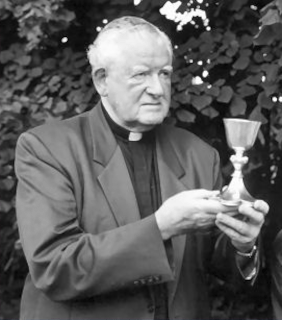
Flannery edits the Dominican bi-monthly journal entitled Doctrine and Life from 1958 to 1988, while at St. Saviour’s Priory, Dublin, where he also serves as prior from 1957 to 1960. He also edits the Religious Life Review. He publishes many English language documents on the Second Vatican Council.
O’Riordan joins the Communist Party of Ireland in 1935 while still in the IRA and works on the communist newspaper The Irish Workers’ Voice. In 1937, following the urgings of Peadar O’Donnell, several hundred Irishmen, mostly IRA or ex-IRA men, go to fight for the Spanish Republic in the Spanish Civil War with the XVth International Brigade. They are motivated in part by enmity towards the 800 or so Blueshirts, led by Eoin O’Duffy who go to Spain to fight on the “nationalist” side in the Irish Brigade. He accompanies a party led by Frank Ryan. In the Republic’s final offensive of July 25, 1938, he carries the flag of Catalonia across the River Ebro. On August 1, he is severely injured by shrapnel on the Ebro front. He is repatriated to Ireland the following month, after the International Brigades are disbanded.
In 1938 O’Riordan is offered an Irish Army commission by the Irish Free State but chooses instead to train IRA units in Cork. As a result of his IRA activities during World War II, or the Emergency as it is known in neutral Ireland, he is interned in the Curragh internment camp from 1939 until 1943 where he is Officer Commanding of the Cork Hut and partakes in Máirtín Ó Cadhain’s Gaelic League classes as well as publishing Splannc (Irish for “Spark,” named after Vladimir Lenin‘s newspaper).
In 1944 O’Riordan is founding secretary of the Liam Mellows Branch of the Labour Party and in 1945 is a founding secretary of the Cork Socialist Party, whose other notable members include Derry Kelleher, Kevin Neville and Máire Keohane-Sheehan.
In 1947, O’Riordan is a founding secretary of the Irish Workers’ League and general secretary thereafter, and of its successor organisation the Irish Workers’ Party from 1962–70.
In all O’Riordan runs for election five times, campaigning throughout for the establishment of a socialist republic in Ireland but given Ireland’s Catholic conservatism and fear of communism, he does so without success. He does, however, receive playwright Sean O’Casey‘s endorsement in 1951.
O’Riordan’s participation in the Spanish Civil War is always an important part of his political identity. In 1966 he attends the International Brigades’ Reunion in Berlin and is instrumental in having Frank Ryan’s remains repatriated from Germany to Ireland in 1979.
O’Riordan is a member of the Irish Chile Solidarity Committee and attends the 1st Party Congress of the Communist Party of Cuba in 1984. He also campaigns on behalf of the Birmingham Six and attends their Appeal trial in 1990. He serves as General Secretary of the Communist Party of Ireland (1970–83) and as National Chairman of the party (1983–88). He publishes many articles under the auspices of the CPI.
O’Riordan’s last major public outing comes in 2005 at the re-dedication of the memorial outside Dublin’s Liberty Hall to the Irish veterans of the Spanish Civil War. He and other veterans are received by President of IrelandMary McAleese. He is also presented with Cuba’s Medal of Friendship by the Cuban Consul Teresita Trujillo to Ireland on behalf of Cuban President Fidel Castro.
In 1969, according to Soviet dissident Vasili Mitrokhin, O’Riordan is approached by IRA leaders Cathal Goulding and Seamus Costello with a view to obtaining guns from the Soviet KGB to defend Irish republican areas of Belfast during the communal violence that marks the outbreak of the Troubles. Mitrokhin alleges that O’Riordan then contacts the Kremlin, but the consignment of arms does not reach Ireland until 1972. The operation is known as Operation Splash. The IRA splits in the meantime between the Provisional IRA and the Official IRA and it is the latter faction who receives the Soviet arms. Mitrokhin’s allegations are repeated in Boris Yeltsin‘s autobiography.
O’Riordan’s book, Connolly Column – The Story of the Irishmen who fought for the Spanish Republic 1936–1939, is published in 1979 and deals with the Irish volunteers of the International Brigade who fought in support of the Spanish Republic against Francisco Franco in the Spanish Civil War (1936–1939). An updated version of the book is reprinted in 2005 and is launched by the Lord Mayor of Dublin, Cllr. Michael Conaghan at a book launch at SIPTU headquarters, Liberty Hall. The book is the inspiration for Irish singer-songwriter Christy Moore‘s famous song “Viva la Quinta Brigada.”
In 1991, O’Riordan’s wife dies at the age of 81 at their home. He continues to live in their family home before moving to Glasnevin in 2000 to be close to his son Manus who lives nearby. He lives there until falling ill in November 2005 and is taken to the Mater Hospital. His health rapidly deteriorates, and he quickly develops Alzheimer’s disease. Soon afterwards he is moved to St. Mary’s Hospital in the Phoenix Park where he spends the final few months of his life, before his death at the age of 88 on May 18, 2006.
O’Riordan’s funeral at Glasnevin Crematorium is attended by over a thousand mourners. Following a wake the previous night at Finglas Road, hundreds turn up outside the house of his son Manus and traffic grounds to a halt as family, friends and comrades – many of whom are waving the red flag of the Communist Party of Ireland – escort O’Riordan to Glasnevin Cemetery. A secular ceremony takes place led by Manus O’Riordan, Head of Research at SIPTU, with contributions from O’Riordan’s family, Communist Party general secretary Eugene McCartan and IBMT representative Pauline Frasier.
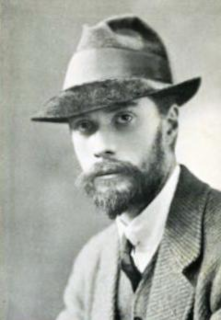
Darrell Edmund Figgis, Irish writer, Sinn Féin activist and independent parliamentarian in the Irish Free State, dies in London on October 27, 1925. The little that has been written about him has attempted to highlight how thoroughly his memory and works have been excised from Irish popular culture.
Figgis is born at Glen na Smoil, Palmerstown Park, Rathmines in Dublin, on September 17, 1882, the son of Arthur William Figges, tea merchant, and Mary Anne Deane. While still an infant, his family emigrates to Calcutta, India. There his father works as an agent in the tea business, founding A. W. Figgis & Co. They return when he is ten years of age, though his father continues to spend much of his time in India. As a young man he works in London at the tea brokerage owned by his uncle, and it is at this time that he begins to develop his interest in literature and literary criticism.
In 1910 Figgis, with the help of G. K. Chesterton, who wrote the introduction to his first book of verse, joins the Dent publishing company. He moves to Achill Island in 1913 to write, learn the Irish language and gain an appreciation of Irish culture, as perceived by many of his contemporaries to uniquely exist on the western seaboard. On his detention following the 1916 Easter Rising, he and the publishing house parted company. Subsequently, he establishes his own firm in which he republishes the works of William Carleton and others.
Figgis joins the Irish Volunteers in Dublin in 1913 and organises the original Battalion of Volunteers in Achill, where he had built a house. While in London, he is contacted by The O’Rahilly, who acquaints him with the arms dealers who had supplied the Ulster Volunteers. In this way he becomes part of the London group that discusses the financing and supply of German rifles for the Volunteers. He travels with Erskine Childers, initially to Belgium and from there to Germany, to make the purchase of the army surplusMauser rifles. He then charters the tug Gladiator, from which the arms are transferred at sea to the Childers’ yacht Asgard and Conor O’Brien‘s Kelpie.
At this time the Royal Navy is patrolling the Irish Sea in anticipation of imminent war with Germany, and Figgis is tasked with taking a motorboat to Lambay Island to signal to the Asgard the all-clear. By his own account, he is unable to persuade the skipper of the pilot vessel to put to sea as one of the worst storms in many years is raging. Due to luck and the skill of the crews, the three over-laden yachts arrive at their destinations. Figgis, accompanied by Seán McGarry, watch Asgard helplessly from Howth pier until Erskine decides to take a calculated risk and sails into the harbour. Against the odds, the conspiracy to buy rifles in Germany and land them safely in Ireland has succeeded. A large party of Volunteers, on their way to Dublin with rifles and ammunition is confronted by a detachment of the King’s Own Scottish Borderers and Dublin Metropolitan Police. With their route blocked, Figgis and Thomas MacDonagh engage the officers in an attempt to distract them.
Although Figgis does not participate in the 1916 Easter Rising, he is arrested and interned by the British authorities between 1916 and 1917 in Reading Gaol. After his release, he returns to Ireland. At the 1917 Sinn Féin Ardfheis he and Austin Stack are elected Honorary Secretaries of the party. The conference sees Éamon de Valera replace Arthur Griffith as President of the party. Shortly after, Figgis is one of four recently released internees who travels to the South Longford constituency to campaign for Joseph McGuinness in the by-election caused by the death of John Phillips. The overwhelming victory of the Sinn Féin candidate over the Irish Parliamentary Party (IPP) nominee marks the beginning of the eclipse of the latter party by the former party. In May 1918, Figgis is arrested for his alleged part in the spurious German Plot a second time and again deported to England. In 1918, he becomes editor of the newspaper The Republic.
From September 1919 to 1921 Figgis heads the Commission of Inquiry into the Resources and Industries of Ireland. At this time a serious rift between Figgis and Michael Collins, then Minister for Finance, becomes a matter of public record. This close attention of Collins will pursue Figgis in his later activities on the Constitution Committee. While he is participating in a Dáil Court at Carrick-on-Shannon, the proceedings are interrupted by a British Army raid. An officer named Captain Cyril Crawford summarily condemns Figgis and Peadar Kearney to be hanged. He orders rope for the purpose, but another officer intervenes and Keaney and Figgis are set free.
Figgis supports the Anglo-Irish Treaty. He is extremely critical of the Collins/De Valera Pact for the June 1922 Irish general election which is an attempt to avoid a split in the Sinn Féin party and, more importantly, in the Irish Republican Army (IRA). On May 25, 1922, he attends a meeting of the executive council of the Farmers’ Union and representatives, of business interests, and encourages them to put forward candidates in constituencies where anti-Treaty candidates might otherwise head the poll. As he is a member of the Sinn Féin Ard Chomhairle National Executive at the time, he is expelled from the party.
Soon after the signing of the Treaty, the necessity of quickly drafting a constitution for the proposed Free State becomes apparent. It is intended by Arthur Griffith that Figgis will chair the Constitution Committee, but this proposal is vetoed by Collins who nominates himself for the position specifically to minimise Figgis’ influence. The animosity between Collins and Figgis remained an undercurrent of the project. In the end, Collins decides the job should go to Captain David Robinson, but this did nothing to heal the rift between Figgis and James G. Douglas.
In December 1923, it is decided that a committee be established to investigate the means by which a public radio broadcasting service should be operated in the Free State. A central issue of contention is whether the service should be run and controlled directly by the State or operated commercially by an Irish Broadcasting Company. The latter option, it is suggested, would follow the model adopted in the UK by the establishment of the BBC. Figgis is co-opted onto the committee, and this decision leads to a series of allegations resulting in the new State’s first corruption scandal of which Figgis himself is the focus. The allegations result in his resignation from the Broadcasting committee and the launching of a second enquiry. He strenuously denies any impropriety.
On November 18, 1924, Figgis’s wife Millie commits suicide in the back of a taxi in Rathfarnham using a Webley revolver given to them by Collins following the 1922 assault. A year later, his new love, a 21-year-old Catholic woman named Rita North, dies due to complications when a doctor tries to surgically remove an already dead child. The court, after investigating her death, determines that she died due to peritonitis, an inflammation in the lining of the abdominal cavity. The public, however, jumps to the conclusion that she died in a failed illegal abortion.
Figgis himself commits suicide in a London boarding house in Granville Street on October 27, 1925, just a week after giving evidence at North’s inquest. He had been staying at the Royal Automobile Club until the day before his death, as is usual when he visits London. A small group of mourners comprising close family and friends attend his interment at the Hampstead Cemetery in West Hampstead, London.
Colley is the son of Harry and Christina Colley. His father is a veteran of the 1916 Easter Rising and a former adjutant in the Irish Republican Army (IRA), who is elected to Dáil Éireann in 1944, as a Fianna Fáil candidate. He is educated at St. Joseph’s Secondary C.B.S. in Fairview, where one of his classmates and closest friends is Charles Haughey, who later becomes his political archrival. He studies law at University College Dublin (UCD) and qualifies as a solicitor in the mid-1940s. He remains friends with Haughey after leaving school and, ironically, encourages him to become a member of Fianna Fáil in 1951. Haughey is elected to Dáil Éireann in the 1957 Irish general election, ousting Colley’s father in the process. This puts some strain on the relationship between the two young men.
Colley is elected to the Dáil at the 1961 Irish general election, reclaiming his father’s old seat in the Dublin North-East constituency. Furthermore, he is elected in the same constituency as Haughey, thereby accentuating the rivalry. Thereafter, he progresses rapidly through the ranks of Fianna Fáil. He becomes a member of the Dáil at a time when a change from the older to the younger generation is taking place, a change facilitated by TaoiseachSeán Lemass.
Colley is active in the Oireachtas as chairman of some of the Joint Labour Committees, which are set up under the Labour Court, to fix legally enforceable wages for groups of workers who have not been effectively organised in trade unions. He is also leader of the Irish parliamentary delegation to the Consultative Assembly of the Council of Europe. His work as a backbencher is rewarded by his appointment as Parliamentary Secretary to the Minister for Lands in October 1964.
Following the return of Lemass’s government at the 1965 Irish general election, Colley joins the cabinet as Minister for Education. He introduces a plan to establish comprehensive schools, set up an advisory council on post-primary school accommodation in Dublin, and introduces a school psychological service.
Colley is promoted as Minister for Industry and Commerce in a cabinet reshuffle in July 1966, and he continues the government policy of economic expansion that had prevailed since the late 1950s.
In November 1966, Seán Lemass resigns suddenly as party leader. Colley contests the subsequent leadership election. He is the favoured candidate of party elders such as Seán MacEntee and Frank Aiken, the latter managing Colley’s campaign. Charles Haughey and Neil Blaney also declare their interest in the leadership; however, both withdraw when the Minister for Finance, Jack Lynch, announces his candidacy. Colley does not back down, and the leadership issue goes to a vote for the first time in the history of the Fianna Fáil party. The leadership election takes place on November 9, 1966, and Lynch beats Colley by 59 votes to 19. When the new Taoiseach announces his cabinet, Colley retains the Industry and Commerce portfolio.
In the wake of the Arms Crisis in 1970, a major reshuffle of the cabinet takes place, with four Ministers either removed, or resigned, or simply retired from the government due to the scandal. Colley remains loyal to the party leader and is rewarded by his appointment as Minister for Finance, the second most important position in government.
In 1973, Fianna Fáil are ousted after sixteen years in government when the national coalition of Fine Gael and the Labour Party come to power. Colley is appointed opposition Spokesman on Finance, in the new Fianna Fáil front bench. As the 1977 Irish general election approaches, Colley and Martin O’Donoghue are the main architects of Fianna Fáil’s election manifesto.
Fianna Fáil sweeps to power at the 1977 Irish general election, with a 20-seat Dáil majority, contrary to opinion polls and political commentators. Colley is re-appointed as Minister for Finance and Minister for the Public Service, and is also appointed as Tánaiste, establishing him firmly as the heir apparent to Taoiseach Jack Lynch.
In December 1979, Jack Lynch resigns unexpectedly as Taoiseach and as Fianna Fáil leader. Colley and Charles Haughey seek the leadership position and are evenly matched. A secret ballot is taken on December 7, 1979. The Minister for Foreign Affairs, Michael O’Kennedy, announces his support for Haughey on the eve of the election. This apparently swings the vote, and Haughey beats Colley by 44 votes to 38. Colley remains as Tánaiste but demands and receives a veto on Haughey’s ministerial appointments to the departments of Justice and Defence.
Fianna Fáil loses power at the 1981 Irish general election. Haughey delays naming a new opposition front bench, but Colley remains a key member of the Fianna Fáil hierarchy. The party regains office at the February 1982 Irish general election. He demands the same veto as before on Haughey’s Defence and Justice appointments but is refused. When it is revealed that Ray MacSharry is to be appointed Tánaiste in his stead, he declines another ministerial position. This effectively brings his front bench political career to an end, but he remains a vocal critic of the party leadership from the backbenches.
When the Fianna Fáil government collapses and are replaced by another coalition government after the November 1982 Irish general election, a number of TDs and Senators express lack of confidence in Haughey’s leadership once again. Several unsuccessful leadership challenges take place in late 1982 and early 1983, with Colley now supporting Desmond O’Malley and the Gang of 22 who oppose Haughey.
Colley dies suddenly on September 17, 1983, aged 57, while receiving treatment for a heart condition at Guy’s Hospital, Southwark, London. He is survived by his wife, three sons, and four daughters, one of whom, Anne Colley, becomes a TD as a member of the Progressive Democrats party.
By 1972, Ahern has met his future wife, Miriam Kelly, a bank official who lives near the Aherns’ family home. They marry in St. Columba’s Church, Iona Road in 1975. They have two daughters from the marriage, Georgina and Cecelia. Georgina is the wife of Westlife member Nicky Byrne. Cecelia is a best-selling author. The Aherns separate in 1992.
Ahern is elected to the Dáil, the lower house of the Oireachtas, in 1977 as a member of the Fianna Fáil party for the newly created Dublin Finglas constituency. He is elected to the Dublin City Council in 1979, later becoming Lord Mayor of Dublin (1986–87). An assistant whip (1980–81) in the first government of Taoiseach Charles Haughey, he becomes a junior minister in Haughey’s second government (1982) and Minister for Labour in his third (1987–89) and fourth (1989–91) governments.
Ahern’s success in establishing general economic agreements with employers, unions, and farmers in 1987 and 1990 and his role in constructing the first Fianna Fáil coalition government (with the Progressive Democrats) in 1989 confirms his reputation as a skillful negotiator. He is made Minister for Finance in 1991. In the contest to choose Haughey’s successor, Ahern withdraws in favour of Albert Reynolds, and he remains Minister for Finance in each of Reynolds’s two governments (February–November 1992 and 1993–94). In November 1994, following the fall of the Fianna Fáil–Labour Party government, Reynolds resigns, and Ahern is elected party leader. He is set to become Taoiseach in a new coalition with the Labour Party, but at the eleventh-hour Labour opts to join a government with Fine Gael and Democratic Left.
Ahern forms a Fianna Fáil–Progressive Democrats minority government following elections in 1997. Credited with overseeing a thriving economy, he is reelected Taoiseach in 2002. He plays a major role in securing peace in Northern Ireland, participating in the signing of the Good Friday Agreement in 1998 and helping negotiate the return of devolution to Northern Ireland in 2007. On May 15, 2007, he becomes the first Taoiseach to address a joint session of the Parliament of the United Kingdom.
Soon afterward Ahern wins a third term as Taoiseach. He is reelected despite implications of his involvement in an influence-peddling scandal. The Tribunal of Inquiry into Certain Planning Matters & Payments, ultimately better known as the Mahon Tribunal, which is investigating alleged illegal payments by developers to politicians to influence zoning decisions in and around Dublin during the early 1990s, subsequently questions Ahern about his personal finances during his tenure as Minister for Finance. In early April 2008, as the investigation of Ahern’s involvement mounts, he announces that he will step down as Taoiseach and Leader of Fianna Fáil in May. He is succeeded in both posts by Brian Cowen. In the Mahon Tribunal’s final report, issued on March 22, 2012, it indicates that it does not believe Ahern had told the truth when questioned by the commission about alleged financial improprieties, though it does not directly accuse him of corruption. Ahern, threatened with expulsion from Fianna Fáil in the wake of the report, resigns from the party later in March while still maintaining that he had testified truthfully to the tribunal.
Ahern says in April 2018 that he is considering running for President of Ireland in 2025 as an independent candidate. That same month he walks out of an interview with DW News after being questioned on the findings of the Mahon Tribunal.
In October 2018, Ahern is appointed to chair the Bougainville Referendum Commission, which is responsible for preparing an independence referendum in Bougainville, Papua New Guinea, which takes place in December 2019.
In 1987, O’Rourke is appointed Minister for Education by Charles Haughey. She and her brother, Brian Lenihan Snr, become the first brother and sister in Irish history to serve in the same cabinet. In the November 1991 cabinet reshuffle, she becomes Minister for Health. In February 1992, Charles Haughey resigns as Taoiseach and Fianna Fáil leader, and she contests the subsequent leadership election along with Michael Woods and Albert Reynolds. Reynolds wins the election, and she is subsequently dropped from her ministerial position, but is appointed to a junior ministry as Minister of State for Labour Affairs at the Departments of Industry and Commerce, and later Enterprise and Employment.
In 1994, Bertie Ahern becomes party leader, and he appoints O’Rourke as deputy leader of Fianna Fáil, serving in the position until 2002. Following Ahern’s election as Taoiseach in June 1997, she becomes Minister for Public Enterprise, holding this position until she loses her Dáil seat at the 2002 Irish general election. This follows a vote management strategy from Fianna Fáil head office which restricts her from campaigning in her traditional areas around Kilbeggan, in an attempt to win 2 of the 3 seats in Westmeath. The loss of her Dáil seat is also attributed to her association with and the championing of, the privatisation of Telecom Éireann, which proves a financial disaster for many small investors, due to the share price falling radically, post privatisation. During this term as Minister, she also becomes the subject of public criticism by Ryanair chief executive Michael O’Leary. Following the loss of her Dáil seat, she is nominated to Seanad Éireann as a Senator by Taoiseach Bertie Ahern where she becomes Leader of the Seanad and leader of Fianna Fáil in the Seanad.
In January 2006, O’Rourke receives the party nomination to stand at the 2007 Irish general election. She narrowly defeats her nearest rival and Dáil election running mate, Kevin “Boxer” Moran of Athlone Town Council, causing a controversy when she thanks her election team for working “like blacks.” She is re-elected to the Dáil at the May 2007 Irish general election, with her highest ever vote.
In November 2008, during a march against the re-introduction of college fees, students from the Athlone Institute of Technology lay a funeral wreath at the door of O’Rourke’s constituency office. The card in the wreath states “Sincere sympathies on the death of free fees. We will remember this.” She describes the act as “heinous.” The wreath is placed there because she is not speaking at a rally against the fees.
In July 2010, O’Rourke concedes that she does not expect the party to be in power after the next general election. On RTÉ Radio‘s Today with Pat Kenny programme, she says the government is taking tough decisions to steer the country through the financial crisis and this will make it easy for the opposition. She says there is a general air of “crossness” within the Fianna Fáil party over their standing in the polls, but nobody is harboring leadership ambitions to challenge Brian Cowen.
In November 2010, O’Rourke says there is then more to unite her party and Fine Gael than to divide them. She points to the common approach of the two parties to Northern Ireland, Europe and the current financial crisis. In an address to the 1916–1921 Club in Dublin Castle, she says that most voters no longer defined themselves in terms of Civil War politics.
O’Rourke’s senior years lead her to often being referred to as the “Mammy of the Dáil.”
O’Rourke contests the 2011 Irish general election but is defeated on the poll. She had been critical of former Taoiseach Brian Cowen, saying that he should have resigned after his infamous “congested” radio interview. She supports the attack on Cowen by her nephew, former Finance Minister Brian Lenihan Jnr, who says he is “disappointed” by Cowen’s performance, and he had to provide the leadership when the Taoiseach did not.
As well as being a well-known politician, O’Rourke makes regular appearances in the media in a non-political capacity. She has been a contestant on RTÉ‘s reality series Celebrity Bainisteoir, as well as other shows such as Sex & Sensibility. She has guest presented Tonight with Vincent Browne.
In 2012, Just Mary: My Memoir is published. It wins the 2012 Irish Book Award in the “Listeners’ Choice” category.
O’Rourke comes from a strong political family, her father Patrick Lenihan serves as a TD for Longford–Westmeath from 1965 to 1970. Her brother Brian Lenihan is a senior government Minister and Tánaiste. Another brother, Paddy Lenihan, is a County Councillor in Roscommon, but resigns from Fianna Fáil in 1983 and becomes associated with Neil Blaney‘s Independent Fianna Fáil party. Two of her nephews, Brian Lenihan Jnr and Conor Lenihan, both sons of her brother Brian, serve as Ministers. Brian Lenihan Jnr is the Minister for Finance. Conor Lenihan is a Minister of State.
O’Rourke is widowed in January 2001, following the death of her husband, Enda. She has two sons. Aengus O’Rourke, her adopted son, runs for Athlone Town Council in 2009. The other son, Feargal O’Rourke, becomes Managing Partner of PricewaterhouseCoopers in Ireland in 2015 and is considered the “grand architect” of the Double Irish tax system, a major contributor to Ireland’s economic success in attracting U.S. multinationals to Ireland.
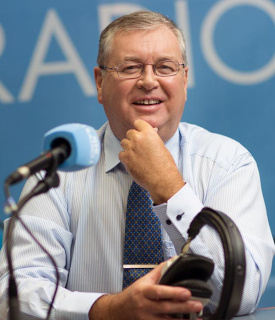
Duffy is brought up in Ballyfermot, one of five siblings. His father is Jimmy and his mother Mabel. His father, who has problems with alcohol, dies aged 58 in 1984. His 25-year-old brother Aidan is killed in a road accident on the Maynooth Road in 1991, with Duffy first learning of the “horrific accident” on the news on RTÉ Radio. His brother Brendan is described by him as “crippled, ruined and wrecked by a savage addiction” to sniffing glue which he develops as a teenager.
Duffy attends De La Salle Boys’ primary school, St. Lorcan’s B.N.S and St. John’s De La Salle College. He enrolls at Trinity College, Dublin (TCD) in 1977 to study Social Work and is elected President of Trinity College Students’ Union in 1979, becoming President of the Union of Students in Ireland (USI) four years later.
Duffy considers resigning from RTÉ in 2007 after the broadcaster forces him to give Minister for JusticeMichael McDowell a platform on Liveline to make a “party political broadcast.” He considers it “direct party-political interference” in Liveline. However, he goes ahead with the broadcast and does not resign or make any protest on air.
In October 2008, Duffy is proactive as a supporter of Irish pensioners who march on Leinster House to protest at the proposed means testing of their medical cards in the Government Budget. However, earlier that month, he is reportedly censored by the government when he attempts to continually discuss the effects of the global financial crisis in Ireland. This follows on from the outrage caused when he is held responsible by Minister for FinanceBrian Lenihan Jnr for inciting widespread public fear that Irish citizens are on the verge of losing their savings. Several callers freely speak of their lack of confidence in the banking system, of how they have withdrawn their money from banks, some of which are identified, and are either carrying it around on their person, or considering keeping it “under the mattress,” or burying it in their garden. Lenihan personally calls Cathal Goan, the Director-General of RTÉ, to express his outrage at the sudden increase in potentially disastrous speculation following the show.
The extent of the Finance Minister’s concern first publicly emerges the following morning when he is interviewed by RTÉ’s economics editor George Lee. In that interview, Lenihan insists that deposits are not in any danger and says that people should not be going to banks to shift their deposit accounts “on the basis of unfounded allegations made on radio programmes.”
Rival broadcaster TV3 accuses Raidió Teilifís Éireann (RTÉ) and Duffy of waging a “dirty tricks” war against them after a late-night game show run by TV3 is berated by callers to Liveline and saying several times on air that he has been unable to get a representative from the station to reply to callers’ concerns. TV3 says a lengthy statement is sent to the Liveline office almost two hours before the September 2009 show goes on air but is ignored, despite the fact that it clarifies some of the issues. The Play TV service is discontinued by TV3 in March 2010 after 29 complaints to the Broadcasting Authority of Ireland (BAI), though TV3 says it is because of a decline in viewership.
Duffy is famous for taking up the causes of the disadvantaged on Liveline, and examples of this include Berry Fleming who lost her job in 2010, and Aubrey McCarthy, who is trying desperately to get his removal business off the ground in 2012/2013.
Duffy is frequently lampooned at length on the satirical TV programme The Savage Eye. It portrays him as a fetish garment clad sado-masochist who derives perverse pleasure by urging his call-in radio listeners in a strong working-class Dublin accent, to express excesses of degradation and misery as he “empathizes” verbally and plays with his nipple clamps. He has since questioned viewership figures for The Savage Eye on his daily radio show and has questioned whether it is “blasphemous” on his Sunday afternoon religious affairs TV show Spirit Level.
Duffy is married and is the father of triplets. He currently resides on Dublin’s Northside. His autobiography, Just Joe, is launched by Gay Byrne in Harry’s Bar in October 2011. In 2014, he makes a cameo in Mrs. Brown’s Boys D’Movie as himself. The film is negatively received but is a moderate box office success.
In 1992, Duffy wins a Jacob’s Award for his reports on RTÉ Radio 1’s The Gay Byrne Show. He is named 11th most influential person of 2009 by Village.
Cowen is exposed to politics at a young age. His grandfather was a councillor in the Fianna Fáil party, and his father, Bernard Cowen, held a seat in Dáil Éireann, the lower house of the Oireachtas (Irish parliament). He is an exemplary debater in school and often speaks at his father’s election rallies. He studies at University College Dublin and at the Incorporated Law Society of Ireland, where he is trained as a solicitor. His father’s death in 1984 prompts a by-election for the seat he had held in the Dáil. At the age of 24, he captures the seat, becoming one of the youngest members ever to sit in the Dáil.
Cowen’s political mentor is Albert Reynolds, who becomes Taoiseach in 1992 when Fianna Fáil is in a coalition government with the Progressive Democrats. He is an outspoken critic of the coalition, famously stating about the Progressive Democrats, “When in doubt, leave them out!” He serves as Minister for Labour (1992–93), and in 1993, after the breakup of the Fianna Fáil–Progressive Democrats government, he helps to negotiate the short-lived coalition of Fianna Fáil and the Labour Party. He then serves as Minister for Transport, Energy, and Communications (1993–94), leaving office after Fianna Fáil is forced into opposition by the formation of a Fine Gael–Labour–Democratic Left coalition.
During Fianna Fáil’s years out of government, Cowen serves successively as opposition Spokesperson for Agriculture, Food, and Forestry (1994–97) and Spokesperson for Health (1997). Following elections in 1997, Fianna Fáil leader Bertie Ahern forms a coalition government with the Progressive Democrats, and the party once again returns to power. Cowen serves as Minister for Health and Children (1997–2000), Minister for Foreign Affairs (2000–04), and Minister for Finance (2004–08). In June 2007 he was appointed Tánaiste.
Cowen is known for his sharp tongue and sometimes rough-hewn manner, but he is also recognized for his fierce intelligence, wit, and jovial demeanour. A combative politician and loyal party member, he is for many years seen as an obvious successor to Ahern. In April 2008, amid an investigation into possible past financial misconduct, Ahern announces that he will resign as Taoiseach and Leader of Fianna Fáil the following month. Cowen, who had remained supportive of Ahern throughout, is elected Leader of Fianna Fáil in April 2008. He becomes Taoiseach the following month and is faced with leading the country amid the global financial crisis that creates Ireland’s worst economy since the 1930s.
Cowen’s government oversees the bailout of Ireland’s banking system, which had been thrown into crisis by the collapse of the housing market, but the rescue comes at the cost of a skyrocketing deficit. As the country’s economic difficulties deepen, he seeks a cure that he hopes would obviate the need of foreign intervention, proposing an increase in income taxes and cuts in services. In November 2010, however, as concern for Ireland’s financial stability grows among its eurozone partners, he agrees to accept a bailout of more than $100 million from the European Union and the International Monetary Fund. There is concern in Ireland that one condition for foreign aid might be an increase in Ireland’s comparatively low corporate taxes. The Green Party, Fianna Fáil’s junior partner in the governing coalition, responds to the situation by calling for early elections.
In mid-January 2011 Cowen’s leadership of Fianna Fáil is challenged by Minister for Foreign Affairs Micheál Martin, partly in response to rumours that had swirled of a golf course meeting that had taken place between the Taoiseach and the former head of the Anglo Irish Bank before the government’s bailout of the Irish banking industry. He survives a leadership vote, but about one-third of the party’s parliamentary bloc votes against him. In a rapid succession of events that occur over the course of a few days, an unsuccessful reshuffle of the cabinet follows the resignation of six cabinet ministers, after which Cowen calls for an election to be held on March 11 and then announces that he will step down as party leader but continue as caretaker Taoiseach until the election. The Green Party then withdraws from the ruling coalition, forcing an even earlier election. Waiting until the parliament passes a finance bill that is necessary to meet the conditions of an International Monetary Fund–European Union loan but which imposes austerity measures that had proved very unpopular with much of the Irish public, he officially calls the election for February 25. Martin takes over as the Leader of Fianna Fáil, which suffers a crushing defeat in the election at the hands of Fine Gael.
In May 2014, Cowen becomes part of the board of Topaz Energy. He is appointed to the board of Beacon Hospital in February 2015. In July 2017, he is conferred with an honorary doctorate from the National University of Ireland. During his 50-minute acceptance speech he criticises the EU for its behaviour towards Ireland during the financial crisis and expresses regret that so many jobs were lost during the recession. Following the conferring ceremony, the NUI faces considerable public criticism for deciding to make the award to Cowen. Former (and founding) President of the University of Limerick, Edward M. Walsh, announces that he will hand back his own honorary doctorate in protest, and does so on November 14, 2018.
On July 5, 2019, Cowen is admitted to Beacon Hospital after suffering a major brain hemorrhage. He is then transferred to St. Vincent’s University Hospital where he spends five months before transferring to a physical rehabilitation facility. As of late 2020, while he is still in hospital following a stroke the previous year, he has been making steady progress.
The Northern state consists of the six northeastern counties of Ulster with a unionist majority. They are Antrim, Down, Armagh, Derry, Tyrone, and Fermanagh. Belfast is to be the seat of a government and hold limited devolved powers. The counties of Donegal, Cavan, and Monaghan are to be absorbed within the Irish Free State controlled from parliament in Dublin.
Irish nationalists are dismayed with the plan. Protestant Unionists, particularly those living within the boundaries of the new state, accept and start to implement the Act. Sectarian attacks are launched upon Catholic homes in Belfast, Derry, Banbridge, Lisburn, and Dromore. Catholics are driven from Belfast shipyards and from various engineering works in the city. Supposedly these attacks are in revenge for Irish Republican Army (IRA) assassinations.
The IRA continues the campaign to establish a republic with the Irish War of Independence. By the middle of 1921, both sides are exhausted, and a truce is called on June 9.
In July 1921, Éamon DeValera, the president of Dáil Éireann, goes to London to meet with Prime Minister Lloyd George. They agree an Irish delegation will come to London to discuss terms in the autumn.
During the debate, Lloyd George insists Ireland remain part of the Commonwealth and Dáil Éireann members take the oath of allegiance to the British throne. After a delay of two months, Lloyd George delivers the ultimatum on December 5, sign a treaty within three days or there will be war.
The Anglo-Irish Treaty is to give Ireland a 26 county Free State with Dominion status. The right to raise taxes, regulate foreign trade, independence in internal affairs, own an army, and the oath of allegiance is changed to one of fidelity.
The British are to retain three naval bases within the jurisdiction of the Free State, at Cobh, Lough Swilly, and Berehaven. The Northern Ireland boundary is to be determined by a commission. This gives false hope to large tracts of Tyrone, Fermanagh, Down, Armagh, and Derry City would be given to the Free State as they have Catholic majorities.
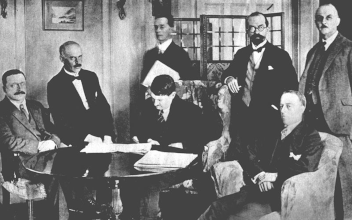
Just after 2:00 AM on December 6, 1921, the Irish delegation, without consulting the Dáil, finally sign a treaty with the British. Collins writes, prophetically, later on the day of the signing, “early this morning I signed my death warrant.”
The Treaty displeases the Catholics in the north and the unionists in the south. Meanwhile, many of those involved in the conflict are abhorred at the fact that not all of Ireland is to leave the United Kingdom.
(From: “The Anglo-Irish Treaty (1921)” by Brian O’Neill, Your Irish Culture, http://www.yourirish.com, May 20, 2020)
McCreevy is educated locally at Naas by the Congregation of Christian Brothers, and later at the fee paying Franciscan Gormanston College. He studies Commerce at University College Dublin and goes on to become a chartered accountant. His family background is modest, his father and ancestors since the late 18th century are lockkeepers on the Grand Canal, a job carried on by his mother after the death of his father, when McCreevy is four years old.
McCreevy’s political career begins with when he wins a seat in the Kildare constituency at the 1977 Irish general election, which is a landslide for Charles Haughey‘s supporters in Fianna Fáil and he is re-elected at every subsequent election until he joins the European Commission. Between 1979 and 1985, he serves as an elected member of the Kildare County Council.
In the 1979 Fianna Fáil leadership election, McCreevy strongly supports the controversial Charles Haughey, who narrowly wins the post. However, in a time of severe budgetary difficulties for Ireland, he soon becomes disillusioned with the new Taoiseach and his fiscal policies. In October 1982, he launches a motion of no-confidence in the party leader, which evolves into a leadership challenge by Desmond O’Malley. In an open ballot and supported by only 21 of his 79 colleagues, the motion fails and McCreevy is temporarily expelled from the parliamentary party.
In later years O’Malley is expelled from Fianna Fáil itself and forms the Progressive Democrats (PDs), espousing conservative fiscal policies. Although considered ideologically close to the PDs, and a personal friend of its erstwhile leader, Mary Harney, McCreevy chooses to remain a member of Fianna Fáil, where he eventually serves in joint FF-PD Governments.
For his first 15 years as TD, while Haughey remains leader, McCreevy remains a backbencher. In 1992, Albert Reynolds becomes Taoiseach and McCreevy is appointed Minister for Social Welfare. In this role, he is principally remembered for a set of 12 cost-cutting measures, collectively termed the “dirty dozen”, which are arguably minor in their direct impact but provide a major political headache for his party in the 1992 Irish general election.
In 1993, McCreevy becomes Minister for Tourism, Transport and Communication, which he holds until the government falls in December 1994. In opposition under new Fianna Fáil leader Bertie Ahern, he is appointed Opposition Spokesperson for Finance. In this role he is viewed as actively pro-enterprise, anti-spending and a key advocate for tax cuts.
In 1997, Fianna Fáil returns to power and McCreevy becomes Minister for Finance. His period coincides with the era of the “Celtic Tiger,” which sees the rapid growth of the Irish economy due to social partnership between employers, government and unions, increased female participation in the labour force, decades of tuition-free secondary education, targeting of foreign direct investment, a low corporation tax rate, an English-speaking workforce only five time-zones from New York City, and membership of the European Union – which provides payments for infrastructural development, export access to the European Single Market and a Eurozone country. He is a consistent advocate of cutting taxes and spending.
In 2004, McCreevy is selected by the Government of Ireland to replace David Byrne as Ireland’s European Commissioner. He is appointed to the Internal Market and Services portfolio, by President of the European CommissionJosé Manuel Barroso. At his confirmation hearings in the European Parliament MEPs describe him as “fluent and relaxed.” He also informs them that he has campaigned for the ratification of every European Treaty since 1972.
In October 2007, McCreevy, commenting on the Northern Rock bank’s loss of investor confidence, claims that banking regulations in the UK, which forces banks to be open to scrutiny from outside investors, caused the panic. He says if access to the bank’s dealings had been restricted, then the trouble could have been avoided.
Irish constitutional law requires a referendum to alter the constitution for such a major change as the adoption of the Treaty of Lisbon. Interviewed beforehand, McCreevy says that he has not read the Treaty in full himself, though he understands and endorses it. The referendum is held on June 12, 2008, and the Irish electorate does not approve the Treaty. He is heavily criticised in the European Parliament and by the leader of the Socialist group in the European Parliament, Martin Schulz, who demands on June 17, 2008, that McCreevy be removed as a European Commissioner. Schulz slightly misquotes McCreevy, whom he stated had contributed to Ireland’s rejection of the Treaty of Lisbon with remarks during the referendum campaign that no “sane person” would read the document.
Following McCreevy’s departure from the commission, he is forced to resign from the board of a new banking firm, NBNK Investments, after an EU ethics committee finds a conflict of interest with his work as a European Commissioner in charge of financial regulation.






 seamus dubhghaill