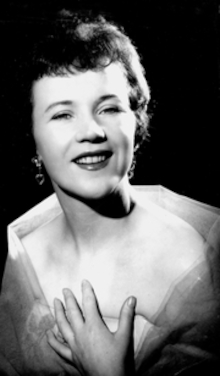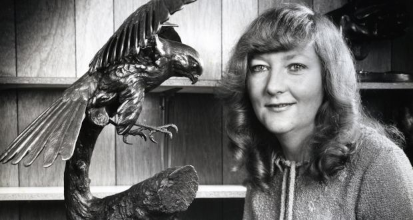
Rynhart is born Jeanne Scuffil in Dublin on March 17, 1946, to Kathleen Connolly and Frederick Scuffil, a sign writer for the Guinness Brewery. She is an apprentice to George Collie RHA for two years and then attends the National College of Art and Design, graduating in 1969 before moving to Coventry, England, where she continues her studies in fine art and sets up a studio with sculptor John Letts. She returns to Ireland in 1981, moving to Ballylickey, near Bantry in County Cork, where she establishes the Rynhart Fine Art gallery and workshop with her husband, Derek.
One of the first bronze craft studios in Ireland, the Rynhart pieces include both small figurative cold cast bronze sculptures of flower sellers, fishermen, horses, sailing boats and musical instruments as well as bronze life-size statues, smelted in a foundry. Her busts of Oscar Wilde and Jonathan Swift are in the Dublin Writers Museum and a Rynhart bust of James Joyce is in New York Public Library.
Rynhart creates the Molly Malone statue for the 1988 Dublin Millennium celebrations. The statue is controversial at the time of its unveiling due to the statue’s revealing dress. Registrar of Aosdána, Adrian Munnelly, writes to the An Bord Fáilte criticising it. The statue is defended by the Lord Mayor of DublinBen Briscoe. Rynhart herself writes in The Irish Times that the clothing and appearance are accurate for women of that era. The statue has since become one of the most popular tourist attractions in Dublin and is fondly regarded by locals.
In 1994, Rynhart’s daughter Audrey joins the business. In 2010, Audrey and her husband, Les Elliott, take over the running of the business which is now based in their studio in Glengarriff, County Cork. From then onwards, Rynhart continues to do some modelling work but has largely retired.
Rynhart dies on June 9, 2020, aged 74, in Schull Community Hospital, Cork, following a short illness. She is buried in the Abbey Cemetery, Bantry, and is survived by her husband, Derek, daughter, Audrey, son, Barry, and grandchildren, Lydia and Sophie.
Murphy’s father is Nicholas Murphy and her mother Mary Gertrude Purcell of Carrigmore, in Montenotte, Cork. She is sent away to school, to a convent in Sussex, England.
At Christmas 1915 Murphy attends an evening at the Fleischmann home where she meets Terence MacSwiney. Her family does not want the couple involved and does not approve of her growing interest in nationalism and socialism. In 1917 she marries MacSwiney in St. Joseph’s Church, Bromyard, Herefordshire, while he is interned due to his involvement in the Easter Rising of 1916. Her bridesmaid is Geraldine O’Sullivan, and his best man is Richard Mulcahy. The couple had waited until she had come of age at 25 so that she is financially independent of her parents. They have a daughter, Máire MacSwiney Brugha.
MacSwiney sees very little of her husband during their married life as he is often arrested. He dies due to his hunger strike on October 25, 1920, as Lord Mayor of Cork. Her husband’s death has a huge impact on her life, being a public event as well as a personal loss. She completes a lecture and interview tour of the United States, over nine months, with his sister Mary. She is the first woman to be given the Freedom of New York City, in 1922.
MacSwiney begins to suffer from depression and takes her daughter to Germany, leaving her there while she travels Europe. She eventually loses custody of her child and by 1934 she no longer has any involvement in her daughter’s life.
MacSwiney spends a lot of time in Paris, where she continues to be engaged with politics, typically those of left-wing, including communist, groups. She becomes involved with Pierre Kaan and they have a daughter, Alix, who is born on May 5, 1926, in Germany. Kaan is sent to a concentration camp by the Gestapo and dies on May 18, 1945, as a result of his treatment there.
MacSwiney is critical of American foreign policy on Vietnam, calling the United States a “world imperialist power.”
MacSwiney never resolves her relationships with either her own daughter or her family. She is paid a pension as the widow of Terence MacSwiney from 1950. She is living in Tonbridge in Kent with her daughter near the end of her life. She dies on October 26, 1982, at Oakwood Hospital in Barming Heath near Maidstone.
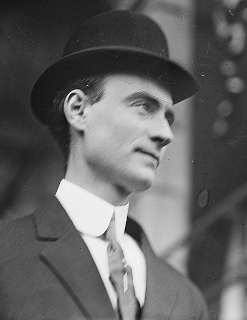
Emmet is a son of Dr. Robert Emmet from County Tipperary (later to become State Physician of Ireland) and Elizabeth Mason of County Kerry, both of whose portraits are today displayed at Cork’s Crawford Art Gallery. He is the elder brother of Robert Emmet, who is executed for leading the Irish Rebellion of 1803, becoming one of Ireland’s most famous republican martyrs. His sister, Mary Anne Holmes, holds similar political beliefs.
Emmet is a man of liberal political sympathies and becomes involved with a campaign to extend the democratic franchise for the Irish Parliament and to end discrimination against Catholics. He is called to the Irish bar in 1790 and quickly obtains a practice, principally as counsel for prisoners charged with political offenses. He also becomes the legal adviser of the Society of the United Irishmen.
When the Dublin Corporation issues a declaration of support of the Protestant Ascendancy in 1792, the response of the United Irishmen is their nonsectarian manifesto which is largely drawn up by Emmet. In 1795 he formally takes the oath of the United Irishmen, becoming secretary in the same year and a member of the executive in 1797. As by this time the United Irishmen had been declared illegal and driven underground, any efforts at peaceful reform of government and Catholic emancipation in Ireland are abandoned as futile, and their goal is now the creation of a non-sectarian Irish republic, independent from Britain and to be achieved by armed rebellion. Although Emmet supports this policy, he believes that the rebellion should not commence until French aid has arrived, differing from more radical members such as Lord Edward FitzGerald.
British intelligence infiltrates the United Irishmen and manages to arrest most of their leaders on the eve of the rebellion. Though not among those taken at the house of Oliver Bond on March 12, 1798, Emmet is arrested about the same time and is one of the leaders imprisoned initially at Kilmainham Gaol and later in Scotland at Fort George until 1802. Upon his release he goes to Brussels where he is visited by his brother Robert in October 1802 and is informed of the preparations for a fresh rising in Ireland in conjunction with French aid. However, at that stage France and Britain are briefly at peace, and the Emmets’ pleas for help are turned down by Napoleon.
Emmet receives news of the failure of his brother’s rising in July 1803 in Paris, where he is in communication with Napoleon Bonaparte. He then emigrates to the United States and joins the New York bar where he obtains a lucrative practice.
After the death of Matthias B. Hildreth, Emmet is appointed New York State Attorney General in August 1812 but is removed from office in February 1813 when the opposing Federalist Party obtains a majority in the Council of Appointment.
Mitchel is born in Camnish, near Dungiven, County Derry on November 3, 1815, the son of a Presbyterian minister. At the age of four, he is sent to a classical school, run by an old minister named Moor, nicknamed “Gospel Moor” by the students. He reads books from a very early age. When a little over five years old, he is introduced to Latin grammar by his teacher and makes quick progress. In 1830, not yet 15 years old, he enters Trinity College, Dublin and obtains a law degree in 1834. In the spring of 1836 he meets Jane Verner, the only daughter of Captain James Verner. Though both families are opposed to the relationship, they become engaged in the autumn and are married on February 3, 1837, by the Rev. David Babington in Drumcree Church, the parish church of Drumcree.
Mitchel works in a law office in Banbridge, County Down, where he eventually comes into conflict with the local Orange Order. He meets Thomas Davis and Charles Gavan Duffy during visits to Dublin. He joins the Young Ireland movement and begins to write for The Nation. Deeply affected by the misery and death caused by the Great Famine, he becomes convinced that nothing will ever come of the constitutional efforts to gain Irish freedom. He then forms his own paper, United Irishmen, to advocate passive resistance by Ireland’s starving masses.
In May 1848, the British tire of Mitchel’s open defiance. Ever the legal innovators in Ireland, they invent a crime especially for the Young Irelanders – felony-treason. They arrest him for violating this new law and close down his paper. A rigged jury convicts him, and he is deported first to Bermuda and then to Australia. However, in June 1853, he escapes to the United States.
Mitchel works as a journalist in New York City and then moves to the South. When the American Civil War erupts, he is a strong supporter of the Southern cause, seeing parallels with the position of the Irish. His family fully backs his commitment to the Southern cause. He loses two sons in the war, one at the Battle of Gettysburg in 1863 and another at the Battle of Fort Sumter in 1864, and another son loses an arm. His outspoken support of the Confederacy causes him to be jailed for a time at Fort Monroe, where one of his fellow prisoners is Confederate PresidentJefferson Davis.
In 1874, the British allow Mitchel to return to Ireland and in 1875 he is elected in a by-election to be a member of the Parliament of the United Kingdom representing the Tipperary constituency. However, his election is invalidated on the grounds that he is a convicted felon. He contests the seat again in the resulting by-election and is again elected, this time with an increased vote.
Unfortunately, Mitchel, one of the staunchest enemies to English rule of Ireland in history, dies eight days later in Newry on March 20, 1875, and is buried there. Thirty-eight years later, his grandson, John Purroy Mitchel, is elected Mayor of New York City.
Gill is born on October 25, 1858, in Ballygraigue, Nenagh, County Tipperary, the first of four sons of Robert Gill, a civil engineer who is assistant county surveyor, and Mary (née Clampett), daughter of a woolen merchant, James Clampett of Mount Kennett, County Limerick. He attends St. Joseph’s CBS Nenagh, St. John’s College, Kilkenny, and Trinity College Dublin becoming a journalist, firstly as editor of the Catholic World magazine of New York, and an associate editor of the North American Review (1883–85). He marries Annie Fennell of Dublin in 1882 and they have two sons, Donat and Roy, and a daughter Finola.
Gill is a friend and political ally of Charles Stewart Parnell. After the death of Parnell, he remains with the Irish Parliamentary Party. He works with Horace Plunkett in developing the Irish co-operative movement. He is member and honorary secretary to the 1895 Recess Committee which leads to the formation of both the Department of Agriculture and Technical Instruction (DATI), forerunner of the Irish Department of Agriculture, and the Vocational Education Committee (VEC). His key work for the Recess Committee is research into the state aid to agriculture in France and Denmark. In February 1900, he is appointed Secretary of the new Department of Agriculture and Technical Instruction in Ireland. In 1907, he is appointed Chairman of the Departmental Committee on Irish Forestry. He also serves on a number of governmental committees concerning agriculture and agricultural production. He is President of the Irish Technical Instruction Association from 1925 to 1929.
A raconteur with, in the words of R. A. Anderson, ‘a queer charm about him,’ Gill moves in Dublin literary circles, and in his retirement, he makes a translation of Louis Paul-Dubois’ Le drame irlandais et l’Irlande nouvelle (1927), published posthumously as The Irish struggle and its results (1934).
(Pictured: “Portrait of T.P. Gill, Journalist, Secretary, Department of Agriculture and Technical Instruction,” oil on canvas by Sarah Purser, 1898, National Gallery of Ireland)
Brady leaves little record of his life before photography. Speaking to the press in the last years of his life, he states that he was born between 1822 and 1824 in Warren County, New York, near Lake George. He is the youngest of three children to Irish immigrant parents, Andrew and Samantha Julia Brady. In official documents before and during the war, however, he claims to have been born in Ireland.
At age 16, Brady moves to Saratoga, New York, where he meets portrait painter William Page and becomes Page’s student. In 1839, the two travel to Albany, New York, and then to New York City, where he continues to study painting with Page, and also with Page’s former teacher, Samuel F. B. Morse. Morse had met Louis-Jacques-Mandé Daguerre in France in 1839 and returned to the United States to enthusiastically push the new daguerreotype invention of capturing images. At first, Brady’s involvement was limited to manufacturing leather cases that hold daguerreotypes. But soon he becomes the center of the New York artistic colony that wishes to study photography. Morse opens a studio and offers classes. Brady is one of the first students.
In 1844, Brady opens his own photography studio at the corner of Broadway and Fulton Street in New York, and by 1845, he begins to exhibit his portraits of famous Americans, including the likes of Senator Daniel Webster and poet Edgar Allan Poe. In 1849, he opens a studio at 625 Pennsylvania Avenue in Washington, D.C., where he meets Juliet Handy, whom he marries in 1850 and lives with on Staten Island. His early images are daguerreotypes, and he wins many awards for his work. In the 1850s ambrotype photography becomes popular, which gives way to the albumen print, a paper photograph produced from large glass negatives most commonly used in American Civil War photography.
In 1850, Brady produces The Gallery of Illustrious Americans, a portrait collection of prominent contemporary figures. The album, which features noteworthy images including the elderly Andrew Jackson at the Hermitage, is not financially rewarding but invites increased attention to his work and artistry. In 1854, Parisian photographer André-Adolphe-Eugène Disdéri popularizes the carte de visite and these small pictures rapidly become a popular novelty, with thousands being created and sold in the United States and Europe.
At first, the effect of the American Civil War on Brady’s business is a brisk increase in sales of cartes de visite to departing soldiers. He readily markets to parents the idea of capturing their young soldiers’ images before they might be lost to war by running an ad in The New York Daily Tribune. However, he is soon taken with the idea of documenting the war itself. He first applies to an old friend, General Winfield Scott, for permission to have his photographers travel to the battle sites, and eventually, he makes his application to President Abraham Lincoln himself. Lincoln grants permission in 1861, with the proviso that Brady finances the project himself.
His efforts to document the American Civil War on a grand scale by bringing his photographic studio onto the battlefields earns Brady his place in history. His first popular photographs of the conflict are at the First Battle of Bull Run, in which he gets so close to the action that he barely avoids capture. While most of the time the battle has ceased before pictures are taken, he comes under direct fire at the First Battle of Bull Run, Petersburg, and Fredericksburg.
Brady also employs Alexander Gardner, James Gardner, Timothy H. O’Sullivan, William Pywell, George N. Barnard, Thomas C. Roche, and seventeen other men, each of whom is given a traveling darkroom, to go out and photograph scenes from the American Civil War. He generally stays in Washington, D.C., organizing his assistants and rarely visiting battlefields personally.
This may be due, at least in part, to the fact that Brady’s eyesight has begun to deteriorate in the 1850s. Many of the images in Brady’s collection are, in reality, thought to be the work of his assistants. He is criticized for failing to document the work, though it is unclear whether it is intentional or due simply to a lack of inclination to document the photographer of a specific image. Because so much of his photography is missing information, it is difficult to know not only who took the picture, but also exactly when or where it was taken.
In October 1862 Brady opens an exhibition of photographs from the Battle of Antietam in his New York gallery, titled The Dead of Antietam. Many images in this presentation are graphic photographs of corpses, a presentation new to America. This is the first time that many Americans see the realities of war in photographs, as distinct from previous “artists’ impressions.”
Brady, through his many paid assistants, takes thousands of photos of American Civil War scenes. Much of the popular understanding of the Civil War comes from these photos. There are thousands of photos in the U.S. National Archives and Records Administration and the Library of Congress taken by him and his associates. The photographs include Lincoln, Ulysses S. Grant, and soldiers in camps and battlefields. The images provide a pictorial cross reference of American Civil War history. He is not able to photograph actual battle scenes, as the photographic equipment in the day is still in the infancy of its technical development and requires that a subject be still for a clear photo to be produced.
Following the conflict, a war-weary public loses interest in seeing photos of the war, and Brady’s popularity and practice decline drastically.
During the war, Brady spends over $100,000 (equivalent to $1,691,000 in 2020) to create over 10,000 plates. He expects the U.S. government to buy the photographs when the war ends. When the government refuses to do so he is forced to sell his New York City studio and go into bankruptcy. The United States Congress grants Brady $25,000 in 1875, but he remains deeply in debt. The public was unwilling to dwell on the gruesomeness of the war after it has ended, and so private collectors are scarce.
Depressed by his financial situation and loss of eyesight and devastated by the death of his wife in 1887, Brady dies penniless in the charity ward of Presbyterian Hospital in New York City on January 15, 1896, from complications following a streetcar accident. His funeral is financed by veterans of the 7th New York Infantry Regiment. He is buried in the Congressional Cemetery, which is located in Barney Circle, a neighborhood in the Southeast quadrant of Washington, D.C.
Brady photographs 18 of the 19 American presidents from John Quincy Adams to William McKinley. The exception is the 9th President, William Henry Harrison, who dies in office three years before Brady starts his photographic collection. He photographs Abraham Lincoln on many occasions. His Lincoln photographs have been used for the $5 bill and the Lincoln penny. One of his Lincoln photos is used by the National Bank Note Company as a model for the engraving on the 90c Lincoln Postage issue of 1869.
(Pictured: “Mathew B. Brady,” oil on canvas by Charles Loring Elliott, 1857, Metropolitan Museum of Art, New York)
Higgins is born on April 24, 1896, on the west coast of Ireland in Foxford, County Mayo. He is the eldest son of Joseph, a policeman stationed in Foxford at the time of his son’s birth, and Annie Higgins. His poem “Father and Son” is a loving tribute to his father. He grows up in Ballivor, County Meath, where his family has farmed for several generations. He spends the largest part of his adult life in Dublin, in a house he has built beside the River Dodder in Rathfarnham. His health is poor, and though his friends are inclined to regard him as a hypochondriac, his frequent predictions that he would die young prove to be accurate.
Higgins marries Beatrice May Moore in 1921. The marriage is a happy one. Even Frank O’Connor, who dislikes him, praises him as a kind and considerate husband. He is however reputed to have had a number of affairs, notably with the actress Ria Mooney.
Higgins is a student of William Butler Yeats and serves on the board of the Abbey Theatre from 1935 until his death. His best-known book of poetry is The Gap of Brightness (1940). He is also well known for his poem “Father and Son.” He writes a moving elegy for his fellow poet Pádraic Ó Conaire. He is generally acknowledged to be a fine poet but is less successful in his Abbey Theatre work. Frank O’Connor says unkindly that Higgins could not direct a children’s poetry recitation.
In 1937 Higgins is tour manager of the Abbey Theatre production of Teresa Deevy‘s Katie Roche, which tours to the Ambassador Theatre in New York City. There are five performances from October 2-6. His Abbey career can be seen in the Abbey Theatre archives.
Higgins is a popular and convivial man. Even O’Connor, who comes to regard him with deep suspicion, admits that he is a delightful person to know. His circle of friends includes many of the leading Irish literary figures of his time, including Yeats, Padraic O Conaire, George William Russell, Lennox Robinson, and for a time O’Connor. O’Connor, however, comes to regard him as untrustworthy and a troublemaker, and describes him unflatteringly in his memoir My Father’s Son. For Yeats, Higgins seems to feel a genuine affection, once remarking that he never left Yeats’ house without “feeling like a thousand dollars.” He is also capable of great kindness and generosity to younger writers like Patrick Kavanagh.
(Pictured: “F. R. Higgins,” Oil on Canvas by Sean O’Sullivan, courtesy of the Abbey Theatre, Dublin)
Diarmuid O’Hegarty (Ó hÉigeartuigh), civil servant and revolutionary, is born Jeremiah Stephen Hegarty on December 26, 1892, in Lowertown, Skibbereen, County Cork, the eldest of seven children of Jeremiah Hegarty (1856–1934) and his wife Eileen (née Barry), both teachers. He is educated at the Christian Brothers school, St. Patrick’s Place, Cork, joins the civil service in 1910 and is posted to the Department of Agriculture and Technical Instruction, acquiring invaluable administrative experience as private secretary to T. P. Gill, secretary of the department.
O’Hegarty is a member of the Keating branch of the Gaelic League and the closely associated Teeling circle of the Irish Republican Brotherhood (IRB). In 1913 he becomes secretary and stage manager of a troupe of Gaelic players, Na hAisteoirí, which includes several who later become prominent revolutionaries: Piaras Béaslaí, Gearóid O’Sullivan, Fionán Lynch, and Con Collins. As second lieutenant of F Company, 1st Battalion, Dublin Brigade, Irish Volunteers, during the Easter Rising, he is in charge of barricades in Church Street, Mary Lane, Mary’s Abbey, and Jameson Distillery, an area which sees fierce fighting. Imprisoned in Knutsford (May 1-18), he is released in error and returns to his post in the civil service. On his return he is a key figure in the reorganisation of the Volunteers and IRB, becoming a member of the executive of the IRB’s supreme council along with Michael Collins and Seán Ó Murthuile. He also becomes a central figure in Kathleen Clarke‘s prisoner support group, the Irish Volunteer Dependents Fund, and when it amalgamates with the more moderate Irish National Aid Association to form the INA&VDF in August 1916, he helps to ensure that it is dominated by republicans.
O’Hegarty is very close to Michael Collins and Harry Boland and in 1918 this IRB triumvirate exercises considerable control in the nomination of Sinn Féin candidates for the 1918 Irish general election. In the same year he is dismissed from the civil service for refusing to take the oath of allegiance, but his administrative talents find ample outlet in the secretariat of the revolutionary Dáil and later in the service of the Irish Free State to such an extent that he has been called ‘the civil servant of the revolution’ and ‘the Grey Eminence of the Free State Government.’ As clerk of the First Dáil and secretary to the Dáil cabinet (1919–21), he is largely responsible for its success, organising meetings of the clandestine parliament and coordinating the work of various departments from his offices on the corner of O’Connell Street and Abbey Street and later in Middle Abbey Street. He is determined that the Dáil will demonstrate its worth by ‘functioning as any progressive government would be expected to function.’ He records the minutes and handles all correspondence of the Dáil cabinet. As the conduit through which the Dáil’s ministers communicate, his role is central to the effective operation of government on the run. The influence this gives him within the revolutionary movement is bolstered by his senior role within the IRB and the positions of military significance which he occupies. He is a member of the Volunteer Executive (Jun 1916–Nov 1921), Irish Republican Army (IRA) Director of Communications (Jul 1918–Mar 1920), and Director of Organisation (Mar 1920–Apr 1921). When convicted of illegal assembly and jailed in Mountjoy Prison (Nov 1919–Feb 1920), he immediately wields power within the prison, ordering Noel Lemass off a hunger strike.
O’Hegarty resigns his military duties in April 1921 to concentrate on his work in the Dáil secretariat and serves as secretary to the Irish delegation during the Anglo–Irish Treaty negotiations in London (Oct–Dec 1921). He is a vital voice for the Treaty within the IRB and is appointed secretary to the cabinet of the Provisional Government in 1922, participating in the unsuccessful army unification talks of May 1922. During the Irish Civil War, he is briefly seconded from his civil service post to serve as military governor of Mountjoy Prison (Jul-Aug 1922), where he threatens that prisoners who persist in leaning out of windows and talking to the public outside the prison will be shot. Peadar O’Donnell, who is a prisoner there at the time, remembers him as the focus of much ‘republican bitterness.’ A member of the army council during the Irish Civil War, he serves as Director of Organisation (Jul–Dec 1922) and Director of Intelligence (Dec 1922–May 1923), leaving the army with the rank of lieutenant general on May 1, 1923, to resume his civil service career.
O’Hegarty is secretary to the Executive Council of the Irish Free State (1923–32) and principal private secretary to its president, W. T. Cosgrave. Again, he records the cabinet minutes and is the administrative pivot upon which government turns. He serves as secretary to numerous governmental delegations and is widely praised for his work in this role at the 1926 Imperial Conference and the 1930 Imperial Conference. In 1927 he goes to New York to represent the government at a hearing into the fate of republican funds in the United States. His career is the prime example of the influence of revolutionary veterans within the higher civil service in the early years of the state. After the change of government following the 1932 Irish general election, he is one of the very few senior civil servants who is effectively removed from his position. He is appointed to be a commissioner of public works, becoming chairman in 1949, a position he holds until his retirement in 1957. In 1939–40 he serves on the Economy Committee established by the government to advise on wartime spending, and in 1941 is a member of a tribunal of inquiry into public transport, which is principally concerned with the poor financial state of Great Southern Railways.
On April 27, 1922, with Michael Collins as his best man, O’Hegarty marries Claire Archer, daughter of Edward Archer, a post office telegraph inspector from Dublin, and Susan Archer (née Matthews). Her brother is William (Liam) Archer. They live at 9 Brendan Road, Donnybrook, Dublin.
Zappone is nominated by Taoiseach Enda Kenny to the 24th Seanad in 2011, having been recommended by Eamon Gilmore, the then leader of Fine Gael‘s coalition partners, the Labour Party. With her Seanad nomination, she becomes the first openly lesbian member of the Oireachtas and the first member in a recognised same-sex relationship.
Zappone is elected to the Dáil for the Dublin South-West constituency at the 2016 Irish general election, becoming the first openly lesbian TD and, by her own reckoning, the world’s 32nd lesbian to be elected to a national parliament. In May 2016, after a delay in government formation, due to prolonged talks, she becomes Ireland’s first openly lesbian government Minister and the first Minister to have been openly gay at the time of appointment to cabinet, when Taoiseach Enda Kenny appoints her as the Minister for Children and Youth Affairs. She loses her seat at the February 2020 Irish general election and continues to serve as a minister until June 2020 on the election of a new government.
In July 2021, it is announced that Zappone is to be appointed to the newly created position of Special Envoy to the UN for Freedom of Opinion and Expression. It subsequently emerges that the proposed appointment had not been flagged in advance of the Cabinet meeting where it was proposed by Minister Simon Coveney, raising the concerns of the Taoiseach, Micheál Martin. However, he does not block the appointment, attracting criticism from within government, the opposition and the public, with Sinn Féin describing the appointment as “cronyism.”
In the following days it is reported that Zappone had lobbied for the creation of an appointment to the part-time position, which was not openly advertised or subject to a competition. Further controversy arises when it is reported that shortly prior to the announcement of her appointment, she had hosted a party for 50 guests, including politicians such as Leo Varadkar, at the Merrion Hotel, while the COVID-19 pandemic in the Republic of Ireland was ongoing. Comparisons are made between the party and the Oireachtas Golf Society scandal from earlier in the pandemic. On August 4, 2021, she announces that she will not take up the envoy role, saying “While I am honoured to have been appointed by the Government to be the Special Envoy on Freedom of Opinion and Expression, it is clear that criticism of the appointment process has impacted the legitimacy of the role itself. It is my conviction that a Special Envoy role can only be of real value to Ireland and to the global community if the appointment is acceptable to all parties.”
In September 2021, Zappone is invited to appear before the Oireachtas Committee on Foreign Affairs and Defence, but chooses not to attend. As a U.S. citizen and resident, the committee has no power to compel her attendance.
William Grattan Tyrone Power, Irish stage actor, comedian, author and theatrical manager known professionally as Tyrone Power, is born in Kilmacthomas, County Waterford, on November 20, 1797. He is an ancestor of actor Tyrone Power and is also referred to as Tyrone Power I.
The young Power takes to the stage, achieving prominence throughout the world as an actor and manager. He is well known for acting in such Irish-themed plays as Catherine Gore‘s King O’Neil (1835), his own St. Patrick’s Eve (1837), Samuel Lover‘s Rory O’More (1837) and The White Horse of the Peppers (1838), Anna Maria Hall‘s The Groves of Blarney (1838), Eugene Macarthy’s Charles O’Malley (1838), and William Bayle Bernard‘s His Last Legs (1839) and The Irish Attorney (1840). In his discussion of these works, Richard Allen Cave argues that Power, both in his acting as well as his choice of plays, seeks to rehabilitate the Irishman from the derogatory associations with “stage Irishmen.”
Power has a number of notable descendants by his wife Anne, daughter of John Gilbert of the Isle of Wight:
Sir Tyrone Guthrie, British theatrical director (1900–1971)
Maurice Henry Anthony O’Reilly Power (1821–1849), trained as a barrister but later took up acting
Frederick Augustus Dobbyn Nugent Power (1823–1896), civil engineer, left a large estate of £197,000, equivalent to £15.6 million or 28 million US dollars in 2006
Clara Elizabeth Murray Power (born 1825)
Mary Jane Power (born 1827)
Harold Littledale Power (1833–1901), actor, wine merchant, mine agent & engineer
Tyrone Power, Sr. (1869–1931), English theatre and silent movie star
Tyrone Power (1914–1958), American Hollywood star of the 1930s to 1950s
Romina Power (born 1951), American singer and film actress
Power is said to have purchased the land that is later occupied by Madison Square Garden, New York, shortly before his death. The lawyer who holds the papers cannot be found so the Power family is unable to claim right to the property.
Power is lost at sea on March 17, 1841, when the SS President disappears without trace in the North Atlantic shortly after departing for England. Anne Power is buried in the churchyard of St. Mary The Virgin Church in High Halden, Kent, England.