D’Arcy is born to a Russian-Jewish mother and an Irish Catholic father. She works in small theatres in Dublin from the age of fifteen and later becomes an actress.
D’Arcy is married in 1957 to English playwright and author John Arden. They write several plays together which are highly critical of the British presence in Ireland. They settle in Galway in 1971 and establish the Galway Theatre Workshop in 1976. The couple has five sons, one of whom predeceases his mother.
The couple writes a number of stage pieces and improvisational works for amateur and student players, including The Happy Haven (1960) and The Workhouse Donkey (1964). She writes and produces many plays, including The Non-Stop Connolly Show (1977).
D’Arcy has also written a number of books, including Tell Them Everything (1981), Awkward Corners (with John Arden, 1988), and Galway’s Pirate Women: A Global Trawl (1996).
As an activist, in 1961, D’Arcy joins the anti-nuclear Committee of 100, led by Bertrand Russell. In 1981, her peace-activism results in her incarceration in Armagh Jail, after defacing a wall at the Ulster Museum. Her book Tell Them Everything (Pluto Press, 1981) tells the story of her time during the Armagh and H-Blockdirty protests and is one of the earliest accounts about the Armagh women, their republicanism and imprisonment.
D’Arcy also directs Yellow Gate Women (2007), a film about the attempts by women of Greenham Common Women’s Peace Camp to outwit the British and United States military at RAF Greenham Common with bolt cutters and legal challenges. Challenging censorship since 1987, she runs a women’s kitchen pirate radio from her home in Galway.
In 2011, D’Arcy refuses to stand for a minute’s silence to honour Police Service of Northern Ireland (PSNI) officer Ronan Kerr, killed by dissident republicans, at an Aosdána meeting. Her actions are deliberate, she tells the media afterwards, which attracts fierce criticism of her perceived support for armed republican groups in Northern Ireland.
Along with Niall Farrell, D’Arcy is arrested in October 2012 for scaling the perimeter fence of Shannon Airport, in protest at the use of the airport as a stopover for U.S. military flights. As a consequence of her trespassing on airport property, she is imprisoned in 2014 after she refuses to sign a bond saying that she will not trespass on non-public parts of Shannon Airport.
Born John Gerard Smyth, upon joining the Norbertine Roman Catholic religious order in 1945, he changes his name to Brendan. The Norbertines, also known as the “Premonstratensians,” are aware of Smyth’s crimes as early as the late 1970s, yet they do not report him to either the Garda Síochána or the Royal Ulster Constabulary (RUC). He is moved from parish to parish and between dioceses and countries whenever allegations are made. In some cases, the order does not inform the diocesan bishop that Smyth has a history of sexual abuse and should be kept away from children. He abuses children in parishes in Rhode Island and North Dakota and at one time works in Boston and is suspected of similar actions while on pastoral work in Wales and Italy. Norbertine Father Bruno Mulvihill makes several attempts to alert church authorities about the abuse committed by Smyth.
Smyth’s first conviction follows the reporting to police of his abuse of four siblings in Belfast’s Falls Road. After his arrest in 1991, he flees to the Republic of Ireland, where he spends the next three years on the run, staying mostly at Kilnacrott Abbey. This leads to the collapse of the Fianna Fáil–Labour Party coalition government in December 1994 when the poor handling of an extradition request from the RUC by the Irish Attorney General‘s office leads to a further delay of Smyth’s trial. An award-winning UTVCounterpoint programme on the scandal by journalist Chris Moore, followed by a book, accuses the head of the Norbertines and the Archbishop of Armagh of mishandling the case, and the Norbertines of negligence and a failure to tell others of Smyth’s crimes, enabling him to sexually abuse large numbers of children for 40 years.
Smyth dies in prison of a heart attack at the age of 70 on August 22, 1997, after collapsing in the exercise yard, one month into a 12-year prison sentence. The Norbertines hold his funeral before dawn and cover his grave with concrete to deter vandalism. He is buried in Kilnacrott Abbey, which is later put up for sale with 44 acres of land, including the grave.
On October 27, 2005, the title “Reverend” is removed from his gravestone following a campaign by one of Smyth’s victims.
Reviewers of the case differ as to whether there is a deliberate plot to conceal Smyth’s behaviour, incompetence by his superiors at Kilnacrott Abbey, or some combination of factors. Cahal Daly, both as Bishop of Down and Connor, a diocese where some of the abuse takes place, and later as Cardinal Archbishop of Armagh, is recorded as having been privately furious at the Norbertine “incompetence.” Smyth’s activities are investigated by the Northern Ireland Historical Institutional Abuse Inquiry, finding that: “…despite knowing his history of abusing children, the Norbertine religious order moved Smyth to different dioceses where he abused more children…”
In 2010, Daly’s successor as Roman Catholic Archbishop of Armagh, Cardinal Seán Brady, faces “huge pressure to resign” after he admits that in 1975, he witnessed two teenage boys sign oaths of silence after testifying in a Church inquiry against Smyth. Survivor groups see this as evidence of collusion, but Brady says he “did not have the authority” to turn Smyth in. On March 17, 2010, the Deputy First Minister of Northern Ireland, Martin McGuinness, calls for Brady to resign.
In 2013, some of Smyth’s alleged Rhode Island victims between 1965 and 1968, both male and female, call for the Diocese of Providence to investigate Smyth. As of 2019, he is among those listed by the Diocese of Providence as being “credibly accused” of committing sex abuse.
Module 6 of the 2014-2016 Northern Ireland Historical Institutional Abuse Inquiry is dedicated to Smyth’s crimes in Northern Ireland.
A two-part dramatisation of the Smyth case, Brendan Smyth: Betrayal of Trust, is broadcast by the BBC on March 13, 2011, with Ian Beattie in the title role and Richard Dormer as Chris Moore.
(Pictured: Father Brendan Smyth, Our Lady of Mercy, East Greenwich, Rhode Island, USA, c. 1965)
McCabe resigns his Dáil seat on October 30, 1924, along with several other TDs, and the resulting by-election on March 11, 1925, is won by the Cumann na nGaedheal candidate Martin Roddy. He does not stand for public office again and returns to his post as a schoolteacher.
In the 1930s McCabe is involved with the short-lived but widely followed Irish Christian Front (ICF), serving as the organisation’s secretary and announcing its creation to the public on August 22, 1936. He is also a member of the Blueshirts during this period and later the Irish Friends of Germany (later known as the “National Club”) during World War II, a would-be Nazi Collaborator group in the event Germany were to invade Ireland. He chairs their meetings, denies the group is a fifth column and expresses the belief that a German victory will lead to a United Ireland. He is interned in 1940–41 because of his pro-German sympathies, which he claims resulted from the desire to “see the very lifeblood squeezed out of England.”
In 1935, McCabe co-founds the Educational Building Society with Thomas J. O’Connell. He retires from teaching in the 1940s and becomes the full-time managing director of the EBS.
McCabe dies in Dublin on May 31, 1972, leaving his wife, son, and three daughters. There is a bronze bust of him in the headquarters of the Educational Building Society, Westmoreland Street, Dublin.
The son of a member of the Royal Air Force (RAF), Keenan is born on July 17, 1941, in Swatragh, County Londonderry, Northern Ireland, before his family moves to Belfast. As a teenager, he moves to England to find work, for a time working as a television repairman in partnership with his brother in Corby, Northamptonshire. During this time, he comes to the attention of the police when he damages a cigarette machine, which leads to police having his fingerprints on file. He returns to Northern Ireland when the Troubles begin and starts working at the Grundig factory in the Finaghy area of Belfast where he acquires a reputation as a radical due to his involvement in factory trade union activities.
Despite his family having no history of republicanism, Keenan joins the Provisional Irish Republican Army in 1970 or 1971, and by August 1971 is the quartermaster of the Belfast Brigade. He is an active IRA member, planning bombings in Belfast and travelling abroad to make political contacts and arrange arms smuggling, acquiring contacts in East Germany, Libya, Lebanon and Syria. In 1972, he travels to Tripoli to meet with Libyan leader Muammar Gaddafi in order to acquire arms and finance from his government. In early 1973 he takes over responsibility for control of the IRA’s bombing campaign in England and also becomes IRA Quartermaster General. In late 1973, he is the linchpin of the kidnap of his former employer at Grundig, director Thomas Niedermayer.
In early 1974, Keenan plans to break Gerry Adams and Ivor Bell out of Long Kesh using a helicopter, in a method similar to Seamus Twomey‘s escape from Mountjoy Prison in October 1973, but the plan is vetoed by Billy McKee. He is arrested in the Republic of Ireland in mid-1974 and sentenced to twelve months imprisonment for IRA membership. On March 17, 1975, he is shot and wounded while attempting to lead a mass escape from Portlaoise Prison. While being held in Long Kesh, Gerry Adams helps to devise a blueprint for the reorganisation of the IRA, which includes the use of covert cells and the establishment of a Southern Command and Northern Command. As the architects of the blueprint, Adams, Bell and Brendan Hughes, are still imprisoned, Martin McGuinness and Keenan tour the country trying to convince the IRA Army Council and middle leadership of the benefits of the restructuring plan, with one IRA member remarking “Keenan was a roving ambassador for Adams.” The proposal is accepted after Keenan wins support from the South Derry Brigade, East Tyrone Brigade and South Armagh Brigade, with one IRA member saying, “Keenan was really the John the Baptist to Adams’ Christ.”
In December 1975, members of an IRA unit based in London are arrested following the six-day Balcombe Street siege. The IRA unit had been active in England since late 1974 carrying out a series of bombings, and a few months after his release from prison Keenan visits the unit in Crouch Hill, London, to give it further instructions. In follow-up raids after the siege, police discover crossword puzzles in his handwriting and his fingerprints on a list of bomb parts. A warrant is issued for his arrest.
Garda Síochána informer Sean O’Callaghan claims that Keenan recommended IRA Chief of Staff Seamus Twomey to authorise an attack on Ulster Protestants in retaliation to an increase in sectarian attacks on Catholic civilians by Protestant loyalist paramilitaries, such as the killing of three Catholics in a gun and bomb attack by the Ulster Volunteer Force (UVF) on Donnelly’s Bar in Silverbridge, County Armagh on December 19, 1975. According to O’Callaghan “Keenan believed that the only way, in his words, to put the nonsense out of the Prods [Protestants] was to just hit back much harder and more savagely than them.” Soon after the sectarianKingsmill massacre occurs, when ten Protestant men returning home from their work are ordered out of a minibus they are travelling in and executed en masse with a machine gun on January 5, 1976.
Keenan is arrested on the basis of the 1975 warrant near Banbridge on March 20, 1979, when the Royal Ulster Constabulary (RUC) stopped two cars travelling north on the main road from Dublin to Belfast and is extradited to England to face charges relating to the Balcombe Street Gang‘s campaign in England. His capture is a blow to the IRA, in particular as he was carrying an address book listing his contacts including Palestinian activists in the United Kingdom. The IRA responds by dispatching Bobby Storey and three other members to break Keenan out of prison using a helicopter, but all four are arrested and remanded to Brixton Prison. Keenan stands trial at the Old Bailey in London in June 1980 defended by Michael Mansfield and is accused of organising the IRA’s bombings in England and being implicated in the deaths of eight people including Ross McWhirter and Gordon Hamilton Fairley. He is sentenced to eighteen years imprisonment after being found guilty on June 25, 1980.
Keenan continues to support Gerry Adams while in prison. In August 1982 Adams is granted permission by the IRA’s Army Council to stand in a forthcoming election to the Northern Ireland Assembly, having been refused permission at a meeting the previous month. In a letter sent from Leicester Prison, Keenan writes that he “emphatically” supports the move and endorses the Army Council’s decision.
Keenan is released from prison in June 1993 and by 1996 is one of seven members of the IRA’s Army Council. Following the events after the IRA’s ceasefire of August 1994, he is openly critical of Gerry Adams and the “tactical use of armed struggle,” or TUAS, strategy employed by the republican movement. After the Northern Ireland peace process becomes deadlocked over the issue of the IRA decommissiong its arms, he and the other members of the Army Council authorise the Docklands bombing which kills two people and marks the end of the IRA’s eighteen-month ceasefire in February 1996.
Keenan outlines the IRA’s public position in May 1996 at a ceremony in memory of hunger striker Seán McCaughey at Milltown Cemetery, where he states, “The IRA will not be defeated…Republicans will have our victory…Do not be confused about decommissioning. The only thing the Republican movement will accept is the decommissioning of the British state in this country.” In the same speech he accuses the British of “double-dealing” and denounces the Irish government as “spineless.”
On February 25, 2001, Keenan addresses a republican rally in Creggan, County Armagh, saying that republicans should not fear “this phase” of “the revolution” collapsing should the Good Friday Agreement fail. He confirms his continued commitment to the Armalite and ballot box strategy, saying that both political negotiations and violence are “legitimate forms of revolution” and that both “have to be prosecuted to the utmost.” He goes on to say, “The revolution can never be over until we have British imperialism where it belongs—in the dustbin of history,” a message aimed at preventing rank-and-file IRA activists defecting to the dissident Real IRA.
Keenan plays a key role in the peace process, acting as the IRA’s go-between with the Independent International Commission on Decommissioning (IICD). Gerry Adams remarks, “There wouldn’t be a peace process if it wasn’t for Brian Keenan.” Keenan resigns from his position on the Army Council in 2005 due to ill-health, and is replaced by Bernard Fox, who had taken part in the 1981 Irish hunger strike. On May 6, 2007, he is guest speaker at a rally in Cappagh, County Tyrone, to commemorate the 20th anniversary of the deaths of the so-called “Loughgall Martyrs,” eight members of the IRA East Tyrone Brigade killed by the Special Air Service (SAS) in 1987.
In July 2002, Keenan is diagnosed as suffering from terminal colorectal cancer. It is alleged by the Irish Independent and The Daily Telegraph that Keenan succeeded Thomas “Slab” Murphy as Chief of Staff of the Provisional IRA at some point between the late 1990s and the mid-2000s before he relinquished the role to deal with his poor health caused by cancer.
Keenan’s last years are spent living with his wife in Cullyhanna, County Armagh, where he dies of cancer on May 21, 2008. He is an atheist and receives a secular funeral, representing a major republican show of strength.
Paul Joseph Brady, Irish singer-songwriter and musician, is born in Belfast, Northern Ireland, on May 19, 1947. Interested in a wide variety of music from an early age, his work straddles folk and pop.
Brady begins learning piano around age six and by the age of eleven he has begun to play guitar, spending hours of his school holidays learning every song that the Shadows had recorded. He is also influenced by Chuck Berry.
In 1963, Brady begins performing as a piano player in a hotel in Bundoran, County Donegal. In October 1964, he attends University College Dublin and performs with a number of R&B groups, covering songs by the likes of Ray Charles and James Brown. The first of these is the Inmates (late 1964–about April 1965), which evolves into the Kult (about April–December 1965), featuring Brady, Jackie McAuley (ex-Them, and future Belfast Gypsies and Trader Horne), Brendan Bonass, and Dave Pennefather. He can be seen in the documentary film Charlie Is My Darling waiting outside Dublin‘s Adelphi Cinema for the Rolling Stones‘ concert of September 3, 1965. He next joins Rootzgroup (late 1965–May 1966) and Rockhouse (about May–December 1966).
During Brady’s time at college in Dublin, the country sees a huge rise in interest in traditional Irish music. He joins the popular Irish band The Johnstons when Michael Johnston leaves in May 1967. They move to London in 1969 and subsequently to New York City in 1972 to expand their audience. Despite some success, he returns to Ireland in 1974 to join the Irish group Planxty, the band that subsequently launches the solo careers of Andy Irvine, Liam O’Flynn, Dónal Lunny, and Christy Moore.
When Planxty disbands in late 1975, Brady forms a duo with Irvine from 1976 to 1978, a partnership that produces the successful album, Andy Irvine/Paul Brady. The next few years see him establish his popularity and reputation as one of Ireland’s best interpreters of traditional songs. His versions of ballads like “Arthur McBride” and “The Lakes of Pontchartrain” are considered definitive and are still popular at concerts today. In 1975 in New York, he records three albums for Shanachie Records as guitar accompanist to resident Irish fiddlers Andy McGann, Paddy Reynolds and John Vesey. He also records a 1976 album, The High Part of the Road, for the same label with Irish fiddler Tommy Peoples.
In 1978, Brady releases his first solo album, Welcome Here Kind Stranger, which wins him critical acclaim and is voted the “Folk Album of the Year” by Melody Maker magazine. However, it proves to be his last album covering traditional material. He decides to delve into pop and rock music and releases his first album of this genre in 1981, Hard Station.
Brady releases a number of successful solo albums throughout the 1980s: True for You (1983), Back to the Centre (1985), and Primitive Dance (1987). By the end of the decade, he is recognised and accepted as a respected performer and songwriter. His songs are being covered by a number of other artists, including Santana and Dave Edmunds.
Dylan is sufficiently impressed by Brady’s work to name-check him in the booklet of his 1985 box set, Biograph. The actual quote is “(…) people get too famous too fast these days and it destroys them. Some guys got it down – Leonard Cohen, Paul Brady, Lou Reed, secret heroes, John Prine, David Allen Coe, Tom Waits. I listen more to that kind of stuff than whatever is popular at the moment. They’re not just witchdoctoring up the planet, they don’t set up barriers (…)”.
In 1991, Brady reaches number 5 in the Irish Singles Chart with Nobody Knows.
Since his Hard Station album (1981), Brady is on various major labels until he creates his own label, PeeBee Music, in the late 1990s. He releases three albums in the 1990s: Trick or Treat, Songs & Crazy Dreams (a remixed compilation of earlier songs) and Spirits Colliding, which are met with critical acclaim. Trick or Treat is on Fontana/Mercury Records and receives a lot of promotion. As a result, some critics consider it his debut album and note that the record benefits from the expertise of experienced studio musicians, as well as producer Gary Katz, who works with the rock group Steely Dan. Rolling Stone, after praising his earlier but less-known solo records, calls Trick or Treat Brady’s “most compelling collection.”
Brady goes on to record several other albums, fifteen in total since going solo in 1978, and collaborates with a number of other established musicians including Bonnie Raitt and Richard Thompson. In 2006, he collaborates with Cara Dillon on the track “The Streets of Derry” from her album After the Morning. He also works with Fiachra Trench.
Brady’s fifteenth studio album, Hooba Dooba, is released in March 2010.
In 2017, a friendship is struck with Theo Katzman (Vulfpeck) and Brady tours Ireland in 2019 as half of this duo with Joe Dart, also of vulfpeck, Louis Cato and Lee Pardini. He continues to tour, record and collaborate with other artists. In 2019, Jimmy Buffett begins performing a cover of Brady’s hit, “The World is What you Make It.” In September 2019, Brady joins Buffett on his tour stops in both Dublin and London.
Brady releases the album Unfinished Business on his own label, PeeBee Music, licensed to Proper Music UK, in 2017.
While Brady and Andy Irvine’s planned tour of their 1976 album Andy Irvine/Paul Brady is impacted by the COVID-19 pandemic, they finish the tour in 2022. Musicians to join them on the tour include fiddle player Kevin Burke and multi-instrumentalist Dónal Lunny, both of whom had played on the original album.
In 2009, Brady receives an honorary degree of Doctor of Letters from the University of Ulster, in recognition of his services to traditional Irish music and songwriting.
Frederick Edward McWilliamCBERA, Northern Irish surrealistsculptor, dies in London on May 13, 1992. He works chiefly in stone, wood and bronze. His style of work consists of sculptures of the human form contorted into strange positions, often described as modern and surreal.
McWilliam is born in Banbridge, County Down,on April 30, 1909, the son of Dr. William McWilliam, a local general practitioner. Growing up in Banbridge has a great influence on his work. He makes references to furniture makers such as Carson the Cooper and Proctors in his letters to his friend, Marjorie Burnett.
McWilliam attends Campbell College in Belfast and later attends Belfast College of Art from 1926. After 1928, he continues to study at the Slade School of Fine Art in London. He originally intends to become a painter, but influenced by Alfred Horace Gerrard, head of the sculpture department at the Slade, and by Henry Moore whom he meets there, he turns to sculpture. He receives the Robert Ross Leaving Scholarship which enables him and his wife, Beth (née Crowther), to travel to Paris where he visits the studio of Constantin Brâncuși.
During the first year of World War II, he joins the Royal Air Force and is stationed in England for four years where he is engaged in interpreting aerial reconnaissance photographs. He is then posted to India. While there he teaches art in the Hindu Art School in New Delhi.
After his return from India, McWilliam teaches for a year at the Chelsea School of Art. He is then invited by A. H. Gerrard to teach sculpture at the Slade. He continues in this post until 1968.
During the Northern IrelandTroubles McWilliam produces a series of bronzes in 1972 and 1973 known as Women of Belfast in response to the bombing at the Abercorn Tea-Rooms.
In 1964 McWilliam is awarded an Honorary Doctor of Letters from Queen’s University Belfast. In 1966 he is appointed CBE and in 1971 he wins the Oireachtas Gold Medal. He is represented in many public collections, including the Museum of Modern Art in New York City and Tate Britain in London. In 1984 the National Self-Portrait Gallery purchases a McWilliam self-portrait amongst acquisitions from fellow Northerners Brian Ballard, Brian Ferran and T. P. Flanagan.
Hughes is born in Bellaghy, County Londonderry, Northern Ireland, on February 28, 1956, into a republican family, the youngest of four brothers in a family of ten siblings. His father, Joseph, had been a member of the Irish Republican Army in the 1920s and one of his uncles had smuggled arms for the republican movement. This results in the Hughes family being targeted when internment is introduced in 1971, and his brother Oliver is interned for eight months without trial in Operation Demetrius. He leaves school at the age of 16 and starts work as an apprentice painter and decorator.
Hughes is returning from an evening out in Ardboe, County Tyrone, when he is stopped at an Ulster Defence Regiment (UDR) checkpoint. When the soldiers realise he comes from a republican family, he is badly beaten. His father encourages him to see a doctor and report the incident to the police, but he refuses, saying he “would get his own back on the people who did it, and their friends.”
Hughes initially joins the Official Irish Republican Army but leaves after the organisation declares a ceasefire in May 1972. He then joins up with Dominic McGlinchey, his cousin Thomas McElwee and Ian Milne, before the three decide to join the Provisional Irish Republican Army in 1973. He, Milne and McGlinchey take part in scores of IRA operations, including daylight attacks on Royal Ulster Constabulary (RUC) stations, bombings, and attacks on off-duty members of the RUC and UDR. Another IRA member describes the activities of Hughes:
“He led a life perpetually on the move, often moving on foot up to 20 miles for one night then sleeping during the day, either in fields and ditches or safe houses; a soldierly sight in his black beret and combat uniform and openly carrying a rifle, a handgun and several grenades as well as food rations.”
On April 18, 1977, Hughes, McGlinchey and Milne are travelling in a car near the town of Moneymore when an RUC patrol car carrying four officers signals them to stop. The IRA members attempt to escape by performing a U-turn but lose control of the car which ends up in a ditch. They abandon the car and open fire on the RUC patrol car, killing two officers and wounding another, before running off through the fields. A second RUC patrol comes under fire while attempting to prevent the men from fleeing, and despite a search operation by the RUC and British Army the IRA members escape. Following the Moneymore shootings, the RUC name Hughes as the most wanted man in Northern Ireland, and issue wanted posters with pictures of Hughes, Milne and McGlinchey. Milne is arrested in Lurgan, County Armagh, in August 1977, and McGlinchey later in the year in the Republic of Ireland.
Hughes is arrested on March 17, 1978, at Lisnamuck, near Maghera in County Londonderry, after an exchange of gunfire with the British Army the night before. British soldiers manning a covert observation post spot Hughes and another IRA volunteer approaching them wearing combat clothing with “Ireland” sewn on their jackets. Thinking they might be from the Ulster Defence Regiment, one of the soldiers stands up and calls to them. The IRA volunteers open fire on the British troops, who return fire. A soldier of the Special Air Service (SAS), Lance Corporal David Jones, is killed and another soldier wounded. Hughes is also wounded and is arrested nearby the next morning.
In February 1980, Hughes is sentenced to a total of 83 years in prison. He is tried for, and found guilty of, the murder of one British Army soldier (for which he receives a life sentence) and wounding of another (for which he receives 14 years) in the incident which leads to his arrest, as well as a series of gun and bomb attacks over a six-year period. Security sources describe him as “an absolute fanatic” and “a ruthless killer.” Fellow republicans describe him as “fearless and active.”
Hughes is involved in the mass hunger strike in 1980 and is the second prisoner to join the 1981 Irish Hunger Strike in the H-Blocks at the Long Kesh Detention Centre. His hunger strike begins on March 15, 1981, two weeks after Bobby Sands began his hunger strike. He is also the second striker to die, at 5:43 p.m. BST on May 12, after 59 days without food, refusing requests from the IRA leadership outside the prison to end the strike after the death of Sands. The journey of his body from the prison to the well-attended funeral near Bellaghy is marked by rioting as the hearse passes through loyalist areas. His death leads to an upsurge in rioting in nationalist areas of Northern Ireland.
Hughes’s cousin Thomas McElwee is the ninth hunger striker to die. Oliver Hughes, one of his brothers, is elected twice to Magherafelt District Council.
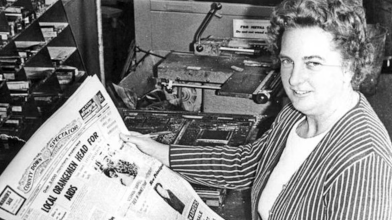
Born Annie Roslyn Roycroft, she is the fifth of six children born to Tom Roycroft of County Cork and Annie Stephens of County Kerry. Her father works in the Royal Irish Constabulary (RIC), which is what prompts the move to County Down. She gets her education at Bangor Central Public Elementary School and Technical College before going on to get a job with the local newspaper, the County Down Spectator in 1941.
Roycroft begins her career with the County Down Spectator as a junior office assistant but shows the instincts of a journalist and learns journalistic skills by typing up the reports dictated by the newspaper’s journalists. She begins submitting local news stories and in 1952 she is taken on as a journalist despite misgivings among the teams locally about a woman working in the field.
Roycroft then takes a break working as a clerk for North Down Borough Council before being asked to return as the editor for the County Down Spectator. A member of the National Union of Journalists, so that she knows how to pay her journalists properly, she has a reputation of standing her ground during reporting of the Troubles. She leaves County Down and her role as editor in 1983 when she marries Joe Stephens and eventually moves to Cork.
Roycroft is very involved in the Church of Ireland. She is a Sunday school teacher from the age of sixteen. When she moves to Cork, she turns her time to working with the church.
Roycroft dies in Beaumont, Cork, on January 11, 2019. She is predeceased by her husband. She writes her memoirs, Memoirs of a Scribbler, in 1995. She is remembered in the book Bangor in the Eighties which is dedicated to her.
(Photo: From “Annie Stephens obituary: One of Ireland’s first female newspaper editors,” The Irish Times, http://www.irishtimes.com, February 16, 2019)
In April 1916, Germany offers the Irish 20,000 Mosin–Nagant 1891 rifles, ten machine guns and accompanying ammunition, but no German officers. It is a fraction of the quantity of the arms Casement had hoped for, with no military expertise on offer. The weapons leave Germany bound for Ireland on a German cargo vessel named the SS Libau, disguised as a Norwegian vessel, Aud-Norge.
Casement confides his personal papers to Dr. Charles Curry, with whom he has stayed at Riederau on the Ammersee, before leaving Germany. He departs with Robert Monteith and Sergeant Daniel Beverley (Bailey) of the Irish Brigade in a submarine, initially the SM U-20, which develops engine trouble, and then the SM U-19, shortly after the Aud sails. According to Monteith, Casement believes the Germans are toying with him from the start and providing inadequate aid that will doom a rising to failure. He wants to reach Ireland before the shipment of arms and to convince Eoin MacNeill, who he believes is still in control, to cancel the rising.
Casement sends John McGoey, a recently arrived Irish American, through Denmark to Dublin, ostensibly to advise what military aid is coming from Germany and when, but with Casement’s orders “to get the Heads in Ireland to call off the rising and merely try to land the arms and distribute them.” McGoey does not reach Dublin, nor does his message. His fate is unknown until recently. Evidently abandoning the Irish Nationalist cause, he joins the Royal Navy in 1916, survives the war, and later returns to the United States, where he dies in an accident on a building site in 1925.
About 2:00 a.m. on the morning of April 21, 1916, three days before the rising begins, Robert Monteith, Daniel Bailey (calling himself Beverly), and Casement climb into a small boat for the trip to shore at Banna Strand in Tralee Bay, County Kerry. Their boat, now in the Imperial War Museum in London, capsizes before they reach shore.
Monteith helps an exhausted Casement to safety on shore. Casement is convinced that the Rising cannot be successful without a large number of German troops, and the best he has been able to obtain is one boatload of arms. Suffering from a recurrence of the malaria that had plagued him since his days in the Congo, and too weak to travel, Monteith and Bailey leave Casement at the ruins of McKenna’s Fort, an ancient ring fort in Rahoneen, Ardfert, now renamed Casement’s Fort, and head for Tralee.
About 1:30 p.m., Casement is discovered by two Royal Irish Constabulary (RIC) officers. He nearly talks his way out of being arrested, but a 12-year-old boy at the scene points out a piece of paper Casement had tossed away as the police approach. On that paper is a German code list. He is arrested on charges of high treason, sabotage and espionage against the Crown. He manages to send word to Dublin about the inadequate German assistance.
The Kerry Brigade of the Irish Volunteers might have tried to rescue Casement over the next three days, but its leadership in Dublin holds that not a shot is to be fired in Ireland before the Easter Rising is in train and therefore orders the Brigade to “do nothing.” A subsequent internal inquiry attaches “no blame whatsoever” to the local Volunteers for failing to attempt a rescue. Casement is taken to Brixton Prison and placed under special observation for fear of an attempt of suicide as there is no staff at the Tower of London to guard suicidal cases.
On the day of his execution by hanging at Pentonville Prison, August 3, 1916, Casement is received into the Catholic Church at his request. He is attended by two Catholic priests, Dean Timothy Ring and Father James Carey, from the East London parish of SS Mary and Michael. The latter, also known as James McCarroll, says of Casement that he was “a saint … we should be praying to him [Casement] instead of for him.” At the time of his death he is 51 years old.
Casement’s body is buried in quicklime in the prison cemetery at the rear of Pentonville Prison, though his last wish was to be buried at Murlough Bay on the north coast of County Antrim, in present-day Northern Ireland. Finally, in 1965, his remains are repatriated to Ireland. His remains lay in state at the Garrison Church, Arbour Hill (now Arbour Hill Prison) in Dublin for five days, close to the graves of other leaders of the 1916 Easter Rising, although he would not be buried beside them. After a state funeral, the remains are buried with full military honours in the republican plot in Glasnevin Cemetery in Dublin, alongside other Irish republicans and nationalists. The President of Ireland, Éamon de Valera, who is then in his mid-eighties and the last surviving leader of the Easter Rising, attends the ceremony, along with an estimated 30,000 others.
Long comes from a carpentry and blacksmithing background. In 1959, he enters Queen’s University Belfast to study civil engineering. He graduates with first class honours and then takes a PhD at Queens. In 1967, he moves to Canada, working as a bridge designer for Fenco Engineering in Toronto.
Long, however, spends only a year in Canada, returning to Belfast in 1968 to become an associate professor of civil engineering at Queen’s University Belfast. In 1976, he is promoted to a full professorship. His work is largely in the field of concrete structures, particularly in chloride resistance, maintenance problems and arch bridge structures. He publishes twenty papers in journals managed by the Institution of Civil Engineers and wins eight of the institution’s medals for these, including the ICE Gold Medal.
From 1997 Long works on the FlexiArch, a precast concrete arch in which the individual voussoirs are joined by a flexible polymeric membrane. The arch arrives to site flat packed and when lifted into position by a crane, the gaps between the voussoirs close under gravity and form the correct arch profile. He patents the product, which is produced by Irish precast manufacturer Macrete, in 2004. The product can be constructed within a day and, containing no corrodible elements, has been stated to have a design lifespan of 300 years. More than fifty FlexiArch bridges have been constructed in the UK and Ireland and spans up to 30m are possible.
By 2002, Long is appointed dean of the faculty of engineering at QUB. In November of that year, he is appointed president of the ICE for the 2002–2003 session, the first Northern Irish person to hold that position. He is also a Fellow of the Royal Academy of Engineering and of the Institute for the Advancement of Engineering.
Long is appointed an officer of the Order of the British Empire in the 2006 New Year Honours for services to higher education and civil engineering. He resigns as professor at QUB in 2006 but remains there as an emeritus professor in the School of Natural and Built Environment. Since 2015, the ICE Northern Ireland awards the Adrian Long medal to the best paper in an ICE journal to be authored by a Northern Ireland member. The medal features a bust of Long.




 seamus dubhghaill