seamus dubhghaill

Promoting Irish Culture and History from Little Rock, Arkansas, USA


Leave a comment

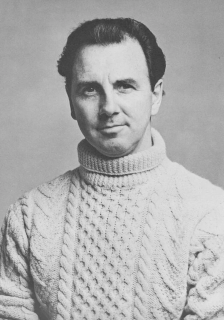
Death of Patrick Michael Clancy, Irish Folk Singer

Patrick Michael Clancy, Irish folk singer best known as a member of The Clancy Brothers and Tommy Makem, dies of lung cancer at home on November 11, 1998. In addition to singing and storytelling, Clancy plays the harmonica with the group, which is widely credited with popularizing Irish traditional music in the United States and revitalizing it in Ireland. He also starts and runs the folk music label Tradition Records, which records many of the key figures of the American folk music revival.

Clancy is born on March 7, 1922, at Carrick-on-Suir, County Tipperary, one of eleven children and the eldest of four boys born to Johanna McGrath and Bob Clancy. During World War II he serves as a flight engineer in the Royal Air Force in India. After his demobilization, Clancy works as a baker in London. In 1947 he emigrates to Toronto, Canada with his brother Tom Clancy. The following year, the two brothers move to Cleveland, Ohio to stay with relatives. Later, they attempt to move to California, but their car breaks down and they relocate to the New York City area instead.

After moving to Greenwich Village in 1951, both Patrick and Tom devote themselves primarily to careers in the theater. In addition to appearing in various Off-Broadway productions and television shows, they produce and star in plays at the Cherry Lane Theatre in Greenwich Village and at a playhouse in Martha’s Vineyard. After losing money on some unsuccessful plays, the brothers begin singing concerts of folk songs after their evening acting jobs are over. They soon dub these concerts “Midnight Specials” and the “Swapping Song Fair.” Patrick and Tom are often joined by other prominent folk singers of the day, including Pete Seeger, Woody Guthrie, and Jean Ritchie.

In 1956 their younger brother, Liam Clancy, immigrates to New York, where he teams up with Tommy Makem, whom he had met while collecting folk songs in Ireland. The two begin singing together at Gerde’s Folk City, a club in Greenwich Village. Patrick and Tom sing with them on occasion, usually in informal folk “sing-songs” in the Village. Around the same time, Patrick founds Tradition Records with folk-song collector and heiress Diane Hamilton, and in 1956 the Clancy Brothers and Tommy Makem release their first album, The Rising of the Moon, with only Patrick’s harmonica as musical accompaniment. However, the Clancys and Makem do not become a permanent singing group until 1959.

In the late 1950s, Clancy with his brothers and Makem begin to take singing more seriously as a permanent career, and soon they record their second album, Come Fill Your Glass with Us. This album proves to be more successful than their debut album, and they begin receiving job offers as singers at important nightclubs, including the Gate of Horn in Chicago and the Blue Angel in New York City. The group garners nationwide fame in the United States after an appearance on The Ed Sullivan Show, which leads to a contract with Columbia Records in 1961. Over the course of the 1960s, the Clancy Brothers and Tommy Makem record approximately two albums a year for Columbia. By 1964, Billboard magazine reports that the group was outselling Elvis Presley in Ireland.

The group performs together on stage, recordings, and television to great acclaim in the United States, Ireland, the United Kingdom, Canada, and Australia until Tommy Makem leaves to pursue a solo career in 1969. They continue performing first with Bobby Clancy and then with Louis Killen until Liam leaves in 1976 also to pursue a solo career. In 1977 after a short hiatus, the group reforms with Patrick, Tom, and Bobby Clancy and their nephew Robbie O’Connell. Liam returns in 1990 after the death of Tom Clancy.

In 1968, after two decades in North America, Clancy returns to live in Carrick-on-Suir, where he purchases a dairy farm and breeds exotic cattle. When not on tour or working on his farm, he spends much of his time fishing, reading, and doing crossword puzzles. In the late 1990s, he is diagnosed with a brain tumor. The tumor is successfully removed, but he is also stricken with terminal lung cancer around the same time. He continues performing until his failing health prevents him from doing so any longer.

Patrick Clancy dies at home of lung cancer on November 11, 1998, at the age of 76. He is buried, wearing his trademark white cap, in the tiny village of Faugheen, near Carrick-on-Suir.

Leave a comment

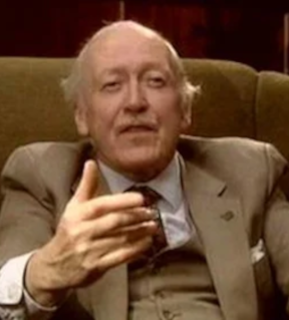
Death of Vincent Dowling, Actor, Director & Producer

Vincent Gerard Dowling, Irish theatre actor, director and producer, dies at Massachusetts General Hospital in Boston on May 10, 2013.

Dowling is born in Kimmage, Dublin, on September 7, 1929, the sixth of four sons and three daughters of William Dowling, a ship’s captain, and his wife Mary (née Kelly). His father is violent toward the family and leaves when he is a toddler. Helped by money provided by a priest, the Dowlings move in 1934 from the basement of his maternal uncle’s flat in Merrion Square, Dublin, to a house in Mount Merrion, County Dublin. In 1942, financial necessity forces the family’s move to a smaller residence in Marlborough Road, Donnybrook, Dublin.

Dowling is educated at St. Mary’s College in Rathmines, Dublin, having previously attended Kilmacud National School and CBS Dún Laoghaire, both in County Dublin. He is a bright student, but with his fees in arrears, the dean of studies induces him to leave school early in September 1945 for a clerkship with the Standard Life Assurance Company. A few years later, he finds his vocation when he accompanies a girlfriend to the academy of acting run by Brendan Smith. He signs up in 1948 for a two-year course during which he performs in and stage-manages academy plays and stage-manages for Smith’s professional company. Upon quitting Standard Life in June 1950, he spends a year touring Ireland with Smith’s company, both as an actor and the touring group’s manager.

Dowling comes to prominence in the 1950s for his role as Christy Kennedy in the long-running radio soap opera, The Kennedys of Castleross, and as a member of the Abbey Theatre company. He returns to the Abbey as artistic director from 1987 to 1990.

Following two months in the United States in 1969 lecturing and directing at Loyola University Chicago, he spends periods during 1972–74 directing for the Missouri Repertory Theatre and lecturing and directing at the University of Missouri – Kansas City. On extended leave from the Abbey, he directs in various American theatres throughout 1975, the year he married Olwen O’Herlihy, daughter of the Irish actor Dan O’Herlihy. After his request for six months leave each year is refused, he quits the Abbey in 1976, having done over a hundred major roles for the company.

In 1976, Dowling becomes a U.S. citizen and is appointed artistic and producing director of the Great Lakes Shakespeare Festival (GLSF) in Cleveland, Ohio, from 1976 to 1984, where he directs, produces and acts in many classical works, by William Shakespeare and others. He is credited with discovering actor Tom Hanks. He receives an Ohio Valley Emmy Award for the 1983 PBS broadcast of his 1982 GLSF production of The Playboy of the Western World.

Dowling is visiting professor at the College of Wooster in Ohio during the 1986-87 academic year. He founds the Miniature Theatre of Chester (now the Chester Theatre Company), in Chester, Massachusetts, in 1990.

Dowling marries actress Brenda Doyle in 1952. They have four daughters, including actress Bairbre Dowling, before divorcing in 1975. In 1975, he marries Olwen O’Herlihy, with whom he has a son.

Politician Richard Boyd Barrett is the biological son of Dowling and recording artist and actress Sinéad Cusack from a 1966 relationship while both are at the Abbey Theatre. Boyd Barrett is adopted as an infant. Dowling contacts Boyd Barrett after his connection with Cusack is publicly revealed in 2007. Their relationship is made known after his death.

Dowling dies on May 10, 2013, in Massachusetts General Hospital due to complications arising from surgery. Following a funeral service at the First Congregational Church of Chester, his remains are interred in the nearby cemetery.

Dowling receives honorary doctorates from Westfield State University in Massachusetts, and from Kent State University, John Carroll University and the College of Wooster, all in Ohio. His papers, from 1976 onward, are housed at the Kent State University and John Carroll University libraries.


Leave a comment

Death of Liam Clancy, Irish Folk Singer

William “Liam” Clancy, Irish folk singer and actor, dies on December 4, 2009, in Bon Secours Hospital, Cork. He is the youngest and last surviving member of the influential folk group The Clancy Brothers, who are regarded as Ireland’s first pop stars. They record 55 albums, achieve global sales of millions and appear in sold-out concerts at such prominent venues as Carnegie Hall and the Royal Albert Hall.

Clancy is born in Carrick-on-Suir, County Tipperary on September 2, 1935, the ninth and youngest surviving child of Robert Joseph Clancy and Joanna McGrath. He receives a Christian Brothers education before taking a job as an insurance man in Dublin. While there he also takes night classes at the National College of Art and Design.

Clancy begins singing with his brothers, Paddy and Tom Clancy, at fund-raising events for the Cherry Lane Theatre and the Guthrie benefits. The Clancy Brothers and Tommy Makem, begin recording on Paddy Clancy’s Tradition Records label in the late 1950s. Liam plays guitar in addition to singing and also records several solo albums. They record their seminal The Rising of the Moon album in 1959. There are international tours, which include performances at Carnegie Hall and the Royal Albert Hall. The quartet records numerous albums for Columbia Records and enjoys great success during the 1960s folk revival. In 1964, thirty percent of all albums sold in Ireland are Clancy Brothers and Tommy Makem records.

After The Clancy Brothers split up, Liam has a solo career in Canada. In 1975, he is booked to play a festival in Cleveland, Ohio, where Tommy Makem is also playing. The two play a set together and form the group Makem and Clancy, performing in numerous concerts and recording several albums together until 1988. The original Clancy Brothers and Tommy Makem line-up also get back together in the 1980s for a reunion tour and album.

In later life, Liam maintains a solo career accompanied by musicians Paul Grant and Kevin Evans, while also engaging in other pursuits. In 2001, Clancy publishes a memoir titled The Mountain of the Women. He is also in No Direction Home, the 2005 Bob Dylan documentary directed by Martin Scorsese. In 2006, Clancy is profiled in a two-hour documentary titled The Legend of Liam Clancy, produced by Anna Rodgers and John Murray with Crossing the Line Films, which wins the award for best series at the Irish Film and Television Awards in Dublin. His final album, The Wheels of Life, is released in 2009. It includes duets with Mary Black and Gemma Hayes as well as songs by Tom Paxton and Donovan.

Liam Clancy dies from pulmonary fibrosis on December 4, 2009, in Bon Secours Hospital, Cork. He is buried in the new cemetery in An Rinn, County Waterford, where he spent the last number of years of his life, owning a successful recording studio.


Leave a comment

Birth of Ernest Roland Ball, Singer & Songwriter

Ernest Roland Ball, American singer and songwriter, most famous for composing the music for the song “When Irish Eyes Are Smiling” in 1912, is born in Cleveland, Ohio, on July 22, 1878. He is not himself Irish.

Ball receives formal music training at the Cleveland Conservatory.

Ball’s growing career is much buoyed when James J. Walker, then a state senator of New York, asks him to write music for some lyrics he had written. He does, and the song “Will You Love Me In December as You Do In May?” becomes a hit. Walker later becomes known as “Dapper Jimmy Walker,” Mayor of New York City, a fortunate event for Ball’s career.

Ball accompanies singers, sings in vaudeville and writes sentimental ballads, mostly with Irish themes. He collaborates with Chauncey Olcott on many songs including “When Irish Eyes are Smiling,” for which Olcott writes the lyrics. He writes other Irish favorites including “Mother Machree,” “A Little Bit of Heaven,” “Dear Little Boy of Mine” and “Let the Rest of the World Go By.” “Mother Machree” is made popular by the famous Irish tenor, John McCormick. He also works with J. Keirn Brennan on songs like “For Dixie and Uncle Sam” and “Good Bye, Good Luck, God Bless You.”

Ball becomes a charter member of the American Society of Composers, Authors and Publishers (ASCAP) in 1907, and writes many American standards. He is also a fine pianist, and his playing is preserved on several piano roll recordings he makes for the Vocalstyle Music Company, based in Cincinnati in his home state of Ohio.

Ernest Ball dies on May 3, 1927, just after walking off stage at the Yost Theater in Santa Ana, California while on tour with “Ernie Ball and His Gang,” an act starring Ball and a male octet. He is posthumously inducted into the Songwriters Hall of Fame in 1970.

A 1944 musical Irish Eyes Are Smiling tells the story of Ball’s career and stars Dick Haymes and June Haver. His grandson is the guitar string entrepreneur Ernie Ball, great-grandson is singer-songwriter/content producer Sherwood Ernest Ball, and his great-great-granddaughters are actress Hannah Marks and singer/songwriter Tiare’ Ball.


Leave a comment

Death of Pop Singer Dusty Springfield

Mary Isobel Catherine Bernadette O’Brien, English pop singer and record producer known professionally as Dusty Springfield, dies in Henley-on-Thames on March 2, 1999, following a long battle against cancer.

With her distinctive, sensual mezzo soprano sound, she is an important blue-eyed soul singer and, at her peak, is one of the most successful British female performers, with six top 20 singles on the United States Billboard Hot 100 and sixteen on the United Kingdom Singles Chart from 1963 to 1989. She is a member of both the U.S. Rock and Roll Hall of Fame and UK Music Hall of Fame. International polls name Springfield among the best female rock artists of all time. Her image, supported by a peroxide blonde bouffant hairstyle, evening gowns, and heavy make-up, as well as her flamboyant performances on the black and white television of the 1960s, make her an icon of the Swinging Sixties.

Born in West Hampstead, North London, on April 16, 1939, into an Irish family that enjoys music, Springfield learns to sing at home. In 1958, she joins her first professional group, The Lana Sisters, and two years later forms a pop-folk vocal trio, The Springfields, with her brother Tom Springfield. Her solo career begins in 1963 with the upbeat pop hit “I Only Want to Be with You.” Among the hits that follow are “Wishin’ and Hopin’” (1964), “I Just Don’t Know What to Do with Myself” (1964), “You Don’t Have to Say You Love Me” (1966), and “Son of a Preacher Man” (1968).

As a fan of U.S. pop music, she brings many little-known soul singers to the attention of a wider UK record-buying audience by hosting the first national TV performance of many top-selling Motown artists beginning in 1965. Although she is never considered a Northern Soul artist in her own right, her efforts contribute a great deal to the formation of the genre.

Partly owing to these efforts, a year later she eventually becomes the best-selling female singer in the world and tops a number of popularity polls, including Melody Maker‘s Best International Vocalist. She is the first UK singer to top the New Musical Express readers’ poll for Female Singer.

To boost her credibility as a soul artist, Springfield goes to Memphis, Tennessee to record Dusty in Memphis, an album of pop and soul music with the Atlantic Records main production team. Released in 1969, it has been ranked among the greatest albums of all time by the U.S. magazine Rolling Stone and in polls by VH1 artists, New Musical Express readers, and Channel 4 viewers. The album is also awarded a spot in the Grammy Hall of Fame. Despite its current recognition, the album does not sell well and after its release Springfield experiences a career slump for several years. However, in collaboration with Pet Shop Boys, she returns to the Top 10 of the UK and U.S. charts in 1987 with “What Have I Done to Deserve This?” Two years later, she has two other UK hits on her own with “Nothing Has Been Proved” and “In Private.” Subsequently in the mid-1990s, owing to the inclusion of “Son of a Preacher Man” on the Pulp Fiction soundtrack, interest in her early output is revived.

In January 1994, while recording her penultimate album, A Very Fine Love, in Nashville, Springfield falls ill. When she returns to the UK a few months later, her physicians diagnose breast cancer. She receives months of chemotherapy and radiation treatment, and the cancer goes into remission. In 1995, in apparent good health, she sets about promoting the album, which is released that year. By mid-1996, the cancer returns, and, in spite of vigorous treatments, she dies in Henley-on-Thames on March 2, 1999. Her induction into the Rock and Roll Hall of Fame in Cleveland, Ohio, is scheduled just two weeks after her death. Her friend Elton John helps induct her into the Hall of Fame, declaring, “I’m biased but I just think she was the greatest white singer there ever has been … Every song she sang, she claimed as her own.”

Springfield is cremated and some of her ashes are buried at Henley-on-Thames, while the rest are scattered by her brother, Tom Springfield, at the Cliffs of Moher, County Clare, Ireland.


Leave a comment

Death of Richard Butler, Irish-born Officer in the Continental Army

Richard Butler, an Irish-born officer in the Continental Army during the American Revolutionary War, is killed on November 4, 1791, while fighting Native Americans in the United States in a battle that is known as St. Clair’s defeat.

Born on April 1, 1743, in St. Bridget’s Parish, Dublin, Butler is the oldest son of Thomas and Eleanor Butler (née Parker). His father is an Irish aristocrat who serves in the British Army. He is the brother of Colonel Thomas Butler and Captain Edward Butler. All three brothers serve in the American Revolution and in the Northwest Indian War against the Northwestern Confederacy of Native American tribes in the Northwest Territories. His two other brothers, William and Percival, serve in the Revolution but do not see later military service.

In 1748 Butler’s father opens a gun shop in Dublin, but that same year the family moves to Lancaster, Pennsylvania, where he learns to make the Pennsylvania long rifles used in the French and Indian War.

By 1760, the family moves to the frontier at Carlisle, Pennsylvania, where Thomas and his sons manufacture long rifles and become friends with Daniel Morgan. The Butler gun shop still stands in Carlisle.

By the 1770s, Butler and his brother William are important traders at Fort Pitt in Pennsylvania and in Ohio. Butler Street in Pittsburgh is named for them.

At the outset of the American Revolution, the Continental Congress names Butler a commissioner in 1775 to negotiate with the Indians. He visits representatives of the Delaware, Shawnee, and other tribes to secure their support, or at least neutrality, in the war with Britain.

On July 20, 1776, Butler is commissioned a major in the 8th Pennsylvania Regiment in the Continental Army, serving first as second in command to his friend Daniel Morgan. He is promoted to lieutenant colonel on March 12, 1777, retroactive to September 1776. On June 7, 1777, he is promoted to colonel and placed in command of 9th Pennsylvania Regiment.

During the war Butler sees action at the Battle of Saratoga (1777) and the Battle of Monmouth (1778). His four other brothers also serve and are noted for their bravery as the “fighting Butlers.” In January 1781 he is transferred to the 5th Pennsylvania Regiment and leads the Continental Army at the Battle of Spencer’s Ordinary.

At the conclusion of the Battle of Yorktown in October 1781, General George Washington confers on Butler the honor of receiving Cornwallis’ sword of surrender, an honor which he gives to his second in command, Ebenezer Denny. At the last moment, Baron von Steuben demands that he receive the sword. This almost precipitates a duel between Butler and Von Steuben.

At the victory dinner for his officers, George Washington raises his glass and toasts, “The Butlers and their five sons!”

Following Yorktown, Butler remains in the Continental Army and is transferred to the 3rd Pennsylvania Regiment following a consolidation of the Army on January 1, 1783. On September 30 of the same year, he is breveted as a brigadier general. He remains in active service with the Continental Army until it is finally disbanded on November 3, 1783.

In 1783 Butler and his brothers become original members of the Pennsylvania Society of the Cincinnati, a military society of officers who had served in the Continental Army.

After the war, the Confederation Congress puts Butler in charge of Indians of the Northwest Territory. He negotiates the Treaty of Fort Stanwix in 1784, in which the Iroquois surrender their lands. He is also called upon during later negotiations, such as the Treaty of Fort McIntosh in 1785.

Butler returns to Pennsylvania and is a judge in Allegheny County. He also serves in the state legislature. He marries Maria Smith, and they have four children, only one of whom lives to have children and continue the line. He also fathers a son, Captain Butler (or Tamanatha) with Shawnee chief Nonhelema. He and his Shawnee son fight in opposing armies in 1791.

In 1791, Butler is commissioned a major general in the levies (i.e. militiamen conscripted into Federal service) under Major General Arthur St. Clair to fight against the Western Confederacy of Native Americans in the Northwest Territories (modern day Ohio). He is killed in action on November 4, 1791, in St. Clair’s Defeat at what is now Fort Recovery, Ohio.

Reportedly Butler is first buried on the battlefield, which site is then lost until it is accidentally found years later. The remains are laid to rest with the remains of the other fallen at Fort Recovery.

Butler County, Ohio, where Fort Hamilton stood, is named for Richard Butler, as are Butler County, Kentucky, and Butler County, Pennsylvania. The city of Butler, Pennsylvania and the General Richard Butler Bridge, located in the city of Butler, are also named for him. A miniature portrait of Butler is painted by “The Painter of The Revolution,” Colonel John Trumbull, in 1790 and is in the collection of Yale University.

Butler is also honored in the name of General Richard Butler KYSAAR, Butler County, Kentucky recognized August 20, 2016. A chapter of the Sons of the American Revolution is named for him as as is the General Richard Butler Chapter of the Daughters of the American Revolution (DAR), founded in Butler, Pennsylvania.


Leave a comment

Birth of Stephen Clegg Rowan, Vice Admiral in the U.S. Navy

Stephen Clegg Rowan, a vice admiral in the United States Navy, who serves during the Mexican–American War and the American Civil War, is born in Dublin on December 25, 1808. He has a 63-year career, which is one of the longest in the history of the United States Navy.

Rowan comes to the United States at the age of ten and lives in Piqua, Ohio. He is a graduate of Miami University and is appointed as a midshipman in the U.S. Navy on February 1, 1826, at the age of seventeen. Later, he takes an active role in the Mexican–American War, serving as executive officer of the sloop-of-war USS Cyane during the capture of Monterey, California on July 7, 1846, and in the occupation of both San Diego and Los Angeles. In January 1847 he leads a provisional battalion, with the nominal rank of major, of seven companies of naval infantry (along with a company of artillery and a company of sappers and miners) for the recapture of Los Angeles.

Captain of the steam sloop USS Pawnee at the outbreak of the American Civil War, he attempts to relieve Fort Sumter and burn the Norfolk Naval Shipyard. In the fall of 1861, he assists in the capture of the forts at Hatteras Inlet. Then, taking command of a flotilla in the North Carolina sounds, he cooperates in the capture of Roanoke Island in February 1862. Promoted simultaneously to captain and commodore for gallantry, he then supports the capture of Elizabeth City, Edenton, and New Bern. During the summer of 1863, he commands the broadside ironclad USS New Ironsides on blockade duty off Charleston, South Carolina and the following August assumes command of Federal forces in the North Carolina sounds. During this time the rebel semi-submersible CSS David attacks the USS New Ironsides with a spar torpedo. In the ensuing explosion, one man is killed, and a large hole is torn into the ironclad, but she continues her blockading duties.

Commissioned rear admiral on July 25, 1866, Rowan serves as commandant of the Norfolk Naval Shipyard until 1867, when he assumes command of the Asiatic Squadron. Returning in 1870, he is appointed vice admiral, following the death of Admiral David Farragut and the promotion of Vice Admiral David Dixon Porter in August of that year. In December 1870 he reaches the mandatory retirement age of 62 but, like admirals Farragut and Porter before him, he is allowed to remain on active duty.

Rowan serves as commandant of the New York Navy Yard from 1872 to 1876, as governor of the Philadelphia Naval Asylum at Philadelphia, Pennsylvania, in 1881, and as superintendent of the United States Naval Observatory, Washington, D.C., from 1882 until his retirement in 1889.

In 1882 Rowan is elected as a First Class Companion of the District of Columbia Commander of the Military Order of the Loyal Legion of the United States (MOLLUS). He is assigned MOLLUS insignia number 2510. His son, Hamilton Rowan, an officer in the United States Army, is elected as a Second Class Companion of MOLLUS and becomes a First Class Companion upon his father’s death.

Rowan dies at the age of 81 in Washington, D.C. on March 31, 1890.


Leave a comment

Death of Tom Clancy of the Irish Folk Group The Clancy Brothers

Thomas Joseph Clancy, a member of the Irish folk group the Clancy Brothers, dies in Cork, County Cork, on November 7, 1990. He has the most powerful voice of the brothers and has previously been an actor in numerous stage productions, appearing with Orson Welles in King Lear. He also performs often on television and occasionally in the movies.

Clancy is born on October 29, 1924, one of eleven children born to Johanna McGrath and Bob Clancy in Carrick-on-Suir, County Tipperary. After being apprenticed as a baker, he follows his older brother Patrick “Paddy” Clancy into the Royal Air Force (RAF) in 1943 during World War II, despite both having been members of the Irish Republican Army. In the RAF, he works as a radio operator on bombing runs over Germany.

Discharged from the RAF at the end of the war, Clancy tours with a British repertory company. In 1947 he and his brother Paddy emigrate to Canada. They then move to New York where he meets his first wife and his oldest daughter is born in 1950. They then soon move to Cleveland, Ohio, to live with relatives. He works for a while as a repertory actor at the Cleveland Play House, before returning temporarily to Ireland. While in Ireland, Clancy works for the Shakespeareana Internationale company run by English actor and manager Geoffrey Kendal. After Paddy sends him extra money, he returns to the United States. The brothers plan to move to California, but their car breaks down. They decide to try New York City instead and find work as actors, both on and off Broadway.

In 1956 their brother Liam Clancy joins them, accompanied by his friend Tommy Makem. Liam and Tommy begin singing together, and in 1959 are joined by the older Clancy brothers as The Clancy Brothers and Tommy Makem. The group performs together until Liam leaves in 1976. Makem had left in 1969 to be replaced for a brief time by Bobby Clancy and later Louis Killen.

Clancy continues singing with The Clancy Brothers until 1976, when the group is disbanded. The group reforms in 1977 with a new line-up. Clancy performs with his brothers Paddy and Bobby and their nephew Robbie O’Connell until his death. He also performs with Paddy, Liam, and Tommy Makem during their reunion tour from 1984 to 1985.

Clancy takes the lead vocals on many of the group’s songs, such as “The Rising of the Moon,” “The Moonshiner,” “Haul Away Joe,” “Red Haired Mary,” “The Barnyards of Delgaty,” “Carrickfergus,” “I Once Loved a Lass,” “The Bold Fenian Men,” among others.

Clancy continues to act during his singing career, appearing in the movies The Killer Elite (1975) and Swashbuckler (1976). He also appears on episodes of Little House on the Prairie, Starsky and Hutch, and The Incredible Hulk, among others. He acts in several TV movies as well.

After an absence of fifteen years, Clancy returns to Broadway in May 1974 in Eugene O’Neill‘s A Moon for the Misbegotten. The Irish Times reviews his performance of Phil Hogan: “In ‘Moon’ he deftly measures up to the formidable company in which he finds himself – a wily, sly rogue with a whimsical humour and a genuine concern for his daughter.” The play is a hit and wins three Tony Awards.

Clancy dies from stomach cancer at the age of 66 on November 7, 1990 at Mercy University Hospital in Cork, County Cork. He is survived by his wife Joan and their three daughters, Rayleen, Blawneen and Rosie. Prior to his marriage to Joan, he has children, Eileen and Thomas, with Yvonne Marcus, in Cleveland, Ohio. He also has a daughter, Cait, with his second wife Laine, in the mid-1950s.

Clancy’s last recording is made in 1988 with Robbie O’Connell, Bobby Clancy, and Paddy Clancy at Saint Anselm College in Goffstown, New Hampshire. Unfortunately, the recording is marred by unevenly mixed instruments and voices. After his death, Liam returns to the Clancy Brothers to fill in his place.


Leave a comment

Death of Irish Folk Musician Tommy Makem

Thomas “Tommy” Makem, internationally celebrated Irish folk musician, artist, poet and storyteller, dies in Dover, New Hampshire, on August 1, 2007, following a lengthy battle with lung cancer.

Makem is born in Keady, County Armagh, on November 4, 1932. He is best known as a member of The Clancy Brothers and Tommy Makem. He plays the long-necked 5-string banjo, tin whistle, low whistle, guitar, bodhrán and bagpipes, and sings in a distinctive baritone. He is sometimes known as “The Bard of Armagh,” taken from a traditional song of the same name, and “The Godfather of Irish Music.”

Makem’s mother, Sarah Makem, is an important source of traditional Irish music, who is visited and recorded by, among others, Diane Guggenheim Hamilton, Jean Ritchie, Peter Kennedy and Sean O’Boyle. His father, Peter Makem, is a fiddler who also plays the bass drum in a local pipe band named “Oliver Plunkett,” after a Roman Catholic martyr of the reign of Charles II of England. His brother and sister are folk musicians as well. Makem, from the age of eight, is member of the St. Patrick’s church choir for 15 years where he sings Gregorian chant and motets. He does not learn to read music but he makes it in his “own way.”

Makem starts to work at 14 as a clerk in a garage and later he works for a while as a barman at Mone’s Bar, a local pub, and as a local correspondent for The Armagh Observer.

Makem emigrates to the United States in 1955, carrying his few possessions and a set of bagpipes from his time in a pipe band. Arriving in Dover, New Hampshire, he works at Kidder Press, where his hand was accidentally crushed by a press in 1956. With his arm in a sling, he leaves Dover for New York City to pursue an acting career.

The Clancys and Makem are signed to Columbia Records in 1961. The same year, at the Newport Folk Festival, Makem and Joan Baez are named the most promising newcomers on the American folk scene. During the 1960s, the Clancy Brothers and Tommy Makem perform sellout concerts at such venues as Carnegie Hall, and make television appearances on shows like The Ed Sullivan Show and The Tonight Show. The group performs for President John F. Kennedy. They also play in smaller venues such as the Gate of Horn in Chicago. They appear jointly in the UK Albums Chart in April 1966, when Isn’t It Grand Boys reaches number 22.

Makem leaves the group in 1969 to pursue a solo career. In 1975, he and Liam Clancy are both booked to play a folk festival in Cleveland, Ohio, and are persuaded to do a set together. Thereafter they often perform as Makem and Clancy, recording several albums together. He once again goes solo in 1988. Throughout the 1970s and 1980s he performs both solo and with Liam Clancy on The Irish Rovers‘ various television shows, which are filming in Canada and Ireland.

In the 1980s and 1990s, Makem is a principal in a well-known Irish music venue in New York, “Tommy Makem’s Irish Pavilion.” This East 57th Street club is a prominent and well-loved performance spot for a wide range of musicians. Among the performers and visitors are Paddy Reilly, Joe Burke, and Ronnie Gilbert. Makem is a regular performer, often solo and often as part of Makem and Clancy, particularly in the late fall and holiday season. The club is also used for warm-up performances in the weeks before the 1984 reunion concert of The Clancy Brothers and Tommy Makem at Lincoln Center for the Performing Arts. In addition, the after-party for Bob Dylan‘s legendary 30th Anniversary Concert Celebration at Madison Square Garden in 1992 is held at the Irish Pavilion.

In 1997 Makem writes a book, Tommy Makem’s Secret Ireland, and in 1999 premiers a one-man theatre show, Invasions and Legacies, in New York. His career includes various other acting, video, composition, and writing credits. He also establishes the Tommy Makem International Festival of Song in South Armagh in 2000.

Tommy Makem dies in Dover, New Hampshire, on August 1, 2007, following a lengthy battle with lung cancer. He continues to record and perform until very close to the end. Paying tribute to him after his death, Liam Clancy says, “He was my brother in every way.” He is buried next to his wife at New Saint Mary Cemetery in Dover.


Leave a comment

Death of Ulysses S. Grant, 18th President of the United States

Ulysses S. Grant, American military leader who serves as the 18th president of the United States (1869 to 1877), dies on July 23, 1883, after a long and painful battle with throat cancer.

Grant is born Hiram Ulysses Grant in Point Pleasant, Ohio, on April 27, 1822, to Jesse Root Grant, a tanner and merchant, and Hannah Simpson Grant. His mother descends from Presbyterian immigrants from Ballygawley, County Tyrone.

Raised in Ohio, Grant possesses an exceptional ability with horses, which serves him well through his military career. He is admitted to West Point, graduates 21st in the class of 1843 and serves with distinction in the Mexican–American War. In 1848, he marries Julia Dent, and together they have four children. He abruptly resigns his army commission in 1854 and returns to his family but lives in poverty for seven years.

Grant joins the Union Army after the American Civil War breaks out in 1861 and rises to prominence after winning several early Union victories on the Western Theater. In 1863 he leads the Vicksburg campaign, which gains control of the Mississippi River. President Abraham Lincoln promotes him to lieutenant general after his victory at Chattanooga. For thirteen months, he fights Robert E. Lee during the high-casualty Overland Campaign and at Petersburg. On April 9, 1865, Lee surrenders to Grant at Appomattox. A week later, Lincoln is assassinated and is succeeded by Andrew Johnson, who promotes him to General of the Army in 1866. Later he openly breaks with Johnson over Reconstruction policies as he used the Reconstruction Acts, which had been passed over Johnson’s veto, to enforce civil rights for recently freed African Americans.

A war hero, drawn in by his sense of duty, Grant is unanimously nominated by the Republican Party and is elected president in 1868. As president, Grant stabilizes the post-war national economy, supports ratification of the Fifteenth Amendment, and crushes the Ku Klux Klan. He appoints African Americans and Jewish Americans to prominent federal offices. In 1871, to help reduce federal patronage, he creates the first Civil Service Commission. The Liberal Republicans and Democrats unite behind his opponent in the 1872 presidential election, but he is handily re-elected. His Native American policy is to assimilate Indians into the White culture. The Great Sioux War of 1876 is fought during his term. In his foreign policy, the Alabama claims against Great Britain are peacefully resolved, but his prized Caribbean Dominican Republic annexation is rejected by the United States Senate.

Grant’s responses to corruption charges, in his federal departments rife with scandal, are mixed, often naïvely defending the culprits, particularly his war-time comrade Orville E. Babcock. But he also appoints cabinet reformers, such as John Brooks Henderson, for the prosecution of the Whiskey Ring. The Panic of 1873 plunges the nation into a severe economic depression that allows the Democrats to win the House majority. In the intensely disputed 1876 presidential election, he facilitates the approval by Congress of a peaceful compromise.

In his retirement, Grant is the first president to circumnavigate the world on his tour, meeting with Queen Victoria and many prominent foreign leaders. In 1880, he is unsuccessful in obtaining the Republican presidential nomination for a third term. In the final year of his life, facing severe financial reversals and dying of throat cancer, he writes his memoirs, which prove to be a major critical and financial success.

After a year-long struggle with throat cancer, surrounded by his family, Grant dies at 8:08 AM at his Mount McGregor cottage on July 23, 1885, at the age of 63. Philip Sheridan, then Commanding General of the Army, orders a day-long tribute to Grant on all military posts, and President Grover Cleveland orders a thirty-day nationwide period of mourning. After private services, the honor guard places Grant’s body on a special funeral train, which travels to West Point and New York City. A quarter of a million people view it in the two days before the funeral. Tens of thousands of men, many of them veterans from the Grand Army of the Republic (GAR), march with Grant’s casket drawn by two dozen black stallions to Riverside Park in the Morningside Heights neighborhood of Upper Manhattan. His pallbearers include Union generals William Tecumseh Sherman and Philip Sheridan, Confederate generals Simon Bolivar Buckner and Joseph E. Johnston, Admiral David Dixon Porter, and Senator John A. Logan, the head of the GAR. Following the casket in the seven-mile-long procession are President Cleveland, the two living former presidents Rutherford B. Hayes and Chester A. Arthur, all of the President’s Cabinet, as well as the justices of the Supreme Court.

Attendance at the New York funeral tops 1.5 million. Ceremonies are held in other major cities around the country, while Grant is eulogized in the press and likened to George Washington and Abraham Lincoln. His body is laid to rest in a temporary tomb in Riverside Park. Twelve years later, on April 17, 1897, he is reinterred in the General Grant National Memorial, also known as “Grant’s Tomb,” the largest mausoleum in North America.