seamus dubhghaill

Promoting Irish Culture and History from Little Rock, Arkansas, USA


Leave a comment

Birth of James Stephens, Novelist & Poet

istepja001p1

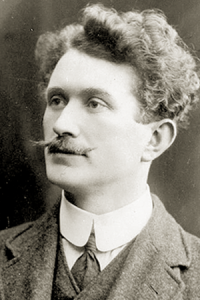
James Stephens, Irish novelist and poet, is born in Dublin on February 9, 1880.

Stephens’ mother works in the home of the Collins family of Dublin and is adopted by them. He is committed to the Meath Protestant Industrial School for Boys as a small child and spends his childhood there. He attends school with his adopted brothers Thomas and Richard before graduating as a solicitor’s clerk. He is known affectionately in school as “Tiny Tim” due to his 4’10” stature. He is much enthralled by the tales of military valour of his adoptive family and would have become a soldier if not for his height.

By the early 1900s Stephens is increasingly inclined to socialism and the Irish language and by 1912 is a dedicated Irish Republican. He is a close friend of the 1916 Easter Rising leader Thomas MacDonagh, who is then editor of The Irish Review and deputy headmaster in St. Enda’s School, the radical bilingual school run by Patrick Pearse. His growing nationalism brings a schism with his adopted family, but probably wins him his job as registrar in the National Gallery of Ireland, where he works between 1915 and 1925, having previously had an ill-paid job with the Mecredy solicitors’ firm.

Stephens produces many retellings of Irish myths and fairy tales. His retellings are marked by a rare combination of humour and lyricism. He also writes several original novels, The Crock of Gold, Etched in Moonlight and Demi-Gods, based loosely on Irish fairy tales. The Crock of Gold in particular has achieved enduring popularity and has often been reprinted.

Stephens begins his career as a poet under the tutelage of “Æ” (George William Russell). His first book of poems, Insurrections, is published in 1909. His last book, Kings and the Moon (1938), is also a volume of verse.

Stephens’s influential account of the 1916 Easter Rising, Insurrection in Dublin, describes the effect of the deaths by execution of his friend Thomas MacDonagh and others as being “like watching blood oozing from under a door.” Of MacDonagh he writes:

No person living is the worse off for having known Thomas MacDonagh, and I, at least, have never heard MacDonagh speak unkindly or even harshly of anything that lived. It has been said of him that his lyrics were epical; in a measure it is true, and it is true in the same measure that his death was epical. He was the first of the leaders who was tried and shot.

Stephens lives between Paris, London and Dublin. During the 1930s he is a friend of James Joyce, and they mistakenly believe that they share a birthday. Joyce, who is concerned about his ability to finish what later becomes Finnegans Wake, proposes that Stephens assist him, with the authorship credited to JJ & S, short “Jameses Joyce & Stephens,” but also a pun on the popular Irish whiskey made by John Jameson & Sons. The plan is never implemented, as Joyce is able to complete the work on his own.

During the last decade of Stephens’ life, he finds a new audience through a series of broadcasts on the BBC. He dies at Eversleigh on Saint Stephen’s Day, December 26, 1950.


1 Comment

Birth of Edward Martyn, Playwright & Activist

edward-martyn

Edward Martyn, Irish playwright and early republican political and cultural activist, is born in County Galway on January 30, 1859. He serves as the first president of Sinn Féin from 1905 to 1908.

Martyn is the elder son of John Martyn of Tullira Castle, Ardrahan and Annie Mary Josephine (née Smyth) of Masonbrook, Loughrea, both of County Galway. He is educated at Belvedere College, Dublin, and Wimbledon College, London, both Jesuit schools, after which he enters Christ Church, Oxford in 1877, but leaves without taking a degree in 1879. His only sibling, John, dies in 1883.

Martyn begins writing fiction and plays in the 1880s. While his own output is undistinguished, he acquires a well-earned reputation as a noted connoisseur of music, both European classical and Irish traditional. He is a fine musician in his own right, giving memorable performances for guests on an organ he has installed at Tullira. He uses his wealth to benefit Irish culture.

Martyn is reportedly pivotal in introducing William Butler Yeats and Lady Gregory to each other in 1896. The three found the Irish Literary Theatre, for whom Martyn writes his best and most popular plays, The Heather Field and A Tale of a Town. He covers the costs of the company’s first three seasons, which proves crucial to establishing the company and the future of the Abbey Theatre. He later parts ways with Yeats and Gregory, something he later regrets, but remains on warm terms with Lady Gregory until the end of his life.

Martyn is a cousin and friend to George Moore (1852–1933). The two make frequent trips all over Europe, where Moore influences Martyn’s views on modern art, which result in the latter purchasing several works by Edgar Degas, Claude Monet, Jean-Baptiste-Camille Corot and Kitagawa Utamaro, all later donated to the National Gallery of Ireland. Moore does not share Martyn’s fenian ideas nor espousal of violent means to achieve national sovereignty. Their different political opinions eventually drive their friendship apart.

Martyn is descended from Richard Óge Martyn, a leading Irish Confederate, and Oliver Óge Martyn, a Jacobite who fights in the Williamite War in Ireland. Yet by his lifetime, the family are unionists. Martyn’s outlook begins to change in the 1880s after studying Irish history, as well as living through the events of the Irish Land War. He comes out as an Irish republican when he famously refuses to allow “God Save The Queen” to be sung after a dinner party at Tullira. By this stage he is involved with the political work of Maude Gonne and Arthur Griffith and is a vocal opponent of the visit of Queen Victoria to Ireland in 1897. He also protests the visit by Edward VII in 1903, this time as chairman of the People’s Protection Committee. He is the first president of Sinn Féin from 1905 to 1908. In 1908 he resigns from the party and politics in general to concentrate on writing and his other activities.

He is on close personal terms with Thomas MacDonagh, Joseph Mary Plunkett and Patrick Pearse, and deeply mourns their executions in the aftermath of the Easter Rising. A parish hall and church that he founded at Labane, near Tullira, are burned by the Black and Tans. He supports the Anglo-Irish Treaty of 1921.

Martyn dies at Tullira on December 5, 1923, after years of ill health. Friends and family are shocked at a provision in his will that directs that his body be donated for the use of medical science and, after dissection, be buried in an unmarked pauper’s grave. The Palestrina Choir sings at his graveside. He bequeaths his papers to the Carmelites of Clarendon Street in Dublin, who subsequently misplace and lose them. Portraits of Martyn exist by, among others, John Butler Yeats and Sarah Purser. On his death the senior line of the Martyn family dies out. His property is inherited by his cousins, the Smyths of Masonbrook and Lord Hemphill. Tullira is sold by the latter forty years later changing ownership several times since.


Leave a comment

British Release of Fenian Prisoners

cuba-five

The British, in a general amnesty, release 33 Fenian prisoners on January 5, 1871. Most of these prisoners are men who have either been swept up by the British in 1865, when they suppressed the Fenian newspaper The Irish People for taking part in the Fenian Rising of March 1867, or had been rounded up after the “Smashing of the Van” rescue of Thomas J. Kelly and Timothy Deasy in September 1867.

The British penal system of the period is brutal under normal circumstances, and the Fenians receive much harsher treatment than that received by the normal inmates. Those Fenians still on the outside agitate constantly for the release of their comrades. The man most responsible for the release of 1871 is John “Amnesty” Nolan, who thus earns his sobriquet.

The names of many of the men released by William Ewart Gladstone’s government are well known to those who have studied the Irish republican movement. One of them is Jeremiah O’Donovan Rossa, as steadfast an enemy of English rule in Ireland as any who has ever lived. After Rossa’s death in the United States, his body is returned to Ireland for burial, and his funeral in 1915 includes the famous eulogy by Patrick Pearse, one of the seminal moments in the renewal of armed struggle for Irish freedom. Another Fenian released that day is John Devoy, who perhaps more than any other man keeps the struggle for Irish freedom alive among Irish exiles in America.

The British government releases the Fenians on condition that they exile themselves to the country of their choice and not return until their sentences have expired. Many chose to go to Australia, but Rossa, Devoy, John McClure, Henry Mulleda, and Charles Underwood O’Connell, who have all been imprisoned together, chose to go to the United States and ship together from Liverpool on board the Cuba. The so-called Cuba Five arrive in New York City to a hero’s welcome from the city’s large Irish community and even receive a resolution of welcome from the United States House of Representatives.

(Pictured: “The Cuba Five” – John Devoy, Jeremiah O’Donovan Rossa, Charles Underwood O’Connell, Henry Mulleda and John McClure)


Leave a comment

Birth of Thomas Davis, Founder of Young Ireland Movement

Thomas Osborne Davis, Irish writer and the chief organiser and poet laureate of the Young Ireland movement, is born in Mallow, County Cork, on October 14, 1814.

Davis is the son of a Welsh father, a surgeon in the Royal Artillery, and an Irish mother. Through his mother he is descended from the Gaelic noble family of O’Sullivan Beare. His father dies one month after his birth and his mother moves to Warrington Place near Mount Street bridge in Dublin. In 1830, they move to 67 Lower Baggot Street. He attends school in Lower Mount Street before studying at Trinity College, Dublin. He graduates in Law and receives an arts degree in 1836, before being called to the Irish Bar in 1838.

Davis gives a voice to the 19th-century foundational culture of modern Irish nationalism. Formerly it is based on the republicans of the 1790s and on the Catholic emancipation movement of Daniel O’Connell in the 1820s-30s, which has little in common with each other except for independence from Britain. Davis aims to create a common and more inclusive base for the future. He establishes The Nation newspaper with Charles Gavan Duffy and John Blake Dillon.

He writes some stirring nationalistic ballads, originally contributed to The Nation and afterwards republished as Spirit of the Nation, as well as a memoir of Curran, the Irish lawyer and orator, prefixed to an edition of his speeches, and a history of King James II‘s parliament of 1689. He has formed many literary plans which are unfinished at the time of his early death.

Davis supports O’Connell’s Repeal Association from 1840, hoping to recreate the old Parliament of Ireland. They split during a debate on the proposed new Queen’s University of Ireland, when Davis is reduced to tears by O’Connell’s superior debating skill. Davis is in favour of a university that would inclusively educate all Irish students. O’Connell and the Catholic hierarchy prefer a separate system for Catholic students within Ireland that would remain under church control.

O’Connell generally refers to his inexperienced allies as “Young Ireland,” initially as a dismissive term, that from the 1870s becomes the accepted term for nationalists inspired by Davis. He also prefers a federal arrangement with Britain in the 1840s while Davis seeks a greater degree of autonomy. Both agree that a gradual and non-violent process is the best way forward. Despite their differences, O’Connell is distraught at Davis’s early death.

Davis is a Protestant but preaches unity between Catholics and Protestants. To him, it is not blood that makes a person Irish, but the willingness to be part of the Irish nation. He is to the fore of Irish nationalist thinking and it has been noted by later nationalist notables, such as Patrick Pearse, that while Theobald Wolfe Tone laid out the basic premise that Ireland as a nation must be free, Davis is the one who built this idea up promoting the Irish identity.

He is the author of influential songs such as The West’s Awake, A Nation Once Again and In Bodenstown Churchyard. He also writes The Lament for Owen Roe O’Neill.

Thomas Davis dies from scarlet fever on September 16, 1845, at the age of thirty. He is buried in Mount Jerome Cemetery, Dublin.


Leave a comment

Death of Hunger Striker Thomas Patrick Ashe

Thomas Patrick Ashe, a member of the Gaelic League, the Irish Republican Brotherhood (IRB), and a founding member of the Irish Volunteers, dies on September 25, 1917, at Mater Misericordiae Hospital in Dublin following a hunger strike.

Ashe is born in Lispole, County Kerry, on January 12, 1885. He enters De La Salle Training College, Waterford in 1905 and begins a teaching career as principal of Corduff National School, Lusk, County Dublin, in 1908.

Ashe plays a major part in the 1916 Easter Rising outside the capital city commanding the Fingal battalion of the Irish Volunteers. He is commandant of the 5th battalion of the Dublin brigade, a force of 60–70 men engaging British forces around north County Dublin during the rising. They are armed only with a few rounds, about a dozen service rifles, a dozen Mausers, and a dozen Martini carbines. Some of Ashe’s men are armed only with a shotgun against the well-equipped army regulars.

Ashe’s battalion wins a major victory in Ashbourne, County Meath, where they engage a much larger force. They capture a significant quantity of arms and up to twenty Royal Irish Constabulary (RIC) vehicles. Eleven RIC members, including County Inspector Alexander Gray, and two volunteers are killed during the 5-1/2-hour battle. Twenty-four hours after the rising collapses, Ashe’s battalion surrenders on the orders of Patrick Pearse. On May 8, 1916, Ashe and Éamon de Valera are court-martialled and sentenced to death. The sentences are commuted to penal servitude for life. Ashe is imprisoned in Frongoch internment camp and Lewes Prison in Lewes, East Sussex, England.

De Valera, Ashe, and Thomas Hunter lead a prisoner hunger strike on May 28, 1917. With accounts of prison mistreatment appearing in the Irish press and mounting protests in Ireland, Ashe and the remaining prisoners are freed on June 18, 1917, by David Lloyd George as part of a general amnesty.

Upon his release, Ashe returns to Ireland and begins a series of speaking engagements. In August 1917, he is arrested and charged with sedition for a speech that he makes in Ballinalee, County Longford, where Michael Collins is also speaking. He is detained at the Curragh but is then transferred to Mountjoy Prison in Dublin. He is convicted and sentenced to two years hard labour. Ashe and other prisoners, including Fionán Lynch and Austin Stack, demand prisoner of war status.

On September 20, 1917, Ashe again goes on hunger strike. He dies at Mater Misericordiae Hospital on September 25, 1917, after being force fed by prison authorities. At the inquest into his death, the jury condemns the staff at the prison for the “inhuman and dangerous operation performed on the prisoner, and other acts of unfeeling and barbaric conduct.” His body lies in state at Dublin City Hall and is buried in Glasnevin Cemetery in Dublin.

The Ashe Memorial Hall built in 1928, housing the Kerry County Museum, in Tralee is named after him while Nelson Street, also in Tralee, is renamed Ashe Street. Ashe is a relative of Catherine Ashe, the paternal grandmother of American actor Gregory Peck, who emigrates to the United States in the 19th century.


Leave a comment

Birth of Robert Ballagh, Artist, Painter & Designer

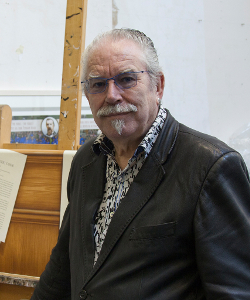
Robert “Bobby” Ballagh, artist, painter and designer, is born in Dublin on September 22, 1943. His painting style is strongly influenced by pop art. He is particularly well known for his hyperealistic renderings of well-known Irish literary, historical or establishment figures.

Ballagh grows up in a ground-floor flat on Elgin Road in Ballsbridge, the only child of a Presbyterian father and a Catholic mother. He studies at Bolton Street College of Technology and becomes an atheist while attending Blackrock College. Before turning to art as a profession, he is a professional musician with the Irish showband Chessmen. He meets artist Michael Farrell during this period, and Farrell recruits him to assist with a large mural commission, which is painted at Ardmore Studios.

Ballagh represents Ireland at the 1969 Biennale de Paris. Among the theatre sets he has designed are sets for Riverdance, I’ll Go On, Gate Theatre (1985), Samuel Beckett‘s Endgame (1991) and Oscar Wilde‘s Salomé (1998). He also designs over 70 Irish postage stamps and the last series of Irish banknotes, “Series C,” before the introduction of the euro. He is a member of Aosdána and his paintings are held in several public collections of Irish painting including the National Gallery of Ireland, the Hugh Lane Gallery, the Ulster Museum, Trinity College, Dublin, and Nuremberg‘s Albrecht Dürer House.

In 1991, he co-ordinates the 75th anniversary commemoration of the 1916 Easter Rising, during which he claims he is harassed by the Special Branch of the Garda Síochána.

He is the president of the Ireland Institute for Historical and Cultural Studies, which promotes international republicanism. It is based at the new Pearse centre at 27 Pearse Street, Dublin, which is the birthplace of Pádraig Pearse in 1879.

In July 2011 it is reported that he might consider running for the 2011 Irish Presidential election with the backing of Sinn Féin and the United Left Alliance. A Sinn Féin source confirms there has been “very informal discussions” and that Ballagh’s nomination is “a possibility” but “very loose at this stage.” However, on July 25 Ballagh rules out running in the election, saying that he has never considered being a candidate. His discussions with the parties had been about the election “in general” and he has no ambitions to run for political office.

That same month, Ballagh breaks ranks with his colleagues in the travelling production of Riverdance in their decision to perform in Israel. He is an active member of the Ireland Palestine Solidarity Campaign, which insists that artists and academics participate in boycotts of Israeli businesses and cultural institutions.

In July 2012, Ballagh says he is “ashamed and profoundly depressed” at the en masse closure of Irish galleries and museums. He cites an example of some Americans and Canadians on holiday in Ireland. “They described most of the National Gallery as being closed along with several rooms in the Hugh Lane Gallery. I’m glad they didn’t bother going out to the Museum of Modern Art in Kilmainham because that’s closed too. At the point I met them, they were returning from Galway where they had found the Nora Barnacle Museum closed too.” He condemns the hypocrisy of political leaders, saying, “I know arts funding is not a big issue for people struggling to put food on the table, but we are talking about the soul of the nation.”


Leave a comment

The Funeral of Jeremiah O’Donovan Rossa

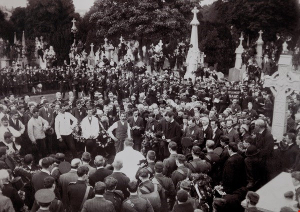
The funeral of Fenian Jeremiah O’Donovan Rossa is held before a huge crowd at Glasnevin Cemetery in Dublin on August 1, 1915.

Rossa’s body had been returned from New York City where he died June 29. He had been exiled by the British for his Fenian activities in 1871. While in exile, Rossa manages to alienate many of his former Fenian colleagues, including his good friend John Devoy, with his uncompromising advocacy of violence to end British rule in Ireland. Perhaps his attitude is due in part to the harsh treatment he receives in British prisons as well as scenes he witnesses while helping to distribute relief in his native County Cork during the Great Hunger.

In the late 1870s, he organizes the “Skirmishing Fund,” which finances the infamous Fenian dynamite campaign in England. When he dies in New York on June 29, 1915, he is estranged from most in the Irish republican movement.

Rossa’s funeral is one of the seminal events in the revival of the Irish republican movement in Ireland. During the three days when Rossa lays in the vestibule of the City Hall, encased in a coffin with a plate glass lid, thousands of citizens pass by to pay their final respects.

The coffin is conveyed from the City Hall in the four-horse bier in waiting at 2:25 PM and fifteen minutes later the cortège starts, headed by a guard of honour of the Irish Volunteers with rifles, a mounted guard being supplied by the same body. The coffin is thickly covered with wreaths and an open carriage behind is also filled with floral tokens, while many of the contingents carry wreaths to be placed on the grave.

The procession, in marching four deep at a slow pace, takes a little over fifty minutes to pass the corner of Dame Street into George’s Street. A conservative estimate of those who actually take part in the procession give the numbers as exceeding 6,000 and there must be at least ten times that number lining the streets.

The funeral comes into College Green at about 3:00 PM, headed by a body of Volunteers with the St. James’s Band. It is nearing 6:00 PM when the hearse passes through the main gates of Glasnevin Cemetery. The avenue leading to the mortuary chapel is lined by detachments of Volunteers. The prayers in the chapel are said by the Rev. D. Byrne, chaplain. Several priests then accompany the coffin to the grave, which is situated just beyond the eastern fringe of the O’Connell circle, close to the graves of two other prominent Fenians, John O’Leary and James Stephens.

Patrick Pearse gives an address at the graveside which has resounded with republicans down through the years. The final words of his oration provide them with one of their most enduring slogans, “Ireland unfree will never be at peace.”

A firing party then fires a volley, the Last Post is sounded, and wreaths are laid on the grave.


Leave a comment

Birth of Michael Joseph O’Rahilly, Republican & Nationalist

Michael Joseph O’Rahilly, Irish republican and nationalist known as The O’Rahilly, is born in BallylongfordCounty Kerry, on April 22, 1875.

O’Rahilly is educated in Clongowes Wood College. As an adult, he becomes a republican and a language enthusiast. He joins the Gaelic League and becomes a member of An Coiste Gnotha, its governing body. He is well travelled, spending at least a decade in the United States and in Europe before settling in Dublin.

O’Rahilly is a founding member of the Irish Volunteers in 1913, which is organized to work for Irish independence and resist the proposed Home Rule. He serves as the IV Director of Arms. He personally directs the first major arming of the Irish Volunteers, the landing of 900 Mausers at the Howth gun-running on July 26, 1914.

O’Rahilly is not party to the plans for the Easter Rising, nor is he a member of the Irish Republican Brotherhood (IRB), but he is one of the main people who train the Irish Volunteers for the coming fight. The planners of the Rising go to great lengths to prevent those leaders of the Volunteers who are opposed to unprovoked, unilateral action from learning that a rising is imminent, including its Chief-of-Staff Eoin MacNeillBulmer Hobson, and O’Rahilly. When Hobson discovers that an insurrection is planned, he is kidnapped by the Military Council leadership.

Learning this, O’Rahilly goes to Patrick Pearse‘s school, Scoil Éanna, on Good Friday. He barges into Pearse’s study, brandishing his revolver as he announces, “Whoever kidnaps me will have to be a quicker shot!” Pearse calms O’Rahilly, assuring him that Hobson is unharmed, and will be released after the rising begins.

O’Rahilly takes instructions from MacNeill and spends the night driving throughout the country, informing Volunteer leaders in CorkKerryTipperary, and Limerick that they are not to mobilise their forces for planned manoeuvres on Sunday.

Arriving home, O’Rahilly learns that the Rising is about to begin in Dublin on the next day, Easter Monday, April 24, 1916. Despite his efforts to prevent such action which he feels can only lead to defeat, he sets out to Liberty Hall to join Pearse, James ConnollyThomas MacDonaghTom ClarkeJoseph PlunkettCountess MarkieviczSeán Mac DiarmadaEamonn Ceannt and their Irish Volunteers and Irish Citizen Army troops. Arriving in his De Dion-Bouton motorcar, he gives one of the most quoted lines of the rising, “Well, I’ve helped to wind up the clock — I might as well hear it strike!”

O’Rahilly fights with the General Post Office (GPO) garrison during Easter Week. On Friday, April 28, with the GPO on fire, O’Rahilly volunteers to lead a party of men along a route to Williams and Woods, a factory on Great Britain Street, now Parnell Street. A British machine-gun at the intersection of Great Britain and Moore streets cuts him and several of the others down. Wounded and bleeding badly, O’Rahilly slumps into a doorway on Moore Street, but hearing the English marking his position, makes a dash across the road to find shelter in Sackville Lane, now O’Rahilly Parade. He is wounded diagonally from shoulder to hip by sustained fire from the machine-gunner.

The specific timing of O’Rahilly’s death is very difficult to pin down but understanding can be gained from his final thoughts. Despite his obvious pain, he takes the time to write a message to his wife on the back of a letter he received from his son in the GPO. It is this last message to Nancy that artist Shane Cullen etches into his limestone and bronze sculpture. The text reads:

Written after I was shot. Darling Nancy I was shot leading a rush up Moore Street and took refuge in a doorway. While I was there, I heard the men pointing out where I was and made a bolt for the laneway I am in now. I got more [than] one bullet, I think. Tons and tons of love dearie to you and the boys and to Nell and Anna. It was a good fight anyhow. Please deliver this to Nannie O’ Rahilly, 40 Herbert Park, Dublin. Goodbye Darling.


Leave a comment

Birth of Irish Politician Mary MacSwiney

Mary MacSwiney, Irish politician and educationalist, is born in London on March 27, 1872, to an Irish father and English mother. In 1927, she becomes leader of Sinn Féin when Éamon de Valera resigns from the presidency of the party.

MacSwiney returns to Ireland with her family at the age of six and is educated at St. Angela’s School in Cork. At the age of twenty, she obtains a teaching post at a private school in England and studies for a Teaching Diploma at the University of Cambridge, which is normally reserved for men.

Influenced by her younger brother Terence MacSwiney‘s staunch Irish republicanism, MacSwiney joins the Gaelic League and Inghinidhe na hÉireann. She is a founder member of Cumann na mBan when it is formed in 1914 in Cork and becomes a National Vice-President of the organisation. She leads the denunciation of British rule at the Convention of November 1914. In 1916, she is arrested and imprisoned following the Easter Rising and is also dismissed from her teaching position due to her republican activities. Several months later, upon her release from prison, she and her sister Annie re-found Scoil Íte, a sister school to Patrick Pearse‘s St. Enda’s School, and she remains involved with the school for the rest of her life.

MacSwiney supports the Irish War of Independence in 1919–21. After the death of her brother Terence in October 1920 on hunger strike during the height of the war, she is elected for Sinn Féin to the Cork Borough constituency in 1921. She gives evidence in Washington, D.C., before the American Commission on Conditions in Ireland. For nine months she and Terence’s widow, Muriel, tour the United States lecturing and giving interviews.

MacSwiney is active in her friendship with Harry Boland and de Valera, whom she cultivates assiduously. In October 1921, a second delegation is to be sent to London which for the first time includes Michael Collins. MacSwiney, who remains implacably opposed, pleads with de Valera to be allowed to go. She is refused as de Valera thinks her to be “too extreme.” She strongly opposes the Anglo-Irish Treaty, debating during December 1921 to January 1922 to resume the war. On December 21 she speaks for three hours, criticising the agreement from all angles.

MacSwiney is arrested at Nell Ryan’s home, a safe house, at 40 Herbert Park, Ballsbridge, on November 4, 1922, when it is raided by Free State soldiers. She is interned at Mountjoy Gaol and immediately goes on hunger strike. Cumann na mBan organizes vigils outside the prison in protest of Mary’s and the others internment. The Women’s Prisoner’s Defence League is formed in August 1922 to protect their rights. During the hunger strike she refuses doctor’s visits and is resigned to her death. Her condition is critical, and she is given the Last Rites by a Catholic priest. The Government is not prepared to allow strikers die, so she is released.

En route to Liam Lynch‘s funeral, MacSwiney is again arrested when the car in which she is riding is stopped and she is recognised. She is taken with Kate O’Callaghan to Kilmainham Gaol. Fearless of death, she begins another protest. They continued to be interned without charge, but it is explained she is distributing anti-government propaganda. After nineteen days of hunger strike, she is due to be released on April 30, 1923. The Governor allows O’Callaghan to go but stays a decision on MacSwiney. Most of the women on hunger strike are sent to the North Dublin Union.

MacSwiney retains her seat at the 1923 Irish general election and, along with other Sinn Féin members, refuses to enter the Dáil Éireann.

In March 1926 the party holds its Ardfheis. MacSwiney and Father Michael O’Flanagan lead the section from which Éamon de Valera and Fianna Fáil break away. De Valera has come to believe that abstentionism is not a workable tactic and now sees the need to become the elected government of the Dáil. The conference instructs a joint committee of representatives from the two sections to arrange a basis for co-operation. That day, it issues a statement declaring “the division within our ranks is a division of Republicans.” The next day, de Valera’s motion to accept the Free State Constitution, contingent upon the abolition of the Oath of Allegiance, narrowly fails by a vote of 223 to 218. However, de Valera takes the great majority of Sinn Féin support with him when he founds Fianna Fáil.

MacSwiney continues to maintain a republican position until her death. By then she is vice-president of Sinn Féin and Cumann na mBan but loses her seat at the June 1927 Irish general election. When lack of funds prevents Sinn Féin contesting the second election called that year, MacSwiney declares “no true Irish citizen can vote for any of the other parties.”

Mary MacSwiney dies at her home in Cork on March 8, 1942. Her stance, both before and after the Treaty, may be summed up by her statement, “A rebel is one who opposes lawfully constituted authority and that I have never done.”


Leave a comment

Birth of Revolutionary James Fintan Lalor

james-fintan-lalor

James Fintan Lalor, Irish revolutionary, journalist, and one of the most powerful writers of his day, is born on March 10, 1807, in Tinnakill House, Raheen, County Laois. A leading member of the Irish Confederation (Young Ireland), he plays an active part in both the Rebellion in July 1848 and the attempted Rising in September of that same year.

His father Patrick is an extensive farmer and is the first Catholic MP for Laois from 1832–1835. The household is a very political one where active discussion on national issues is encouraged.

Because of an accident when he is young, James is semi-crippled all his life. He is not a very healthy young man and consequently is educated at home. He spends some time attending college in Carlow but is forced to return home because of his health.

His father is passionately opposed to the payment of tithes and urges Catholics not to pay. James supports this stand but it is the land question and the power of the landlords to evict tenants that exercises James in particular. His father is also a great supporter of Daniel O’Connell and the Repeal movement. However, James does not support the Repeal movement as he considers it to be flawed. As a result, a rift occurs between James and his father on this question. Such is the rift that James leaves home and spends time in Belfast and Dublin. He finally returns home due to ill health and heals his differences with his father.

It is while writing from home that James achieves national prominence. His writings have a profound effect on such figures as Michael Davitt, Patrick Pearse, James Connolly, and Arthur Griffith. He contributes articles to The Nation and The Felon. He advocates rent strikes and active resistance to any wrongdoings. His central theme is the rights of the tenant farmer to his own land. In his opinion, land reform is the biggest issue of the time. He writes articles such as “What must be done,” “The Faith of a felon,” “Resistance,” and “Clearing Decks.” It is he who says it is time for revolution and active resistance. This is especially evident during famine years when tenants are being evicted for nonpayment of rent. As a result, he is arrested and imprisoned. Upon his release he continues to write. He is now a nationally acclaimed writer, revolutionary, and reformer.

Ill health once again curtails his efforts. An attack of bronchitis eventually brings about his early death on December 27, 1849, at the age of 43. He is buried in Glasnevin Cemetary in Dublin.