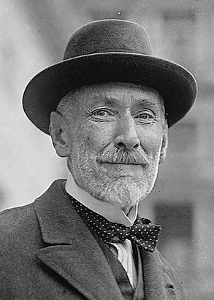
Threatened by lung trouble in 1879, Plunkett goes to the United States and spends ten years as a cattle rancher in the Bighorn Mountains of Wyoming. He returns to Ireland in 1889 and devotes himself to the agricultural cooperative movement, first organizing creameries and then, in 1894, the Irish Agricultural Organisation Society, a forerunner of similar societies in England, Wales, and Scotland. A moderate Unionist member of Parliament for South County Dublin from 1892 to 1900, he becomes vice president (1899–1907) of the new Department of Agriculture and Technical Instruction for Ireland, which he has been instrumental in creating.
Plunkett’s later experience convinces him of the need for the independence of an Ireland without partition inside the Commonwealth, and he fights strongly for this goal, as chairman of the Irish Convention (1917–18) and, in 1919, as founder of the Irish Dominion League and of the Plunkett Foundation for Cooperative Studies, an agricultural research and information centre. He is appointed to the first Senate of the Irish Free State (1922–23). His house in Dublin is bombed and burned during in the Irish Civil War and he lives in England thereafter. In 1924 the Plunkett Foundation also moves to England. In 1924 he presides over a conference in London on agricultural co-operation in the British Commonwealth and in 1925 he visits South Africa to help the movement there.
Gilbert’s family makes their residence at King House in Boyle, County Roscommon, until early 1823, when they journey to Liverpool, thence departing for India on March 14. Gilbert spends much of her childhood in India but is educated in Scotland and England. At age 19 she elopes with Lieutenant Thomas James. The couple separates five years later, and, in 1843, Gilbert launches a career as a dancer. Her London debut in June 1843 as “Lola Montez, the Spanish dancer” is disrupted when she is recognized as Mrs. James. The fiasco would probably have ended the career of anyone less beautiful and determined, but Gilbert receives additional dancing engagements throughout Europe. During her travels she reputedly forms liaisons with Franz Liszt and Alexandre Dumas, among many others.
Late in 1846, Gilbert dances in Munich and Ludwig I of Bavaria is so struck by her beauty that he offers her a castle. She accepts, becomes Baroness Rosenthal and Countess of Lansfeld, and remains as his mistress. Under Gilbert’s influence, Louis inaugurates liberal and anti-Jesuit governmental policies, but his infatuation with her helps to bring about the collapse of his regime in the revolution of 1848. In March of that year Ludwig abdicates in favour of his son. Gilbert flees to London, where in 1849 she marries Lieutenant George Heald, although she has never been divorced from James. Heald later leaves her.
From 1851 to 1853 Gilbert performs in the United States. Her third marriage, to Patrick P. Hull of San Francisco in 1853, ends in divorce soon after she moves to Grass Valley, California. There, among other amusements, she coaches young Lotta Crabtree in singing and dancing. She settles in New York City after an unsuccessful tour of Australia in 1855–1856 and gathers a following as a lecturer on such topics as fashion, gallantry, and beautiful women. An apparently genuine religious conversion leads her to take up various personal philanthropies.
Gilbert publishes Anecdotes of Love; Being a True Account of the Most Remarkable Events Connected with the History of Love; in All Ages and among All Nations (1858), The Arts of Beauty, or, Secrets of a Lady’s Toilet with Hints to Gentlemen on the Art of Fascination (1858), and Lectures of Lola Montez, Including Her Autobiography (1858). The international notoriety of her heyday persists long after her death and inspires numerous literary and balletic allusions.
Gilbert spends her last days in rescue work among women. By November 1859 she is showing the tertiary effects of syphilis, and her body begins to waste away. She dies at the age of 39 on January 17, 1861. She is buried in Green-Wood Cemetery in Brooklyn, New York.
With a reign of 63 years, seven months and two days, she is the longest-reigning British monarch and the longest-reigning queen regnant in world history until her great-great-granddaughter Elizabeth II surpasses her on September 9, 2015. She restores dignity to the English monarchy and ensures its survival as a ceremonial political institution. Edward VII accedes to the throne upon her death.
Born on May 24, 1819, in Kensington Palace, London, Victoria comes to the throne after the death of her uncle, King William IV, in 1837. As a young woman ascending to the throne, her future husband describes her “as one whose extreme obstinacy was constantly at war with her good nature.” Her first prime minister, William Lamb, 2nd Viscount Melbourne, becomes her close friend and adviser, and she succeeds in blocking his replacement by Tory leader Sir Robert Peel in 1839. Two years later, however, an election results in a Tory majority in the House of Commons, and she is compelled to accept Peel as prime minister. Never again does she interfere so directly in the politics of democratic Britain.
In 1839, her first cousin Albert, a German prince, comes to visit the English court at Windsor, and Victoria proposes to him five days after his arrival. Prince Albert accepts, and they are married in February 1840. He soon becomes the dominant influence in her life and serves as her private secretary. Among his greatest achievements as Prince Consort is his organization of The Great Exhibition of 1851, the first world’s fair, in the Crystal Palace in London. He also steers her support away from the Whigs to the conservative Tories. She later is a vocal supporter of Benjamin Disraeli, leader of the Conservative Party.
Victoria and Albert build royal residences at Osborne House on the Isle of Wight and at Balmoral Castle in Scotland and become increasingly detached from London. They have nine children, including Victoria, later the empress of Germany, and the Prince of Wales, later King Edward VII. In 1861, Albert dies, and Victoria’s grief is such that she does not appear in public for three years. She never entirely gets over the loss and, until the end of her life, has her maids nightly lay out Albert’s clothes for the next day and in the morning replace the water in the basin in his room.
Disraeli coaxes Victoria out of seclusion, and she is impressed by his efforts to strengthen and expand the British Empire. In 1876, he has her made “empress of India,” a title which pleases her and makes her a symbol of imperial unity. During the last few decades of her life, her popularity, which had suffered during her long public absence, increases greatly. She never embraces the social and technological advances of the 19th century but accepts the changes and works hard to fulfill her ceremonial duties as head of state.
Following a custom she maintains throughout her widowhood, Victoria spends the Christmas of 1900 at Osborne House on the Isle of Wight. Rheumatism in her legs has rendered her lame and her eyesight is clouded by cataracts. Through early January, she feels weak and unwell, and by mid-January she is drowsy, dazed and confused. She dies in the early evening of Tuesday, January 22, 1901, at the age of 81. Her son and successor King Edward VII, and her eldest grandson, Emperor Wilhelm II of Germany, are at her deathbed. Her favourite pet Pomeranian, Turi, is laid upon her deathbed as a last request.
Victoria’s funeral is held on Saturday, February 2, in St. George’s Chapel, Windsor Castle, and after two days of lying-in-state, she is interred beside Prince Albert in Frogmore Mausoleum at Windsor Great Park. When she dies, she has 37 surviving great-grandchildren, and their marriages with other monarchies give her the name “grandmother of Europe.”
Kuno Meyer, German scholar distinguished in the field of Celticphilology and literature, is born in Hamburg, Germany on December 20, 1858. He was considered first and foremost a lexicographer among Celtic scholars but is known by the general public in Ireland rather as the man who introduced them to Selections from Ancient Irish Poetry (1911). His brother was the distinguished classical scholar, Eduard Meyer.
Meyer then takes up the post of lecturer in Teutonic languages at the new University College, Liverpool, the precursor of the University of Liverpool, which is established three years earlier.
In 1903, Meyer founds the School of Irish Learning in Dublin, and the next year creates its journal Ériu of which he is the editor. Also in 1904, he becomes Todd Professor in the Celtic Languages at the Royal Irish Academy. In October 1911, he follows Heinrich Zimmer as Professor of Celtic Philology at Friedrich Wilhelm University in Berlin. The following year, a volume of Miscellany is presented to him by pupils and friends in honour of his election, and he is made a freeman of both Dublin and Cork.
At the outbreak of World War I, Meyer leaves Europe for the United States, where he lectures at Columbia University, University of Illinois at Urbana-Champaign, and elsewhere. A pro-German speech he gives in December 1914 to Clan na Gael on Long Island causes outrage in Britain and some factions among the Irish, and as a result, he is removed from the roll of freemen in Dublin and Cork and from his Honorary Professorship of Celtic at Liverpool. He also resigns as Director of the School of Irish Learning and editor of Ériu. Harvard University also had extended an invitation to Meyer to lecture on campus, but it subsequently cancels the invitation in the fall of 1914 on account of Meyer’s propagandist activity.
Meyer nevertheless accepts candidacy for the post of exchange professor at Harvard, at the recommendation of German professors there. However, when the April 1915 issue of The Harvard Advocate awards first prize to an anti-German satirical poem “Gott mit Uns” written by an undergraduate, Meyer sends the university and the press a letter of protest, rebuking the faculty members who served as judges for failure to exercise neutrality. Meyer also declines his candidacy from the exchange professorship in the letter. In a reply, President Abbott Lawrence Lowell says, in explaining Harvard’s policy, that freedom of speech includes pro-German and pro-Allied voices alike.
Meyer is injured in a railway collision in 1915 and meets 27-year-old Florence Lewis while he is recovering in a California hospital. They marry shortly afterwards. He returns to Germany in 1917 and dies in Leipzig on October 11, 1919.
Posthumously, in 1920, Meyer’s name is restored, both by Dublin and Cork, in their Rolls of Honorary Freemen. The restoration occurs on April 19, 1920, in Dublin, where Sinn Féin had won control of the City Council three months earlier, rescinding the decision taken in 1915 by the Irish Parliamentary Party. The restoration in Cork follows on May 14, 1920.
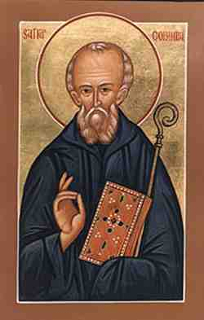
St. Columba, also called Colum or Columcille, Irish abbot and missionary Evangelist is born on December 7, 521, in Tír Chonaill (mainly modern County Donegal) in the north of Ireland. He is credited with spreading Christianity in what is today Scotland at the start of the Hiberno-Scottish mission. He also founds the important abbey on Iona, which becomes a dominant religious and political institution in the region for centuries. He is the Patron Saint of Derry and is highly regarded by both the Gaels of Dál Riata and the Picts. Today he is remembered as a Catholic saint and one of the Twelve Apostles of Ireland.
Columba studies under Saints Finnian of Movilla and Finnian of Clonard and is ordained into the priesthood around 551. He founds churches and the famous monasteries Daire Calgaich, in Derry, and Dair-magh, in Durrow.
Columba and his twelve disciples erect a church and monastery on the island of Iona (c. 563) as their springboard for the conversion of Scotland. It is regarded as the mother house and its abbots as the chief ecclesiastical rulers even of the bishops. Columba gives formal benediction and inauguration to Áedán mac Gabráin of Dunadd as king of Dál Riata.
Columba accompanies Aidan to Ireland in 575 and takes a leading role in a council held at Druim Cetta, which determines the position of the ruler of Dál Riata in relation to the king of Ireland. The last years of Columba’s life are apparently primarily spent in Iona, where he is already revered as a saint. He and his associates and successors spread the gospel more than any other contemporary group of religious pioneers in Britain.
Columba dies on Iona and is buried in 597 by his monks in the abbey he created. In 794 the Vikings descend on Iona. Columba’s relics are finally removed in 849 and divided between Scotland and Ireland. The parts of the relics which go to Ireland are reputed to be buried in Downpatrick, County Down, with St. Patrick and St. Brigid or at Saul Church neighbouring Downpatrick.
Three Latin hymns may be attributed to Columba with some degree of certainty. Excavations in 1958 and 1959 revealed Columba’s living cell and the outline of the original monastery.
St. Columba’s Feast Day, 9 June, has been designated as International Celtic Art Day. The Book of Kells and the Book of Durrow, great medieval masterpieces of Celtic art, are associated with Columba.
Columbanus is born in 543 in the Kingdom of Meath, now part of Leinster. Well-born, handsome and educated, he is torn between a desire for God and easy access to the pleasures of the world. Acting on advice of a holy anchoress, he decides to withdraw from the world. His family opposes the choice, his mother going so far as to block the door. He leaves home and studies Scripture extensively under Sinell, Abbot of Cluaninis in Lough Erne. He then moves to Bangor Abbey on the coast of Down, where Saint Comgall is serving as the abbot. He stays at Bangor until his fortieth year, when he receives Comgall’s permission to travel to the continent.
In middle age, Columbanus feels a call to missionary life. With twelve companions (Saint Attala, Columbanus the Younger, Cummain, Deicolus, Eogain, Eunan, Saint Gall, Gurgano, Libran, Lua, Sigisbert and Waldoleno) he travels to Scotland, England, and then to France in 585. The area, though nominally Christian, has fallen far from the faith, but are ready for missionaries, and they have some success. They are warmly greeted at the court of King Gontram of Burgundy, and the king invites the band to stay. They choose the half-ruined Roman fortress of Annegray in the Vosges Mountains for their new home with Columbanus as their abbot.
The simple lives and obvious holiness of the group draws disciples to join them and the sick to be healed by their prayers. Columbanus, to find solitude for prayer, often lives for long periods in a cave seven miles from the monastery, using a messenger to stay in touch with his brothers. When the number of new monks over-crowds the old fortress, King Gontram gives them the Gallo-Roman castle called Luxovium in present-day Luxeuil-les-Bains, some eight miles from Annegray, in 590. Soon after, a third house called Ad-fontanas is founded at present-day Fontaine-lès-Luxeuil. Columbanus serves as master of them all, and writes a Rule for them. It incorporates many Celtic practices, is approved by the Council of Mâcon in 627, but is superseded by the Benedictine.
Problems arise early in the 7th century. Many Frankish bishops object to a foreign missionary with so much influence, to the Celtic practices he brought, especially those related to Easter, and his independence from them. In 602 he is summoned to appear before them for judgment. Instead of appearing, he sends a letter advising them to hold more synods and to concern themselves with more important things than which rite he uses to celebrate Easter. The dispute over Easter continues for years, with Columbanus appealing to multiple popes for help. It is only settled when Columbanus abandons the Celtic calender when he moves to Italy.
In addition to his problems with the bishops, Columbanus speaks out against vice and corruption in the royal household and court, which is in the midst of a series of complex power grabs. Brunhilda of Austrasia stirs up the bishops and nobilty against the abbot. Theuderic II orders him to conform to the local ways and shut up. Columbanus refuses and is briefly imprisoned at Besançon, but he escapes and returns to Luxeuil. Theuderic II and Brunhilda send an armed force to force him and his foreign monks back to Ireland. As soon as his ship sets sail, a storm drives them back to shore. The captain takes it as a sign and sets the monks free.
They make their way to King Chlothar II at Soissons, Neustria and then the court of King Theudebert II of Austrasia in 611. Columbanus travels to Metz, France, then Mainz, Germany, where he sails up the Rhine to the lands of the Suebi and Alamanni, and finally Lake Zurich. Their evangelization work there is unsuccessful and the group passes on to Arbon, then Bregenz on Lake Constance. Saint Gall, who knows the local language best, takes the lead in this region. Many are converted to the faith and the group founds a new monastery as their home and base. However, a year later political upheaval causes Columbanus to cross the Alps into Italy, arriving in Milan in 612. The Christian royal family treats him well, and he preaches and writes against Arianism and Nestorianism. In gratitude, King Agilulf, the king of the Lombards, gives him a tract of land called Bobbio between Milan and Genoa in Italy. There he rebuilds a half-ruined church of Saint Peter, and around it he founds an abbey that is to be the source for evangelization throughout northern Italy for centuries to come.
Columbanus always enjoys being in the forests and caves, and as he walks through the woods, birds and squirrels ride on his shoulders. Toward the end of his life comes word that his old enemies are dead and his brothers want him to come back north, but he declines. Knowing that his time is almost done, he retires to his cave on the mountainside overlooking the Trebbia River. Columbanus dies of natural causes at Bobbio, Italy on November 21, 615.
Columbanus’ influence continues for centuries as those he converted hand on the faith, the brothers he taught evangelize untold numbers more, and his brother monks found over one hundred monasteries to protect learning and spread the faith.
(Pictured: Saint Columbanus stained glass window, Bobbio Abbey crypt)
In 1790 Russell resumes his military career as a junior officer in the 64th Regiment of Foot and is posted to Belfast. The French Revolution in 1789 is warmly greeted in Belfast as are its ideals of liberty, equality, and fraternity. With his keen mind and radical ideas, Russell soon becomes a confidante of Henry Joy McCracken, James Hope, Samuel Neilson and others who are to play a prominent role in the United Irish movement. With them he develops ideas of parliamentary reform, to include the bulk of the people, and Catholic emancipation.
Russell leaves the army in July 1791 and attends a convention of the Whig Club in Belfast to mark Bastille Day. The convention is addressed by William Drennan, who proposes a brotherhood promoting separation from England and co-operation with the increasingly radical Cisalpine Club in the pursuit of political and social reforms. However, Russell notes the lack of trust between Dissenters and Catholics which is due to fears that Catholic radicalism can be bought off by religious concessions. Informing Wolfe Tone of his observations, within weeks leads to Wolfe Tone’s publication of Argument on Behalf of the Catholics of Ireland to address these suspicions. The pamphlet is extremely well received and provides the impetus for the founding of the Society of United Irishmen in Belfast on October 18, 1791.
Pressure from Dublin Castle later forces the United Irish movement to become a clandestine organisation as the would-be revolutionaries seek to continue their slow progress towards challenging the occupying British.
In 1795 Russell, Andrew Henderson, Henry Joy McCracken and Samuel Neilson lead a band of United Irishmen to the top of Cavehill overlooking the town of Belfast where they swear an oath “never to desist in our effort until we have subverted the authority of England over our country and asserted her independence” prior to Wolfe Tone’s exile to the United States. The event is noted in Dublin Castle although there is no immediate move to disband or arrest the members of the United Irishmen.
In 1796, Russell publishes an ambitious and far-sighted document, Letter to the People of Ireland, which lays out his vision of social and economic reform for the Irish nation. In addition to his stance on religious freedom, he makes clear his anti-slavery views in the Northern Star on March 17, 1792.
Russell takes an active part in organising the Society of United Irishmen becoming the United Irish commander in County Down. However, the outbreak of the French Revolution in 1793 leads to an ongoing campaign against the United Irishmen and in 1796 he is arrested and imprisoned as a “state prisoner” in Dublin. In March 1799 he and the other state prisoners are transferred to Fort George in Scotland, an extensive fortress some miles north of Inverness built in the wake of the failed Jacobite rebellion of 1745-46. He is released on condition of exile to Hamburg in June 1802 following a brief cessation in the war with France.
Not content to sit things out in Hamburg, Russell soon makes his way to Paris where he meets Robert Emmet who is planning another insurrection pending the French renewal of the war against England. He agrees to return to Ireland in March 1803 to organise the North in conjunction with James Hope. However, he meets with little success as much of the north is subdued following the suppression of the Irish Rebellion of 1798 and displays little appetite for a renewed outbreak. Finally, finding some support in the vicinity of Loughinisland, he prepares to take to the field on July 23, 1803, the date set by Emmett.
However, the plan is badly thought out and quickly collapses, forcing Russell to flee to Dublin before a shot is fired in anger. He manages to hide for a number of weeks, but Dublin is a hard place in which to hide in the days following the failure of Emmett’s rebellion as the shocked authorities have launched a massive campaign of raids and arrests in an effort to finally eradicate the United Irishmen.
Thomas Russell is promptly arrested and sent to Downpatrick Gaol where he is executed by hanging then beheaded on October 21, 1803.
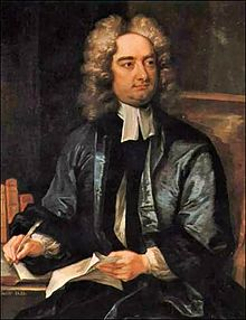
Swift is born in Dublin on November 30, 1667. His father, an attorney, also named Jonathan Swift, dies just two months before he is born. Without steady income, his mother struggles to provide for her newborn. Moreover, he is a sickly child. It is later discovered that he suffers from Ménière’s disease, a condition of the inner ear that leaves the afflicted nauseous and hard of hearing. In an effort to give her son the best upbringing possible, Swift’s mother gives him over to Godwin Swift, her late husband’s brother and a member of the respected professional attorney and judges group Gray’s Inn. Godwin Swift enrolls his nephew in the Kilkenny Grammar School (1674–1682), which is perhaps the best school in Ireland at the time. His transition from a life of poverty to a rigorous private school setting proves challenging. He does, however, make a fast friend in William Congreve, the future poet and playwright.
At age 14, Swift commences his undergraduate studies at Trinity College, Dublin. In 1686, he receives a Bachelor of Arts degree and goes on to pursue a master’s degree. Not long into his research, huge unrest breaks out in Ireland. The king of Ireland, England and Scotland is soon to be overthrown. What becomes known as the Glorious Revolution of 1688 spurs him to move to England and start anew. For 10 years, Swift works in Surrey‘s Moor Park and acts as an assistant to Sir William Temple.
During his Moor Park years, Swift met the daughter of Temple’s housekeeper, an 8-year-old named Esther Johnson. They become lovers for the rest of their lives until Johnson’s death. It is rumored that they marry in 1716, and that Swift keeps of lock of Johnson’s hair in his possession at all times.
During his decade of work for Temple, Swift returns to Ireland twice. On a trip in 1695, he takes all necessary requirements to become an ordained priest in the Anglican tradition. Under Temple’s influence, he also begins to write, first short essays and then a manuscript for a later book. Temple dies in 1699. Swift completes the task of editing and publishing Temple’s memoirs. He then leans on his priestly qualifications and finds work ministering to a pea-sized congregation just 20 miles outside of Dublin. For the next ten years, he gardens, preaches and works on the house provided to him by the church. He also returns to writing. His first political pamphlet is titled A Discourse on the Contests and Dissentions in Athens and Rome.
In 1704, Swift anonymously releases A Tale of a Tub and The Battle of the Books. Tub, although widely popular with the masses, is harshly disapproved of by the Church of England. Ostensibly, it criticizes religion, but Swift means it as a parody of pride. Nonetheless, his writings earn him a reputation in London and when the Tories come into power in 1710, they ask him to become editor of The Examiner, their official paper. After a time, he becomes fully immersed in the political landscape and begins writing some of the most cutting and well-known political pamphlets of the day, including The Conduct of the Allies, an attack on the Whigs. Privy to the inner circle of Tory government, he lays out his private thoughts and feelings in a stream of letters to his beloved Stella. They are later published as The Journal to Stella.
When he sees that the Tories will soon fall from power, Swift returns to Ireland. In 1713, he takes the post of dean at St. Patrick’s Cathedral in Dublin. While leading his congregation at St. Patrick’s, he begins to write what would become his best-known work. In 1726, at last finished with the manuscript, he travels to London and benefits from the help of several friends, who anonymously publish it as Travels into Several Remote Nations of the World, in Four Parts. By Lemuel Gulliver, First a Surgeon, and then a Captain of Several Ships, more simply known as Gulliver’s Travels. The book is an immediate success and has not been out of print since its first run.
Not long after the celebration of this work, Swift’s longtime love, Esther Johnson, falls ill. She dies in January 1728. Her death moves Swift to write The Death of Mrs. Johnson.
In 1742, Swift suffers a stroke and loses the ability to speak. On October 19, 1745, Jonathan Swift dies. He is laid to rest next to Esther Johnson inside Dublin’s St. Patrick’s Cathedral.
Williams becomes a member of the Young Ireland movement and contributes poetry to The Nation under the pseudonym “Shamrock.” He is immediately successful. In the January 21, 1843 edition there appears: “Shamrock is a jewel. He cannot write too often. His verses are full of vigour, and as natural as the harp of Tara.”
Later in 1843 Williams goes to Dublin to study medicine at Saint Vincent’s Hospital. In 1848 he brings out a newspaper, the Irish Tribune, to take the place of the suppressed United Irishman, founded by John Mitchel. Before the sixth weekly publication, it is seized by the Government, and proceedings are instituted against the editors, Williams and his friend Kevin Izod O’Doherty. On October 30, 1848, at a third trial, O’Doherty is convicted of treason and transported to Australia while Williams is successfully defended by lawyer and fellow poet Samuel Ferguson two days afterwards on the same charge. He then resumes his medical studies, takes out his degree at Edinburgh, Scotland in 1849 and emigrates to the United States in 1851.
Williams is married to Elizabeth Connolly on September 8, 1856, with whom he has four children of whom the youngest is commemorated in Lines on the Death of his Infant Daughter, Katie.
In the United States Williams practises medicine until he becomes ill and dies of tuberculosis in Thibodaux, Louisiana on July 5, 1862. He is buried there in St. Joseph’s Cemetery. His headstone is later erected that year by Irish members of the 8th New Hampshire Volunteer Infantry, then encamped in Thibodaux.
Burke’s parents, though in moderate circumstances, gave him a good education. He studies at first under the care of the Patrician Brothers and is afterwards sent to a private school. An attack of typhoid fever when he is fourteen years old, and the famine year of 1847 have a sobering effect. Toward the end of that year, he asks to be received into the Order of Preachers and is sent to Perugia in Italy to make his novitiate. On December 29, he is clothed there in the habit of St. Dominic and receives the name of Thomas.
Shortly afterward Burke is sent to Rome to begin his studies at the College of St. Thomas, the future Pontifical University of Saint Thomas Aquinas, where he is a student of philosophy and theology. He passes thence to the Roman convent of Santa Sabina. His superiors send him, while yet a student, as novice-master to Woodchester, the novitiate of the resuscitated English Province. He is ordained into the priesthood on March 26, 1853. On August 3, 1854, he defends publicly the theses in universâ theologiâ. He is made lector at the College of St. Thomas in 1854.
Early in the following year Burke is recalled to Ireland to found the novitiate of the Irish Province at Tallaght, near Dublin. In 1859 he preaches his first notable sermon on “Church Music.” It immediately lifts him into fame.
Elected Prior of Tallaght in 1863, Burke goes to Rome the following year as Rector of the Dominican Convent of San Clemente and attracts great attention by his preaching. He returns to Ireland in 1867 and delivers his oration on Daniel O’Connell at Glasnevin before fifty thousand people.
Bishop Leahy takes him as his theologian to the First Vatican Council in 1870, and the following year he is sent as Visitor to the Dominican convents in America. He is besieged with invitations to preach and lecture. The seats are filled hours before he appears, and his audiences overflow the churches and halls in which he lectures. In New York City he delivers the discourses in refutation of the English historian James Anthony Froude.
In an eighteen-month period Burke gives four hundred lectures, exclusive of sermons, with the proceeds amounting to nearly $400,000. His mission is a triumph, but the triumph is dearly won. When he arrives in Ireland on March 7, 1873, he is spent and broken.
During the next decade Burke preaches in Ireland, England, and Scotland. He begins the erection of the church in Tallaght in 1883, and the following May preaches a series of sermons in the new Dominican church, London. In June he returns to Tallaght in a dying condition and preaches his last sermon in the Jesuit church, Dublin, in aid of the starving children of Donegal. A few days afterwards, on July 2, 1882, he dies. He is buried in the church of Tallaght, now a memorial to him.
(Pictured: Statue of Thomas Nicholas Burke by John Francis Kavanagh by Nimmo’s Pier in Galway)