seamus dubhghaill

Promoting Irish Culture and History from Little Rock, Arkansas, USA


Leave a comment

Brian Cowen Resigns as Fianna Fáil Leader

Taoiseach Brian Cowen resigns as leader of the ruling Fianna Fáil party on January 22, 2011. Having won a secret leadership ballot on Tuesday, January 18, during a week of political turmoil, he says he will remain at the head of government until the upcoming election on March 11, 2011.

Cowen has seen his ratings plummet amid Ireland’s economic crisis and its bailout by the European Union (EU) and International Monetary Fund (IMF).

“I’m concerned that renewed internal criticism of Fianna Fáil is deflecting attention from this important debate,” Cowen says. “Therefore, taking everything into account after discussing the matter with my family I have taken on my own counsel, the decision to step down.”

Cowen says he spoke to John Gormley, leader of the junior coalition party, the Green Party, before making the announcement. He says his resignation will not affect government business.

“My political assessment is that this is the right thing to do for the party,” Cowen says at a press conference at the Merrion Hotel in central Dublin. “But it’s about me directing my attention to the country.”

During the past week, six ministers resigned, and Cowen’s cabinet reshuffle collapsed, prompting a Green Party threat to pull out of the coalition government.

“I believe that it was my duty to put in place the best possible team we could to fight this election to put them on the frontbench and into position,” Cowen says. “It was not a cynical view by me, it was a political act.”

Opposition parties demand Cowen set a new date for the general election. The Fine Gael leader, Enda Kenny, says he would move a motion of no confidence in Cowen as Taoiseach in the Dáil on Tuesday, January 25, unless he goes to the president to seek a dissolution of parliament. He says his party will also vote against the government in upcoming motion of confidence previously put forward by the Labour Party.

The Labour Party leader, Eamon Gilmore, says the Irish people do not want the government to remain in office another day. “It is simply not tenable for Cowen to remain on as Taoiseach as his colleagues in Fianna Fáil squabble over the remnants of their party,” he says.

The Sinn Féin president, Gerry Adams, says Cowen’s decision will lead to further instability. “The government and Fianna Fáil are in chaos. Their focus is not on the problems facing the country,” he says.

(From: “Irish prime minister Brian Cowen resigns as party leader” by David Batty, The Guardian, http://www.theguardian.com, January 22, 2011)


Leave a comment

Sinn Féin MPs Enter the House of Commons

On January 21, 2002, Sinn Féin‘s four MPs take the historic step of signing up to use the facilities of the House of Commons, whose authority over Northern Ireland republicans have been fighting for almost a century. Party policy is also changed to allow MPs to sit in the Irish Parliament, the Dáil.

Amid concern among some republicans that the move comes close to recognising British rule, Sinn Féin president and Belfast West MP, Gerry Adams, insists that his party will never take its seats at Westminster. “There will never ever be Sinn Féin MPs sitting in the British houses of parliament,” he tells a Westminster press conference.

David Trimble, the Ulster Unionist Party (UUP) Northern Ireland First Minister, predicts this controversial move is a first step towards the same situation in Westminster.

However, flanked by his three fellow Sinn Féin MPs, Martin McGuinness (Mid Ulster), Pat Doherty (West Tyrone) and Michelle Gildernew (Fermanagh and South Tyrone), Adams says taking up seats in the Dáil is a very different proposition from doing so the Commons. No Sinn Féin member would take the loyalty oath to the Queen, needed to take up a seat in Parliament, but that was a mere side issue to the key question of sovereignty, he says. Even if the oath were amended, the party would still refuse to take its seats because republicans do not recognise parliament’s jurisdiction over Northern Ireland.

“There are lots of things which there can be no certainty of and there are some things of which we can be certain,” Adams says. “There will never, ever be Sinn Féin MPs sitting in the British Houses of Parliament. The transfer of power by London and Dublin to the Assembly in the north … is all proof of where we see the political centre of gravity on the island of Ireland and that is in the island of Ireland.”

Adams insists his party’s presence in the Commons is a “temporary” measure until they can join the parliament of a united Ireland.

A ban on MPs using Commons facilities without taking the loyalty oath was lifted in December 2001 to Conservative fury. Tories end three decades of cross-party cooperation over the move, which also entitles Sinn Féin’s four MPs to allowances of £107,000 a year each.

Shadow Secretary of State for Northern Ireland Quentin Davies claims Adams plans to use the cash for party political campaigning – something forbidden by Westminster rules. He accuses British Prime Minister Tony Blair of “deliberately contributing to a great propaganda coup in which … the British Government are licking their boots.” The Prime Minister’s spokesman says Blair acknowledges “many victims do feel very strongly about what has happened, but the Prime Minister’s view is that this peace process has saved many lives.”

Sitting alongside a giant Irish tricolour inside his new office, Adams likens his presence there to that of MPs who had served in the British Army and intelligence services – suggesting some of them still do. He also dismisses concerns about the misuse of the money, accusing those “complaining loudest” of being from parties “indicted for corruption and sleaze.”

Sinn Féin’s move into their new offices coincides with a “routine” meeting with the Prime Minister in Downing Street to discuss the peace process. The Sinn Féin president uses publicity surrounding the controversial move to issue a new challenge to Blair to tackle the loyalist “killing campaign.” Adams is joined in Downing Street by his three fellow Sinn Féin MPs.

“There have been 300 bombs over the last nine or ten months,” Adams says. “The British Prime Minister has to face up to the reality that the threat to the peace process within Northern Ireland comes from within loyalism.”

Adams blames Betty Boothroyd‘s decision to bar Sinn Féin MPs from using Commons facilities for the current controversy. “We are here, elected, with our mandate renewed and increased,” he adds.

Adams is asked how he would react if he met former Cabinet minister Lord Tebbit and his wife, who was badly injured by the 1984 Provisional Irish Republican Army (IRA) bomb attack at the Tories conference at the Grand Brighton Hotel in Brighton, at the Commons. “I don’t ignore anyone. As someone who has been wounded and shot and someone whose house has been bombed, I understand precisely how others who have suffered more than me feel about all of this,” Adams replies. “I would like to think that as part of building a peace process that all of us agree there must be dialogue.”

(Pictured: from left, Sinn Fein MPs Michelle Gildernew, Martin McGuinness, Gerry Adams and Pat Doherty)


Leave a comment

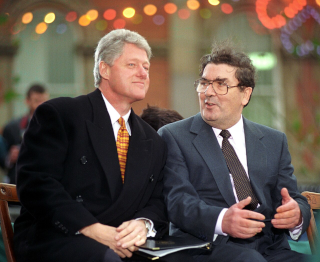
Birth of John Hume, Northern Ireland Nationalist Politician

John Hume KCSG, Irish nationalist politician from Northern Ireland, is born into a working-class Catholic family in Derry, County Londonderry, on January 18, 1937. He is widely regarded as one of the most important figures in the recent political history of Ireland and is credited as being the thinker behind many political developments in Northern Ireland, from the power sharing Sunningdale Agreement to the Anglo-Irish Agreement and the Good Friday Agreement. He wins the Nobel Peace Prize in 1998 alongside the leader of the Ulster Unionist Party (UUP), David Trimble.

Hume is the eldest of seven children of Samuel Hume, a former soldier and shipyard worker, and Anne “Annie” (née Doherty), a seamstress. He has a mostly Irish Catholic background, though his surname derives from one of his great-grandfathers, a Scottish Presbyterian who migrated to County Donegal. He attends St. Columb’s College and goes on to St. Patrick’s College, Maynooth, the leading Catholic seminary in Ireland and a recognised college of the National University of Ireland, where he intends to study for the priesthood. Among his teachers is Tomás Ó Fiaich, the future cardinal and Primate of All Ireland.

Hume does not complete his clerical studies but does obtain an M.A. degree in French and history from the college in 1958. He then returns home to his native Derry, where he becomes a teacher at his alma mater, St. Columb’s College. He is a founding member of the Credit Union movement in the city and is chair of the University for Derry Committee in 1965, an unsuccessful fight to have Northern Ireland’s second university established in Derry in the mid-1960s.

Hume becomes the youngest ever President of the Irish League of Credit Unions at age 27. He serves in the role from 1964 to 1968. He once says that “all the things I’ve been doing, it’s the thing I’m proudest of because no movement has done more good for the people of Ireland, north and south, than the credit union movement.”

Hume becomes a leading figure in the civil rights movement in the late 1960s along with people such as Hugh Logue. He is a prominent figure in the Derry Citizens’ Action Committee. The DCAC is set up in the wake of the October 5, 1968, march through Derry which had caused much attention to be drawn towards the situation in Northern Ireland. The purpose of the DCAC is to make use of the publicity surrounding recent events to bring to light grievances in Derry that had been suppressed by the Unionist Government for years. The DCAC, unlike the Northern Ireland Civil Rights Association (NICRA), is aimed specifically at a local campaign, improving the situation in Derry for everyone, and maintaining a peaceful stance. The committee also has a Stewards Association that is there to prevent any violence at marches or sit-downs.

Hume becomes an Independent Nationalist member of the Parliament of Northern Ireland in 1969 at the height of the civil rights campaign. He is elected to the Northern Ireland Assembly in 1973 and serves as Minister of Commerce in the short-lived power-sharing Executive in 1974. He stands unsuccessfully for the Westminster Parliament for the Londonderry constituency in October 1974, and is elected for Foyle in 1983.

In October 1971, Hume joins four Westminster MPs in a 48-hour hunger strike to protest at the internment without trial of hundreds of suspected Irish republicans. State papers that have been released under the 30-year rule that an Irish diplomat eight years later in 1979 believes Hume supported the return of internment.

In 1977, Hume challenges a regulation under the Civil Authorities (Special Powers) Act (Northern Ireland) 1922 which allows any soldier to disperse an assembly of three or more people. The Lord Chief Justice of Northern Ireland, Robert Lowry, holds that the regulation is ultra vires under Section 4 of the Government of Ireland Act 1920 which forbids the Parliament of Northern Ireland to make laws in respect of the army.

A founding member of the Social Democratic and Labour Party (SDLP), Hume succeeds Gerry Fitt as its leader in 1979. He also serves as one of Northern Ireland’s three Members of the European Parliament and serves on the faculty of Boston College, from which he receives an honorary degree in 1995.

Hume is directly involved in secret talks with the British government and Sinn Féin, in an effort to bring Sinn Féin to the discussion table openly. The talks are speculated to lead directly to the Anglo-Irish Agreement in 1985.

The vast majority of unionists reject the agreement and stage a massive and peaceful public rally in Belfast City Centre to demonstrate their distaste. Many Republicans and nationalists also reject it, as they see it as not going far enough. Hume, however, continues dialogue with both governments and Sinn Féin. The “Hume–Adams process” eventually delivers the 1994 Irish Republican Army (IRA) ceasefire which ultimately provides the relatively peaceful backdrop against which the Good Friday agreement is brokered.

On February 4, 2004, Hume announces his complete retirement from politics and is succeeded by Mark Durkan as SDLP leader. He does not contest the 2004 European Parliament election where his seat is won by Bairbre de Brún of Sinn Féin, nor does he run in the 2005 United Kingdom general election, in which Mark Durkan retains the Foyle constituency for the SDLP.

Hume and his wife, Pat, continue to be active in promoting European integration, issues around global poverty and the Credit Union movement. He is also a supporter of the Campaign for the Establishment of a United Nations Parliamentary Assembly, an organisation which campaigns for democratic reformation of the United Nations.

In 2015, Hume is diagnosed with Alzheimer’s disease, of which he had first displayed symptoms in the late 1990s. He dies in the early hours of August 3, 2020, at a nursing home in Derry, at the age of 83. On his death, former Labour Party leader and prime minister Tony Blair says, “John Hume was a political titan; a visionary who refused to believe the future had to be the same as the past.” The Dalai Lama says on Twitter, “John Hume’s deep conviction in the power of dialogue and negotiations to resolve conflict was unwavering… It was his leadership and his faith in the power of negotiations that enabled the 1998 Good Friday Agreement to be reached. His steady persistence set an example for us all to follow.”

(Pictured: John Hume with U.S. President Bill Clinton in 1995)


Leave a comment

Proportional Representation Used in Ireland for the First Time

Proportional Representation (PR), specifically the Single Transferable Vote (STV), is used in Ireland for the first time in the local elections on January 15, 1920.

The STV, sometimes known as Proportional Ranked Choice Voting (P-RCV), is a multi-winner electoral system in which each voter casts a single vote in the form of a ranked-choice ballot. Voters have the option to rank candidates, and their vote may be transferred according to alternate preferences if their preferred candidate is eliminated or elected with surplus votes, so that their vote is used to elect someone they prefer over others in the running. STV aims to approach Proportional Representation based on votes cast in the district where it is used, so that each vote is worth about the same as another. Formally, STV satisfies a fairness criterion known as proportionality for solid coalitions.

Under STV, no one party or voting bloc can take all the seats in a district unless the number of seats in the district is very small or almost all the votes cast are cast for one party’s candidates, which is seldom the case. This makes it different from other district voting systems. In majoritarian or plurality systems – such as first-past-the-post (FPTP), instant-runoff voting (IRV; also known as the alternative vote), block voting, and ranked-vote block voting – one party or voting bloc can take all the seats in a district.

The key to STV’s approximation of proportionality is that each voter effectively only casts a single vote in a district contest electing multiple winners, while the ranked ballots (and sufficiently large districts) allow the results to approach proportionality. The use of a quota means that, for the most part, each successful candidate is elected with the same number of votes. This equality produces fairness – a party taking twice the votes than another party will take twice the seats compared to that other party.

Under STV, multiple winners are selected for a constituency (a multi-member district). Every sizeable group within the district wins at least one seat: the more seats the district has, the smaller the size of the group needed to elect a member. In this way, STV provides approximately proportional representation, ensuring that substantial minority factions have some representation.

STV is distinguished from plurality voting systems, like FPTP, plurality block voting and the single non-transferable vote (SNTV) by the fact that votes are transferable under STV but are not under the other systems. STV reduces the number of “wasted” votes, votes which are cast for unsuccessful candidates by electing multiple representatives for a district. Additionally, surplus votes collected by successful candidates are transferred to aid other candidates, preventing waste caused by successful candidates receiving votes over and above those actually needed to secure the seat.

An important characteristic of STV is that it enables votes to be cast for individual candidates rather than for parties. Party lists are therefore not needed, as opposed to many other proportional electoral systems). It is the voters who create their own ordered list of candidates. The ranked voting also allows voters to form consensus behind the most popular candidates.

In the 1921 Northern Ireland general elections, when PR is used, every seat is contested. However, after Northern Ireland reverts to the first-past-the-post (FPTP) system, numerous seats go uncontested by nationalists who know they have no chance of winning seats. In the 1933 Northern Ireland general election, fought under the British first-past-the-post system, only 19 of 52 seats are contested. Gerrymandered voting districts plus first-past-the-post see Unionists gain 36 of 52 seats in the election. This can be contrasted with the 1920 Irish local elections when Sinn Féin wins control of 10 of 12 urban councils.


Leave a comment

Birth of Michelle O’Neill, Vice President of Sinn Féin

Michelle O’Neill (née Doris), Irish politician who serves as deputy First Minister of Northern Ireland between 2020 and 2022, is born in Fermoy, County Cork, Republic of Ireland, on January 10, 1977. She has been serving as Vice President of Sinn Féin since 2018 and is the Member of the Legislative Assembly (MLA) for Mid Ulster since 2007.

O’Neill comes from an Irish republican family in Clonoe, County Tyrone, Northern Ireland. Her father, Brendan Doris, was a Provisional Irish Republican Army (IRA) prisoner and Sinn Féin councillor. Her uncle, Paul Doris, is a former national president of the Irish Northern Aid Committee (NORAID). A cousin, Tony Doris, was one of three IRA members killed by the British Army‘s Special Air Service (SAS) in the Coagh ambush in 1991. Another cousin, IRA volunteer Gareth Malachy Doris, was shot and wounded during the 1997 Coalisland attack.

After the death of Brendan Doris in 2006, Martin McGuinness pays tribute to the Doris family as “a well-known and respected republican family [who] have played a significant role in the republican struggle for many years.”

O’Neill attends St. Patrick’s Girls’ Academy, a Catholic grammar school in Dungannon, County Tyrone. She subsequently begins to train as an accounting technician, before pursuing a political career.

O’Neill becomes involved in republican politics in her teens, assisting her father with constituency work in his role as a Dungannon councillor. She joins Sinn Féin after the Good Friday Agreement in 1998, at the age of 21, and starts working as an advisor to Francie Molloy in the Northern Ireland Assembly, holding this role until 2005.

O’Neill serves on the Dungannon and South Tyrone Borough Council from 2005 to 2011. She serves as the first female Mayor of Dungannon and South Tyrone from 2010 to 2011. In the 2007 Northern Ireland Assembly election she is elected to represent Mid Ulster in the Northern Ireland Assembly. In 2011, she is appointed to the Northern Ireland Executive by deputy First Minister Martin McGuinness as Minister for Agriculture and Rural Development. In 2016, she is promoted to Minister of Health. In January 2020, she becomes deputy First Minister of Northern Ireland after the New Decade, New Approach (NDNA) agreement restores the power sharing executive.

O’Neill automatically relinquishes her office following Paul Givan‘s resignation as first minister on February 3, 2022. Sinn Féin becomes the largest party after the 2022 Northern Ireland Assembly election, putting O’Neill in line to become the First Minister of Northern Ireland, and the Democratic Unionist Party (DUP) leader to become the deputy First Minister of Northern Ireland. However, she remains to be officially sworn in as First Minister because, as part of its opposition to the Northern Ireland Protocol, the DUP has refused to nominate a deputy First minister and there is therefore no functioning executive of Northern Ireland.

In August 2022, O’Neill is asked in a BBC interview whether it was right during the Troubles for the Provisional IRA “to engage in violent resistance to British rule.” She is criticised for her response, “I think at the time there was no alternative, but now thankfully we have an alternative to conflict, and that is the Good Friday Agreement – that is why it’s so precious to us all.”

In May 2023, O’Neill attends the coronation of King Charles, saying, “Well obviously I wanted to be here. We live in changing times, and it was the respectful thing to do, to show respect and to be here for all those people at home, who I had said I would be a first minister for all. Attendance here is about honouring that and fulfilling my promise.”

Under O’Neill’s leadership, Sinn Fein has led most opinion polls for the next United Kingdom general election.


Leave a comment

Death of Seán MacEntee, Fianna Fáil Politician

Seán Francis MacEntee (Irish: Seán Mac an tSaoi), Fianna Fáil politician, dies on January 9, 1984, in Booterstown, Dublin. He serves as Tánaiste (1959-65), Minister for Social Welfare (1957-61), Minister for Health (1957-65), Minister for Local Government and Public Health (1941-48), Minister for Industry and Commerce (1939-41), and Minister for Finance (1932-39 and 1951-54). He serves as a Teachta Dála (TD) from 1918 to 1969. At the time of his death, he is the last surviving member of the First Dáil.

MacEntee is born as John McEntee at 47 King Street, Belfast, on August 23, 1889, the son of James McEntee, a publican, and his wife, Mary Owens, both of whom are from Monaghan. James McEntee is a prominent Nationalist member of Belfast Corporation and a close friend of Joseph Devlin MP.

MacEntee is educated at St. Mary’s Christian Brothers’ Grammar School, St. Malachy’s College and the Belfast Municipal College of Technology where he qualifies as an electrical engineer. His early political involvement is with the Irish Socialist Republican Party in Belfast. He quickly rises through the ranks of the trade union movement becoming junior representative in the city’s shipyards. Following his education, he works as an engineer in Dundalk, County Louth, and is involved in the establishment of a local corps of the Irish Volunteers in the town. He mobilises in Dundalk and fights in the General Post Office garrison in the Easter Rising in 1916. He is sentenced to death for his part in the rising. This sentence is later commuted to life imprisonment. He is released in the general amnesty in 1917 and is later elected a member of the National Executives of both Sinn Féin and the Irish Volunteers in October 1917. He is later elected Sinn Féin Member of Parliament (MP) for South Monaghan at the 1918 Irish general election.

An attempt to develop MacEntee’s career as a consulting engineer in Belfast is interrupted by the Irish War of Independence in 1919. He serves as Vice-Commandant of the Belfast Brigade of the Irish Republican Army (IRA). He is also a member of the Volunteer Executive, a sort of Cabinet and Directory for the Minister for Defence and the HQ Staff, however, he remains one of the few Sinn Féiners from the north. On August 6, 1920, he presents ‘a Memorial’ lecture to the Dáil from the Belfast Corporation. He tells the Dáil it is the only custodian of public order, that a Nationalist pogrom is taking place, and he advises them to fight Belfast. The Dáil government’s policy is dubbed Hibernia Irredenta or “Greening Ireland.” He is asked to resign his South Monaghan seat after voting against a bunting celebration in Lurgan to mark the signing of the Anglo-Irish Treaty.

In April 1921 MacEntee is transferred to Dublin to direct a special anti-partition campaign in connection with the May general election. It remains Michael Collins‘s policy, he declares, that the largely Protestant shipyard workers of Belfast are being directed by the British, urging all Irishmen to rejoin the Republic. Correspondingly the Ulster Unionist Council rejects the call for a review of the boundary commission decision made on Northern Ireland. But when Ulstermen choose James Craig as Premier, Collins denounces democracy in the north as a sham. It is on the partition of Ireland issue that MacEntee votes against the Anglo-Irish Treaty of 1921. During the subsequent Irish Civil War, he commands the IRA unit in Marlboro Street Post Office in Dublin. He later fights with Cathal Brugha in the Hamman Hotel and is subsequently interned in Kilmainham and Gormanstown until December 1923.

After his release from prison, MacEntee devotes himself more fully to his engineering practice, although he unsuccessfully contests the Dublin County by-election of 1924. He becomes a founder-member of Fianna Fáil in 1926 and is eventually elected a TD for Dublin County at the June 1927 Irish general election.

MacEntee founds the Association of Patent Agents in 1929, having gained his interest in Patents when he worked as an assistant engineer in Dundalk Urban District Council. He values his status as a Patent Agent as he maintains his name on the Register for over 30 years while he holds Ministerial rank in the Irish Government, although he is not believed to have taken any active part in the patent business, which is carried on by his business partners.

In 1932, Fianna Fáil comes to power for the very first time, with MacEntee becoming Minister for Finance. In keeping with the party’s protectionist economic policies his first budget in March of that year sees the introduction of new duties on 43 imports, many of them coming from Britain. This sees retaliation from the British government, which in turn provokes a response from the Irish government. This is the beginning of the Anglo-Irish Trade War between the two nations, however, a treaty in 1938, signed by MacEntee and other senior members brings an end to the issue.

In 1939, World War II breaks out and a cabinet reshuffle results in MacEntee being appointed as Minister for Industry and Commerce, taking over from his rival Seán Lemass. During his tenure at this department, he introduces the important Trade Union Act (1941). In 1941, another reshuffle of ministers takes place, with him becoming Minister for Local Government and Public Health. The Health portfolio is transferred to a new Department of Health in 1947. Following the 1948 Irish general election, Fianna Fáil returns to the opposition benches for the first time in sixteen years.

In 1951, Fianna Fáil are back in government, although in minority status, depending on independent deputies for survival. MacEntee once again returns to the position of Minister for Finance where he feels it is vital to deal with the balance of payments deficit. He brings in a harsh budget in 1951 which raises income tax and tariffs on imports. His chief aim is to cut spending and reduce imports, however, this comes at a cost as unemployment increases sharply. The increases are retained in his next two budgets in 1952 and 1953. It is often said that it is his performance during this period that costs Fianna Fáil the general election in 1954. The poor grasp on economics also does his political career tremendous damage as up to that point he is seen as a likely successor as Taoiseach. Seán Lemass, however, is now firmly seen as the “heir apparent.”

In 1957, Fianna Fáil returns to power with an overall majority with MacEntee being appointed Minister for Health. The financial and economic portfolios are dominated by Lemass and other like-minded ministers who want to move away from protection to free trade. He is credited during this period with the reorganisation of the health services, the establishment of separate departments of health and social welfare, and the fluoridation of water supplies in Ireland. In 1959, he becomes Tánaiste when Seán Lemass is elected Taoiseach.

Following the 1965 Irish general election, MacEntee is 76 years old and retires from the government. He re-emerges in 1966 to launch a verbal attack on Seán Lemass for deciding to step down as party leader and Taoiseach. The two men, however, patch up their differences shortly afterwards. MacEntee retires from Dáil Éireann in 1969 at the age of 80, making him the oldest TD in Irish history.

MacEntee dies in Dublin on January 9, 1984, at the age of 94. He is buried in Glasnevin Cemetery, Dublin.


Leave a comment

Storm Frank Causes Widespread Flooding

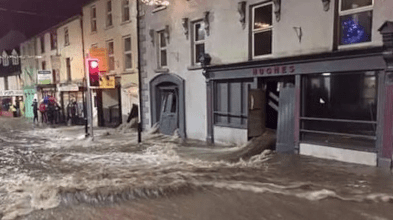
Clean-up operations are underway around Ireland on Wednesday, December 30, 2015, in the wake of Storm Frank, which causes widespread flooding following its landfall in western areas on Tuesday, December 29. Thousands of households and businesses are left without electricity in many areas of the country.

A Met Éireann status orange wind warning is lifted at 2:00 p.m. on Wednesday although the forecasts caution that severe winds of 65-80 km/h and gusts of up 130 km/h are still expected. While the heaviest rainfall from the storm falls overnight, many rivers and lakes have yet to peak meaning further flooding is possible.

According to an ESB Networks spokesman, 7,500 homes are without power in the afternoon, down from the overnight total of 13,000. He says repair crews are working to restore power to those cut off. The biggest single outage overnight is around Bandon and Fermoy in County Cork where 4,000 homes are without power, although it has been restored to almost all homes by the afternoon of December 30.

At 2:00 p.m. on Wednesday, the worst affected areas are County Wicklow with 1,200 houses without power, Macroom in County Cork where 600 are without power and Athlone where 500 homes are cut off. Around 500 homes in Naas, County Kildare, are without power as are 350 houses in Skerries in north County Dublin. It is hoped that power will be restored to all customers by the evening.

County Cork appears to be the worst affected by the storm where 60 mms (almost three inches) of rain falls since the morning of December 29. The threat of further flooding in Cork remains as the ESB increases the flow of water through the Inniscarra Dam to 250 cumecs (cubic metres per second) between 9:00 a.m. and midday which leads to increased flooding downstream. This is higher than the level of flow (180 cumecs) the previous and between December 6 and 12 along the River Lee following Storm Desmond.

Cork County manager Tim Lucey says there has been “extensive flooding” across a range of areas, but that Midleton and Bandon are worst hit with some 90 properties affected in each of the towns. He tells RTÉ Radio that one positive is the fact flood defences in Mallow and Fermoy have done their job. He notes that some five feet of water has built up behind a flood barrier in Mallow and this indicates the damage that could have been done to the town.

South Galway bears the brunt of flooding in the west, with river gauges expected to rise further over the coming days. Overnight rainfall is not as heavy as anticipated in the west, but several properties succumb to the waters. Up to 30 families in the south Galway area are forced to stay with relatives, with several being accommodated in hotels by Galway County Council, as floodwaters cut off access routes to their homes.

In Mayo, the area around the Neale remains underwater and a number of minor roads and thousands of acres of farmland are also affected. With rain continuing to fall across the west, conditions are expected to remain critical over the next few days.

The N11 between Rosslare and Dublin, the N25 from Cork to Waterford, the N71 between Cork and Killarney and the N4 between Dublin and Sligo all have diversions in place. The N25 is closed overnight between Killeagh and Castlemartyr in County Cork due to flooding. The N71 Cork/Bandon Road is also closed overnight at the viaduct due to flooding. There is severe flooding on the N40 South Ring Rd. at J6 Kinsale, particularly on the westbound off-ramp. The N11 Dublin/Wexford Road is impassable through Enniscorthy and also at Kyle’s Cross near Oylegate. The N4 is closed eastbound at Ballynafid in County Westmeath due to flooding. There are also several road closures in Kerry, Waterford and Tipperary.

Midleton is also hit by severe flooding as water levels in the Owenacurra River rise dramatically with up to 30 families having to be evacuated from their homes. Macroom in mid-Cork is also flooded for the first time during the year. Bandon is put on red alert by Cork County Council’s early warning system. Traders and residents are told to take all measures necessary to protect their property and stock. Locals stay up all night preparing the town for the latest round of flooding. Nevertheless, some 20 businesses in Bandon are flooded for the second time in a month after waters start to come up shores and gutters in the town as water levels in the River Bandon rise overnight.

The River Slaney burst its banks in Enniscorthy, County Wexford, causing widespread flooding in the town. Several cars have to be abandoned. High tide in Enniscorthy occurs around 10:30 a.m. on December 30.

Limerick City Council and Limerick County Council say there has been no significant flooding in the county as a result of overnight rainfall but that water levels along the lower River Shannon continue to increase. Water levels on the river rise by some 11cm at Castleconnell and Montpelier.

The ESB says the flow of water through Parteen Weir, which regulates water flow through Ardnacrusha power plant, will remain at 440 (cubic metres per second) on December 30 and that the situation will be reviewed again the following day. “The levels in Lough Derg may reach 2009 levels in the coming days and, as a result, the flow through Parteen Weir may increase to 2009 levels (up to 500 cumecs) in the coming days,” it says.

Clare County Council says water levels on the lower River Shannon at Springfield, Clonlara, have increased by 5-10cm in the last 24 hours and are some 20cm below a peak level recorded on December 13th. It says the Mulkear River in County Limerick, which enters the River Shannon south of Annacotty, is currently in flood and is contributing to increased water levels at Springfield. Council staff are assisted by the Fire Service and Defence Forces at Springfield in their pumping operations and transporting residents of some 12 homes isolated by floodwaters.

Fianna Fáil urges Taoiseach Enda Kenny to call an emergency Cabinet meeting to address the fallout from the storm. The party’s environment spokesman, Barry Cowen, says many communities felt neglected as further significant damage was inflicted on homes and businesses by the rainfall and winds brought by Storm Frank. “The scenes that we are witnessing in communities impacted by the latest storm are truly heart-breaking,” he says. “People feel neglected by the Government. It’s astonishing that the Taoiseach has decided not to interrupt his Christmas holidays in light of the devastation caused by Storm Frank.”

The Government’s National Coordination Group on Severe Weather meets in Dublin on December 30. Sinn Féin MEP Liadh Ní Riada says the Government has displayed “ineptitude in preparing flood defences” and that “more hollow promises” from the Coalition are no substitute for action. “The risk of flooding is increasing and will continue to increase. People across this island need to know that our political leaders have a plan to prevent this happening in the future,” she says.

(From: “Storm Frank causes floods, closes roads and cuts power to thousands” by Ronan McGreevy, Th Irish Times, http://www.irishtimes.com, December 30, 2015 | Pictured: Water flows through buildings and down the street in Graignamanagh, Co Kilkenny on Tuesday night by Paul B via Twitter)


Leave a comment

Birth of Daniel F. Cohalan, Irish American Lawyer & Politician

Daniel Florence Cohalan, American lawyer and politician of Irish descent, is born December 21, 1867, in Middletown, Orange County, New York, the eldest of five sons of Timothy E. Cohalan and Ellen Cohalan (née O’Leary), both Irish immigrants.

Cohalan graduates from Manhattan College in 1885, takes a master’s degree in 1894, and is given an honorary LL.D. in 1911. He is admitted to the bar in 1888, and practices law in New York City. In September 1889, he removes to the Bronx, practices law there, and enters politics, joining Tammany Hall, becoming an adviser to party boss Charles F. Murphy and later to John F. Curry. He is Grand Sachem of the Tammany Society from 1908 to 1911.

Cohalan is active in Democratic Party politics by 1900, drafting state party platforms and serving as a delegate to the national conventions in 1904 and 1908.

On May 18, 1911, Cohalan is appointed by Gov. John Alden Dix to the New York Supreme Court, to fill the vacancy caused by the election of James Aloysius O’Gorman as U.S. Senator from New York. In November 1911, he is elected to succeed himself. On December 28, 1923, he tenders his resignation, to become effective on January 12, 1924, claiming that the annual salary of $17,500 is not enough to provide for his large family.

Cohalan is a close associate of Irish revolutionary leader John Devoy and is influential in many Irish American societies including Clan na Gael. He helps to form the Sinn Féin League in 1907 and is a key organiser of the Irish Race Convention and the Friends of Irish Freedom (FOIF) on March 4-5, 1916. He is involved with the financing and planning of the Easter Rising in Dublin and is instrumental in sending Roger Casement to Germany in 1914. He is Chairman of the Irish Race Convention held in Philadelphia on February 22-23, 1919, and active in the Friends of Irish Freedom (1916–34).

When the United States enters World War I, Cohalan’s earlier work to obtain German assistance for Ireland becomes a liability, but he urges Irish Americans to support the war effort and to insist that self-determination for Ireland be included among the war aims. He opposes the peace treaty and the League of Nations and leads an Irish American delegation to the United States Senate Committee on Foreign Relations hearings, contributing to the defeat of the treaty in the Senate.

Cohalan strongly opposes President Woodrow Wilson‘s proposals for the League of Nations, on the basis that the Irish Republic had been denied a policy of self-determination at the Paris Peace Conference in 1919. In 1920, he works for the nomination of Hiram W. Johnson as the Republican Party candidate for president. His quarrels with Franklin D. Roosevelt begin in 1910, and he fights Roosevelt’s nomination for president in 1932 and 1936. He breaks with both Éamon de Valera and Irish American leader Joseph McGarrity in late 1919 on Irish American political direction.

In the aftermath of the Anglo–Irish Treaty, Cohalan and the FOIF back Arthur Griffith, Michael Collins and the Irish Free State. He visits Ireland in 1923 and supports William T. Cosgrave in the election of that year.

Cohalan dies at his home in Manhattan, New York, on November 12, 1946, and is buried on November 15 at the Calvary Cemetery in Woodside, Queens, New York. The Daniel F. Cohalan papers are in the possession of the American Irish Historical Society, New York.

State Senator John P. Cohalan (1873–1950) is one of Cohalan’s eleven siblings, and church historian Monsignor Florence Daniel Cohalan (1908–2001) is one of his nine children.


Leave a comment

Birth of Dolours Price, Provisional Irish Republican Army Volunteer

Dolours Price, a Provisional Irish Republican Army (IRA) volunteer, is born in Belfast on December 16, 1950.

Price and her sister, Marian, also an IRA member, are the daughters of Albert Price, a prominent Irish republican and former IRA member from Belfast. Their aunt, Bridie Dolan, is blinded and loses both hands in an accident while handling IRA explosives. 

Price becomes involved in Irish republicanism in the late 1960s and she and Marian participate in the Belfast to Derry civil rights march in January 1969 and are attacked in the Burntollet Bridge incident.

In 1971 Price and her sister join the Provisional Irish Republican Army (IRA). In 1972 she joins an elite group within the IRA called “The Unknowns” commanded by Pat McClure.  The Unknowns are tasked with various secretive activities and transport several accused traitors across the border into the Republic of Ireland where they are “disappeared.” She personally states that she had driven Joe Lynskey across the border to face trial. In addition, she states that she, Pat McClure and a third Unknown were tasked with killing Jean McConville, with the third Unknown actually shooting her.

Price leads the car bombing attacks in London on March 8, 1973, which injure over 200 people and is believed to have contributed to the death of one person who suffers a fatal heart attack. The two sisters are arrested, along with Gerry Kelly, Hugh Feeney and six others, on the day of the bombing as they are boarding a flight to Ireland. They are tried and convicted at the Great Hall in Winchester Castle on November 14, 1973. Although originally sentenced to life imprisonment, which is to run concurrently for each criminal charge, their sentence is eventually reduced to 20 years. She serves seven years for her part in the bombing. She immediately goes on a hunger strike demanding to be moved to a prison in Northern Ireland. The hunger strike lasts for 208 days because the hunger strikers are force-fed by prison authorities to keep them alive.

On the back of the hunger-striking campaign, Price’s father contests Belfast West at the February 1974 United Kingdom general election, receiving 5,662 votes (11.9%). The Price sisters, Hugh Feeney, and Gerry Kelly are moved to Northern Ireland prisons in 1975 as a result of an IRA truce. In 1980 she receives the royal prerogative of mercy and is freed on humanitarian grounds in 1981, purportedly suffering from anorexia nervosa due to the invasive trauma of daily force feedings.

After her release in 1980, Price marries Irish actor Stephen Rea, with whom she has two sons, Danny and Oscar. They divorce in 2003.

The Price sisters remain active politically. In the late 1990s, Price and her sister claim that they have been threatened by their former colleagues in the IRA and Sinn Féin for publicly opposing the Good Friday Agreement (i.e. the cessation of the IRA’s military campaign). she is a contributor to The Blanket, an online journal, edited by former Provisional IRA member Anthony McIntyre, until it ceases publication in 2008.

In 2001, Price is arrested in Dublin and charged with possession of stolen prescription pads and forged prescriptions. She pleads guilty and is fined £200 and ordered to attend Alcoholics Anonymous meetings.

In February 2010, it is reported by The Irish News that Price had offered help to the Independent Commission for the Location of Victims’ Remains in locating graves of three men, Joe Lynskey, Seamus Wright, and Kevin McKee. The bodies of Wright and McKee are recovered from a singular grave in County Meath in August 2015. It is unclear if Price played a role in their recovery. The remains of Joe Lynskey have not been recovered as of April 2021.

Price is the subject of the 2018 feature-length documentary I, Dolours in which she gives an extensive filmed interview.

In 2010, Price claims Gerry Adams had been her officer commanding (OC) when she was active in the IRA. Adams, who has always denied being a member of the IRA, denies her allegation. She admits taking part in the murder of Jean McConville, as part of an IRA action in 1972. She claims the murder of McConville, a mother of ten, was ordered by Adams when he was an IRA leader in West Belfast. Adams subsequently publicly further denies Price’s allegations, stating that the reason for them is that she is opposed to the Provisional Irish Republican Army’s abandonment of paramilitary warfare in favour of politics in 1994, in the facilitation of which Adams has been a key figure.

Oral historians at Boston College interview both Price and her fellow IRA paramilitary Brendan Hughes between 2001 and 2006. The two give detailed interviews for the historical record of the activities in the IRA, which are recorded on condition that the content of the interviews is not to be released during their lifetimes. Prior to her death in May 2011, the Police Service of Northern Ireland (PSNI) subpoena the material, possibly as part of an investigation into the disappearance of a number of people in Northern Ireland during the 1970s. In June 2011, the college files a motion to quash the subpoena. A spokesman for the college states that “our position is that the premature release of the tapes could threaten the safety of the participants, the enterprise of oral history, and the ongoing peace and reconciliation process in Northern Ireland.” In June 2011, U.S. federal prosecutors ask a judge to require the college to release the tapes to comply with treaty obligations with the United Kingdom. On July 6, 2012, the United States Court of Appeals for the First Circuit agrees with the government’s position that the subpoena should stand. On October 17, 2012, the Supreme Court of the United States temporarily blocks the college from handing over the interview tapes. In April 2013, after Price’s death, the Supreme Court turns away an appeal that seeks to keep the interviews from being supplied to the PSNI. The order leaves in place a lower court ruling that orders Boston College to give the Justice Department portions of recorded interviews with Price. Federal officials want to forward the recordings to police investigating the murder of Jean McConville.

Price dies in her Malahide, County Dublin, home on January 23, 2013, from a toxic effect of mixing prescribed sedative and anti-depressant medication. Her body is found the following day. The inquest returns a verdict of death by misadventure. She is buried at Milltown Cemetery in West Belfast.


Leave a comment

The 1918 Irish General Election & Rise of Sinn Féin

The 1918 Irish general election is the part of the 1918 United Kingdom general election which takes place in Ireland on December 14, 1918. It is a key moment in modern Irish history because it sees the overwhelming defeat of the moderate nationalist Irish Parliamentary Party (IPP), which had dominated the Irish political landscape since the 1880s, and a landslide victory for Sinn Féin. Sinn Féin had never previously stood in a general election but had won six seats in by-elections in 1917–18. The party vows in its manifesto to establish an independent Irish Republic. In Ulster, however, the Irish Unionist Alliance (IUA) is the most successful party.

In 1918, a system called plural voting is in place in both Britain and Ireland. Plural voting is a practice whereby one person might be able to vote multiple times in an election. Property and business owners can vote both in the constituency where their property lay and that in which they live, if the two are different. In the newly formed Irish Free State this system is ended by the Electoral Act 1923 and is abolished in the United Kingdom by the Representation of the People Act 1948. Plural voting remains in effect in Northern Ireland until 1969.

The 1918 election is held in the aftermath of World War I, the Easter Rising and the Conscription Crisis. It is the first general election to be held after the Representation of the People Act 1918. It is thus the first election in which women over the age of 30, and all men over the age of 21, can vote.

Sinn Féin is founded by Arthur Griffith in 1905. He believes that Irish nationalists should emulate the Ausgleich of Hungarian nationalists who, in the 19th century under Ferenc Deák, had chosen to boycott the imperial parliament in Vienna and unilaterally establish their own legislature in Budapest.

Griffith initially favours a peaceful solution based on “dual monarchy” with Britain, that is two separate states with a single head of state and a limited central government to control matters of common concern only. However, by 1918, under its new leader, Éamon de Valera, Sinn Féin has come to favour achieving separation from Britain by means of an armed uprising if necessary and the establishment of an independent republic.

In the aftermath of the 1916 Easter Rising, the party’s ranks are swelled by participants and supporters of the rebellion as they are freed from British gaols and internment camps. At its 1917 Ardfheis (annual conference) de Valera is elected leader, and the new, more radical policy is adopted.

Prior to 1916, Sinn Féin had been a fringe movement having a limited cooperative alliance with William O’Brien‘s All-for-Ireland League and enjoyed little electoral success. However, between the Easter Rising of that year and the 1918 general election, the party’s popularity increases dramatically. This is due to the failure to have the Home Rule Bill implemented when the IPP resists the partition of Ireland demanded by Ulster Unionists in 1914, 1916 and 1917, but also popular antagonism towards the British authorities created by the execution of most of the leaders of the 1916 rebels and by their botched attempt to introduce Home Rule on the conclusion of the Irish Convention linked with military conscription in Ireland (see Conscription Crisis of 1918).

Sinn Féin demonstrates its new electoral capability in four by-election successes in 1917 in which George Noble Plunkett, Joseph McGuinness, de Valera and W. T. Cosgrave are each elected, although it loses three by-elections in early 1918 before winning two more with Patrick McCartan and Arthur Griffith. In one case there are unproven allegations of electoral fraud. The party benefits from a number of factors in the 1918 elections, including demographic changes and political factors.

In the aftermath of the elections, Sinn Féin’s elected members refuse to attend the British Parliament in Westminster, and instead form a parliament in Dublin, Dáil Éireann (“Assembly of Ireland”), which declares Irish independence as a republic. The Irish War of Independence is conducted under this revolutionary government which seeks international recognition and sets about the process of state-building. The next election is part of 1921 Irish elections.

(Pictured: L to R, Éamon de Valera of Sinn Féin, Sir Edward Carson on the Irish Unionist Alliance, and John Dillon of the Irish Parliamentary Party)