seamus dubhghaill

Promoting Irish Culture and History from Little Rock, Arkansas, USA


Leave a comment

Birth of Annie Horniman, Theatre Patron & Manager

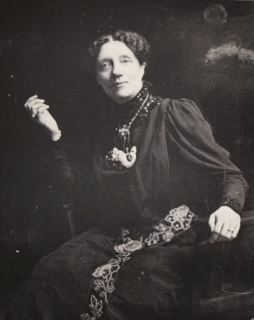
Annie Elizabeth Fredericka Horniman CH, English theatre patron and manager, is born at Surrey Mount, Forest Hill, London, on October 3, 1860. She establishes the Abbey Theatre in Dublin and founds the first regional repertory theatre company in Britain at the Gaiety Theatre in Manchester. She encourages the work of new writers and playwrights, including W. B. YeatsGeorge Bernard Shaw and members of what become known as the Manchester School of dramatists.

Horniman, the elder child of Frederick John Horniman and his first wife Rebekah (née Emslie). Her father is a tea merchant and the founder of the Horniman Museum. Her grandfather is John Horniman who founds the family tea business of Horniman and Company. She and her younger brother, Emslie, are educated privately at their home. Her father is opposed to the theatre, which he considers sinful, but their German governess takes her and Emslie secretly to a performance of The Merchant of Venice at The Crystal Palace when she is fourteen years old.

Horniman’s father allows her to enter the Slade School of Fine Art in 1882. Here she discovers that her talent in art is limited but she develops other interests, particularly in the theatre and opera. She takes great pleasure in Richard Wagner‘s Der Ring des Nibelungen and in Henrik Ibsen‘s plays. She cycles in London and twice over the Alps, smokes in public and explores alternative religions. The “lonely rich girl” has become “an independent-minded woman.” In 1890 she joins the occult society, the Hermetic Order of the Golden Dawn, where she remains a member until disagreements with its leaders lead to her resignation in 1903. During this time she meets and becomes a friend of W. B. Yeats, acting as his amanuensis for some years. Their friendship endures. Frank O’Connor recalls that on the day Yeats hears of her death, he spends the entire evening speaking of his memories of her.

Horniman’s first venture into the theatre is in 1894 and is made possible by a legacy from her grandfather. She anonymously supports her friend Florence Farr in a season of new plays at the Royal Avenue Theatre, London. This includes a new play by Yeats, The Land of Heart’s Desire, and the première of George Bernard Shaw’s play Arms and the Man. In 1903, Yeats persuades her to go to Dublin to back productions by the Irish National Theatre Society. Here she discovers her skill as a theatre administrator. She purchases a property and develops it into the Abbey Theatre, which opens in December 1904. Although she moves back to live in England, she continues to support the theatre financially until 1910. Meanwhile, in Manchester she purchases and renovates the Gaiety Theatre in 1908 and develops it into the first regional repertory theatre in Britain.

At the Gaiety, Horniman appoints Ben Iden Payne as the director and employs actors on 40-week contracts, alternating their work between large and small parts. The plays produced include classics such as Euripides and Shakespeare, and she introduces works by contemporary playwrights such as Ibsen and Shaw. She also encourages local writers who form what becomes known as the Manchester School of dramatists, the leading members of which are Harold BrighouseStanley Houghton and Allan Monkhouse. The Gaiety company undertakes tours of the United States and Canada in 1912 and 1913. Horniman becomes a well-known public figure in Manchester, lecturing on subjects which include women’s suffrage and her views about the theatre. In 1910 she is awarded the honorary degree of MA by the University of Manchester. During World War I the Gaiety continues to stage plays but financial difficulties lead to the disbandment of the permanent company in 1917, following which productions in the theatre are by visiting companies. In 1921 she sells the theatre to a cinema company.

As a result of her tea connection, Horniman is known as “Hornibags.” She holds court at the Midland Hotel, wearing exotic clothing and openly smoking cigarettes, which is considered scandalous at the time. She introduces Manchester to what is called at the time “the play of ideas.” The theatre critic James Agate notes that her high-minded theatrical ventures have “an air of gloomy strenuousness” about them.

Horniman moves to London where she keeps a flat in Portman Square. In 1933 she is made a Companion of Honour. She and Algernon Blackwood might be the only past or present members of an occult society to receive a United Kingdom honour.

Horniman dies, unmarried, on August 6, 1937, while visiting friends in Shere, Surrey. Her estate amounts to a little over £50,000. The Annie Horniman Papers are held in the John Rylands Research Institute and Library at the University of Manchester. Her portrait, painted by John Butler Yeats in 1904, hangs in the public area of the Abbey Theatre.


Leave a comment

Birth of William Orpen, Irish-born Artist

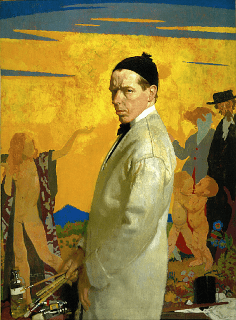
Major Sir William Newenham Montague Orpen, KBE, RA, RHA, Irish artist who mainly works in London and is best known for his vigorously characterized portraits, is born on November 27, 1878, at Oriel, Grove Avenue, Stillorgan, County Dublin. He also works as an official war artist during World War I.

Orpen is the fourth and youngest son of Arthur Herbert Orpen (1830–1926), a solicitor, and his wife, Anne Caulfield (1834–1912), the eldest daughter of the Right Rev. Charles Caulfield (1804–1862), the Bishop of Nassau. Both his parents are amateur painters, and his eldest brother, Richard Caulfield Orpen, becomes a notable architect. His nieces are Bea Orpen and Kathleen Delap. The historian Goddard Henry Orpen is his second cousin. The family lives at “Oriel,” a large house with extensive grounds containing stables and a tennis court. He appears to have a happy childhood there.

Orpen is a naturally talented painter, and six weeks before his thirteenth birthday is enrolled at the Dublin Metropolitan School of Art. During his six years at the college, he wins every major prize there, plus the British Isles gold medal for life drawing, before leaving to study at the Slade School of Fine Art in London between 1897 and 1899. At the Slade he masters oil painting and begins to experiment with different painting techniques and effects.

While at the Slade, Orpen becomes engaged to Emily Scobel, a model and the subject of his painting The Mirror (1900). She ends their relationship in 1901, and he marries Grace Knewstub, the sister-in-law of Sir William Rothenstein. He and Knewstub have three daughters together, but the marriage is not a happy one. By 1908, he has begun a long-running affair with Evelyn Saint-George, a well-connected American millionairess based in London, with whom he also has a child.

Orpen first exhibits at the New English Art Club (NEAC) in 1899, becoming a member in 1900. In 1901, he holds a solo exhibition at the Carfax Gallery in central London. His portraits, which establish his reputation, show the influence of the Realist artist Édouard Manet. He also becomes known as a painter of group portraits such as Homage to Manet (1909), in which he portrays members of the contemporary English art world sitting in conversation beneath a famous portrait by that artist.

At the start of World War I, a number of Irish people living in England return to Ireland to avoid conscription. Among them is Orpen’s studio assistant and former pupil, Seán Keating. Keating encourages him to do likewise, but he refuses and commits himself to supporting the British war effort. In December 1915, he is commissioned into the Royal Army Service Corps and reports for clerical duty at London’s Kensington Barracks in March 1916. Throughout 1916 he continues painting portraits, most notably one of a despondent Winston Churchill, but soon starts using both his own contacts and those of Evelyn Saint-George, to secure a war artist posting.

He is the official painter of the Paris Peace Conference after World War I. Throughout 1919 he paints individual portraits of the delegates to the Conference and these form the basis of his two large paintings, A Peace Conference at the Quai d’Orsay and The Signing of Peace in the Hall of Mirrors. In both pictures, the architecture overwhelms the gathered politicians and statesmen who’s political wranglings and vainglory diminish them in Orpen’s eyes.

Orpen is appointed Knight Commander of the Order of the British Empire in 1918 and is elected an associate of the Royal Academy of Arts in 1919.

Orpen becomes seriously ill in May 1931, and, after suffering periods of memory loss, dies at the age of 52 on September 29, 1931, in South Kensington, London, of liver and heart failure. He is buried at Putney Vale Cemetery in southwest London. A stone tablet in the Island of Ireland Peace Park Memorial at Mesen, Belgium, commemorates him. He is posthumously regarded as a facile and prolific, but somewhat superficial, artist who nevertheless achieves great popularity in his day.

(Pictured: “Self-portrait” (1913), oil on canvas by William Orpen, Saint Louis Art Museum)


Leave a comment

Birth of Kitty Wilmer O’Brien, Landscape Artist

Kitty Wilmer O’Brien, Irish oil and watercolour landscape artist, is born in India on August 7, 1910.

Wilmer is born to Major Harold Gordon Wilmer and Alice Violet McEntire. Her father is killed at Gallipoli when she is four years old. She has a younger brother, Harold, who follows in the family military tradition and is killed in 1942. She learns her skills in the Royal Hibernian Academy (RHA) schools in Dublin, starting in 1926, where she wins a number of awards for her art. She is trained by Lilian Davidson who is working out of her studio in Earlsfort Terrace in Dublin. She wins the Taylor Scholarship in 1933 which sends her to the Slade School of Fine Art in London.

In 1936, Wilmer marries Dr. Brendan O’Brien, a Dublin surgeon and son of Dermod O’Brien. She and her husband settle in Dublin after working abroad for a few years. They have two sons, Dermod and Anthony, who is also an artist. Another artistic relative is Geraldine O’Brien.

In the period from the 1940s and 1950s O’Brien exhibits in Dublin with Brigid Ganly, RHA, her sister-in-law, as well as submitting works to the Society of Dublin Painters, the Royal Hibernian Academy and the Water Colour Society of Ireland. She exhibits annually in the Irish Living Art Exhibition and the Oireachtas Art Exhibition. O’Brien is elected a member of the Royal Hibernian Academy in 1976. She is president of the Water Colour Society of Ireland from 1962 to 1981.

O’Brien dies in Dublin in 1982.


Leave a comment

Birth of Letitia Marion Hamilton, Landscape Artist

Letitia Marion Hamilton, Irish landscape artist and Olympic bronze medalist, is born on July 30, 1878, in Hamwood House, County Meath.

Hamilton is the daughter of Charles Robert Hamilton and Louisa Caroline Elizabeth Brooke. She attends Alexandra College. She and her sister Eva are great-granddaughters of the artist Marianne-Caroline Hamilton, and cousins of watercolourist Rose Maynard Barton. The sisters’ father can only afford one dowry, so the sisters remain unmarried, with their artistic careers helping to support the household. Both she and her sister study at the Dublin Metropolitan School of Art under William Orpen. She studies enameling there also, winning a silver medal in 1912 by both the School and the Board of Education National Commission. Her work shows elements of Art Nouveau, foreshadowing her later modernist leanings. She also studies in Belgium with Frank Brangwyn and the Slade School of Fine Art.

Hamilton first exhibits in 1902 and goes go on to become a prolific painter of the Irish countryside, exhibiting more than 200 paintings at the Royal Hibernian Academy (RHA). Both sisters travel widely in Europe, with Letitia being influenced by modern European artistic trends of the early 20th-century. She is internationally exhibited, Royal Academy of Arts, Burlington Gallery and Kensington Art Gallery in London, in Scotland, and Paris. Her exposure to impressionism comes from studying with Anne St. John Partridge in France. Her style matures in the 1920s. That year, she is one of the founding members of the Society of Dublin Painters, along with Paul Henry, Grace Henry, Mary Swanzy, and Jack Butler Yeats. It is around this time that she changes her signature from MH (May Hamilton) to LMH, reflecting her full name. She works on small oil sketches, which later develop into finished works. Her style is rapid, with loose, fluid brush strokes. In the early 1920s, she travels to Venice, painting on a gondola studio loaned to her by artist and friend Ada Longfield. The works from this trip are considered among her best, with her exploring light effects, pastel shades, and strong outlines. She later employs these elements into her works on Irish landscapes.

Hamilton becomes a member of the Royal Hibernian Academy in 1943. In 1948, she becomes the last person to win a bronze medal at the art competitions at the London Olympic Games. She serves as president of the Society of Dublin Painters in the late 1950s. Despite her failing eyesight later in life, she continues to paint, mounting her final exhibition in 1963, a year before her death at the age of 86 in Dublin on August 11, 1964. She is also a committee member of the Water Colour Society of Ireland.

Examples of Hamilton’s work are held in a number of collections, including Hugh Lane Gallery, Limerick City Gallery of Art, Crawford Art Gallery, Ulster Museum, National Gallery of Ireland, and Waterford Art Gallery. Her painting Canal Scene in Venice attains the highest price for a Hamilton work in 2004, which sells at Sotheby’s in London, for £33,600.

(Pictured: “Slieve Donard, Co. Down” by Letitia Marion Hamilton, oil on canvas, signed with monogram lower left)


Leave a comment

Death of Surrealist Sculptor F. E. McWilliam

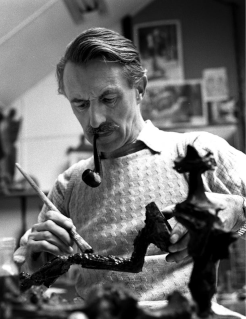
Frederick Edward McWilliam CBE RA, Northern Irish surrealist sculptor, dies in London on May 13, 1992. He works chiefly in stone, wood and bronze. His style of work consists of sculptures of the human form contorted into strange positions, often described as modern and surreal.

McWilliam is born in Banbridge, County Down, on April 30, 1909, the son of Dr. William McWilliam, a local general practitioner. Growing up in Banbridge has a great influence on his work. He makes references to furniture makers such as Carson the Cooper and Proctors in his letters to his friend, Marjorie Burnett.

McWilliam attends Campbell College in Belfast and later attends Belfast College of Art from 1926. After 1928, he continues to study at the Slade School of Fine Art in London. He originally intends to become a painter, but influenced by Alfred Horace Gerrard, head of the sculpture department at the Slade, and by Henry Moore whom he meets there, he turns to sculpture. He receives the Robert Ross Leaving Scholarship which enables him and his wife, Beth (née Crowther), to travel to Paris where he visits the studio of Constantin Brâncuși.

During the first year of World War II, he joins the Royal Air Force and is stationed in England for four years where he is engaged in interpreting aerial reconnaissance photographs. He is then posted to India. While there he teaches art in the Hindu Art School in New Delhi.

After his return from India, McWilliam teaches for a year at the Chelsea School of Art. He is then invited by A. H. Gerrard to teach sculpture at the Slade. He continues in this post until 1968.

The 1950s see McWilliam receive many commissions including the Four Seasons Group for the Festival of Britain exhibition in 1951. A major commission in 1957 is Princess Macha for Altnagelvin Area Hospital in Waterside, Derry.

During the Northern Ireland Troubles McWilliam produces a series of bronzes in 1972 and 1973 known as Women of Belfast in response to the bombing at the Abercorn Tea-Rooms.

In 1964 McWilliam is awarded an Honorary Doctor of Letters from Queen’s University Belfast. In 1966 he is appointed CBE and in 1971 he wins the Oireachtas Gold Medal. He is represented in many public collections, including the Museum of Modern Art in New York City and Tate Britain in London. In 1984 the National Self-Portrait Gallery purchases a McWilliam self-portrait amongst acquisitions from fellow Northerners Brian Ballard, Brian Ferran and T. P. Flanagan.

The Arts Council of Northern Ireland organises a retrospective of his work in 1981 and a second retrospective is shown at the Tate Gallery in 1989 for his 80th birthday.

McWilliam continues carving up to his death. He dies of cancer in London on May 13, 1992.

In September 2009 Banbridge District Council opens a gallery and studio dedicated to the work of and named after McWilliam.


Leave a comment

Death of Micheál Mac Liammóir, Actor & Playwright

Micheál Mac Liammóir, British-born Irish actor, playwright, impresario, writer, poet and painter, dies in Dublin on March 6, 1978. He co-founds the Gate Theatre with his partner Hilton Edwards and is one of the most recognizable figures in the arts in twentieth-century Ireland.

Mac Liammóir is born Alfred Willmore on October 25, 1899. He is born to a Protestant family living in the Kensal Green district of London.

As Alfred Willmore, he is one of the leading child actors on the English stage, in the company of Noël Coward. He appears for several seasons in Peter Pan. He studies painting at London’s Slade School of Fine Art, continuing to paint throughout his lifetime. In the 1920s he travels all over Europe. He is captivated by Irish culture and learns the Irish language which he speaks and writes fluently. He changes his name to an Irish version, presenting himself in Ireland as a descendant of Irish Catholics from Cork. Later in his life, he writes three autobiographies in Irish and translates them into English.

While acting in Ireland with the touring company of his brother-in-law Anew MacMaster, Mac Liammóir meets the man who becomes his partner and lover, Hilton Edwards. Their first meeting takes place in the Athenaeum, Enniscorthy, County Wexford. Deciding to remain in Dublin, where they live at Harcourt Terrace, the pair assists with the inaugural production of Galway‘s Irish language theatre, An Taibhdhearc. The play is Mac Liammóir’s version of the mythical story Diarmuid agus Gráinne, in which Mac Liammóir plays the lead role as Diarmuid.

Mac Liammóir and Edwards then throw themselves into their own venture, co-founding the Gate Theatre in Dublin in 1928. The Gate becomes a showcase for modern plays and design. Mac Liammóir’s set and costume designs are key elements of the Gate’s success. His many notable acting roles include Robert Emmet/The Speaker in Denis Johnston‘s The Old Lady Says “No!” and the title role in Hamlet.

In 1948, Mac Liammóir appears in the NBC television production of Great Catherine with Gertrude Lawrence. In 1951, during a break in the making of Othello, he produces Orson Welles‘s ghost-story Return to Glennascaul which is directed by Hilton Edwards. He plays Iago in Welles’s film version of Othello (1951). The following year, he goes on to play ‘Poor Tom’ in another Welles project, the TV film of King Lear (1953) for CBS.

Mac Liammóir writes and performs a one-man show, The Importance of Being Oscar, based on the life and work of Oscar Wilde. The Telefís Éireann production wins him a Jacob’s Award in December 1964. It is later filmed by the BBC with Mac Liammóir reprising the role.

Mac Liammóir narrates the 1963 film Tom Jones and is the Irish storyteller in 30 Is a Dangerous Age, Cynthia (1968) which stars Dudley Moore.

In 1969 Mac Liammóir has a supporting role in John Huston‘s The Kremlin Letter. In 1970 he performs the role of narrator on the cult album Peace on Earth by the Northern Irish showband, The Freshmen and in 1971 he plays an elocution teacher in Curtis Harrington‘s What’s the Matter with Helen?.

Mac Liammóir claims when talking to Irish playwright Mary Manning, to have had a homosexual relationship with General Eoin O’Duffy, former Garda Síochána Commissioner and head of the paramilitary Blueshirts in Ireland, during the 1930s. The claim is revealed publicly by RTÉ in a documentary, The Odd Couple, broadcast in 1999. However, Mac Liammóir’s claims have not been substantiated.

Mac Liammóir’s life and artistic development are the subject of a major study by Tom Madden, The Making of an Artist. Edwards and Mac Liammóir are the subject of a biography, titled The Boys by Christopher Fitz-Simon.

Micheál Mac Liammóir dies at his and Edwards’s Dublin home, 4 Harcourt Terrace, at the age of 78 on March 6, 1978. Edwards and Mac Liammóir are buried alongside each other at St. Fintan’s Cemetery, Sutton, Dublin.


Leave a comment

Death of Annie Horniman, Theatre Patron & Manager

Annie Elizabeth Fredericka Horniman CH, English theatre patron and manager, dies on August 6, 1937, while visiting friends in Shere, Surrey, England. She establishes the Abbey Theatre in Dublin and founds the first regional repertory theatre company in Britain at the Gaiety Theatre in Manchester. She encourages the work of new writers and playwrights, including W. B. Yeats, George Bernard Shaw and members of what become known as the Manchester School of dramatists.

Horniman is born at Surrey Mount, Forest Hill, London, on October 3, 1860, the elder child of Frederick John Horniman and his first wife Rebekah (née Emslie). Her father is a tea merchant and the founder of the Horniman Museum. Her grandfather is John Horniman who founds the family tea business of Horniman and Company. She and her younger brother Emslie are educated privately at their home. Her father is opposed to the theatre, which he considers sinful, but their German governess takes her and Emslie secretly to a performance of The Merchant of Venice at The Crystal Palace when she is fourteen years old.

Horniman’s father allows her to enter the Slade School of Fine Art in 1882. Here she discovers that her talent in art is limited but she develops other interests, particularly in the theatre and opera. She takes great pleasure in Richard Wagner‘s Der Ring des Nibelungen and in Henrik Ibsen‘s plays. She cycles in London and twice over the Alps, smokes in public and explores alternative religions. The “lonely rich girl” has become “an independent-minded woman.” In 1890 she joins the occult society, the Hermetic Order of the Golden Dawn, where she remains a member until disagreements with its leaders lead to her resignation in 1903. During this time she meets and becomes a friend of W. B. Yeats, acting as his amanuensis for some years. Their friendship endures. Frank O’Connor recalls that on the day Yeats hears of her death, he spends the entire evening speaking of his memories of her.

Horniman’s first venture into the theatre is in 1894 and is made possible by a legacy from her grandfather. She anonymously supports her friend Florence Farr in a season of new plays at the Royal Avenue Theatre, London. This includes a new play by Yeats, The Land of Heart’s Desire, and the première of George Bernard Shaw’s play Arms and the Man. In 1903 Yeats persuades her to go to Dublin to back productions by the Irish National Theatre Society. Here she discovers her skill as a theatre administrator. She purchases a property and develops it into the Abbey Theatre, which opens in December 1904. Although she moves back to live in England, she continues to support the theatre financially until 1910. Meanwhile, in Manchester she purchases and renovates the Gaiety Theatre in 1908 and develops it into the first regional repertory theatre in Britain.

At the Gaiety, Horniman appoints Ben Iden Payne as the director and employs actors on 40-week contracts, alternating their work between large and small parts. The plays produced include classics such as Euripides and Shakespeare, and she introduces works by contemporary playwrights such as Ibsen and Shaw. She also encourages local writers who form what becomes known as the Manchester School of dramatists, the leading members of which are Harold Brighouse, Stanley Houghton and Allan Monkhouse. The Gaiety company undertakes tours of the United States and Canada in 1912 and 1913. Horniman becomes a well-known public figure in Manchester, lecturing on subjects which include women’s suffrage and her views about the theatre. In 1910 she is awarded the honorary degree of MA by the University of Manchester. During World War I the Gaiety continues to stage plays but financial difficulties lead to the disbandment of the permanent company in 1917, following which productions in the theatre are by visiting companies. In 1921 she sells the theatre to a cinema company.

As a result of her tea connection, Horniman is known as “Hornibags.” She holds court at the Midland Hotel, wearing exotic clothing and openly smoking cigarettes, which is considered scandalous at the time. She introduces Manchester to what is called at the time “the play of ideas.” The theatre critic James Agate notes that her high-minded theatrical ventures have “an air of gloomy strenuousness” about them.

Horniman moves to London where she keeps a flat in Portman Square. In 1933 she is made a Companion of Honour. She and Algernon Blackwood might be the only past or present members of an occult society to receive a United Kingdom honour.

Horniman dies, unmarried, on August 6, 1937, while visiting friends in Shere, Surrey. Her estate amounts to a little over £50,000. The Annie Horniman Papers are held in the John Rylands Research Institute and Library at the University of Manchester. Her portrait, painted by John Butler Yeats in 1904, hangs in the public area of the Abbey Theatre.


Leave a comment

Birth of F. E. McWilliam, Surrealist Sculptor

Frederick Edward McWilliam CBE RA, Northern Irish surrealist sculptor, is born in Banbridge, County Down, on April 30, 1909. He works chiefly in stone, wood and bronze. His style of work consists of sculptures of the human form contorted into strange positions, often described as modern and surreal.

McWilliam is the son of Dr. William McWilliam, a local general practitioner. Growing up in Banbridge has a great influence on his work. He makes references to furniture makers such as Carson the Cooper and Proctors in his letters to his friend, Marjorie Burnett.

McWilliam attends Campbell College in Belfast and later attends Belfast College of Art from 1926. After 1928, he continues to study at the Slade School of Fine Art in London. He originally intends to become a painter, but influenced by Alfred Horace Gerrard, head of the sculpture department at the Slade, and by Henry Moore whom he meets there, he turns to sculpture. He receives the Robert Ross Leaving Scholarship which enables him and his wife, Beth (née Crowther), to travel to Paris where he visits the studio of Constantin Brâncuși.

During the first year of World War II, he joins the Royal Air Force and is stationed in England for four years where he is engaged in interpreting aerial reconnaissance photographs. He is then posted to India. While there he teaches art in the Hindu Art School in New Delhi.

After his return from India, McWilliam teaches for a year at the Chelsea School of Art. He is then invited by A. H. Gerrard to teach sculpture at the Slade. He continues in this post until 1968.

The 1950s see McWilliam receive many commissions including the Four Seasons Group for the Festival of Britain exhibition in 1951. A major commission in 1957 is Princess Macha for Altnagelvin Area Hospital in Waterside, Derry.

During the Northern Ireland Troubles McWilliam produces a series of bronzes in 1972 and 1973 known as Women of Belfast in response to the bombing at the Abercorn Tea-Rooms.

In 1964 McWilliam is awarded an Honorary Doctor of Letters from Queen’s University Belfast. In 1966 he is appointed CBE and in 1971 he wins the Oireachtas Gold Medal. He is represented in many public collections, including the Museum of Modern Art in New York City and Tate Britain in London. In 1984 the National Self-Portrait Gallery purchases a McWilliam self-portrait amongst acquisitions from fellow Northerners Brian Ballard, Brian Ferran and T. P. Flanagan.

The Arts Council of Northern Ireland organises a retrospective of his work in 1981 and a second retrospective is shown at the Tate Gallery in 1989 for his 80th birthday.

McWilliam continues carving up to his death. He dies of cancer in London on May 13, 1992.

In September 2009 Banbridge District Council opens a gallery and studio dedicated to the work of and named after McWilliam.


Leave a comment

Death of Rosamond Praeger, Artist & Sculptor

Sophia Rosamond Praeger, Irish artist, sculptor, illustrator, poet and writer, dies at Rock Cottage, County Down, Northern Ireland, on April 17, 1954.

Praeger is born on April 15, 1867, in Holywood, County Down. She is the daughter of Willem Emilius Praeger, a Dutch linen merchant who had settled in Ireland in 1860, and Marie Patterson. She has five brothers of who Robert goes on to become a distinguished naturalist. Within months of her birth the family moves to Woodburn House, Croft Road, Holywood, where they have as a neighbour Rev. Charles McElester, a Non-subscribing Presbyterian minister who runs a day school in his church. She both attends this school, and later teaches there. She receives her secondary education at Sullivan Upper School, Holywood, the Belfast School of Art, and the Slade School of Fine Art, London. Before returning to Ireland to open a studio in Belfast and then in Holywood, she studies art in Paris.

Praeger writes and illustrates children’s books but achieves fame with her sculpture The Philosopher which is exhibited at the Royal Academy of Arts in London, bought by an American collector, and is now on display in the Colorado Springs Museum and Art Gallery. She mostly works in plaster, but also uses stone, marble, terracotta and bronze, and her work includes relief panels, memorial plaques and stones. She exhibits in London and Paris, at the Royal Hibernian Academy, as well as at the Irish Decorative Art Association Exhibitions. She is a member of the Guild of Irish Art Workers.

Among Praeger’s other works are The Wai, Johnny the Jig, These Little Ones, St. Brigid of Kildare and The Fairy Fountain. For the Causeway School near Bushmills, County Antrim, she carves Fionnula the Daughter of Lir in stone. She models a heraldic figure for the Northern Bank in Donegall Square West, Belfast, and bronze plaques for the front door of the Carnegie library, Falls Road, Belfast, as well as the angels on Andrews Memorial Hall in Comber, County Down, and some work in St. Anne’s Cathedral, Belfast. She illustrates three books for her brother, Robert Praeger. She is President of the Royal Ulster Academy, an honorary Fellow of the Royal Hibernian Academy, and she receives an honorary doctorate from Queen’s University, Belfast. In 1939 she is awarded the MBE.

Praeger maintains her studio in Hibernian Street, Holywood, up until 1952, at the age of 85. She dies at Rock Cottage, County Down, on April 17, 1954. She is buried in the Priory Cemetery, Holywood. Her work in included in the collections of the Ulster Museum and the National Gallery of Ireland, and some private collections around the world

(From: “Sophia Rosamond Praeger (1867 – 1954): Sculptor” by Kate Newmann and Richard Froggatt, Dictionary of Ulster Biography, http://www.newulsterbiography.co.uk)


2 Comments

Death of Nelly O’Brien, Miniaturist, Artist & Activist

Ellen Lucy or Nelly O’Brien, Irish miniaturist, landscape artist, and Gaelic League activist, dies suddenly on April 1, 1925, while visiting her brother Dermod at 66 Elm Park Gardens, London.

O’Brien is born Ellen Lucy O’Brien on June 4, 1864, at Cahirmoyle, County Limerick. She is the eldest child of Edward William O’Brien and Mary O’Brien (née Spring Rice). Her siblings are Lucy and Dermod, with Dermod also becoming an artist. Her father is a landowner, and her mother is a sculptor and painter and sister of Thomas Spring Rice. Her grandfather is William Smith O’Brien.

While a young child, O’Brien spends two years living on the French Riviera from 1866 to 1868. Her mother later dies of tuberculosis, and the three children are raised by their aunt, the writer and nationalist, Charlotte Grace O’Brien. Their father remarries in 1880, to Julia Marshall, with whom he has two sons and two daughters.

O’Brien attends school in England from 1879, and later enrolls to study painting at the Slade School of Fine Art. She meets Walter Osborne through her brother Dermod, and considers herself engaged to him, but Osborne dies on April 24, 1903. A portrait of O’Brien by Osborne is held in the Hugh Lane Gallery.

O’Brien returns to Ireland and begins to paint miniatures on ivory using a magnifying glass. She also paints watercolour landscapes. Her first exhibition with the Royal Hibernian Academy (RHA) is in 1896, where she shows three works including Sketch near Malahide. She exhibits with the RHA on and off until 1922. During some of her time in Dublin, she lives with her half-brother, Edward Conor Marshall O’Brien, on Mount Street.

As part of an exhibition of Irish painters, O’Brien exhibits a number of portrait miniatures at the London Guildhall in 1904. The 1906 Oireachtas na Gaeilge features a number of her paintings, and in the same year she becomes honorary secretary of a newly established art committee. At the MunsterConnacht exhibition in Limerick of 1906, she exhibits a miniature of William Smith O’Brien amongst her 12 works on show. She produces many portraits, including one of Douglas Hyde, which is exhibited by the RHA in 1916.

O’Brien is an early member of the Gaelic League, being present at its first Oireachtas na Gaeilge in 1897 and founding the Craobh na gCúig gCúigí (Branch of the Five Provinces). In 1905, she writes a long letter in defence of Douglas Hyde and the Gaelic League in The Church of Ireland Gazette. She holds meetings of Craobh na gCúig gCúigí in her flat at 7 St. Stephen’s Green every Saturday night in 1907. In 1911, she founds Coláiste Eoghain Uí Chomhraí (O’Curry Irish College) in Carrigaholt, County Clare, which is named in honour of Eugene O’Curry, with the help of her cousin and friend Mary Spring Rice.

One of her ultimate goals is to create a national Irish church, which would unite Protestants and Catholics through the Irish language. To this end, she establishes the Irish Guild of the Church with Seoirse de Rút in 1914. The aim of the organisation is to provide a communal union for members of the Church of Ireland who are dedicated to “Irish Ireland” ideals.

Acting as a representative for the Gaelic League, she travels to the United States with Fionan MacColuim in 1914 to 1915, to fund raise and promote Irish art and industries. At Coláiste Eoghain Uí Chomhraí, she stresses the importance of the Irish language in the home, as well as the skills of housewives and those in domestic service in strengthening the language and Irish culture.

O’Brien notes that she initially thought that the 1916 Easter Rising was “in the nature a demonstration against conscription as it had been announced that the volunteers would resist disarmament.” She is staying with the Hydes at 1 Earlsfort Place during the Rising, as her flat at College Park Chambers had been destroyed. She protests the conscription bill in Ireland as a mass meeting of women at the Mansion House in 1918. She launches the Gaelic Churchman in 1919 as the official publication of the Irish Guild of the Church. In one article entitled A plea for the Irish services, she promotes her campaign for Irish language services in Protestant churches. In her capacity of vice-president of the guild, she invites Éamon de Valera to attend one of their meetings in 1921.

O’Brien dies suddenly on April 1, 1925, while visiting Dermod at 66 Elm Park Gardens, London. She is buried at the family plot in Cahirmoyle.

(Pictured: Nelly O’Brien by Sir Joshua Reynolds, 1723-1792)