seamus dubhghaill

Promoting Irish Culture and History from Little Rock, Arkansas, USA


Leave a comment

Execution of James Dickey, Member of the Society of United Irishmen

James Dickey, a young barrister from a Presbyterian family in Crumlin, County Antrim, in the north of Ireland, is hanged at Corn Market, Belfast, on June 26, 1798. He is active in the Society of United Irishmen and is hanged with Henry Joy McCracken for leading rebels at the Battle of Antrim.

The Society of United Irishmen is formed in October 1791 by leading citizens in Belfast who seek a representative government in Ireland based on principles they believe have been modelled by the American and French Revolutions. At their first meeting they embrace the argument of Theobald Wolfe Tone for a “brotherhood of affection” between Irishmen of all religious persuasions. Tone argues that in Ireland the landed Anglican Ascendancy and the English appointed Irish executive employ division between Protestants and Catholics to balance “the one party by the other, plunder and laugh at the defeat of both.”

Despairing of reform, and in the hope of French assistance, in May 1798, the United Irishmen take up arms against the Dublin government and the British Crown. Beginning in Kildare, the insurrection spreads to other counties in Leinster before finally reaching the Presbyterian districts surrounding Belfast. On June 5, the Antrim societies of United Irishmen meet in Templepatrick where they elect textile manufacturer Henry Joy McCracken as their General. The next day McCracken issues a proclamation calling for the United army of Ulster to rise. The initial plan meets with success, as the towns of Larne, Ballymena, Maghera and Randalstown are taken and the bridge at Toome is damaged to prevent the government rushing reinforcements into Antrim from west of the River Bann.

According to the memoirs of James Burns from Templepatrick, Dickey commands the insurgents at Randalstown and kills Samuel Parker, a “traitor, with his own hands, while standing at his own door, where he went for the purpose.”

McCracken leads a body of about 6,000 rebels in an attack on Antrim town. As promised, Catholic Defenders turn out, but in the march upon the town tensions with the Presbyterian United Irish causes some desertions and a delay in McCracken’s planned assault. McCracken’s men are defeated, and his army melts away. On June 15, Dickey, together with McCracken, James Hope, James Orr and about fifty other rebel survivors from Antrim, arrive at Slemish, near Ballymena. There they set up camp for three weeks before leaving under threat of attack from Colonel Green of the Tay Fencibles.

Dickey is captured by the Sutherland fencibles on Divis, a hill northwest of Belfast. He is court-martialed and hanged at Corn Market, Belfast on June 26, 1798. Famously, before his hanging he refuses to wear a black hood saying to the hangman, “Sir, don’t cover my face!” According to local legend he shouts, “Don’t think gentlemen, I am ashamed to show my face among you, I am dying for my country!” However, a loyalist source hostile to the United Irish cause, Henry Joy of the Belfast News Letter, has Dickey on the scaffold recanting his commitment to the “brotherhood of affection” between Catholic and Protestant. He supposedly warned the assembled that had “the Presbyterians of the north succeeded in their [republican] designs, they would ultimately have had to contend with the Roman Catholics.” It is testament to the sentiment that in the north is to largely expunge the memory of his, and McCracken’s, sacrifice.

Dickey is 22 years old at the time of his execution. His head is placed on a spike outside the Market House on Belfast’s High Street.

Dickey’s brother, John Dickey of Crumlin, is also implicated in the rebellion. He is informed on by neighbours who had noticed that he was making pikes and attending secret meetings of the United Irishmen late at night. Arrested and court-martialed, he refuses the terms granted by the government to the “State Prisoners” in Dublin. He is transported to the West Indies for penal servitude but manages to escape and makes his way to the United States.


Leave a comment

Birth of Robert Stewart, 2nd Marquess of Londonderry

Robert Stewart, 2nd Marquess of Londonderry, KG, GCH, PC, PC (Ire), Anglo-Irish politician and statesman usually known as Lord Castlereagh, derived from the courtesy title Viscount Castlereagh by which he is styled from 1796 to 1821, is born in Dublin on June 18, 1769. As secretary to the Viceroy of Ireland, he works to suppress the Irish Rebellion of 1798 and to secure passage in 1800 of the Irish Act of Union. As the Foreign Secretary of the United Kingdom from 1812, he is central to the management of the coalition that defeats Napoleon and is British plenipotentiary at the Congress of Vienna. In the post-war government of Lord Liverpool, he is seen to support harsh measures against agitation for reform.

Stewart is born in 28 Henry Street, in Dublin’s Northside. He is the second and only surviving child of Robert Stewart (the elder) and his wife Sarah Frances Seymour-Conway. His parents marry in 1766. He has recurring health problems throughout his childhood, and is sent to The Royal School, Armagh, rather than to England for his secondary education. At the encouragement of Charles Pratt, 1st Earl Camden, who takes a great interest in him and treats him as if he is a grandson by blood, he later attends St. John’s College, Cambridge (1786–87), where he applies himself with greater diligence than expected from an aristocrat and excels in his first-year examinations. But he then withdraws, pleading an illness that he admits to Camden is something “which cannot be directly acknowledged before women,” i.e. something sexually transmitted.

Early in his career in Ireland, and following a visit to revolutionary France, Stewart recoils from the democratic politics of his Presbyterian constituents in Ulster. Crossing the floor of the Irish House of Commons in support of the government, he takes a leading role in detaining members of the republican conspiracy, the United Irishmen, his former political associates among them. After the 1798 Rebellion, as Chief Secretary for Ireland, he pushes the Act of Union through the Irish Parliament. But it is without the Catholic Emancipation that both he and British Prime Minister William Pitt believe should have accompanied the creation of a United Kingdom.

From 1805 Stewart serves under Pitt and then the Duke of Portland as Secretary of State for War. In 1809 he is obliged to resign after fighting a duel with the Foreign Secretary, George Canning, in a dispute over the Walcheren Campaign. In 1812 he returns to government serving Lord Liverpool as Foreign Secretary and as Leader of the House of Commons.

Stewart organises and finances the alliance that defeats Napoleon, bringing the powers together at the Treaty of Chaumont in 1814. After Napoleon’s second abdication in 1815, he works with the European courts represented at the Congress of Vienna to frame the territorial, and broadly conservative, continental order that holds until mid-century. He blocks harsh terms against France believing that a treaty based on vengeance and retaliation will upset a necessary balance of powers. France is restored to the frontiers of 1791, and her British-occupied colonies are returned. In 1820 Stewart enunciates a policy of non-intervention, proposing that Britain hold herself aloof from continental affairs.

After 1815, at home, Stewart supports repressive measures that link him in public opinion to the Peterloo Massacre of 1819. Widely reviled in both Ireland and Great Britain, overworked, and personally distressed, he commits suicide on August 12, 1822. He is found in a dressing room seconds after he has cut his own throat using a small knife. He collapses and dies almost instantly.

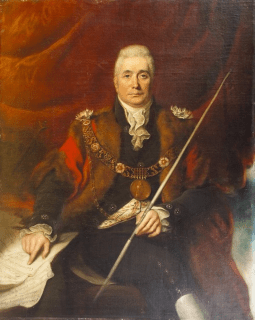
(Pictured: “Robert Stewart, 2nd Marquess of Londonderry,” oil on canvas by Thomas Lawrence, National Portrait Gallery)


Leave a comment

Death of Father Michael Murphy

Fr. Michael Murphy, Irish Roman Catholic priest and United Irishmen leader during the Irish Rebellion of 1798, dies at the Battle of Arklow in Arklow, County Wicklow, on June 9, 1798.

Murphy is born in 1767. While his birthplace in Ireland is undetermined, various locations, such as Ballinoulart, Castleannesley or in Kilnew, County Wexford, are documented as possibilities. He is ordained a priest in 1785 at Wexford after completing hedge school in Oulart. His first parish is at Ballycanew, after Theology and Philosophy studies at the Irish College in Bordeaux in France. Murphy joins the Rebellion on May 27, 1798, following the vandalism of his church by Crown yeomen, despite a mostly pacifist stance by the church leadership.

Murphy proceeds toward battle at Gorey, Kilthomas Hill, then Ballyorril Hill where he meets with fellow priest Fr. John Murphy of Boolavogue. He is attacking a gun position on horseback at the Battle of Arklow on June 9, 1798, when he is killed by gunfire. His grave is at Castle Ellis.

(Pictured: Michael Murphy Monument in Arklow, County Wicklow)


Leave a comment

Death of Leonard McNally, Barrister, Playwright, United Irishman

Leonard McNally, an Irish barrister, playwright, lyricist, founding member of the United Irishmen and spy for the British Government within Irish republican circles, dies in Dublin on June 8, 1820.

McNally is born in Dublin in 1752, the son of a merchant and wine importer. He is raised by his mother with the support of his uncle. He is born into a Roman Catholic family, but at some point in the 1760s he converts to the Church of Ireland. He is passionate about theatre, entirely self-educated and initially becomes a merchant in Bordeaux like his father.

However, in 1774 McNally goes to London to study law at the Middle Temple but returns to Dublin to be called to the Irish bar in 1776. After returning to London in the late 1770s, he qualifies as a barrister in England as well, in 1783. He practises for a short time in London and, while there, supplements his income by writing plays and editing The Public Ledger.

Returning to Ireland, McNally developes a successful career as a barrister in Dublin. He develops an expertise in the law of evidence and, in 1802, publishes what becomes a much-used textbook, The Rules of Evidence on Pleas of the Crown. The text plays a crucial role in defining and publicising the beyond reasonable doubt standard for criminal trials.

Not long after returning to Ireland, McNally becomes involved in radical politics, having already in 1782 published a pamphlet in support of the Irish cause. He becomes Dublin’s leading radical lawyer of the day. In 1792, he represents James Napper Tandy, a radical member of the Irish Parliament, in a legal dispute over parliamentary privilege. In the early 1790s, he becomes a founder member of the United Irishmen, a clandestine society which soon develops into a revolutionary Irish republican organisation. He ranks high in its leadership and acts as the organisation’s chief lawyer, representing many United Irishmen in court. This includes defending Wolfe Tone and Robert Emmet, the leaders of the 1798 and 1803 rebellions respectively, at their trials for treason. In 1793, he is wounded in a duel with Sir Jonah Barrington, who had insulted the United Irishmen. Barrington subsequently describes McNally as “a good-natured, hospitable, talented and dirty fellow.”

After McNally’s death in 1820, it emerges that he had for many years been an informant for the government, and one of the most successful British spies in Irish republican circles that there has ever been. In 1794, when a United Irishmen plot to seek aid from Revolutionary France is uncovered by the British government, McNally turns informer to save himself, although, subsequently, he also receives payment for his services. He is paid an annual pension in respect of his work as an informer of £300 a year, from 1794 until his death in 1820.

From 1794, McNally systematically informs on his United Irishmen colleagues, who often gather at his house for meetings. It is he that betrays Lord Edward FitzGerald, one of the leaders of the 1798 rebellion, as well as Robert Emmet in 1803. A significant factor in the failure of the 1798 rebellion is the excellent intelligence provided to the government by its agents. McNally is considered to be one of the most damaging informers.

The United Irishmen represented by McNally at their trials are invariably convicted and he is paid by the crown for passing the secrets of their defence to the prosecution. During the trial of Emmet, he provides details of the defence’s strategy to the crown and conducts his client’s case in a way that assists the prosecution. For example, three days before the trial he assures the authorities that Emmet “does not intend to call a single witness, nor to trouble any witness for the Crown with a cross-examination, unless they misrepresent facts… He will not controvert the charge by calling a single witness.” For his assistance to the prosecution in Emmet’s case, he is paid a bonus of £200, on top of his pension, half of which is paid five days before the trial.

After McNally’s death, his activities as a government agent become generally known when his heir attempts to continue to collect his pension of £300 per year. He is still remembered with opprobrium by Irish nationalists. In 1997, the Sinn Féin newspaper, An Phoblacht, in an article on McNally, describes him as “undoubtedly one of the most treacherous informers of Irish history.”

McNally is a successful dramatist and writes a number of well-constructed but derivative comedies, as well as comic operas. His first dramatic work is The Ruling Passion, a comic opera written in 1771, and he is known to have authored at least twelve plays between 1779 and 1796 as well as other comic operas. His works include The Apotheosis of Punch (1779), a satire on the Irish playwright Richard Brinsley Sheridan, Tristram Shandy (1783), which is an adaptation of Laurence Sterne‘s novel, Robin Hood (1784), Fashionable Levities (1785), Richard Cœur de Lion (1786), and Critic Upon Critic (1788).

McNally also writes a number of songs and operettas for Covent Garden. One of his songs, The Lass of Richmond Hill, becomes very well-known and popular following its first public performance at Vauxhall Gardens in London in 1789. It is said to be a favourite of George III and popularises the romantic metaphor “a rose without a thorn,” a phrase which he used in the song.

Nothing is known of McNally’s first wife Mary O’Brien, other than that she dies in 1786. In London in 1787, he elopes with Frances I’Anson, as her father William I’Anson a solicitor, disapproves of McNally. Frances, and her family’s estate, Hill House in Richmond, North Yorkshire, is the subject of a song with lyrics by McNally and composed by James Hook, The Lass of Richmond Hill. In 1795, Frances dies during childbirth at age 29 and is survived by only one daughter. In early 1799, McNally marries his third wife, Louisa Edgeworth, the daughter of a clergyman from County Longford.

When McNally’s son, who has the same and professions, dies on February 13, 1820, it is widely reported to have been McNally. The son is buried in Donnybrook, Dublin, on February 17, 1820, and McNally sends a letter on March 6, 1820, to the Proprietor of Saunders’s Newsletter seeking damages for the severe injury caused by the circulation of his death. In June 1820, McNally is on his deathbed, and although he had been a Protestant for most of his adult life, he seeks absolution from a Roman Catholic priest. He dies and is also buried in Donnybrook on June 8, 1820.


Leave a comment

The Battle of Antrim

The Battle of Antrim is fought on June 7, 1798, in County Antrim during the Irish Rebellion of 1798 between British troops and Irish insurgents led by Henry Joy McCracken. The British win the battle, beating off a rebel attack on Antrim town following the arrival of reinforcements but the county governor, John O’Neill, 1st Viscount O’Neill, is fatally wounded.

The outbreak of the United Irish rebellion in Leinster on May 23 had prompted calls from Ulster United Irishmen to take to the field in support of their southern comrades. However, the organisation in Ulster had been severely damaged in a brutal disarmament campaign the previous year, and the new leadership are less radical and are not willing take to the field without French assistance, which is expected daily.

After waiting for two weeks while the rebellion rages in the south, the grassroots United Irish membership in Antrim decides to hold a number of meetings independent of their leaders. The outcome is the election of Henry Joy McCracken as their adjutant general and the decision to rise immediately. McCracken, together with James Hope, quickly formulate a plan to attack and seize all government outposts in County Antrim and then for the main attack to fall on Antrim town. Then using artillery seized at Antrim, the rebels are to march on Belfast in conjunction with the United Irish rebels in County Down.

McCracken has high hopes that many members of the militia will desert and join him, as disaffection is believed to be widespread, evidenced by the execution of four of the Monaghan militia for treason in Belfast in May.

On 6 June, McCracken and James Hope issue a proclamation calling for the United army of Ulster to rise. The initial plan meets with success, as the towns of Larne, Ballymena, Portaferry and Randalstown are taken and the bridge at Toome damaged to prevent the government from rushing reinforcements into Antrim from west of the River Bann. The rebels then assemble at Donegore Hill in preparation for the march and attack on Antrim town, where an emergency meeting of the county’s magistrates called by the county governor, Lord O’Neill, is due to take place.

Although almost 10,000 rebels assemble at Donegore, many display reluctance for the coming fight and stay on the hill in reserve or desert later so that probably fewer than 4,000 actually take part in the attack. The United Irishmen in Ulster are mostly Presbyterian, but are joined with Catholic Defenders and the tension between the two groups on the march likely causes some desertions. These difficulties lead to a loss of momentum, and the attack is delayed. McCracken is forced to make adjustments to his plan of attack, which had envisaged a simultaneous overwhelming assault on the town from four separate points.

The town is garrisoned by a small force of about 200 yeomen, cavalry under Lt. Col. William Lumley and armed volunteers but they also have four artillery pieces and the delay in the rebel attack allows them to send requests for assistance to Belfast and Lisburn from where reinforcements are already on the way. The garrison forms themselves at the base of the demesne wall of Antrim Castle, with artillery to the front and cavalry to the rear with their flanks anchored by the Market House and Presbyterian Meeting House. A part of the Scottish Quarter in the town is also burned by the garrison as it is perceived to be a stronghold of rebel sympathisers.

The attack finally begins shortly before 3:00 p.m. when the rebels begin a cautious march through the town. As rebel front ranks arrive to face the garrison’s defensive line, artillery opens fire on the rebels, causing them to pull back out of range. Large clouds of dust and smoke are thrown up which, together with the fires from the Scottish Quarter, obscure the garrison’s view of events.

The rebel withdrawal is mistaken for a full retreat and the cavalry moves out to pursue and rout the supposed fleeing rebels. The cavalry effectively runs into a gauntlet of rebels who are protected by a long churchyard wall and stationed in houses along the main street, suffering heavy losses to the gunfire and pikes of the rebels.

After routing the cavalry, the rebels attack the remainder of the garrison, which then begins to pull back to the safety of the castle wall. This is mistaken by a newly arrived rebel column as an attack on them, causing them to flee in panic. In the confusion, the county commander, Lord O’Neill, trapped with his magistrates, is fatally wounded by James Clements who avoids trial by joining the army. A rebel attempt to seize the artillery is only narrowly beaten off by troops stationed behind the demesne wall.

At this critical juncture, British reinforcements from Belfast arrive outside the town and, assuming it to be held by the rebels, begin to shell it with their artillery. This prompts more desertions and the rebel army begins to disintegrate, but their withdrawal is protected by a small band under James Hope which fights a successful rearguard action from the church grounds along the main street. This allows the bulk of the rebels to withdraw safely.

When the military enters the town, they begin a spree of looting, burning and murder, of which the most enthusiastic perpetrators are reported to be the Monaghan militiamen, who are anxious to prove their loyalty and expunge the shame of the recent executions of their comrades for sedition. The town of Templepatrick is burned to the ground and Old Stone Castle is razed to the ground. McCracken, Hope and their remaining supporters withdraw northward, establishing camps of ever dwindling size along the route of their retreat until news of the defeat at Ballynahinch causes their final dispersion. McCracken is arrested by yeomen on July 7 and is hanged in Belfast on July 17, having refused an offer of clemency in return for informing on his comrades.

Commemoration of the centenary of the battle, marked by a nationalist parade in Belfast on June 6, 1898, provokes loyalist riots.


Leave a comment

The Battle of Prosperous

The Battle of Prosperous, a military engagement between British Crown forces and United Irishmen rebels, takes place in the town of Prosperous, County Kildare, on May 24, 1798, during the Irish Rebellion of 1798.

Prosperous is founded by Sir Robert Brooke in 1780 as a village for processing cotton produced in the Americas. When a rebellion spearheaded by the United Irishmen breaks out against British rule in Ireland, rebel forces led by John Esmonde make plans to capture Prosperous. Esmonde has 200 rebels under his command, while Prosperous is garrisoned by elements of the Royal Cork City Militia under the command of Captain Richard Swayne and reinforced by detachments of a Welsh mounted fencible regiment, the Ancient British Regiment of Fencible Cavalry Dragoons (also known as the Ancient Britons), numbering 150 men in all.

On May 24, 1798, Esmonde leads his forces to attack Prosperous. Their entry is preceded by the infiltration of a small rebel vanguard, who with the possible help of female sympathisers residing in Prosperous, scale the walls of the town’s barracks, kill the sentries and open the town gates. The barracks are quickly surrounded and attacked by the rebels who repulse an attempt by the garrison to break out. “Swayne himself was surprised in bed, shot and piked to death and his body burned in a tar barrel.” The remainder of the garrison are trapped in the upper floors of the barracks, which is set on fire by the rebels, causing them to jump in desperation onto the ground below, where they are summarily executed with pikes. While the rebels suffer no known casualties, approximately 40 members of the garrison are killed in the battle.

Ten members of the garrison, all belonging to the Ancient Britons, manage to escape from Prosperous to Dunlavin, County Wicklow, where they participate in the Dunlavin Green executions on May 26. Esmonde is later captured by Crown forces and brought to Dublin for trial. As he had previously enlisted at the rank of lieutenant in the Clane Yeomanry, Esmonde is court-martialled on June 13 and found guilty of being a deserter. He is executed by hanging on June 14 on Carlisle Bridge (now the O’Connell Bridge) with his coat being worn reversed to indicate that he had been convicted of desertion. Prosperous remains under the control of the United Irishmen until June 19, when a detachment of the 5th Dragoon Guards under the command of Lieutenant Colonel Stewart recaptures the town.


Leave a comment

Birth of Myles Byrne, United Irishman & French Army Officer

Myles Byrne, United Irishman, French army officer and author, is born into a Catholic farming family in the townland of Ballylusk, near Monaseed, County Wexford, on March 20, 1780.

At the age of 17, Byrne is asked to join the government Yeomanry. He chooses instead to join the Society of United Irishmen. In defiance of the British Crown and the Protestant Ascendancy the oath-bound movement is determined to achieve an independent and representative government for Ireland. He participates in preparations in Wexford for the Irish Rebellion of 1798 and, at the age of 18, fights at the Battle of Tubberneering on June 4 and, in command of a division of pikemen, in the Battle of Arklow on June 9, in which the rebel leader Father Michael Murphy is killed. In the face of a general rout, he leads a rebel charge in the Battle of Vinegar Hill on June 21.

Keeping command of a small band, Byrne seizes Goresbridge on June 23 but has to deplore the murder of several prisoners and other atrocities committed by his men in revenge for the torture and executions that had been visited upon the peasantry by the yeomanry and government militia. After further skirmishes he joins Joseph Holt and Michael Dwyer in taking to the Wicklow Mountains to continue a guerrilla resistance.

After Holt accepts transportation to Australia in November, Byrne, assisted by his sister, escapes to Dublin. He recalls of his sister, “If I had not remarked a long scar on her neck, she would not have mentioned anything herself. A yeoman … threatened to cut her throat with his sabre if she did not tell instantly the place in which I was hiding. The cowardly villain, no doubt, would have put his threat in execution had not some of his comrades interfered to prevent him.”

In the winter of 1802-03, Byrne enters into the plans of Robert Emmet and Anne Devlin for a renewed uprising. In his Memoirs he describes a meeting he arranged between Robert Emmet and the Wexford rebel leader Thomas Cloney at Harold’s Cross Green, Dublin, just prior to Emmet’s Rebellion, “I can never forget the impression this meeting made on me at the time – to see two heroic patriots, equally devoted to poor Ireland, discussing the best means of obtaining her freedom.”

In July 1803, the plans unravel when Anne Devlin’s cousin, Michael Dwyer, still holding out in Wicklow, recognises that there are neither the promised arms nor convincing proof of an intended French landing. In the north Thomas Russell and James Hope find no enthusiasm for a renewal of the struggle in what in 1798 are the strongest United Irish and Catholic Defender districts.

In Dublin, with their preparations revealed by an accidental explosion of a rebel arms depot, Emmet proceeds with a plan to seize the centres of government. The rising, for which for Byrne turns out with Emmet and Malachy Delaney in gold-trimmed green uniforms, is broken up after a brief confrontation in Thomas Street.

Two days after the fight in Thomas Street, Byrne meets with the fugitive Emmet and agrees to go to Paris to procure French assistance. But in Paris he finds Napoleon‘s attentions focused elsewhere. The First Consul uses a cessation of hostilities with Britain to pursue a very different venture, the re-enslavement of Haiti.

Byrne is commissioned as a captain in Napoleon’s Irish Legion. But at a time when he is convinced that “all Catholic Ireland” is “ready to rise the moment a rallying point was offered,” the Irish exiles cannot deflect the First Consul from other priorities. Rather than in Ireland, with his diminishing Irish contingent, he is to see action in the Low Countries, Germany and Spain.

Byrne rises to the rank of brigadier general and is awarded the Legion of Honour in 1813. Following the Bourbon Restoration, with fellow legionnaire John Allen, he narrowly avoids deportation as a foreign Bonapartist. An introduction to the Prince de Broglie, then vice-president of the Chamber of Deputies, and two audiences with the Minister of War, Marshal Henri Clarke, the Duke of Feltre, contribute to the latter’s decision to quash the deportation order. In August 1817 Byrne is naturalised as a French citizen.

For much of the next decade Byrne finds himself effectively retired on half pay. Returned to active military service in 1828, he distinguishes himself in the French expedition to Morea during the Greek War of Independence. He retires in 1835 with the rank of Chef de Bataillion.

In the 1840s, Byrne is Paris correspondent for The Nation in Dublin, the Young Irelander newspaper that does much to rehabilitate the memory of the United Irishmen.

In his last years Byrne writes his Memoirs, which are an account of his participation in the Irish Rebellion and his time in the Irish Legion of Napoleon. These are first published in three volumes in 1863, but there have been many subsequent reprints. Against the portrayal of 1798 as a series of disjointed, unconnected risings, his memoirs present the United Irishmen as a cohesive revolutionary organisation whose aim of a democratic, secular, republic had captured the allegiance of a great mass of the Irish people.

Byrne dies at his house in the rue Montaigne (now rue Jean Mermoz, 8th arrondissement, near Champs-Élysées), Paris on January 24, 1862, and is buried in Montmartre Cemetery. His grave there is marked by a Celtic Cross, however this headstone appears to be a 1950s replacement for an earlier one.

(Pictured: Miles Byrne (1780-1862), United Irishman. Photograph taken by an unknown photographer in Paris in February 1859. The photograph now resides in Áras an Uachtaráin, the residence of the President of Ireland, in Dublin.)


Leave a comment

The Execution of Roddy McCorley, Irish Nationalist

Roddy McCorley, Irish nationalist, is executed on February 28, 1800. He is alleged to be a member of the United Irishmen and claimed as a participant in their rebellion of 1798.

McCorley, the son of a miller, and is born near Toome in the civil parish of Duneane, County Antrim, in what is now Northern Ireland. A few years before the Irish Rebellion of 1798, his father is believed to have been executed for stealing sheep. These charges appear to be politically motivated in an attempt to remove a troublesome agitator at a time of great social unrest. Following his father’s execution, his family is evicted from their home.

There is uncertainty as to whether McCorley is actually actively involved with the predominantly Presbyterian United Irishmen or the predominantly Catholic Defenders. His role in the 1798 rebellion itself is unrecorded. In a ballad called “Roddy McCorley” written in the 1890s by Ethna Carbery, he is claimed to have been one of the leaders of the United Irishmen at the Battle of Antrim, however there is no contemporary documentary evidence to support this claim or prove that he was even active in the rebellion.

After the rebellion, McCorley joins a notorious outlaw gang known as Archer’s Gang, made up of former rebels and led by Thomas Archer. Some of these men had been British soldiers who changed sides in the conflict, and as such are guilty of treason and thus exempt from the terms of amnesty offered to the rank and file of the United Irishmen. This means that they are always on the run in an attempt to evade capture. This “quasi-rebel” group are claimed to have attacked loyalists and participated in common crime. It is believed that McCorley is caught while in hiding, having been betrayed by an informer.

After McCorley is arrested he is tried by court martial in Ballymena on February 20, 1800, and sentenced to be hanged “near the Bridge of Toome,” in the parish of Duneane. His execution occurs on February 28, 1800. The bridge had been partially destroyed by rebels in 1798 to prevent the arrival of loyalist reinforcements from west of the River Bann.

McCorley’s body is then dismembered and buried under the gallows, on the main Antrim to Derry road. A letter published in the Belfast News Letter a few days after his execution gives an account of the execution and how he was viewed by some. In it he is called Roger McCorley, which may be his proper Christian name.

His great-grandson, Roger McCorley, is an officer in the Irish Republican Army in the Irish War of Independence (1919–1921).

In addition to Ethna Carbery’s ballad, historian Guy Beiner uncovers earlier references to McCorley in Presbyterian folklore, which he shows to have been repeatedly forgotten and obscured on the background of mainstream Presbyterian identification with Unionism.

Carbery’s ballad is re-popularised by The Clancy Brothers and Tommy Makem, The Dubliners, The Kingston Trio, and others during the folk music revival of the 1960s. It is recorded in 1995 by Shane MacGowan and The Popes for their album The Snake and has also been recorded by other contemporary artists, such as Heather Dale on her 2006 album The Hidden Path. The melody for “Roddy McCorley” is reused in 1957 for “Sean South,” about a failed operation that year during the IRA’s border campaign.

An account of McCorley’s career compiled in the early twentieth century from local traditions and correspondence with his descendants, Who Fears to Speak of ’98?, is written by the Belfast antiquary and nationalist Francis Joseph Bigger. It contains an edited version of an early 19th-century ballad about Roddy McCorley’s fate.


Leave a comment

Birth of Arthur Wolfe, 1st Viscount Kilwarden

Arthur Wolfe, 1st Viscount Kilwarden KC, Anglo-Irish peer, politician and judge, who held office as Lord Chief Justice of Ireland, is born on January 19, 1739, at Forenaughts House, Naas, County Kildare.

Wolfe is the eighth of nine sons born to John Wolfe (1700–60) and his wife Mary (d. 1763), the only child and heiress of William Philpot, a successful merchant at Dublin. One of his brothers, Peter, is the High Sheriff of Kildare, and his first cousin Theobald is the father of the poet Charles Wolfe.

Wolfe is educated at Trinity College Dublin, where he is elected a Scholar, and at the Middle Temple in London. He is called to the Irish Bar in 1766. In 1769, he marries Anne Ruxton (1745–1804) and, after building up a successful practice, takes silk in 1778. He and Anne have four children, John, Arthur, Mariana and Elizabeth.

In 1783, Wolfe is returned as Member of Parliament for Coleraine, which he represents until 1790. In 1787, he is appointed Solicitor-General for Ireland, and is returned to Parliament for Jamestown in 1790.

Appointed Attorney-General for Ireland in 1789, Wolfe is known for his strict adherence to the forms of law, and his opposition to the arbitrary measures taken by the authorities, despite his own position in the Protestant Ascendancy. He unsuccessfully prosecutes William Drennan in 1792. In 1795, Lord Fitzwilliam, the new Lord Lieutenant of Ireland, intends to remove him from his place as Attorney-General to make way for George Ponsonby. In compensation, Wolfe’s wife is created Baroness Kilwarden on September 30, 1795. However, the recall of Fitzwilliam enables Wolfe to retain his office.

In January 1798, Wolfe is simultaneously returned to Parliament for Dublin City and Ardfert. However, he leaves the Irish House of Commons when he is appointed Chief Justice of the Kings Bench for Ireland and created Baron Kilwarden on July 3, 1798.

After the Irish Rebellion of 1798, Wolfe becomes notable for twice issuing writs of habeas corpus on behalf of Wolfe Tone, then held in military custody, but these are ignored by the army and forestalled by Tone’s suicide in prison. In 1795 he had also warned Tone and some of his associates to leave Ireland to avoid prosecution. Tone’s godfather, Theobald Wolfe of Blackhall (the father of Charles Wolfe), is Wolfe’s first cousin, and Tone may have been Theobald’s natural son. These attempts to help a political opponent are unique at the time.

After the passage of the Acts of Union 1800, which he supports, Wolfe is created Viscount Kilwarden on December 29, 1800. In 1802, he is appointed Vice-Chancellor of the University of Dublin.

In 1802 Wolfe presides over the case against Town Major Henry Charles Sirr in which the habitual abuses of power used to suppress rebellion are exposed in court.

In the same year Wolfe orders that the well-known Catholic priest Father William Gahan be imprisoned for contempt of court. In a case over the disputed will of Gahan’s friend John Butler, 12th Baron Dunboyne, the priest refuses to answer certain questions on the ground that to do so would violate the seal of the confessional, despite a ruling that the common law does not recognize the seal of the confessional as a ground for refusing to give evidence. The judge apparently feels some sympathy for Gahan’s predicament, as he is released from prison after only a few days.

During the Irish rebellion of 1803, Wolfe, who had never been forgiven by the United Irishmen for the execution of William Orr, is clearly in great danger. On the night of July 23, 1803, the approach of the Kildare rebels induces him to leave his residence, Newlands House, in the suburbs of Dublin, with his daughter Elizabeth and his nephew, Rev. Richard Wolfe. Believing that he will be safer among the crowd, he orders his driver to proceed by way of Thomas Street in the city centre. However, the street is occupied by Robert Emmet‘s rebels. Unwisely, when challenged, he gives his name and office, and he is rapidly dragged from his carriage and stabbed repeatedly with pikes. His nephew is murdered in a similar fashion, while Elizabeth is allowed to escape to Dublin Castle, where she raises the alarm. When the rebels are suppressed, Wolfe is found to be still alive and is carried to a watch-house, where he dies shortly thereafter. His last words, spoken in reply to a soldier who called for the death of his murderers, are “Murder must be punished; but let no man suffer for my death, but on a fair trial, and by the laws of his country.”

Wolfe is succeeded by his eldest son John Wolfe, 2nd Viscount Kilwarden. Neither John nor his younger brother Arthur, who dies in 1805, have male issue, and on John’s death in 1830 the title becomes extinct.

(Pictured: Portrait of Lord Chief Justice of Ireland, Arthur Wolfe (later Viscount Kilwarden) by Hugh Douglas Hamilton, between 1797 and 1800, Gallery of the Masters)


Leave a comment

Death of Henry Charles Sirr

Henry Charles Sirr, Irish soldier, Town Major (police chief) of Dublin, extortioner, wine merchant and collector, dies on January 7, 1841, in his rooms in Dublin Castle. He is one of the founders of the Irish Society for Promoting Scriptural Education in the Irish Language.

Sirr is born in Dublin Castle on November 25, 1764, the son of Major Joseph Sirr, the Town Major of Dublin from 1762 to 1767. He serves in the British Army from 1778 until 1791 and is thereafter a wine merchant. In 1792 he marries Eliza D’Arcy, the daughter of James D’Arcy. He is the father of Rev. Joseph D’Arcy Sirr, MRIA and of Henry Charles Sirr.

In 1796, upon the formation of yeomanry in Dublin, Sirr volunteers his services, and is appointed acting Town Major, and is thenceforward known as the chief agent of the Castle authorities. In 1798 he is promoted to the position of Town Major, and receives, in accordance with precedent, a residence in Dublin Castle.

Sirr is active in the efforts of the Castle to suppress the republican and insurrectionary Society of United Irishmen. In the months prior to their rising in May and June 1798, he is prominent in the arrests of Peter Finnerty, the editor of their Dublin paper, The Press, on October 31, 1797, and of their leaders Thomas Russell and the popular Lord Edward Fitzgerald. It is the capture of FitzGerald on May 19, 1798, that brings him before the public.

In 1802, in a lawsuit, Hevey v. Sirr, presided over by Arthur Wolfe, 1st Viscount Kilwarden, Sirr is fined £150 damages, and costs, for the assault and false imprisonment of John Hevey. His lawyer in this case refers to his “very great exertions and laudable efforts” to crush the Irish Rebellion of 1798. The opposing lawyer, John Philpot Curran, tells a long tale of a grudge held by Sirr against Hevey, the latter a prosperous businessman and a Yeoman volunteer against the Rebellion, who has happened to be in court during a treason case brought by Sirr. Hevey recognises the witness for the prosecution, describes him in court “a man of infamous character,” and convinces the jury that no credit is due to the witness. The treason case collapses. Sirr and his colleague had then subjected Hevey to wrongful arrest, imprisonment incommunicado, extortion of goods and money, and condemnation to hanging. Curran implies that these techniques are typical of the methods used by Sirr and by others to suppress the Rebellion.

On August 25, 1803, Sirr is instrumental in the arrest of Robert Emmet, in the course of who’s abortive rising the previous month in Dublin, Kilwarden had been murdered.

In 1808 the Dublin police is re-organised and Sirr’s post is abolished, but he is allowed to retain the title. Niles’ Register of March 24, 1821 remarks that “Several persons have been arrested at a public house in Dublin, by major Sirr, charged with being engaged in a treasonable meeting, and committed to prison. We thought that this old sinner, given to eternal infamy by the eloquence of Curran, had gone home.”

Sirr is an avid collector of documents and curios. He sells McCormac’s Cross and other valuable antiquities in exchange for second-rate copied paintings. The remains are given by his older son, Joseph, to Trinity College, Dublin at some time between 1841 and 1843. It now forms the Sirr Collection of the Trinity College Library, Dublin.

Henry Charles Sirr dies on January 7, 1841, in Dublin Castle. He is buried in the churchyard of St. Werburgh’s Church, while his victim, Lord Edward FitzGerald, is buried in the vaults of the same church.