Comparatively little is known of his early life, and it has been suggested that he was illegitimate and took his mother’s surname and that his father’s surname was actually Gannon. He emigrates with his father to Baltimore, Maryland, in 1793, eventually settling in Philadelphia, Pennsylvania. A short time after their arrival, the friend who had invited them and offered them food and hospitality dies of yellow fever. Several days later, his father also succumbs to the same disease.
One morning, while Brown is wandering along the banks of the Delaware River, he meets the captain of a ship then moored in port. The captain inquires if he wants employment and Brown agrees. The captain engages him as a cabin boy, thereby setting him on the naval promotion ladder, where he works his way to the captaincy of a merchant ship. After ten years at sea, where he develops his skills as a sailor and reaches the rank of captain, Brown is press-ganged into a Royal Navy warship. British impressment of American sailors is one of the primary issues leading to the War of 1812.
During the Napoleonic Wars, Brown escapes the ship he is serving on, a galley, and scuttles the vessel. However, the French do not believe he had assisted them and imprison him in Lorient. On being transferred to Metz, he escapes, disguised in a French officer’s uniform. However, he is recaptured and is imprisoned in the fortress of Verdun. In 1809, he escapes from there in the company of a British Army officer named Clutchwell, and eventually reaches German territory.
Returning to England, Brown renounces his maritime career and on July 29, 1809, he marries Elizabeth Chitty, daughter of an English shipping magnate, in Kent. As he is a Catholic and she a Protestant, they agree to raise their sons as Catholics and their daughters as Protestants. Despite lengthy periods of enforced separation, they have nine children. He leaves the same year for the Río de la Plata on board Belmond and sets himself up as a merchant in Montevideo, Uruguay.
Late in 1811 Brown settles in Buenos Aires just as a criollo rebellion against Spanish colonial rule in Argentina is gaining strength. By April 1812, he is developing a coastal shipping business in fruit and hides. As the Spanish naval blockade of 1812–14 begins to choke trade, he is first commissioned by the patriot government as a privateer licensed to raid Spanish merchantmen, and then, on March 1, 1814, invited to take charge of a small rebel naval squadron to contest Spanish control of the Río de la Plata estuary. Leading a fleet of nineteen ships, he fixes with great speed on a set of wartime naval routines and signaling methods, and organises a system of discipline, founding the navy on principles that pay exceptional attention to the welfare of ordinary seamen.
In early March 1814, Brown shows personal courage and incisive skill in outwitting and defeating a more powerful Spanish force near Martín García Island, thereby dividing the Spanish blockade. A Spanish attempt in May 1814 to break his blockade of Montevideo is decisively crushed by him and his makeshift navy, and the Spanish strongholds on the Atlantic coast collapse, ending open war. In 1815 and 1816, however, he carries out skirmishing raids on military and commercial targets belonging to Spanish South American possessions, until detained by a British colonial governor in Barbados in July 1816 for alleged infringements of international rules of trade.
Illness, and a tortuous but ultimately successful appeal process, take up most of 1817–18, but when Brown returns to Argentina in October 1818, political enemies set in motion a prosecution for alleged disobedience of orders. Cashiered in August 1819, then restored in rank but forced to retire, he attempts suicide the following month. Convalescence and resumption of his trading concern occupies him for several years.
A repentant government renews Brown’s command of the navy in December 1825, when war breaks out with Brazil. Though vastly outnumbered by the Brazilian fleet, he shows audacity and great finesse in a number of successful engagements in the Plate estuary in 1826, roving up the Brazilian coast on occasion to create great confusion. In February 1827, he triumphs in a series of actions known as the Battle of Juncal. After another year of commercial privateering against the Brazilian merchant fleet, he is one of two delegates selected to sign peace terms with Brazil in October 1828.
Retiring from active service that month, Brown tries to remain neutral as civil war erupts in Argentina, but reluctantly accepts the post of governor of Buenos Aires under General Juan Lavalle from December 1828 to May 1829, when he resigns in disgust at government excesses. During 1829–37 he holds aloof from the despotic government of Juan Manuel de Rosas. After French and British encroachments on the region in the later 1830s, he offers to take charge of the navy again to protect national independence and is available to defend Argentine interests when war breaks out with a French-backed Uruguay in early 1841. Though exasperated by a long and “stupid war,” he blockades the Uruguayan navy effectively until French and British fleets intervene in July 1845 with overwhelming force to capture his squadron and bring the war to an end.
Idolised by the Argentinian population for his high-principled and humane advocacy of independent democracy, Brown passes his last years trading and farming a country estate. In late 1847, he journeys to Ireland, hoping to find relations in Mayo, and is shocked by the hunger and destitution of the Great Famine.
Brown dies on March 3, 1857, at his home in Buenos Aires and is buried with full military honours. The Argentine government issues a comuniqué: “With a life of permanent service to the national wars that our homeland has fought since its independence, William Brown symbolized the naval glory of the Argentine Republic.” During his burial, General Bartolomé Mitre famously says: “Brown in his lifetime, standing on the quarterdeck of his ship, was worth a fleet to us.” His grave is currently located in the La Recoleta Cemetery in Buenos Aires.
Fulton is born in Portadown, County Armagh in 1961, one of the children of Jim Fulton, a former British soldier who works as a window cleaner. His mother, Sylvia (née Prentice), comes from a family of wealthy car dealers. He grows up in the working classProtestant Killycomain area.
Fulton leaves school early and promptly joins the Mid-Ulster UVF, being sworn in at the age of 15. His early activity includes being part of the UVF gang that opens fire on a Craigavon mobile sweetshop on March 28, 1991, killing two teenaged girls and one man, all Catholics. The attack is allegedly planned by Robin Jackson.
In the early 1990s, Billy Wright, also from Portadown, takes over command of the UVF Mid-Ulster Brigade from Jackson. The Mid-Ulster Brigade, founded in 1972 by its first commander, Billy Hanna, operates mainly in the Lurgan and Portadown areas. Fulton soon becomes Wright’s closest associate and right-hand man and has an “extreme fixation and obsession over Wright.” He even has an image of Wright tattooed over his heart.
Fulton is alleged to have perpetrated twelve sectarian killings in the 1990s, and reportedly is implicated in many other attacks. His victims are often questioned about their religion prior to their killings, and sometimes they are killed in front of their families. He is very violent and has a quick temper. Wright is the only person who is able to control him. A Royal Ulster Constabulary (RUC) detective who knows both of them says that whenever they are stopped by the police in the 1990s, Wright is “coolness personified,” while Fulton rage’s, shouts and makes threats.
The Mid-Ulster Brigade calls themselves the “Brat Pack,” which journalist Martin O’Hagan of the Sunday World altered to “Rat Pack.” After the nickname of “King Rat” is given to Wright by local Ulster Defence Association commander Robert John Kerr as a form of pub bantering, O’Hagan takes to describing Wright by that term. This soubriquet is thereafter used by the media, much to Wright’s fury. This leads him to issue threats against O’Hagan and all journalists who work for the newspaper. The unit initially welcomes the Combined Loyalist Military Command ceasefire in October 1994; however, things change drastically over the next few years.
Following the order given in August 1996 by the UVF’s Brigade Staff (Belfast leadership) for Wright and the Portadown unit of the Mid-Ulster Brigade to stand down, Fulton remains loyal to Wright and defies the order. This comes after the Mid-Ulster UVF’s killing of a Catholic taxi driver, Michael McGoldrick, while the UVF are on ceasefire. After Wright defies a UVF order to leave Northern Ireland, he forms the breakaway Loyalist Volunteer Force, taking the members of the officially-disbanded Portadown unit with him, including Fulton.
Fulton, as Wright’s deputy, assumes effective control of the LVF when Wright is sent to the Maze Prison in March 1997. When Wright is shot dead by the Irish National Liberation Army (INLA) in December 1997, in a prison van while being taken to the Maze’s visitor block, Fulton assumes control of the LVF. He is deeply affected by Wright’s death, and reportedly spends many nights alone by his grave. In May 1998, the LVF calls a ceasefire. It is accepted by the Northern Ireland Office six months later.
Fulton is arrested in 1998 after shooting at an off-duty soldier in Portadown. He is heavily intoxicated at the time and sentenced to four years imprisonment. While he is out on compassionate leave in early 1999, he allegedly organises the killing of Catholic lawyer Rosemary Nelson. During the Drumcree standoff, Nelson had represented the Catholic Portadown residents who opposed the Orange Order‘s march through the predominantly nationalist Garvaghy area. She is blown up by a car bomb on March 15, 1999, outside her home in Lurgan. The bomb is allegedly made by a man from the Belfast UDA but planted by Fulton’s associates acting on his orders.
Colin Port, the Deputy Chief Constable of Norfolk Constabulary who heads the investigation into Nelson’s death, says “without question” Fulton is the person who had masterminded her killing. Although he is back in prison at the time, he is excited when he hears the news of her death on the radio. He is linked to the killing by police informers but not forensics. It is also revealed that prior to his own death, Wright had threatened to kill Nelson in the belief she had defended Irish Republican Army (IRA) volunteers. Fulton is released from prison in April 2001.
On June 10, 2002, Fulton, who has been held on remand in HM Prison Maghaberry since December 2001, is found dead in his prison cell with a leather belt around his neck. He is found on his bed rather than hanging from the ceiling, leading to speculation that his death had been accidentally caused by autoerotic asphyxiation. Friends claim he had expressed suicidal thoughts due to both his failure to recover from his close friend Wright’s death, as well as his fears that he was suffering from stomach cancer. Some reports suggest his unstable mental state had seen him stand down as leader several weeks before his death, with the LVF’s power base transferred to Belfast. He was also afraid that rival loyalist inmates wished to kill him inside the prison.
At the time of his death, Fulton is awaiting trial, having been charged with conspiracy to murder Rodney Jennett, a member of a rival loyalist paramilitary organisation, in connection with an ongoing feud. He leaves behind his wife, Louise and two children, Lee and Alana. His funeral is attended by 500 mourners, including a number of senior loyalist paramilitaries, including Johnny Adair and John White, who act as pallbearers alongside Fulton’s brother Jim and son, Lee. After a service at St. Columba’s Parish Church, he is interred in Kernan Cemetery in Portadown.
The Tandragee killings take place in the early hours of Saturday, February 19, 2000, on an isolated country road outside Tandragee, County Armagh, Northern Ireland. Two young Protestant men, Andrew Robb and David McIlwaine, are beaten and repeatedly stabbed to death in what is part of a Loyalist feud between the Ulster Volunteer Force (UVF) and their rivals, the breakaway Loyalist Volunteer Force (LVF). The men are not members of any loyalist paramilitary organisation. It later emerges in court hearings that Robb had made disparaging remarks about the killing of UVF Mid-Ulster Brigade leader Richard Jameson by an LVF gunman the previous month. This had angered the killers, themselves members of the Mid-Ulster UVF, and in retaliation they lure the two men to the remote lane on the outskirts of town, where they kill and mutilate them. The UVF’s Brigade Staff (Belfast leadership) does not sanction the killings.
The origins of the lethal 2000–01 loyalist feud which erupts between the UVF and the LVF begins when a brawl breaks out in the Portadown F.C. Society Club on December 27, 1999. The leader of the UVF Mid-Ulster Brigade, Richard Jameson, is jostled and insulted by members of the LVF who are holding a celebration at the club to commemorate the second anniversary of the shooting death of their former leader and founder, Billy Wright, inside the Maze Prison by the Irish National Liberation Army (INLA).
Shortly after Jameson leaves the club, he returns with a number of UVF men armed with baseball bats and pickaxe handles. A violent altercation breaks out in which 12 people are seriously injured including three LVF prisoners out on Christmas parole. The LVF decides to retaliate and sends a gunman to assassinate Jameson in the driveway outside his home on January 10, 2000. The UVF’s Brigade Staff in Belfast immediately convenes a “war council” at “the Eagle,” their headquarters over a chip shop on the Shankill Road, where they discuss plans to avenge Jameson’s killing. The LVF’s leader, Mark “Swinger” Fulton, who is imprisoned at the time, claims to no avail that his organisation is not involved in the shooting.
At 1:30 a.m. on Saturday, February 19, 2000, Protestant acquaintances, Andrew Robb, a 19-year-old unmarried father, and David McIlwaine, an 18-year-old graphic design student at Lurgan Tech, both of Portadown, leave “The Spot” nightclub in Tandragee together with three others after spending Friday night out. The club is managed by Willie Frazer, well known as a loyalist victims’ advocate and political activist, who has since suggested that the killings were linked to a threat posed to him by the UVF. Billy Wright had reportedly frequented the nightclub before his imprisonment and death.
The group of three men and two women attempt to enter a taxi, but regulations stipulate that no more than four passengers can travel together. Robb and McIlwaine get out of the vehicle and head in search of a house party. The pair knocks on the door of a house in Sinton Park belonging to Mid-Ulster UVF member Stephen Leslie Brown, 19, also known as “Stephen Leslie Revels.” They are invited inside where other UVF members Noel Dillon and Mark Burcombe are also present. Alcoholic beverages are consumed at the party.
The atmosphere inside the house suddenly turns ugly when Dillon asks the teenagers how they feel about the LVF killing of UVF Mid-Ulster brigadier Richard Jameson. McIlwaine remains silent, however Robb replies, “So fucking what, it’s got fuck all to do with me,” to which Dillon takes exception. When he informs Robb that Jameson had been his good friend, Robb makes further disparaging comments which also anger Brown. Brown, out of earshot of the teenagers, decides to assault Robb in retaliation, saying he will “punch the head off Andrew.” Neither Robb nor McIlwaine has been a member of any loyalist paramilitary organisation, although Robb has tenuous links to the LVF having been an associate of Billy Wright and even photographed in 1996 at a march led by Wright. Writers Henry McDonald and Ian S. Wood allege that, unknown to the teenagers, a UVF unit had gone to “The Spot” to seek out two known LVF individuals rumoured to have been involved in Jameson’s killing; however, they had already left the nightclub by the time the UVF arrived. The UVF men encounter Robb and McIlwaine instead and target them as LVF members implicated in Jameson’s death.
Under the pretense of another party elsewhere, Brown lures Robb and McIlwaine into his car along with Dillon and Burcombe. Brown drives off toward Druminure Road where he stops the car at a gate leading to a field and orders the passengers to get out. Burcombe leads McIlwaine away from the vehicle. As they are walking downhill, Burcombe informs McIlwaine that the other two men are going to “give Andrew Robb a beating for slabbering about Richard Jameson. Don’t worry about it, it’s nothing to do with you.” Brown and Dillon proceed to attack Robb with a series of savage kicks. He is then stabbed deeply in the abdomen and throat and dies instantly. He also sustains wounds and gashes to his face and head.
The two perpetrators return, both “walking with a swagger” to where McIlwaine waits downhill from the parked car with Burcombe. McIlwaine makes an attempt to run away but Brown, Dillon, and Burcombe catch up with him as he falls to the ground. Brown gives him a severe kicking, mostly in the head. Dillon produces a butcher’s knife and cuts McIlwaine’s throat while Brown shouts encouragement and Burcombe overlooks the scene from about five feet away. Brown and Dillon leave McIlwaine still breathing on the ground. Once they are back inside the car, Brown proposes to drive the car over his head, but Dillon dissuades him. Brown halts the vehicle, takes the knife and walks back over to where McIlwaine is lying on the road making a “wheezing” sound. Brown stabs McIlwaine repeatedly in the face and chest. When he notices that McIlwaine appears to be looking up at him, Brown stabs him deeply in his left eye, the wound penetrating his brain, killing him. According to Burcombe’s later testimony, Brown appears “crazed” as he hands the knife back to Dillon and says he is “buzzing.” He subsequently goes on to recount stabbing McIlwaine in the eye. He threatens to cut Burcombe’s throat or kill a member of his family if he tells anyone what happened.
Several hours later, at 9:30 a.m., the mutilated bodies of Robb and McIlwaine are discovered lying in pools of blood on the roadside 100 metres apart from one another by a woman taking her children to dancing lessons. Because of the devastating stab wounds inflicted upon the teenagers, the Royal Ulster Constabulary (RUC) assumes that McIlwaine had received a shotgun blast to his face. Both of their throats are slashed so deeply that the teenagers are nearly decapitated. The RUC immediately sets up an inquiry into the killings. Postmortems reveal that Robb had sustained a severe cut to the neck and three penetrating wounds to the abdomen. There are no defence injuries. McIlwaine received a severe throat injury, seven penetrating wounds to the chest and penetrating wounds to the face and to the left eye. Both teenagers were intoxicated at the time of their deaths.
The killings deeply shock the community and are strongly condemned by local politicians. The young men’s funerals attract hundreds of mourners. They are buried in adjacent graves at Kernan Cemetery in Portadown.
After the attacks Adair brands the UVF “Protestant killers” and even produces a newssheet in which he lists McIlwaine and Robb as Protestant victims of the UVF along with the likes of the murdered Frankie Curry and regular targets Jackie Mahood, Kenny McClinton and Clifford Peeples. The UVF Brigade Staff in Belfast does not sanction the killings of Robb and McIlwaine. The LVF leadership, however, maintains that the blame for the killings lies with the UVF and threatens to strike back against carefully selected targets in the Belfast UVF.
The day after the homicides, a number of people are arrested in connection with the crime, including Noel Dillon. The arrests are not made under anti-terrorist legislation, and the suspects are all released unconditionally the same evening. On February 27, 2000, Stephen Brown is brought before the Armagh magistrate’s court after he is charged with both murders. The police tell the court they have plenty of forensic evidence connecting him to the homicides. Ten months later, Brown is released on bail after the court is told the prosecution has expressed doubts about their principal witness and the forensic evidence is not sufficient to secure a conviction. On February 6, 2001, the charges against Brown are unexpectedly dropped by the Director of Public Prosecutions. In April 2001, Mark Burcombe is arrested under the Prevention of Terrorism Acts in relation to his UVF activities but is released without charge.
David McIlwaine’s father, Paul, campaigns for nine years to obtain justice for his son. He enlists the aid of a nationalist human rights group and sets up his own online support group, “Justice for David McIlwaine.”
On November 2, 2005, the Tandragee double killing is reconstructed and featured on the BBC One programme Crimewatch in which a £10,000 award is offered. After viewing the programme, Mark Burcombe consults a clergyman and solicitor and subsequently presents himself to police outside Hillsborough Castle to give them information regarding the events which took place on February 19, 2000. He is interviewed about the killings over a period of four days and admits to having known both Robb and McIlwaine. He is arrested and charged with the murders along with Stephen Brown, who had also been arrested on November 7, 2005, in connection with the double killing. Noel Dillon had committed suicide in January of that same year. When Detective Chief Inspector Tim Hanley charges Brown with the murders, the latter pleads not guilty to each charge. In January 2008, shortly before his trial is due to start, Burcombe decides to turn “Queen’s evidence.” He formally agrees to admit to and give a full account of his own role in the murders and to give evidence against Stephen Brown. He signs an Agreement under the Serious Organised Crime and Police Act 2005 to receive a reduced sentence in return for giving evidence against his co-defendant.
Burcombe pleads guilty to the offence of conspiracy to cause grievous bodily harm to Andrew Robb and is sentenced to 28 months’ imprisonment with two months consecutive for an unrelated suspended sentence. The Robb and McIlwaine families are outraged and disappointed at the leniency shown to Burcombe. Sinn Féin president Gerry Adams asks Patricia Scotland, Baroness Scotland of Asthal, the Attorney General for Northern Ireland, to review the case and consider an appeal to impose a heavier sentence, writing that “all records before the courts on this crime verify it was a barbaric act.” Adams also goes on to affirm that he shares the McIlwaine family’s belief that a state agent was involved in the homicides and was being protected. Lady Scotland, however, backs the plea bargain deal.
Stephen Brown is found guilty of the murders on March 3, 2009. The trial, which commences on November 25, 2008, is held at the Belfast Crown Court without a jury. The prosecution relies upon three pieces of evidence to prove Brown’s culpability. These are the testimony of Mark Burcombe, the forensic material found by the RUC at the crime scene, and the hearsay evidence of Brown’s former girlfriend who claims he had admitted to her that he had killed McIlwaine. Burcombe declares that McIlwaine was murdered because he had witnessed Robb’s killing.
One month later, April 3, Brown is sentenced to 35 years in prison for each count of murder. The trial judge, who had passed sentence on Brown, declares that the murders are “among the most gruesome of the past 40 years.” He goes on to add, “they represent unbridled mindless violence and a total disregard for the value and dignity of human life.” Brown makes an unsuccessful appeal to have his murder conviction overturned on May 24, 2011.
Educated at home in the upper-class style and by herself, Martin becomes fluent in Irish, English, French and a number of other languages. According to Maria Edgeworth, who meets her during her tour of Connemara in 1833, she is courted in 1834 by Count Adolphe de Werdinsky, whom she had met in London earlier in the year. She refuses to marry and de Werdinsky feigns a suicide attempt at Ballynahinch.
Martin publishes her first novel, St. Etienne, a Tale of the Vendean War, in 1845.
In 1847, Martin marries a cousin, Colonel Arthur Gonne Bell. He takes the name of Martin on marriage, by Royal Licence. In the same year, her father dies of famine fever contracted while visiting his tenants in the Clifdenworkhouse.
On the death of her father, Martin inherits a heavily encumbered estate of 200,000 acres. In the following two years, her remaining fortune is destroyed in the famine as she attempts to alleviate its effects on her tenants. Penniless, she emigrates with her husband to Belgium. There she contributes to a number of periodicals, notably Encyclopaedie Des Gens Du Monde.
In 1850, Martin’s autobiographical novel, Julia Howard: A Romance, is published. Martin and her husband sail to the United States in 1850, but she dies at the Union Place Hotel in New York City on November 7, 1950, ten days after arrival due to complications of premature childbirth in which the baby does not survive.
Martin’s husband returns to England. He arranges for the posthumous publication of her novel, Deed, not Words (1857). In 1883, he is killed in a railway accident.
Scriven is born on September 10, 1819, of prosperous parents in Banbridge, County Down. He graduates with a degree from Trinity College Dublin in 1842. His fiancée accidentally drowns in 1843, the night before they are to be married. In 1844, at the age of 25, he leaves his native country and migrates to Canada, settling in Woodstock, Ontario. He leaves his country feeling a spiritual calling to serve the Lord in his Plymouth Brethren faith. He remains in Canada only briefly after becoming ill but returns for good in 1847.
For two or three years Scriven conducts a private school at Brantford. In 1855, while staying with James Sackville in Bewdley, Ontario, north of Port Hope, he receives news from Ireland of his mother being terribly ill. He writes a poem to comfort his mother called “Pray Without Ceasing.” It is later set to music and renamed by Charles Crozat Converse, becoming the hymn “What a Friend We Have in Jesus.” Scriven does not have any intentions nor dream that his poem would be published in the newspaper and later become a favorite hymn among the millions of Christians around the world.
About 1857, Scriven moves near to Port Hope, Ontario. Here he again falls in love and is due to be married, but in August 1860 his fiancée becomes ill with pneumonia and dies. He then devotes the rest of his life to tutoring, preaching and helping others.
In 1869, Scriven publishes a collection of 115 hymns entitled Hymns and other verses which does not include “What a Friend We Have in Jesus.”
Scriven drowns at age 66 on August 10, 1886. At the time of his death, he is very ill with fever and has been brought to a friend’s home to recover. It is a very hot night, and he goes outside possibly to cool down or to get a drink of cold water from the spring. His friend reports, “We left him about midnight. I withdrew to an adjoining room to watch and pray. You may imagine my surprise and dismay when upon visiting his room I found it empty. All search failed to find a trace of the missing man, until a little after noon his body was discovered in the nearby river, lifeless and cold in death.” To this day, no one knows for certain if his death is an accident or a suicide. He is buried next to his second fiancée in her family cemetery, Pengelley Family Cemetery, at Pengelly Landing, Peterborough County, Ontario, Canada.
A tall obelisk is built upon his grave with the words from the song and the following inscription:
“This monument was erected to the memory of Joseph M. Scriven, B.A., by lovers of his hymn, which is engraved hereon, and is his best memorial. Born at Seapatrick, Co. Down, Ireland, 10 Sept. 1819, emigrated to Canada 1844. Entered into rest at Bewdley, Rice Lake, 10 August 1886, and buried here. Blessed are the pure in heart for they shall see God.“
A plaque can be found on the Port Hope-Peterborough Highway with the following inscription:
“Four miles north, in the family Pengelley Cemetery, lies the philanthropist and author of this great masterpiece, written at Port Hope, 1857. The composer of the music, Charles C. Converse, was a well-educated versatile and successful Christian, whose talents ranged from law to professional music. Under the pen name of Karl Reden, he wrote numerous scholarly articles on many subjects. Though he was an excellent musician and composer with many of his works performed by the leading American orchestras and choirs of his day, his life is best remembered for this simple music so well suited to Scriven’s text.“
Lukas Media LLC releases the full-length documentaryFriends in Jesus, The stories and Hymns of Cecil Frances Alexander and Joseph Scriven in 2011. The 45-minute documentary movie details the life of Scriven and his influence on popular hymns.
The play is a tragicomedy about a small rural town in Ireland where many of the townspeople are extras in a Hollywood film. The story centres on Charlie Conlon and Jake Quinn, who, like much of the town, are employed as extras for the filming. The key point in the play is when a local teenager commits suicide, by drowning himself with stones in his pockets, after he is humiliated by one of the film stars. The script calls upon the cast of two to perform all 15 characters (men and women), often switching gender and voice swiftly and with minimal costume change. Comedy also derives from the efforts of the production crew to create the proper “Irish feel” – a romanticised ideal that often conflicts with the reality of daily life.
The play is first shown as a DubbleJoint Production premiering in West Belfast in August 1996. The set design, by Jack Kirwan, is simple – a backcloth depicting the cloudy sky above the Blasket Islands, a row of shoes (symbolising the myriad characters) and a trunk, a box, and two tiny stools. The lighting design is originally by James C. McFetridge and this design is used in both the London West End and the Broadway versions of the show.
The show moves to the Edinburgh Festival Fringe in 1999. It then returns to Ireland and has a brief run in Dublin before moving to London‘s Tricycle Theatre. It then transfers to the New Ambassadors Theatre in London’s West End. The show, however, proves so successful, its run is extended and moves to the Duke of York’s Theatre up the road, where it remains for three years.
The original cast of Hill and Campion take the show to Broadway and, as its West End run continues to play to packed houses, actors line up to play Charlie and Jake, most notably Bronson Pinchot, Rupert Degas and Simon Delaney.
The play wins the Irish Times/ESB Irish Theatre Award for Best Production in 1999, wins two Laurence Olivier Awards in 2001 for Best New Comedy and Best Actor (Conleth Hill) and is also nominated for three Tony Awards in 2001.
The play is revived at London’s Tricycle Theatre in 2011, with Jamie Beamish as Charlie and Owen McDonnell as Jake, and at the Tron Theatre, Glasgow in 2012 performed by Robbie Jack and Keith Fleming.
For the 20th anniversary of the first production, The Dukes in Lancaster and The Theatre Chipping Norton co-produce a touring production which opens at The Dukes on February 25, 2016, and tours 35 venues between then and May 28, 2016. Charlie de Bromhead plays Jake and Conan Sweeny plays Charlie.
The original version of the play is created in collaboration with theatre director Pam Brighton, who later sues Marie Jones for co-authorship rights. Brighton loses the case in the high court, and subsequently becomes bankrupt.
In April 1916, Germany offers the Irish 20,000 Mosin–Nagant 1891 rifles, ten machine guns and accompanying ammunition, but no German officers. It is a fraction of the quantity of the arms Casement had hoped for, with no military expertise on offer. The weapons leave Germany bound for Ireland on a German cargo vessel named the SS Libau, disguised as a Norwegian vessel, Aud-Norge.
Casement confides his personal papers to Dr. Charles Curry, with whom he has stayed at Riederau on the Ammersee, before leaving Germany. He departs with Robert Monteith and Sergeant Daniel Beverley (Bailey) of the Irish Brigade in a submarine, initially the SM U-20, which develops engine trouble, and then the SM U-19, shortly after the Aud sails. According to Monteith, Casement believes the Germans are toying with him from the start and providing inadequate aid that will doom a rising to failure. He wants to reach Ireland before the shipment of arms and to convince Eoin MacNeill, who he believes is still in control, to cancel the rising.
Casement sends John McGoey, a recently arrived Irish American, through Denmark to Dublin, ostensibly to advise what military aid is coming from Germany and when, but with Casement’s orders “to get the Heads in Ireland to call off the rising and merely try to land the arms and distribute them.” McGoey does not reach Dublin, nor does his message. His fate is unknown until recently. Evidently abandoning the Irish Nationalist cause, he joins the Royal Navy in 1916, survives the war, and later returns to the United States, where he dies in an accident on a building site in 1925.
About 2:00 a.m. on the morning of April 21, 1916, three days before the rising begins, Robert Monteith, Daniel Bailey (calling himself Beverly), and Casement climb into a small boat for the trip to shore at Banna Strand in Tralee Bay, County Kerry. Their boat, now in the Imperial War Museum in London, capsizes before they reach shore.
Monteith helps an exhausted Casement to safety on shore. Casement is convinced that the Rising cannot be successful without a large number of German troops, and the best he has been able to obtain is one boatload of arms. Suffering from a recurrence of the malaria that had plagued him since his days in the Congo, and too weak to travel, Monteith and Bailey leave Casement at the ruins of McKenna’s Fort, an ancient ring fort in Rahoneen, Ardfert, now renamed Casement’s Fort, and head for Tralee.
About 1:30 p.m., Casement is discovered by two Royal Irish Constabulary (RIC) officers. He nearly talks his way out of being arrested, but a 12-year-old boy at the scene points out a piece of paper Casement had tossed away as the police approach. On that paper is a German code list. He is arrested on charges of high treason, sabotage and espionage against the Crown. He manages to send word to Dublin about the inadequate German assistance.
The Kerry Brigade of the Irish Volunteers might have tried to rescue Casement over the next three days, but its leadership in Dublin holds that not a shot is to be fired in Ireland before the Easter Rising is in train and therefore orders the Brigade to “do nothing.” A subsequent internal inquiry attaches “no blame whatsoever” to the local Volunteers for failing to attempt a rescue. Casement is taken to Brixton Prison and placed under special observation for fear of an attempt of suicide as there is no staff at the Tower of London to guard suicidal cases.
On the day of his execution by hanging at Pentonville Prison, August 3, 1916, Casement is received into the Catholic Church at his request. He is attended by two Catholic priests, Dean Timothy Ring and Father James Carey, from the East London parish of SS Mary and Michael. The latter, also known as James McCarroll, says of Casement that he was “a saint … we should be praying to him [Casement] instead of for him.” At the time of his death he is 51 years old.
Casement’s body is buried in quicklime in the prison cemetery at the rear of Pentonville Prison, though his last wish was to be buried at Murlough Bay on the north coast of County Antrim, in present-day Northern Ireland. Finally, in 1965, his remains are repatriated to Ireland. His remains lay in state at the Garrison Church, Arbour Hill (now Arbour Hill Prison) in Dublin for five days, close to the graves of other leaders of the 1916 Easter Rising, although he would not be buried beside them. After a state funeral, the remains are buried with full military honours in the republican plot in Glasnevin Cemetery in Dublin, alongside other Irish republicans and nationalists. The President of Ireland, Éamon de Valera, who is then in his mid-eighties and the last surviving leader of the Easter Rising, attends the ceremony, along with an estimated 30,000 others.
In 1838, Hill purchases land in Gweedore (Irish: Gaoth Dobhair), a “district” in northwest County Donegal in the west of Ulster, and, over the next few years, he expands his holdings to 23,000 acres. He himself describes the condition of the local population as “more deplorable than can well be conceived.” According to the schoolmaster, Patrick McKye, they are in the “most needy, hungry and naked condition of any people.” Among other improvements, he builds a port, Bunbeg Harbour, to encourage fishing, improves the roads and other infrastructure, and constructs The Gweedore Hotel to attract wealthy tourists.
However, Hill’s attempts to reform local farming practices, in particular, his suppression of the rundale system of shared landholding, proves unpopular and controversial. While his reforms may have protected Gweedore from the worst effects of the Great Famine of the 1840s, as the local population did not decrease, as it did elsewhere in Ireland, his attitude to the famine is uncompromising and unsympathetic:
“The Irish people have profited much by the Famine, the lesson was severe; but so were they rooted in old prejudices and old ways, that no teacher could have induced them to make the changes which this Visitation of Divine Providence has brought about, both in their habits of life and in their mode of agriculture.”
Hill’s book Facts from Gweedore (1845) provides an account of conditions in Gweedore and seeks to explain and justify Hill’s agricultural reforms. It runs to five editions and plays a large part in the bitter public debates about the effects of Irish landlordism. In June 1858, he gives evidence to a House of Commonsselect committee on Irish poverty. The committee is critical of his actions.
Hill is twice married, to two sisters, daughters of Edward Austen Knight, brother of Jane Austen. On October 21, 1834, he marries Cassandra Jane Knight (1806–42). They have four children:
Norah Mary Elizabeth Hill (December 12, 1835 – April 24, 1920)
Captain Arthur Blundell George Sandys Hill (May 13, 1837 – June 16, 1923)
Augustus Charles Edward Hill (March 9, 1839 – December 9, 1908)
Cassandra Jane Louisa Hill (March 12, 1842 – August 16, 1901)
On May 11, 1847, Hill marries Louisa Knight (1804–89), niece and goddaughter of Jane Austen. She had moved to Ulster after Cassandra’s death to look after the children. The marriage prompts a parliamentary investigation into the legality of a marriage between a widower and his deceased wife’s sister. They have one son:
George Marcus Wandsbeck Hill (April 9, 1849 – March 22, 1911)
Hill dies at his residence, Ballyare House, in Ramelton, County Donegal, on April 6, 1879. He is buried at Conwal Parish Church in Letterkenny, alongside his first wife.
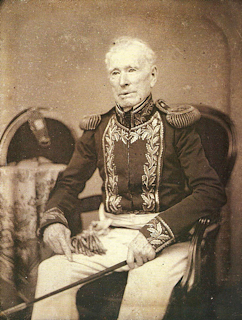
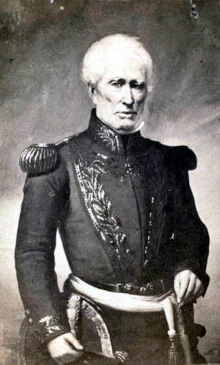
Brown is born on June 22, 1777, in Foxford, County Mayo. Comparatively little is known of his early life, and it has been suggested that he was illegitimate and took his mother’s surname and that his father’s surname was actually Gannon. He emigrates with his father to Baltimore, Maryland, in 1793, eventually settling in Philadelphia, Pennsylvania. A short time after their arrival, the friend who had invited them and offered them food and hospitality dies of yellow fever. Several days later, his father also succumbs to the same disease.
One morning, while Brown is wandering along the banks of the Delaware River, he meets the captain of a ship then moored in port. The captain inquires if he wants employment and Brown agrees. The captain engages him as a cabin boy, thereby setting him on the naval promotion ladder, where he works his way to the captaincy of a merchant ship. After ten years at sea, where he develops his skills as a sailor and reaches the rank of captain, Brown is press-ganged into a Royal Navy warship. British impressment of American sailors is one of the primary issues leading to the War of 1812.
During the Napoleonic Wars, Brown escapes the ship he is serving on, a galley, and scuttles the vessel. However, the French do not believe he had assisted them and imprison him in Lorient. On being transferred to Metz, he escapes, disguised in a French officer’s uniform. However, he is recaptured and is imprisoned in the fortress of Verdun. In 1809, he escapes from there in the company of a British Army officer named Clutchwell, and eventually reaches German territory.
Returning to England, Brown renounces his maritime career and on July 29, 1809, he marries Elizabeth Chitty, daughter of an English shipping magnate, in Kent. As he is a Catholic and she a Protestant, they agree to raise their sons as Catholics and their daughters as Protestants. Despite lengthy periods of enforced separation, they have nine children. He leaves the same year for the Río de la Plata on board Belmond and sets himself up as a merchant in Montevideo, Uruguay.
Late in 1811 Brown settles in Buenos Aires just as a criollo rebellion against Spanish colonial rule in Argentina is gaining strength. By April 1812, he is developing a coastal shipping business in fruit and hides. As the Spanish naval blockade of 1812–14 begins to choke trade, he is first commissioned by the patriot government as a privateer licensed to raid Spanish merchantmen, and then, on March 1, 1814, invited to take charge of a small rebel naval squadron to contest Spanish control of the Río de la Plata estuary. Leading a fleet of nineteen ships, he fixes with great speed on a set of wartime naval routines and signaling methods, and organises a system of discipline, founding the navy on principles that pay exceptional attention to the welfare of ordinary seamen.
In early March 1814, Brown shows personal courage and incisive skill in outwitting and defeating a more powerful Spanish force near Martín García Island, thereby dividing the Spanish blockade. A Spanish attempt in May 1814 to break his blockade of Montevideo is decisively crushed by him and his makeshift navy, and the Spanish strongholds on the Atlantic coast collapse, ending open war. In 1815 and 1816, however, he carries out skirmishing raids on military and commercial targets belonging to Spanish South American possessions, until detained by a British colonial governor in Barbados in July 1816 for alleged infringements of international rules of trade.
Illness, and a tortuous but ultimately successful appeal process, take up most of 1817–18, but when Brown returns to Argentina in October 1818, political enemies set in motion a prosecution for alleged disobedience of orders. Cashiered in August 1819, then restored in rank but forced to retire, he attempts suicide the following month. Convalescence and resumption of his trading concern occupies him for several years.
A repentant government renews Brown’s command of the navy in December 1825, when war breaks out with Brazil. Though vastly outnumbered by the Brazilian fleet, he shows audacity and great finesse in a number of successful engagements in the Plate estuary in 1826, roving up the Brazilian coast on occasion to create great confusion. In February 1827, he triumphs in a series of actions known as the Battle of Juncal. After another year of commercial privateering against the Brazilian merchant fleet, he is one of two delegates selected to sign peace terms with Brazil in October 1828.
Retiring from active service that month, Brown tries to remain neutral as civil war erupts in Argentina, but reluctantly accepts the post of governor of Buenos Aires under General Juan Lavalle from December 1828 to May 1829, when he resigns in disgust at government excesses. During 1829–37 he holds aloof from the despotic government of Juan Manuel de Rosas. After French and British encroachments on the region in the later 1830s, he offers to take charge of the navy again to protect national independence and is available to defend Argentine interests when war breaks out with a French-backed Uruguay in early 1841. Though exasperated by a long and “stupid war,” he blockades the Uruguayan navy effectively until French and British fleets intervene in July 1845 with overwhelming force to capture his squadron and bring the war to an end.
Idolised by the Argentinian population for his high-principled and humane advocacy of independent democracy, Brown passes his last years trading and farming a country estate. In late 1847, he journeys to Ireland, hoping to find relations in Mayo, and is shocked by the hunger and destitution of the Great Famine.
Brown dies on March 3, 1857, at his home in Buenos Aires and is buried with full military honours. The Argentine government issues a comuniqué: “With a life of permanent service to the national wars that our homeland has fought since its independence, William Brown symbolized the naval glory of the Argentine Republic.” During his burial, General Bartolomé Mitre famously says: “Brown in his lifetime, standing on the quarterdeck of his ship, was worth a fleet to us.” His grave is currently located in the La Recoleta Cemetery in Buenos Aires.
Britain’s enemies in Continental Europe have long recognised Ireland as a weak point in Britain’s defences. Landing troops there is a popular strategic goal, not only because an invader can expect the support of a large proportion of the native population, but also because at least initially they will face fewer and less reliable troops than elsewhere in the British Isles. Additionally, embroiling the British Army in a protracted Irish campaign will reduce its availability for other theatres of war. Finally, French planners consider that a successful invasion of Ireland might act as the ideal platform for a subsequent invasion of Great Britain.
Unaware of Humbert’s surrender, the French despatch reinforcements under the command of CommodoreJean-Baptiste-François Bompart on September 16. Having missed one invasion force, the Royal Navy is more watchful. Roving frigate patrols cruise off the principal French ports and in the approaches to Ireland, while squadrons of battleships from the Channel Fleet sail nearby, ready to move against any new invasion force. In command of the squadron on the Irish station is Commodore Sir John Borlase Warren, a highly experienced officer (and politician) who has made a name for himself raiding the French coast early in the war.
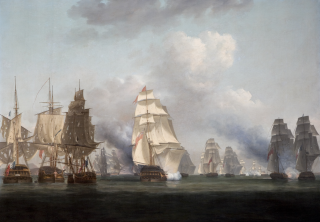
The squadron carrying the reinforcements is soon spotted after leaving Brest. After a long chase, the French are brought to battle in a bay off the rugged County Donegal coast in the west of Ulster, very close to Tory Island. During the action the outnumbered French attempt to escape, but are run down and defeated piecemeal, with the British capturing four ships and scattering the survivors. Over the next fortnight, British frigate patrols scour the passage back to Brest, capturing three more ships. Of the ten ships in the original French squadron, only two frigates and a schooner reach safety. British losses in the campaign are minimal.
The battle marks the last attempt by the French Navy to launch an invasion of any part of the British Isles. It also ends the last hopes the United Irishmen have of obtaining outside support in their struggle against the British. After the action, Wolfe Tone is recognised aboard the captured French flagship and arrested. He is brought ashore by the British at Buncrana, on the Inishowen peninsula. He is later tried for treason, convicted, and commits suicide while in prison in Dublin, hours before he is to be hanged.
(Pictured: Attack of the French Squadron under Monsr. Bompart Chef d’Escadre, upon the Coast of Ireland, by a Detachment of His Majesty’s Ships under the Command of Sir J. B. Warren, October 12, 1798, by Nicholas Pocock, 1799)





 seamus dubhghaill