seamus dubhghaill

Promoting Irish Culture and History from Little Rock, Arkansas, USA


Leave a comment

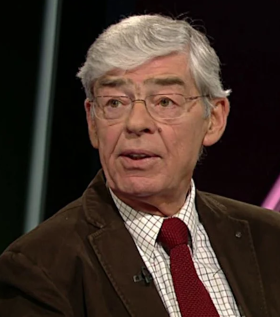
Birth of Alan Dukes, Former Fine Gael Politician

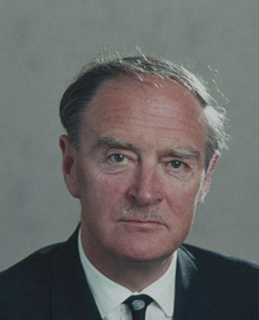
Alan Martin Dukes, former Fine Gael politician, is born in Drimnagh, Dublin, on April 20, 1945. He holds several senior government positions and serves as a Teachta Dála (TD) from 1981 to 2002. He is one of the few TDs to be appointed a minister on their first day in the Dáil.

His father, James F. Dukes, is originally from Tralee, County Kerry, and is a senior civil servant and the founding chairman and chief executive of the Higher Education Authority (HEA), while his mother is from near Ballina, County Mayo.

The Dukes family originally comes from the north of England. His grandfather serves with the Royal Engineers in World War I and settles in County Cork and then County Kerry afterward where he works with the Post Office creating Ireland’s telephone network.

Dukes is educated by the Christian Brothers at Coláiste Mhuire, Dublin, and is offered several scholarships for third level on graduation, including one for the Irish language. His interest in the Irish language continues to this day, and he regularly appears on Irish-language television programmes.

On leaving school he attends University College Dublin (UCD), where he captains the fencing team to its first-ever Intervarsity title.

Dukes becomes an economist with the Irish Farmers’ Association (IFA) in Dublin in 1969. After Ireland joins the European Economic Community (EEC) in 1973, he moves to Brussels where he is part of the IFA delegation. In this role, he is influential in framing Ireland’s contribution to the Common Agricultural Policy (CAP). He is appointed as chief of staff to Ireland’s EEC commissioner Richard Burke, a former Fine Gael politician.

In the 1979 European Parliament election, Dukes stands as a Fine Gael candidate in the Munster constituency. He has strong support among the farming community, but the entry of T. J. Maher, a former president of the IFA, as an independent candidate hurts his chances of election. Maher tops the poll.

He stands again for Fine Gael at the 1981 Irish general election in the expanded Kildare constituency, where he wins a seat in the 22nd Dáil. On his first day in the Dáil, he is appointed Minister for Agriculture by the Taoiseach, Garret FitzGerald, becoming one of only eight TDs so appointed. He represents Kildare for 21 years.

This minority Fine Gael–Labour Party coalition government collapses in February 1982 on the budget but returns to power with a working majority in December 1982. Dukes is again appointed to cabinet, becoming Minister for Finance less than two years into his Dáil career.

He faces a difficult task as finance minister. Ireland is heavily in debt while unemployment and emigration are high. Many of Fine Gael’s plans are deferred while the Fine Gael–Labour Party coalition disagrees on how to solve the economic crisis. The challenge of addressing the national finances is made difficult by electoral arithmetic and a lack of support from the opposition Fianna Fáil party led by Charles Haughey. He remains in the Department of Finance until a reshuffle in February 1986 when he is appointed Minister for Justice.

Fine Gael fails to be returned to government at the 1987 Irish general election and loses 19 of its 70 seats, mostly to the new Progressive Democrats. Outgoing Taoiseach and leader Garret FitzGerald steps down and Dukes is elected leader of Fine Gael, becoming Leader of the Opposition.

This is a difficult time for the country. Haughey’s Fianna Fáil runs on promises to increase spending and government services, and attacking the cutbacks favoured by Fine Gael. However, on taking office, the new Taoiseach and his finance minister Ray MacSharry immediately draw up a set of cutbacks including a spate of ward and hospital closures. This presents a political opportunity for the opposition to attack the government.

However, while addressing a meeting of the Tallaght Chamber of Commerce, Dukes announces, in what becomes known as the Tallaght Strategy that: “When the government is moving in the right direction, I will not oppose the central thrust of its policy. If it is going in the right direction, I do not believe that it should be deviated from its course, or tripped up on macro-economic issues.”

This represents a major departure in Irish politics whereby Fine Gael will vote with the minority Fianna Fáil Government if it adopts Fine Gael’s economic policies for revitalising the economy. The consequences of this statement are huge. The Haughey government is able to take severe corrective steps to restructure the economy and lay the foundations for the economic boom of the nineties. However, at a snap election in 1989, Dukes does not receive electoral credit for this approach, and the party only makes minor gains, gaining four seats. The outcome is the first-ever coalition government for Fianna Fáil, whose junior partner is the Progressive Democrats led by former Fianna Fáil TD Desmond O’Malley.

The party’s failure to make significant gains in 1989 leaves some Fine Gael TDs with a desire for a change at the top of the party. Their opportunity comes in the wake of the historic 1990 Irish presidential election. Fine Gael chooses Austin Currie TD as their candidate. He had been a leading member of the Northern Ireland Civil Rights Association (NICRA) movement in the 1960s and had been a member of the Social Democratic and Labour Party (SDLP) before moving south.

Initially, Fianna Fáil’s Brian Lenihan Snr is the favourite to win. However, after several controversies arise, relating to the brief Fianna Fáil administration of 1982, and Lenihan’s dismissal as Minister for Defence midway through the campaign, the Labour Party’s Mary Robinson emerges victorious. To many in Fine Gael, the humiliation of finishing third is too much to bear and a campaign is launched against Dukes’ leadership. He is subsequently replaced as party leader by John Bruton.

Bruton brings Dukes back to the front bench in September 1992, shortly before the November 1992 Irish general election. In February 1994, Dukes becomes involved in a failed attempt to oust Bruton as leader and subsequently resigns from the front bench. Bruton becomes Taoiseach in December 1994 and Dukes is not appointed to cabinet at the formation of the government.

In December 1996, Dukes returns as Minister for Transport, Energy and Communications following the resignation of Michael Lowry. At the 1997 Irish general election, he tops the poll in the new Kildare South constituency, but Fine Gael loses office. He becomes Chairman of the Irish Council of the European Movement. In this position, he is very involved in advising many of the Eastern European countries who are then applying to join the European Union.

In 2001, Dukes backs Michael Noonan in his successful bid to become leader of Fine Gael.

After 21 years, Dukes loses his Dáil seat at the 2002 Irish general election. This contest sees many high-profile casualties for Fine Gael, including Deputy Leader Jim Mitchell, former deputy leader Nora Owen and others. Many local commentators feel that Dukes’ loss is due to a lack of attention to local issues, as he is highly involved in European projects and has always enjoyed a national profile.

He retires from frontline politics in 2002 and is subsequently appointed Director General of the Institute of International and European Affairs. He remains active within Fine Gael and serves several terms as the party’s vice-president. From 2001 to 2011, he is President of the Alliance française in Dublin, and in June 2004, the French Government appoints him an Officer of the Legion of Honour. In April 2004, he is awarded the Commander’s Cross of the Order of Merit of the Republic of Poland.

In December 2008, Dukes is appointed by Finance Minister Brian Lenihan Jnr as a public interest director on the board of Anglo Irish Bank. The bank is subsequently nationalised, and he serves on the board until the Irish Bank Resolution Corporation (IBRC) is liquidated in 2013.

From 2011 to 2013, Dukes serves as chairman of the Board of Irish Guide Dogs for the Blind. In 2011, he founds the think tank Asia Matters, which inks an agreement with the Chinese People’s Association for Friendship with Foreign Countries in May 2019.

Dukes has lived in Kildare since first being elected to represent the Kildare constituency in 1981. His wife Fionnuala (née Corcoran) is a former local politician and serves as a member of Kildare County Council from 1999 until her retirement in 2009. She serves as Cathaoirleach of the council from 2006 to 2007, becoming only the second woman to hold the position in the body’s one-hundred-year history. They have two daughters.


Leave a comment

Birth of J. B. Malone, Hillwalking Enthusiast

John James Bernard (J. B.) Malone, an Irish hillwalking enthusiast who popularises the pastime through his television programmes and books, is born on December 13, 1913, in Leeds, West Yorkshire, England. He is responsible for the establishment of the Wicklow Way as a recognised walking trail, having first proposed it in 1966.

Malone is born to James Bernard Malone and his wife, Agnes (née Kenny), both from Dublin. He is raised mainly in England and completes his secondary education at the Marist Brothers College, Grove Ferry, Kent.

Malone moves to Ireland in 1931 where he finds employment in a builders’ providers firm and an insurance company before joining the Irish Army in 1940. There he becomes a cartographer in the intelligence section. In 1947, having left the army, he goes to work at the Department of Posts and Telegraphs as a draughtsman. He remains employed in the Irish civil service until his retirement in 1979. Also in 1947, he marries Margaret Garry, and they have three children.

Malone starts hillwalking in 1931 when he climbs Montpelier Hill to visit the ruins of the Hell Fire Club. Later, while on leave during his military career, he develops a detailed knowledge of walking routes throughout the hills of County Wicklow. He sits on the Board of An Taisce in Ireland from 1970 to 1974.

Following his retirement from the civil service, Malone is appointed as a field officer with the Long-Distance Walking Routes Committee of Cospóir, the Irish Sports Council. There, he negotiates rights of way with landowners to enable his vision of the Wicklow Way to become a reality. He first proposes a guided walking route through the Wicklow hills in 1966, although he had first raised the idea as early as 1942.

From 1938 to 1975 Malone contributes a regular column to the Evening Herald entitled Over the Hills. Between 1967 and 1968 he writes the column Know your Dublin, illustrated by Liam C. Martin. The column features information on a Dublin landmark and is later compiled into a book published in 1969.

During the 1960s, Malone presents a television documentary series on RTÉ entitled Mountain and Meadow, in which, accompanied by a cameraman, he introduces viewers to a variety of hill walks in Wicklow and surrounding counties. In 1980, he presents a one-hour TV programme on the newly opened Wicklow Way.

From 1950 to 1988, Malone writes several books on hillwalking in the Dublin Mountains and the Wicklow Mountains.

In 1980, Malone is made an honorary life member of An Óige, the Irish Youth Hostel Association (IYHA), in recognition of his contribution to promoting the Irish countryside.

Malone dies at the age of 75 on October 17, 1989, at St. James’s Hospital in Dublin. He is buried in Bohernabreena Cemetery, Tallaght, County Dublin.

Following his death in 1989, Malone’s contribution to hillwalking in Ireland is marked by the erection of the J.B. Malone Memorial Stone plaque in his honour on a section of the Wicklow Way overlooking Lough Tay.

In October 2014, on the 25th anniversary of Malone’s death, the South Dublin Libraries hold an exhibition on his life and work.

(Pictured: The John James Bernard Malone memorial, on the Wicklow Way overlooking Lough Tay and Luggala)


Leave a comment

Death of Stephen Lucius Gywnn, Writer & Politician

Stephen Lucius Gwynn, Irish journalist, biographer, author, poet and Protestant Nationalist politician, dies on June 11, 1950, at Terenure, Dublin. As a member of the Irish Parliamentary Party (IPP) he represents Galway Borough as its Member of Parliament from 1906 to 1918. He serves as a British Army officer in France during World War I and is a prominent proponent of Irish involvement in the Allied war effort. He founds the Irish Centre Party in 1919, but his moderate nationalism is eclipsed by the growing popularity of Sinn Féin.

Gwynn is born in St. Columba’s College in Rathfarnham, County Dublin, where his father John Gwynn (1827–1917), a biblical scholar and Church of Ireland clergyman, is warden. His mother, Lucy Josephine (1840–1907), is the daughter of the Irish nationalist William Smith O’Brien. He is the eldest of ten children (eight brothers and two sisters). Shortly after his birth the family moves to Ramelton in County Donegal to the parish where his father has been appointed parson. He later becomes Regius Professor of Divinity at Trinity College Dublin (TCD).

Gwynn spends his early childhood in rural County Donegal, which is to shape his later view of Ireland. He attends Brasenose College, Oxford, where, as scholar, in 1884 he is awarded first-class honours in classical moderations and in 1886 literae humaniores. During term holidays he returns to Dublin, where he meets several of the political and literary figures of the day.

After graduating, Gwynn spends ten years from 1886 tutoring as a schoolmaster, for a time in France, which creates a lifelong interest in French culture, as expressed in his Praise of France (1927). By 1896 he has developed an interest in writing, becoming a writer and journalist in London focused on English themes, until he comes into contact with the emerging Irish literary revival, when he serves as secretary of the Irish Literary Society.

This is the beginning of a long and prolific career as a writer covering a wide range of literary genres, from poetry and biographical subjects to general historical works. The eighteenth century is Gwynn’s particular specialism. He writes numerous books on travel and on the topography of his own homeland, as well as on his other interests: wine, eighteenth-century painting and fishing.

Gwynn returns to Ireland in 1904 when he enters politics. In the 1906 Galway Borough by-election he wins a seat for Galway Borough, which he represents as a member of the Irish Parliamentary Party until 1918. During this period, he is active in the Gaelic League and is one of the few Irish MPs to have close links to the Irish literary revival. Along with Joseph Maunsel Hone and George Roberts he founds the Dublin publishing house of Maunsel and Company. He is opposed to the demand for the Irish language to be a compulsory subject for matriculation. He supports the campaign which wins the establishment of a Catholic university when he serves on the Irish University Royal Commission in 1908. During the debate on the third Home Rule Bill, and at the request of his party leader John Redmond, he writes The case for Home Rule (1911) and is in charge of much of the party’s official publicity and its replies to criticism from Sinn Féin.

On the outbreak of World War I in August 1914, Gwynn strongly supports Redmond’s encouragement of Irish nationalists and the Irish National Volunteers to support the Allied and British war effort by enlisting in Irish regiments of the Irish Divisions, especially as a means to ensure the implementation of the suspended Home Rule Act at the end of an expectedly short war. Now over fifty, he enlists in January 1915 with the 7th Leinster Regiment in the 16th (Irish) Division. In July he is commissioned as a captain in the 6th (Service) Battalion, Connaught Rangers and serves with them on the Western Front at Messines, the Somme and elsewhere.

Gwynn is one of five Irish Nationalist MPs who enlist and serve in the army, the others being John L. Esmonde, Willie Redmond, William Redmond and D. D. Sheehan, as well as former MP Tom Kettle. Together with Kettle and William Redmond, he undertakes a recruitment drive for the Irish divisions, co-operating with Kettle on a collection of ballads called Battle Songs for the Irish Brigade (1915). He is made a chevalier of the Legion of Honour in July 1915. In 1916, he is appointed to the Dardanelles Commission.

Recalled to Ireland in late 1917 to participate in the Irish Convention chaired by Sir Horace Plunkett, Gwynn sides with the Redmondite faction of the Irish Party in supporting a compromise with the southern unionists in an attempt to reach consensus on a Home Rule settlement which would avoid partition. On the death of Redmond in March 1918, he takes over as leader of the moderate nationalists in the Convention. He opposes the threat of compulsory military service during the Conscription Crisis of 1918, though as a member of the Irish Recruiting Council he continues to support voluntary recruitment, encountering intense opposition led by Sinn Féin.

Gwynn forms the Irish Centre Party in 1919 and stands unsuccessfully as an Independent Nationalist for Dublin University in the 1918 Irish general election. The party merges with Plunkett’s Irish Dominion League to press for a settlement by consent on the basis of dominion status, but Gwynn subsequently breaks with Plunkett due to his willingness to accept partition as a temporary compromise. The polarities which divide Ireland during the Irish War of Independence and Irish Civil War increasingly sideline his brand of moderate cultural nationalism. Although he supports the newly emergent nation, he equally condemns some of the excesses, such as the burning of houses belonging to Free State senators.

Gwynn’s personal life also becomes complicated at this stage and around 1920. He has a romantic association with married artist Grace Henry who is perhaps the best-known female artist in Ireland at the time. During this period, he and Grace travel in France and Italy and at various stages in his life she painted portraits of him including a very distinguished looking one of him in his late 60s or early 70s. Their relationship contributes significantly to the separation of Henry from her artist husband Paul Henry in 1930.

During the 1920s, Gwynn also devotes himself to writing, covering political events as Irish correspondent to The Observer and The Times. Later in his career, he writes some substantial works, and together with his son Denis Gwynn (The Life of John Redmond, 1932) does much to shape the retrospective image and self-justification of John Redmond. In the mid-1930s he authors three books with a connecting theme of fishing with the artist Roy Beddington serving as illustrator: The Happy Fisherman (1936), From River to River (1937), and Two in a Valley (1938).

Gwynn is awarded an honorary D.Litt. by the National University of Ireland in 1940, and a Litt.D. by the University of Dublin in 1945. The Irish Academy of Letters awards him the Gregory Medal in April 1950. In his literary writings he stands for a humanism and tolerance, which qualities, due to political upheavals, were relatively rare in the Ireland of his day.

Gwynn dies on June 11, 1950, at his home in Terenure, Dublin, and is buried at Tallaght Cemetery, south County Dublin.

Gwynn marries his cousin Mary Louisa (d. 1941), daughter of Rev. James Gwynn. She later converts to Catholicism. They have three sons and two daughters who are brought up in her religion, of whom Aubrey (1892–1983) becomes a Jesuit priest and professor of medieval history at University College Dublin (UCD). Their second son, Denis Rolleston (1893–1971), is professor of modern Irish history at University College Cork (UCC).

Gwynn’s brother Edward John (1868–1941) becomes provost of Trinity College and another brother Robert Malcolm becomes its senior dean. His sister Lucy Gwynn is the first woman registrar of Trinity. A third brother, Charles, has a successful career in the British Army and retires as a Major General. Younger brothers Lucius and Jack are noted cricketers.


Leave a comment

Death of Father Austin Flannery

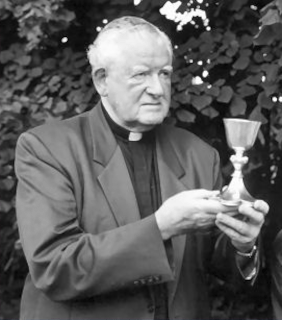
Fr. Austin Flannery OP, was a Dominican priest, scholar, editor, journalist and social justice campaigner, dies of a heart attack at Kiltipper Woods Care Centre, Dublin, on October 21, 2008.

Born William “Liam” Flannery at Rearcross, County Tipperary, on January 10, 1925, he is the eldest of seven children produced by William K. Flannery and his wife Margaret (née Butler), merchants, publicans and hoteliers there and later at New Ross, County Wexford. After national school in Rearcross, he is educated at St. Flannan’s College in Ennis, County Clare, completing his secondary education at Newbridge College, Newbridge, County Kildare, a Dominican institution where he revels in an environment spurring independent thinking.

Flannery joins the Dominican Order in 1943, making his first profession in September 1944. After studies in theology at St. Mary’s Priory, Tallaght, County Dublin, and then at Blackfriars Hall, Oxford, he is ordained a Catholic priest on September 2, 1950, and adopts the forename Austin. He continues his studies at the Pontifical University of Saint Thomas Aquinas in Rome where he is awarded a doctorate in dogmatic theology. After his studies he teaches theology at Glenstal Abbey, County Limerick, for two years in the mid-1950s, before returning to Newbridge College for a year to teach Latin.

Flannery edits the Dominican bi-monthly journal entitled Doctrine and Life from 1958 to 1988, while at St. Saviour’s Priory, Dublin, where he also serves as prior from 1957 to 1960. He also edits the Religious Life Review. During and after the Second Vatican Council he makes available in English all the documents from the event.

Flannery’s campaigning to end apartheid in South Africa leads to involvement with Kader Asmal, and the founding the Irish Anti-Apartheid Movement, of which he serves as chairman and president. In the late sixties his campaigning on behalf of the Dublin Housing Action Committee, due to its association with republicans and left-wing activists, leads him to being accused of being a communist. He is dismissed in the Dáil by the then Minister for Finance, Charles Haughey, as “a gullible cleric.”

From August 1969, Flannery is a member of the executive committee of the Northern Relief Coordination Committee, raising funds on behalf of the families of those interned without trial in Northern Ireland during the early 1970s.

Flannery embodies the post-Vatican II conception of the priest as a social catalyst engaged by the gospel, closer to his flock than to the clerical hierarchy. He has a great gift for friendship, is indefatigably interested in people, and courts religious affairs commentators and journalists at a time when the hierarchy ignores them, magnifying his influence.

Flannery dies of a heart attack on October 21, 2008, at Kiltipper Woods Care Centre, Dublin. Following a funeral mass at St. Saviour’s Priory, he is buried in the Dominican plot at Glasnevin Cemetery, Dublin, on October 24, 2008.


Leave a comment

Birth of Father Austin Flannery

Father Austin (Liam) Flannery OP, Dominican priest, editor, publisher and social justice campaigner is born Liam Flannery at Rearcross, County Tipperary, on January 10, 1925.

Flannery is the eldest of seven children produced by William K. Flannery and his wife Margaret (née Butler). He is educated at St. Flannan’s College in Ennis, County Clare, completing his secondary education at Dominican College Newbridge in Newbridge, County Kildare.

Flannery joins the Dominican Order in September 1944, leading to studies in theology at St. Mary’s Dominican Priory in Tallaght, Dublin, and then at Blackfriars Priory in Oxford, England. Joining the Dominicans he chooses the name Austin and is ordained a priest in 1950. He continues his studies at the Pontificium Athenaeum Internationale Angelicum in Rome. After his studies he teaches Latin at Newbridge College in Newbridge, County Kildare, and then theology at Glenstal Abbey in Murroe, County Limerick.

Flannery edits the Dominican bi-monthly journal entitled Doctrine and Life from 1958 to 1988, while at St. Saviour’s Priory, Dublin, where he also serves as prior from 1957 to 1960. He also edits the Religious Life Review. He publishes many English language documents on the Second Vatican Council.

Flannery’s campaigning to end apartheid in South Africa leads to involvement with Kader Asmal, and the founding the Irish Anti-Apartheid Movement, of which he serves as chairman and president. In the late 1960s his campaigning on behalf of the Dublin Housing Action Committee, due to its association with republicans and left-wing activists, leads him to being accused of being a communist. He is dismissed in the Dáil by the then Minister for Finance, Charles Haughey, as “a gullible cleric.”

Flannery dies of a heart attack at the age of 83 on October 21, 2008. He is buried in the Dominican plot at Glasnevin Cemetery in Glasnevin, Dublin.


Leave a comment

Birth of Caitlín Maude, Poet, Actress & Singer

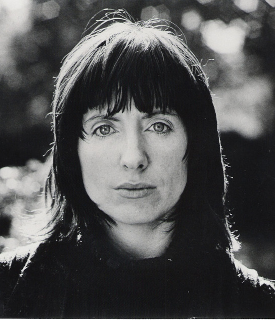
Caitlín Maude, Irish poet, activist, teacher, actress and traditional singer, is born in Casla, County Galway on May 22, 1941.

Maude is reared in the Irish language. Her mother, Máire Nic an Iomaire, is a school teacher from Ballyfinglas. She receives her primary education from her mother on a small island off the coast of Rosmuc, Connemara. Her father, John Maude, is from Cill Bhriocáin in Rosmuc. She attends University College Galway, where she excels in French. She becomes a teacher, working in schools in Counties Kildare, Mayo, and Wicklow. She also works in other capacities in London and Dublin.

Maude is widely praised as an actor. She acts at the University, at An Taibhdhearc in Galway and the Damer in Dublin, and is particularly successful in a production of An Triail by Máiréad Ní Ghráda in 1964, in which she plays the protagonist of the story, Máire Ní Chathasaigh. She herself is a playwright and co-authors An Lasair Choille with poet Michael Hartnett.

Maude begins writing poetry in Irish in secondary school and develops a lyrical style closely attuned to the rhythms of the voice. Though not conventionally religious, she says in an interview that she has a deep interest in the spiritual and that this leaves its mark on her poetry. She is noted as a highly effective reciter of her own verse. Géibheann is the best-known of her poems, and is studied at Leaving Certificate Higher Level Irish in the Republic of Ireland. A posthumous collected edition, Caitlín Maude, Dánta, is published in 1984, Caitlín Maude: file in 1985 in Ireland and Italy, and Coiscéim in 1985.

As a member of the Dublin Irish-speaking community Maude is active in many campaigns, including the establishment of the Gaelscoil (Irish-medium primary school) Scoil Santain in Tallaght, County Dublin.

Maude is a sean-nós singer of distinction. She makes one album in this genre, Caitlín, released in 1975 on Gael Linn Records and now available as a CD. It contains both traditional songs and a selection of her poetry.

Maude marries Cathal Ó Luain in 1969. They have one child, their son Caomhán.

Maude dies of complications from cancer at the age of 41 on June 6, 1982. She is buried in Bohernabreena graveyard overlooking the city on the Dublin Mountains.

In 2001, a new writers’ centre in Galway, Ionad Schribhneoiri Chaitlin Maude, Gaillimh, is named in her memory.


Leave a comment

Death of Liam Cosgrave, 6th Taoiseach of Ireland

liam-cosgrave

Liam Cosgrave, politician who serves as Taoiseach from February 1973 to July 1977, dies at the age of 97 in Tallaght, Dublin on October 4, 2017. He is the longest-lived Taoiseach, dying at the age of 97 years, 174 days.

Born in Castleknock, Dublin on April 13, 1920, Cosgrave is the son of William Thomas Cosgrave, the first President of the Executive Council and head of the government of the Irish Free State during the first 10 years of its existence (1922–32). He is educated at Castleknock College, Dublin, studies law at King’s Inns and is called to the Irish bar in 1943. In that same year he enters Dáil Éireann (the lower house of the Oireachtas, the Irish parliament), and he retains his seat until his retirement from politics in 1981.

In 1948, when the first inter-party government replaces Éamon de Valera’s Fianna Fáil regime, which had been in power for the previous 16 years, Cosgrave becomes Parliamentary Secretary to the Taoiseach and to the Minister for Industry and Commerce. It is a short-lived administration, going out of power in 1951 after three years of rule. But in a second inter-party government (1954–57), he becomes Minister for External Affairs and leads the first Irish delegation to the United Nations General Assembly in 1956.

Cosgrave succeeds James Dillon as leader of the Fine Gael party in 1965. Eight years later, as leader of a coalition government in which Fine Gael combines forces with the Labour Party, he becomes Taoiseach. He and British Prime Minister Edward Heath are the main participants in the intergovernmental conference at Sunningdale in December 1973 that gives birth to Northern Ireland’s first, though short-lived, power-sharing executive (1973–74). A devout Roman Catholic, he is intensely conservative on social issues and shocks his cabinet colleagues by voting against his own government’s bill on liberalizing the sale of contraceptives in 1974. The National Coalition is defeated in the 1977 Irish general election, largely on the economic issues of inflation and unemployment.

Cosgrave retires at the 1981 Irish general election. In 1981, he retires as Dáil Deputy for Dún Laoghaire to be replaced by his son, Liam T. Cosgrave. He reduces his involvement in public life but makes occasional appearances and speeches.

Liam Cosgrave dies on October 4, 2017, at the age of 97 of natural causes. He had been at Tallaght Hospital for several months prior to his death there. His funeral is held on October 7, 2017, after which he is interred alongside his father at Inchicore‘s Goldenbridge Cemetery.


Leave a comment

Birth of Luke Kelly, Founding Member of The Dubliners

luke-kelly

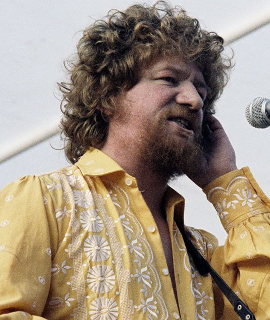
Luke Kelly, singer, folk musician and actor, is born into a working-class family in Lattimore Cottages at 1 Sheriff Street, Dublin on November 17, 1940. He is noted as a founding member of the band The Dubliners.

After Dublin Corporation demolished Lattimore Cottages in 1942, the Kellys become the first family to move into the St. Laurence O’Toole flats, where Luke spends the bulk of his childhood, although the family is forced to move by a fire in 1953 and settles in the Whitehall area.

Kelly is interested in music during his teenage years and regularly attends cèilidh with his sister Mona and listens to American vocalists including Fats Domino, Al Jolson, Frank Sinatra and Perry Como. He also has an interest in theatre and musicals, being involved with the staging of plays by Dublin’s Marian Arts Society. The first folk club he comes across is in the Bridge Hotel, Newcastle upon Tyne in early 1960. Having already acquired the use of a banjo, he starts memorising songs.

Kelly befriends Sean Mulready in Birmingham and lives in his home for a period. Mulready is a teacher who is forced from his job in Dublin because of his communist beliefs. Mulready’s brother-in-law, Ned Stapleton, teaches Kelly “Rocky Road to Dublin.” During this period he studies literature and politics under the tutelage of Mulready, his wife Mollie, and Marxist classicist George Derwent Thomson.

In 1961 there is a folk music revival or “ballad boom,” as it is later termed, in waiting in Ireland. Kelly returns to Dublin in 1962. A concert John Molloy organises in the Hibernian Hotel leads to his “Ballad Tour of Ireland” with the Ronnie Drew Ballad Group. This tour leads to the Abbey Tavern and the Royal Marine Hotel and then to jam-packed sessions in the Embankment, Tallaght. Ciarán Bourke joins the group, followed later by John Sheahan. They rename themselves The Dubliners at Kelly’s suggestion, as he is reading James Joyce‘s book of short stories, entitled Dubliners, at the time. Kelly is the leading vocalist for the group’s eponymous debut album in 1964, which includes his rendition of “Rocky Road to Dublin.”

In 1964 Kelly leaves the group for nearly two years and is replaced by Bob Lynch and John Sheahan. Kelly goes with Deirdre O’Connell, founder of the Focus Theatre, to whom he marries the following year, back to London and becomes involved in Ewan MacColl‘s “gathering.”

When Bob Lynch leaves The Dubliners, John Sheahan and Kelly rejoin. The ballad boom in Ireland is becoming increasingly commercialised with bar and pub owners building ever larger venues for pay-in performances. Ewan MacColl and Peggy Seeger on a visit to Dublin express concern to Kelly about his drinking.

The arrival of a new manager for The Dubliners, Derry composer Phil Coulter, results in a collaboration that produces three of Kelly’s most notable performances: “The Town I Loved So Well”, “Hand Me Down My Bible“, and “Scorn Not His Simplicity”, a song about Phil’s son who had Down Syndrome. Kelly remains a politically engaged musician, becoming a supporter of the movement against South African apartheid and performing at benefit concerts for the Irish Travellers community.

Kelly’s health deteriorates in the 1970s. During a concert in the Cork Opera House on June 30, 1980 he collapses on the stage. He had already suffered for some time from migraines and forgetfulness which had been ascribed to his intense schedule, alcohol consumption, and “party lifestyle.” A brain tumor is diagnosed. Although he tours with the Dubliners after enduring an operation, his health deteriorates further. He forgets lyrics, has to take longer breaks in concerts due to weakness and becomes more withdrawn. In the autumn of 1983 he has to leave the stage in Traun, Austria and again in Mannheim, Germany. Shortly after this, he has to cancel the tour of southern Germany and, after a short stay in hospital in Heidelberg, he is flown back to Dublin.

After another operation Kelly spends Christmas with his family but is taken to hospital again in the New Year, where he dies on January 30, 1984. His funeral in Whitehall attracts thousands of mourners from across Ireland. His gravestone in Glasnevin Cemetery, Dublin, bears the inscription: Luke Kelly – Dubliner.


Leave a comment

Birth of Thomas Burke, Irish Dominican Preacher

thomas-nicholas-burke-statue

Thomas Nicholas Burke, Irish Dominican preacher, is born in Galway, County Galway on September 8, 1830.

Burke’s parents, though in moderate circumstances, gave him a good education. He studies at first under the care of the Patrician Brothers and is afterwards sent to a private school. An attack of typhoid fever when he is fourteen years old, and the famine year of 1847 have a sobering effect. Toward the end of that year, he asks to be received into the Order of Preachers and is sent to Perugia in Italy to make his novitiate. On December 29, he is clothed there in the habit of St. Dominic and receives the name of Thomas.

Shortly afterward Burke is sent to Rome to begin his studies at the College of St. Thomas, the future Pontifical University of Saint Thomas Aquinas, where he is a student of philosophy and theology. He passes thence to the Roman convent of Santa Sabina. His superiors send him, while yet a student, as novice-master to Woodchester, the novitiate of the resuscitated English Province. He is ordained into the priesthood on March 26, 1853. On August 3, 1854, he defends publicly the theses in universâ theologiâ. He is made lector at the College of St. Thomas in 1854.

Early in the following year Burke is recalled to Ireland to found the novitiate of the Irish Province at Tallaght, near Dublin. In 1859 he preaches his first notable sermon on “Church Music.” It immediately lifts him into fame.

Elected Prior of Tallaght in 1863, Burke goes to Rome the following year as Rector of the Dominican Convent of San Clemente and attracts great attention by his preaching. He returns to Ireland in 1867 and delivers his oration on Daniel O’Connell at Glasnevin before fifty thousand people.

Bishop Leahy takes him as his theologian to the First Vatican Council in 1870, and the following year he is sent as Visitor to the Dominican convents in America. He is besieged with invitations to preach and lecture. The seats are filled hours before he appears, and his audiences overflow the churches and halls in which he lectures. In New York City he delivers the discourses in refutation of the English historian James Anthony Froude.

In an eighteen-month period Burke gives four hundred lectures, exclusive of sermons, with the proceeds amounting to nearly $400,000. His mission is a triumph, but the triumph is dearly won. When he arrives in Ireland on March 7, 1873, he is spent and broken.

During the next decade Burke preaches in Ireland, England, and Scotland. He begins the erection of the church in Tallaght in 1883, and the following May preaches a series of sermons in the new Dominican church, London. In June he returns to Tallaght in a dying condition and preaches his last sermon in the Jesuit church, Dublin, in aid of the starving children of Donegal. A few days afterwards, on July 2, 1882, he dies. He is buried in the church of Tallaght, now a memorial to him.

(Pictured: Statue of Thomas Nicholas Burke by John Francis Kavanagh by Nimmo’s Pier in Galway)


Leave a comment

Birth of Conor McGregor, Mixed Martial Artist & Boxer

conor-mcgregor

Conor Anthony McGregor, Irish professional mixed martial artist and boxer, is born on July 14, 1988 in Crumlin, Dublin. He is the former Ultimate Fighting Championship (UFC) featherweight and lightweight champion. He has also competed as a welterweight in mixed martial arts (MMA), and light middleweight in boxing. He is #3 on the UFC’s pound for pound rankings.

McGregor is raised in Crumlin and attends a Gaelscoil and Gaelcholáiste at both primary and at secondary level in Coláiste de hÍde in Tallaght, where he also develops his passion for sport playing association football. In his youth, he plays football for Lourdes Celtic Football Club. At the age of 12, he also begins boxing at Crumlin Boxing Club.

In 2006, McGregor moves with his family to Lucan, Dublin, attending Gaelcholáiste Coláiste Cois Life. Following that, he commences a plumbing apprenticeship. While in Lucan, he meet future UFC fighter Tom Egan and they soon start training mixed martial arts (MMA) together.

McGregor starts his MMA career in 2008 and, in 2012, he wins both the Cage Warriors Featherweight and Lightweight Championships, holding both titles simultaneously before vacating them to sign with the UFC. In 2015, at UFC 194, he defeats José Aldo for the UFC Featherweight Championship via knockout thirteen seconds into the first round, which is the fastest victory in UFC title fight history. Upon defeating Eddie Alvarez for the UFC Lightweight Championship at UFC 205, McGregor becomes the first fighter in UFC history to hold titles in two weight divisions simultaneously.

McGregor begins his professional boxing career in 2017. In his debut boxing match, he is defeated by Floyd Mayweather, Jr.

McGregor is the biggest pay-per-view (PPV) draw in MMA history, having headlined four out of the six highest-selling UFC pay-per-view events. His headline bout with Nate Diaz at UFC 202 drew 1.65 million PPV buys, the most ever for an MMA event. His boxing match with Mayweather drew 4.3 million PPV buys in North America, the second most in history.