seamus dubhghaill

Promoting Irish Culture and History from Little Rock, Arkansas, USA


Leave a comment

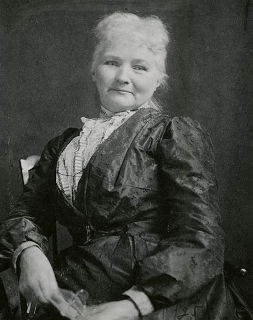
Death of Mary Harris “Mother” Jones, Union Organizer & Activist

Mary G. Harris Jones, known as Mother Jones, an Irish-born American schoolteacher and dressmaker who becomes a prominent union organiser, community organiser, and activist, dies in Silver Spring, Maryland, on November 30, 1930. She is once deemed “the most dangerous woman in America” because of her union activities.

Jones is the daughter of Richard Harris, a Roman Catholic tenant farmer and railway labourer, and Ellen (née Cotter) Harris. She is baptised on August 1, 1837, in Cork, County Cork. Her exact date of birth is uncertain. She and her family are victims of the Great Famine, as are many other Irish families of the time. The famine forces more than a million families, including the Harrises, to immigrate to North America when she is ten years old. She lives in the United States and Canada, where she attends and later teaches in a Roman Catholic normal school in Toronto. In the United States she teaches in a convent school in Monroe, Michigan and works as a seamstress. In 1861 she marries George Jones, an iron-moulder and labour union member in Memphis, Tennessee. After the death of her husband and their four children in a yellow fever epidemic in 1867, she relocates to Chicago, Illinois, where she becomes involved with an early industrial union, the Knights of Labor. Her seamstress shop is destroyed in the Great Chicago Fire of 1871.

In the 1890s Jones becomes known as ‘Mother’ Jones and begins a long association with socialist causes and the United Mine Workers of America. She attends the founding convention of Social Democracy of America, later known as the Cooperative Brotherhood, in 1897 and in the same year organises support and publicity for striking bituminous coal miners in West Virginia, including a children’s march and parades of farmers delivering food to the miners’ camp. These types of defiant mass action become her trademark. Notable activities include organising women in support of an 1899 anthracite coal strike in eastern Pennsylvania, directing strikes of young women working in textile mills, a 1903 ‘children’s crusade’ against child labour which includes a ninety-mile march from Philadelphia to New York City, participating in 1905 in the founding convention of the Industrial Workers of the World, a radical labour union committed to the organisation of unskilled workers, campaigning for the release of Mexican revolutionaries imprisoned in American jails, and testifying in 1915 in congressional hearings against the abuse of corporate power by Rockefeller interests.

Jones reportedly meets with James Connolly, Irish socialist and labour organiser, in New York City in 1910. She is arrested for the first time for violating a federal injunction during a miners’ strike in West Virginia in 1902. In 1904, during a Colorado miners’ campaign, she has to avoid the authorities to escape possible deportation. During a 1914 strike in Ludlow, Colorado, she is imprisoned without trial for nine weeks. In 1919 she is arrested in Pennsylvania during a steelworkers’ strike for defending freedom of speech and the right of workers to organise unions. She remains active in the labour movement and radical causes into her nineties.

During her later years, Jones lives with her friends Walter and Lillie May Burgess on their farm in what is now Adelphi, Maryland. She celebrates her self-proclaimed 100th birthday there on May 1, 1930, and is filmed making a statement for a newsreel.

Jones dies on November 30, 1930, at the Burgess farm then in Silver Spring, Maryland, though now part of Adelphi. There is a funeral Mass at St. Gabriel’s Catholic Church in Washington, D.C. She is buried in the Union Miners Cemetery in Mount Olive, Illinois, alongside miners who died in the 1898 Battle of Virden.

In 1932, about 15,000 Illinois mine workers gather in Mount Olive to protest against the United Mine Workers, which soon becomes the Progressive Mine Workers of America. Convinced that they have acted in the spirit of Mother Jones, the miners decide to place a proper headstone on her grave. By 1936, the miners have saved up more than $16,000 and are able to purchase “eighty tons of Minnesota pink granite, with bronze statues of two miners flanking a twenty-foot shaft featuring a bas-relief of Mother Jones at its center.” On October 11, 1936, also known as Miners’ Day, an estimated 50,000 people arrive at Mother Jones’s grave to see the new gravestone and memorial. Since then, October 11 is not only known as Miners’ Day but is also referred to and celebrated in Mount Olive as “Mother Jones’s Day.”

The farm where she died begins to advertise itself as the “Mother Jones Rest Home” in 1932, before being sold to a Baptist church in 1956. The site is now marked with a Maryland Historical Trust marker, and a nearby elementary school is named in her honor.

Leave a comment

The Battle of Chickamauga

On September 19, 1863, the 5th Confederate Infantry, consisting of a large number of Irish from Memphis, fight in one of the bloodiest battles of the American Civil War at Chickamauga, Georgia. One of the commanders is Cork-born Patrick Cleburne whom historians universally recognize as one of the most capable officers on either side during the awful conflict, although Chickamauga might not have been his finest hour. Cleburne is known as the “Stonewall of the West.” He is one of six Confederate generals to die in the Battle of Franklin.

The Battle of Chickamauga marks the end of a Union Army offensive, the Chickamauga campaign, in southeastern Tennessee and northwestern Georgia. It is the first major battle of the war fought in Georgia, the most significant Union Army defeat in the Western Theater, and involves a high number of casualties, second only to the casualties suffered at the Battle of Gettysburg.

The battle is fought between the Army of the Cumberland, one of the principal Union armies in the Western Theater, under Major General William Rosecrans and the Confederate Army of Tennessee under General Braxton Bragg and is named for Chickamauga Creek. The West Chickamauga Creek meanders near and forms the southeast boundary of the battle area and the park in northwest Georgia. The South Chickamauga ultimately flows into the Tennessee River about 3.5 miles northeast of downtown Chattanooga.

After his successful Tullahoma campaign, Rosecrans renews the offensive, aiming to force the Confederates out of Chattanooga. In early September, he consolidates his forces scattered in Tennessee and Georgia and forces Bragg’s army out of Chattanooga, heading south. The Union troops follow it and brush with it at Davis’s Cross Roads. Bragg is determined to reoccupy Chattanooga and decides to meet a part of Rosecrans’s army, defeat it, and then move back into the city. On September 17 he heads north, intending to attack the isolated XXI Corps. As Bragg marches north on September 18, his cavalry and infantry fight with Union cavalry and mounted infantry, which are armed with Spencer repeating rifles. The two armies fight at Alexander’s Bridge and Reed’s Bridge, as the Confederates try to cross the West Chickamauga Creek.

Fighting begins in earnest on the morning of September 19. Bragg’s men strongly assault but cannot break the Union Army line. The next day, Bragg resumes his assault. In late morning, Rosecrans is misinformed that he has a gap in his line. In moving units to shore up the supposed gap, Rosecrans accidentally creates an actual gap directly in the path of an eight-brigade assault on a narrow front by Confederate Lieutenant General James Longstreet, whose corps has been detached from the Army of Northern Virginia. In the resulting rout, Longstreet’s attack drives one-third of the Union Army, including Rosecrans himself, from the field.

Union Army units spontaneously rally to create a defensive line on Horseshoe Ridge (“Snodgrass Hill“), forming a new right wing for the line of Major General George H. Thomas, who assumes overall command of remaining forces. Although the Confederates launch costly and determined assaults, Thomas and his men hold until twilight. Union forces then retire to Chattanooga while the Confederates occupy the surrounding heights, besieging the city.

Thomas withdraws the remainder of his units to positions around Rossville Gap after darkness falls. The Army of Tennessee camps for the night, unaware that the Union Army has slipped from their grasp. Bragg is not able to mount the kind of pursuit that would be necessary to cause Rosecrans significant further damage. Many of his troops had arrived hurriedly at Chickamauga by rail, without wagons to transport them, and many of the artillery horses had been injured or killed during the battle. The Tennessee River is now an obstacle to the Confederates and Bragg has no pontoon bridges to affect a crossing. Bragg’s army pauses at Chickamauga to reorganize and gather equipment lost by the Union Army. Although Rosecrans had been able to save most of his trains, large quantities of ammunition and arms are left behind.

Army of Tennessee historian Thomas L. Connelly has criticized Bragg’s performance, claiming that for over four hours on the afternoon of September 20, he missed several good opportunities to prevent the Union escape, such as by a pursuit up the Dry Valley Road to McFarland’s Gap, or by moving a division to the north to seize the Rossville Gap or McFarland’s Gap via the Reed’s Bridge Road.

The battle is damaging to both sides in proportions roughly equal to the size of the armies: Union losses are 16,170 (1,657 killed, 9,756 wounded, and 4,757 captured or missing), Confederate losses are 18,454 (2,312 killed, 14,674 wounded, and 1,468 captured or missing). Among the dead are Confederate generals Benjamin Hardin Helm (husband of Abraham Lincoln‘s sister-in-law), James Deshler, and Preston Smith, and Union general William H. Lytle. Confederate general John Bell Hood, who had already lost the use of his left arm from a wound at Gettysburg, is severely wounded with a bullet in his leg, requiring it to be amputated. Although the Confederates are technically the victors, driving Rosecrans from the field, Bragg did not achieve his objectives of destroying Rosecrans or of restoring Confederate control of East Tennessee, and the Confederate Army suffers casualties that they can ill afford.


Leave a comment

Birth of Thomas Paterson, Historian & Museum Curator

Thomas George Farquhar Paterson, local historian, folklore collector and museum curator, is born on February 29, 1888, in or near Toronto, Ontario, Canada.

Paterson is the eldest child in a family of seven sons and one daughter born to John and Rachel (née Farquhar) Paterson. His parents had emigrated from County Armagh, in what is now Northern Ireland. Their first three children are born in Canada, but the family returns to Ireland in the early 1890s, to the family farm in Cornascreeb, five miles south of Portadown, County Armagh. Also known as George, he attends Aghory national school, and leaves at age 14 to be apprenticed to a grocer in Portadown. In 1911, he takes a position in Couser’s, the leading grocery and wine merchant’s business in Armagh. In time becoming the manager, he is acquainted with the local gentry and clergy.

However, the grocery trade is never Paterson’s main interest. From an early age, he is fascinated by the history and folklore of his native place. He becomes an expert on the genealogy of the gentry as well as of the farming families around Armagh, and also collects material on many aspects of Armagh life. His notebooks eventually contain well over a million words of notes on history, archaeology, dialect, folkways and natural history, as well as drawings and plans of traditional houses, fireside accoutrements and farm implements. His knowledge of history, archaeology and natural history is widely recognised, and in 1931 Armagh County Council asks him to become honorary curator of the small museum established by the Armagh Natural History and Philosophical Society. Four years later, he leaves Couser’s and becomes full-time curator of the museum, re-named the Armagh County Museum. He greatly augments and improves the collections, and in the late 1950s oversees the enlargement of the building. His life’s work culminates in the opening of the new building in 1962. He retires a year later at the age of 75.

Paterson’s work wins the respect of scholars, including Emyr Estyn Evans, a lifelong friend, and material that he records has been cited in a wide variety of books and journal articles. Over one hundred citations are listed in a posthumous bibliography in 1972, and since then hundreds of scholarly works have drawn on his published and unpublished material. His manuscripts are in Armagh County Museum, where they form an important resource.

Paterson publishes a book, Country Cracks: Old Tales from the County of Armagh (1939), and a very large number of articles in newspapers and journals, especially in Seanchas Ardmhacha, Ulster Journal of Archaeology and Ulster Folklife. He sometimes uses the pseudonym “Cornascreeb.” He greatly assists researchers interested in the Armagh background of Alexander Campbell and his father Thomas Campbell and is made an honorary member of the Disciples of Christ Historical Society, based in Nashville, Tennessee.

Paterson is a founder member of the committee that re-establishes the Ulster Journal of Archaeology. He is active in local history societies, and for many years is a member of the Ancient Monuments Advisory Council. He records many local sites for the register of ancient monuments. He is a member of the Northern Ireland committee of the National Trust and seeks to preserve Armagh’s architectural heritage and local industrial archaeology. He donates much important archive material to the Public Record Office of Northern Ireland. He describes and collects folk artefacts, at least thirty years before most academic historians are interested in such objects, and he is a foundation trustee of the Ulster Folk Museum in Cultra, County Down. He is also a member of the first board of the Institute of Irish Studies in Queen’s University Belfast (QUB), from 1965.

Membership of the Royal Irish Academy is an honour not often accorded to someone who has not had a university education, still less to someone who leaves school at the age of 14, but Paterson is elected MRIA in 1941. He is conferred with an honorary MA by QUB in 1944. His service on many public bodies is acknowledged by the award of an Order of the British Empire (OBE).

Paterson never marries and dies in Armagh on April 6, 1971. Hundreds of people contribute to a memorial fund. Some of the money subscribed is used to purchase nineteenth-century drawings for the county museum, and in 1975 the memorial committee also publishes Harvest home: the last sheaf: a selection from the writings of T. G. F. Paterson relating to County Armagh, edited by Emyr Estyn Evans.


Leave a comment

Patrick Cleburne Commands Brigade at the Battle of Perryville

On October 8, 1862, Irish-born Confederate Brigadier General Patrick Cleburne commands a brigade at the Battle of Perryville, (Kentucky) in the American Civil War. His brigade is part of the army of General Braxton Bragg. Encouraged by Jefferson Davis, Bragg invades Kentucky in August. On August 30, at the Battle of Richmond, Cleburne receives a very painful injury when a ball passes through his open mouth and out his left cheek, taking several teeth with it. However, less than a month later, he is back with his command in time for the crucial battle at Perryville.

The largest and last major battle of the Confederate Heartland Offensive (Kentucky Campaign), the Battle of Perryville, pits Bragg’s Confederate army against General Don Carlos Buell‘s Union army. While Bragg wins the battle tactically, Confederate forces retreat from the battlefield and end the campaign, leaving Kentucky under Union control for the rest of the war.

In conjunction with General Edmund Kirby Smith, Bragg invades the Commonwealth of Kentucky in August 1862. While the Confederate forces see early success in the Battles of Richmond and Munfordville, they ultimately are unable to achieve their larger goal of taking control of the state. By late October, Bragg and Smith’s armies retreat into Tennessee.

On October 7, 1862, the 55,000-man Union Army of the Ohio under the command of General Buell converges on the small crossroads town of Perryville, Kentucky, in three columns. Union forces first skirmish with Confederate cavalry on the Springfield Pike before the fighting continues on Peters Hill as the gray-clad infantry arrive. Based on the intelligence Bragg receives from his cavalry, he believes that he faces only a small portion of General Buell’s army, not the main body. Both sides settle in for the coming battle that would decide the fate of Kentucky.

In the early morning hours of October 8, 1862, fighting begins around Peters Hill as a Union division advances up the pike searching for water, halting just before the Confederate line. General Bragg orders his army to attack the supposedly isolated Union force, but it is noon before the assault gets underway. By that point, a new Union Corps, numbering about 13,000, arrives on the field further to the Union left, led by General Alexander M. McCook. The Confederates shift their focus on this isolated corps, believing it to be the force they faced earlier in the morning.

In the afternoon, the Confederate attacks open up. Bragg plans to commit three divisions. Due to the surprise of the Confederates, the plan works. Many of the Union soldiers in McCook’s corps are inexperienced and have been in the service for less than three months. For over five hours, McCook’s corps struggle to survive.

Cleburne’s brigade enters the battle at about 3:40 p.m. Cleburne’s horse, Dixie, is killed by an artillery shell, which also wounds Cleburne in the ankle, but he keeps his troops moving forward. As they advance up the slope, they are subjected to Confederate artillery fire. Cleburne later surmises that the friendly fire is caused by his men wearing blue uniform trousers, which had been captured from Union soldiers at Richmond. On Cleburne’s left, Brigadier General Daniel W. Adams‘s brigade joins the attack against the 15th Kentucky, which had been reinforced by three companies of the 3rd Ohio. The Union troops retreat to the west toward the Russell House, McCook’s headquarters.

Meanwhile, the majority of the veteran Union forces are under orders not to engage because General Buell, only two miles from the main fight, cannot hear the battle raging. The acoustic shadow dissipates in the area’s rolling hills. In the fighting, the Confederates see much success all across the battlefield at places like Open Knob, where they capture seven Union cannons, Loomis’s Heights, and the H. P. Bottoms Farm. They manage to push back the Union corps over a mile from their positions. Eventually, the Union troops are reinforced by two brigades that stabilize their line, bringing the Confederate attack to a halt. Later, a Confederate brigade assaults the Union force on the Springfield Pike but is repulsed and falls back into Perryville. The Union forces pursue, and skirmishing occurs in the streets in the evening before dark.

After five hours of brutal fighting, on October 8, 1862, night falls upon the battlefield at Perryville. During the night, word finally reaches General Bragg of the true nature of what lay before him. Rather than facing a small Union force, he faces Gen. Buell’s entire army, the majority of which do not see combat. Weighing his options, Bragg, short of men and supplies, withdraws during the night and, after pausing at Harrodsburg, continues the Confederate retreat by way of the Cumberland Gap into East Tennessee.

Cleburne performs a final valuable service to the Confederate cause during Bragg’s retreat. He saves thousands of rifles, cartridges, and other supplies by using stragglers to drag the supply-wagon train to safety.

The Confederate offensive is over and the Union controls Kentucky.


Leave a comment

Birth of Irish American Writer Cormac McCarthy

Cormac McCarthy, Irish American writer who authors twelve novels, two plays, five screenplays, and three short stories, spanning the Western and post-apocalyptic genres, is born in Providence, Rhode Island, on July 20, 1933. He is known for his graphic depictions of violence and his unique writing style, recognizable by a sparse use of punctuation and attribution. He is widely regarded as one of the greatest American novelists.

McCarthy is one of six children born into the Irish Catholic family of Gladys Christina McGrail and Charles Joseph McCarthy. Although he is born in Rhode Island, he is raised primarily in Tennessee where his father works as a lawyer for the Tennessee Valley Authority. He attends St. Mary’s Parochial School and Knoxville Catholic High School and is an altar boy at Knoxville‘s Church of the Immaculate Conception. In 1951, he enrolls at the University of Tennessee, but drops out to join the United States Air Force.

McCarthy’s debut novel, The Orchard Keeper, is published in 1965. Awarded literary grants, he is able to travel to southern Europe, where he writes his second novel, Outer Dark (1968). Suttree (1979), like his other early novels, receives generally positive reviews, but is not a commercial success. A MacArthur Fellowship enables him to travel to the American Southwest, where he researches and writes his fifth novel, Blood Meridian (1985). Although it initially garners a lukewarm critical and commercial reception, it has since been regarded as his magnum opus, with some labeling it the Great American Novel.

McCarthy first experiences widespread success with All the Pretty Horses (1992), for which he receives both the National Book Award and the National Book Critics Circle Award. It is followed by The Crossing (1994) and Cities of the Plain (1998), completing The Border Trilogy. His 2005 novel No Country for Old Men receives mixed reviews. His 2006 novel The Road wins the 2007 Pulitzer Prize for Fiction and the James Tait Black Memorial Prize for Fiction.

Many of McCarthy’s works have been adapted into film. The 2007 film adaptation of No Country for Old Men is a critical and commercial success, winning four Academy Awards, including Best Picture. The films All the Pretty Horses, The Road, and Child of God are also adapted from his works of the same names, and Outer Dark is turned into a 15-minute short. He has a play adapted into a 2011 film, The Sunset Limited.

McCarthy works with the Santa Fe Institute, a multidisciplinary research center, where he publishes the essay “The Kekulé Problem” (2017), which explores the human unconscious and the origin of language. He is elected to the American Philosophical Society in 2012. His final novels, The Passenger and Stella Maris, are published on October 25, 2022, and December 6, 2022, respectively.

McCarthy dies of natural causes at his home in Santa Fe, New Mexico, on June 13, 2023, aged 89. Stephen King says McCarthy is “maybe the greatest American novelist of my time … He was full of years and created a fine body of work, but I still mourn his passing.”


Leave a comment

Death of Thomas Francis Meagher

Thomas Francis Meagher, Irish nationalist and leader of the Young Irelanders in the Rebellion of 1848, drowns on July 1, 1867, after falling overboard from the steamboat G. A. Thompson into the Missouri River.

Meagher is born on August 3, 1823, at Waterford, County Waterford, in what is now the Granville Hotel on the Quay. He is educated at Roman Catholic boarding schools. When he is eleven, his family sends him to the Jesuits at Clongowes Wood College in County Kildare. It is at Clongowes that he develops his skill of oratory, becoming at age 15 the youngest medalist of the Debating Society. After six years, he leaves Ireland for the first time, to study in Lancashire, England, at Stonyhurst College, also a Jesuit institution. He returns to Ireland in 1843, with undecided plans for a career in the Austrian army, a tradition among a number of Irish families.

Meagher becomes a member of the Young Ireland Party in 1845 and in 1847 is one of the founders of the Irish Confederation, dedicated to Irish independence. In 1848 he is involved, along with William Smith O’Brien, in an abortive attempt to mount an insurrection against English rule. Arrested for high treason, he is condemned to death, but his sentence is commuted to life imprisonment in Van Diemen’s Land, now Tasmania.

Meagher escapes in 1852 and makes his way to the United States. After a speaking tour of U.S. cities, he settles in New York City, studies law and is admitted to the bar in 1855. He soon becomes a leader of the Irish in New York and, from 1856, edits the Irish News.

At the outbreak of the American Civil War, Meagher becomes a captain of New York volunteers and fights at the First Battle of Bull Run in July 1861. He then organizes the Irish Brigade, and in February 1862 is elevated to the rank of brigadier general. After his brigade is decimated at the Battle of Chancellorsville in May 1863, he resigns his commission, however in December he returns to command the military district of Etowah, with headquarters at Chattanooga, Tennessee.

At the close of the war, Meagher is appointed secretary of Montana Territory where, in the absence of a territorial governor, he serves as acting governor.

In the summer of 1867, Meagher travels to Fort Benton, Montana, to receive a shipment of guns and ammunition sent by General William Tecumseh Sherman for use by the Montana Militia. On the way to Fort Benton, the Missouri River terminus for steamboat travel, he falls ill and stops for six days to recuperate. When he reaches Fort Benton, he is reportedly still ill.

Sometime in the early evening of July 1, 1867, Meagher falls overboard from the steamboat G. A. Thompson, into the Missouri River. His body is never recovered. Some believe his death to be suspicious and many theories circulate about his death. Early theories included a claim that he was murdered by a Confederate soldier from the war, or by Native Americans. In 1913 a man claims to have carried out the murder of Meagher for the price of $8,000 but then recants. In the same vein, American journalist and novelist Timothy Egan, who publishes a biography of Meagher in 2016, claims Meagher may have been murdered by Montana political enemies or powerful and still active vigilantes. On the frontier men are quick to kill rather than adjudicate. A similar theory shown on Death Valley Days (1960) has him survive the assassination attempt because his aide had been mistakenly murdered when he accepted one of his trademark cigars, and Meagher uses his apparent death as leverage over his political opponents.


Leave a comment

Death of Pop Singer Dusty Springfield

Mary Isobel Catherine Bernadette O’Brien, English pop singer and record producer known professionally as Dusty Springfield, dies in Henley-on-Thames on March 2, 1999, following a long battle against cancer.

With her distinctive, sensual mezzo soprano sound, she is an important blue-eyed soul singer and, at her peak, is one of the most successful British female performers, with six top 20 singles on the United States Billboard Hot 100 and sixteen on the United Kingdom Singles Chart from 1963 to 1989. She is a member of both the U.S. Rock and Roll Hall of Fame and UK Music Hall of Fame. International polls name Springfield among the best female rock artists of all time. Her image, supported by a peroxide blonde bouffant hairstyle, evening gowns, and heavy make-up, as well as her flamboyant performances on the black and white television of the 1960s, make her an icon of the Swinging Sixties.

Born in West Hampstead, North London, on April 16, 1939, into an Irish family that enjoys music, Springfield learns to sing at home. In 1958, she joins her first professional group, The Lana Sisters, and two years later forms a pop-folk vocal trio, The Springfields, with her brother Tom Springfield. Her solo career begins in 1963 with the upbeat pop hit “I Only Want to Be with You.” Among the hits that follow are “Wishin’ and Hopin’” (1964), “I Just Don’t Know What to Do with Myself” (1964), “You Don’t Have to Say You Love Me” (1966), and “Son of a Preacher Man” (1968).

As a fan of U.S. pop music, she brings many little-known soul singers to the attention of a wider UK record-buying audience by hosting the first national TV performance of many top-selling Motown artists beginning in 1965. Although she is never considered a Northern Soul artist in her own right, her efforts contribute a great deal to the formation of the genre.

Partly owing to these efforts, a year later she eventually becomes the best-selling female singer in the world and tops a number of popularity polls, including Melody Maker‘s Best International Vocalist. She is the first UK singer to top the New Musical Express readers’ poll for Female Singer.

To boost her credibility as a soul artist, Springfield goes to Memphis, Tennessee to record Dusty in Memphis, an album of pop and soul music with the Atlantic Records main production team. Released in 1969, it has been ranked among the greatest albums of all time by the U.S. magazine Rolling Stone and in polls by VH1 artists, New Musical Express readers, and Channel 4 viewers. The album is also awarded a spot in the Grammy Hall of Fame. Despite its current recognition, the album does not sell well and after its release Springfield experiences a career slump for several years. However, in collaboration with Pet Shop Boys, she returns to the Top 10 of the UK and U.S. charts in 1987 with “What Have I Done to Deserve This?” Two years later, she has two other UK hits on her own with “Nothing Has Been Proved” and “In Private.” Subsequently in the mid-1990s, owing to the inclusion of “Son of a Preacher Man” on the Pulp Fiction soundtrack, interest in her early output is revived.

In January 1994, while recording her penultimate album, A Very Fine Love, in Nashville, Springfield falls ill. When she returns to the UK a few months later, her physicians diagnose breast cancer. She receives months of chemotherapy and radiation treatment, and the cancer goes into remission. In 1995, in apparent good health, she sets about promoting the album, which is released that year. By mid-1996, the cancer returns, and, in spite of vigorous treatments, she dies in Henley-on-Thames on March 2, 1999. Her induction into the Rock and Roll Hall of Fame in Cleveland, Ohio, is scheduled just two weeks after her death. Her friend Elton John helps induct her into the Hall of Fame, declaring, “I’m biased but I just think she was the greatest white singer there ever has been … Every song she sang, she claimed as her own.”

Springfield is cremated and some of her ashes are buried at Henley-on-Thames, while the rest are scattered by her brother, Tom Springfield, at the Cliffs of Moher, County Clare, Ireland.


Leave a comment

General Patrick Cleburne Commands Division in the Battle of Stones River

Irish-born Confederate States Army General Patrick Cleburne commands a division in the Battle of Stones River, also known as the Second Battle of Murfreesboro, one of the fiercest battles of the Western theater of the American Civil War. The battle takes place in Middle Tennessee from December 31, 1862, to January 2, 1863.

In early December 1862, the transfer of Confederate General Simon Bolivar Buckner creates a vacancy for a division command in General Braxton Bragg‘s Army of Tennessee. There is no man in that Army who can breathe a word against the promotion of Patrick Ronayne Cleburne to that post, nor the promotion to major general that goes with it. Usually, the months of December and January are quiet times, with soldiers in winter camps, but Union Major General William S. Rosecrans intends to drive Bragg’s army from Tennessee, winter or not.

Rosecrans’s Army of the Cumberland marches from Nashville, Tennessee, on December 26, 1862, to challenge Bragg’s Army of Tennessee at Murfreesboro. Bragg awaits his advance along Stones River, just west of Murfreesboro.

On December 31, each army commander plans to attack his opponent’s right flank, but Bragg has a shorter distance to go and thus strikes first. Cleburne’s division is on the Confederate left. A massive assault by the corps of Major General William J. Hardee, followed by that of Leonidas Polk, overruns the wing commanded by Major General Alexander M. McCook and drives the corps from the field. Union General Thomas Crittenden, observing from a distance, says it is the first time the Army of the Cumberland has ever seen such panic.

A stout defense by the division of Brigadier General Philip Sheridan in the right center of the line prevents a total collapse, and the Union assumes a tight defensive position backing up to the Nashville Turnpike. Repeated Confederate attacks are repulsed from this concentrated line, most notably in the cedar “Round Forest” salient against the brigade of Colonel William B. Hazen. Bragg attempts to continue the assault with the division of Major General John C. Breckinridge, but the troops are slow in arriving and their multiple piecemeal attacks fail.

Later, Confederate Corps commander William Hardee expresses his belief that had a fresh division followed up Cleburne’s, Rosecrans entire army would have been routed. Night falls, however, and the two armies bring in the New Year sleeping on their arms. Rosecran’s army is badly whipped, but it stays put on January 1st.

Bragg is cautious and only probes to discover if the Union army is still there. The Union army has fortified their position to the west of the river, in front of Cleburne. Bragg decides to attack them east of the river. Fighting resumes on January 2, 1863, when Bragg orders Breckinridge to assault a lightly defended Union position on a hill to the east of the Stones River. Chasing the retreating Union forces, this attack is successful at first, but they are led into a deadly trap. Faced with overwhelming artillery, the Confederates are repulsed with heavy losses. Bragg chooses to withdraw his army on January 3 to Tullahoma, Tennessee. Though his army has abandoned the field, Cleburne’s performance in his first battle as a major general has been outstanding. His eventual rise to corps command seems certain, but factors away from the battlefield prevent that.

The battle ends in a victory for the Union army following the Confederate army’s withdrawal on January 3, largely due to a series of tactical miscalculations by Confederate General Braxton Bragg, but the victory is costly for the Union army. Nevertheless, it is an important victory for the Union because it provides a much-needed boost in morale after the Union’s recent defeat at the Battle of Fredericksburg and also reinforces President Abraham Lincoln‘s foundation for issuing the Emancipation Proclamation, which ultimately discourages European powers from intervening on the Confederacy’s behalf.


Leave a comment

Baptism of Mary Harris “Mother” Jones, Union Organizer & Activist

Mary G. Harris Jones, known as Mother Jones, an Irish-born American schoolteacher and dressmaker who becomes a prominent union organiser, community organiser, and activist, is baptised on August 1, 1837, in Cork, County Cork. Her exact date of birth is uncertain. She is once deemed “the most dangerous woman in America” because of her union activities.

Jones is the daughter of Richard Harris, a Roman Catholic tenant farmer and railway labourer, and Ellen (née Cotter) Harris. She and her family are victims of the Great Famine, as are many other Irish families of the time. The famine forces more than a million families, including the Harrises, to immigrate to North America when she is ten years old. She lives in the United States and Canada, where she attends and later teaches in a Roman Catholic normal school in Toronto. In the United States she teaches in a convent school in Monroe, Michigan and works as a seamstress. In 1861 she marries George Jones, an iron-moulder and labour union member in Memphis, Tennessee. After the death of her husband and their four children in a yellow fever epidemic in 1867, she relocates to Chicago, Illinois, where she becomes involved with an early industrial union, the Knights of Labor. Her seamstress shop is destroyed in the Great Chicago Fire of 1871.

In the 1890s Jones becomes known as ‘Mother’ Jones and begins a long association with socialist causes and the United Mine Workers of America. She attends the founding convention of Social Democracy of America, later known as the Cooperative Brotherhood, in 1897 and in the same year organises support and publicity for striking bituminous coal miners in West Virginia, including a children’s march and parades of farmers delivering food to the miners’ camp. These types of defiant mass action become her trademark. Notable activities include organising women in support of an 1899 anthracite coal strike in eastern Pennsylvania, directing strikes of young women working in textile mills, a 1903 ‘children’s crusade’ against child labour which includes a ninety-mile march from Philadelphia to New York City, participating in 1905 in the founding convention of the Industrial Workers of the World, a radical labour union committed to the organisation of unskilled workers, campaigning for the release of Mexican revolutionaries imprisoned in American jails, and testifying in 1915 in congressional hearings against the abuse of corporate power by Rockefeller interests.

Jones reportedly meets with James Connolly, Irish socialist and labour organiser, in New York City in 1910. She is arrested for the first time for violating a federal injunction during a miners’ strike in West Virginia in 1902. In 1904, during a Colorado miners’ campaign, she has to avoid the authorities to escape possible deportation. During a 1914 strike in Ludlow, Colorado, she is imprisoned without trial for nine weeks. In 1919 she is arrested in Pennsylvania during a steelworkers’ strike for defending freedom of speech and the right of workers to organise unions. She remains active in the labour movement and radical causes into her nineties.

During her later years, Jones lives with her friends Walter and Lillie May Burgess on their farm in what is now Adelphi, Maryland. She celebrates her self-proclaimed 100th birthday there on May 1, 1930, and is filmed making a statement for a newsreel.

Jones dies on November 30, 1930, at the Burgess farm then in Silver Spring, Maryland, though now part of Adelphi. There is a funeral Mass at St. Gabriel’s in Washington, D.C. She is buried in the Union Miners Cemetery in Mount Olive, Illinois, alongside miners who died in the 1898 Battle of Virden.

In 1932, about 15,000 Illinois mine workers gather in Mount Olive to protest against the United Mine Workers, which soon becomes the Progressive Mine Workers of America. Convinced that they have acted in the spirit of Mother Jones, the miners decide to place a proper headstone on her grave. By 1936, the miners have saved up more than $16,000 and are able to purchase “eighty tons of Minnesota pink granite, with bronze statues of two miners flanking a twenty-foot shaft featuring a bas-relief of Mother Jones at its center.” On October 11, 1936, also known as Miners’ Day, an estimated 50,000 people arrive at Mother Jones’s grave to see the new gravestone and memorial. Since then, October 11 is not only known as Miners’ Day but is also referred to and celebrated in Mount Olive as “Mother Jones’s Day.”

The farm where she died begins to advertise itself as the “Mother Jones Rest Home” in 1932, before being sold to a Baptist church in 1956. The site is now marked with a Maryland Historical Trust marker, and a nearby elementary school is named in her honor.


Leave a comment

Birth of Classical Guitarist John Feeley

John Feeley, classical guitarist, and a teacher and editor of guitar music, is born Ballinasloe, County Galway, on May 24, 1955.

Feeley starts playing guitar in popular music, and at age seventeen is recognised as one of Europe‘s best electric guitarists. After graduating from Trinity College Dublin, with a first-class degree in music, he moves to the United States to study with Oscar Ghiglia, Angel Romero, and David Russell, completing a master’s degree at Queens College, City University of New York. In the following years he teaches at Memphis State University in Memphis, Tennessee. He now teaches at the Dublin Institute of Technology (DIT) Conservatory of Music and Drama, Dublin. His past students include all current members of the Dublin Guitar Quartet, along with Redmond O’Toole, Michael O’Toole and Alec O’Leary, director of the Guitar Festival of Ireland. Composers Benjamin Dwyer, Ciarán Farrell, David Fennessy and David Flynn, all of whom have written music for Feeley, are also guitar students of his.

In 2006 Feeley completes a doctorate (Doctor of Philosophy in Music [Performance]) at Maynooth University, which involves a major thesis in three volumes with the title Classical Guitar Music by Irish Composers: Performing Editions and Critical Commentary.

Feeley has appeared at such festivals as the Guitar Festival of Ireland, Bath International Music Festival, the Dundee International Guitar Festival, and the Wirral International Guitar Festival. He has won numerous awards including the Special Award for interpretation in the 1984 Mauro Giuliani competition, Italy. He has appeared as a soloist with the American Symphony Orchestra at Carnegie Hall, the RTÉ National Symphony Orchestra, the Ulster Orchestra, the Irish Chamber Orchestra and the Contempo Quartet. He performs regularly in duet with the flautist William Dowdall.

Feeley is an enthusiastic champion of contemporary Irish music and in this capacity has commissioned works from many of Ireland’s leading composers including Seóirse Bodley, John Buckley, Jerome de Bromhead, Jane O’Leary, Brent Parker and Eric Sweeney. He also has a great interest in traditional Irish and Scottish music and has recorded with The Chieftains and published his own arrangements of traditional melodies.

Feeley has been described by The Washington Post as “Ireland’s leading classical guitarist” and by Michael Dervan in The Irish Times as “a trailblazer … when it comes to the guitar and guitar-playing in Ireland.”