seamus dubhghaill

Promoting Irish Culture and History from Little Rock, Arkansas, USA


Leave a comment

Birth of John FitzGibbon, 1st Earl of Clare, Lord Chancellor of Ireland

John FitzGibbon, 1st Earl of Clare PC (Ire), Attorney-General for Ireland from 1783 to 1789 and Lord Chancellor of Ireland from 1789 to 1802, is born near Donnybrook, Dublin, on August 23, 1749. He remains a deeply controversial figure in Irish history, being described variously as an old-fashioned anti-Catholic Whig political party hardliner and an early advocate of the Act of Union between Ireland and Great Britain (which finally happens in 1801, shortly before his death).

FitzGibbon is the son of John FitzGibbon of Ballysheedy, County Limerick, and his wife Isabella Grove, daughter of John Grove, of Ballyhimmock, County Cork. His father is born a Catholic but converts to the state religion in order to become a lawyer and amasses a large fortune. He has three sisters, Arabella, Elizabeth, and Eleanor. He is educated at Trinity College Dublin (TCD) and Christ Church, Oxford. He enters the Irish House of Commons in 1778 as Member for Dublin University, and holds this seat until 1783, when he is appointed Attorney General. From the same year, he represents Kilmallock until 1790. He is appointed High Sheriff of County Limerick for 1782.

When appointed Lord Chancellor of Ireland in 1789, FitzGibbon is granted his first peerage as Baron FitzGibbon, of Lower Connello in the County of Limerick, in the Peerage of Ireland that year. This does not entitle him to a seat in the British House of Lords, only in the Irish House of Lords. His later promotions come mostly in the Peerage of Ireland, being advanced to a Viscountcy in 1793 and the Earldom of Clare in 1795. He finally achieves a seat in the British House of Lords in 1799 when created Baron FitzGibbon, of Sidbury in the County of Devon, in the Peerage of Great Britain.

As Lord Chancellor for Ireland, FitzGibbon is a renowned champion of the Protestant Ascendancy and an opponent of Catholic emancipation. He despises the Parliament of Ireland‘s popular independent Constitution of 1782. He is also personally and politically opposed to the Irish politician Henry Grattan who urges a moderate course in the Irish Parliament and is responsible for defeating Grattan’s efforts to reform the Irish land tithe system under which Irish Catholic farmers (and all non-Anglican farmers) are forced to financially support the minority Anglican Church of Ireland. These are not fully repealed until 1869 when the Church of Ireland is finally disestablished, although Irish tithes are commuted after the Tithe War (1831–1836).

FitzGibbon opposes the Irish Roman Catholic Relief Act 1793 personally but apparently recommends its acceptance in the House of Lords, being forced out of necessity when that Act had been recommended to the Irish Executive by the British Cabinet led by William Pitt the Younger. Pitt expects Ireland to follow the British Roman Catholic Relief Act 1791 and allow Catholics to vote again and hold public offices. At the same time, FitzGibbon apparently denounces the policy this Act embodies, so it is probably safe to say that FitzGibbon’s own beliefs and principles conflict with his obligations as a member of the Irish executive of the time.

FitzGibbon’s role in the recall, soon after his arrival, of the popular pro-Emancipation Lord Lieutenant of Ireland, William Fitzwilliam, 4th Earl of Fitzwilliam, is debatable. Although he is probably politically opposed to the Lord Lieutenant of Ireland, Fitzwilliam is apparently recalled, because of his own independent actions. Fitzwilliam is known to be friendly to the Ponsonby family and is generally a Foxite liberal Whig. His close association with and patronage of Irish Whigs led by Grattan and Ponsonby during his short tenure, along with his alleged support of an immediate effort to secure Catholic emancipation in a manner not authorized by the British cabinet is likely what leads to his recall. Thus, if anyone is to blame in the short-lived “Fitzwilliam episode” it is Henry Grattan and the Ponsonby brothers – presumably William Ponsonby, later Lord Imokilly, and his brother George Ponsonby — not to mention Lord Fitzwilliam himself. Irish Catholics at the time and later naturally see things very differently and blame hardline Protestants such as FitzGibbon.

Irish Catholics and FitzGibbon apparently agree on one point – Irish political and economic union with Great Britain, which eventually takes place in 1801. Pitt wants Union with Ireland concomitantly with Catholic emancipation, commutation of tithes, and the endowment of the Irish Catholic priesthood. Union is opposed by most hardline Irish Protestants, as well as liberals such as Grattan. FitzGibbon is a strong supporter of the Union since 1793 but refuses to have Catholic emancipation with the Union.

In the end, FitzGibbon’s views wins out, leading to the Union of Ireland with Great Britain to form the United Kingdom of Great Britain and Ireland without any concessions for Ireland’s Catholic majority, or for that matter, Catholics in the rest of the new United Kingdom. He later claims that he has been duped by the way in which the Act is passed and is bitterly opposed to any concessions during the short remainder of his life.

FitzGibbon’s role as Lord Chancellor of Ireland during the period of the 1798 rebellion is questionable. According to some, he supports a hardline policy which uses torture, murder and massacre to crush the rebellion, or that as Lord Chancellor, he has considerable influence on military affairs, and that martial law cannot be imposed without his consent. Others allege that as Lord Chancellor, he has no say in military affairs. His former side is displayed by sparing the lives of the captured United Irish leaders in return for their confession of complicity and provision of information relating to the planning of the rebellion. However, this willingness of the prisoners to partake of the agreement is spurred by the execution of the Sheares brothers on July 14, 1798.

In contrast to the leniency shown to the largely upper-class leadership, the full weight of military repression is inflicted upon the common people throughout the years 1797–98 with untold thousands suffering imprisonment, torture, transportation and death. Fitzgibbon ss inclined to show no mercy to unrepentant rebels and in October 1798 he expressed his disgust upon the capture of Wolfe Tone that he had been granted a trial and his belief that Tone should have been hanged as soon as he set foot on land.

FitzGibbon is quick to recognise that sectarianism is a useful ally to divide the rebels and prevent the United Irishmen from achieving their goal of uniting Protestant, Catholic and Dissenter, writing in June 1798, “In the North nothing will keep the rebels quiet but the conviction that where treason has broken out the rebellion is merely popish.”

FitzGibbon is noted by some as a good, improving landlord to both his Protestant and Catholic tenants. Some claim that the tenants of his Mountshannon estate call him “Black Jack” FitzGibbon. However, there is no evidence to support this claim, although there is little to no evidence on his dealings as a landlord. Irish nationalists and others point out that while he might have been interested in the welfare of his own tenants on his own estate, he treats other Irish Catholics very differently. Without further evidence, his role as a Protestant landowner in mainly Catholic Ireland is of little importance against his known dealings as Lord Chancellor.

FitzGibbon dies at his home, 6 Ely Place near St. Stephen’s Green, Dublin, on January 28, 1802, and is buried in the churchyard at St. Peter’s Church, Aungier Street, Dublin. A hero to Protestant hardliners, but despised by the majority Catholic population, his funeral cortege is the cause of a riot and there is a widespread story that a number of dead cats are thrown at his coffin as it departs Ely Place.
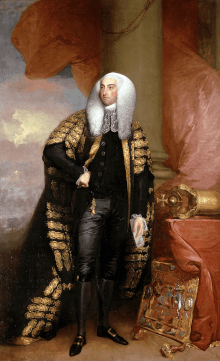
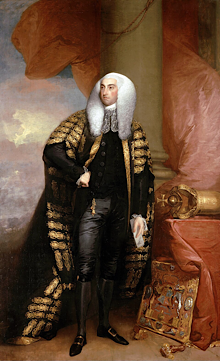
(Pictured: “Portrait of John FitzGibbon, 1st Earl of Clare,” painting by Gilbert Stuart, 1789)


Leave a comment

The Roman Catholic Relief Act 1829 Receives Royal Assent

The Roman Catholic Relief Act 1829, also known as the Catholic Emancipation Act 1829, receives royal assent on April 13, 1829. The act removes the sacramental tests that bar Roman Catholics in the United Kingdom from Parliament and from higher offices of the judiciary and state. It is the culmination of a fifty-year process of Catholic emancipation which had offered Catholics successive measures of “relief” from the civil and political disabilities imposed by Penal Laws in both Great Britain and in Ireland in the seventeenth and early eighteenth centuries.

Convinced that the measure is essential to maintain order in Catholic-majority Ireland, Arthur Wellesley, 1st Duke of Wellington, helps overcome the opposition of King George IV and of the House of Lords by threatening to step aside as Prime Minister and retire his Tory government in favour of a new, likely-reform-minded Whig ministry.

In Ireland, the Protestant Ascendancy has the assurance of the simultaneous passage of the Parliamentary Elections (Ireland) Act 1829. Its substitution of the British ten-pound for the Irish forty-shilling freehold qualification disenfranchises over 80% of Ireland’s electorate. This includes a majority of the tenant farmers who had helped force the issue of emancipation in 1828 by electing to parliament the leader of the Catholic Association, Daniel O’Connell.

O’Connell had rejected a suggestion from “friends of emancipation,” and from the English Roman Catholic bishop, John Milner, that the fear of Catholic advancement might be allayed if the Crown were accorded the same right exercised by continental monarchs: a veto on the confirmation of Catholic bishops. O’Connell insists that Irish Catholics would rather “remain forever without emancipation” than allow the government “to interfere” with the appointment of their senior clergy. Instead, he relies on their confidence in the independence of the priesthood from Ascendancy landowners and magistrates to build his Catholic Association into a mass political movement. On the basis of a “Catholic rent” of a penny a month (typically paid through the local priest), the Association mobilises not only the Catholic middle class, but also poorer tenant farmers and tradesmen. Their investment enables O’Connell to mount “monster” rallies that stay the hands of authorities and embolden larger enfranchised tenants to vote for pro-emancipation candidates in defiance of their landlords.

O’Connell’s campaign reaches its climax when he himself stands for parliament. In July 1828, he defeats a nominee for a position in the British cabinet, William Vesey-FitzGerald, in a County Clare by-election, 2057 votes to 982. This makes a direct issue of the parliamentary Oath of Supremacy by which, as a Catholic, he will be denied his seat in the Commons.

As Lord Lieutenant of Ireland, Wellington’s brother, Richard Wellesley, had attempted to placate Catholic opinion, notably by dismissal of the long-serving Attorney-General for Ireland, William Saurin, whose rigid Ascendancy views and policy made him bitterly unpopular, and by applying a policy of prohibitions and coercion against not only the Catholic Ribbonmen but also the Protestant Orangemen. But now both Wellington and his Home Secretary, Robert Peel, are convinced that unless concessions are made, a confrontation is inevitable. Peel concludes, “though emancipation was a great danger, civil strife was a greater danger.” Fearing insurrection in Ireland, he drafts the Relief Bill and guides it through the House of Commons. To overcome the vehement opposition of both the King and of the House of Lords, Wellington threatens to resign, potentially opening the way for a new Whig majority with designs not only for Catholic emancipation but also for parliamentary reform. The King initially accepts Wellington’s resignation and the King’s brother, Ernest Augustus, Duke of Cumberland, attempts to put together a government united against Catholic emancipation. Though such a government would have considerable support in the House of Lords, it would have little support in the Commons and Ernest abandons his attempt. The King recalls Wellington. The bill passes the Lords and becomes law.

The key, defining, provision of the Acts is its repeal of “certain oaths and certain declarations, commonly called the declarations against transubstantiation and the invocation of saints and the sacrifice of the mass, as practised in the Church of Rome,” which had been required “as qualifications for sitting and voting in parliament and for the enjoyment of certain offices, franchises, and civil rights.” For the Oath of Supremacy, the act substitutes a pledge to bear “true allegiance” to the King, to recognise the Hanoverian succession, to reject any claim to “temporal or civil jurisdiction” within the United Kingdom by “the Pope of Rome” or “any other foreign prince … or potentate,” and to “abjure any intention to subvert the present [Anglican] church establishment.”

This last abjuration in the new Oath of Allegiance is underscored by a provision forbidding the assumption by the Roman Church of episcopal titles, derived from “any city, town or place,” already used by the United Church of England and Ireland. (With other sectarian impositions of the Act, such as restrictions on admittance to Catholic religious orders and on Catholic-church processions, this is repealed with the Roman Catholic Relief Act 1926.)

The one major security required to pass the Act is the Parliamentary Elections (Ireland) Act 1829. Receiving its royal assent on the same day as the relief bill, the act disenfranchises Ireland’s forty-shilling freeholders, by raising the property threshold for the county vote to the British ten-pound standard. As a result, “emancipation” is accompanied by a more than five-fold decrease in the Irish electorate, from 216,000 voters to just 37,000. That the majority of the tenant farmers who had voted for O’Connell in the Clare by-election are disenfranchised as a result of his apparent victory at Westminster is not made immediately apparent, as O’Connell is permitted in July 1829 to stand unopposed for the Clare seat that his refusal to take the Oath of Supremacy had denied him the year before.

In 1985, J. C. D. Clark depicts England before 1828 as a nation in which the vast majority of the people still believed in the divine right of kings, and the legitimacy of a hereditary nobility, and in the rights and privileges of the Anglican Church. In Clark’s interpretation, the system remained virtually intact until it suddenly collapsed in 1828, because Catholic emancipation undermined its central symbolic prop, the Anglican supremacy. He argues that the consequences were enormous: “The shattering of a whole social order. … What was lost at that point … was not merely a constitutional arrangement, but the intellectual ascendancy of a worldview, the cultural hegemony of the old elite.”

Clark’s interpretation has been widely debated in the scholarly literature, and almost every historian who has examined the issue has highlighted the substantial amount of continuity before and after the period of 1828 through 1832.

Eric J. Evans in 1996 emphasises that the political importance of emancipation was that it split the anti-reformers beyond repair and diminished their ability to block future reform laws, especially the great Reform Act of 1832. Paradoxically, Wellington’s success in forcing through emancipation led many Ultra-Tories to demand reform of Parliament after seeing that the votes of the rotten boroughs had given the government its majority. Thus, it was an ultra-Tory, George Spencer-Churchill, Marquess of Blandford, who in February 1830 introduced the first major reform bill, calling for the transfer of rotten borough seats to the counties and large towns, the disfranchisement of non-resident voters, the preventing of Crown officeholders from sitting in Parliament, the payment of a salary to MPs, and the general franchise for men who owned property. The ultras believed that a widely based electorate could be relied upon to rally around anti-Catholicism.

In Ireland, emancipation is generally regarded as having come too late to influence the Catholic-majority view of the union. After a delay of thirty years, an opportunity to integrate Catholics through their re-emerging propertied and professional classes as a minority within the United Kingdom may have passed. In 1830, O’Connell invites Protestants to join in a campaign to repeal the Act of Union and restore the Kingdom of Ireland under the Constitution of 1782. At the same, the terms under which he is able to secure the final measure of relief may have weakened his repeal campaign.

George Ensor, a leading Protestant member of the Catholic Association in Ulster, protests that while “relief” bought at the price of “casting” forty-shilling freeholders, both Catholic and Protestant, “into the abyss,” might allow a few Catholic barristers to attain a higher grade in their profession, and a few Catholic gentlemen to be returned to Parliament, the “indifference” demonstrated to parliamentary reform will prove “disastrous” for the country.

Seeking, perhaps, to rationalise the sacrifice of his freeholders, O’Connell writes privately in March 1829 that the new ten-pound franchise might actually “give more power to Catholics by concentrating it in more reliable and less democratically dangerous hands.” The Young Irelander John Mitchel believes that the intent is to detach propertied Catholics from the increasingly agitated rural masses.

In a pattern that had been intensifying from the 1820s as landlords clear land to meet the growing livestock demand from England, tenants have been banding together to oppose evictions and to attack tithe and process servers.

One civil disability not removed by 1829 Act are the sacramental tests required for professorships, fellowships, studentships and other lay offices at universities. These are abolished for the English universities – Oxford, Cambridge and Durham – by the Universities Tests Act 1871, and for Trinity College Dublin by the “Fawcett’s Act” 1873.

Section 18 of the 1829 act, “No Roman Catholic to advise the Crown in the appointment to offices in the established church,” remains in force in England, Wales and Scotland, but is repealed with respect to Northern Ireland by the Statute Law Revision (Northern Ireland) Act 1980. The entire act is repealed in the Republic of Ireland by the Statute Law Revision Act 1983.


Leave a comment

Birth of Maurice Lenihan, Journalist & Author

Maurice Lenihan, journalist and author, is born on February 5, 1811, in St. Patrick’s parish, Waterford, County Waterford.

Lenihan is the eldest of fifteen children (ten sons and five daughters) of James Lenihan, woolen draper, and Margaret Lenihan (née Bourke) from Carrick-on-Suir, County Tipperary, where her family is also involved in the woolen trade. He receives his early education at a school attached to St. John’s College, Waterford, and in 1823 goes to Carlow College, which then caters both for junior seminarians and lay students, and it is clear that he is in the latter category. He studies there as a boarder for eight years despite the financial pressure on the family arising from the death of his father in 1829.

Lenihan begins his journalistic career with the Tipperary Free Press in 1831, moves to The Waterford Chronicle two years later, and in 1841 becomes the editor of The Limerick Reporter. This is followed by a brief stint with The Cork Examiner before he settles in Nenagh in 1843 and establishes his own newspaper, The Tipperary Vindicator. In 1849 he purchases The Limerick Reporter, amalgamates it with his existing publication to form The Limerick Reporter and Tipperary Vindicator, and moves to Limerick, where he resides for the remainder of his life. His paper integrates local reporting and analysis with reports and commentary on national and international events and discussion of the major intellectual ideas of the age. He also fosters the careers of local writers, in particular the poets John Francis O’Donnell and Michael Hogan.

Lenihan plays a distinguished role in Limerick local politics, serving on the municipal council continuously from 1863 until his retirement in 1887, and as mayor in 1884. He takes a prominent part also in national political debates and controversies of the period. He is a moderate constitutional nationalist, strongly influenced in his youth by Daniel O’Connell, though he later defends Fenian prisoners. In the 1830s he supports the abolition of tithes, and campaigns in the 1860s for the disestablishment of the Church of Ireland. He champions the cause of Catholic education and favours the teaching of the Irish language in schools and colleges. He consistently supports liberal party candidates in elections and in the 1880s espouses the twin aims of land reform and parliamentary independence.

Lenihan marries a local Nenagh woman, Elizabeth Spain, in November 1843. They have two sons and seven daughters. The family is dogged by ill-health and steadily declining fortunes. The financial problems are caused in part by the losses incurred in the publication in 1866 of Lenihan’s major work of scholarship, Limerick, its history and antiquities. The genesis of this enterprise lay in a series of articles on the sieges of 1690 and 1691, which he had researched and published in his own newspaper. With the encouragement and guidance of his friend, the historian and scholar Eugene O’Curry, he spends five years in research and writing. He had amassed through purchase and borrowing an impressive collection of manuscript materials, most notably the Arthur manuscripts, and these are supplemented by transcripts from most of the principal sources then extant in both Britain and Ireland. He supplements this documentary material with his own local knowledge and oral evidence from elderly residents. The work is haphazardly, even chaotically, arranged and is notable for its voluminous footnotes. These arise from a self-confessed problem in organising his material and from the fact that he acquires further information after the main text has been drafted. These deficiencies are more than compensated for by the vast range of primary source material that, in addition to forming the basis for the main narrative, is reproduced in total or summary form in both the footnotes and appendices. This material has proved invaluable to subsequent generations of scholars researching the history of Limerick.

Poverty, poor health, and personal tragedy are prominent in his final years. His newspaper becomes progressively unprofitable, and he is forced to sell his books and manuscripts to the British Museum. Five of his children predecease him. He dies on December 25, 1895, and is buried in Mount St. Lawrence Cemetery in Limerick.

(From: “Lenihan, Maurice” by Liam Irwin, Dictionary of Irish Biography, http://www.dib.ie, October 2009)


Leave a comment

Death of William Rokeby, Statesman, Cleric & Archbishop of Dublin

William Rokeby, a leading statesman and cleric in early sixteenth-century Ireland, dies at Kirk Sandall, near Doncaster in South Yorkshire, on November 29, 1521. He holds the offices of Bishop of Meath, Archbishop of Dublin and Lord Chancellor of Ireland. He is commemorated in the Rokeby Chapels in two Yorkshire churches, St. Oswald’s Church, Kirk Sandall, and Halifax Minster.

Rokeby is born at Kirk Sandall, eldest of the five sons of John Rokeby (died 1506). His younger brother, Sir Richard Rokeby (died 1523), is Comptroller of the Household to Cardinal Thomas Wolsey and later Treasurer of Ireland. He retains a deep affection for Kirk Sandall and returns there to die. He goes to school at Rotherham, studies at the University of Oxford and becomes a fellow of King’s Hall, later Trinity College, Cambridge. He becomes vicar of his home parish in 1487 and is transferred to Halifax, another town for which he has a deep attachment, in about 1499. In 1507 he is made Bishop of Meath.

On the death of Walter Fitzsimon in 1511, Rokeby becomes Archbishop of Dublin. It has been suggested that his elevation is due at least in part to his English birth, as the Crown is anxious to place Englishmen high up in the Irish hierarchy. No doubt his brother’s close connection to Wolsey also plays a part. He is Lord Chancellor of Ireland from 1512 to 1513 and from 1516 to 1522.

Writer Roderick J. O’Flanagan believes that Rokeby is a good and diligent Lord Chancellor, although he does not leave behind many written judgments. He is clearly a trusted servant of the Crown; in particular, Thomas Howard, 2nd Duke of Norfolk, the Lord Deputy, Surrey, with the approval of Henry VIII, choose Rokeby in 1520 as mediator in the feud between Maurice FitzGerald, 9th Earl of Desmond, and Piers Butler, 8th Earl of Ormond, which has become exceptionally bitter.

As Archbishop Rokeby makes a reputation as a peacemaker, settling a long and bitter dispute between the Dean and Chapter of St. Patrick’s Cathedral, Dublin. He gives permission to Gerald FitzGerald, 9th Earl of Kildare, for the original foundation of Maynooth College, which is suppressed in 1535. He is frequently at the English Court, so often indeed that he is accused of neglecting his official duties back in Ireland. He participates in the christening of the future Queen Mary I in 1516 and the ceremony by which Wolsey receives his cardinal’s hat.

As Archbishop of Dublin, Rokeby is best remembered for the Synod of 1518. The Synod prohibits the use of any tin chalice at Mass, and the disposal of Church property by laymen; and attempts to regulate the procedure for dealing with intestate estates, the payment of tithes and burial fees and the rules for admission to the clergy. Rather comically, he strictly forbids clergymen to play football.

Rokeby is appointed Archdeacon of Surrey on March 27, 1519. By 1521 his health is failing, and he retires to Kirk Sandall, where he dies on November 29. In his will he leaves £200 to rebuild St. Mary’s Church, Beverley, whose tower had collapsed the previous year.

Rokeby makes elaborate provisions in his will for the disposal of his remains. In accordance with his wishes, his body is buried in St. Oswald’s Church, Kirk Sandall, but his heart and bowels are buried in the Church of St. John the Baptist, Halifax (now known as Halifax Minster). Mortuary chapels are erected at both spots, which still exist today.

O’Flanagan praises Rokeby as a good man, a good bishop and, so far as we can tell from the scanty records, a good judge. Irish author F. Elrington Ball, while acknowledging his good qualities, suggests that he was a failure as Irish Lord Chancellor, due partly to his frequent absences in England.

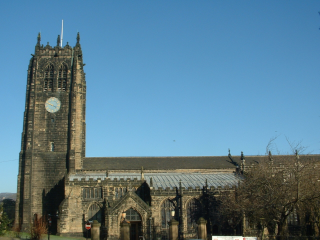
(Pictured: Halifax Minster, where Rokeby’s heart is buried)


Leave a comment

The Irish Church Act 1869 Receives Royal Assent

The Irish Church Act 1869 receives British royal assent on July 26, 1869. The Act is an act of the Parliament of the United Kingdom which separates the Church of Ireland from the Church of England and disestablishes the former, a body that commands the adherence of a small minority of the population of Ireland. The Act is passed during the first ministry of William Ewart Gladstone and comes into force on January 1, 1871. It is strongly opposed by Conservatives in both houses of Parliament.

The Act means the Church of Ireland is no longer entitled to collect tithes from the people of Ireland. It also ceases to send representative bishops as Lords Spiritual to the House of Lords in Westminster. Existing clergy of the church receive a life annuity in lieu of the revenues to which they are no longer entitled: tithes, rentcharge, ministers’ money, stipends and augmentations, and certain marriage and burial fees.

The passage of the Bill through Parliament causes acrimony between the House of Commons and the House of Lords. Queen Victoria personally intervenes to mediate. While the Lords extort from the Commons more compensation to alleviate the disestablished churchmen, in the end, the will of the Commons prevail.

The Irish Church Act is a key move in dismantling the Protestant Ascendancy which had dominated Ireland for several centuries previously.


Leave a comment

Death of James Warren Doyle, Bishop of Kildare and Leighlin

James Warren Doyle, Roman Catholic Bishop of Kildare and Leighlin, who uses the signature “JKL”, an acronym from “James Kildare and Leighlin,” dies on June 15, 1834. He is active in the Anti-Tithe movement and a campaigner for Catholic emancipation until it is attained in 1829. He is also an educator, church organiser and the builder of the Cathedral of the Assumption in Carlow.

Doyle is born close to New Ross, County Wexford in 1786, the posthumous son of a respectable Catholic farmer. His mother, Anne Warren, of Quaker extraction, is living in poverty at the time of his birth. At the age of eleven he witnesses the horrors of the Battle of New Ross between the United Irishmen and British Crown forces supplemented by the militia and yeomanry.

Doyle receives his early education at Clonleigh, at Rathconrogue at the school of a Mr. Grace, and later at the Augustinian College, New Ross under the care of an Augustinian monk, Rev. John Crane.

Doyle joins the Augustinian friars in 1805 at Grantstown, County Wexford, and then studies for his doctorate at Coimbra in Portugal (1806–08). His studies are disturbed by the Peninsular War, during which he serves as a sentry in Coimbra. Later, he accompanies the British Army with Arthur Wellesley‘s forces to Lisbon as an interpreter.

Following Doyle’s return to Ireland, he is ordained to the priesthood on October 1, 1809, at Enniscorthy. He teaches logic at the Augustinian College, New Ross. In 1813, he is appointed to a professorship at St. Patrick’s, Carlow College, holding the Chair of Rhetoric and in 1814, the Professorship of Theology.

Michael Corcoran, Bishop of Kildare and Leighlin, dies on February 22, 1819. Doyle is a popular choice of the clergy and bishops of the Archdiocese of Dublin and is chosen by the Holy See as Corcoran’s successor. He is formally named in August 1819 and is duly consecrated in Carlow Parish Church on November 14. During his fifteen-year tenure as Bishop of Kildare and Leighlin, he earns respect nationwide for his polemics in furtherance of the Catholic position in both Irish and British society, and in supporting the work of the Catholic Association. His books on pastoral, political, educational and inter-denominational matters provide a rich source of material for social and religious historians. He is a close ally of Daniel O’Connell in the political campaign for Catholic emancipation which is finally passed in 1829 by the Wellington government.

In 1830, the new tithe-proctor of Graigue, a parish of 4,779 Catholics and 63 Protestants, decides to break with the tradition of Doyle’s predecessor and to enforce seizure orders for the collection of arrears of Tithes. Tithes provide financial support of the established Anglican Church of Ireland. Some of the recalcitrant Catholics habitually transfer ownership of their livestock to Doyle in order to avoid seizure at the town fair. The new proctor requests their priest’s cooperation in handing over the assets. Doyle refuses, and the proctor, aided by the Royal Irish Constabulary, seize some of the livestock. A mass riot breaks out at the fair and there is several casualties. A civil disobedience campaign follows, peppered with sporadic violence mostly at county fairs over the seizure of livestock. A period of instability that becomes known as the Tithe War follows.

Doyle is a leader of nonviolent resistance to the Tithe, devoting himself both to strengthening the nonviolent resistance and to discouraging like paramilitary secret societies who have taken to using violence to drive out tithe-collectors and to intimidate collaborators. He says, “I maintain the right which [Irish Catholics] have of withholding, in a manner consistent with the law and their duty as subjects, the payment of tithe in kind or in money until it is extorted from them by the operation of the law.”

Given Doyle’s prior experience in education, his major contribution is arguably in helping the establishment of National Schools across Ireland from 1831, the initiative of Edward Smith-Stanley, Chief Secretary for Ireland, which are initially started with a UK government grant of £30,000. The proposed system is ahead of state provision for education in England or Scotland at that time. This Model School prototype is, in some respects, experimental. His involvement is a sign of his practicality and foresight.

Doyle makes statements on other issues: the theological status of ‘non-Catholic’ Christians, freedom to convert to Protestantism, mixed marriages and, as already mentioned, on the union of Catholics and Anglicans. On this last issue he is asked to resign by Rome and is eventually allowed to continue after agreeing not to speak on the issue again.

The construction of Carlow Cathedral of the Assumption crowns Doyle’s career, being started in 1828 and finished at the end of November 1833. He falls ill for a number of months before dying on June 15, 1834. He is buried in his new cathedral. A sculpture, by John Hogan, in memorial to Doyle is finished in 1839.

Several biographies are written on Doyle before 1900 and his influence on the later Irish Catholic bishops in the period 1834-1900 is considerable. He had proved that negotiations with government could be beneficial to his church, his congregation, and its finances.


Leave a comment

The Whiteboys

the-whiteboys

The Whiteboys, a secret Irish agrarian organisation in 18th-century Ireland which uses violent tactics to defend tenant farmer land rights for subsistence farming, is created on October 1, 1761. Their name derives from the white smocks the members wear in their nightly raids. They seek to address rack-rents, tithe collection, excessive priests’ dues, evictions and other oppressive acts. As a result they target landlords and tithe collectors. Over time, Whiteboyism becomes a general term for rural violence connected to secret societies. Because of this generalisation, the historical record for the Whiteboys as a specific organisation is unclear. There are three major outbreaks of Whiteboyism: 1761–64, 1770–76 and 1784–86.

Between 1735 and 1760 there is an increase in land used for grazing and beef cattle, in part because pasture land is exempt from tithes. The landlords, having let their lands far above their value, on condition of allowing the tenants the use of certain commons, now enclose the commons, but do not lessen the rent. As more landlords and farmers switch to raising cattle, labourers and small tenant farmers are forced off the land. The Whiteboys develop as a secret oath-bound society among the peasantry. Whiteboy disturbances had occurred prior to 1761 but were largely restricted to isolated areas and local grievances, so that the response of local authorities had been limited.

Their operations are chiefly in the counties of Waterford, Cork, Limerick, and Tipperary. This combination is not political. It is not directed against the government, but against the local landlords. Members of different religious affiliations take part.

The first major outbreak occurs in County Limerick in November 1761 and quickly spreads to counties Tipperary, Cork, and Waterford. A great deal of organisation and planning seems to have gone into the outbreak, including the holding of regular assemblies. Initial activities are limited to specific grievances and the tactics used non-violent, such as the levelling of ditches that closed off common grazing land, although cattle hamstringing is often practised as the demand for beef prompts large landowners to initiate the process of enclosure. As their numbers increase, the scope of Whiteboy activities begins to widen, and proclamations are clandestinely posted stipulating demands such as that rent not be paid, that land with expired leases not be rented until it has lain fallow for three years, and that no one pay or collect tithes demanded by the Anglican Church. Threatening letters are also sent to debt collectors, landlords, and occupants of land gained from eviction, demanding that they give up their farms.

March 1762 sees a further escalation of Whiteboy activities, with marches in military array preceded by the music of bagpipes or the sounding of horns. At Cappoquin they fire guns and march by the military barracks playing the Jacobite tune “The lad with the white cockade.” These processions are often preceded by notices saying that Queen Sive and her children will make a procession through part of her domain and demand that the townspeople illuminate their houses and provide their horses, ready saddled, for their use. More militant activities often follow such processions with unlit houses in Lismore attacked, prisoners released in an attack on Tallow jail and similar shows of strength in Youghal.

The events of March 1762, however, prompt a more determined response, and a considerable military force under Charles Moore, 1st Marquess of Drogheda is sent to Munster to crush the Whiteboys.

On April 2, 1762 a force of 50 militia men and 40 soldiers set out for Tallow. By mid-April at least 150 suspected Whiteboys have been arrested. Clogheen in County Tipperary bears the initial brunt of this assault as the local parish priest, Fr. Nicholas Sheehy, had earlier spoken out against tithes and collected funds for the defence of parishioners charged with rioting. An unknown number of “insurgents” are reported killed in the “pacification exercise” and Fr. Sheehy is unsuccessfully indicted for sedition several times before eventually being found guilty of a charge of accessory to murder, and hanged, drawn and quartered in Clonmel in March 1766.

In the cities, suspected Whiteboy sympathisers are arrested and in Cork, citizens form an association of about 2,000 strong which offer rewards of £300 for capture of the chief Whiteboy and £50 for the first five sub-chiefs arrested. They often accompany the military on their rampages. The leading Catholics in Cork also offer similar rewards of £200 and £40 respectively.

Acts passed by the Parliament of Ireland (to 1800) and Parliament of the United Kingdom of Great Britain and Ireland (from 1801) to empower the authorities to combat Whiteboyism are commonly called “Whiteboy Acts.”


Leave a comment

Execution of John Atherton, Anglican Bishop of Waterford & Lismore

john-atherton-execution-pamphlet

John Atherton, Anglican Bishop of Waterford and Lismore in the Church of Ireland, is executed on December 5, 1640, on a charge of immorality.

Atherton is born in 1598 in Somerset, England. He studies at Oxford University and joins the ranks of the Anglican clergy. In 1634 he becomes Bishop of Waterford and Lismore in the Church of Ireland. In 1640 he is accused of buggery with a man, John Childe, his steward and tithe proctor. They are tried under a law that Atherton himself had helped to institute. They are both condemned to death, and Atherton is executed in St. Stephen’s Green, Dublin. Reportedly, he confesses to the crime immediately before his execution, although he had proclaimed his innocence before that.

More recently, some historical evidence has been developed that shows Atherton might have been a victim of a conspiracy to discredit him and his patrons. This is attributable to Atherton’s status as an astute lawyer, who seeks to recover lost land for the relatively weak Protestant Church of Ireland during the 1630s. Unfortunately for Atherton, this alienates him from large landowners, who then allegedly use his sexuality to discredit him.

English Puritan, Congregationalist and Independent activists, as well as English and Scottish Presbyterian activists, contemporaneously campaign to abolish Episcopacy (bishops) within the embattled Church of England, Church of Scotland and Church of Ireland, notionally expediting the political interest in Atherton’s downfall.

Posthumous accusations of sexual wrongdoing also include allegations of “incest” with his sister-in-law, and infanticide of the resultant child, as well as zoophilia with cattle. However, these allegations begin to be circulated several months after his death in an anonymous pamphlet, and may have been intended to further discredit the bishop’s campaign to restore the finances of the Church of Ireland.

(Pictured: Anonymous pamphlet of the hangings of John Atherton and John Childe, 1641)