Craig, known as Jim, grows up in an Ulster Protestant family on the Shankill Road. In the early 1970s, he, a former boxer, is sent to the HM Prison Maze for a criminal offence unrelated to paramilitary activities. While serving his sentence at the Maze he joins the Ulster Defence Association (UDA), and is asked by the organisation’s commander at the time, Charles Harding Smith, to take control of the UDA prisoners inside, on account of his reputation as a “hard man.”
After his release in 1976, Craig sets up a large protection racket and becomes the UDA’s chief fundraiser. By 1985, he has managed to blackmail and extort money from a number of construction firms, building sites, as well as pubs, clubs, and shops in Belfast and elsewhere in Northern Ireland, whose intimidated owners pay protection money out of fear of Craig and his associates. It is alleged that the UDA receives hundreds of thousands of pounds, some of which also find their way inside Craig’s pockets as part of his “commission.” He is acquitted on a firearm charge and Ulster Freedom Fighters (a cover name for the UDA) membership on March 18, 1982. In 1985, he is brought to court after a number of businessmen decide to testify against him, with the condition that their identities remained hidden. The case falls apart when Craig’s defence argues that his client’s rights were violated by the concealment of the witnesses’ identities.
Craig allegedly is involved in the double killing of a Catholic man and a Protestant man on the Shankill Road in 1977. The men, both colleagues, had entered a loyalist club and were later stabbed, shot and put into a car which was set on fire. By this time the UDA West Belfast Brigade no longer wants him in their ranks, as they claim they can no longer “afford him.” Craig, who is ordered to leave the Shankill Road, goes on to join forces with John McMichael’sSouth Belfast Brigade. In addition to being the principal fundraiser, he also sits on the UDA’s Inner Council. He usually travels in the company of his bodyguard, Artie Fee, a UDA member from the Shankill Road.
The rival Ulster Volunteer Force (UVF) carries out an investigation after it is rumoured Craig has been involved in the death of UVF major William Marchant, who is gunned down by Provisional Irish Republican Army gunmen from a passing car on the Shankill Road on April 28, 1987. Marchant is the third high-ranking UVF man to be killed by the IRA during the 1980s. Although their inquiries reveal that Craig had quarrelled with Marchant as well as Lenny Murphy and John Bingham prior to their killings, the UVF feel that there is not enough evidence to warrant an attack on such a powerful UDA figure as Craig.
In December 1987, when UDA South Belfast brigadier John McMichael is blown up by an IRA booby-trap car bomb outside his home in Lisburn‘s Hilden estate, it is believed that Craig had organised his death with the IRA. Allegedly Craig fears McMichael is about to expose his racketeering business, thus putting an end to his lucrative operation. McMichael reportedly sets up an inquiry and discovers that Craig is spending money on a lavish scale, going on holidays at least twice a year and indulging in a “champagne lifestyle.” At the same time, it is suggested that Craig has made certain deals with Irish republican paramilitary groups, dividing up the rackets in west Belfast, and he would be doing the IRA a favour by helping them to eliminate a high-profile loyalist such as McMichael. Craig has established links with republicans during his time in prison, and the profitable deals and exchanges of information between them ensures he will most likely not be a target for IRA assassination.
Craig is named as an extortionist in Central Television’s 1987 programme The Cook Report. He plans to sue the programme’s producers for libel. In January 1988, Jack Kielty (father of future television presenter Patrick Kielty), a building contractor from County Down who had promised to testify as a key witness against Craig, is murdered by the UDA. This killing is attributed to Craig, although it is never proven.
Craig is shot dead by two gunmen from the UDA in “The Castle Inn” (later called “The Bunch of Grapes”), a pub in Beersbridge Road, east Belfast on October 15, 1988, where he has been lured in the belief that there is to be a UDA meeting. He is playing pool in the pub at the time of his fatal shooting by the two men, both of whom are wearing boilersuits and ski masks and carrying automatic weapons. Upon spotting Craig they open fire, spraying the room with gunfire. Craig dies instantly. A bystander pensioner is also murdered in the attack, and four other bystanders are wounded by stray bullets. The UDA claims the killing is carried out due to Craig’s “treason” and involvement in John McMichael’s murder as they know he had provided the IRA with information to successfully carry out the assassination. They apologise for the unintentional death of the pensioner. Craig is not given a paramilitary funeral, and none of the UDA’s command attend it.
Following the trial and execution of the Lord Deputy of Ireland, Thomas Wentworth, 1st Earl of Strafford, in May 1641, Ireland is in a state of turmoil. There is growing tension between Catholics and Protestants (particularly those of a Puritan tendency) with the former generally sympathetic to King Charles while the latter supports the English Parliament and the ScottishCovenanters in the dispute that shortly leads to the outbreak of the English Civil War. This forms part of the wider War of the Three Kingdoms.
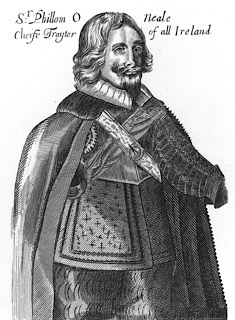
On October 23, a major uprising breaks out in Ulster organised by leading members of the Gaelic aristocracy. The rebels attack Protestant plantation settlements as well as native Irish Protestants and take garrison towns held by the Irish Army. Irish government authorities in Dublin struggle to contain the insurgency with the limited number of troops they have at their disposal. A last-minute warning saves Dublin Castle from a surprise attack, although O’Neill is clearly unaware of the failure of the Dublin plot when he issues his proclamation.
After seizing several key strategic points in Ulster over the previous twenty-four hours, O’Neill makes his proclamation in Dungannon, a town that has symbolic importance as the traditional capital of the O’Neill dynasty.
In support of his actions, O’Neill claims to have a document from King Charles commissioning him. The Commission is supposedly signed under the Great Seal of Scotland. By declaring their loyalty to the Crown and defence of the Catholic religion, O’Neill and his followers adopt a political stance which is taken up by the subsequent Irish Confederation which governs rebel-controlled territory in the name of the King from 1642 until 1649. The Proclamation encourages many Catholics to believe they can lawfully join the rising with the King’s blessing, while Protestants are left demoralised.
O’Neill’s second and more trenchant proclamation is made “from our camp at Newry” on November 4, 1641 alongside Rory Maguire. He also publishes the actual royal commission that gives authority for his earlier proclamation. It is subtly different, in that it empowers him to arrest and seize property from all of Charles’s English Protestant subjects living in Ireland, but exempts his Irish and Scottish subjects.
Until the late nineteenth century historians generally accept that the commission is genuine, or at the very least Charles had secretly encouraged the Irish Catholics to launch a rising. Since then, for a variety of reasons, it has been considered to be a forgery produced by O’Neill and his associates without the knowledge of the King. They may well have acquired a copy of the Great Seal of Scotland when they captured the garrison town of Charlemont on October 23.
The historian David Stevenson notes that it would be unlikely that the commission would have been addressed to O’Neill. Had it been genuine it would almost certainly have been issued to more senior Irish Royalists such as the James Butler, 1st Duke of Ormond, or the leading Catholic noble of Ulster, Randal MacDonnell, 1st Marquess of Antrim. It is also unlikely to have been issued at Edinburgh as O’Neill claimed. However, King Charles was in Edinburgh on October 1, dealing with Scottish political matters.
Forgery or not, King Charles publicly proclaims all the Irish rebels as traitors on January 1, 1642.
That the Commission is genuine is widely accepted in England and Scotland by the King’s opponents and even some of his own supporters. It seems to tie in with earlier rumours of an army plot which had suggested that Charles might bring over the New Irish Army, made up largely of Ulster Catholics, to impose his will on England and Scotland. Anger at the King’s alleged links with the insurgents grow – particularly as horror stories of atrocities committed, such as the Portadown Massacre, begin to filter across the Irish Sea. Tensions arising from news of the Irish rebellion is a factor in the English push to Civil War in early 1642.
The Scottish authorities dispatch an Army which quickly retakes much of Ulster from the insurgents. Once the English Civil War breaks out in October 1642, Charles’ emissaries begin negotiations with the Irish rebels for their support, which seems to present further evidence to his opponents of his links with the Catholic Ulster leaders. Many of these later dealings are exposed when Charles private letters are captured during the Battle of Naseby (1645) and published as King’s Cabinet Opened.
When O’Neill is captured in 1653 following the Cromwellian conquest of Ireland, he is put on trial for his life. The authorities offer to spare him if he will repeat his earlier claims that Charles had ordered the Catholics to rise in 1641. O’Neill now refuses to implicate the King, who had been executed four years earlier, and is put to death himself. Nonetheless, the English Republicans continue to use O’Neill’s earlier claims of the King’s involvement to justify their decision to commit regicide.
Rossa becomes a shopkeeper in Skibbereen where, in 1856, he establishes the Phoenix National and Literary Society, the aim of which is “the liberation of Ireland by force of arms.” This organisation later merges with the IRB, founded two years later in Dublin.
In December 1858, Roosa is arrested and jailed without trial until July 1859. He is charged with plotting a Fenian rising in 1865, put on trial for high treason, and sentenced to penal servitude for life due to previous convictions. He serves his time in Pentonville, Portland, and Chatham prisons in England.
After giving an understanding that he will not return to Ireland, Rossa is released as part of the Fenian amnesty of 1870. Boarding the S.S. Cuba, he leaves for the United States with his friend John Devoy and three other exiles. Together they were dubbed “The Cuba Five.”
In 1885, Rossa is shot outside his office near Broadway by an Englishwoman, Yseult Dudley, but his wounds are not life-threatening. He is allowed to visit Ireland in 1894, and again in 1904. On the latter visit, he is made a “Freeman of the City of Cork.”
Rossa is seriously ill in his later years and is finally confined to a hospital bed in St. Vincent’s Hospital, Staten Island, where he dies suddenly at the age of 83 on June 29, 1915. His body is returned to Ireland for burial and a hero’s welcome. The funeral at Glasnevin Cemetery on August 1, 1915, is a huge affair, garnering substantial publicity for the Irish Volunteers and the IRB at time when a rebellion, later to emerge as the Easter Rising, is being actively planned. The graveside oration given by Patrick Pearse remains one of the most famous speeches of the Irish independence movement stirring his audience to a call to arms.
O’Doherty receives a good education and studies medicine, but before he is qualified, joins the Young Ireland party and in June 1848, together with Thomas Antisell and Richard D’Alton Williams, establish The Irish Tribune. Only five editions are issued, the first being on June 10, 1848. On July 10, 1848, when the fifth edition is issued, O’Doherty is arrested and charged with treason felony. At the first and second trials the juries disagree, but at the third trial, he is found guilty and sentenced to transportation for ten years.
O’Doherty arrives in Tasmania in November 1849, is at once released on parole to reside at Oatlands, and his professional services are utilised at St. Mary’s Hospital, Hobart. The other Irish prisoners nickname him “St. Kevin.” In 1854 he receives a pardon with the condition that he must not reside in Great Britain or Ireland. He goes to Paris and carries on his medical studies, making one secret visit to Ireland to marry Mary Eva Kelly, to whom he is affianced before leaving Ireland. He receives an unconditional pardon in 1856, and completes his studies in Dublin, graduating FRCS in 1857. He practises in Dublin successfully, and in 1862 goes to Brisbane, Australia, and becomes well known as one of its leading physicians.
O’Doherty is elected a member of the Legislative Assembly of Queensland in 1867, in 1872 is responsible for a health act being passed, and is also one of the early opponents of the trafficking of Kanakas. In 1885, he resigns as he intends to settle in Europe.
In Ireland, O’Doherty is cordially welcomed, and is returned unopposed as Irish Parliamentary Party (IPP) MP for North Meath to the House of Commons of the United Kingdom in the November 1885 United Kingdom general election. However, finding the climate does not suit him, he does not seek re-election in 1886 and returns to Brisbane in that year. He attempts to take up his medical practice again but is not successful. He dies in poor circumstances in Brisbane on July 15, 1905.
O’Doherty’s wife and a daughter survive him. A fund is raised by public subscription to provide for his widow, a poet, who in her early days is well known as the author of Irish patriotic verse in The Nation under the soubriqet “Eva.” In Australia, she occasionally contributes to Queensland journals, and one of her poems is included in A Book of Queensland Verse. She dies at Brisbane on May 21, 1910.
Mitchel is born in Camnish, near Dungiven, County Derry on November 3, 1815, the son of a Presbyterian minister. At the age of four, he is sent to a classical school, run by an old minister named Moor, nicknamed “Gospel Moor” by the students. He reads books from a very early age. When a little over five years old, he is introduced to Latin grammar by his teacher and makes quick progress. In 1830, not yet 15 years old, he enters Trinity College, Dublin (TCD) and obtains a law degree in 1834.
In the spring of 1836, Mitchel meets Jane Verner, the only daughter of Captain James Verner. Though both families are opposed to the relationship, they become engaged in the autumn and are married on February 3, 1837, by the Rev. David Babington in Drumcree Church, the parish church of Drumcree.
Mitchel works in a law office in Banbridge, County Down, where he eventually comes into conflict with the local Orange Order. He meets Thomas Davis and Charles Gavan Duffy during visits to Dublin. He joins the Young Ireland movement and begins to write for The Nation. Deeply affected by the misery and death caused by the Great Famine, he becomes convinced that nothing will ever come of the constitutional efforts to gain Irish freedom. He then forms his own paper, United Irishman, to advocate passive resistance by Ireland’s starving masses.
In May 1848, the British tire of Mitchel’s open defiance. Ever the legal innovators in Ireland, they invent a crime especially for the Young Irelanders – felony-treason. They arrest him for violating this new law and close down his paper. A rigged jury convicts him, and he is deported first to Bermuda and then to Australia. However, on June 8, 1853, he escapes to the United States.
Mitchel works as a journalist in New York City and then moves to the South. When the American Civil War erupts, he is a strong supporter of the Southern cause, seeing parallels with the position of the Irish. His family fully backs his commitment to the Southern cause. He loses two sons in the war, one at the Battle of Gettysburg in 1863 and another at the Battle of Fort Sumter in 1864, and another son loses an arm. His outspoken support of the Confederacy causes him to be jailed for a time at Fort Monroe, where one of his fellow prisoners is Confederate PresidentJefferson Davis.
In 1874, the British allow Mitchel to return to Ireland and in 1875 he is elected in a by-election to be a member of the Parliament of the United Kingdom representing the Tipperary constituency. However, his election is invalidated on the grounds that he is a convicted felon. He contests the seat again in the resulting by-election and is again elected, this time with an increased vote.
Unfortunately, Mitchel, one of the staunchest enemies to English rule of Ireland in history, dies in Newry on March 20, 1875, and is buried there. Thirty-eight years later, his grandson, John Purroy Mitchel, is elected Mayor of New York City.
News of the outbreak of the rebellion prompts Major-General Sir James Duff, Military Commander in Limerick, to gather a force of about 600 men, mainly Dublinmilitia members, backed up by seven artillery pieces, and sets out on a forced march to Dublin on May 27. His twin objectives are to restore communications between the two cities and to crush any resistance encountered on the way. As the soldiers enter County Kildare, they discover the bodies of several rebel victims, among them Lieutenant William Giffard, the son of the commander of the Dublin militia, Captain John Giffard, which reportedly inflames the soldiers.
However, by the time Duff’s column arrives in Monasterevin in County Kildare, at 7:00 a.m. on May 29, the bulk of the rebel forces have already accepted a government amnesty from Generals Gerard Lake and Ralph Dundas, following their defeat at the Battle of Kilcullen and had surrendered at Knockaulin Hill, several kilometres to the east of the Curragh on May 27. Not aware that the rebels are gathering to surrender on the Curragh plain, Duff reinforces his column and marches to the nearby town of Kildare, and on to the adjacent southwest corner of the Curragh.
Duff’s force had by now grown to 700 militia, dragoons and yeomanry with four pieces of artillery, three having been presumably left at Monasterevin. The designated place of surrender, the ancient fort of Gibbet Rath, is a wide expanse of plain with little or no cover for several kilometres around but neither the rebels nor Duff’s force have seemingly any reason to fear treachery as a separate peaceful surrender to General Dundas at Knockaulin Hill, who is accompanied only by two dragoons, has been successfully accomplished without bloodshed.
By the time of Duff’s arrival at Gibbet Rath on the morning of May 29, an army of between 1,000 and 2,000 rebels is waiting to surrender in return for the promised amnesty. They are subjected to an angry tirade for their treason by Duff who orders them to kneel for pardon and then to stack their arms. Shortly after the weapons are stacked, an infantry and cavalry assault results in the death of about 350 men. Accounts of why the massacre began differ. Rebel claims that Duff orders his troops to attack the disarmed and surrounded men are denied by Duff himself who claims that the rebels fired on his men, while another source records “one man in the crowd, saying he would not hand over his fire-lock loaded, blazed it off in the air”.
However, Duff redrafts his own official report of the engagement before submission to Dublin Castle, his final draft is transmitted without references to his knowledge of the surrender preparations. The original report reads as follows with the items in brackets excised from his final report:
“My Dear Genl. (I have witnessed a melancholy scene) We found the Rebels retiring from this Town on our arrival armed. We followed them with Dragoons; I sent on some of the Yeomen to tell them, on laying down their arms, they should not be hurt. Unfortunately some of them Fired on the Troops; from that moment they were attacked on all sides, nothing could stop the Rage of the Troops. I believe from Two to Three hundred of the Rebels were killed. (They intended, we are told, to lay down their arms to General Dundas). We have 3 men killed & several wounded. I am too fatigued to enlarge. I have forwarded the mails to Dublin.”
The grieving Captain John Giffard expresses his own satisfaction as follows:
“My troops did not leave my hero unavenged – 500 rebels bleaching on the Curragh of Kildare—that Curragh over which my sweet innocent girls walked with me last Summer, that Curragh was strewed with the vile carcasses of popish rebels and the accursed town of Kildare has been reduced to a heap of ashes by our hands.”
General Duff receives no censure for the massacre and, upon his arrival in Dublin the following day, is feted as a hero by the population who honour him with a victory parade. General Dundas, by contrast, is denounced for having shown clemency toward the rebels. However, because of the massacre, wavering rebels are discouraged from surrendering and there are no further capitulations in County Kildare until the final surrender of William Aylmer in July. Dr. Chambers considers that Lake and Duff are not in communication about the surrenders, being on opposite sides of the Curragh. Duff and his 500 men arrive in Kildare after a forced march from Limerick and find it sacked by the rebels, along with the piked body of Duff’s nephew.
Duff is later involved in an unsuccessful campaign after the Battle of Vinegar Hill to trap and destroy a surviving rebel column in Wexford led by Anthony Perry who fights and eludes Duff’s forces at the battle of Ballygullen/Whiteheaps on 5 July.
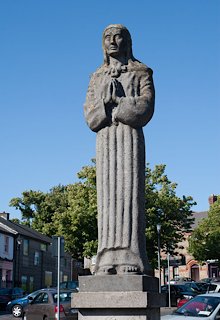
(Pictured: The statue of Saint Brigid at the Market Square of Kildare which is dedicated to the memory of the victims at Gibbet Rath)
Kickham’s father, John Kickham, is the proprietor of the principal drapery in the locality and is held in high esteem for his patriotic spirit. His mother, Anne O’Mahony, is related to the Fenian leader John O’Mahony. He grows up largely deaf and almost blind, the result of an explosion with a powder flask when he is thirteen. He is educated locally, where it is intended that he study for the medical profession. During his boyhood the campaign for a repeal of the Acts of Union 1800 between Great Britain and Ireland is at its height, and he soon becomes versed in its arguments and is inspired by its principles. He often hears the issues discussed in his father’s shop and at home amongst all his friends and acquaintances.
From a young age Kickham is imbued with these patriotic ideals. He becomes acquainted with the teaching of the Young Irelanders through their newspaper The Nation from its foundation in October 1842. His father read the paper aloud every week for the family. Like all the young people of the time, and a great many of the old ones, his sympathies are with the Young Irelanders on their secession from the Repeal Association.
When he is 22 years old, Kickham contributes The Harvest Moon sung to the air of “The Young May Moon,” to The Nation on August 17, 1850. Other verses are to follow, but the finest of his poems according to A. M. O’Sullivan, appear in other journals. Rory of the Hill, The Irish Peasant Girl, and Home Longings, better known as Slievenamon, are published in the Celt. The First Felon appears in the Irishman. Patrick Sheehan, the story of an old soldier, is published in the Kilkenny Journal, and becomes very popular as an anti-recruiting song.
Kickham begins to write for a number of papers, including The Nation, but also the Celt, the Irishman, the Shamrock, and becomes one of the leading writers of The Irish People, the Fenian newspaper, in which many of his poems appear. His writings are signed using his initials, his full name, or the pseudonyms, “Slievenamon” and “Momonia.”
Kickham is the leading member of the Confederation Club in Mullinahone, which he is instrumental in founding. When the revolutionary spirit begins to grip the people in 1848, he turns out with a freshly made pike to join William Smith O’Brien and John Blake Dillon when they arrive in Mullinahone in July 1848. On hearing of the progress of O’Brien through the country, he sets to work manufacturing pikes and is in the forge when news reaches him that the leaders are looking for him. It is here that he meets James Stephens for the first time. At O’Brien’s request, he rings the chapel bell to summon the people and before midnight a Brigade has answered the summons. He later writes a detailed account about this period which brings his connection with the attempted Rising of 1848 to a close.
After the failed 1848 uprising at Ballingarry, Kickham has to hide for some time, as a result of the part he had played in rousing the people of his native village to action. When the excitement has subsided, he returns to his father’s house and resumes his interests in the sports of fishing and fowling and spends much of his time in literary pursuits. Some of the authors in which he is well versed are Alfred Tennyson and Charles Dickens and he greatly admires George Eliot, and after William Shakespeare, is Robert Burns.
In the autumn of 1857, a messenger arrives from New York with a message for James Stephens from members of the Emmet Monument Association, calling on him to get up an organization in Ireland. On December 23, Stephens dispatches Joseph Denieffe to the United States with his reply and outlines his conditions and his requirements from the organisation in America. Denieffe returnd on March 17, 1858, with the acceptance of Stephens’ terms and £80. That evening the Irish Republican Brotherhood commences. Those present in Langan’s, lathe-maker and timber merchant, 16 Lombard Street, for that first meeting are Stephens, Kickham, Thomas Clarke Luby, Peter Langan, Denieffe and Garrett O’Shaughnessy. Later it includes members of the Phoenix National and Literary Society, which is formed in 1856 by Jeremiah O’Donovan Rossa in Skibbereen, County Cork.
In mid-1863, Stephens informs his colleagues that he wishes to start a newspaper, with financial aid from O’Mahony and the Fenian Brotherhood in America. The offices are established at 12 Parliament Street, almost at the gates of Dublin Castle. The first issue of The Irish People appears on November 28, 1863. The staff of the paper along with Kickham are Luby and Denis Dowling Mulcahy as the editorial staff, O’Donovan Rossa and James O’Connor in charge of the business office, with John Haltigan being the printer. John O’Leary is brought from London to take charge in the role of Editor. Shortly after the establishment of the paper, Stephens departs on an America tour, and to attend to organizational matters. Before leaving, he entrusts to Luby a document containing secret resolutions on the Committee of Organization or Executive of the IRB. Though Luby intimates its existence to O’Leary, he does not inform Kickham as there seems no necessity. This document later forms the basis of the prosecution against the staff of The Irish People.
Kickham’s first contribution to The Irish People, entitled Leaves from a Journal, appears in the third issue and is based on a journal he kept on his way to America in 1863. This article leaves no doubt as to his literary capacity according to O’Leary. It falls to Kickham, as a good Catholic, to tackle the priests, though not exclusively with articles such as “Two Sets of Principles,” a rebuff to the doctrines laid down by Lord Carlisle, and “A Retrospect,” dealing with the tenant-right movement chiefly but also the events of the recent past and their bearing on the present. Kickham articulates the attitude held by the IRB in relation to priests, or more particularly in politics.
On July 15, 1865, American-made plans for a rising in Ireland are discovered when the emissary loses them at Kingstown railway station. They find their way to Dublin Castle and to Superintendent Daniel Ryan, head of G Division. Ryan has an informer within the offices of The Irish People named Pierce Nagle. He supplies Ryan with an “action this year” message on its way to the IRB unit in Tipperary. With this information, Ryan raids the offices of The Irish People on September 15, followed by the arrests of O’Leary, Luby, and O’Donovan Rossa. Kickham is caught after a month on the run. Stephens is also caught but with the support of Fenian prison warders John J. Breslin and Daniel Byrne is less than a fortnight in Richmond Bridewell when he vanishes and escapes to France. The last issue of The Irish People is dated September 16, 1865.
On November 11, 1865, Kickham is convicted of treason. Judge William Keogh, with many expressions of sympathy for the prisoner, and many compliments in reference to his intellectual attainments, sentences him to fourteen years’ penal servitude. The prisoners’ refusal to disown their opposition to British rule in any way, even when facing charges of life-imprisonment, earn them the nickname of “the bold Fenian men.” Kickham spends time from 1866 until his release in the Woking Convict Invalid Prison.
Kickham is given a free pardon from Queen Victoria on February 24, 1869, because of ill-health, and upon his release he is made Chairman of the Supreme Council of the IRB and the unchallenged leader of the reorganized movement. He is an effective orator and chairman of meetings despite his physical handicaps. He wears an ear trumpet and can only read when he holds books or papers within a few inches of his eyes. For many years he carries on conversations by means of the deaf and dumb alphabet.
Kickham is the author of three well-known stories, dealing sympathetically with Irish life and manners and the simple faith, the joys and sorrows, the quaint customs and the insuppressible humour of the peasantry. Knocknagow is deemed one of the finest tales of peasant life ever written. Sally Cavanagh is a touching story illustrating the evils of landlordism and emigration. For the Old Land deals with the fortunes of a small farmer’s family.
Kickham dies on August 22, 1882, at the house of James O’Connor, a former member of the IRB and afterward MP for West Wicklow, 2 Montpelier Place, Blackrock, Dublin, where he had been living for many years, and had been cared for by the poet Rose Kavanagh. He is buried in Mullinahone, County Tipperary.
In January and February 1689, Butler votes against the motion to put William of Orange and Mary on the throne and against the motion to declare that James II has abdicated it. Nevertheless, he subsequently joins the forces of William of Orange, by whom he is made colonel of the 2nd Troop of Horse Guards on April 20, 1689. He accompanies William in his Irish campaign, debarking with him in Carrickfergus on June 14, 1690, and commands this troop at the Battle of the Boyne in July 1690. In February 1691 he becomes Lord Lieutenant of Somerset.
Butler serves on the continent under William of Orange during the Nine Years’ War and, having been promoted to major general, he fights at the Battle of Steenkerque in August 1692 and the Battle of Landen in July 1693, where he is taken prisoner by the French and then exchanged for the Duke of Berwick, James II’s illegitimate son. He is promoted to lieutenant general in 1694.
Butler plays a dramatic role at the notorious meeting of the Privy Council on March 8, 1711, when Antoine de Guiscard, a French double agent who is being questioned about his treasonable activities, attempts to assassinate Robert Harley, 1st Earl of Oxford, against whom he has a personal grudge for drastically cutting his allowance, by stabbing him with a penknife. Harley is wounded, but not seriously, due largely to the fact that he is wearing a heavy gold brocade waistcoat in which the knife gets stuck. Several Councillors, including Butler, stab Guiscard in return. Guiscard implores Butler to finish the deed, but he replies that it is not for him to play the hangman. In any case, he has the sense to see that Guiscard must be kept alive at least long enough to be questioned, although as it turns out Guiscard’s wounds are fatal, and he dies a week later.
On April 23, 1712, Butler leaves Harwich for Rotterdam to lead the British troops taking part in the war. Once there he allows himself to be made the tool of the Tory ministry, whose policy is to carry on the war in the Netherlands while giving secret orders to him to take no active part in supporting their allies under Prince Eugene. In July 1712, he advises Prince Eugene that he can no longer support the siege of Le Quesnoy and that he is withdrawing the British troops from the action and instead intends to take possession of Dunkirk. The Dutch are so exasperated at the withdrawal of the British troops that they close the towns of Bouchain on Douai to British access, despite the fact that they have plenty of stores and medical facilities available. Butler takes possession of Ghent and Bruges as well as Dunkirk, in order to ensure his troops are adequately provided for. On April 15, 1713, he becomes Lord Lieutenant of Norfolk.
Ormonde’s position as Captain-General makes him a personage of much importance in the crisis brought about by the death of Queen Anne and, during the last years of Queen Anne, he almost certainly has Jacobite leanings and corresponds with the Jacobite Court including his cousin, Piers Butler, 3rd Viscount Galmoye, who keeps barrels of gunpowder at Kilkenny Castle. King George I, on his accession to the throne in August 1714, institutes extensive changes and excludes the Tories from royal favour. Butler is stripped of his posts as Captain-General, as colonel of the 1st Regiment of Foot Guards and as Commander in Chief of the Forces with the first two posts going to the Duke of Marlborough and the role of Commander-in-Chief going to John Dalrymple, 2nd Earl of Stair. On November 19, 1714, Butler is instead made a member of the reconstituted Privy Council of Ireland.
Accused of supporting the Jacobite rising of 1715, Butler is impeached for high treason by Lord Stanhope on June 21, 1715. He might avoid the impending storm of Parliamentary prosecution, if he remains in England and stands trial but instead, he chooses to flee to France in August 1715 and initially stays in Paris with Lord Bolingbroke. On August 20, 1715, he is attainted, his estate forfeited, and honours extinguished. The Earl Marshal is instructed to remove the names and armorial bearings of Butler and Bolingbroke from the list of peers and his banner as Knight of the Garter is taken down in St. George’s Chapel.
On June 20, 1716, the Parliament of Ireland passes an act extinguishing the regalities and liberties of the county palatine of Tipperary; for vesting Butler’s estate in the crown and for giving a reward of £10,000 for his apprehension, should he attempt to land in Ireland. But the same parliament passes an act on June 24, 1721, to enable his brother, Charles Butler, 1st Earl of Arran, to purchase his estate, which he does accordingly.
Butler subsequently moves to Spain where he holds discussions with Cardinal Giulio Alberoni. He later takes part in a Spanish and Jacobite plan to invade England and puts James Francis Edward Stuart on the British throne in 1719, but his fleet is disbanded by a storm in the Bay of Biscay. In 1732, he moves to Avignon, where he is seen in 1733 by the writer Lady Mary Wortley Montagu. He dies at Avignon in exile on November 16, 1745, but his body is returned to London and buried in Westminster Abbey on May 22, 1746.
On July 20, 1682, Butler, then called Lord Ossory, marries Lady Anne Hyde, daughter of Laurence Hyde, who is then Viscount Hyde of Kenilworth but becomes Earl of Rochester in November. The couple has a daughter, Mary, who dies young in 1688.
Following the death of his first wife in 1685, Butler plans to marry again in order to secure a male heir. He gains permission from the House of Lords for the arranging of a jointure for another marriage in May 1685, and in August of that year, he marries Lady Mary Somerset, daughter of the Duke of Beaufort and Mary Capel. The couple has a son, Thomas (1686–1689), and two daughters, Elizabeth (1689–1750) and Mary (1690–1713). His second wife is a Lady of the Bedchamber to Queen Anne. Their younger daughter, Mary, marries John Ashburnham, 1st Earl of Ashburnham.
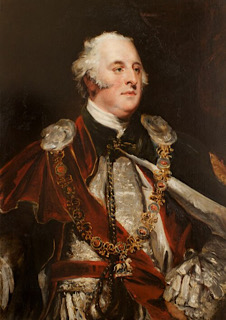
(Pictured: Portrait of James Butler, 2nd Duke of Ormonde, by Michael Dahl, National Portrait Gallery)
Joyce is the eldest of three sons of Michael Joyce, an Irish Catholic from a family of tenant farmers in Ballinrobe, County Mayo, and his wife, Gertrude (née Brooke), who although born in Shaw and Crompton, Lancashire, is from a well-off AnglicanAnglo-Irish family of physicians associated with County Roscommon. The Joyces return to Ireland in 1909. William, a precocious child, attends Coláiste Iognáid SJ, a Jesuit school in County Galway, from 1915 to 1921. At the age of fourteen, he abandons Catholicism for Anglicanism, apparently after being told that all non-Catholics, including his mother, would be damned. In adult life he is nominally anglican, though his adherence to Christianity is tenuous.
The Joyces are unionists and teach their children fervent imperialism. During the Irish War of Independence, Joyce openly associates with the Black and Tans and acts as a scout for them. An acquaintance claims that his views are so extreme even loyalists dislike him. On December 9, 1921, he flees to England to join the Worcestershire Regiment and is followed to England in 1923 by the rest of the family. When he enlists, he claims to be eighteen, but after he contracts rheumatic fever, his age is discovered, and he is discharged in March 1922. For a time, he studies mathematics and chemistry at Battersea Polytechnic Institute as a pre-medical student (1922–23), but he leaves of his own accord, with a reputation for laziness and violent political views. His studies in English and history at Birkbeck College are more successful. He is a brilliant linguist and mathematician and graduates BA with first-class honours in 1927. He publishes an academic article on philology and considers progressing to an MA. He later falsely claims that his research had been plagiarised by a Jewish academic. In 1932, he enrolls at King’s College, London, for a Ph.D. in educational psychology.
Joyce is disturbed by the difference between depressed post-war Britain and the imperial ideal that he had imbibed in Galway and is mocked for his outspoken patriotism and obvious Irishness. He identifies strongly with Thomas Carlyle, an earlier angry anti-liberal from the provinces. His life is marked by repeated episodes of hero worship, followed by disillusion and bitter denunciation. In 1923, he joins the British Fascists, an organisation that has a significant Irish loyalist membership, and in 1924 he allies himself with a militant splinter group, the National Fascists. Most British fascists see themselves as Tory auxiliaries, and they often provide a security presence at conservative meetings. On October 22, 1924, while stewarding a meeting addressed by a Jewish conservative candidate, he has his face slashed and is left with a prominent scar across his right cheek. He joins the Conservative Party in 1928 and is active in the Chelsea constituency until 1930, when he is forced out because of his eccentricities and sexual misbehaviour. On April 30, 1927, he marries Hazel Kathleen Barr. They have two daughters but separate in 1935, largely because of his infidelities, heavy drinking, and temper. The marriage is dissolved in 1937.
In November 1933, Joyce abandons his Ph.D. studies to work for Sir Oswald Mosley‘s British Union of Fascists (BUF). By early 1934 he has become its paid publicity director, traveling throughout Britain to organise meetings. He is a powerful, rabble-rousing speaker, driven by an instinctive awareness that vitriolic verbal abuse gives speaker and audience a sense of power and solidarity. MI5 sees him as a compelling, though deranged, personality. On February 8, 1937, he marries Margaret Cairns White, a BUF activist from Lancashire, with whom he had cohabited since 1936.
Joyce leads a BUF faction that favours a recruitment strategy based on uncompromising ideological assertion. This is challenged by populists who prioritise marches and displays and hold that indoctrination should follow membership. In February 1937, he is BUF candidate for the London County Council in Shoreditch. The party wins 14 percent of the vote. In March 1937, he, along with many full-time BUF staff, are sacked when the BUF cuts expenses. But his dismissal also reflects Mosley’s awareness that his obsessive rhetoric repels “respectable” recruits and that he is no longer a biddable, slavish admirer of “the Leader.” He later falsely claims near-exclusive credit for the BUF’s escalating antisemitism, a view that Mosley eventually finds it convenient to adopt in order to evade his own responsibility.
In April 1937, Joyce founds the National Socialist League, helped by a wealthy patron. He supports himself as a private tutor, refusing to take Jewish pupils. He is active in various antisemitic and pro-Nazi groups such as the Right Club and engages in “peace” campaigns based on the view that British interests lay with Germany against Russia. Political marginalisation intensifies his admiration for Nazi Germany and hero worship of Adolf Hitler. By the time of the Munich crisis in 1938, he has decided that if war comes, he will go to Germany, though he also considers moving to Ireland. He renews his British passport for one-year terms in August 1938 and August 1939.
On August 26, 1939, Joyce and his wife leave London for Berlin. He is allegedly tipped off about his impending arrest and internment by an MI5 officer, to whom he had supplied information on communists. His siblings, whom he recruited into his fascist organisations, are variously penalised for his activities. At a loose end in Berlin, he is persuaded by a British associate to become a radio announcer with the English-language service of the Reichs-Rundfunk-Gesellschaft (RRG). He makes his first broadcast on September 6, 1939, and receives a contract in October. He finds in radio an outlet for his forceful style and delight in saying the unsayable, and in the early years of the war takes an exultant pride in recounting Nazi victories. His performances are admired by Joseph Goebbels, whom Joyce, to his regret, never meets. On September 26, 1940, he acquires German citizenship.
The novel experience of hearing the enemy in one’s own living room attracts wide audiences in Britain. Joyce’s practice of naming newly captured prisoners of war in his broadcasts is also a compelling motive for listening. In fact, he tries to recruit British prisoners of war as collaborators. The name “Lord Haw-Haw,” invented by the Daily Express radio critic in September 1939, initially applies to several English-language broadcasters but in time becomes associated with Joyce. He is initially a figure of fun, imitated by comedians, but there are sinister undercurrents of terrifying omnipotence, intensified by his sneering, gloating delivery and his delighted deployment of the “big lie” technique. It is widely believed that British-based fifth columnists supply him with information, that he predicts air raids, and shows minute local knowledge. In time, fear and his growing notoriety feed popular hatred of him in Britain, though his anti-British taunts allegedly win appreciative Irish audiences. He exults that he is daily committing treason and rendering himself liable to the death penalty.
In 1940, Joyce publishes a commissioned self-justifying propaganda work, Twilight over England. His representation of himself echoes that of Hitler in Mein Kampf – the provincial patriot, whose martial sacrifices are betrayed by corrupt elites, learning through poverty the hollowness of bourgeois patriotism and the need to synthesise socialism with nationalism. He shares with his hero a paranoid belief in his own ability to create an alternative reality through language and obstinacy. He dreams of becoming the English Führer.
In Berlin, the Joyces’ marriage comes under increasing strain, marked by drunken rows, domestic violence, and infidelity on both sides, though they retain a fierce mutual fascination. They divorce on August 12, 1941, but remarry on February 11, 1942, while continuing their previous behaviour. As the Axis powers begin to fail, his broadcasts become more defensive, focusing on the Soviet threat. On October 14, 1944, he is awarded the German War Merit Cross, first class. On October 22, he is sworn into the Volkssturm (territorial army) and begins drilling. The Joyces are evacuated from Berlin in March 1945, initially to Apen near the Dutch border and then to Hamburg, where he makes a last, drunken, defiant broadcast on April 30, 1945, the day of Hitler’s death. After an unsuccessful attempt to escape to Sweden, the Joyces hide at Flensburg near the Danish border. On May 28, 1945, he is shot and captured while gathering firewood.
Joyce is brought back to Britain on June 16 after Parliament passed legislation simplifying treason trial procedures. At his September 17-20 trial, he proves his American citizenship, but the court holds that his illegally acquired British passport incurred duties of allegiance. His appeals are rejected by the Court of Appeal and the House of Lords. His fate is influenced by British public opinion, and possibly by a desire to avoid antagonising the Soviet Union. In his death cell he blames the defeat of national socialism on German limitations. He also fantasises that he could have saved Hitler from his incompetent subordinates.
Joyce is hanged by Albert Pierrepoint at Wandsworth Prison on January 3, 1946. Unlike most of his fellow Nazis, he proclaims to the end his allegiance to national socialism and hatred of Jews. He corresponds cheerfully with Margaret, joking evasively about the death camps and expressing a belief that his spirit will survive, watch over her, and continue his work. To neo-Nazis he becomes a martyr. Even among those to whom his activities had been repellent, a significant body of opinion holds he should not have been condemned on a questionable and innovative technicality. The historian A. J. P. Taylor maintains that Joyce was executed for making a false declaration to obtain a passport, a misdemeanour that normally incurs a £2 fine.
In 1976, Joyce is reinterred in Galway as it is feared that a grave in England might become a fascist shrine. Thomas Kilroy‘s play Double Cross (1986) juxtaposes Joyce and Brendan Bracken as Irishmen who reinvented themselves through fantasies of Britishness. The BBC Sound Archive has recordings of some of Joyce’s broadcasts and transcripts of others, collected during the war as evidence for a future treason trial.
(From: “Joyce, William Brooke (‘Lord Haw-Haw’)” by Patrick Maume, Dictionary of Irish Biography, http://www.dib.ie, October 2009)
Dickson is born on December 25, 1744, the eldest son of John Dickson, a tenant farmer of Ballycraigy, in the parish of Carnmoney, County Antrim. His mother is Jane Steel and, on the death of his uncle, William Steel, on May 13, 1747, the family adds his mother’s maiden name to their own.
In his boyhood, Dickson is educated by Robert White, a Presbyterian minister from Templepatrick and enters University of Glasgow in November 1761. Following graduation, he is apparently employed for a time in teaching, and in 1771 he is ordained as a Presbyterian minister. Until the outbreak of the American Revolutionary War, he occupies himself mainly with parochial and domestic duties. His political career begins in 1776, when he speaks and preaches against the “unnatural, impolitic and unprincipled” war with the American colonies, denouncing it as a “mad crusade.” On two government fast-days his sermons on “the advantages of national repentance” (December 13, 1776), and on “the ruinous effects of civil war” (February 27, 1778) create considerable excitement when published. Government loyalists denounce Dickson as a traitor.
Political differences are probably at the root of a secession from his congregation in 1777. The seceders form a new congregation at Kircubbin, County Down, in defiance of the authority of the general synod.
In 1771 Dickson marries Isabella Gamble, a woman of some means, who dies on July 15, 1819. They have at least eight children, but he outlives them all. One of his sons is in the Royal Navy and dies in 1798.
Dickson enters with zest into the volunteer movement of 1778, being warmly in favour of the admission of Roman Catholics to the ranks. This is resisted “through the greater part of Ulster, if not the whole.” In a sermon to the Echlinville volunteers on March 28, 1779, he advocates the enrolment of Catholics and though induced to modify his language in printing the discourse, he offends “all the Protestant and Presbyterian bigots in the country.” He is accused of being a papist at heart, “for the very substantial reason, among others, that the maiden name of the parish priest’s mother was Dickson.”
Though the contrary has been stated, Dickson is not a member of the Volunteer conventions at Dungannon in 1782 and 1783. He throws himself heart and soul into the famous election for County Down in August 1783, when the families of Hill and Stewart, compete for the county seat in Parliament. He, with his forty-shilling freeholders, fails to secure the election of Robert Stewart. But in 1790 he successfully campaigns for the election of Stewart’s son, better known as Lord Castlereagh. Castlereagh proves his gratitude by referring at a later date to Dickson’s popularity in 1790, as proof that he was “a very dangerous person to leave at liberty.”
In December 1791, Dickson joins Robert White’s son, John Campbell White, taking the “test” of the first Society of United Irishmen, organised in October in Belfast following a meeting held with Theobald Wolfe Tone, Protestant secretary of the Catholic Committee in Dublin. According to Dickson himself, he attends no further meetings of the Society but devotes himself to spreading its principles among the volunteer associations, in opposition to the “demi-patriotic” views of the Whig Club.
At a great volunteer meeting in Belfast on July 14, 1792, Dickson opposes a resolution for the gradual removal of Catholic disabilities and assists in obtaining a unanimous pledge in favour of total and immediate emancipation. Parish and county meetings are held throughout Ulster, culminating in a provincial convention at Dungannon on February 15, 1793. He is a leading spirit at many of the preliminary meetings, and, as a delegate from the Barony of Ards, he has a chief hand in the preparation of the Dungannon resolutions. Their avowed object is to strengthen the throne and give vitality to the constitution by “a complete and radical reform.” He is nominated on a committee of thirty to summon a national convention. The Irish parliament goes no further in the direction of emancipation than the Roman Catholic Relief Act 1793, which receives the royal assent on April 9, and remains unextended until 1829. While the passing of Lord Clare‘s Convention Act, still in force, makes illegal all future assemblies of delegates “purporting to represent the people, or any description of the people.”
In March and April 1798, Dickson is in Scotland arranging some family affairs. During his absence plans are made for an insurrection in Ulster, and soon after his return he agrees to take the place of Thomas Russell, who had been arrested, as adjutant-general of the United Irish forces for County Down. A few days before the county is to rise, he is himself arrested at Ballynahinch.
Dickson is conveyed to Belfast and lodged in the “black hole” and other prisons until August 12 when he is removed to a prison ship with William Tennant, Robert Hunter, Robert Simms, David Bailie Warden and Thomas Ledlie Birch, and detained there amid considerable discomfort. On March 25, 1799, Dickson, Tennant, Hunter, and Simms join the United Irish “State Prisoners” on a ship bound for Fort George, Highland prison in Scotland. This group, which includes Samuel Neilson, Arthur O’Connor, Thomas Russell, William James MacNeven, and Thomas Addis Emmet, arrives in Scotland on April 9, 1799. He spends two years there.
Unlike the more high-profile prisoners like O’Connor and MacNeven who are not released until June 1802, Tennant, Dickson, and Simms are permitted to return to Belfast in January 1802.
Dickson returns to liberty and misfortune. His wife has long been a helpless invalid, his eldest son is dead, his prospects are ruined. His congregation at Portaferry had been declared vacant on November 28, 1799. William Moreland, who had been ordained as his successor on June 16, 1800, at once offers to resign, but Dickson will not hear of this. He has thoughts of emigration but decides to stand his ground. At length, he is chosen by a seceding minority from the congregation of Keady, County Armagh, and installed minister on March 4, 1803.
Dickson’s political engagement ends with his attendance on September 9, 1811, of a Catholic meeting in Armagh, on returning from which he is cruelly beaten by Orangemen. In 1815 he resigns his charge in broken health and henceforth subsists on charity. Joseph Wright, an Episcopalian lawyer, gives him a cottage rent-free in the suburbs of Belfast, and some of his old friends make him a weekly allowance. His last appearance in the pulpit is early in 1824. He dies on December 27, 1824, having just passed his eightieth year, and is buried “in a pauper’s grave” at Clifton Street Cemetery, Belfast.