Bowman is brought up in Ballsbridge in south Dublin. His father works for Great Southern Railways (later CIÉ) and his mother is a nurse, originally from County Monaghan. He is educated at Belvedere College and Trinity College Dublin where he receives a bachelor’s degree in history and political science in 1970 and a PhD in political science in 1980. He joins Radio Éireann in 1962, later becoming the presenter and commentator on numerous current affairs programmes, as well as an analyst of political developments and interviewer of politicians on radio and later on television. In the 1980s, he presents the current affairs programme Today Tonight, the precursor to Prime Time.
Bowman wins Jacob’s Awards in 2013 and 2016 for his radio broadcasting, the former for his presentation of the current affairs programme, Day by Day. In April 2008, he comments on RTÉ television coverage of the state funeral of Patrick Hillery, a former President of Ireland.
Bowman chairs the audience-participation political programme Questions and Answers on RTÉ One television for 21 years, the final edition airing on June 29, 2009. He is the presenter of Bowman: Sunday: 8.30 (previously Bowman Saturday) on radio, a weekly compilation of material from broadcasting archives at home and abroad.
Bowman writes a history of RTÉ Television called Window and Mirror. RTÉ Television: 1961-2011. It is launched by TaoiseachEnda Kenny at the National Museum of Ireland in Dublin on November 23, 2011.
Bowman is married to psychiatrist Eimer Philbin Bowman and they have have four children: Jonathan, Emma, Abie and Daniel. His eldest son, Jonathan Philbin Bowman, a journalist, television and radio presenter, dies in an accident in March 2000. His daughter, Emma Philbin Bowman, works in Dublin as a psychotherapist. His middle son, Abie Philbin Bowman, is a columnist for The Dubliner magazine and a stand-up comedian, while in 2005 his youngest son, Daniel, initiates Be Not Afraid, a charity wristband campaign which raises over €80,000 in aid of Turning the Tide of Suicide and the Irish Red Cross and later sets up a youth marketing firm, Spark.
Plunkett’s only grown sibling, a younger brother, from whom he is estranged from about 1916, for reasons not fully clear but connected to his mother’s will, is the noted British naval officer Sir Reginald Drax. Another younger brother dies in infancy.
The title passes to Plunkett at his father’s death in 1899 at a fairly young age. The young Lord Dunsany returns to Dunsany Castle in 1901 after war duty. In that year he is also confirmed as an elector for the Representative Peers for Ireland in the House of Lords.
In 1903, Plunkett meets Lady Beatrice Child Villiers (1880–1970), youngest daughter of Victor Child Villiers, 7th Earl of Jersey, who is then living at Osterley Park. They marry in 1904. Their one child, Randal, is born in 1906. Lady Beatrice is supportive of her husband’s interests and helps him by typing his manuscripts, selecting work for his collections, including the 1954 retrospective short story collection, and overseeing his literary heritage after his death.
The Plunketts are socially active in Dublin and London and travel between homes in Meath, London and Kent, other than during the First and Second World Wars and the Irish War of Independence. He circulates with many literary figures of the time. To many of these in Ireland he is first introduced by his uncle, the co-operative pioneer Sir Horace Plunkett, who also helps to manage his estate and investments for a time. He is friendly, for example, with George William Russell, Oliver St. John Gogarty, and for a time, W. B. Yeats. He also socialises at times with George Bernard Shaw and H. G. Wells and is a friend of Rudyard Kipling.
In 1910 Plunkett commissions a two-story extension to Dunsany Castle, with a billiard room, bedrooms and other facilities. The billiard room includes the crests of all the Lords Dunsany up to the 18th.
Plunkett serves as a second lieutenant in the Coldstream Guards in the Second Boer War. Volunteering in World War I and appointed Captain in the Royal Inniskilling Fusiliers, he is stationed for a time at Ebrington Barracks in Derry, Northern Ireland. Hearing while on leave of disturbances in Dublin during the Easter Rising of 1916, he drives in to offer help and is wounded by a bullet lodged in his skull. After recovery at Jervis Street Hospital and what is then the King George V Hospital (now St. Bricin’s Military Hospital), he returns to duty. His military belt is lost in the episode and later used at the burial of Michael Collins. Having been refused forward positioning in 1916 and listed as valuable as a trainer, he serves in the later war stages in the trenches and in the final period writing propaganda material for the War Office with MI7b. There is a book at Dunsany Castle with wartime photographs, on which lost members of his command are marked.
During the Irish War of Independence, Plunkett is charged with violating the Restoration of Order in Ireland Act 1920, tried by court-martial on February 4, 1921, convicted, and sentenced to pay a fine of 25 pounds or serve three months in prison without labour. The Crown Forces had searched Dunsany Castle and had found two double-barrelled shotguns, two rook rifles, four Very pistols, an automatic pistol and a large quantity of pistol ammunition, along with shotgun and rifle ammunition.
During World War II, Plunkett signs up for the Irish Army Reserve and the British Home Guard, the two countries’ local defence forces, and is especially active in Shoreham, Kent, the English village bombed most during the Battle of Britain.
Plunkett’s fame arises chiefly from his prolific writings. He is involved in the Irish Literary Revival. Supporting the Revival, he is a major donor to the Abbey Theatre, and he moves in Irish literary circles. He is well acquainted with W. B. Yeats, Lady Gregory, Percy French, George “AE” Russell, Oliver St. John Gogarty, Padraic Colum and others. He befriends and supports Francis Ledwidge, to whom he gives the use of his library, and Mary Lavin.
Plunkett makes his first literary tour to the United States in 1919 and further such visits up to the 1950s, in the early years mostly to the eastern seaboard and later, notably, to California. His own work and contribution to the Irish literary heritage are recognised with an honorary degree from Trinity College Dublin.
In 1940, Plunkett is appointed Byron Professor of English in the University of Athens in Greece. Having reached Athens by a circuitous route, he is so successful that he is offered a post as Professor of English in Istanbul. However, he has to be evacuated due to the German invasion of Greece in April 1941, returning home by an even more complex route, his travels forming a basis for a long poem published in book form (A Journey, in 5 cantos: The Battle of Britain, The Battle of Greece, The Battle of the Mediterranean, Battles Long Ago, The Battle of the Atlantic, special edition January 1944). Olivia Manning‘s character Lord Pinkrose in her novel sequence the Fortunes of War is a mocking portrait of Dunsany in that period.
In 1947, Plunkett transfers his Meath estate in trust to his son and heir and settles in Kent at his Shoreham house, Dunstall Priory, not far from the home of Rudyard Kipling. He visits Ireland only occasionally thereafter and engages actively in life in Shoreham and London. He also begins a new series of visits to the United States, notably California, as recounted in Hazel Littlefield-Smith’s biographical Dunsany, King of Dreams.
In 1957, Plunkett becomes ill while dining with the Earl and Countess of Fingall at Dunsany, in what proves to be an attack of appendicitis. He dies in hospital in Dublin, at the age of 79, on October 25, 1957. He is buried in the churchyard of the ancient church of St. Peter and St. Paul, Shoreham, Kent. His funeral is attended by many family members, representatives of his old regiment and various bodies in which he had taken an interest, and figures from Shoreham. A memorial service is held at Kilmessan in County Meath, with a reading of “Crossing the Bar,” which coincides with the passing of a flock of geese.
Beatrice survives Plunkett, living mainly at Shoreham and overseeing his literary legacy until her death in 1970. Their son Randal succeeds to the barony and is in turn succeeded by his grandson, the artist Edward Plunkett. Plunkett’s literary rights pass from Beatrice to Edward.
McLynn grows up with two younger brothers in Galway. She studies History of Art and Modern English at Trinity College Dublin but is more heavily involved in the college’s drama society. She graduates with an MA.
Although McLynn is in her early thirties when playing Mrs. Doyle in Father Ted, makeup is used to make her look far older to fit the character’s elderly profile. She receives a British Comedy Award for her performances in 1996. The award is presented to her by Tony Blair.
McLynn is critically acclaimed for her performance in the 2005 film Gypo, receiving an Irish Film & Television Academy award nomination for Best Actress.
McLynn appears as Libby Croker in Shameless, which is produced by the British broadcaster Channel 4. In January 2011 it is announced that she has left the show, reportedly after a “difficult year.” She also plays the role of Alice’s mother in the Comedy Central show Threesome. She stars in Samuel Beckett’s Happy Days at the Crucible Theatre, Sheffield, in 2011. She plays Mary Whyte in the BBC’s 2013 sitcom Father Figure.
In 2014, McLynn plays the part of Evelyn in “Kiss for the Camera”, a series three episode of the BBC comedy Pramface. On May 12, 2014, she joins the cast of EastEnders as Yvonne Cotton, the mother of Charlie Cotton (Declan Bennett) and ex-daughter-in-law of Dot Branning (June Brown). After starting as a recurring character, she quickly becomes a regular when her character’s storylines escalate. She makes her final appearance on January 13, 2015, at the end of her contract. However, she returns to the soap opera on May 14, 2015 for one single episode to give evidence against Dot during Nick Cotton‘s (John Altman) murder trial.
In 2017, McLynn appears as the mother of lead character Marcella in Roisin Conaty‘s E4 comedy GameFace, and in April 2018 she portrays Sister Mary in the BBC Two biopic Dave Allen At Peace. She appears as a minor character named Mrs. Trattner in the 2018 film Johnny English Strikes Again.
In 2021 McLynn appears as Oona in the E4 S6 of Inside No. 9. She also appears as Carol, a bar landlady, in the film Last Night in Soho, which is released in October 2021. She also appears in Doctor Who, as Mary in the New Year’s special “Eve of the Daleks.”
McLynn is married to theatrical agent Richard Cook. She is a patron of the children’s charity World Vision Ireland and is president of Friends of Innisfree Housing Association. She is also a patron for Littlehill Animal Rescue, Sanctuary in Ireland and Birmingham Greyhound Protection.
Edward Bruce is proclaimed the last High King of Ireland on June 29, 1315. He is crowned in 1316. He reigns between 1315 and 1318. The English colonists in Ireland vehemently oppose him.
Bruce, the brother of the King of Scots, Robert the Bruce, leads a three-year military campaign, known as the Bruce campaign, against the Anglo-Norman lordship of Ireland. This invasion, which lasts from 1315 to 1318, ultimately gives rise to the two nations we recognize now as Ireland and Scotland.
In May 1315, a Scots army of up to six thousand soldiers lands on the Antrim coast. That June, near Carrickfergus, many Gaelic lords led by Donnell O’Neill of Ulster join Bruce. “All the Gaels of Ireland agreed to grant him lordship and they called him King of Ireland,” declares the Irish annals.
The invasion coincides with the Great European Famine (1315-1317), which brings hardship and disillusionment among Bruce’s followers. The annals ruefully comment, “falsehood and famine and homicide filled the country, and undoubtedly men ate each other in Ireland.”
In February 1317, Dublin, the capital of the English royal administration in Ireland, comes close to being captured by the Bruce brothers. The brothers encamp at Castleknock within sight of the city walls. The panicking Dubliners burn the suburbs of the city. In order to re-fortify the city walls, they dismantle the Dominicanpriory north of the River Liffey and tear down the bridge across the river. The Bruce brothers do not lay siege to the city and instead move south to Munster.
In 1318, the invasion is brought to an end when, after marching south from Ulster for one last push, Bruce risks an open battle with an English army north of Dundalk at Faughart and is killed. His corpse is dismembered, and portions of it hung over the gates of various Irish towns. His decapitated head is brought to King Edward II of England by the victor, John de Bermingham, a minor Anglo-Irish baron who is elevated to the status of “Earl of Louth” for bringing the Bruce campaign in Ireland to an end.
A conference at Trinity College Dublin, in 2015, entitled The Irish-Scottish World in the Middle Ages, explores this key moment in the history of Ireland and Scotland. “The Bruce Invasion was a watershed moment in that story,” says Seán Duffy, Professor of Medieval Irish History and one of the organizers of the conference.
“Although Edward Bruce was defeated and killed in 1318, the effect of the invasion was far-reaching. The tide of Anglo-Norman expansion in Ireland turned back and the late Middle Ages saw the flowering of a Gaelic literary and cultural revival. Scotland, meanwhile, was galvanized by its victory over the English at Bannockburn which secured its path to independent nationhood.”
“Few peoples have as much in common as the Irish and the Scots. The very name Scotland is an ever-present reminder of that connection, because, in the Latin of the early Middle Ages, a Scotus was an Irishman, and the homeland of the Scoti was Ireland. That the name came to be applied to the northern part of Britain is testament to the strength of Irish influence on what we now know today as Scotland.”
(From: “On This Day: Edward Bruce, the last High King of Ireland, dies in 1318” by IrishCentral Staff, http://www.irishcentral.com, October 2022 | Pictured: Grave of Edward de Bruce, High King of Ireland, in Faughart Cemetery, County Louth)
(Robert John) Douglas Gageby, one of the pre-eminent Irish newspaper editors of his generation, dies on June 24, 2004, following a lengthy illness. His life is well documented and a book of essays about him, Bright Brilliant Days: Douglas Gageby and the Irish Times, written by many of his colleagues, some of whom had attained fame for their literary achievements, is published in 2006.
Gageby is educated at Belfast Royal Academy and Trinity College Dublin, where he is elected a scholar in Modern Languages (French and German) in 1940. He is also actively involved with the student newspaper, Trinity News. He enlists in the Irish Army as a private soldier at the outbreak of World War II. He is commissioned later, and he serves as an intelligence officer. He reports from post-war Germany for The Irish Press and goes on to work under Conor Cruise O’Brien in the Irish News Agency. In 1954 he is the first editor of the Evening Press. In 1963 he becomes editor of The Irish Times, a post he holds until 1986, having been brought back from a short retirement in 1974. He is credited with moving The Irish Times from a Unionist organ into a successful Irish journal of record.
In 2003 it is revealed that a director, and later Chairman, of The Irish Times, Major Thomas Bleakley McDowell, had referred to Gageby as a “white nigger” for his views and role in the paper during the Northern Ireland civil rights movement‘s campaign in the 1960s. The comment appears in a letter from the British Ambassador to Dublin, Sir Andrew Gilchrist, to Kelvin White, head of the Irish Section of the British Foreign Office and is dated October 2, 1969. Gilchrist is referring to conversations which he had with McDowell where the latter professes himself to be fully behind the British government in the North and hostile to Gageby’s coverage of the civil rights movement. However, historian Mark O’Brien notes, “Despite his contacts with London, McDowell’s actions did not interfere with Gageby’s editorials on Northern Ireland”, due to the fact McDowell believes in editorial independence (even though McDowell strongly disagrees with Gageby’s nationalist views), and because Gageby is making the newspaper commercially successful. Under the 30 year rule, this letter is made available to newspapers on December 22 and 23, 1999, but no newspaper publishes it at that time.
The communiqué is later discovered by the historian Jack Lane and published in the Irish Political Review, a small magazine strongly antagonistic to The Irish Times, in January 2003. He brings it to the attention of The Irish Times editor, Geraldine Kennedy, on January 10, 2003, and she replies on January 15, 2003 saying she is “unable to confirm the veracity of it” and does not publish it. When, on January 26, 2003, the Sunday Independent (Ireland) publishes the story, The Irish Times finally follows the next day, January 27. Nonetheless, on April 24, 2004, Kennedy defends her position by saying, “The contents of the letter in question were published on January 27, 2003, as soon as its existence was drawn to my attention.”
Gageby dies on June 24, 2004, following a two year illness. His private funeral is conducted by Rev. Terence McCaughey, a family friend. The Irish Times endows an annual Douglas Gageby Fellowship for young journalists and a stand of trees is planted in his memory at Moynalty. His papers are presented to Dublin City University (DCU).
Paul McGuinness, the founder of Principle Management Limited, a popular music act management company based in Dublin, is born on June 16, 1951, in Rinteln, Westphalia, Germany. He is the manager of the rock band U2 from 1978 to 2013.
McGuinness is born in a British military hospital at Rinteln where his father, Philip McGuinness, a native of Liverpool, is serving with the Royal Air Force. His mother, Sheila McGuinness (née Lyne), is a schoolteacher from County Kerry. There are three children in the family: Paul, Niall, and Katy.
McGuinness receives his early formal education in Ireland at the private Jesuit boarding school, Clongowes Wood College. From there he goes on to Trinity College Dublin, where he directs plays, edits the magazine T.C.D. Miscellany, and promotes gigs, but drops out before obtaining a degree.
Before becoming involved with U2, Guinness works as a film assistant director on productions such as John Boorman‘s Zardoz. For a time, he also manages folk-rock group Spud.
McGuinness first meets U2 at a Dublin gig on May 25, 1978, where they are supporting the Gamblers. Following this meeting, he becomes U2’s manager, having been introduced to the band by Bill Graham, a journalist with Hot Press magazine. His original agreement with the band is that the money is to be split equally five ways, though this is later changed.
McGuinness founds Principle Management Limited on March 29, 1984. He and Bill Whelan set up a music publishing company called McGuinness/Whelan Publishing in the late 1980s. Whelan later composes the music for the theatrical show Riverdance.
In 2002, McGuinness is presented with a Lifetime Achievement Award at the Meteor Music Awards at the Point Theatre in Dublin and U2 wins the best Irish Band Award.
Noted for his business acumen, McGuinness is responsible for U2 3D concert films, U2-branded iPods, sponsorship from BlackBerry and the first-ever concert streamed live on YouTube.
McGuinness is regarded as the fifth member of U2, although in an interview with The Irish Press in 1985, when asked if he is the fifth member of U2, he replies, “The fifth member of U2 is in Adam (Clayton)‘s trousers.” He is also regarded as one of the most successful managers in the music business.
McGuinness steps down as manager of U2 after 34 years on November 13, 2013, with Madonna‘s manager, Guy Oseary, succeeding him in 2014 when he sells Principle Management Limited to Live Nation.
McGuinness is a founding partner of TV3 (Ireland) and is one of the owners of Ardmore Film Studios. He becomes a member of the Arts Council of Ireland on January 1, 1988, having been appointed by Charles Haughey. He serves until February 2000 when he resigns.
McGuinness has been an advocate on behalf of artists, record labels, and music publishers. On January 28, 2008, in a speech at the Midem music industry convention in Cannes, he specifically accuses companies such as Apple, Google, Yahoo!, and Facebook of building “multi-billion dollar industries on the back of our content without paying for it.”
In 2015, McGuinness founds Primo Productions, a film and TV company. Primo produces three seasons of Riviera, a drama set in the South of France. He writes the “list of ingredients” for the show: “Rich people behaving badly in the sun, yachts, Maseratis, great clothes, beautiful women, art fraud, money laundering through the auction houses, Russians, English people, American, French. Murder, adultery.” Everyday life on the Côte d’Azur. His production partner is Kris Thykier of Archery Pictures. The show is originally commissioned by Anne Mensah of Sky Atlantic.
McGuinness marries Kathy Gilfillan in 1977. They meet while he is studying at Trinity. Gilfillan is director of The Lilliput Press. They have two children.
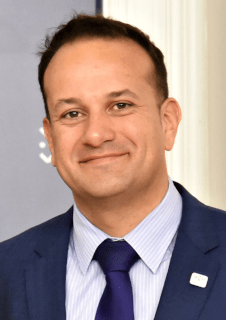
The current Taoiseach, 66-year-old Enda Kenny, announced his resignation the previous month after six years at the head of the centrist party, setting off a battle to lead the ruling Fine Gael.
“If somebody of my age, of my mixed-race background and of all the things that make up my character can potentially become leader of our country, then I think that sends out a message to every child born today that there is no office in Ireland that they can’t aspire to,” Varadkar tells Newstalk radio.
The Fine Gael parliamentary party votes overwhelmingly (70 percent) in favor of Varadkar while 65 percent of members favor Coveney. As Varadkar is backed by most lawmakers and local representatives, he gains victory under the center-right party’s electoral college system.
Varadkar’s position is confirmed later in the month after parliament resumes following a break.
Varadkar’s father, Ashok, a doctor, moves to Ireland in the 1970s and his youngest son is born in Dublin in 1979. He studies medicine at Trinity College Dublin and spends several years as a junior doctor before qualifying as a general practitioner in 2010.
Varadkar is first elected in local elections in 2003 and in 2007 to the lower house of Ireland’s assembly, the Dáil Éireann. He comes to public prominence in 2015 when Ireland votes in favor of same-sex marriage.
Varadkar’s most pressing first international task is negotiating Ireland’s new arrangement with the United Kingdom after it leaves the European Union.
In a radio interview in 2015, Varadkar speaks for the first time about being gay, “It’s not something that defines me. I’m not a half-Indian politician, or a doctor politician or a gay politician for that matter. It’s just part of who I am. It doesn’t define me. It is part of my character I suppose.”
Varadkar’s partner is also a doctor in Dublin.
(From: “Ireland’s ruling party elects Varadkar new leader” by Jane Mcintosh, Deutsche Welle (DW), http://www.dw.com, June 2, 2017)
Lever is born in Amiens Street, Dublin, on August 31, 1806. He is the second son of James Lever, an architect and builder, and is educated in private schools. His escapades at Trinity College, Dublin (1823–1828), where he earns a degree in medicine in 1831, are drawn on for the plots of some of his novels. The character Frank Webber in the novel Charles O’Malley is based on a college friend, Robert Boyle, who later becomes a clergyman. He and Boyle earn pocket-money singing ballads of their own composing in the streets of Dublin and play many other pranks which he embellishes in the novels Charles O’Malley, Con Cregan and Lord Kilgobbin.
Before seriously embarking upon his medical studies, Lever visits Canada as an unqualified surgeon on an emigrant ship. Arriving in Canada, he journeys into the backwoods, where he is affiliated to a tribe of Native Americans but has to flee because his life is in danger, as later his character Bagenal Daly does in his novel The Knight of Gwynne.
Back in Europe, Lever pretends he is a student from the University of Göttingen and travels to the University of Jena and then to Vienna. He loves German student life and several of his songs, such as “The Pope He Loved a Merry Life,” are based on student-song models. His medical degree earns him an appointment to the Board of Health in County Clare and then as a dispensary doctor in Portstewart, County Londonderry, but his conduct as a country doctor earns him the censure of the authorities.
In 1833 Lever marries his first love, Catherine Baker, and in February 1837, after varied experiences, he begins publishing The Confessions of Harry Lorrequer in the recently established Dublin University Magazine. Before Harry Lorrequer appears in volume form (1839), he has settled on the strength of a slight diplomatic connection as a fashionable physician in Brussels.
In 1842 Lever returns to Dublin to edit the Dublin University Magazine and gathers round him a typical coterie of Irish wits. In June 1842 he welcomes William Makepeace Thackeray, the author of The Snob Papers, to Templeogue, four miles southwest of Dublin, on his Irish tour. The O’Donoghue and Arthur O’Leary (1845) make his native land an impossible place for Lever to continue in. Thackeray suggests London, but Lever requires a new field of literary observation and anecdote. His creative inspiration exhausted, he decides to renew it on the continent. In 1845 he resigns his editorship and goes back to Brussels, whence he starts upon an unlimited tour of central Europe in a family coach. Now and again, he halts for a few months and entertains to the limit of his resources in some ducal castle or other which he hires for an off season.
Depressed in spirit as Lever is, his wit is unextinguished. He is still the delight of the salons with his stories, and in 1867, after a few years’ experience of a similar kind at La Spezia, he is cheered by a letter from Lord Derby offering him the more lucrative consulship of Trieste. The $600 annual salary does not atone to Lever for the lassitude of prolonged exile. Trieste, at first “all that I could desire,” became with characteristic abruptness “detestable and damnable.”
Lever’s depression, partly due to incipient heart disease, partly to the growing conviction that he is the victim of literary and critical conspiracy, is confirmed by the death of his wife on April 23, 1870, to whom he is tenderly attached. He visits Ireland in the following year and seems alternately in high and low spirits. Death had already given him one or two runaway knocks, and, after his return to Trieste, he fails gradually, dying suddenly, however, and almost painlessly, from heart failure on June 1, 1872, at his home, Villa Gasteiger. His daughters, one of whom, Sydney, is believed to have been the real author of A Rent in a Cloud (1869), are well provided for.
French attends Trinity College Dublin, and trains in acting. She settles in Ireland and has lived in Dublin since 1990. She and her husband have two daughters.
French is enthralled by both acting and writing since her childhood but eventually focuses more on acting. She grows up reading mystery and crime novels. She trains as a professional actor at Trinity, and she works in theatre, film, and voice-over.
In her later 30s, her passion for writing is rekindled. She begins writing her debut novel in the months-long lulls between castings. In the Woods is published in 2007 to international acclaim and receives rave reviews from many publications. Publishers Weekly praises her, saying she “expertly walks the line between police procedural and psychological thriller in her debut” and that “Ryan and Maddox are empathetic and flawed heroes, whose partnership and friendship elevate the narrative beyond a gory tale of murdered children and repressed childhood trauma.” It receives several literary prizes, is a bestseller in hardcover and paperback, and has been termed a “dream debut.” In 2014, Flavorwire includes it in their 50 of the Greatest Debut Novels Since 1950. As of 2015 more than one million copies of In the Woods have been sold.
French’s second novel, The Likeness (2008), presents the story of the first novel’s co-lead, Cassie Maddox. It quickly achieves high positions on bestseller lists in various countries and stays on The New York Times Best Seller list for several months. In its reviews of the novel, Kirkus Reviews praises its mix of “police procedures, psychological thrills and gothic romance beautifully woven into one stunning story.” In an interview with The Guardian, French states that Donna Tartt‘s The Secret History was an influence on The Likeness, opening up the “landscape of friendship as something worthy of exploration and something that could be powerful enough to trigger a murder.”
French’s first six novels are part of the Dublin Murder Squad series. After publishing The Trespasser in 2016, she publishes two standalone novels. Both The Witch Elm and The Searcher also take place in Ireland.
In 2015, Euston Films & Veritas acquire TV production rights. Sarah Phelps writes the screenplay, which she bases on both In the Woods and The Likeness, for the eight-episode series of Dublin Murders, commissioned by the BBC for BBC One and Starz, with RTÉ later joining the project. Filming commences in 2018 in Belfast and Dublin and continues in Dublin to late February 2019. Broadcast begins on BBC One on October 14, 2019, on RTÉ One on October 16, 2019, and on Starz on November 10, 2019.
Archer is the eldest son of Rev. Richard Archer (1796? – 1849), perpetual curate of Maghera hamlet, County Down, and his wife, Jane Matilda (née Campbell). Nothing is known of his education, though his two younger brothers attend Trinity College Dublin (TCD). At some point, he apparently appears to become estranged from his family.
Archer moves to Dublin around 1846, where for many years he pursues a business career. He achieves fame as a naturalist, and in 1849, is one of the twelve founder members of the Dublin Microscopical Club, of which he is the secretary and moving spirit for many years. Between 1858 and 1885 he writes over 230 scientific papers on Irish fauna and flora in the Quarterly Journal of Microscopical Science, the vast majority of which are short notes on desmids collected in Ireland. Sometimes the same article is published in two or more journals.
Archer is a member of the Dublin University Zoological Association and is elected a member of the Royal Irish Academy (MRIA) on January 10, 1870, and Fellow of the Royal Society (FRS) in 1875, on which occasion it is stated that he has “a knowledge of the minute freshwater organisms unparalleled among British naturalists and perhaps not surpassed for any other country.”
Archer begins a new career when he becomes librarian of the Royal Dublin Society (RDS) in January 1877. The bulk of the society’s library is being taken over by the state to form the National Library of Ireland. He becomes the chief librarian of the new institution and has the task of overseeing the changes. Most of the ideas put forward in his pamphlet, Suggestions as to public library buildings . . . with especial reference to the National Library of Ireland (Dublin, 1881), are used by Sir Thomas Newenham Deane in his design for its new building, which opens in August 1890. His adoption of the Dewey Decimal Classification system and the inception of a dictionary catalogue, both novel in the day, are to prove of lasting value to users of the library.
In poor health, Archer retires in 1895. He dies, unmarried, at his home, 52 Mount Street Lower, Dublin, on August 14, 1897. He is a shy, modest man, who declines professorships at the Royal College of Science for Ireland and at Trinity College Dublin (TCD), and who is nominated for membership of the Royal Irish Academy (RIA) and the Royal Society without his knowledge.




 seamus dubhghaill