seamus dubhghaill

Promoting Irish Culture and History from Little Rock, Arkansas, USA


4 Comments

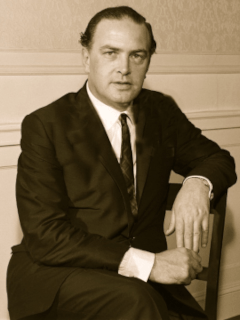
Death of Gusty Spence, UVF Leader & Loyalist Politician

Augustus Andrew Spence, a leader of the paramilitary Ulster Volunteer Force (UVF) and a leading loyalist politician in Northern Ireland, dies in a Belfast hospital on September 25, 2011. One of the first UVF members to be convicted of murder, he is a senior figure in the organisation for over a decade.

Spence, the sixth of seven children, is born and raised in the Shankill Road area of West Belfast in Northern Ireland, the son of William Edward Spence, a member of the Ulster Volunteers who fought in World War I, and Isabella “Bella” Hayes. The family home is 66 Joseph Street in an area of the lower Shankill known colloquially as “the Hammer.” He is educated at the Riddel School on Malvern Street and the Hemsworth Square school, finishing his education at the age of fourteen. He is also a member of the Church Lads’ Brigade, a Church of Ireland group, and the Junior Orange Order. His family has a long tradition of Orange Order membership.

Spence takes various manual jobs in the area until joining the British Army in 1957 as a member of the Royal Ulster Rifles. He rises to the rank of Provost Sergeant (battalion police). He is stationed in Cyprus and sees action fighting against the forces of Colonel Georgios Grivas. He serves until 1961 when ill-health forces him to leave. He then finds employment at the Harland & Wolff shipyard in Belfast, where he works as a stager (builder of the scaffolding in which the ships are constructed), a skilled job that commands respect among working class Protestants and ensures for him a higher status within the Shankill.

From an early age Spence is a member of the Prince Albert Temperance Loyal Orange Lodge, where fellow members include John McQuade. He is also a member of the Royal Black Institution and the Apprentice Boys of Derry. Due to his later involvement in a murder, he is expelled from the Orange Order and the Royal Black Institution. The Reverend Martin Smyth is influential in his being thrown out of the Orange Order.

Spence’s older brother Billy is a founding member of Ulster Protestant Action (UPA) in 1956, and he is also a member of the group. He is frequently involved in street fights with republicans and garners a reputation as a “hard man.” He is also associated loosely with prominent loyalists such as Ian Paisley and Desmond Boal and is advised by both men in 1959 when he launches a protest against Gerry Fitt at Belfast City Hall after Fitt had described Spence’s regiment as “murderers” over allegations that they had killed civilians in Cyprus. He, along with other Shankill Road loyalists, break from Paisley in 1965 when they side with James Kilfedder in a row that follows the latter’s campaigns in Belfast West. Paisley intimates that Kilfedder, a rival for the leadership of dissident unionism, is close to Fine Gael after learning that he had attended party meetings while a student at Trinity College Dublin (TCD). The Shankill loyalists support Kilfedder and following his election as MP send a letter to Paisley accusing him of treachery during the entire affair.

Spence claims that he is approached in 1965 by two men, one of whom was an Ulster Unionist Party MP, who tells him that the Ulster Volunteer Force is to be re-established and that he is to have responsibility for the Shankill. He is sworn in soon afterward in a ceremony held in secret near Pomeroy, County Tyrone. Because of his military experience, he is chosen as the military commander and public face of the UVF when the group is established. However, RUC Special Branch believes that his brother Billy, who keeps a much lower public profile, is the real leader of the group. Whatever the truth of this intelligence, Spence’s Shankill UVF team is made up of only around 12 men on its formation. Their base of operations is the Standard Bar, a pub on the Shankill Road frequented by Spence and his allies.

On May 7, 1966, a group of UVF men led by Spence petrol bomb a Catholic-owned pub on the Shankill Road. Fire also engulfs the house next door, killing the elderly Protestant widow, Matilda Gould (77), who lives there. On May 27, he orders four UVF men to kill an Irish Republican Army (IRA) member, Leo Martin, who lives on the Falls Road. Unable to find their target, the men drive around in search of any Catholic instead. They shoot dead John Scullion (28), a Catholic civilian, as he walks home. Spence later writes “at the time, the attitude was that if you couldn’t get an IRA man you should shoot a Taig, he’s your last resort.” On June 26, the same gang shoots dead Catholic civilian Peter Ward (18) and wounds two others as they leave a pub on Malvern Street in the lower Shankill. Two days later, the government of Northern Ireland uses the Special Powers Act to declare the UVF illegal. Shortly after, Spence and three others are arrested.

In October 1966, Spence is sentenced to life imprisonment for the murder of Ward, although he has always claimed his innocence. He is sent to Crumlin Road Prison. During its July 12, 1967, march, the Orange lodge to which he belongs stops outside the prison in tribute to him. This occurs despite him having been officially expelled from the Orange Order following his conviction. His involvement in the killings gives him legendary status among many young loyalists and he is claimed as an inspiration by the likes of Michael Stone. Tim Pat Coogan describes Spence as a “loyalist folk hero.” The murder of Ward is, however, repudiated by Paisley and condemned in his Protestant Telegraph, sealing the split between the two.

Spence appeals against his conviction and is the subject of a release petition organised by the Ulster Constitution Defence Committee, although nothing comes of either initiative. Despite the fact that control of the UVF lay with his closest ally, Samuel “Bo” McClelland, from prison he is often at odds with the group’s leadership, in particular with regards to the 1971 McGurk’s Bar bombing. Spence now argues that UVF members are soldiers and soldiers should not kill civilians, as had been the case at McGurk’s Bar. He respects some Irish republican paramilitaries, who he feels also live as soldiers, and to this end he writes a sympathetic letter to the widow of Official IRA leader Joe McCann after he is killed in 1972.

Spence is granted two days leave in early July 1972 to attend the wedding of his daughter Elizabeth to Winston Churchill “Winkie” Rea. The latter had formally asked Spence for his daughter’s hand in marriage during a prison visit. Met by two members of the Red Hand Commando upon his release, Spence is informed of the need for a restructuring within the UVF and told not to return to prison. He initially refuses and goes on to attend his daughter’s wedding. Afterward a plot is concocted where Jim Curry, a Red Hand Commando member, will drive Spence back to prison but the car is to be stopped and Spence “kidnapped.” As arranged, the car in which he is a passenger is stopped in Springmartin and he is taken away by UVF members. He remains at large for four months and during that time gives an interview to ITV‘s World in Action in which he calls for the UVF to take an increased role in the Northern Ireland conflict against the Provisional IRA. At the same time, he distances himself from any policy of random murders of Catholics. He also takes on responsibility for the restructuring, returning the UVF to the same command structure and organisational base that Edward Carson had utilised for the original UVF, with brigades, battalions, companies, platoons and sections. He also directs a significant restocking of the group’s arsenal, with guns mostly taken from the security forces. He gives his permission for UVF brigadier Billy Hanna to establish the UVF’s Mid-Ulster Brigade in Lurgan. His fugitive status earns him the short-lived nickname the “Orange Pimpernel.” He is arrested along with around thirty other men at a UVF drinking club in Brennan Street, but after giving a false name, he is released.

Spence’s time on the outside comes to an end on November 4 when he is captured by Colonel Derek Wilford of the Parachute Regiment, who identifies him by tattoos on his hands. He is sent directly to Long Kesh Detention Centre soon afterward, where he shares a cell with William “Plum” Smith, one of the Red Hand Commandos whom he had met upon his initial release and who had since been jailed for attempted murder.

Spence soon becomes the UVF commander within the Long Kesh Detention Centre. He runs his part of Long Kesh along military lines, drilling inmates and training them in weapons use while also expecting a maintenance of discipline. As the loyalist Long Kesh commander, he initially also has jurisdiction over the imprisoned members of the Ulster Defence Association (UDA), although this comes to an end in 1973 when, following a deterioration in relations between the two groups outside the prison walls, James Craig becomes the UDA’s Maze commander. By this time Spence polarises opinion within the UVF, with some members fiercely loyal to a man they see as a folk hero and others resenting his draconian leadership and increasing emphasis on politics, with one anonymous member even labelling him “a cunt in a cravat.”

Spence begins to move toward a position of using political means to advance one’s aims, and he persuades the UVF leadership to declare a temporary ceasefire in 1973. Following Merlyn Rees‘ decision to legalise the UVF in 1974, Spence encourages them to enter politics and support the establishment of the Volunteer Political Party (VPP). However, his ideas are abandoned as the UVF ceasefire falls apart that same year following the Ulster Workers’ Council strike and the Dublin and Monaghan bombings. The carnage of the latter shocks and horrifies Spence. Furthermore, the VPP suffers a heavy defeat in West Belfast in the October 1974 United Kingdom general election, when the DUP candidate, John McQuade, captures six times as many votes as the VPP’s Ken Gibson.

Spence is increasingly disillusioned with the UVF, and he imparts these views to fellow inmates at Long Kesh. According to Billy Mitchell, Spence quizzes him and others sent to Long Kesh about why they are there, seeking an ideological answer to his question. When the prisoner is unable to provide one, Spence then seeks to convince them of the wisdom of his more politicised path, something that he accomplishes with Mitchell. David Ervine and Billy Hutchinson are among the other UVF men imprisoned in the mid-1970s to become disciples of Spence. In 1977, he publicly condemns the use of violence for political gain, on the grounds that it is counterproductive. In 1978, he leaves the UVF altogether. His brother Bobby, also a UVF member, dies in October 1980 inside the Maze, a few months after the death of their brother Billy.

Released from prison in 1984, Spence soon becomes a leading member of the UVF-linked Progressive Unionist Party (PUP) and a central figure in the Northern Ireland peace process. He initially works solely for the PUP but eventually also sets up the Shankill Activity Centre, a government-supported scheme to provide training and leisure opportunities for unemployed youths.

Spence is entrusted by the Combined Loyalist Military Command (CLMC) to read out their October 13, 1994, statement that announces the loyalist ceasefire. Flanked by his PUP colleagues Jim McDonald and William Plum Smith, as well as Ulster Democratic Party (UDP) members Gary McMichael, John White and David Adams, he reads the statement from Fernhill, a former Cunningham family home on their former Glencairn estate in Belfast’s Glencairn area. This building had been an important training centre for members of Edward Carson’s original UVF. A few days after the announcement, he makes a trip to the United States along with the PUP’s David Ervine and Billy Hutchinson and the UDP’s McMichael, Adams and Joe English. Among their engagements is one as guests of honour of the National Committee on American Foreign Policy. He goes on to become a leading advocate for the Good Friday Agreement.

In August 2000, Spence is caught up in moves by Johnny Adair‘s “C” Company of the UDA to take control of the Shankill by forcing out the UVF and other opponents. Due to his involvement in the peace process and the eventual Good Friday Agreement, the authorities insist against his wishes to install additional security measures to the doors and windows. As a result, when Adair’s men try to force their way into Spence’s Shankill home, they only manage to push a long stick through a partially open window of the bungalow and dislodge a few of his military frames off the opposite wall. There is no other damage and other than that small disruption no one is able to gain any physical entry into the property. When Spence’s wife dies three years later, he says that C Company is responsible for her death, as the events had taken on her health.

On May 3, 2007, Spence reads out the statement by the UVF announcing that it will keep its weapons but put them beyond the reach of ordinary members. The statement also includes a warning that activities could “provoke another generation of loyalists toward armed resistance.” He does not specify what activities or what is being resisted.

Spence marries Louie Donaldson, a native of the city’s Grosvenor Road, on June 20, 1953, at Wellwood Street Mission, Sandy Row. The couple has three daughters, Elizabeth (born 1954), Sandra (1956) and Catherine (1960). Louie dies in 2003. Spence, a talented footballer in his youth with Old Lodge F.C., is a lifelong supporter of Linfield F.C.

Spence dies in a Belfast hospital at the age of 78 on September 25, 2011. He had been suffering from a long-term illness and was admitted to hospital 12 days prior to his death. He is praised by, among others, PUP leader Brian Ervine, who states that “his contribution to the peace is incalculable.” Sinn Féin‘s Gerry Kelly claims that while Spence had been central to the development of loyalist paramilitarism, “he will also be remembered as a major influence in drawing loyalism away from sectarian strife.”

However, a granddaughter of Matilda Gould, a 74-year-old Protestant widow who had died from burns sustained in the UVF’s attempted bombing of a Catholic bar next door to her home, objects to Spence being called a “peacemaker” and describes him as a “bad evil man.” The unnamed woman states, “When you go out and throw a petrol bomb through a widow’s window, you’re no peacemaker.”

Spence’s funeral service is held in St. Michael’s Church of Ireland on the Shankill Road. Notable mourners include Unionist politicians Dawn Purvis, Mike Nesbitt, Michael McGimpsey, Hugh Smyth and Brian Ervine, UVF chief John “Bunter” Graham and UDA South Belfast brigadier Jackie McDonald. In accordance with his wishes, there are no paramilitary trappings at the funeral or reference to his time in the UVF. Instead, his coffin is adorned with the beret and regimental flag of the Royal Ulster Rifles, his former regiment. He is buried in Bangor, County Down.


3 Comments

Birth of Lucy Gwynn, First Woman Registrar of Trinity College Dublin

Lucy Penelope Gwynn, the first woman registrar of Trinity College Dublin (TCD), is born in County Donegal on September 22, 1865.

Gwynn’s father, John Gwynn, is a Syriacist and Regius Professor of Divinity at TCD. Her mother is Lucy O’Brien, daughter of MP William Smith O’Brien. Her eight brothers include the author and politician Stephen Gwynn, the academic Edward Gwynn, the career soldier Major General Sir Charles Gwynn, the cricketers Lucius Gwynn and Arthur Gwynn, the academic cleric and social reformer Robert (Robin) Gwynn, the Indian civil servant and journalist John Tudor (Jack) Gwynn and the Irish civil servant Brian Gwynn. She has one sister, Mary Gwynn, the wife of Henry Bowen and stepmother of the writer Elizabeth Bowen. She is a niece of Harriet Monsell.

Gwynn is appointed first lady registrar of Trinity College Dublin in February 1905. Women had only been admitted to the university the previous year. Despite coming from a family of academics, she had been unable to get a university education herself. She is 39 years old when appointed to her position in the university.

Students describe Gwynn as a pioneer. Her role as women’s registrar is described by one of her charges as “to control our movements to some extent and to protect the college and the students from criticism.”

In 1907, Gwynn is summoned before the Fry Commission on Dublin University to defend the position of women at Trinity. She is supported by the parents of the students. The result is that the commission endorses the principle of women’s admission to the university.

In 1922, the Dublin University Women Graduates’ Association is founded, under Gwynn’s presidency.

Gwynn never marries. As an eldest daughter she is required to assist in the management of her parents’ household and attend to them in their old age. From her mother’s brother, architect Robert Donough O’Brien, she inherits the house he had designed and built at Parteen-a-Lax in County Clare, close to Limerick. It is there that she retires at the end of her working life. Her hobby is tending its beautiful garden which lay next to the River Shannon.

Gwynn dies in County Clare in 1947.

Founded, by subscription, in 1948 in memory of Lucy Gwynn, the Lucy Gwynn Memorial Prize is awarded annually in the Michaelmas term to a Junior Sophister woman student for distinction in her course. The award is made by two women on the university staff nominated by the Board, and one of the female tutors. The value of the prize is €1,207.


Leave a comment

Birth of Sir Thomas Drew, Anglo-Irish Architect

Sir Thomas Drew, Anglo-Irish architect, is born in Victoria Place, Belfast, on September 18, 1838.

Drew is the son of the Rev. Thomas Drew, son of a Limerick grocer, and Isabella Drew (née Dalton), daughter of a Dublin attorney. He is one of four sons and eight daughters of the couple, although most of the children die young. His sister, Catherine Drew, is a prominent London journalist and an early champion of women’s rights.

Drew is trained under Sir Charles Lanyon before moving to work in Dublin, where he becomes principal assistant to William George Murray. In 1865, he becomes the diocesan architect of the united dioceses of Down, Connor and Dromore, and from that point forward Church architecture is his principal activity. He is consulting architect for both St. Patrick’s Cathedral and Christ Church Cathedral in Dublin.

Drew marries Adelaide Anne, sister of William George Murray, in 1871.

Among other projects, Drew is responsible for the design of the Ulster Bank on Dame Street, Rathmines Town Hall (completed 1899) and the Graduates Memorial Building at Trinity College Dublin (TCD). He takes an interest in historic buildings and is the first to draw serious attention to the architectural and historic importance of the St. Audoen’s Church, Dublin’s oldest parish church, in 1866. He produces detailed plans of the church for which he wins an award from the Royal Institute of the Architects of Ireland (RIAI), carries out excavations and draws up a paper on the church and its history.

From 1885 to 1892, Richard Orpen works with Drew as a managing assistant. Drew’s most significant work in Belfast is St. Anne’s Cathedral, completed in 1899.

Drew is knighted in the 1900 Birthday Honours and is inaugural president of the Royal Society of Ulster Architects, serving from 1901 to 1903. In addition, he is president of the Royal Institute of the Architects of Ireland (RIAI), the Royal Society of Antiquaries of Ireland (RSAI) and the Royal Hibernian Academy (RHA) and holds the chair in architecture at the National University of Ireland. He lives in Gortnadrew, Monkstown, County Dublin.

Drew dies on March 13, 1910, a month after an unsuccessful operation for appendicitis. He is buried in Dean’s Grange Cemetery.

Selected works:


Leave a comment

Birth of Journalist Terry Keane

Terry Keane, Irish social columnist and fashion journalist, is born in Guildford, Surrey, England, on September 9, 1939.

Born Ann Teresa O’Donnell, she studies medicine at Trinity College Dublin (TCD). She drops out without taking a degree and later marries a young barrister, Ronan Keane. The couple separates in the 1990s, but never divorce. Ronan Keane goes on to become Chief Justice of Ireland (2000-2004).

Keane spends the majority of her career working for the Irish newspaper, the Sunday Independent, where she is the principal contributor of the newspaper’s long-running gossip column, “The Keane Edge.”

In “The Keane Edge” column there are often hints of a relationship with a prominent political figure, named in the column as Sweetie, and her relationship is apparently widely known in certain circles, though never openly confirmed. She leaves the paper on bad terms after selling the story of her 27-year affair with former Taoiseach Charles Haughey to the British newspaper The Sunday Times, a rival to the affiliated London Independent newspapers, though she admits her affair on The Late Late Show in 1999.

Keane’s death on May 31, 2008, after a long illness is announced by her son-in-law, the Irish garden designer and television personality Diarmuid Gavin. She is survived by her children Jane, Madeleine and Justine, who is married to Gavin. Her son Tim dies in 2004. One of her granddaughters, Holly Carpenter, is Miss Ireland in 2011.


Leave a comment

Death of Frederick May, Composer & Arranger

Frederick May, Irish composer and arranger, dies in Dublin on September 8, 1985. His musical career is seriously hindered by a lifelong hearing problem, and he produces relatively few compositions.

May is born on June 9, 1911, into a Dublin Protestant family who lives in the suburb of Donnybrook. His father, also named Frederick, is employed at the Guinness Brewery. He pursues his musical studies at the Royal Irish Academy of Music, where he is taught composition by John Larchet. In 1930, McCullough Pigott and Co. publishes his Irish Love Song. That same year he is awarded the Esposito Cup at the Feis Ceoil and as a result of this he is nominated as the first recipient of a new scholarship prize worth £100 to be spent on the further study of piano. In July 1930, he takes his preliminary examination for the Bachelor of Music at Trinity College Dublin (TCD) before departing Dublin to utilise his scholarship in London. In September he enrolls at the Royal College of Music (RCM) where his teachers include Charles Kitson, Ralph Vaughan Williams, R. O. Morris and Gordon Jacob. He takes his final TCD examination in December 1931 submitting a string quartet and on December 10 his degree is conferred. During 1932 his study is funded by the RCM’s Foli Scholarship and in October he is awarded the Octavia Travelling Scholarship.

May’s compositions are few in number and he produces most of his small output in the 1930s and early 1940s. His first significant work is the Scherzo for Orchestra, written while he is still a student in London. The first orchestral run through of Scherzo for Orchestra takes place on March 17, 1933, and it receives its first public performance on December 1 when it is heard as part of the Patron’s Concert. Between the months of May and October he composes his Four Romantic Songs, which receive their premiere in London at a Macnaghten-Lemare concert on January 22, 1934. At some point, probably in the second half of 1933, he follows in the footsteps of other Octavia Scholarship winners and travels to Vienna to study with Egon Wellesz.

On January 1, 1936, May takes up the position of Director of Music at the Abbey Theatre in Dublin, a position he retains until he is fired in 1948. His duties mainly consist of leading the piano trio which bears the title “The Abbey Orchestra” in music during the intervals of productions. In 1936, he composes what is today his best-known composition, the String Quartet in C Minor, described in the Grove’s Dictionary of Music and Musicians as “one of the most individual statements from an Irish composer in the first half of the 20th century.” He composes the quartet as his hearing is beginning to deteriorate and he later describes it as “an appeal for release.” String Quartet in C Minor is not premiered until 1948 when it is performed by the Martin Quartet in the Wigmore Hall, London. This is followed by Symphonic Ballad (1937), Suite of Irish Airs (1937), Spring Nocturne (1938), Songs from Prison (1941) and Lyric Movement for Strings (1942). He effectively ceases original composition at this point.

Following a long break from composition, May produces what is to be his valedictory work in 1955, the nine-minute orchestral piece Sunlight and Shadows. It is given its first performance on January 22, 1956, by the Radio Éireann Symphony Orchestra at Dublin’s Gaiety Theatre. Although this is his last original work, he does not abandon music completely. He produces arrangements of Irish music for Radio Éireann, which while not perhaps rewarding artistically, does help to alleviate his always precarious financial situation. He also composes a number of songs for voice and piano and a short piece entitled Idyll for violin and piano. The latter is chosen as a set work for the junior violin competition at the Feis Ceoil in 2017.

Throughout his life May suffers from significant mental health issues which result in hospitalisation. He also experiences otosclerosis, as a result of which he gradually becomes increasingly deaf. In addition, he suffers from severe tinnitus with constant ringing noises in his head. In later life he becomes homeless for a time due to alcoholism and sleeps at night in Grangegorman Asylum, Dublin. He is rescued by some friends led by Garech Browne whose record company, Claddagh Records, records the String Quartet in 1974.

Throughout his career May is an advocate of better musical education in Ireland and expresses his views on this and other musical matters through the medium of The Bell, a monthly journal dealing with the arts. He is a co-founder, along with Brian Boydell and Aloys Fleischmann, of the Music Association of Ireland (now “Friends of Classical Music”), set up in 1948 to promote art music as an integral part of the cultural life of Ireland. Later he becomes a member of Aosdána. He lives the last years of his life at Orthopaedic Hospital of Ireland, Clontarf, Dublin. He dies on September 8, 1985, at the age of 74 and is buried in Mount Jerome Cemetery.


4 Comments

Birth of Fiachra Trench, Musician & Composer

Fiachra Terence Wilbrah Trench, Irish musician and composer, is born on September 7, 1941, in Dublin, County Dublin.

Trench studies chemistry at Trinity College Dublin (TCD) and composition and organ at the Royal Irish Academy of Music with A. J. Potter and George Hewson, before moving on to the University of Georgia in 1963, and then the University of Cincinnati. From 1969 to 1991, he lives and works in London. In 1972, he co-produces, and plays keyboards on, the If album Waterfall, as well as appearing on Solid Gold Cadillac‘s eponymous first album. In 1973, he plays piano on the If album Double Diamond.

Trench and his songwriting partner of the 1980s, Ian Levine, write and produce some popular hi-NRG club hits of the era for Miquel Brown, Barbara Pennington and Evelyn Thomas. It is through Levine that he comes to co-write the theme tune for the 1981 BBC Doctor Who spin-off K-9 and Company. He is credited with the string arrangements on The Boomtown Rats‘ “I Don’t Like Mondays” and “Fairytale of New York” by The Pogues. Other artists he works with include Van Morrison on his 1989 album Avalon Sunset, Elvis Costello, Art Garfunkel, Sinéad O’Connor, The Corrs, Phil Lynott (including the orchestral arrangements on Lynott’s solo hit “Old Town“), Sweet (arrangement and piano on early hits), Joan Armatrading and Paul McCartney. His string arrangements on the Van Morrison song “Have I Told You Lately” are among his most beautiful works. He teaches McCartney’s late wife Linda to play the piano. In 1996, he conducts the French entry in the Eurovision Song Contest, “Diwanit bugale,” composed and performed by Dan Ar Braz.

Trench scores and composes music for films including Pearl Harbor, The Boxer, The Tailor of Panama and The Ring. In 2006, he reworks Clint Mansell‘s “Lux Aeterna” for the 2006 Allied Irish Banks (AIB) Ryder Cup advert “Epic” directed by Enda McCallion.


4 Comments

Death of Edward Pennefather, Barrister & Lord Chief Justice of Ireland

Edward Pennefather, PC, KC, Irish barrister, Law Officer and judge of the Victorian era, who holds office as Lord Chief Justice of Ireland, dies on September 6, 1847, in Dunlavin, County Wicklow.

Pennefather is born at Darling Hill, Knockevan, County Tipperary, on October 22, 1773, the second son of William Pennefather of Knockevan, member of the Irish House of Commons for Cashel, and his wife Ellen Moore, daughter of Edward Moore, Archdeacon of Emly. He goes to school in Clonmel and graduates from Trinity College Dublin. He is called to the Irish Bar in 1795. He lives at Rathsallagh House, near Dunlavin, County Wicklow.

His brother, Richard Pennefather, has a longer and more successful career as a judge. Appointed a Baron of the Court of Exchequer in 1821, he serves for nearly 40 years and is held in universal regard. With the general support of the profession, he remains on the Bench until shortly before his death at eighty-six, by which time he is blind. Edward and Richard, “the two Pennefathers,” are leading practitioners in the Court of Chancery (Ireland).

Pennefather is generally regarded as more gifted, a master of the law of equity and also a skilled libel lawyer. In 1816, he is one of the lead counsels in the celebrated libel case of Bruce v. Grady, which arises from the publication of a scurrilous poem called “The Nosegay,” written by a barrister, Thomas Grady, about his former friend, the notably eccentric banker George Evans Brady of Hermitage House, Castleconnell, County Limerick. The quarrel is said to arise from a dispute over money which Bruce had loaned to Grady. The plaintiff claims £20000 but the jury awards £500.

Pennefather is made a King’s Counsel by 1816. He is very briefly Attorney-General for Ireland in 1830 and is made Third Serjeant-at-law (Ireland) in the same year. He becomes Second Serjeant and First Serjeant in the two following years. He is Solicitor-General for Ireland in the first Peel ministry in 1835 and again in the second Peel ministry in 1841. In the latter year, he is appointed Lord Chief Justice of the Queen’s Bench for Ireland and holds the position until he resigns on health grounds in 1846.

According to Elrington Ball, Pennefather is considered to be one of the greatest Irish advocates of his time, and one with few rivals in any age, but he does not live up to expectations as a judge, due largely to his age and increasing ill-health. As a judge he is remembered mainly for presiding at the trial of Daniel O’Connell in 1843 for sedition, where his alleged bias against the accused damages his reputation: he is accused of acting as prosecutor rather than judge, and his summing-up is described as simply an extra speech for the prosecution. Further damage to his reputation is done by the majority decision of the House of Lords quashing the verdict in the O’Connell case: while many of the errors were the fault of the prosecution, the Law Lords do not spare Pennefather for his conduct of the proceedings, and in particular for his summing-up. The Law Lords comment severely that the course of the trial, if condoned, will make a mockery of trial by jury in Ireland.

The related trial of Sir John Gray descends into farce when the Attorney-General, Sir Thomas Cusack-Smith, who is noted for his hot temper, challenges one of the defence counsel, Gerald Fitzgibbon, to a duel, for having allegedly accused him of improper motives. Pennefather tells the Attorney-General severely that a man in his position has no excuse for such conduct, whereupon the Attorney-General agrees to let the matter drop. The public notes with interest that Fitzgibbon’s wife and daughter are present in Court during the contretemps.

Following a long illness, Pennefather dies in Dunlavin, County Wicklow, on September 6, 1847. He is buried in Christ Church Cemetery, Delgany, County Wicklow.

In January 1806, Pennefather marries Susannah Darby, eldest daughter of John Darby of Leap Castle, County Offaly, and his wife Anne Vaughan, and sister of John Nelson Darby, one of the most influential of the early Plymouth Brethren. They have ten children, including Edward, the eldest son and heir; Richard, Auditor General of Ceylon; Ellen, who marries James Thomas O’Brien, Bishop of Ossory, Ferns and Leighlin, and Dorothea, who marries in 1850, as his second wife, James Stopford, 4th Earl of Courtown, and has three sons. Two of Dora’s sons, General Sir Frederick Stopford, commander at the Landing at Suvla Bay, and Admiral Walter Stopford, become famous.


Leave a comment

Birth of John FitzGibbon, 1st Earl of Clare, Lord Chancellor of Ireland

John FitzGibbon, 1st Earl of Clare PC (Ire), Attorney-General for Ireland from 1783 to 1789 and Lord Chancellor of Ireland from 1789 to 1802, is born near Donnybrook, Dublin, on August 23, 1749. He remains a deeply controversial figure in Irish history, being described variously as an old-fashioned anti-Catholic Whig political party hardliner and an early advocate of the Act of Union between Ireland and Great Britain (which finally happens in 1801, shortly before his death).

FitzGibbon is the son of John FitzGibbon of Ballysheedy, County Limerick, and his wife Isabella Grove, daughter of John Grove, of Ballyhimmock, County Cork. His father is born a Catholic but converts to the state religion in order to become a lawyer and amasses a large fortune. He has three sisters, Arabella, Elizabeth, and Eleanor. He is educated at Trinity College Dublin (TCD) and Christ Church, Oxford. He enters the Irish House of Commons in 1778 as Member for Dublin University, and holds this seat until 1783, when he is appointed Attorney General. From the same year, he represents Kilmallock until 1790. He is appointed High Sheriff of County Limerick for 1782.

When appointed Lord Chancellor of Ireland in 1789, FitzGibbon is granted his first peerage as Baron FitzGibbon, of Lower Connello in the County of Limerick, in the Peerage of Ireland that year. This does not entitle him to a seat in the British House of Lords, only in the Irish House of Lords. His later promotions come mostly in the Peerage of Ireland, being advanced to a Viscountcy in 1793 and the Earldom of Clare in 1795. He finally achieves a seat in the British House of Lords in 1799 when created Baron FitzGibbon, of Sidbury in the County of Devon, in the Peerage of Great Britain.

As Lord Chancellor for Ireland, FitzGibbon is a renowned champion of the Protestant Ascendancy and an opponent of Catholic emancipation. He despises the Parliament of Ireland‘s popular independent Constitution of 1782. He is also personally and politically opposed to the Irish politician Henry Grattan who urges a moderate course in the Irish Parliament and is responsible for defeating Grattan’s efforts to reform the Irish land tithe system under which Irish Catholic farmers (and all non-Anglican farmers) are forced to financially support the minority Anglican Church of Ireland. These are not fully repealed until 1869 when the Church of Ireland is finally disestablished, although Irish tithes are commuted after the Tithe War (1831–1836).

FitzGibbon opposes the Irish Roman Catholic Relief Act 1793 personally but apparently recommends its acceptance in the House of Lords, being forced out of necessity when that Act had been recommended to the Irish Executive by the British Cabinet led by William Pitt the Younger. Pitt expects Ireland to follow the British Roman Catholic Relief Act 1791 and allow Catholics to vote again and hold public offices. At the same time, FitzGibbon apparently denounces the policy this Act embodies, so it is probably safe to say that FitzGibbon’s own beliefs and principles conflict with his obligations as a member of the Irish executive of the time.

FitzGibbon’s role in the recall, soon after his arrival, of the popular pro-Emancipation Lord Lieutenant of Ireland, William Fitzwilliam, 4th Earl of Fitzwilliam, is debatable. Although he is probably politically opposed to the Lord Lieutenant of Ireland, Fitzwilliam is apparently recalled, because of his own independent actions. Fitzwilliam is known to be friendly to the Ponsonby family and is generally a Foxite liberal Whig. His close association with and patronage of Irish Whigs led by Grattan and Ponsonby during his short tenure, along with his alleged support of an immediate effort to secure Catholic emancipation in a manner not authorized by the British cabinet is likely what leads to his recall. Thus, if anyone is to blame in the short-lived “Fitzwilliam episode” it is Henry Grattan and the Ponsonby brothers – presumably William Ponsonby, later Lord Imokilly, and his brother George Ponsonby — not to mention Lord Fitzwilliam himself. Irish Catholics at the time and later naturally see things very differently and blame hardline Protestants such as FitzGibbon.

Irish Catholics and FitzGibbon apparently agree on one point – Irish political and economic union with Great Britain, which eventually takes place in 1801. Pitt wants Union with Ireland concomitantly with Catholic emancipation, commutation of tithes, and the endowment of the Irish Catholic priesthood. Union is opposed by most hardline Irish Protestants, as well as liberals such as Grattan. FitzGibbon is a strong supporter of the Union since 1793 but refuses to have Catholic emancipation with the Union.

In the end, FitzGibbon’s views wins out, leading to the Union of Ireland with Great Britain to form the United Kingdom of Great Britain and Ireland without any concessions for Ireland’s Catholic majority, or for that matter, Catholics in the rest of the new United Kingdom. He later claims that he has been duped by the way in which the Act is passed and is bitterly opposed to any concessions during the short remainder of his life.

FitzGibbon’s role as Lord Chancellor of Ireland during the period of the 1798 rebellion is questionable. According to some, he supports a hardline policy which uses torture, murder and massacre to crush the rebellion, or that as Lord Chancellor, he has considerable influence on military affairs, and that martial law cannot be imposed without his consent. Others allege that as Lord Chancellor, he has no say in military affairs. His former side is displayed by sparing the lives of the captured United Irish leaders in return for their confession of complicity and provision of information relating to the planning of the rebellion. However, this willingness of the prisoners to partake of the agreement is spurred by the execution of the Sheares brothers on July 14, 1798.

In contrast to the leniency shown to the largely upper-class leadership, the full weight of military repression is inflicted upon the common people throughout the years 1797–98 with untold thousands suffering imprisonment, torture, transportation and death. Fitzgibbon ss inclined to show no mercy to unrepentant rebels and in October 1798 he expressed his disgust upon the capture of Wolfe Tone that he had been granted a trial and his belief that Tone should have been hanged as soon as he set foot on land.

FitzGibbon is quick to recognise that sectarianism is a useful ally to divide the rebels and prevent the United Irishmen from achieving their goal of uniting Protestant, Catholic and Dissenter, writing in June 1798, “In the North nothing will keep the rebels quiet but the conviction that where treason has broken out the rebellion is merely popish.”

FitzGibbon is noted by some as a good, improving landlord to both his Protestant and Catholic tenants. Some claim that the tenants of his Mountshannon estate call him “Black Jack” FitzGibbon. However, there is no evidence to support this claim, although there is little to no evidence on his dealings as a landlord. Irish nationalists and others point out that while he might have been interested in the welfare of his own tenants on his own estate, he treats other Irish Catholics very differently. Without further evidence, his role as a Protestant landowner in mainly Catholic Ireland is of little importance against his known dealings as Lord Chancellor.

FitzGibbon dies at his home, 6 Ely Place near St. Stephen’s Green, Dublin, on January 28, 1802, and is buried in the churchyard at St. Peter’s Church, Aungier Street, Dublin. A hero to Protestant hardliners, but despised by the majority Catholic population, his funeral cortege is the cause of a riot and there is a widespread story that a number of dead cats are thrown at his coffin as it departs Ely Place.

(Pictured: “Portrait of John FitzGibbon, 1st Earl of Clare,” painting by Gilbert Stuart, 1789)


Leave a comment

Birth of William Corbet, Anglo-Irish Soldier

William Corbet, an Anglo-Irish soldier in the service of France, is born in Ballythomas, County Cork, on August 17, 1779. In September 1798, he accompanies James Napper Tandy in an aborted French mission to Ireland in support of the United Irish insurrection. After two years of incarceration, he escapes from Ireland and serves in the campaigns of Napoleon reaching the rank of colonel. In 1831, under the July Monarchy, he is employed in the Morea expedition to Greece. He returns to France in 1837, retiring with the rank of Major-General.

Corbet is born into a branch of the Corbet family, an Anglo-Irish Protestant family. In 1798, as a member of the Society of United Irishmen, he is expelled from Trinity College Dublin with Robert Emmet and others for treasonable activities and goes instead to Paris. In September of the same year, he joins a French military force under James Napper Tandy with the rank of Captain and sails from Dunkirk with arms and ammunition for Ireland. The expedition has to turn back following the defeat of General Jean Joseph Amable Humbert and arriving in Hamburg they are handed over to the British authorities and taken to Ireland, where they are imprisoned in Kilmainham Gaol.

Corbet escapes in 1803 and returns to France. He is appointed professor of English at the military college of Saint-Cyr. Later that year he becomes a captain in the Irish Legion. Following the death of his brother Thomas (who was also in the Legion) in a duel with another officer, he is transferred to the 70th Regiment of the line, where he serves in André Masséna‘s expedition to Portugal, and distinguishes himself in the retreat from Torres Vedras and the Battle of Sabugal. After the Battle of Salamanca, he is appointed chef de bataillon of the 47th regiment and serves until 1813 when he is summoned to Germany to join the staff of Marshal Auguste de Marmont. He serves at the battles of Lützen, Bautzen, Dresden and others and is made a commander of the Legion of Honour. In December 1814, he is naturalised as a French citizen. In 1815, after the abdication of Napoleon, he is promoted to colonel and chief of staff to General Louis-Marie-Celeste d’Aumont at Caen.

In the period of the Bourbon Restoration in France, Corbet’s friendship with the opposition leader, General Maximilien Sébastien Foy, places him under some suspicion, but in 1828 he is selected by Marshal Nicolas Joseph Maison to accompany him on an expedition against Ibrahim Pasha in Morea, Greece. After serving as governor of Navarino, Messenia, and Nafplio, he relieves Argos from the attack of Theodoros Kolocotronis, who is then acting in the interest of Russia and Count Ioannis Kapodistrias, and defeats him.

In 1837, Corbet returns to France where, with the rank of Major-General, he is commander in the region of Calvados. He dies at Saint-Denis on August 12, 1842.

The Irish novelist Maria Edgeworth bases the main theme of her novel Ormond on Corbet’s 1803 escape from Kilmainham Gaol.


Leave a comment

Birth of Gerard Hogan, Judge, Lawyer & Academic

Gerard William Augustine Hogan, MRIA, Irish judge, lawyer and academic who has served as a Judge of the Supreme Court of Ireland since October 2021, is born on August 13, 1958, in Carrick-on-Suir, County Tipperary. He previously serves as Advocate General of the European Court of Justice from 2018 to 2021, a Judge of the Court of Appeal from 2014 to 2018 and a Judge of the High Court from 2010 to 2014. He first works as a barrister and lecturer in law specialising in constitutional and administrative law.

Hogan is born to Mai and Liam Hogan. His father is the deputy principal of the Christian Brothers secondary school in the town. He is educated at University College Dublin (UCD), from where he receives BCL and LLM degrees in 1979 and 1981. He co-authors his first book Prisoners’ Rights: A Study in Irish Prison Law in 1981 with Paul McDermott and Raymond Byrne. He obtains a John F. Kennedy memorial scholarship to study for an LLM at the University of Pennsylvania Law School. He subsequently attends the King’s Inns. He holds two doctorates – an LLD from UCD and a PhD in law from Trinity College Dublin in 2001.

In 1986, early in his legal career, he supports the Anti-Apartheid Movement with other legal scholars, including Mary McAleese, Mary Robinson and Bryan MacMahon. He is involved with the Progressive Democrats and in 1988 writes the party’s proposed new Constitution of Ireland with Michael McDowell. In May 2021, he is made a member of the Royal Irish Academy.

Hogan is called to the Bar in July 1984 and becomes a Senior Counsel in 1997. He appears domestically in cases in the High Court and the Supreme Court and internationally at the European Court of Human Rights and the European Court of Justice.

Hogan is noted in particular for his experience in constitutional law. He acts for the Attorney General of Ireland in references made by President Mary Robinson under Article 26 of the Constitution of Ireland to the Supreme Court regarding the Information (Termination of Pregnancies) Bill 1995 and the Employment Equality Bill of 1997. He appears again for the Attorney General (with Dermot Gleeson and Paul Gallagher) in another reference made by President Mary McAleese regarding the Health (Amendment) (No. 2) Bill 2004.

Hogan is a law lecturer and fellow at Trinity College Dublin from 1982 to 2007. He lectures on constitutional law, competition law and the law of tort. He is regarded as “one of the foremost constitutional and administrative lawyers in Ireland.” He is the co-author of Administrative Law in Ireland and JM Kelly: The Irish Constitution, the core Irish legal texts in Irish administrative and constitutional law respectively. He also writes a text on political violence and a book chronicling the origins of the Constitution of Ireland.

During his career as a barrister, Hogan is involved in cases involving employment law, habeas corpus, immigration law, judicial review, company law and commercial law.

Hogan appears for Katherine Zappone and Ann Louise Gilligan in Zappone v. Revenue Commissioners in the High Court and Miss D in her case related to the rights to travel abroad for an abortion. He represents the State in the High Court and the Supreme Court in litigation that emerges following a court finding that an offence of unlawful carnal knowledge is unconstitutional. In 2008, he acts for Colm Murphy and Seamus Daly in the Supreme Court who are contesting an action taken by families of victims of the Omagh bombing when they are refused access to books of evidence.

Hogan is involved in several tribunals and Oireachtas committee investigations, appearing either in the actual proceedings or in related court proceedings. He represents Desmond O’Malley at the Beef Tribunal in 1992, Dermot Desmond at the Moriarty Tribunal in 2004, and Jim Higgins and Brendan Howlin in actions related to the Morris Tribunal. He acts for the Committee on Members’ Interests of Seanad Éireann in action taken by Ivor Callely.

Hogan is the first barrister to appear in an Irish court without a wig, following the enactment of the Courts and Court Officers Act 1995.

Throughout his career, Hogan has been a member of committees and boards in areas requiring legal expertise. He chairs the Department of Justice‘s Balance in Criminal Law Review Group and is a member of three other review groups: the Constitution Review Group, the Competition and Mergers Review Group and the Offences Against the State Acts Review Group. He is also a member of the Competition Authority‘s Advisory Panel and the Committee on Court Practice and Procedure.

Hogan is appointed a Judge of the High Court in 2010. Soon after his appointment, he holds an emergency hearing in his home regarding a blood transfusion for a sick baby. He is one of three judges who hears a case taken by Marie Fleming, seeking a right to die in 2012. His reference to the European Court of Justice in 2014 regarding the International Safe Harbor Privacy Principles, results in a declaration by the Grand Chamber that the Safe Harbour Decision is invalid. He subsequently becomes a Judge of the Court of Appeal upon its establishment in October 2014.

In May 2018, Hogan is nominated by the Government of Ireland for appointment as the Advocate General to the European Court of Justice. His term begins in October 2018 and was scheduled to expire in October 2024. Anthony Collins is appointed in 2021 to complete his term following his appointment to the Supreme Court. He concludes his term on October 7, 2021.

In one of his first opinions, on a reference from the French Conseil d’État, Hogan finds that Regulation (EU) No 1169/2011 of the European Parliament and of the Council of October 25, 2011, requires that products originating from Israeli-occupied territories should indicate if these products come from such a territory. His opinion is followed by the Court of Justice.

In April 2021, the Irish government nominates Hogan to the Supreme Court of Ireland. He is appointed in October 2021.