seamus dubhghaill

Promoting Irish Culture and History from Little Rock, Arkansas, USA


Leave a comment

The Kingsmill Massacre

The Kingsmill massacre, also referred to as the Whitecross massacre, is a mass shooting that takes place on January 5, 1976, near the village of Whitecross in south County ArmaghNorthern Ireland. Gunmen stop a minibus carrying eleven Protestant workmen, line them up alongside it and shoot them. Only one victim survives, despite having been shot 18 times. A Catholic man on the minibus is allowed to go free. A group calling itself the South Armagh Republican Action Force claims responsibility. It says the shooting is retaliation for a string of attacks on Catholic civilians in the area by Loyalists, particularly the killing of six Catholics the night before. The Kingsmill massacre is the climax of a string of tit for tat killings in the area during the mid-1970s, and is one of the deadliest mass shootings of the Troubles.

On January 5, 1976, just after 5:30 p.m., a red Ford Transit minibus is carrying sixteen textile workers home from their workplace in Glenanne. Five are Catholics and eleven are Protestants. Four of the Catholics get out at Whitecross and the bus continues along the rural road to Bessbrook. As the bus clears the rise of a hill, it is stopped by a man in combat uniform standing on the road and flashing a torch. The workers assume they are being stopped and searched by the British Army. As the bus stops, eleven gunmen in combat uniform and with blackened faces emerge from the hedges. A man “with a pronounced English accent” begins talking. He orders the workers to get out of the bus and to line up facing it with their hands on the roof. He then asks, “Who is the Catholic?” The only Catholic is Richard Hughes. His workmates, now fearing that the gunmen are loyalists who have come to kill him, try to stop him from identifying himself. However, when Hughes steps forward the gunman tell him to “get down the road and don’t look back.”

The lead gunman then says, “Right,” and the others immediately open fire on the workers. The eleven men are shot at very close range with automatic rifles, which includes Armalites, an M1 carbine and an M1 Garand. A total of 136 rounds are fired in less than a minute. The men are shot at waist height and fall to the ground, some falling on top of each other, either dead or wounded. When the initial burst of gunfire stops, the gunmen reload their weapons. The order is given to “Finish them off,” and another burst of gunfire is fired into the heaped bodies of the workmen. One of the gunmen also walks among the dying men and shoots them each in the head with a pistol as they lay on the ground. Ten of them die at the scene: John Bryans (46), Robert Chambers (19), Reginald Chapman (25), Walter Chapman (23), Robert Freeburn (50), Joseph Lemmon (46), John McConville (20), James McWhirter (58), Robert Walker (46) and Kenneth Worton (24). Alan Black (32) is the only one who survives. He had been shot eighteen times and one of the bullets had grazed his head. He says, “I didn’t even flinch because I knew if I moved there would be another one.”

After carrying out the shooting, the gunmen calmly walk away. Shortly after, a married couple comes upon the scene of the killings and begin praying beside the victims. They find the badly wounded Alan Black lying in a ditch. When an ambulance arrives, Black is taken to a hospital in Newry, where he is operated on and survives. The Catholic worker, Richard Hughes, manages to stop a car and is driven to Bessbrook Royal Ulster Constabulary (RUC) station, where he raises the alarm. One of the first police officers on the scene is Billy McCaughey, who had taken part in the Reavey killings. He says, “When we arrived it was utter carnage. Men were lying two or three together. Blood was flowing, mixed with water from the rain.” Some of the Reavey family also come upon the scene of the Kingsmill massacre while driving to hospital to collect the bodies of their relatives. Johnston Chapman, the uncle of victims Reginald and Walter Chapman, says the dead workmen were “just lying there like dogs, blood everywhere”. At least two of the victims are so badly mutilated by gunfire that immediate relatives are prevented from identifying them. One relative says the hospital mortuary “was like a butcher’s shop with bodies lying on the floor like slabs of meat.”

Nine of the dead are from the village of Bessbrook, while the bus driver, Robert Walker, is from Mountnorris. Four of the men are members of the Orange Order and two are former members of the security forces: Kenneth Worton is a former Ulster Defence Regiment (UDR) soldier while Joseph Lemmon is a former Ulster Special Constabulary (USC) officer. Alan Black is appointed a Member of the Order of the British Empire (MBE) in the 2021 New Year Honours, for his cross-community work since the massacre.

The next day, a telephone caller claims responsibility for the attack on behalf of the “South Armagh Republican Action Force” or “South Armagh Reaction Force.” He says that it was retaliation for the Reavey–O’Dowd killings the night before, and that there will be “no further action on our part” if loyalists stop their attacks. He adds that the group has no connection with the Irish Republican Army (IRA). The IRA denies responsibility for the killings as it is on a ceasefire at the time.

However, a 2011 report by the Historical Enquiries Team (HET) concludes that Provisional IRA members were responsible and that the event was planned before the Reavey and O’Dowd killings which had taken place the previous day, and that “South Armagh Republican Action Force” was a cover name. Responding to the report, Sinn Féin spokesman Mitchel McLaughlin says that he does “not dispute the sectarian nature of the killings” but continues to believe “the denials by the IRA that they were involved”. Social Democratic and Labour Party (SDLP) Assemblyman Dominic Bradley calls on Sinn Féin to “publicly accept that the HET’s forensic evidence on the firearms used puts Provisional responsibility beyond question” and to stop “deny[ing] that the Provisional IRA was in the business of organising sectarian killings on a large scale.”

The massacre is condemned by the British and Irish governments, the main political parties and Catholic and Protestant church leaders. Merlyn Rees, the British Secretary of State for Northern Ireland, condemns the massacre and forecasts that the violence will escalate, saying “This is the way it will go on unless someone in their right senses stops it, it will go on.”

The British government immediately declares County Armagh a “Special Emergency Area” and deploys hundreds of extra troops and police in the area. A battalion of the Ulster Defence Regiment (UDR) is called out and the Spearhead Battalion is sent into the area. Two days after the massacre, the British Prime Minister Harold Wilson announces that the Special Air Service (SAS) is being sent into South Armagh. This is the first time that SAS operations in Northern Ireland are officially acknowledged. It is believed that some SAS personnel had already been in Northern Ireland for a few years. Units and personnel under SAS control are alleged to be involved in loyalist attacks.

The Kingsmill massacre is the last in the series of sectarian killings in South Armagh during the mid-1970s. According to Willie Frazer of Families Acting for Innocent Relatives (FAIR), this is a result of a deal between the local UVF and IRA groups.

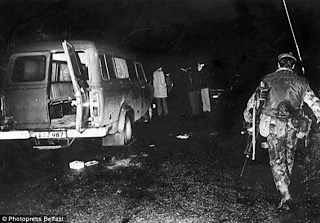
(Pictured: The minibus carrying the textile factory workers is left peppered with bullet holes and blood stains the ground after the massacre, as detectives patrol the scene of the murders)


Leave a comment

The Brookeborough Royal Ulster Constabulary Barracks Attack

An Irish Republican Army (IRA) unit attacks Brookeborough Royal Ulster Constabulary (RUC) barracks on January 1, 1957, in one of the most famous incidents of the IRA’s Operation Harvest (Border campaign). Two IRA men are killed as they attack Brookeborough police station in County Fermanagh. The attack is a military disaster for the IRA, but it proves a major propaganda coup.

The two dead men, Seán South and Fergal O’Hanlon, are hailed as republican martyrs. Their funerals are attended by thousands of people and their lives immortalised in republican ballads.

The Brookeborough raid is the central action in the IRA’s border campaign of 1956-62, yet it is over and done within a matter of minutes. The aim is to unite Ireland by setting up “liberated zones” in Northern Ireland and overthrowing the Stormont government. The campaign is preceded by a series of raids carried out by republican splinter group Saor Uladh. An attack on Rosslea police station in County Fermanagh in November 1955 results in the death of Saor Uladh member Connie Green.

Royal Ulster Constabulary (RUC) officer Gordon Knowles finds himself on the sharp end of the assault as the republicans blow the front wall from the barracks. “I was blown right across the guard room,” he says. “The only thing I felt was like somebody hitting me in the back and that was the bullet going in through the left-hand side of the spine, round the back of the spine and lodging one inch from the back. They shone a torch in my face and said: ‘Oh, let’s go, he’s had it.'”

Knowles is lucky to be alive as medical staff discover thirteen bullet holes in his body. He recovers to resume his police career and still carries bullet splinters in his body to this day.

The Brookeborough raid, involving fourteen IRA men, is planned along identical lines to the Rosslea attack, with very different results. The IRA aims to explode a bomb in front of the police station and to seize RUC weapons.

Just two days previously, the police suffer their first death of the border campaign when Constable John Scally is killed in an attack on Derrylin barracks, another County Fermanagh border station.

Ahead of the Brookeborough attack, the men gather at the County Monaghan family home of Fergal O’Hanlon, who takes part in the raid. O’Hanlon’s sister Pádraigín Uí Mhurchadha describes the scene. “I remember Fergal, on the night, saying to my mother ‘These men, give them a good meal because there are faces here tonight you won’t see again.’ Now it turned out that he happened to be one of the men that she would not see again.”

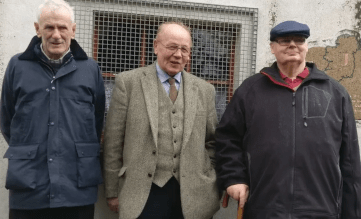
The BBC has recently spoken to three of the IRA men involved the raid.

Micheal Kelly, now in his 80s, has never given an interview before about his role in the attack. “The objective was to attack the barracks, take their guns from them and if necessary, if we had the time and space, to actually destroy the barracks,” he says.

Phil O’Donoghue is also part of the IRA unit. Today, he is honorary president of the 32 County Sovereignty Movement, which is believed to be closely aligned to the Real IRA. He insists the Brookeborough operation was about taking arms rather than killing police officers. “We had strict orders – under no circumstances were we to take on the B Specials (Ulster Special Constabulary) or RUC. We were, if at all possible, to try and take their weapons but we were not in any way to attack them.”

The IRA men arrive in Brookeborough in a stolen tipper lorry, but the driver is unfamiliar with the village and stops in the wrong place. Paddy O’Regan, from Dublin, is in the back of the lorry. His job is to assist Seán South in operating a Bren light machine gun. “When the truck actually stopped, and I got up off the floor and looked over the side of the truck I was looking into a shop – no sign of a barracks.” It is the first in a series of errors – the bomb placed by the station door fails to explode.

Barry Flynn, who has written a history of the border campaign, says he saw Brookeborough as a kind of tragic fiasco. “It became like the Keystone Cops,” he says. “There were a number of grenades thrown at the police station when they found it. One bounced back underneath the lorry and actually damaged the lorry very badly.”

RUC Sgt. Kenneth Cordner is quick to react to the attack. The truck is eventually parked up close to the barracks, allowing Sgt. Cordner a clear field of fire from an upstairs window. Using a Sten sub-machine gun, he opens up with deadly effect on the IRA men below.

Paddy O’Regan is wounded in the ensuing firefight. “We started to return fire on the barracks,” he says. “And after a while I looked down and I saw Seán South lying flat on his face and I felt two thumps in my hip. I knew I was wounded but it didn’t hurt particularly bad. It’s just like somebody hit you a couple of digs and it was just my hips started going numb.”

The order is given to withdraw, according to ex-IRA man Micheal Kelly. “Fergal, the last thing I heard him say, ‘Oh, my legs, oh, my legs!’ He was shot in the legs and bled to death. Seán South, I would say, was dead at this stage.”

The attackers flee across the border leaving the two dead men at a remote farm building where they are found by police.

Bobbie Hanvey is a well-known broadcaster and photographer. In 1957 he is just twelve years old and living across the road from the Brookeborough barracks. He remembers hiding under a bed with two of his friends as the attack unfolded. “The bedroom lit up – it was like daylight with the flames coming out of the guns. That image and the sounds of those guns and that experience has stayed with me to the present day – I’ll never forget it.”

Historian Barry Flynn explains that the Brookeborough raid is also a symbolic moment for the republican movement. The lives of the dead IRA men are subsequently remembered in two famous ballads, “Seán South from Garryowen” and the “Patriot Game.”

“People were writing the songs and, regardless of what was going to happen in the rest of the campaign, the names of Seán South and Fergal O’Hanlon were there forever as the martyrs of Brookeborough”, says Flynn.

The border campaign never again reaches the intensity of the Brookeborough incident, but police officers and IRA men continue to die. The IRA calls a ceasefire in 1962. By then it is clear that its strategy for overthrowing the Stormont government has failed.

(From: “Brookeborough: Failed IRA attack and republican legend” by Robin Sheeran and Bernadette Allen, BBC News NI, http://www.bbc.com, February 22, 2019 | Pictured: Ex-IRA men Micheal Kelly, Phil O’Donoghue and Paddy O’Regan who have a role in the Brookeborough raid)


Leave a comment

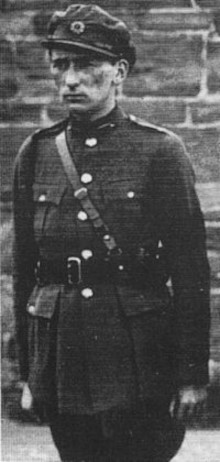
Death of Roger McCorley, Irish Republican Activist

Roger McCorleyIrish republican activist, dies on November 13, 1993.

McCorley is born into a Roman Catholic family at 67 Hillman Street in Belfast on September 6, 1901. He is one of three children born to Roger Edmund McCorley, a meat carver in a hotel, and Agnes Liggett. He has two elder brothers, Vincent and Felix. He joins the Fianna in his teens. His family has a very strong republican tradition, and he claims to be the great-grandson of the United Irishmen folk hero Roddy McCorley, who was executed for his part in the Irish Rebellion of 1798.

McCorley is a member of the Belfast Brigade of the Irish Republican Army (IRA) during the Irish War of Independence (1919–22). He is commandant of the Brigade’s first battalion, eventually becoming Commandant of the Belfast Brigade. In June 1920, he is involved in an attack on a Royal Irish Constabulary (RIC) police barracks at CrossgarCounty Down. On Sunday, August 22, 1920, in Lisburn, he is involved in the assassination of RIC District Inspector Oswald Swanzy, who was held responsible by Michael Collins for the assassination of Tomás Mac CurtainLord Mayor of Cork.

McCorley is noted for his militancy, as he is in favour of armed attacks on British forces in Belfast. The Brigade’s leaders, by contrast, in particular, Joe McKelvey, are wary of sanctioning attacks for fear of loyalist reprisals on republicans and the Catholic population in general. In addition, McCorley is in favour of conducting an armed defense of Catholic areas, whereas McKelvey does not want the IRA to get involved in what he considers to be sectarian violence. McCorley writes later that in the end, “the issue settled itself within a very short space of time, when the Orange mob was given uniforms, paid for by the British, and called the Ulster Special Constabulary (USC).” The role of the USC, a temporary police force raised for counter-insurgency purposes, in the conflict is still debated, but republicans maintain that the organization was responsible for the indiscriminate killings of Catholics and nationalists.

On January 26, 1921, McCorley, is involved in the fatal shooting of three Auxiliary Division officers in their beds in the Railway View hotel in central Belfast. Shortly afterwards, he and another IRA man, Seamus Woods, organize an active service unit (ASU) within the first battalion of the Belfast Brigade, with the intention of carrying out attacks, with or without the approval of the Brigade leadership. The unit consists of 32 men. McCorley later writes, “I issued a general order that, where reprisal gangs [State forces] were cornered, no prisoners were to be taken.” In March 1921, he personally leads the ASU in the killing of three Black and Tans in Victoria Street in central Belfast. He is responsible for the deaths of two more Auxiliaries in Donegall Place in April. In reprisal for these shootings, members of the RIC assassinate two republican activists, the Duffin brothers in Clonard Gardens in west Belfast. On June 10, 1921, both and Woods and McCorley units are involved in the killing a RIC man who is suspected in the revenge killings of the Duffin brothers. Two RIC men and a civilian are also wounded in that attack.

Thereafter, there is what historian Robert Lynch has described as a “savage underground war” between McCorley’s ASU and RIC personnel based in Springfield Road barracks and led by an Inspector Ferris. Ferris is accused of murdering the Lord Mayor of Cork Thomas Mac Curtain and had been posted to Lisburn for his safety. Ferris himself is among the casualties, being shot in the chest and neck, but surviving. McCorley claims to have been one of the four IRA men who shot Ferris. In addition, his men bomb and burn a number of businesses including several cinemas and a Reform Club. In May 1921, however, thirteen of his best men are arrested when surrounded by British troops during an operation in County Cavan. They are held in Crumlin Road Gaol and sentenced to death.

On June 3, McCorley organizes an attack on Crumlin Road Gaol in an attempt to rescue the IRA men held there before they are executed. The operation is not a success; however, the condemned men are reprieved after a truce is agreed between the IRA and British forces in July 1921. On Bloody Sunday (July 10, 1921), he is a major leader in the defense of nationalist areas from attacks by both the police and loyalists. On that day twenty people are killed before he negotiates a truce beginning at noon on July 11. At least 100 people are wounded, about 200 houses are destroyed or badly damaged – most of them Catholic homes, leaving 1,000 people homeless.

In April 1922, McCorley becomes leader of the IRA Belfast Brigade after Joe McKelvey goes south to Dublin to join other IRA members who are against the Anglo-Irish Treaty. With McKelvey’s departure, Seamus Woods becomes Officer Commanding of the IRA’s 3rd Northern Division, which has up to 1,000 members, with McCorley designated as Vice Officer Commanding. McCorley for his part, supports the Treaty, despite the fact that it provides for the partition of Ireland and the continued British rule in Northern Ireland. The reason for this is that Michael Collins and Eoin O’Duffy have assured him that this is only a tactical move and indeed, Collins sends men, money and weapons to the IRA in the North throughout 1922.

However, McCorley’s command sees the collapse of the Belfast IRA. In May 1922, the IRA launches an offensive with attacks all across Northern Ireland. In Belfast, he carries out an assault on Musgrave Street RIC barracks. He also conducts an arson campaign on businesses in Belfast. His men also carry out a number of assassinations, including that of Ulster Unionist Party MP William J. Twaddell, which causes the internment of over 200 Belfast IRA men.

To escape from the subsequent repression, McCorley and over 900 Northern IRA men flee south, to the Irish Free State, where they are housed in the Curragh. McCorley is put in command of these men. In June 1922, the Irish Civil War breaks out between Pro and Anti-Treaty elements of the IRA. He takes the side of the Free State and Michael Collins. After Collins is killed in August 1922, his men are stood down. About 300 of them join the National Army and are sent to County Kerry to put down anti-Treaty guerrillas there. In the Spring of 1923, bitterly disillusioned by the brutal counterinsurgency against fellow republicans, he resigns his command.

McCorley later asserts that he “hated the Treaty” and only supported it because it allowed Ireland to have its own armed forces. Both he and Seamus Woods are severe critics of the Irish Free State inertia towards Northern Ireland after the death of Michael Collins. He comments that when Collins was killed “the Northern element gave up all hope.”

In 1936 McCorley is instrumental in the establishment of the All-Ireland Old IRA Men’s Organization, serving as Vice-President with President Liam Deasy (Cork No. 3 Brigade) and Secretary George Lennon (Waterford No. 2 Brigade).

In the 1940s, McCorley is a founding member of Córas na Poblachta, a political party which aspires to a United Ireland and economic independence from Britain. He dies on November 13, 1993, and is buried in the Republican Plot of Glasnevin Cemetery.


Leave a comment

Death of Basil Stanlake Brooke, Third Prime Minister of Northern Ireland

Basil Stanlake Brooke, 1st Viscount Brookeborough, KG, CBE, MC, TD, PC (Ire), Ulster Unionist Party (UUP) politician who serves as the third Prime Minister of Northern Ireland from May 1943 until March 1963, dies on August 18, 1973, at Colebrooke Park, Brookeborough, County Fermanagh, Northern Ireland. He has been described as “perhaps the last Unionist leader to command respect, loyalty and affection across the social and political spectrum.” Equally well, he has also been described as one of the most hardline anti-Catholic leaders of the UUP, and his legacy involves founding his own paramilitary group, which feeds into the reactivation of the Ulster Volunteers.

Brooke is born on June 9, 1888, at Colebrooke Park, his family’s neo-Classical ancestral seat on what is then the several-thousand-acre Colebrooke Estate, just outside Brookeborough, a village near Lisnaskea in County Fermanagh. He is the eldest son of Sir Arthur Douglas Brooke, 4th Baronet, whom he succeeds as 5th Baronet when his father dies in 1907. His mother is Gertrude Isabella Batson. He is a nephew of Field Marshal Alan Brooke, 1st Viscount Alanbrooke, Chief of the Imperial General Staff (CIGS) during World War II, who is only five years his senior. His sister Sheelah marries Sir Henry Mulholland, Speaker of the Stormont House of Commons and son of Lord Dunleath. He is educated for five years at St. George’s School in Pau, France, and then at Winchester College (1901–05).

After graduating from the Royal Military College, Sandhurst, Brooke is commissioned into the Royal Fusiliers on September 26, 1908, as a second lieutenant. He transfers to the 10th Royal Hussars in 1911. He is awarded the Military Cross and Croix de guerre with palm for his service during World War I.

Brooke is a very active Ulster Unionist Party member and ally of Edward Carson. He founds his own paramilitary group, Brooke’s Fermanagh Vigilance, from men returning from the war front in 1918. Although the umbrella Ulster Volunteers had been quiescent during the war, it is not defunct. It re-emerges strongly in 1920, subsuming groups like Brooke’s.

In 1920, having reached the rank of captain, Brooke leaves the British Army to farm the Colebrooke Estate, the family estate in west Ulster, at which point he turns toward a career in politics.

Brooke has a very long political career. When he resigns the Premiership of Northern Ireland in March 1963, he is Northern Ireland’s longest-serving prime minister, having held office for two months short of 20 years. He also establishes a United Kingdom record by holding government office continuously for 33 years.

In 1921, Brooke is elected to the Senate of Northern Ireland, but he resigns the following year to become Commandant of the Ulster Special Constabulary (USC) in their fight against the Irish Republican Army (IRA). He is created a Commander of the Order of the British Empire in 1921.

In 1929 Brooke is elected to the House of Commons of Northern Ireland as Ulster Unionist Party MP for the Lisnaskea division of County Fermanagh. In the words of the Oxford Dictionary of National Biography, “his thin, wiry frame, with the inevitable cigarette in hand, and clipped, anglicised accent were to be a feature of Stormont for the next forty years.”

Brooke becomes Minister of Agriculture in 1933. By virtue of this appointment, he also acquires the rank of Privy Councilor of Northern Ireland. From 1941 to 1943 he is Minister of Commerce.

On May 2, 1943, Brooke succeeds John M. Andrews as Prime Minister of Northern Ireland. In 1952, while Prime Minister, was raised to the peerage as Viscount Brookeborough, the title taken from the village named after the Brookes. Although a peer, he retained his seat in the House of Commons at Stormont and remained Prime Minister for another decade.

As the Northern Ireland economy begins to de-industrialise in the mid-1950s, leading to high unemployment amongst the Protestant working classes, Brooke faces increasing disenchantment amongst UUP backbenchers for what is regarded as his indifferent and ineffectual approach to mounting economic problems. As this disenchantment grows, British civil servants and some members of the UUP combine to exert discreet and ultimately effective pressure on Brooke to resign to make way for Captain Terence O’Neill, who is Minister of Finance.

In 1963, his health having worsened, Brooke resigns as Prime Minister. However, he remains a member of the House of Commons of Northern Ireland until the 1969 Northern Ireland general election, becoming the Father of the House in 1965. During his last years in the Parliament of Northern Ireland he publicly opposes the liberal policies of his successor Terence O’Neill, who actively seeks to improve relationships with the Republic of Ireland, and who attempts to address some of the grievances of Catholics and grant many of the demands of the Northern Ireland Civil Rights Association (NICRA).

Brooke is noted for his casual style toward his ministerial duties. Terence O’Neill later writes of him, “he was good company and a good raconteur, and those who met him imagined that he was relaxing away from his desk. However, they did not realise that there was no desk.”

In his retirement Brooke develops commercial interests as chairman of Carreras (Northern Ireland), a director of Devenish Trade, and president of the Northern Ireland Institute of Directors. He is also made an honorary LL.D. of Queen’s University Belfast.

From 1970 to 1973, years in which the Stormont institution comes under its greatest strain and eventually crumbles, Brooke makes only occasional forays into political life. In 1972, he appears next to William Craig MP on the balcony of Parliament Buildings at Stormont, a diminutive figure beside the leader of the Vanguard Unionist Progressive Party (VUPP) who is rallying right-wing Unionists against the Government of Northern Ireland. He opposes the Westminster white paper on the future of Northern Ireland and causes some embarrassment to his son, Captain John Brooke, the UUP Chief Whip and an ally of Brian Faulkner, by speaking against the Faulkner ministry‘s proposals.

Brooke dies at his home, Colebrooke Park, on the Colebrooke Estate, on August 18, 1973. His remains are cremated at Roselawn Cemetery, East Belfast, three days later, and, in accordance with his wishes, his ashes are scattered on the demesne surrounding his beloved Colebrooke Park.


Leave a comment

Birth of Liam Tobin, Irish Army Officer

Liam Tobin, officer in the Irish Army and the instigator of the Irish Army Mutiny in March 1924, is born William Joseph Tobin at 13 Great Georges Street in Cork, County Cork, on November 15, 1895. During the Irish War of Independence, he serves as an Irish Republican Army (IRA) intelligence officer for Michael CollinsSquad.

Tobin is the eldest son of Mary Agnes (nee Butler) and David Tobin, a hardware clerk. He has two younger siblings, Katherine and Nicholas Augustine Tobin, also born in Cork. His family moves to John Street in Kilkenny and then to Dublin. He goes to school in Kilkenny and is an apprentice in a hardware shop at the time of the 1916 Easter Rising. As a participant in the Rising, he fights in the Four Courts garrison under Edward Daly. He is arrested, court martialed, and sentenced to death but his sentence is commuted to life imprisonment. He is a prisoner in Kilmainham, Mountjoy, Lewes, Dartmoor, Broadmoor and Pentonville prisons. He is released in June 1917.

In early 1919 Tobin becomes Collins’ chief executive in the Intelligence Directorate handling the many spies in Dublin Castle, including double agent David Neligan. Nancy O’Brien works for Under-Secretary for Ireland James Macmahon, decoding messages sent from London. Each day between 2:30 and 3:30 she passes any information acquired to either Tobin, Joseph McGrath, or Desmond FitzGerald. Tobin is involved in planning the assassinations of British soldiers, informants, members of the Royal Irish Constabulary, the Dublin Metropolitan Police, and operatives of MI5. He constructs detailed profiles of everyone remotely connected to the British government, often using Who’s Who, The Morning Post, and The Times, a newspaper that describes him as “one of the most formidable of [the] Twelve Apostles.”

In October 1921, Tobin travels with the Irish Treaty Delegation as part of Collins’ personal staff.

Tim Pat Coogan and James Mackay have examined Tobin’s involvement in the assassination of British Field Marshal Sir Henry Wilson. Wilson’s public tirades about Collins is evidence of mutual personal dislike between the two men. In May 1922 Collins tells Tobin “We’ll kill a member of that bunch” to the news of “bloody pogroms” in Belfast. Wilson is intimately involved with the Ulster loyalist cause, including the Curragh Mutiny and the establishment of the Ulster Special Constabulary. Just before the shooting, Coogan places Tobin in London. He meets courier Peig Ni Braonain at Euston Station collecting a document that has been sent from Dublin. Returning to Dublin before the incident, he is jubilant when he tells defence minister Richard Mulcahy about Wilson’s death. Mulcahy is appalled and threatens to resign.

Following the Anglo-Irish Treaty, Tobin is appointed deputy director of intelligence in the new state and assigned to the Criminal Investigation Department based at Oriel House. However Collins soon replaces him with Joseph McGrath. Tobin is placed on the Army Council and is Director of Intelligence from September 1922 until his appointment as Senior Aide-de-Camp to the new GovernorGeneral of the Irish Free State, Tim Healy, in November 1922. The position provides an apartment in Viceregal Lodge.

In October 1922, Tobin’s brother Nicholas, a Free State captain, is accidentally shot dead by his own troops during the raid and capture of a bomb making factory at number 8 Gardiner’s Place, Dublin.

Tobin believes in the steppingstone doctrine which sees the Treaty as a stage towards full independence. With the outbreak of the Irish Civil War he remains loyal to Collins and takes the Pro-Treaty side. He leads in the fight against the Anti-Treaty IRA in the south. Disillusioned with the continuing hostilities and in the aftermath of the death of Collins, he forms an association called the IRA Organisation (IRAO) or “Old Irish Republican Army” to distinguish themselves from the anti-treaty insurgents.

Richard Mulcahy, the new Irish defence minister, proposes to reduce the army from 55,000 to 18,000 men in the immediate post- Civil-War period. Tobin knows his own position is to be affected and shares the perception that the Irish Army treats former British officers better than former IRA officers. On March 7, 1924, Tobin, together with Colonel Charlie Dalton, sends an ultimatum to President of the Executive Council of the Irish Free State W. T. Cosgrave demanding an end to the army demobilisation. The immediate response is an order for the arrest of the two men on a charge of mutiny. The cabinet, already wary of the Irish Army, orders an inquiry and appoints Garda Commissioner Eoin O’Duffy to the army command.

On March 18, the mutineers assemble with hostile intent at a Dublin pub. An order is made to arrest the mutineers and the cabinet demands the resignation of the army council. The generals resign, affirming the subservience of the military to the civilian government of the new state.

In later years, Tobin rebuilds relations with his Civil War foes and joins Éamon de Valera‘s Anti-Treaty Fianna Fáil party. He joins up with Joseph McGrath to form the Irish Hospitals’ Sweepstake in the 1930s. Many other former army comrades find work in this lottery. He leaves the Sweep in 1938. After World War II, he becomes Superintendent of the Oireachtas for the Irish Dáil.

On October 14, 1929, Tobin marries Monica “Mona” Higgins at the Church of the Holy Family, Aughrim Street, Dublin. They have two daughters, Máire and Anne Tobin. Following the death of his father, David, in 1956, Tobin’s health declines, resulting in his death in Dublin on April 30, 1963.

Tobin is portrayed by actor Brendan Gleeson in Neil Jordan‘s biopic Michael Collins.


Leave a comment

Birth of Roger McCorley, Irish Republican Activist

Roger McCorley, Irish republican activist, is born into a Roman Catholic family at 67 Hillman Street in Belfast on September 6, 1901.

McCorley is one of three children born to Roger Edmund McCorley, a meat carver in a hotel, and Agnes Liggett. He has two elder brothers, Vincent and Felix. He joins the Fianna in his teens. His family has a very strong republican tradition, and he claims to be the great-grandson of the United Irishmen folk hero Roddy McCorley, who was executed for his part in the Irish Rebellion of 1798.

McCorley is a member of the Belfast Brigade of the Irish Republican Army (IRA) during the Irish War of Independence (1919–1922). He is commandant of the Brigade’s first battalion, eventually becoming Commandant of the Belfast Brigade. In June 1920, he is involved in an attack on a Royal Irish Constabulary (RIC) police barracks at Crossgar, County Down. On Sunday, August 22, 1920, in Lisburn, he is involved in the assassination of RIC District Inspector Oswald Swanzy, who was held responsible by Michael Collins for the assassination of Tomás McCurtain, Lord Mayor of Cork.

McCorley is noted for his militancy, as he is in favour of armed attacks on British forces in Belfast. The Brigade’s leaders, by contrast, in particular, Joe McKelvey, are wary of sanctioning attacks for fear of loyalist reprisals on republicans and the Catholic population in general. In addition, McCorley is in favour of conducting an armed defense of Catholic areas, whereas McKelvey does not want the IRA to get involved in what he considers to be sectarian violence. McCorley writes later that in the end, “the issue settled itself within a very short space of time, when the Orange mob was given uniforms, paid for by the British, and called the Ulster Special Constabulary (USC).” The role of the USC, a temporary police force raised for counter-insurgency purposes, in the conflict is still debated, but republicans maintain that the organization was responsible for the indiscriminate killings of Catholics and nationalists.

On January 26, 1921, McCorley, is involved in the fatal shooting of three Auxiliary Division officers in their beds in the Railway View hotel in central Belfast. Shortly afterwards, he and another IRA man, Seamus Woods, organize an active service unit (ASU) within the first battalion of the Belfast Brigade, with the intention of carrying out attacks, with or without the approval of the Brigade leadership. The unit consists of 32 men. McCorley later writes, “I issued a general order that, where reprisal gangs [State forces] were cornered, no prisoners were to be taken.” In March 1921, he personally leads the ASU in the killing of three Black and Tans in Victoria Street in central Belfast. He is responsible for the deaths of two more Auxiliaries in Donegall Place in April. In reprisal for these shootings, members of the RIC assassinate two republican activists, the Duffin brothers in Clonard Gardens in west Belfast. On June 10, 1921, both and Woods and McCorley units are involved in the killing a RIC man who is suspected in the revenge killings of the Duffin brothers. Two RIC men and a civilian are also wounded in that attack.

Thereafter, there is what historian Robert Lynch has described as a “savage underground war” between McCorley’s ASU and RIC personnel based in Springfield Road barracks and led by an Inspector Ferris. Ferris is accused of murdering the Lord Mayor of Cork Thomas MacCurtain and had been posted to Lisburn for his safety. Ferris himself is among the casualties, being shot in the chest and neck, but surviving. McCorley claims to have been one of the four IRA men who shot Ferris. In addition, his men bomb and burn a number of businesses including several cinemas and a Reform Club. In May 1921, however, thirteen of his best men are arrested when surrounded by British troops during an operation in County Cavan. They are held in Crumlin Road Gaol and sentenced to death.

On June 3, McCorley organizes an attack on Crumlin Road Gaol in an attempt to rescue the IRA men held there before they are executed. The operation is not a success; however, the condemned men are reprieved after a truce is agreed between the IRA and British forces in July 1921. On Bloody Sunday (July 10, 1921), he is a major leader in the defense of nationalist areas from attacks by both the police and loyalists. On that day twenty people are killed before he negotiates a truce beginning at noon on July 11. At least 100 people are wounded, about 200 houses are destroyed or badly damaged – most of them Catholic homes, leaving 1,000 people homeless.

In April 1922, McCorley becomes leader of the IRA Belfast Brigade after Joe McKelvey goes south to Dublin to join other IRA members who are against the Anglo-Irish Treaty. With McKelvey’s departure, Seamus Woods becomes Officer Commanding of the IRA’s 3rd Northern Division, which has up to 1,000 members, with McCorley designated as Vice Officer Commanding. McCorley for his part, supports the Treaty, despite the fact that it provides for the partition of Ireland and the continued British rule in Northern Ireland. The reason for this is that Michael Collins and Eoin O’Duffy have assured him that this is only a tactical move and indeed, Collins sends men, money and weapons to the IRA in the North throughout 1922.

However, McCorley’s command sees the collapse of the Belfast IRA. In May 1922, the IRA launches an offensive with attacks all across Northern Ireland. In Belfast, he carries out an assault on Musgrave Street RIC barracks. He also conducts an arson campaign on businesses in Belfast. His men also carry out a number of assassinations, including that of Ulster Unionist Party MP William J. Twaddell, which causes the internment of over 200 Belfast IRA men.

To escape from the subsequent repression, McCorley and over 900 Northern IRA men flee south, to the Irish Free State, where they are housed in the Curragh. McCorley is put in command of these men. In June 1922, the Irish Civil War breaks out between Pro and Anti-Treaty elements of the IRA. He takes the side of the Free State and Michael Collins. After Collins is killed in August 1922, his men are stood down. About 300 of them join the National Army and are sent to County Kerry to put down anti-Treaty guerrillas there. In the Spring of 1923, bitterly disillusioned by the brutal counterinsurgency against fellow republicans, he resigns his command.

McCorley later asserts that he “hated the Treaty” and only supported it because it allowed Ireland to have its own armed forces. Both he and Seamus Woods are severe critics of the Irish Free State inertia towards Northern Ireland after the death of Michael Collins. He comments that when Collins was killed “the Northern element gave up all hope.”

In 1936 McCorley is instrumental in the establishment of the All-Ireland Old IRA Men’s Organization, serving as Vice-President with President Liam Deasy (Cork No. 3 Brigade) and Secretary George Lennon (Waterford No. 2 Brigade).

In the 1940s, McCorley is a founding member of Córas na Poblachta, a political party which aspires to a United Ireland and economic independence from Britain. He dies on November 13, 1993, and is buried in the Republican Plot of Glasnevin Cemetery.


Leave a comment

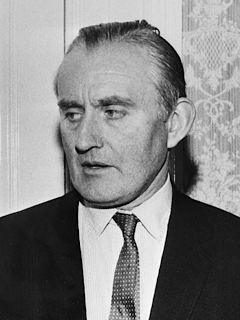
Birth of Pat Doherty, Sinn Féin Politician & Member of Parliament

Patrick Doherty, retired Sinn Féin politician and the abstentionist Member of Parliament (MP) for West Tyrone from 2001 to 2017, is born in Glasgow, Scotland, on July 18, 1945. He is a member of the Northern Ireland Assembly for the West Tyrone Assembly constituency from June 1998 to June 2012. He serves as Vice President of Sinn Féin from 1988 to 2009, when Mary Lou McDonald becomes the party’s new Vice President.

Doherty is educated at St. Joseph’s College, Lochwinnoch, and is a site engineer who likes building stone walls. He is the brother of former Provisional Irish Republican Army (IRA) member Hugh Doherty, known for his involvement in the Balcombe Street siege. According to The Times Guide to the House of Commons, he is married with three daughters and two sons.

Doherty’s parents are from County Donegal in the Republic of Ireland. He moves to Donegal in 1968, shortly before the Troubles break out across the Irish border in Northern Ireland. He is an abstentionist Sinn Féin Member of Parliament of the British parliament for West Tyrone from 2001 to 2017, as well as a member of the Northern Ireland Assembly from the 1998 Northern Ireland Assembly election until 2012. He also stands for election in the Republic of Ireland, in the constituency of Donegal North-East in 1989, 1996 (a by-election) and 1997, and also in the Connacht–Ulster constituency in the European Parliament elections in 1989 and 1994.

In May 2002, using parliamentary privilege, Ulster Unionist Party (UUP) MP David Burnside names Doherty as a member of the IRA Army Council.

Over a two-and-a-half-year period, Doherty spends £16,000 on printer cartridges, an amount that he admits is “probably excessive.”

In 2012, to some surprise, Doherty writes to the Arts Council of Northern Ireland in support of funding for the loyalist Castlederg Young Loyalist Flute Band. He praises the band for reaching out to “all sections of the community.” The band had sought support for its funding application from a community group who then, unbeknownst to the band, reached out to Doherty. A spokesman for the band, whose website includes sections on IRA atrocities, the controversial B Specials and lyrics to songs, including one glorifying Ulster Volunteer Force (UVF) terrorist Brian Robinson, distances themselves from the application, claiming the band is unaware of Doherty’s support and does not want it. He adds that “The band harbours nothing but contempt for Irish republicanism and its attacks on their community.” Four of the band’s members are killed by the IRA.


Leave a comment

The Funeral of Joe B. O’Hagan, Founding Member of the Provisional IRA

Leading Sinn Féin members are among the 5,000 people who attend the funeral of Joe B. O’Hagan, a founding member of the Provisional Irish Republican Army (PIRA), on April 26, 2001. Party president Gerry Adams gives the oration at the graveside when the leading republican figure is buried in Lurgan, County Armagh, Northern Ireland.

O’Hagan, known to all and sundry simply as JB, dies on Monday, April 23, 2001, in the town in which he was born almost 79 years previously and from which he and his wife Bernadette had been exiled for 25 years during the current phase of the conflict. As befitted a soldier of Óglaigh na hÉireann, a uniformed IRA Guard of Honour attends O’Hagan’s body in the wake house and it is six of his comrades who carry the coffin, bedecked in the Irish Tricolour and beret and gloves, from the family home on the first section of its journey to St. Paul’s Chapel for the Funeral Mass.

Up to 2,000 people attend the funeral and businesses in the bustling North Armagh town close along the route as a mark of respect. At St. Colman’s Cemetery just outside the town, Sinn Féin President Gerry Adams pays fulsome tribute to a republican who had been active from the 1940s into the 1990s and right up to his sudden death. Adams notes O’Hagan’s strong faith and welcomes the tribute paid during the Funeral Mass to JB’s republican beliefs and exploits. He adds, however, that it is high time the Catholic hierarchy reverses its directive banning the Tricolour from republican funerals in church premises. “Our National Flag should be allowed to stay on the coffin for the entire ceremony,” he says.

“I have always associated JB with Bernadette,” he tells those gathered at the graveside, “even though they were apart for so many years. They were married for 52 years, and Bernadette told me yesterday that she wouldn’t change a day of it, that she was proud of him and of his life.”

“In many ways he died the way he had lived, very quietly, modestly, not complaining, unassuming to the end. He was one of the most respected republicans of our time. There is no greater tribute that can be paid to any man or woman than to be known as a decent human being and Joe B. was that and more.”

Adams goes on to briefly record the extraordinary history of O’Hagan’s involvement in the republican struggle, as soldier and political activist, since he first joined the IRA in 1940, including that famous 1973 escape from Mountjoy Jail by helicopter, accompanied by Kevin Mallon and the late Seamus Twomey.

“JB grew up in the 1920s in a state abandoned by the Irish Government, where nationalists were subjected to the B-Specials and the Special Powers Act. He stood up at a time when standing up was a very very dangerous thing to do,” says Adams. “It is a wonder to me that he was active in every decade from the 1940s on. There is a mighty man!”

“He also personifies why Irish republicanism has never been defeated. He was an example of a physical force republican who was prepared to support and exhaust other means of struggle. He saw armed struggle as a means rather than as an end, but he never ceased to be an unrepentant republican and to work always for the establishment of an Irish Republic based on national rights for the people of this island. He supported the Good Friday Agreement not as an end but as an effort to build a new accord with our opponents and enemies. Political unionism has found it very difficult to deal with this strategy.”

“Joe B was very philosophical and very wise. He is representative of that republican element who never broke a promise in their lives.”

“Those who seek to defeat the republican struggle by blaming the IRA for everything need to know that none of this will work. That is because of the work that JB and people like him put into this struggle. We won’t be worn down or accept anything less than our full rights. The message for David Trimble and Tony Blair is that it is impossible for us to accept inequality, injustice and second-class citizenship. That is the past. We are looking to the future.”

“Joe B’s passing has left a huge gap, but we should celebrate his life. He touched so many of us. Joe B kept us right. The flame he kept flickering in the lean times is burning brightly now because of his contribution.”

Adams extends his solidarity and sympathy and that of all those present to Bernadette, to O’Hagan’s children, Barry, Kevin, Fintan, Siobhán, Felim and Dara, to his eleven grandchildren and four great-grandchildren, his sisters and entire family circle.

At the end of the Funeral Mass for O’Hagan, the O’Hagan family lead by Joe’s son Fintan place the Irish Tricolour on the coffin before the remains are taken from the chapel. This act is borne out of anger and frustration.

O’Hagan was a republican, an honourable man and a religious man who went to Mass every day. So, his family feels that the Catholic Church, that was as much an influence on O’Hagan’s life as was his republicanism, should respect his wish and allow his coffin to be draped in the Tricolour. The family appeals to the Catholic Church authorities and Adams intercedes on their behalf, but they are refused the right to grant O’Hagan his wish that the Flag not be removed from his coffin.

Dara O’Hagan, the Sinn Féin Northern Ireland Assembly member for Upper Bann, tells the bishop that by sticking to their old policy the Catholic Church is criminalising republicanism and indeed criminalising her father.

Also, the Catholic hierarchy misses a great opportunity to heal a hurt that has existed for over 20 years, when the remains of IRA Volunteer Kevin `Dee’ Delaney were refused entry into Corpus Christi Church in Springhill while bearing the Irish Tricolour. The rancour and hurt felt by republicans over this slight, coming as it does, in conjunction with the British Government’s attempts to criminalise republicanism, has long been an insult that republicans have resented. After all, churches are the people’s property as it is their money and effort that build them. The people of Springhill and the Greater Ballymurphy area paid £5 a brick for the Corpus Christi building and the Delaney family no doubt contributed to that fund.

By taking matters into their own hands, the O’Hagan family claims back some ground for republicans and sends a message to the bishops that they have a part to play in this new political era and that they need to look at their attitude to republicanism.

O’Hagan’s wife Bernadette says that as Fintan draped the Irish Trocolour on Joe’s coffin and the church burst into spontaneous applause, her heart was lifted. “I was so glad, and I walked down the aisle with a smile on my face,” said Bernadette.

(From: “Unassuming and mighty man laid to rest” by Martin Spain, An Phoblacht Republican News, May 3, 2001)


Leave a comment

IRA Kidnaps & Holds Hostage 42 Prominent Loyalist Activists

On February 7, 1922, the Irish Republican Army (IRA) in Northern Ireland kidnaps and holds hostage forty-two prominent loyalist activists in Fermanagh and Tyrone in response to the January 14 arrest of the Monaghan county football team, who were traveling to play Derry in the final of the Ulster Championship game.

A party of eighteen armed B-Specials, a part-time auxiliary police force which is almost 100% Protestant, when traveling by train to Enniskillen, are stopped at Clones railway station in County Monaghan by an IRA group. The B-Specials react immediately by shooting Commander Fitzpatrick. His colleagues retaliate by fatally shooting four Specials and arresting the survivors. Trouble in the North is at a boiling point and in the three days after the Clones incident thirty people are murdered in Belfast.

Intense negotiations between Secretary of State for the Colonies Winston Churchill and Chairman of the Provisional Government of the Irish Free State Michael Collins helps to secure the release of the Monaghan footballers and the Fermanagh and Tyrone loyalists, but for some time the British suspend the evacuation of troops from Ireland. Following the incident, Churchill, who is leading the UK effort on the transfer of power following the Anglo-Irish Treaty, writes to his wife Clementine in what might be termed an understatement, “Ireland is sure to bring us every form of difficulty and embarrassment.”

Collins and James Craig, Prime Minister of Northern Ireland, have further discussions in Dublin in early February 1922 but the meeting breaks down over the question of the boundary revision. Craig informs reporters that he has the assurance of the British Government that the Boundary Commission will make only slight changes. He complains that the maps which Collins had produced led him to the assumption that Collins had already been promised almost half of Northern Ireland. Craig agrees to minor changes but if North and South fail to agree, there will be no change at all. Collins issues a statement which refuses to admit any ambiguity and says that majorities must rule.

The British and the Provisional Government finally agreed that an Irish Free State Agreement Bill will legalise the Treaty and the transfer of power to the Provisional Government and will authorise the election of a Provisional Parliament to enact the Free State Constitution. Final ratification of the Treaty is deferred until the British confirm the Free State Constitution. Only then will Northern Ireland be allowed to exclude itself formally from the Free State.

(From: “OTD in 1922 – The IRA Kidnaps More Than Forty Loyalists Activists and ‘B’ Specials,” Stair na hÉireann | History of Ireland, https://stairnaheireann.net | Picture: Colour image of the IRA patrolling Grafton Street, Dublin, during the Irish Civil War in 1922, 1916 Easter Revolution in Colour)


Leave a comment

Recruitment Begins for the Black and Tans

Recruitment begins for the Black and Tans (Irish: Dúchrónaigh), Britain’s unofficial auxiliary army, on January 2, 1920. They are constables recruited into the Royal Irish Constabulary (RIC) as reinforcements during the Irish War of Independence. Recruitment begins in Great Britain and about 10,000 men enlist during the conflict. The vast majority are unemployed former British soldiers who had fought in World War I. Some sources count a small number of Irishmen as Black and Tans.

The British administration in Ireland promotes the idea of bolstering the RIC with British recruits. They are to help the overstretched RIC maintain control and suppress the Irish Republican Army (IRA), although they are less well trained in ordinary policing. The nickname “Black and Tans” arises from the colours of the improvised uniforms they initially wear, a mixture of dark green RIC (which appears black) and khaki British Army. They serve in all parts of Ireland, but most are sent to southern and western regions where fighting is heaviest. By 1921, Black and Tans make up almost half of the RIC in County Tipperary, for example.

The Black and Tans gain a reputation for brutality and become notorious for reprisal attacks on civilians and civilian property, including extrajudicial killings, arson and looting. Their actions further sway Irish public opinion against British rule and draw condemnation in Britain.

The Black and Tans are sometimes confused with the Auxiliary Division, a counterinsurgency unit of the RIC, also recruited during the conflict and made up of former British officers. However, sometimes the term “Black and Tans” covers both groups. The Ulster Special Constabulary (USC) is founded to reinforce the RIC in Northern Ireland.

More than a third leave the service before they are disbanded along with the rest of the RIC in 1922, an extremely high wastage rate, and well over half receive government pensions. Over 500 members of the RIC die in the conflict and more than 600 are wounded. Some sources state that 525 police, including 152 Black and Tans and 44 Auxiliaries, are killed in the conflict.

Many Black and Tans are left unemployed after the RIC is disbanded and about 3,000 are in need of financial assistance after their employment in Ireland is terminated. About 250 Black and Tans and Auxiliaries, among over 1,300 former RIC personnel, join the Royal Ulster Constabulary. Another 700 join the Palestine Police Force which is led by former British Chief of Police in Ireland, Henry Hugh Tudor. Others are resettled in Canada or elsewhere by the RIC Resettlement branch. Those who return to civilian life sometimes have problems re-integrating. At least two former Black and Tans are hanged for murder in Britain, and another wanted for murder commits suicide before the police can arrest him.

Due to the Tans’ behaviour in Ireland, feelings continue to run high regarding their actions. The term can still stir bad reactions because of their remembered brutality. One of the best-known Irish Republican songs is Dominic Behan‘s “Come Out, Ye Black and Tans.” The Irish War of Independence is sometimes referred to as the “Tan War” or “Black-and-Tan War.” This term is preferred by those who fought on the anti-Treaty side in the Irish Civil War and is still used by Republicans today. The “Cogadh na Saoirse” (“War of Independence”) medal, awarded since 1941 by the Irish government to IRA veterans of the War of Independence, bears a ribbon with two vertical stripes in black and tan.

Some sources say the Black and Tans were officially named the “RIC Special Reserve”, but this is denied by other sources, which say they were not a separate force but “recruits to the regular RIC” and “enlisted as regular constabulary.” Canadian historian D. M. Leeson has not found any historical documents that refer to the Black and Tans as the “Royal Irish Constabulary Special Reserve.”

(Pictured: A group of Black and Tans and Auxiliaries outside the London and North Western Hotel in Dublin following an attack by the IRA, April 1921)