seamus dubhghaill

Promoting Irish Culture and History from Little Rock, Arkansas, USA


Leave a comment

Death of Leslie Montgomery, Playwright & Writer

lynn-doyle-ballygullion

Leslie Alexander Montgomery, playwright, humorist, and writer who writes under the pen name “Lynn Doyle,” dies in Dublin on August 18, 1961. He adopts the pseudonym for his writing, using a homophone of “linseed oil.” Supposedly, he chooses the name after seeing a large tin of linseed oil in a paint shop, initially signing “Lynn C. Doyle” but later dropping the “C.”

Born in Downpatrick, County Down on October 5, 1873, Montgomery is educated at Dundalk in County Louth. He commences work as a bank clerk at the age of 16, and remains with the Northern Banking Company, working in locations such as Keady and Cushendall before a transfer to the quaint seaside town of Skerries in County Armagh. There he becomes branch manager until his retirement in 1934.

Aside from this rather strait-laced, white-collar career, however, Montgomery fosters a life-time passion for writing in various forms and genres, and his contribution to Ulster literature in the early part of the 20th century should not be underestimated.

Montgomery is part of the Ulster Literary Theatre movement founded by Bulmer Hobson and David Parkhill in 1902, and early works include Love and Land, a play that is produced at the Little Theatre in London and represents Montgomery’s first critical success.

Other works during this decade include The Summons and The Lilac Ribbon. By the beginning of the 1920s, Montgomery is a leading northern playwright. He is best known, however for the Ballygullion series, twenty books which fondly caricature Northern Irish village life. The first in the series is published in 1908 and the last in 1957.

Montgomery writes the first book, which would lend its title to the rest of the series, in Dublin. This is followed by other works every few years such as Mr. Wildridge of the Bank, Lobster Salad, Dear Ducks, Me and Mr. Murphy and Rosabelle and Other Stories.

Written in the dialect of the east Ulster region, the stories celebrate an imaginary townland area in the Slieve Gullion region of County Down. They reflect Montgomery’s early years there and in Dundalk. The books also reveal a lot about contemporary Ulster life.

The versatile writer also produces poetry during the 1930s. Ballygullion Ballads, published in 1936 is illustrated by the famous Belfast artist William Conor, as are several of the later editions of his books.

In 1936, Montgomery has the somewhat dubious honour of being the first Irish writer to be appointed to the Censorship Board. He resigns within two years of accepting the job, however, claiming that it is “so terribly easy to read only the marked passages, so hard to wade through the whole book afterwards.”

Following his retirement from the Northern Banking Company, he gains further notoriety as a lecturer, and also regularly broadcasts his stories for the fledgling BBC in Belfast. Indeed, his most productive period as a writer is in his 1960s, during which time he writes his autobiography, An Ulster Childhood, in 1954.

Montgomery dies in Dublin on August 18, 1961, but his legacy is preserved in the Lynn Doyle Collection at Belfast Central Library, which consists of a series of archival boxes which were purchased by the library. The collection is extensive, and includes broadcasts and lecture transcripts, manuscripts, essays, short stories, poetry, personal correspondence, photographs, land leases and legal documents.


Leave a comment

The Fall of Athlone

siege-of-athlone

The fall of Athlone occurs on June 30, 1691 during the Williamite War in Ireland. Despite the bravery of legendary Sergeant Custume and others, severely outnumbered, the Connacht side of the town falls. The remainder of the Irish garrison retreats to Limerick.

The first assault on Athlone comes in 1690 after the defeat of the Irish at the Battle of the Boyne. General Douglas, leading a substantial force of possibly ten thousand consisting mostly of Ulster regiments, is the Williamite commander. When he arrives at Athlone he is confident that he will quickly conquer the town for King William III. However, he had not reckoned on the spirited defence of Athlone by Colonel Richard Grace. Grace, who is at that time over seventy years of age and a veteran of the Irish Confederate Wars and Governor of Athlone, refuses to surrender. After a week the Williamite army retreats.

In 1691, determined to capture Athlone, the Williamites return with their full army of almost 25,000 men. The army is under the command of a Dutch general, Goderd de Ginkell. The Jacobite forces are under the command of a French general, the Marquis de St. Ruth. The Williamites breach the town wall and capture the Leinster town. The Jacobites, in a desperate attempt to keep the enemy at bay, break down several arches of the bridge and the Williamites quickly attempt to repair them. Sergeant Custume leads his men onto the bridge to dislodge the Williamite repair work. They succeed in doing so before meeting their death at the hands of enemy fire.

Ironically the capture of Athlone comes when the Williamites discover the ford that gave Athlone its name and in a surprise attack dislodge the Jacobites and take the castle by storm resulting in wholesale carnage and slaughter. For his services to King William III, but certainly not to Athlone, Ginkle is given the title Earl of Athlone. The bravery of Sergeant Custume has not been forgotten as the military barracks in Athlone is called Custume Barracks in his honour, the only barracks in Ireland named after a non-commissioned officer. A street adjoining the town bridge is named Custume Place.


Leave a comment

Birth of Forrest Reid, Novelist & Critic

forrest-reid

Forrest Reid, novelist, literary critic and translator, is born in Belfast on June 24, 1875. He is, along with Hugh Walpole and J. M. Barrie, a leading pre-war novelist of boyhood. He is still acclaimed as the greatest of Ulster novelists and is recognised with the award of the 1944 James Tait Black Memorial Prize for his novel Young Tom.

Reid is the youngest son of a Protestant family of twelve, six of whom survive. His mother, his father’s second wife, comes from an aristocratic Shropshire family. Although proud of this ancestry, he finds the strict Protestant ethics of his immediate family constricting. He is educated at the Royal Belfast Academical Institution, after which he is initially apprenticed into the Belfast tea-trade before going to Christ’s College, Cambridge, where he reads medieval and modern languages, and is influenced by the novelist E. M. Forster. His first book, The Kingdom of Twilight, is published in 1904. Following graduation in 1908, he returns to Belfast to pursue a writing career.

As well as his fiction, Reid also translates poems from the Greek Anthology. His study of the work of W. B. Yeats, W. B. Yeats: A Critical Study, has been acclaimed as one of the best critical studies of that poet. He also writes the definitive work on the English woodcut artists of the 1860s, Illustrators of the Sixties (1928). His collection of original illustrations from that time is housed in the Ashmolean Museum, Oxford.

Reid is a close friend of Walter de la Mare, whom he first meets in 1913, and about whose fiction he publishes a perceptive book in 1929. He is also an influence on novelist Stephen Gilbert and has good connections to the Bloomsbury Group of writers. He is a founding member of the Imperial Art League (later the Artists League of Great Britain) and is also a close friend of Arthur Greeves, the artist known to be C. S. Lewis‘s best friend. Greeves paints several portraits of Reid, now all in the possession of the Royal Belfast Academical Institution.

Reid publishes articles in many magazines, including Uladh, The Westminster Review and the Ulster Review, and he reviews books for The Manchester Guardian. Apostate, an autobiography, is published in 1926, and its sequel, Private Road, is published in 1940. He is a founder member of the Irish Academy of Letters.

Forrest Reid dies on January 4, 1947, in Warrenpoint, County Down, Northern Ireland.

Though Reid’s books are not necessarily well known today, he has been labelled “the first Ulster novelist of European stature,” and comparisons have been drawn between his own coming of age novel of Protestant Belfast, Following Darkness (1912), and James Joyce‘s seminal novel of growing up in Catholic Dublin, A Portrait of the Artist as a Young Man (1914). Reid’s fiction, which often uses submerged narratives to explore male beauty and love, can be placed within the historical context of the emergence of a more explicit expression of homosexuality in English literature in the 20th century.

A ‘Forrest Reid Collection’ is held at the University of Exeter, consisting of first editions of all Reid’s works and books about him. Many of his original manuscripts are in the archives of the Belfast Central Library. In 2008, Queen’s University Belfast catalogues a large collection of Forrest Reid documentary material including many letters from E. M. Forster.

In 1952 Forster travels to Belfast to unveil a plaque commemorating Forrest Reid’s life at 13 Ormiston Crescent.


Leave a comment

Birth of Alasdair Mac Cába, Revolutionary & Politician

alasdair-mac-caba

Alasdair Mac Cába, teacher, revolutionary, politician, and founder of the Educational Building Society, is born in Keash, County Sligo, on June 5, 1886.

Mac Cába is educated at Keash national school and Summerhill College, Sligo. He wins a scholarship to St. Patrick’s College of Education, Drumcondra, Dublin, qualifying as a primary schoolteacher. He later obtains a diploma in education from University College Dublin (UCD) and is appointed principal of Drumnagranchy national school in County Sligo in 1907.

Mac Cába is elected as a Sinn Féin Member of Parliament (MP) for the constituency of South Sligo at the 1918 general election. In January 1919, Sinn Féin MPs refuse to recognise the Parliament of the United Kingdom and instead assemble at the Mansion House in Dublin as a revolutionary parliament called Dáil Éireann. Mac Cába, however, does not attend as he is in prison at the time.

At the 1921 Irish elections, Mac Cába was re-elected for Sligo–Mayo East. He supports the Anglo-Irish Treaty and votes in favour of it. He is again re-elected for Sligo–Mayo East at the 1922 general election, this time as pro-Treaty Sinn Féin Teachta Dála (TD). During the Treaty debate he asserts that the counties of Ulster which comprise “Northern Ireland” can never be incorporated into an Irish Republic while the British Empire is what it is.

At the 1923 general election, Mac Cába is elected as a Cumann na nGaedheal TD for Leitrim–Sligo. He resigns from Cumann na nGaedheal in 1924 because of dissatisfaction with government attitude to certain army officers and joins the National Party led by Joseph McGrath.

Mac Cába resigns his Dáil seat in March 1925 along with several other TDs, and at the resulting by-election on March 11, 1925, Cumann na nGaedheal candidate Martin Roddy wins his seat. He does not stand for public office again and returns to his post as a schoolteacher.

In the 1930s Mac Cába is involved with the short-lived but widely followed Irish Christian Front, serving as the organisation’s secretary and announcing its creation to the public on August 22, 1936. He is also member of the Blueshirts during this period and later the Irish Friends of Germany during World War II, a would-be Nazi Collaborator group in the event Germany invades Ireland. He chairs their meetings, denies the group is a fifth column and expresses the belief that a German victory would lead to a United Ireland. He is interned in 1940–1941 because of his pro-German sympathies, which he claims results from the desire to “see the very lifeblood squeezed out of England.”

Mac Cába dies in Dublin on May 31, 1972, leaving his wife, son, and three daughters. There is a bronze bust of him in the headquarters of the Educational Building Society, Westmoreland Street, Dublin.


Leave a comment

The Battle of Oulart Hill

battle-of-oulart-hill

The Battle of Oulart Hill takes place on May 27, 1798 when a rebel gathering of between 4,000 and 5,000 massacre a detachment of 110 militia sent from Wexford town to stamp out the spreading rebellion in County Wexford.

When news of the long expected rising on May 23 of the Society of United Irishmen in the midlands reaches County Wexford, it is already in an unsettled condition due to fears brought by the recently instituted anti-insurgent disarmament campaign in the county. The measures used included pitchcapping, half-hanging, and house burnings to uncover rebel conspirators. The recent arrival in Wexford of the North Cork Militia, who are notorious for their brutality in the “pacification” of Ulster, terror raids by local yeomen and finally news of the massacres at Dunlavin Green, Carlow and Carnew, have the effect of drawing people together in large groups for security, especially at night.

One such group of one hundred or so gather on the evening of May 26 at The Harrow, near the parish of Boolavogue under the tutelage of Fr. John Murphy, when they encounter a patrol of about 20 yeomen on their way to the house of a suspected rebel. They burn the suspect’s dwelling but, returning empty-handed, they encounter Fr. Murphy’s band again. The patrol are pushing their way through when a skirmish begins in which they lose two of their number, the rest fleeing with news of the killings.

The reaction on both sides is rapid. Vengeful yeomanry patrols roam, burning and killing indiscriminately, while the rebels rouse the countryside and make several raids on manors and other houses holding arms, killing more loyalists and yeomen. News of the skirmish and raids has by now reached Wexford town and, on the morning of May 27, the bulk of its garrison, 110 of the North Cork militia under Colonel Foote, are ordered north to crush the nascent rebellion. They are joined en route by some 16 yeomen cavalry under Colonel Le Hunt. However, these yeomanry are of doubtful loyalty, many (including their sergeant) having joined the rebels that morning.

The militia reaches the village of Oulart at 2:00 PM on May 27. Finding a mass of “from four to five thousand combatants” occupying the high ground of Oulart hill, they rashly advance and pursue the rebels to the summit. The rebel leaders mistakenly believe a large body of yeoman cavalry is waiting to intercept their flight, so their forces desperately turn to face their enemy and kill the whole detachment in an instant, leaving only the commanding officer, Colonel Foote, and four other survivors to escape to their base at Wexford.

Foote reports that, contrary to his orders, the militia had advanced incautiously and were surrounded and overpowered by the overwhelming rebel numbers, mostly armed with pikes, and that “great numbers” of the rebels were killed.

Following the rebel victory, almost all of North Wexford joins the rebellion. Crown forces and loyalist civilians cede control of the countryside, withdrawing to towns such as Enniscorthy, Gorey and Wexford.

(Pictured: The Battle of Oulart Hill by Fr. Edward Foran OSA (1861-1938) who also designed the 1898 Monument in Oulart Village)


Leave a comment

Birth of William Drennan, Physician, Poet & Political Radical

william-drennan

William Drennan, physician, poet and political radical, is born on May 23, 1754, in Belfast. He is one of the chief architects of the Society of United Irishmen and is known as the first to refer in print to Ireland as “the emerald isle” in his poem When Erin first rose.

Drennan is son the son of Reverend Thomas Drennan (1696–1768), minister of Belfast’s First Presbyterian Church on Rosemary Street. Thomas Drennan is an educated man from the University of Glasgow and is ordained to the congregation of Holywood, County Down in 1731. Drennan is heavily influenced by his father, whose religious convictions serve as the foundation for his own radical political ideas. His sister, Martha, marries fellow future United Irishman Samuel McTier in 1773.

In 1769 Drennan follows in his father’s footsteps by enrolling in the University of Glasgow where he becomes interested in the study of philosophy. In 1772 he graduates in arts and then in 1773 he commences the study of medicine at Edinburgh. After graduating in 1778 he sets up practice in Belfast, specialising in obstetrics. He is credited with being one of the earliest advocates of inoculation against smallpox and of hand washing to prevent the spread of infection. He also writes much poetry, coining the phrase “Emerald Isle” and is the founder and editor of a literary periodical, Belfast Magazine. He moves to Newry in 1783 but eventually moves to Dublin in 1789 where he quickly becomes involved in nationalist circles.

Like many other Ulster Presbyterians, Drennan is an early supporter of the American Colonies in the American Revolution and joins the Volunteers who had been formed to defend Ireland for Britain in the event of French invasion. The Volunteer movement soon becomes a powerful political force and a forum for Protestant nationalists to press for political reform in Ireland eventually assisting Henry Grattan to achieve legislative independence for the Irish parliament in 1782. However, Drennan, like many other reformers, quickly becomes dismayed by the conservative and sectarian nature of the Irish parliament and in 1791 he co-founds the Society of United Irishmen with Wolfe Tone and Thomas Russell.

Drennan writes many political pamphlets for the United Irishmen and is arrested in 1794 for seditious libel, a political charge that is a major factor in driving the United Irishmen underground and into becoming a radical revolutionary party. Although he is eventually acquitted, he gradually withdraws from the United Irishmen but continues to campaign for Catholic Emancipation.

On February 8, 1800, Drennan marries Sarah Swanwick, “an English lady of some wealth” from Shropshire. They have one daughter and four sons.

Drennan settles in Belfast in 1807. In 1810 he co-founds the non-denominational Royal Belfast Academical Institution. As a poet, he is best remembered for his poem The Wake of William Orr, written in memory of a United Irishman executed by the British. Despite his links with revolutionary republicans, he gradually becomes alienated from the post-Union nationalism of the period. His abiding concern for Liberalism and post union realities make him contemplate his political ideas anew.

Drennan dies on February 5, 1820. He directs that his coffin be carried by an equal number of Catholics and Protestants with clergy from different denominations in attendance.

Drennan’s son, John Swanwick Drennan, is a noted poet who, along with his brother William Drennan, write a biography of him for Richard Davis Webb‘s A Compendium of Irish Biography. Through his daughter Sarah, who marries John Andrews of a prominent family of flax merchants, he has several notable descendants, including William Drennan Andrews, judge of the High Court of Justice in Ireland, Sir James Andrews, 1st Baronet, Lord Chief Justice of Northern Ireland, John Miller Andrews, Prime Minister of Northern Ireland, Thomas Andrews who drew up the plans for the RMS Titanic and was aboard and drowned when she sank, and Thomas Drennan, performance artist known primarily for his seminal work ‘Journey to the Centre of Drennan.’


Leave a comment

Death of Cardinal Tomás Ó Fiaich

tomas-o-fiaich

Roman Catholic Cardinal Tomás Ó Fiaich, the Primate of All Ireland and Archbishop of Armagh and an ardent Irish nationalist, dies of cardiac arrest in a hospital at Toulouse, France at the age of 66 on May 8, 1990, after falling ill on a pilgrimage to Lourdes. Lourdes is a Catholic shrine where a peasant girl reported a vision of the Virgin Mary in 1858. Miraculous cures have been reported there.

Ó Fiaich is born Thomas Fee on November 3, 1923, in Cullyhanna, County Armagh, Northern Ireland, within sight of the border with the Republic of Ireland. He changes his name to the Gaelic form as his love of the Irish language and nationalist sentiments develop.

An announcement of the death, issued by the church’s press office in both Belfast and Dublin, says Ó Fiaich had appeared unwell to doctors accompanying the group of 600 pilgrims from his seat at Armagh in Northern Ireland.

Ó Fiaich is admitted first to a hospital in Lourdes, then flown by helicopter to Toulouse. Philippe Giovanni, director of the Rangueil Hospital there, says the cardinal died of a brutal cardiac arrest soon after being admitted.

While calling for a unified Ireland and criticizing British policy in Northern Ireland, Ó Fiaich, whose name is pronounced O’Fee, also castigates the violence of the Irish Republican Army, the predominantly Catholic outlawed guerrilla army that seeks to end British rule in Northern Ireland and unite it with the Republic of Ireland.

Ó Fiaich is appointed spiritual leader of Ireland’s four million Catholics in in 1977. Two years later Pope John Paul II makes him one of the first cardinals of his papacy.

Tributes to Ó Fiaich poured in from some both sides of the Irish border. In Dublin, Taoiseach Charles Haughey says he is “devastated, … deeply grieved.” Britain’s top official in Northern Ireland, Secretary of State Peter Brooke, also expresses sadness. “We did not always agree about everything, but he treated me with the greatest possible courtesy, friendliness and warmth.”

However hardline Protestant leader Ian Paisley of Northern Ireland’s Democratic Unionist Party says Ó Fiaich is “the mallet of Rome against the Protestants of Northern Ireland.” He claims Ó Fiaich had “made an outrageous statement that the majority of bigotry in Ulster stemmed from the Protestant section of the community” and added, “He did not seem to realize that the IRA, which is carrying out the most atrocious of outrages … were the people who needed to be indicted with bigotry.”

In Belfast, Ulster Television suspends scheduled programs for an hour and airs a religious program and a news program about the cardinal.

Ó Fiaich retains close ties to Armagh, which had been dubbed “bandit country” because of the IRA activity. From the time he becomes primate, he speaks publicly of his wishes for a united Ireland. He visits IRA guerrillas in jail, calls the British Army’s fatal shooting of an Irish civilian murder, and says the border dividing Ireland is “unnatural.”

Following his death, Ó Fiaich lies in state at St. Patrick’s Cathedral, Armagh, where thousands of people line up to pay their respects.

(From: AP News, apnews.com, May 8, 1990)


Leave a comment

Terence O’Neill Resigns as Prime Minister of Northern Ireland

File source: http://en.wikipedia.org/wiki/File:Captain_Terence_O%27Neill.jpg

Terence Marne O’Neill, the fourth Prime Minister of Northern Ireland, resigns on April 28, 1969. He is succeeded by James Chichester-Clark.

O’Neill is born on September 10, 1914 in London. Having served in the Irish Guards, he comes to live in Northern Ireland in 1945. He is returned unopposed for the Stormont seat of Bannside in November 1946 for the Ulster Unionist Party (UUP) and ten years later reaches cabinet rank. When Lord Brookeborough retires as prime minister in March 1963, O’Neill succeeds as the apostle of technocratic modernization who could see off the Northern Ireland Labour Party. In community relations O’Neill is unprecedentedly liberal, visiting Catholic schools and, more dramatically, meeting with the Taoiseach of the Irish Republic, Seán Lemass, at Stormont on January 14, 1964. O’Neill hopes to encourage Catholic acceptance of the state, but he more quickly aggravates suspicious unionist and loyalist opinion.

The eruption of the civil rights movement of 1968 multiplies pressures for substantive reform from the British government. O’Neill impresses on his cabinet colleagues the necessity of concessions. On November 22 he unveils a program of reforms, notably the closing down of the gerrymandered Londonderry Corporation. However, the local government’s rate-based franchise is for the time untouched. In a television broadcast on December 9, 1968, O’Neill warns that Northern Ireland stands at the crossroads. He calls for an end to street demonstrations but also promises meaningful reforms. There is a massive response from the public, but attitudes polarize again when a radical civil rights march from Belfast to Derry is attacked by loyalists at Burntollet Bridge on January 4, 1969.

O’Neill’s failure to preserve governmental authority by repression or concession leads to discontent in his party. In an attempt to regain the initiative and remake the Ulster Unionist Party, he calls for an election on February 24, 1969. He refuses to campaign for official unionist candidates opposed to his leadership and lends his support to Independent candidates who vow to support him personally. Breaking with unionist convention, O’Neill openly canvasses for Catholic votes. Such strategic innovations fail to produce a clear victory, however, and a phalanx of anti-O’Neill unionists are returned. There is little evidence that O’Neill’s re-branded unionism has succeeded in attracting Catholic votes.

From O’Neill’s point of view, the election results are inconclusive. He is humiliated by his near-defeat in his own constituency of Bannside by Ian Paisley and resigns as leader of the UUP and as Prime Minister on April 28, 1969 after a series of bomb explosions on Belfast’s water supply by the Ulster Volunteer Force (UVF) bring his personal political crisis to a head. Before leaving, he secures “one person, one vote” in place of the ratepayers’ franchise in local elections as well as the succession of the relatively loyal James Chichester-Clarke.

O’Neill retires from Stormont politics in January 1970 when he resigns his seat, having become the Father of the House in the previous year. On January 23, 1970, he is created a life peer as Baron O’Neill of the Maine, of Ahoghill in the County of Antrim. The Maine is a river which flows near Ahoghill.

O’Neill spends his last years at Lisle Court, Lymington, Hampshire, although he continues to speak on the problems of Northern Ireland in the House of Lords where he sits as a crossbencher. His Reform Policies are largely forgotten by British Unionists and Irish Nationalists in Ulster, however he is remembered by historians for his efforts to reform the discrimination and sectarianism within the Province during the 1960s. In retirement he is also a trustee of the Winston Churchill Memorial Trusts.

Terence O’Neill dies at his home of cancer on June 12, 1990.


Leave a comment

Passage of the Special Powers Act 1922

special-powers-act-1922

The Civil Authorities (Special Powers) Act (Northern Ireland) 1922, often referred to simply as the Special Powers Act, is passed by the Parliament of Northern Ireland on April 7, 1922, shortly after the establishment of Northern Ireland, and in the context of violent conflict over the issue of the partition of Ireland. Its sweeping powers make it highly controversial, and it is seen by much of the Northern Irish nationalist community as a tool of Ulster unionist oppression. The Act is eventually repealed by the Northern Ireland (Emergency Provisions) Act 1973, following the abolition of Northern Ireland’s parliament and the imposition of direct rule by the British government.

At the start of the twentieth century, the people of Ireland are divided into two mutually hostile factions. Nationalists, the much larger group, are mostly Roman Catholic, identify primarily as Irish, and want some form of Irish home rule or independence from Britain. Unionists, the smaller group, concentrates primarily in the province of Ulster, are mostly Protestant, identify primarily as British (although many see themselves as Irish and British), and are committed to remaining within the United Kingdom.

Partition is formally established with the Government of Ireland Act 1920. This also establishes the Parliament of Northern Ireland, which comes into being the following year. Partition is followed by high levels of inter-communal violence, especially in Belfast. The Irish Republican Army (IRA), although it spends most of these years fighting in the Irish Civil War, aims to use armed force to end partition and compel the United Kingdom to withdraw sovereignty from Northern Ireland.

The Act is presented as being necessary to re-establish peace and law and order in Northern Ireland and enables the government to “take all such steps and issue all such orders as may be necessary for preserving the peace and maintaining order,” although it is specified that the ordinary course of law should be interfered with as little as possible. Because it is presented as emergency legislation, the Act is initially current only for one year and has to be renewed annually. In 1928, however, it is renewed for five years and when this period expires in 1933 the Act is made permanent.

Despite rhetoric accompanying the Act which asserts that it is for the purpose of restoring public order, its provisions continue to be used for the entire period of the Northern Irish parliament’s existence. Because the Ulster Unionist Party is the only party ever to form a government in this parliament, the Act is used “almost exclusively on the minority population.” Initially, regulations under the Act are used mostly to curb immediate violence and disorder. One of the most controversial of these is internment without trial.

After the troubles of the early 1920s dies down, the provision for internment is not used until the IRA’s Border Campaign of the 1950s, in which several hundred republicans are interned. Following the outbreak of The Troubles in 1968, many within the Protestant community call for the reintroduction of internment. This occurs in 1971 and authorises internment of those suspected to be involved in terrorism. Although there are loyalist as well as republican terrorists at this time, of the 1,981 men interned, only 107 are loyalists. Due to inadequate intelligence-gathering, many of the interned republicans are members of the Official Irish Republican Army rather than the recently formed Provisional Irish Republican Army (PIRA), which is much more heavily involved in terrorist activity at the time.

Internment ends in 1975 but is credited with increasing support and sympathy for the PIRA amongst the Catholic community and outside of Northern Ireland. It helps to create political tensions which culminate in the 1981 Irish Hunger Strike and the death of MP Bobby Sands. Imprisonment under anti-terrorism laws specific to Northern Ireland continue until the 1998 Good Friday Agreement, but these laws require the right to a fair trial be respected.


Leave a comment

Ian Paisley’s Retirement from the Power-Sharing Assembly

ian-paisley

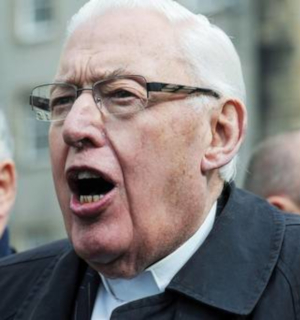
On March 23, 2011, Ian Paisley calls for a new era of sharing and reconciliation in an emotional farewell at his final sitting of the power-sharing Assembly he helped to create at Stormont. Dr. Paisley continues his political career in the House of Lords.

Protestant and Catholic leaders in Northern Ireland‘s unity government celebrate their first full four-year term in power and lauded Paisley, the unlikely peacemaker who made it possible, on his effective retirement day.

Paisley, a stern anti-Catholic evangelist who spent decades rallying pro-British Protestants against compromise, stuns the world in 2007 by agreeing to forge a coalition alongside senior Irish Republican Army (IRA) veterans. Their polar-opposite combination governs Northern Ireland with surprising harmony for the four years leading up to his retirement.

The Northern Ireland Assembly that elects the administration is dissolved on March 14, 2011, in preparation for a May 5 election in the British territory. The 84-year-old Paisley makes his last debate in an elected chamber on March 6, 2011, noting that this local government is not ending in chaos and acrimony, as 1999-2002 attempts at power-sharing repeatedly had done.

At this point, Paisley has already stepped down as a member of the British and European parliaments and as leader of the Democratic Unionists, a party of hard-line Protestant protesters that he founded in 1970 and watched grow over the previous decade into the most popular in Northern Ireland.

Those lauding him include Peter Robinson, who succeeded him in 2008 as leader of both the government and the Democratic Unionists and Sinn Féin‘s Martin McGuinness, the senior Catholic politician who spends decades as a commander of Paisley’s archenemy, the IRA.

The IRA kills nearly 1,800 people in a failed 1970-1997 effort to force Northern Ireland out of the United Kingdom. Northern Ireland remains part of the United Kingdom when the overwhelmingly Catholic rest of Ireland gains its independence in 1922. The outlawed IRA formally renounces violence and disarms in 2005, clearing the way for its allied Sinn Féin party to recognize the legal authority of Northern Ireland and its police.

Still, few observers expected Paisley to agree to a pact so quickly after the IRA-Sinn Féin peace moves or to get along so warmly with McGuinness during their year in partnership.

McGuinness, whose organization once considered Paisley a prime target for assassination, addressing his remarks to the stooped, silver-haired Paisley across the chamber, notes that Ulster wits had christened the two of them “the Chuckle Brothers.” He adds, “And I would like to think that we showed leadership. I think my relationship with him will undoubtedly go down in the history books.”

(From: “Northern Ireland power-sharing marks 1st full term,” the Associated Press and CTV News, March 23, 2011)