O’Byrne is born on December 8, 1929, in Killiney, a suburb of Dublin, the son of John O’Byrne, KC, and Marjorie (née McGuire). He attends St. Mary’s College, Dublin, Castleknock College and University College Dublin (UCD), where he earns a degree in Legal and Political Science. In 1952, he is called to the King’s Inns. In 1954, he abandons a legal career in favour of the performing arts, joining the George Mitchell Singers in London but has a “day job” working for an insurance company. During the summer season in Llandudno, Wales, he meets and later marries a singer and dancer from Dublin named Vicky Fitzpatrick. They have three children, Jane, John, and Dominic.
O’Byrne emigrates to the Union of South Africa in 1958. In 1961, he wins a competition called The Voice of South Africa, thereby gaining a contract with the South African Broadcasting Corporation and a new career. As is commonly the case at the time, both among Irish actors abroad as well as many South Africans in the theatre and broadcast media, he uses Received Pronunciation for his professional speaking voice.
O’Byrne is also an actor, and narrates five films, while in South Africa. He is one of a series of actors who play the science-fiction character Mark Saxon in the original radio dramaNo Place to Hide, originally created by South African author Monty Doyle.
O’Byrne and his family move to Mullingar in 2001, but he continues to do broadcasts for Irish classical-music radio station RTÉ lyric fm, and his programmes for Fine Music Radio are recorded there and transmitted to South Africa for broadcast. He retires in 2004.
In 2010, at the MTN Radio Awards Gala, in Johannesburg, O’Byrne is honoured for his contribution to South African broadcasting, being named one of the inaugural inductees into the Radio Hall of Fame.
The Shankill Butchers gang is based in the Shankill area and is responsible for the deaths of at least 23 people, most of whom are killed in sectarian attacks. The gang is notorious for kidnapping, torturing and murdering random or suspected Catholic civilians. Each victim is beaten ferociously and has their throat hacked with a butcher knife. Some are also tortured and attacked with a hatchet. The gang also kills six Ulster Protestants over personal disputes, and two other Protestants mistaken for Catholics.
The commander of the Shankill Butchers gang is Lenny Murphy. He is the youngest of three sons of Joyce (née Thompson) and William Murphy from the loyalist Shankill Road area of Belfast. At school he is known as a bully and threatens other boys with a knife or with retribution from his two older brothers. Soon after leaving school at 16, he joins the UVF. He often attends the trials of people accused of paramilitary crimes, to become well acquainted with the laws of evidence and police procedure.
On September 28, 1972, Murphy shoots and kills William Edward “Ted” Pavis at the latter’s home in East Belfast. Pavis is a Protestant whom the UVF say has been selling weapons to the Provisional Irish Republican Army (PIRA). Murphy and an accomplice, Mervyn Connor, are arrested shortly afterwards and held on remand in Belfast’s Crumlin Road Gaol. After a visit by police to Connor, fellow inmates suspect that he might cut a deal with the authorities with regard to the Pavis killing. On April 22, 1973, Connor dies by ingesting a large dose of cyanide. Before he dies, he writes a confession to the Pavis murder, reportedly under duress from Murphy. Murphy is brought to trial for the Pavis murder in June 1973. The court hears evidence from two witnesses who had seen Murphy pull the trigger and had later picked him out of an identification parade. The jury acquits him due in part to Murphy’s disruption of the line-up. His freedom is short-lived as he is arrested immediately for a number of escape attempts and imprisoned, then interned, for three years.
In May 1975, Murphy is released from prison. He spends much of his time frequenting pubs on the Shankill Road and assembling a paramilitary team that will enable him to act with some freedom at a remove from the UVF leadership (Brigade Staff). His inner circle consists of two “personal friends.” These are a “Mr. A” and John Murphy, one of Lenny’s brothers, referred to as “Mr. B.” Further down the chain of command are his “sergeants,” William Moore and Bobby “Basher” Bates, a UVF man and former prisoner.
Moore, formerly a worker in a meat-processing factory, had stolen several large knives and meat-cleavers from his old workplace, tools that are later used in more murders. Another prominent figure is Sam McAllister, who uses his physical presence to intimidate others. On October 2, 1975, the gang raids a drinks premises in nearby Millfield. On finding that its four employees, two females and two males, are Catholics, Murphy shoots three of them dead and orders an accomplice to kill the fourth. By now Murphy is using the upper floor of the Brown Bear pub, at the corner of Mountjoy Street and the Shankill Road near his home, as an occasional meeting-place for his unit.
On November 25, 1975, using the city’s sectarian geography to identify likely targets, Murphy roams the areas nearest the Catholic New Lodge in the hope of finding someone likely to be Catholic to abduct. Francis Crossen, a 34-year-old Catholic man and father of two, is walking towards the city centre at approximately 12:40 a.m. when four of the Butchers, in Moore’s taxi, spot him. As the taxi pulls alongside Crossen, Murphy jumps out and hits him with a lug wrench to disorient him. He is dragged into the taxi by Benjamin Edwards and Archie Waller, two of Murphy’s gang. As the taxi returns to the safety of the nearby Shankill area, Crossen suffers a ferocious beating. He is subjected to a high level of violence, including a beer glass being shoved into his head. Murphy repeatedly tells Crossen, “I’m going to kill you, you bastard,” before the taxi stops at an entry off Wimbledon Street. Crossen is dragged into an alleyway and Murphy, brandishing a butcher knife, cuts his throat almost through to the spine. The gang disperses. Crossen, whose body is found the following morning by an elderly woman, is the first of three Catholics to be killed by Murphy in this “horrific and brutal manner.” “Slaughter in back alley” is the headline in the city’s major afternoon newspaper that day. A relative of Crossen says that his family was unable to have an open coffin at his wake because the body was so badly mutilated.
Most of the gang are eventually caught and, in February 1979, receive the longest combined prison sentences in United Kingdom legal history. However, gang leader Lenny Murphy and his two chief “lieutenants” escape prosecution. Murphy is murdered in November 1982 by the Provisional IRA, likely acting with loyalist paramilitaries who perceive him as a threat. The Butchers brought a new level of paramilitary violence to a country already hardened by death and destruction. The judge who oversaw the 1979 trial describes their crimes as “a lasting monument to blind sectarian bigotry.”
Married in 1893, Hinkson’s parents initially settle in England, where he studies law and is called to the Inner Temple in 1902. After suffering the loss of their first two sons in infancy, they have two more sons in addition to their daughter, Pamela. During this time her mother earns the main family income, and it is likely that she determines their return to Ireland in 1911. The Hinksons initially settle in Dalkey, County Dublin, before moving to a house called Clarebeg in Shankill. When Henry Hinkson is appointed resident magistrate for south Mayo (Castlebar) in October 1914, the family moves to Claremorris, County Mayo.
Hinkson is educated privately in England and on the Continent, and in Ireland attends a local convent day-school. She is exposed to her mother’s literary milieu which includes prominent writers of the Irish revival, including George William Russell, James Stephens, and Padraic Colum. Her mother’s memoir, The Years of the Shadow (1919), recalls Pamela’s developing talent for writing poetry and her predilection for war themes, as evidenced by The Blind Soldier, one of her first published poems. By the time she turns her hand to short stories, her earnings from writing enable her to buy the latest fashions.
Two key events that consumed Hinkson’s life and later spark her creativity are World War I and the Easter Rising. H. G. Wells describes in the foreword to his war novel Mr. Britling Sees It Through (1916) a conversation he had with her when she was 12, recalling how she had boldly set him straight on the “Irish question.” Her parents send her away to boarding school in County Wicklow in the hope that she will be distracted from her gloomy preoccupations, which are accentuated by the absence of her brothers, serving in the British Army. After the war she is deeply concerned by the redundancy experienced by demobilised and often maimed soldiers and contributes to the welfare work of the Irish servicemen’s Shamrock Club in London. These issues inform two early novels, The Victors (1925) and Harvest (1926), both written in the guise of an ex-serviceman under the pseudonym “Peter Deane.” By masking her identity, she avoids the possibility of her works being discredited because of her gender and lack of first-hand experience of war. Subsequently she writes under her own name for thirty years.
In contrast to her close relationship with her mother, Hinkson deeply dislikes her father. With the exception of her beloved brother Giles A. Hinckson, a correspondent for The Times in Buenos Aires and Santiago, she never meets a man who matches her high ideals. Though briefly engaged to be married, she is ultimately disillusioned by all men, dismissing them as she had her father. After his death early in 1919, she and her mother are left in financial difficulties, and have to resort to friends and boarding houses for accommodation. Without the financial means to embark on a university degree, she remains at her mother’s side. Though she continues to write, she leads a somewhat stifled life. From 1922 onwards they spend several years on the Continent.
Hinkson’s first novel, The End of All Dreams (1923), addresses the decline of the “big house” amid the revolutionary upheavals of recent Irish history, a theme to which she returns in later works, such as The Deeply Rooted (1935) and her last book, The Lonely Bride (1951). During the 1920s she writes much girls’ school fiction, while her novel Wind from the West (1930) is informed by a period spent in France, where she works as a governess. Her transcription of the memoirs of Lady Fingall (Elizabeth Burke-Plunkett), published under the title Seventy Years Young (1937), illustrates the decline of the Anglo-Irish ascendancy. Informed by war and the Irish troubles, her novels characteristically are solemn, and reflect her ambivalent relationship with Ireland. Inspired by the Irish landscape, but never an ardent supporter of Irish independence, she maintains an abiding attachment to England.
The death of Hinkson’s mother in 1931 is a devastating blow that triggers her most forceful and first truly successful novel, The Ladies’ Road (1932). Documenting the lives of the Irish and English ascendancies before, during, and after World War I, this novel, without being explicitly autobiographical, contains many motifs that resonate with her own life story. When published in the United States in 1946 it proves a massive success, selling 100,000 copies in the Penguin Books edition, a rare feat for a World War I novel appearing immediately after World War II. Other notable works are The Light on Ireland (1935) and her sketches of Irish life, Irish Gold (1939), written while she lodges with friends near Lough Derg, County Tipperary.
Hinkson’s visit to India in the late 1930s as a guest of the viceroy, which she recounts in Indian Harvest (1941), results in her appointment to the Ministry of Information in London (1939–45). She lectures on India in the United States during World War II, and also lectures to British troops and local audiences in Germany (1946–47), broadcasts on radio, and contributes to The Observer, The Spectator, New Statesman, The Manchester Guardian, and Time and Tide. Her novel Golden Rose (1944), written in London during The Blitz, romanticises the British colonial presence in India. Forthright in the expression of her numerous strongly held opinions, she argues ardently and controversially for women’s rights, animal welfare, and retention of Northern Ireland in the UK. Devout in her Catholicism, she is none the less critical of certain Catholic precepts.
Hinkson returns to Ireland in 1959 where she suffers poor health for twenty years until her death in Dublin on May 26, 1982.
(From: “Hinkson, Pamela” by Jessica March, Dictionary of Irish Biography, http://www.dib.ie)
Irish poetSeán Mac Falls is born on November 18, 1957. Belonging to no group or movement and operating outside of literary fashions, his brand of symbolist poetry can, at first reading, appear difficult. His use of allusion, startling diction and subtle punning display submerged metaphor in his work. The overall effect is a fresh implementation of Imagism.
Mac Falls publishes a second book, entitled The Blue Falcon, in 2005. His latest book of verse is titled Garden Theology (2022).
At the age of fifty, a reflective time in his life, Mac Falls purchases an historic, 100-year-old farmhouse property on the Olympic Peninsula in Washington State, overlooking Vancouver Island on the Salish Sea, with a sweeping view across the Strait of Juan de Fuca to Mount Baker. He is seeking a “Gentle House” with the peace and solitude he seeks in which to write. In the ensuing years he desires to share this experience and, looking ahead, establish an artist residency.
In order to preserve and extend the space that proves so generative, Mac Falls’s gift to the writing community is a place for poets, playwrights, painters, filmmakers and songwriters to co-mingle and create and collaborate.
Mac Falls, in collaboration with the esteemed non-profit Tupelo Press, establishes Gentle House as a retreat and ongoing residency for artists with an original founding gift, the property, cottages and a substantial poetry library. During 2022-23, Gentle House will transition to a 501(c)(3) nonprofit literary arts organization. Gentle House continues to subsist on the generosity of Mac Falls’s founding gift, supplemented by a fundraising program that began in earnest in 2021, and is growing each year.
Hannon is founder and mainstay of The Divine Comedy, a band which achieves their biggest commercial success in the last half of the 1990s with the albums Casanova (1996), A Short Album About Love (1997), and Fin de Siècle (1998). He continues to release albums under The Divine Comedy name, the most recent being Office Politics (2019). In 2000 he and Joby Talbot contribute four tracks for Ute Lemper‘s collaboration album, Punishing Kiss.
In 2006 it is announced that Hannon is to lend his vocal ability to the Doctor Who soundtrack CD release, recording two songs – “Love Don’t Roam” for the 2006 Christmas special, “The Runaway Bride“, and a new version of “Song For Ten”, originally used in 2005’s “The Christmas Invasion.” On January 12, 2007, The Guardian website’s “Media Monkey” diary column reports that Doctor Who fans from the discussion forum on the fan website Outpost Gallifrey are attempting to organise mass downloads of the Hannon-sung “Love Don’t Roam,” which is available as a single release on the UKiTunes Store. This is in order to attempt to exploit the new UK Singles Chart download rules, and get the song featured in the Top 40 releases.
The same year Hannon adds his writing and vocal talents to the Air album Pocket Symphony, released in the United States on March 6, 2007. He is featured on the track “Somewhere Between Waking and Sleeping,” for which he writes the lyrics. This song had been originally written for and sung by Charlotte Gainsbourg on her album, 5:55. Though it is not included in its 2006 European release, it is added as a bonus track for its American release on April 24, 2007.
Hannon is credited with composing the theme music for the sitcoms Father Ted and The IT Crowd, the former theme composed for the show and later reworked into “Songs of Love,” a track on The Divine Comedy’s breakthrough album Casanova. Both shows are created or co-created by Graham Linehan. A new Divine Comedy album, Bang Goes the Knighthood, is released in May 2010.
Hannon has collaborated with Thomas Walsh, from the Irish band Pugwash, to create a cricket-themed pop album under the name The Duckworth Lewis Method. The first single, “The Age of Revolution,” is released in June 2009, and a full-length album is released the following week. The group’s second album, Sticky Wickets, comes out in 2013.
In April 2012 Hannon’s first opera commission, Sevastopol, is performed by the Royal Opera House. It is part of a program called OperaShots, which invites musicians not typically working within the opera medium to create an opera. Sevastopol is based upon Leo Tolstoy‘s Sevastopol Sketches. Hannon’s second opera for which he writes music, In May, premiers in May 2013 in Lancaster and is shown in 2014 with overwhelming success.
The world premiere of “To Our Fathers in Distress,” a piece for organ, is performed on March 22, 2014, in London, at the Royal Festival Hall. It is inspired by Hannon’s father, Rt. Revz. Brian Hannon, who suffers from Alzheimer’s disease.
Hannon’s partner is Irish musician Cathy Davey. The couple live in the Dublin area. He is previously married to Orla Little, with whom he has a daughter, Willow Hannon. With Davey, Hannon is a patron of the Irish animal charity My Lovely Horse Rescue, named after the Father TedEurovision song for which he wrote the music.
Politically, Hannon describes himself as being “a thoroughly leftie, Guardian-reading chap, but of the champagne socialist variety.”
Following the outbreak of the Troubles in the late 1960s, the Provisional IRA conducts an armed campaign that seeks to create a united Ireland by ending Northern Ireland‘s status as part of the United Kingdom. As a result of increasing levels of violence in Northern Ireland, internment without trial is introduced there in August 1971, and in the Republic of Ireland the coalition government led by Fine Gael’s Liam Cosgrave is attempting to curb IRA activity. Fine Gael had come to power on a law-and-order ticket, with a policy of “getting tough on crime.” Suspected IRA members are arrested and accused of IRA membership by a superintendent in the Garda Síochána, a crime under the Offences against the State Acts. They are tried at the juryless Special Criminal Court in Dublin, where the traditional IRA policy of not recognising the court results in a fait accompli as no defence is offered and IRA membership carries a minimum mandatory one-year sentence, resulting in internment in all but name. In September 1973 IRA Chief of Staff Seamus Twomey appears at the Special Criminal Court charged with IRA membership, and states, “I refuse to recognise this British-orientated quisling court.” He is found guilty and receives a five-year sentence. By October 1973 the IRA’s command structure is seriously curbed, with Twomey and other senior republicans J. B. O’Hagan and Kevin Mallon all being held in Mountjoy Prison.
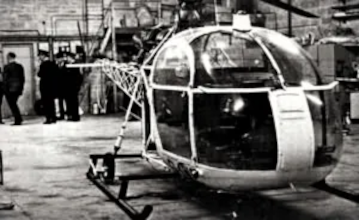
The IRA immediately begins making plans to break Twomey, O’Hagan and Mallon out of the prison. The first attempt involves explosives that had been smuggled into the prison, which are to be used to blow a hole in a door which will give the prisoners access to the exercise yard. From there, they are to scale a rope ladder thrown over the exterior wall by members of the IRA’s Dublin Brigade who are to have a getaway car waiting to complete the escape. The plans when the prisoners cannot gain access to the exercise yard and the rope ladder is spotted, so the IRA begins making new escape plans. The idea of using a helicopter in an escape had been discussed before in a plot to break Gerry Adams out of Long Kesh internment camp but had been ruled out because of faster and more sophisticated British Army helicopters being stationed at a nearby base. The IRA’s GHQ staff approves the plan to break out Twomey, O’Hagan and Mallon, and arrangements are made to obtain a helicopter. A man with an American accent calling himself Mr. Leonard approaches the manager of Irish Helicopters at Dublin Airport, with a view to hiring a helicopter for an aerial photographic shoot in County Laois. After being shown the company’s fleet of helicopters, Leonard arranges to hire a five-seater Alouette II for October 31.
Leonard arrives at Irish Helicopters on October 31 and is introduced to the pilot of the helicopter, Captain Thompson Boyes. Boyes is instructed to fly to a field in Stradbally, in order to pick up Leonard’s photographic equipment. After landing Boyes sees two armed, masked men approaching the helicopter from nearby trees. He is held at gunpoint and told he will not be harmed if he follows instructions. Leonard leaves with one gunman, while the other gunman climbs aboard the helicopter armed with a pistol and an ArmaLite rifle. Boyes is instructed to fly towards Dublin following the path of railway lines and the Royal Canal and is ordered not to register his flight path with Air Traffic Control. As the helicopter approaches Dublin, Boyes is informed of the escape plan and is instructed to land in the exercise yard at Mountjoy Prison.
In the prison’s exercise yard, the prisoners are watching a football match. Shortly after 3:35 p.m. the helicopter swings in to land in the prison yard, with Kevin Mallon directing the pilot using semaphore. A prison officer on duty initially takes no action as he believes the helicopter contains the Minister for Defence, Paddy Donegan. After prisoners surround the eight prison officers in the yard, fights break out as the officers realise an escape attempt is in progress. As other prisoners restrain the officers, Twomey, Mallon and O’Hagan board the helicopter. As the helicopter takes off, in the confusion one officer shouts, “Close the gates, close the fucking gates.” The helicopter flies north and lands at a disused racecourse in the Baldoyle area of Dublin, where the escapees are met by members of the IRA’s Dublin Brigade. Boyes is released unharmed, and the escapees are transferred to a taxi that had been hijacked earlier and are transported to safe houses.
The escape makes headlines around the world and is an embarrassment for Cosgrave’s government, which is criticised for “incompetence in security matters” by opposition party Fianna Fáil. An emergency debate on security is held in Dáil Éireann on November 1.
The IRA releases a statement on the escape, which reads, “Three republican prisoners were rescued by a special unit from Mountjoy Prison on Wednesday. The operation was a complete success, and the men are now safe, despite a massive hunt by Free State forces.” Shortly after the escape Twomey gives an exclusive interview to German magazine Der Spiegel, where the reporter says people throughout Europe are joking about the incident as “the escape of the century.” Irish rebel band the Wolfe Tones writes a song celebrating the escape called “The Helicopter Song,” which is immediately banned by the government yet still tops the Irish Singles Chart after selling twelve thousand copies in a single week.
The escape results in all IRA prisoners being held at Mountjoy Prison and Curragh Camp being transferred to the maximum security Portlaoise Prison. In order to prevent any further escapes, the perimeter of the prison is guarded by members of the Irish Army, and wires are erected over the prison yard to prevent any future helicopter escape. Cosgrave states there will be “no hiding place” for the escapees, and a manhunt involving twenty thousand members of the Irish Defence Forces and Garda Síochána ensues.
Mallon is recaptured at a Gaelic Athletic Association dance in a hotel near Portlaoise on December 10, 1973, and imprisoned in Portlaoise Prison. He escapes from there in a mass break-out on August 18, 1974, when nineteen prisoners escape after overpowering guards and using gelignite to blast through the gates. He is recaptured in Foxrock in January 1975 and returned to Portlaoise Prison. O’Hagan is recaptured in Dublin in early 1975, and also imprisoned in Portlaoise Prison. After the end of his original twelve-month sentence, he is immediately arrested and sentenced to a further two years imprisonment for escaping. Twomey evades recapture until December 2, 1977, when he is spotted sitting in a car in Sandycove by members of the Garda’s Special Branch who are investigating an arms shipment after a tip-off from police in Belgium. He drives away after spotting the officers, before being recaptured in the centre of Dublin after a high-speed car chase. He is also imprisoned in Portlaoise Prison until his release in 1982.
In 2021, Brendan Hughes publishes an autobiography Up Like a Bird, an account of the planning and organisation of the escape, co-authored with Doug Dalby.
Ferguson is born on November 4, 1884, at Growell, near Dromore, County Down, in what is now Northern Ireland, the son of a farmer. In 1902, he goes to work with his brother, Joe, in his bicycle and car repair business. While working there as a mechanic, he develops an interest in aviation, visiting airshows abroad. In 1904, he begins to race motorcycles.
The first person to accomplish powered flight in the UK is Alliot Verdon Roe in June 1908, who also flies an aeroplane of his own design, but this has not yet been achieved in Ireland. Ferguson begins to develop a keen interest in the mechanics of flying and travels to several air shows, including exhibitions in 1909 at Blackpool and Rheims where he takes notes of the design of early aircraft. He convinces his brother that they should attempt to build an aircraft at their Belfast workshop and, working from his notes, they work on the design of a plane, the Ferguson monoplane.
After making many changes and improvements, they transport their new aircraft by towing it behind a car through the streets of Belfast up to Hillsborough Park to make their first attempt at flight. They are at first thwarted by propeller trouble but continue to make technical alterations to the plane. After a delay of nearly a week caused by bad weather, the Ferguson monoplane finally takes off from Hillsborough on December 31, 1909. Ferguson becomes the first Irishman to fly and the first Irishman to build and fly his own aeroplane.
After falling out with his brother over the safety and future of aviation, Ferguson decides to go it alone, and in 1911 founds a company selling Maxwell, Star and Vauxhall cars and Overtime Tractors. He sees at first hand the weakness of having tractor and plough as separate articulated units, and in 1917 he devises a plough that can be rigidly attached to a Ford Model T car — the Eros, which becomes a limited success, competing with the Fordson Model F.
In 1917 Ferguson meets Charles E. Sorensen while Sorensen is in England scouting production sites for the Fordson tractor. They discuss methods of hitching the implement to the tractor to make them a unit. In 1920 and 1921 he demonstrates early versions of his three-point linkage on Fordson tractors at Cork and at Dearborn, Michigan. He and Henry Ford discuss putting the Ferguson system of hitch and implements onto Fordson tractors at the factory, but no deal is struck. At the time the hitch is mechanical. Ferguson and his team of longtime colleagues, including Willie Sands and Archie Greer, soon develop a hydraulic version, which is patented in 1926. After one or two false starts, he eventually founds the Ferguson-Sherman Inc., with Eber and George Sherman.
The new enterprise manufactures the Ferguson plough, incorporating the patented “Duplex” hitch system mainly intended for the Fordson “F” tractor. Following several more years of development, Ferguson’s new hydraulic version of the three-point linkage is first seen on his prototype “Ferguson Black” or ‘Irish tractor’ as he calls it, now in the Science Museum, South Kensington, London. A production version of the “Black” is introduced in May 1936, made at one of the David Brown Engineering Ltd. factories in Huddersfield, West Yorkshire, and designated Ferguson Model A tractor.
In October 1938, Ferguson demonstrates his latest tractor to Henry Ford at Dearborn, and they make the famous “handshake agreement.” He takes with him his latest patents covering future improvements to the Ferguson tractor and it is these that lead to the Ford-Ferguson 9N introduction to the world on June 29, 1939.
Henry Ford II, Ford’s grandson, ends the handshake agreement on June 30, 1947, following unsuccessful negotiations with Ferguson, but continues to produce a tractor, the 8N, incorporating Ferguson’s inventions, the patents on almost all of which have not yet expired, and Ferguson is left without a tractor to sell in North America. His reaction is a lawsuit demanding compensation for damage to his business and for Ford’s illegal use of his designs. The case is settled out of court in April 1952 for just over $9 million. The court case costs him about half of that and a great deal of stress and ill health.
By 1952, most of the important Ferguson patents have expired, and this allows Henry Ford II to claim that the case had not restricted Ford’s activities too much. It follows that all the world’s other tractor manufacturers can also use Ferguson’s inventions, which they do. A year later Ferguson merges with Massey-Harris Limited to become Massey-Harris-Ferguson Co., later Massey Ferguson.
Ferguson dies at his home at Stow-on-the-Wold on October 25, 1960, as the result of a barbiturate overdose. The inquest is unable to conclude whether his death had been accidental or not.
A blue plaque commemorating Ferguson is mounted on the Ulster Bank building in Donegall Square, Belfast, the former site of his showroom. A granite memorial has been erected to Ferguson’s pioneering flight on the North Promenade, Newcastle, County Down, and a full-scale replica of the Ferguson monoplane and an early Ferguson tractor and plough can be seen at the Ulster Folk and Transport Museum at Cultra.
Colleran, and her twin Noreen, are born to John and Josie Colleran. One of a family of five children, her father is a school principal and her mother, also a primary school teacher, dies when she is just 11 years old. She completes her secondary education at St. Louis secondary school in Kiltimagh. She spends a lot of time outdoors as a child, particularly fishing, which sparks her interest in the environment.
On entering higher education, Colleran has a grant from the Department of Education, which requires that she do her studies through the Irish language. Her first choice, Medicine, is not available in Irish so she chooses Science. She graduates with a first-class primary degree in Science at University College Galway (now National University of Ireland, Galway) in 1967.
Colleran lectures in biology at Athlone Regional Technical College (now Athlone Institute of Technology) and Galway Regional Technical College (now Galway-Mayo Institute of Technology) before her appointment as a lecturer in microbiology at NUI Galway in 1976. She is appointed Associate Professor of Microbiology by the Senate of the National University of Ireland in 1990. She is a member of the university’s governing authority for a number of years, but steps down in May 2000 in connection with the selection procedure for the new university president. In October of that year, she is appointed professor of microbiology and chair of the department at NUI Galway.
Colleran is the first director of the Environment Change Institute at NUI Galway set up under the Higher Education Authority‘s Programme for Research in Third Level Institutions in 2000. In 2010, the Environmental Change Institute and the Martin Ryan Marine Research Institute are merged to form the current day Ryan Institute at NUI Galway.
In 1973 Colleran is elected to the committee of the Galway Association of An Taisce, part of a national voluntary organisation the aims of which are to conservation in Ireland through education, publicity and positive action. She serves as membership secretary and then treasurer to the Galway branch before becoming chairman. In 1981, as chairman of the Galway branch, she hits back at claims from Galway County Council that An Taisce are “an anonymous group, wielding power unfairly.” She is involved in the compilation of a controversial planning report, published by An Taisce in 1983, which highlights abuse of planning laws by city and county councillors across Ireland, and in particular in counties Galway, Mayo, Donegal, Kerry and Louth.
Colleran serves as Environmental Officer for An Taisce before being elected National Chairman in 1987, the first time a chairman has come from one of the western county associations. She continues to use her position to campaign against misuse of planning laws, for a clamp down on pollution of rivers and lakes, and against a move to scrap An Foras Forbartha, a body that provides independent monitoring of pollution. During her three years as chairman, until May 1990, she is particularly involved in debates over local environmental and planning issues, in particular over gold mining in the west of Ireland, a proposed airport for Clifden, and the planned sewage treatment plant at Mutton Island, County Galway.
In 1991 plans are announced for a new visitor centre, to be located at Mullaghmore in The Burren. Colleran is among those who are part of an appeal, saying that while the plan for the national park is welcomed by An Taisce, they want the visitor centre to be located three or four miles from Mullaghmore.
President Mary Robinson appoints seven new members to her Council of State in February 1991, including Colleran. Other new members appointed at the time are Monica Barnes, Patricia O’Donovan, Quintan Oliver, Rosemarie Smith, Dónal Toolan and D. Kenneth Whitaker. The new Council of State represents a wide spectrum of Irish life and is widely welcomed, although Fine Gael is disappointed that its leader John Bruton is not included.
In 1991, Colleran is one of 15 people appointed to TaoiseachCharles Haughey‘s Green 2000 Advisory Group, to determine which problems will face the environment in the next century. The group is led by Dr. David Cabot, special advisor on environmental affairs.
In 2003 Colleran is elected as a member of the Royal Irish Academy.
Colleran is recognised at the annual NUI Galway Alumni Awards in 2004 when she receives the award for Natural Science, sponsored by Seavite Bodycare Ltd., which acknowledges a graduate who has made an outstanding contribution in the field of natural science.
Holmes is one of the four surviving children of Dr. Robert Emmet, state physician of Ireland, and Elizabeth Emmet (née Mason). As a young woman she is noted for her intelligence and is a classical scholar. Her father lauds her “good character” and is very hopeful she will make a good wife. Much like her brothers, Robert and Thomas Addis, who are both to join the Society of United Irishmen, she is interested in politics and is a member of liberal intellectual circles. She is a correspondent of Margaret King about their common passion for the writings of Mary Wollstonecraft.
In 1793, a family friend, William Drennan, describes her as genteel but distant. He predicts her match with the barristerRobert Holmes, who she secretly marries on September 21, 1799, in the Dublin Unitarian Church. The couple have at least four children, with Drennan attending all the births. One of their children is Elizabeth Emmet Lenox-Conyngham. Robert Holmes attends to the Emmet family legal affairs for a time, with the couple living with her parents at Casino, near Milltown, Dublin. Holmes helps to raise the children of her brother Thomas Addis, after he is sent to Fort George, Highland, Scotland for his involvement with the United Irishmen. During this time, their mother’s letters to Thomas Addis note Holmes’ devotion to her husband but also her delicate health and tendency towards low spirits. Holmes is the only surviving child of their 17 children who is still in Ireland, and she is a comfort to her parents in their old age. Her father dies in 1802, and her mother almost dies in 1803 at the same time as the arrest and execution of her brother Robert. Some claim that Holmes attempted to recover her brother’s body but failed.
After the failed Irish rebellion of 1803, Holmes’s husband is arrested but she is allowed to spend approximately a week with him. It is long claimed that she collapses and dies on her doorstep following his release in February 1804. In truth, she gives birth to a son at home, following which her health worsens, and her hearing also deteriorates. Her son, Hugh, also later dies. She is attended to by Drennan, who worries that she is succumbing to tuberculosis that December. She dies on March 10, 1805, and is buried with her parents in the graveyard of St. Peter’s Church, Aungier Street, Dublin. There is a legend that her brother Robert’s body is interred with her in secret, but this is unconfirmed. A portrait of Holmes by Thomas Hickey is held by Kilmainham Gaol.
Holmes writes prose and verse for The Press, a publication associated with the Society of United Irishmen. In 1799 she is active, along with members of her extended family, in the movement opposed to the legislative union of Ireland with the United Kingdom. The pamphlet An address to the people of Ireland is attributed to her but is now thought to have been written by Roger O’Connor. Holmes’ poems are included in her daughter’s 1833 book of verse The dream and other poems.
(Pictured: Portrait of Mary Anne Holmes by Thomas Hickey, held in the collections of Kilmainham Gaol)
On September 24, 2000, Westlife, an Irish pop vocal group formed in Sligo in 1998, makes British pop history by becoming the first act to have six consecutive number one singles.
Kian Egan, Mark Feehily and Shane Filan, all schoolmates in Summerhill College in Sligo, participate in a school production of Grease with fellow Sligo men Derrick Lacey, Graham Keighron, and Michael Garrett. They considered it as the start of Westlife. The sextet forms a pop vocal group called Six as One in 1997, which they later rename IOYOU. The group is managed by choreographer Mary McDonagh and two other informal managers. McDonagh first encounters Egan as a six-year-old student at her weekly dance classes, and comes to know Filan and Feehily in their early teens as they star in shows such as Oliver! and Godspell for Sligo Fun Company.
Louis Walsh, the manager of fellow Irish boy bandBoyzone, comes to know the group after Filan’s mother Mae contacts him, but the group fails to secure a BMG record deal with Simon Cowell. Cowell tells Walsh, “You are going to have to fire at least three of them. They have great voices, but they are the ugliest band I have ever seen in my life.” Lacey, Keighron, and Garrett are told they will not be part of the new group, and auditions are held in Dublin where Nicky Byrne and Brian McFadden are recruited. McFadden is part of an R&B group called Cartel before this.
The new group, formed on July 3, 1998, is originally named Westside, but as another band is already using that name, the group is renamed Westlife. They manage to secure a major record deal the second time around under BMG with all other record labels competing. They sign a four million pound record deal with RCA Records. Westlife’s first big break comes in 1998 when they open for Boyzone and Backstreet Boys concerts in Dublin.
Westlife has released twelve studio albums. They rise to fame with their debut international self-titled studio album, Westlife (1999). It is followed by Coast to Coast (2000), World of Our Own (2001), Unbreakable – The Greatest Hits Volume 1 (2002), and Turnaround (2003), which continues the group’s success worldwide. The group then releases their cover albums Allow Us to Be Frank (2004) and The Love Album (2006) and the studio albums Face to Face (2005) and Back Home (2007). After a hiatus of studio recording for almost one year in 2008, they release the studio albums Where We Are (2009), and Gravity (2010), and the compilation album Greatest Hits (2011). After eight years, the quartet group releases their eleventh studio album, Spectrum (2019), followed by their twelfth studio album, Wild Dreams (2021).
Westlife is the act with the most Number 1 debuts on the UK Singles Chart, with all 14 of their chart-toppers landing there in their first week. They have the most singles certifications for a pop band on the UK number one singles artists chart since The Beatles. According to the British Phonographic Industry (BPI), Westlife has been certified for 13.1 million albums, 1.3 million video albums, and 10.4 million singles, with a total of more than 24 million combined sales in the United Kingdom (UK). They are also currently ranked 19th with the most number-one albums of all time and sixth-highest band in the list. The group has accumulated 14 number-one singles as a lead artist as well as having eight number-one albums in the United Kingdom, making them Ireland’s and non-British act’s (since Elvis Presley) most prolific chart-toppers. In 2012, the Official Charts Company lists Westlife 34th among the biggest-selling singles artist, 16th amongst the biggest selling groups, and 14th with most top ten hits — all the highest for a boy band and a pop group in British music history. They are also the biggest selling album group of the 2000s, and three of their studio albums are part of the 50 fastest-selling albums of all time in the UK.
Westlife has the most consecutive number one studio albums in a decade in the UK and Ireland for a band, since The Beatles, and for a pop band and act since ABBA. Also in Ireland, they have 11 number one albums with a total of 13 top two albums, 16 number one singles, as well as 34 top fifty singles. They have sold over 55 million records and are holders of the following Guinness World Records: first to achieve seven consecutive number-one singles in the UK; most public appearances in 36 hours by a pop group; most singles to debut at number one on the UK chart; and top-selling album group in the United Kingdom in the 21st century.
Westlife is one of the most successful music groups of all time, among the highest-profile acts in 2000s popular culture in most territories worldwide, and one of the few boy bands to have continued success after their commercial peak. On the best-selling boy bands of all time list, they are currently tenth worldwide along with the biggest-selling boy band from Ireland in history globally. They have received numerous accolades including one World Music Award, two Brit Awards, four MTV Video Music Awards, and four Record of the Year Awards. As a live act, Westlife has sold 5.5 million concert tickets worldwide from their fourteen concert tours so far. They hold the record for the most shows played at The SSE Arena, Belfast and Wembley Arena. This makes them the biggest arena act of all-time in the United Kingdom. They sell out Croke Park in Dublin in a record-breaking five minutes. Their fourteenth, and latest concert tour is called The Wild Dreams Tour.





 seamus dubhghaill