seamus dubhghaill

Promoting Irish Culture and History from Little Rock, Arkansas, USA


Leave a comment

Birth of Irish Folk Musician Tommy Makem

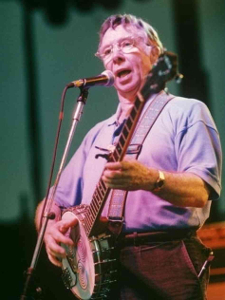
Thomas “Tommy” Makem, internationally celebrated Irish folk musician, artist, poet and storyteller, is born in Keady, County Armagh, on November 4, 1932. He is best known as a member of The Clancy Brothers and Tommy Makem. He plays the long-necked 5-string banjo, tin whistle, low whistle, guitar, bodhrán and bagpipes, and sings in a distinctive baritone. He is sometimes known as “The Bard of Armagh,” taken from a traditional song of the same name, and “The Godfather of Irish Music.”

Makem’s mother, Sarah Makem, is an important source of traditional Irish music, who is visited and recorded by, among others, Diane Guggenheim Hamilton, Jean Ritchie, Peter Kennedy and Sean O’Boyle. His father, Peter Makem, is a fiddler who also plays the bass drum in a local pipe band named “Oliver Plunkett,” after a Roman Catholic martyr of the reign of Charles II of England. His brother and sister are folk musicians as well. Makem, from the age of eight, is member of the St. Patrick’s church choir for 15 years where he sings Gregorian chant and motets. He does not learn to read music but he makes it in his “own way.”

Makem starts to work at 14 as a clerk in a garage and later he works for a while as a barman at Mone’s Bar, a local pub, and as a local correspondent for The Armagh Observer.

Makem emigrates to the United States in 1955, carrying his few possessions and a set of bagpipes from his time in a pipe band. Arriving in Dover, New Hampshire, he works at Kidder Press, where his hand was accidentally crushed by a press in 1956. With his arm in a sling, he leaves Dover for New York City to pursue an acting career.

The Clancys and Makem are signed to Columbia Records in 1961. The same year, at the Newport Folk Festival, Makem and Joan Baez are named the most promising newcomers on the American folk scene. During the 1960s, the Clancy Brothers and Tommy Makem perform sellout concerts at such venues as Carnegie Hall, and make television appearances on shows like The Ed Sullivan Show and The Tonight Show. The group performs for President John F. Kennedy. They also play in smaller venues such as the Gate of Horn in Chicago. They appear jointly in the UK Albums Chart in April 1966, when Isn’t It Grand Boys reaches number 22.

Makem leaves the group in 1969 to pursue a solo career. In 1975, he and Liam Clancy are both booked to play a folk festival in Cleveland, Ohio, and are persuaded to do a set together. Thereafter they often perform as Makem and Clancy, recording several albums together. He once again goes solo in 1988. Throughout the 1970s and 1980s he performs both solo and with Liam Clancy on The Irish Rovers‘ various television shows, which are filming in Canada and Ireland.

In the 1980s and 1990s, Makem is a principal in a well-known Irish music venue in New York, “Tommy Makem’s Irish Pavilion.” This East 57th Street club is a prominent and well-loved performance spot for a wide range of musicians. Among the performers and visitors are Paddy Reilly, Joe Burke, and Ronnie Gilbert. Makem is a regular performer, often solo and often as part of Makem and Clancy, particularly in the late fall and holiday season. The club is also used for warm-up performances in the weeks before the 1984 reunion concert of The Clancy Brothers and Tommy Makem at Lincoln Center for the Performing Arts. In addition, the after-party for Bob Dylan‘s legendary 30th Anniversary Concert Celebration at Madison Square Garden in 1992 is held at the Irish Pavilion.

In 1997 Makem writes a book, Tommy Makem’s Secret Ireland, and in 1999 premiers a one-man theatre show, Invasions and Legacies, in New York. His career includes various other acting, video, composition, and writing credits. He also establishes the Tommy Makem International Festival of Song in South Armagh in 2000.

Tommy Makem dies in Dover, New Hampshire, on August 1, 2007, following a lengthy battle with lung cancer. He continues to record and perform until very close to the end. Paying tribute to him after his death, Liam Clancy says, “He was my brother in every way.” He is buried next to his wife at New Saint Mary Cemetery in Dover.
Leave a comment

Birth of Astronaut & Test Pilot Michael Collins

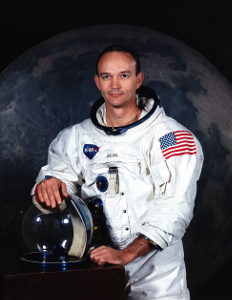
Michael Collins, Irish American former astronaut and test pilot who is part of the Gemini 10 and Apollo 11 missions, is born in Rome, Italy, on October 31, 1930. The Apollo 11 mission includes the first lunar landing in history. His Irish roots can be traced to the town of Dunmanway in County Cork, from which his grandfather, Jeremiah Collins, emigrates in the 1860s.

Collins is born in Rome where his father, United States Army Major General James Lawton Collins, is stationed at the time. After the United States enters World War II, the family moves to Washington, D.C., where Collins attends St. Albans School. During this time, he applies and is accepted to the United States Military Academy in West Point, New York, and decides to follow his father, two uncles, brother and cousin into the armed services.

In 1952, Collins graduates from West Point with a Bachelor of Science degree. He joins the United States Air Force that same year and completes flight training at Columbus Air Force Base in Mississippi. His performance earns him a position on the advanced day fighter training team at Nellis Air Force Base, flying the F-86 Sabres. This is followed by an assignment to the 21st Fighter-Bomber Wing at the George Air Force Base, where he learns how to deliver nuclear weapons. He also serves as an experimental flight test officer at Edwards Air Force Base in California, testing jet fighters.

Collins makes the decision to become an astronaut after watching John Glenn‘s Mercury-Atlas 6 flight. He applies for the second group of astronauts that same year but is not accepted. Disappointed, but undaunted, Collins enters the USAF Aerospace Research Pilot School as the Air Force begins to research space. That year, NASA once again calls for astronaut applications, and Collins is more prepared than ever. In 1963 he is chosen by NASA to be part of the third group of astronauts.

Collins makes two spaceflights. The first, on July 18, 1966, is the Gemini 10 mission, where Collins performs a spacewalk. The second is the Apollo 11 mission on July 20, 1969, the first lunar landing in history. Collins, accompanied by Neil Armstrong and Edwin “Buzz” Aldrin, remains in the Command Module while his partners walk on the moon’s surface. Collins continues circling the moon until July 21, when Armstrong and Aldrin rejoin him. The next day, he and his fellow astronauts leave lunar orbit. They land in the Pacific Ocean on July 24. Collins, Armstrong and Aldrin are all awarded the Presidential Medal of Freedom by Richard Nixon. However, Aldrin and Armstrong end up receiving a majority of the public credit for the historic event, although Collins is also on the flight.

Collins leaves NASA in January 1970, and one year later, he joins the administrative staff of the Smithsonian Institution in Washington, D.C. In 1980, he enters the private sector, working as an aerospace consultant. In his spare time, Collins says he stays active and spends his days “worrying about the stock market” and “searching for a really good bottle of cabernet under ten dollars.”

Collins and his wife, Patricia Finnegan, have three children. The couple lived in both Marco Island, Florida, and Avon, North Carolina until her death in April 2014.

On April 28, 2021, Collins dies of cancer at his home in Naples, Florida, at the age of 90. Buzz Aldrin, who becomes the last survivor of Apollo 11, says that “wherever [Collins has] been or will be, you will always have the Fire to Carry us deftly to new heights and the future.”

On January 30, 2023, Collins’ ashes are interred in Arlington National Cemetery.


Leave a comment

New Departure

Fenians propose a “New Departure,” an alliance with the Parnellites, on October 27, 1878. The term New Departure is used to describe several initiatives in the late 19th century by which Irish republicans, who are committed to independence from Britain by physical force, attempt to find a common ground for co-operation with groups committed to Irish Home Rule by constitutional means. The term refers to the fact that Fenians are to some extent departing from their orthodox doctrine of noninvolvement with constitutional politics, especially the British parliament.

In January 1877, James Joseph O’Kelly, a journalist with the New York Herald persuades John Devoy to meet with Irish parliamentarians. In January 1878, Devoy meets with Charles Stewart Parnell in Dublin. In March the exiled senior Irish Republican Brotherhood member John O’Leary and Supreme Council secretary John O’Connor meet secretly in London with MPs Charles Stewart Parnell, Frank Hugh O’Donnell, William Henry O’Sullivan and O’Kelly. The meeting is sought by Parnell or by William Carroll of Clan na Gael to consider co-operation between the IRB and Parnell. Parnell apparently merely listens and does not commit himself.

John O’Connor and Dr. Mark Ryan, both members of the IRB’s Supreme Council, believe O’Connor Power has some hand in the new departure. John O’Connor suspects that Michael Davitt of the IRB has been influenced by O’Connor Power, and that the new departure proposals conceal some sinister scheme of Power’s devising, assumptions that Davitt hotly rejects. The precedent for constitutional agitation set by Power is not lost on orthodox Fenians such as Dr. Ryan, who sees behind the new departure the nefarious influence of the member for Mayo.

In late 1878 Michael Davitt makes a fund-raising political lecture tour of the United States, promoted by William Carroll and John Devoy of Clan na Gael. On October 13 in Brooklyn, New York, Davitt first presents, in a lecture titled “Ireland in parliament from a nationalist’s point of view,” a doctrine that Irish republicans cannot prevent Irishmen voting or being elected to the British parliament, but they can influence who is sent to that parliament. He states that the Home Rule League, especially Isaac Butt and John O’Connor Power, are failing to prevent Ireland from being “imperialised” or “West Britainised.” Davitt however believes that Parnell and Joseph Biggar are acceptable Irish MPs, and Irish republicans should ensure that more such strong nationalists are voted in. John Devoy follows and points out that if Irish republicans are to gain the support of Britain’s potential enemies, such as Russia, they need to provide far stronger opposition to Britain both inside and outside parliament. He points out that Russia has not yet seen the Irish as providing any such meaningful opposition, in fact to Russia they appear loyal to Britain. Hence it is necessary to replace representatives in all Irish public bodies with suitable committed nationalists. Both Davitt and Devoy at this meeting stress that resolution of the Irish land question by transfer of ownership to the farmers themselves is integral to Irish demands on Britain.

On October 27, 1878, Devoy, without first consulting Davitt, summarises these ideas in what he terms a “new departure” in the New York Herald, and it is reported in Ireland on November 11. He also states that Irish participation in the British parliament is to be temporary, and that at a suitable time Irish nationalist MPs will withdraw to Dublin and form an independent Irish legislature. Davitt is at first worried that perceived connections to the Fenians will threaten Parnell in parliament, but Devoy convinces him that Parnell will not be affected. IRB leaders John O’Leary and Charles Kickham reject the overture to constitutionalists and Parnell gives no comment. He does however adopt the militant rhetoric of land ownership to be transferred to the Irish farmers themselves in various public speeches in Ireland. Hence the stage is set for the successful collaboration in 1879 over the Land War.

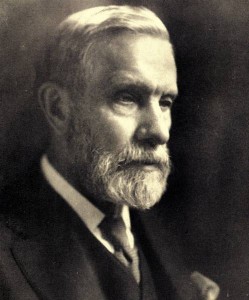
(Pictured: John Devoy)


Leave a comment

Birth of Brigadier General James Lawlor Kiernan

James Lawlor Kiernan, Irish-born Brigadier General in the American Civil War, is born in Mountbellew, County Galway, on October 26, 1837.

Kiernan’s father is a retired British navy surgeon. Kiernan attends Trinity College, Dublin, before emigrating to the United States around 1854. He studies medicine at New York University and practices law in New York until 1861. Upon the outbreak of American Civil War in 1861 he joins the 69th New York State Infantry Regiment as Assistant Surgeon and serves as such through the First Battle of Bull Run. When the 69th returns to Manhattan, he moves west and becomes the surgeon of the 6th Missouri Volunteer Infantry.

After the Battle of Pea Ridge, Kiernan insists on joining the fighting ranks, and in that capacity is seemingly appointed a Major in the 6th Missouri Volunteer Infantry. In May 1863 at Port Gibson, Mississippi, he is wounded in the left lung and left on the battlefield for dead. Recovered and imprisoned, he effects an escape back to Union forces and resigns his commission. On August 1, 1863, he is commissioned a Brigadier General of the United States Volunteers by President Abraham Lincoln, commanding a post at Miliken’s Bend on the Mississippi River. However, ill-health as a result of his battlefield wounds forces him to resign on February 3, 1864.

In May 1865 Kiernan gains a U.S. consular post at Chinkiang, China. He manages to make the trip there, but his health does not allow him to perform the duties. He returns to New York where he becomes an examining physician for the Bureau of Pensions, a position he holds until his death.

James Lawlor Kiernan dies on November 26, 1869. The official cause of death is “congestion of the lungs.” Perhaps he is killed by that Confederate ball that wounded him six years earlier. He is buried in Green-Wood Cemetery in Brooklyn, New York.


Leave a comment

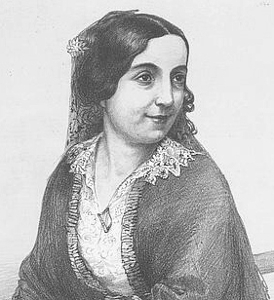
Birth of Soprano Catherine Hayes

Catherine Hayes, world-famous Irish soprano of the Victorian era, is born in Limerick, County Limerick, on October 25, 1818. According to London‘s Daily Express, “Hayes was the ‘Madonna‘ of her day; she was the 19th-century operatic equivalent of the world’s most famous pop star.”

Hayes is born into abject poverty. After five years of vocal study in Paris and Milan she makes her debut at the Italian Opera in Marseilles, in Vincenzo Bellini‘s I Puritani in May 1845, followed by performances of Gaetano Donizetti‘s Lucia di Lammermoor and Gioachino Rossini‘s Mosé in Egitto.

Her debut at La Scala in Milan quickly followed in 1845 with phenomenal success. Shortly thereafter the young Giuseppe Verdi becomes interested in her for one of his new operas. Her great success continues in Vienna, as well as in Venice, Florence, Genoa, Rome and other cities in Italy, where she becomes the most sought after Lucia di Lammermoor.

Early in 1849, Hayes accepts a contract to sing at the Royal Opera House, Covent Garden, London where she makes her debut in Linda di Chamounix in April. In June 1849, she receives an invitation to sing at Buckingham Palace for Queen Victoria and 500 guests. After an evening of Italian music, when the Queen requests an encore, Hayes with a smile sings the beautiful Irish rebel songKathleen Mavourneen.”

During Ireland’s Great Famine in November 1849, her emotional return to her native country results in rave notices for her performance in Lucia di Lammermoor and other operas and concerts in Dublin, Limerick and Cork. Her success is now almost complete.

In 1851 Hayes goes to the United States, where Jenny Lind is creating such a wave of success. Hayes gives concerts in New York City, Boston, Toronto, Philadelphia, Washington, D.C., Charleston, Savannah and New Orleans and forty-five other places including the river towns along the Mississippi River, with equal success. She meets presidents, statesmen and business leaders along the way. She is also destined to meet her future lover and husband in America, Jenny Lind’s former manager. Her travels take her to the “gold rush” in the San Francisco area in the 1850s, where her presence creates a furor, singing for the miners and the elite of San Francisco. The great showman P.T. Barnum sponsors her tour.

She sings in opera and concerts in Peru and Chile, then travels to Hawaii where she gives a concert before continuing on to Australia. Hayes is the first great European opera star to visit Australia. She is mentioned in most Australian history books about early culture in the young colony.  She also travels to Calcutta, India where she performs for the British Military and then on to Singapore and Batavia (Java) before returning to Australia for more opera and concerts.

Hayes returns to England in August 1856, after an absence of five years.  On October 8, 1857, at St. George’s, Hanover Square, she marries William Avery Bushnell. He soon falls into ill-health and dies at Biarritz, France, on July 2, 1858. After her husband’s death she takes part in concerts in London and the country towns.

Catherine Hayes dies in the house of a friend, Henry Lee, at Roccles, Upper Sydenham, Kent, on August 11, 1861, and is buried in Kensal Green Cemetery.


Leave a comment

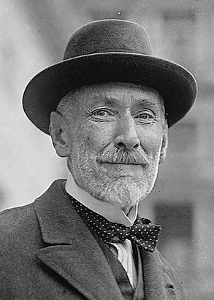
Birth of Sir Horace Curzon Plunkett

Sir Horace Curzon Plunkett, Anglo-Irish agricultural reformer, pioneer of agricultural cooperatives, Unionist Member of Parliament (MP), supporter of Home Rule, Irish Senator and author, is born on October 24, 1854.

Plunkett is the third son of Admiral the 16th Baron of Dunsany, of Dunsany Castle, Dunsany, near Dunshaughlin, County Meath, and the Honourable Anne Constance Dutton, daughter of John Dutton, 2nd Baron Sherborne. He is educated at Eton College and University College, Oxford, of which he becomes an honorary fellow in 1909.

Threatened by lung trouble in 1879, Plunkett goes to the United States and spends ten years as a cattle rancher in the Bighorn Mountains of Wyoming. He returns to Ireland in 1889 and devotes himself to the agricultural cooperative movement, first organizing creameries and then, in 1894, the Irish Agricultural Organisation Society, a forerunner of similar societies in England, Wales, and Scotland. A moderate Unionist member of Parliament for South County Dublin from 1892 to 1900, he becomes vice president (1899–1907) of the new Department of Agriculture and Technical Instruction for Ireland, which he has been instrumental in creating.

Plunkett’s later experience convinces him of the need for the independence of an Ireland without partition inside the Commonwealth, and he fights strongly for this goal, as chairman of the Irish Convention (1917–18) and, in 1919, as founder of the Irish Dominion League and of the Plunkett Foundation for Cooperative Studies, an agricultural research and information centre. He is appointed to the first Senate of the Irish Free State (1922–23). His house in Dublin is bombed and burned during in the Irish Civil War and he lives in England thereafter. In 1924 the Plunkett Foundation also moves to England. In 1924 he presides over a conference in London on agricultural co-operation in the British Commonwealth and in 1925 he visits South Africa to help the movement there.

Plunkett is made a Fellow of the Royal Society in 1902 and Knight Commander of the Royal Victorian Order in 1903. His writings include Ireland in the New Century (1904) and The Rural Life Problem of the United States (1910).

Sir Horace Plunkett dies at Weybridge, Surrey, England on March 26, 1932.


Leave a comment

Laying of the Cornerstone for the White House

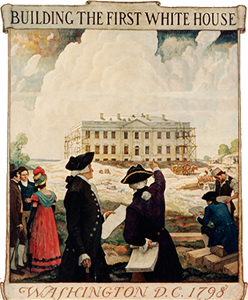
The cornerstone is laid for the White House in the newly designated capital city of Washington, D.C., on October 13, 1792. Earlier in the year, work begins on the neoclassical White House building at 1600 Pennsylvania Avenue under the guidance of Irish American architect James Hoban, whose design is influenced by Leinster House in Dublin and by a building sketch in James GibbsA Book of Architecture.

Hoban is an Irish Catholic raised on an estate belonging to the Earl of Desart in Cuffesgrange, near Callan, County Kilkenny. He works there as a wheelwright and carpenter until his early twenties, when he is given an “advanced student” place in the Dublin Society‘s Drawing School on Lower Grafton Street. He studies under Thomas Ivory. He excels in his studies and receives the prestigious Duke of Leinster‘s medal from the Dublin Society for drawings of “Brackets, Stairs, and Roofs” in 1780. Later, Hoban finds a position as an apprentice to Ivory, from 1779 to 1785.

Following the American Revolutionary War, Hoban emigrates to the United States, and establishes himself as an architect in Philadelphia, Pennsylvania in 1785.

Hoban is in South Carolina by April 1787, where he designs numerous buildings including the Charleston County Courthouse. President George Washington admires Hoban’s work on his Southern Tour and summons the architect to Philadelphia, the temporary national capital, in June 1792.

In July 1792, Hoban is named winner of the design competition for the White House. His initial design seems to have had a 3-story facade, nine bays across, much like the Charleston courthouse. Under Washington’s influence, Hoban amends this to a 2-story facade, eleven bays across, and, at Washington’s insistence, the whole presidential mansion is faced with stone. It is unclear whether any of Hoban’s surviving drawings are actually from the competition.

In 1800, President John Adams becomes the first president to reside in the executive mansion, which soon becomes known as the “White House” because its white-gray Virginia freestone contrasts strikingly with the red brick of nearby buildings.


Leave a comment

Release of U2’s “Rattle and Hum”

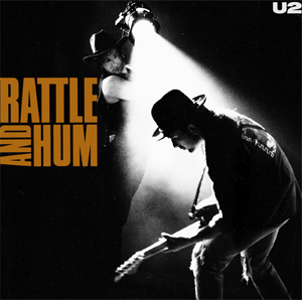
Rattle and Hum, the sixth studio album by Irish rock band U2, is released on October 10, 1988. The album is produced by Jimmy Iovine. A companion rockumentary film directed by Phil Joanou is released on October 27, 1988.

Following the breakthrough success of the band’s previous studio album, The Joshua Tree, the Rattle and Hum project captures their continued experiences with American roots music on The Joshua Tree Tour, further incorporating elements of blues rock, folk rock, and gospel music into their sound. A collection of new studio tracks, live performances, and cover songs, the project includes recordings at Sun Studio in Memphis, Tennessee and collaborations with Bob Dylan, B. B. King, and Harlem‘s New Voices of Freedom gospel choir.

Although Rattle and Hum is intended to represent the band paying tribute to rock legends, some critics accuse U2 of trying to place themselves amongst the ranks of these artists. Critical reception to both the album and the film is mixed. One Rolling Stone editor speaks of the album’s “excitement”, another describes it as “misguided and bombastic.” The film grosses just $8.6 million, but the album is a commercial success, reaching number one in several countries and selling 14 million copies. Lead single “Desire” becomes the band’s first U.K. number-one song while reaching number three in the United States.

At the end of 1988, Rattle and Hum is voted the 21st-best album of the year in the Pazz & Jop, an annual poll of American critics published by The Village Voice. In other critics’ lists of the year’s top albums, it is ranked number one by HUMO, second by the Los Angeles Times and Hot Press, 17th by OOR, 23rd by New Musical Express (NME), and 47th by Sounds.

Lifetime sales for the album have surpassed 14 million copies.


Leave a comment

Long Kesh Prison Hunger Strike Ends

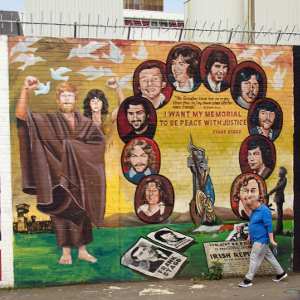
The Irish Republican Army (IRA) hunger strike is called off at Long Kesh prison – later known as HM Prison Maze – on October 3, 1981. While the IRA does not win immediate concessions, in some ways it is a Pyrrhic victory for Margaret Thatcher’s government. It galvanises support and membership for the IRA and generates huge sympathy for the strikers in the United States where fund-raising is a major priority. The death of the first hunger striker, Bobby Sands, creates a martyr and an iconic figure.

In January 1981, prison authorities begin to supply the prisoners with officially issued civilian clothing, whereas the prisoners demand the right to wear their own clothing. On February 4, the prisoners issue a statement saying that the British government has failed to resolve the crisis and declares their intention of a hunger strike. The hunger strike begins on March 1, when Bobby Sands, the IRA’s former officer commanding (OC) in the prison, refuses food. Unlike the first hunger strike the previous year, the prisoners join one at a time and at staggered intervals, which they believe would arouse maximum public support and exert maximum pressure on Prime Minister Margaret Thatcher.

The republican movement initially struggles to generate public support for the second hunger strike. The Sunday before Sands begins his strike, 3,500 people march through west Belfast. During the first hunger strike four months earlier, the marchers had numbered 10,000. Five days into the strike, Independent Republican MP for Fermanagh and South Tyrone Frank Maguire dies, resulting in a by-election. There is debate among nationalists and republicans regarding who should contest the election. After negotiations they agree not to split the nationalist vote by contesting the election and Sands stands as an Anti H-Block candidate against Ulster Unionist Party candidate Harry West. Following a high-profile campaign, the election takes place on April 9, and Sands is elected to the British House of Commons with 30,492 votes to West’s 29,046.

Sands’ election victory raises hopes that a settlement can be negotiated, but Thatcher stands firm in refusing to give concessions to the hunger strikers. The world’s media descends on Belfast, and several intermediaries visit Sands in an attempt to negotiate an end to the hunger strike, including Síle de Valera, granddaughter of Éamon de Valera, Pope John Paul II‘s personal envoy John Magee, and European Commission of Human Rights officials. With Sands close to death, the government’s position remains unchanged.

On 5 May, Sands dies in the prison hospital on the 66th day of his hunger strike, prompting rioting in nationalist areas of Northern Ireland. More than 100,000 people line the route of his funeral, which is conducted with full IRA military honours. Margaret Thatcher shows no sympathy for his death.

In the two weeks following Sands’ death, hunger strikers Francis Hughes, Raymond McCreesh and Patsy O’Hara die. Following the deaths of Joe McDonnell and Martin Hurson, the families of some of the hunger strikers attend a meeting on July 28 with Catholic priest Father Denis Faul. The families express concern at the lack of a settlement to the priest, and a decision is made to meet with Gerry Adams later that day. The following day Adams holds a meeting with six of the hunger strikers to outline a proposed settlement on offer from the British government should the strike be brought to an end. The six men reject the settlement, believing that accepting anything less than the “Five Demands” would be a betrayal of the sacrifice made by Bobby Sands and the other hunger strikers who had died.

The hunger strike begins to break on July 31, when the mother of Paddy Quinn insists on medical intervention to save his life. The following day Kevin Lynch dies, followed by Kieran Doherty on August 2, Thomas McElwee on August 8 and Michael Devine on August 20. On September 6, the family of Laurence McKeown becomes the fourth family to intervene and asks for medical treatment to save his life, and Cahal Daly issues a statement calling on republican prisoners to end the hunger strike.

The strike is called off at 3:15 PM on October 3, 1981. Three days later, James Prior, the new Secretary of State for Northern Ireland, announces partial concessions to the prisoners including the right to wear their own clothes at all times. The only one of the “Five Demands” still outstanding is the right not to do prison work. Following sabotage by the prisoners and the Maze Prison escape in 1983, the prison workshops are closed, effectively granting all of the “Five Demands” but without any formal recognition of political status from the government.

(Pictured: A Belfast mural of the Long Kesh hunger strikers)


2 Comments

Unveiling of the Charles Stewart Parnell Statue in Dublin

The statue of Charles Stewart Parnell on Sackville Street, now known as O’Connell Street, is unveiled in Dublin on October 1, 1911. It is one of the last sculptural initiatives in the city before independence.

On January 3, 1882 a resolution is passed by the Dublin City Council to grant the freedom of the city to Parnell. The plan for the Parnell monument is instigated by John Redmond, who succeeded Parnell as leader of the Irish Parliamentary Party, partly as a symbolic gesture to honour the “uncrowned king of Ireland” and to consolidate his aspiration to reunite the constitutionalists under his own leadership. The monument is funded through the efforts of a voluntary body, the Parnell Committee, founded in 1898. It is first proposed to place the monument on the site of the Thomas Moore statue, which would be moved to another location. The City Council refuses to grant this site and directs that the monument be erected on a site near the Rotunda Hospital, where it now stands.

Augustus Saint-Gaudens, an Irish-born sculptor and the most eminent in the art of public monuments in the United States, accepts the commission. It is however to prove a protracted project as the demand for Saint-Gaudens’ work in America is such that completion of the Parnell project is fraught with delays.

For the Parnell monument, Saint-Gaudens makes a scale replica of the buildings and square in Dublin and also a full scale model of the monument in wood in a field near his studio. In 1904 there is a disastrous fire in his studio and only the head of the statue is saved. The original concept is of an 8-foot high bronze figure placed by a bronze table and set against a 30-foot pyramid. However, as this form is already utilised in the Wellington Monument obelisk in Phoenix Park, Saint-Gaudens and architect Henry Bacon propose a triangular shaft almost double the height of the original.

Saint-Gaudens finally presents Parnell in what he considers a noble and calm manner, depicted in an open frock coat, with one hand resting on a table and the other extended dramatically as if making a point at a parliamentary debate. The shaft of the monument is constructed in undecorated ashlar granite.

On October 1, 1911, the monument is unveiled to a large crowd, many of whom had been absent from the foundation stone ceremony, but there are also strikes and marches indicating the unrest to follow.

In June 1913, John Redmond, as Secretary to the Parnell Monument Committee, writes to the City Council requesting the council to take the Monument into their charge on behalf of the Citizens of Dublin. The Council agrees to this request and ever since then the Parnell Monument has been in the care of the Dublin Corporation.

The inscription on the monument reads:

To Charles Stewart Parnell

No Man has a right to fix the
Boundary to the march of a nation
No man has a right
To say to his country
Thus far shat thou
Go and no further
We have never
Attempted to fix
The ne-plus-ultra
To the progress of
Ireland’s nationhood
And we never shall

At the base of the statue the Irish inscription reads:

Go roimhigid Dia Éire da Clainn