seamus dubhghaill

Promoting Irish Culture and History from Little Rock, Arkansas, USA


Leave a comment

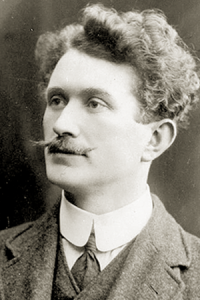
Death of Hunger Striker Thomas Patrick Ashe

Thomas Patrick Ashe, a member of the Gaelic League, the Irish Republican Brotherhood (IRB), and a founding member of the Irish Volunteers, dies on September 25, 1917, at Mater Misericordiae Hospital in Dublin following a hunger strike.

Ashe is born in Lispole, County Kerry, on January 12, 1885. He enters De La Salle Training College, Waterford in 1905 and begins a teaching career as principal of Corduff National School, Lusk, County Dublin, in 1908.

Ashe plays a major part in the 1916 Easter Rising outside the capital city commanding the Fingal battalion of the Irish Volunteers. He is commandant of the 5th battalion of the Dublin brigade, a force of 60–70 men engaging British forces around north County Dublin during the rising. They are armed only with a few rounds, about a dozen service rifles, a dozen Mausers, and a dozen Martini carbines. Some of Ashe’s men are armed only with a shotgun against the well-equipped army regulars.

Ashe’s battalion wins a major victory in Ashbourne, County Meath, where they engage a much larger force. They capture a significant quantity of arms and up to twenty Royal Irish Constabulary (RIC) vehicles. Eleven RIC members, including County Inspector Alexander Gray, and two volunteers are killed during the 5-1/2-hour battle. Twenty-four hours after the rising collapses, Ashe’s battalion surrenders on the orders of Patrick Pearse. On May 8, 1916, Ashe and Éamon de Valera are court-martialled and sentenced to death. The sentences are commuted to penal servitude for life. Ashe is imprisoned in Frongoch internment camp and Lewes Prison in Lewes, East Sussex, England.

De Valera, Ashe, and Thomas Hunter lead a prisoner hunger strike on May 28, 1917. With accounts of prison mistreatment appearing in the Irish press and mounting protests in Ireland, Ashe and the remaining prisoners are freed on June 18, 1917, by David Lloyd George as part of a general amnesty.

Upon his release, Ashe returns to Ireland and begins a series of speaking engagements. In August 1917, he is arrested and charged with sedition for a speech that he makes in Ballinalee, County Longford, where Michael Collins is also speaking. He is detained at the Curragh but is then transferred to Mountjoy Prison in Dublin. He is convicted and sentenced to two years hard labour. Ashe and other prisoners, including Fionán Lynch and Austin Stack, demand prisoner of war status.

On September 20, 1917, Ashe again goes on hunger strike. He dies at Mater Misericordiae Hospital on September 25, 1917, after being force fed by prison authorities. At the inquest into his death, the jury condemns the staff at the prison for the “inhuman and dangerous operation performed on the prisoner, and other acts of unfeeling and barbaric conduct.” His body lies in state at Dublin City Hall and is buried in Glasnevin Cemetery in Dublin.

The Ashe Memorial Hall built in 1928, housing the Kerry County Museum, in Tralee is named after him while Nelson Street, also in Tralee, is renamed Ashe Street. Ashe is a relative of Catherine Ashe, the paternal grandmother of American actor Gregory Peck, who emigrates to the United States in the 19th century.

Leave a comment

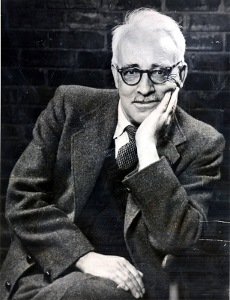
Birth of Irish Writer Frank O’Connor

Frank O’Connor, Irish writer of over 150 works and best known for his short stories and memoirs, is born Michael Francis O’Donovan in Cork, County Cork, on September 17, 1903. The Frank O’Connor International Short Story Award is named in his honour.

Raised in Cork, the only child of Minnie (née O’Connor) and Michael O’Donovan, O’Connor attends Saint Patrick’s School on Gardiner’s Hill and North Monastery CBS. His early life is marked by his father’s alcoholism, debt, and ill-treatment of his mother. His childhood is shaped in part by his mother, who supplies much of the family’s income by cleaning houses, because his father is unable to keep steady employment due to his drunkenness. He adores his mother and is bitterly resentful of his father. In his memoirs, he recalls his childhood as “those terrible years,” and admits that he has never been able to forgive his father for his abuse of himself and his mother. When his mother is seventy, O’Connor is horrified to learn from his own doctor that she has suffered for years from chronic appendicitis, which she has endured with great stoicism, as she has never had the time nor the money to see a doctor.

In 1918 O’Connor joins the First Brigade of the Irish Republican Army and serves in combat during the Irish War of Independence. He opposes the Anglo-Irish Treaty of 1921 and joins the Anti-Treaty IRA during the Irish Civil War, working in a small propaganda unit in Cork City. He is one of twelve thousand Anti-Treaty combatants who are interned by the government of the new Irish Free State. Between 1922 and 1923 he is imprisoned in Cork City Gaol and in Gormanston, County Meath.

Following his release, O’Connor takes various positions including that of teacher of Irish, theatre director, and librarian. He begins to move in literary circles and is befriended by George William Russell (Æ), through whom he comes to know most of the well-known Irish writers of the day, including William Butler Yeats, Lennox Robinson, F. R. Higgins and Lady Gregory. In his memoirs, he pays tribute to both Yeats and Russell for the help and encouragement they gave him.

In 1935, O’Connor becomes a member of the board of directors of the Abbey Theatre in Dublin, founded by Yeats and other members of the Irish National Theatre Society. In 1937, he becomes managing director of the Abbey. Following Yeats’s death in 1939, O’Connor’s long-standing conflict with other board members comes to a head and he leaves the Abbey later that year. In 1950, he accepts invitations to teach in the United States, where many of his short stories have been published in The New Yorker and have won great acclaim. He spends much of the 1950s in the United States, although it is always his intention to return eventually to Ireland.

From the 1930s to the 1960s O’Connor is a prolific writer of short stories, poems, plays, and novellas. His work as an Irish teacher complements his plethora of translations into English of Irish poetry, including his initially banned translation of Brian Merriman‘s Cúirt an Mheán Oíche (The Midnight Court). Many of O’Connor’s writings are based on his own life experiences – notably his well-known The Man of the House in which he reveals childhood details concerning his early life in County Cork. The Sullivan family in this short story, like his own boyhood family, is lacking a proper father figure.

O’Connor’s early years are recounted in An Only Child, a memoir published in 1961 which has the immediacy of a precocious diary. He continues his autobiography through his time with the Abbey Theatre in Dublin in his book My Father’s Son, which is published posthumously in 1968. It contains valuable character sketches of many of the leading Irish literary figures of the 1930s, in particular Yeats and Æ.

Frank O’Connor has a stroke while teaching at Stanford University in 1961, and he later dies from a heart attack in Dublin on March 10, 1966. He is buried in Deans Grange Cemetery two days later.


Leave a comment

Death of John McElroy, Founder of Boston College

Death of Jesuit John McElroy, the founder of Boston College, at age of 95 in Frederick, Maryland, on September 12, 1877.

McElroy is born on May 14, 1782, in Enniskillen, County Fermanagh, the younger of two sons. In the hopes of providing a better life for John and his brother Anthony, their father, a farmer, finances their travel to the United States. In 1803 the two young men board a ship leaving the port of Londonderry and arrive in Baltimore, Maryland, on August 26. McElroy eventually settles in Georgetown, Washington, D.C., and becomes a merchant.

In 1806, McElroy enters Georgetown College in Washington, D.C., the same year he enters the novitiate of the Society of Jesus as a lay brother. He eventually manages the finances of Georgetown College and in 1808 erects the tower building. He managed the school’s finances so well that through the period of economic hardship following the War of 1812, he is able to send several Jesuits to Rome to study.

McElroy is ordained in May 1817, after less than two years of preparation. As a new priest, he is assigned to Holy Trinity Catholic Church in Georgetown as an assistant pastor. In his short time at Trinity, he contributes to the growth of the congregation and enlarging of the church building. This is achieved by increasing the monthly subscription for congregation members from 12½ cents to $12.50 on July 3, 1819. The following day he travels to most of the congregation members’ homes and collects $2,000 in pledges. He immediately sets to work having the Church modified to include two lateral-wing chapels, which are first used on October 3, 1819.

On January 11, 1819, McElroy is granted United States citizenship. Also in 1819, McElroy starts a Sunday School for black children who are taught prayers and catechism simultaneously with spelling and reading, by volunteer members of the congregation. McElroy spends his remaining years in Georgetown teaching the lower grades.

In 1823, McElroy begins negotiations with the Sisters of Charity in Emmitsburg, Maryland, for the establishment of a school for girls in Frederick. In 1824, the St. John’s Benevolent Female Free School is founded by the Sisters of Charity of Saint Joseph at 200 East Second Street in Frederick. In 1825, McElroy sets to work replacing the pre-American Revolution log cabin that houses the school with a modern building large enough to also house an orphanage.

McElroy’s next task is to found an educational institution for boys. On August 7, 1828, the construction of St. John’s Literary Institute begins. The following year the construction is completed, and the school is opened, a school which is currently operating under the name of Saint John’s Catholic Prep.

In October 1847, McElroy is welcomed in Boston, Massachusetts, by the Bishop of Boston, John Bernard Fitzpatrick, to serve as pastor of St. Mary’s parish in the North End. Bishop Fitzpatrick sets McElroy to work on bringing a college to Boston.

In 1853, McElroy finds a property in the South End where the city jail once stood. After two years of negotiations the project falls through due to zoning issues. A new site is identified, and city officials endorse the sale. In 1858, Bishop Fitzpatrick and Father McElroy break ground for Boston College, and for the Church of the Immaculate Conception. Classes began in the fall of 1864 and continue at this location until 1913 when the college moves to its current location at Chestnut Hill. Initially Boston College offers a 7-year program including both high school and college. This joint program continues until 1927 when the high school is separately incorporated.

In 1868, McElroy retires to the Jesuit novitiate in Frederick, Maryland. He visits Georgetown for the final time in 1872 to celebrate his golden jubilee. His eyesight is failing and while moving through his home he falls, fracturing his femur, which eventually leads to his death. Father John McElroy dies September 12, 1877, at the Jesuit novitiate in Frederick, Maryland. For some years leading up to his death, he is regarded as the oldest priest in the United States and the oldest Jesuit in the world. He is buried in the Novitiate Cemetery. In 1903, the Jesuits withdraw from Frederick and the graves are moved from the Frederick Jesuit Novitiate Cemetery to St. John’s Cemetery.


Leave a comment

Birth of John Ireland, First Archbishop of St. Paul

John Ireland, the third Roman Catholic bishop and first Roman Catholic archbishop of Saint Paul, Minnesota, is born in Burnchurch, County Kilkenny, on September 11, 1838. He becomes both a religious as well as civic leader in Saint Paul during the turn of the 20th century.

Ireland is known for his progressive stance on education, immigration and relations between church and state, as well as his opposition to saloons and political corruption. He promotes the Americanization of Catholicism, especially in the furtherance of progressive social ideals. He is a leader of the modernizing element in the Roman Catholic Church during the Progressive Era. He creates or helps to create many religious and educational institutions in Minnesota. He is also remembered for his acrimonious relations with Eastern Catholics.

Ireland’s family immigrates to the United States in 1848 and eventually moves to Saint Paul, Minnesota, in 1852. One year later Joseph Crétin, first bishop of Saint Paul, sends Ireland to the preparatory seminary of Meximieux in France. Ireland is consequently ordained in 1861 in Saint Paul. He serves as a chaplain of the Fifth Minnesota Volunteer Infantry Regiment in the American Civil War until 1863 when ill health leads to his resignation. Later, he is famous nationwide in the Grand Army of the Republic.

Ireland is appointed pastor at Saint Paul’s cathedral in 1867, a position which he holds until 1875. In 1875, he is made coadjutor bishop of St. Paul and in 1884 he becomes bishop ordinary. In 1888 he becomes archbishop with the elevation of his diocese and the erection of the ecclesiastical province of Saint Paul. Ireland retains this title for thirty years until his death in 1918. Before Ireland dies, he burns all of his personal papers.

Ireland is awarded an honorary doctorate (LL.D.) by Yale University in October 1901, during celebrations for the bicentenary of the university.

Ireland is personal friends with Presidents William McKinley and Theodore Roosevelt. At a time when most Irish Catholics are staunch Democrats, Ireland is known for being close to the Republican party. He opposes racial inequality and calls for “equal rights and equal privileges, political, civil, and social.” Ireland’s funeral is attended by eight archbishops, thirty bishops, twelve monsignors, seven hundred priests and two hundred seminarians.

A friend of James J. Hill, Archbishop Ireland has his portrait painted in 1895 by the Swiss-born American portrait painter Adolfo Müller-Ury almost certainly on Hill’s behalf, which is exhibited at M. Knoedler & Co., New York, January 1895 and again in 1897.


Leave a comment

Birth of Fanny Parnell, Poet & Nationalist

Fanny Parnell, Irish poet and Nationalist, is born Frances Isabelle Parnell in Avondale, County Wicklow on September 4, 1848. She is the sister of Charles Stewart Parnell, an important figure in nineteenth century Ireland.

Parnell is the eighth child out of eleven and fourth daughter born to John Henry Parnell, a landowner and the grandson of the last Chancellor of the Exchequer of Ireland, and Delia Tudor Stewart Parnell, an Irish American and the daughter of Admiral Charles Stewart (1778–1869) of the United States Navy. Her mother hates British rule in Ireland, a view presented through her children’s works. She is an intelligent girl and before she is through her teen years, she has studied mathematics, chemistry, and astronomy, and she can speak and write fluently in almost all the major European languages. She also has talents in music and painting and drawing in oil and water colours. Her parents separate when she is young. Soon afterwards, in July 1859, her father dies at the age of forty-eight and she and her mother move to Dalkey. A year later they move to Dublin, and in 1865 they move to Paris where Fanny studies art and writes poetry. In 1874 they move to Bordentown, New Jersey in the United States.

Parnell is known as the Patriot Poet. She shows interest in Irish politics and much of her poetry is about Irish nationalism. While she is living in Dublin in 1864, she begins publishing her poetry under the pseudonym “Aleria” in The Irish People, the newspaper of the Fenian Brotherhood. Most of her later work is published in The Pilot in Boston, the best-known Irish newspaper in America during the nineteenth century. Two of her most widely published works are The Hovels of Ireland, a pamphlet, and Land League Songs, a collection of poems. Her best-known poem is “Hold the Harvest,” which Michael Davitt refers to as the “Marseillaise of the Irish peasant.”

Parnell’s brother, Charles, becomes active in the Irish National Land League, an organisation that fights for poor tenant farmers, in 1879 and she strongly supports him. She and her younger sister, Anna Parnell (1852–1911), co-found the Ladies’ Land League in 1880 to raise money in America for the Land League. In 1881 the Ladies’ Land League continues the work of the men in the Land League while they are being imprisoned by the British government. In Ireland Anna becomes the president of the Ladies’ Land League, and the women hold many protests and quickly become more radical than the men, to the resentment of the male leaders. Fanny stays in America and works to raise money for the organisation. Most of the Land League’s financial support comes from America because of the campaigning done by Fanny Parnell.

Fanny Parnell dies on July 20, 1882, at the young age of 33, of a heart attack at the family mansion in Bordentown, New Jersey. She is buried at the Tudor family plot at Mount Auburn Cemetery in Cambridge, Massachusetts.


Leave a comment

Death of Poet Seamus Heaney, Nobel Prize Recipient

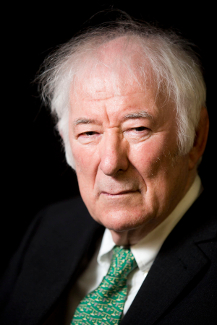
Seamus Justin Heaney, Irish poet, playwright, translator and lecturer, dies in Dublin on August 30, 2013. He is the 1995 recipient of the Nobel Prize in Literature.

Heaney is born near Castledawson, County Londonderry, in Northern Ireland. The family moves to nearby Bellaghy when he is a boy. After attending Queen’s University Belfast, Heaney becomes a lecturer at St. Joseph’s College in Belfast in the early 1960s and begins to publish poetry. He lives in Sandymount, Dublin from 1976 until his death. He also lives part-time in the United States from 1981 to 2006. Heaney is recognised as one of the principal contributors to poetry during his lifetime.

Heaney is a professor at Harvard University from 1981 to 1997, and its Poet in Residence from 1988 to 2006. From 1989 to 1994, he is also the Professor of Poetry at the University of Oxford. In 1996, he is made a Commandeur de l’Ordre des Arts et des Lettres. Other awards that he receives include the Geoffrey Faber Memorial Prize (1968), the E. M. Forster Award (1975), the PEN Translation Prize (1985), the Golden Wreath of Poetry (2001), the T. S. Eliot Prize (2006) and two Whitbread Book Awards (1996 and 1999). In 2011, he is awarded the Griffin Poetry Prize and, in 2012, a Lifetime Recognition Award from the Griffin Trust for Excellence in Poetry. His literary papers are held by the National Library of Ireland.

American poet Robert Lowell describes Heaney as “the most important Irish poet since Yeats,” and many others, including the academic John Sutherland, have said that he is “the greatest poet of our age.” Robert Pinsky has stated that “with his wonderful gift of eye and ear Heaney has the gift of the storyteller.” Upon his death in 2013, The Independent describes him as “probably the best-known poet in the world.” One of his best-known works is Death of a Naturalist, published in 1966.

Seamus Heaney dies in the Blackrock Clinic in Dublin on August 30, 2013, aged 74, following a short illness. After a fall outside a restaurant in Dublin, he enters the hospital for a medical procedure, but dies at 7:30 the following morning before it takes place. His funeral is held in Donnybrook, Dublin, on the morning of September 2, 2013, and he is buried in the evening in the Cemetery of St. Mary’s Church, Bellaghy, County Londonderry, Northern Ireland, in the same graveyard as his parents, young brother, and other family members. His son Michael reveals at the funeral mass that his father texted his final words, “Noli timere” (Latin: “Do not be afraid”), to his wife, Marie, minutes before he died. Shortly after Heaney’s death, graffiti artist Maser paints a mural in Dublin referencing this message.

On September 1, the day after his death, a crowd of 81,553 spectators applaud Heaney for three minutes at a semi-final match of the 2013 All-Ireland Senior Football Championship. His funeral is broadcast live the following day on RTÉ television and radio and is streamed internationally at RTÉ’s website. RTÉ Radio 1 Extra transmits a continuous broadcast, from 8:00 AM until 9:15 PM on the day of the funeral, of his Collected Poems album, recorded in 2009. His poetry collections sell out rapidly in Irish bookshops immediately following his death.


Leave a comment

Death of Samuel Nielson, Society of United Irishmen Founder Member

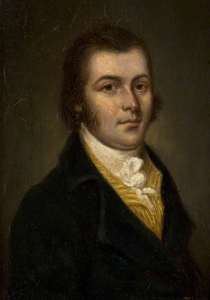
Samuel Neilson, one of the founder members of the Society of United Irishmen and the founder of its newspaper the Northern Star, dies in Poughkeepsie, New York on August 29, 1803.

Neilson is born in Ballyroney, County Down, the son of Presbyterian minister Alexander, and Agnes Neilson. He is educated locally. He is the second son in a family of eight sons and five daughters. At the age of 16, he is apprenticed to his elder brother, John, in the business of woolen drapery in Belfast. Eight years later he establishes his own business.

Despite his commercial success, Neilson is naturally drawn to politics and is early on a member of the reformist Irish Volunteers movement. In 1791, inspired by the French Revolution, he suggests to Henry Joy McCracken the idea of a political society of Irishmen of every religious persuasion. He establishes the Society of United Irishmen in Belfast. The following year he launches the newspaper of the United Irishmen, the Northern Star, which effectively throws away his fortune. As its editor he is a high-profile target for the authorities and is prosecuted for libel several times, being twice imprisoned between 1796 and 1798.

Along with several other state prisoners, Neilson is released in February 1798 following several petitions by influential friends, on grounds of bad health. Upon release he immediately involves himself in the United Irishmen aligning with the radicals among the leadership who are pressing for immediate rebellion and oppose the moderates who wish to wait for French assistance before acting.

The United Irishmen are however, severely penetrated by informants who keep Dublin Castle abreast of their plans and discussions. In March 1798, information of a meeting of the United Irish executive at the house of Oliver Bond leads to the arrest of most of the leadership, leaving Neilson and Lord Edward FitzGerald as the only figures of national importance still at liberty. They decide to press ahead as soon as possible and settled on May 23 as the date for the rebellion to begin.

As the date looms closer, the authorities go into overdrive to sweep up the rump leadership and on May 18 Lord Edward is betrayed in his hiding place and critically wounded while resisting capture. Neilson, now with responsibility for finalising plans for the looming rebellion, decides that Fitzgerald is too valuable to do without, and decides to try and rescue him from Newgate Prison in Dublin. Wary of confiding his plans too early for fear of betrayal, Neilson goes on a reconnaissance of the prison but is spotted by chance by one of his former jailers and after a fierce struggle, he is overpowered and dragged into the prison.

Neilson is indicted for high treason and held in Kilmainham Gaol with other state prisoners for the duration of the doomed rebellion outside. After the execution of Oliver Bond, and the brothers John and Henry Sheares, Neilson and the remaining prisoners agree to provide the authorities with details of the organisation of the United Irishmen, plans for the rebellion, etc. in return for exile.

Following the suppression of the rebellion, Neilson is transferred to Fort George in Inverness-shire, Scotland, and in 1802 he is deported to the Netherlands. From there he makes his way to the United States, arriving in December 1802, and settling in Poughkeepsie, New York.  He has little time to enjoy his liberty before his sudden death on August 29, 1803, of yellow fever, or possibly a stroke.

Nielson is not idle during his short life in America as he completes plans to start a new evening newspaper in Poughkeepsie and also has plans in the works to establish a version of the Society of United Irishmen in the United States. Since his death, his remains have been moved to three different cemeteries before coming to rest in the Poughkeepsie Rural Cemetery in 1880.

(Photograph: (c) National Museums Northern Ireland; Supplied by The Public Catalogue Foundation)


Leave a comment

Death of Frank Harris, Novelist & Journalist

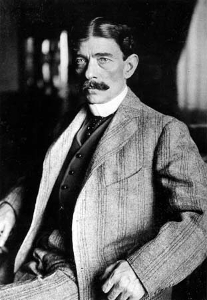
Frank Harris, British editor, novelist, short story writer, journalist and publisher, dies on August 26, 1931. He is friendly with many well-known figures of his day.

Harris is born James Thomas Harris on February 14, 1855, in Galway, County Galway, to Welsh parents. While living with his older brother he is, for a year or more, a pupil at The Royal School, Armagh. At the age of twelve he is sent to Wales to continue his education as a boarder at the Ruabon Grammar School in Denbighshire, a time he is to remember later in My Life and Loves. Harris is unhappy at the school and runs away within a year.

Harris runs away to the United States in late 1869, arriving in New York City virtually penniless. The 13-year-old takes a series of odd jobs to support himself, working first as a shoeshiner, a porter, a general laborer, and a construction worker on the erection of the Brooklyn Bridge. He later turns these early occupational experiences into art, incorporating tales from them into his book The Bomb.

From New York Harris moves to the American Midwest, settling in Chicago, where he takes a job as a hotel clerk and eventually a manager. Owing to Chicago’s central place in the meat packing industry, Harris makes the acquaintance of various cattlemen, who inspire him to leave the big city to take up work as a cowboy. He eventually grows tired of life in the cattle industry and enrolls at the University of Kansas, where he studies law and earns a degree, gaining admission to the Kansas state bar association.

Harris is not cut out to be a lawyer and soon decides to turn his attention to literature. He returns to England in 1882, later traveling to various cities in Germany, Austria, France, and Greece on his literary quest. He works briefly as an American newspaper correspondent before settling down in England to seriously pursue the vocation of journalism.

Harris first comes to general notice as the editor of a series of London papers including The Evening News, The Fortnightly Review and the Saturday Review, the last-named being the high point of his journalistic career, with H. G. Wells and George Bernard Shaw as regular contributors.

From 1908 to 1914 Harris concentrates on working as a novelist, authoring a series of popular books such as The Bomb, The Man Shakespeare, and The Yellow Ticket and Other Stories. With the advent of World War I in the summer of 1914, Harris decides to return to the United States.

From 1916 to 1922 he edits the U.S. edition of Pearson’s Magazine, a popular monthly which combines short story fiction with socialist-tinted features on contemporary news topics. One issue of the publication is banned from the mails by United States Postmaster General Albert S. Burleson during the period of American participation in the Great War. Despite this Harris manages to navigate the delicate situation which faces the left wing press and to keep the Pearson’s Magazine functioning and solvent during the war years.

Harris becomes an American citizen in April 1921. In 1922 he travels to Berlin to publish his best-known work, his autobiography My Life and Loves. It is notorious for its graphic descriptions of Harris’ purported sexual encounters and for its exaggeration of the scope of his adventures and his role in history. Years later, Time Magazine reflects in its March 21, 1960 issue “Had he not been a thundering liar, Frank Harris would have been a great autobiographer….he had the crippling disqualification that he told the truth, as Max Beerbohm remarked, only ‘when his invention flagged’.” A fifth volume, supposedly taken from his notes but of doubtful provenance, is published in 1954, long after his death.

Harris also writes short stories and novels, two books on Shakespeare, a series of biographical sketches in five volumes under the title Contemporary Portraits and biographies of his friends Oscar Wilde and George Bernard Shaw. His attempts at playwriting are less successful. Only Mr. and Mrs. Daventry (1900), which is based on an idea by Oscar Wilde, is produced on the stage.

Married three times, Harris dies of a heart attack in Nice at the age of 75 on August 26, 1931. He is subsequently buried at Cimetière Caucade in the same city. Just after his death a biography written by Hugh Kingsmill (pseudonym of Hugh Kingsmill Lunn) is published.


Leave a comment

Birth of Eugene O’Growney, Priest & Scholar

Eugene O’Growney, Irish priest and scholar, and a key figure in the Gaelic revival of the late 19th century, is born on August 25, 1863 at Ballyfallon, Athboy, County Meath.

The Irish language has largely retreated from Meath when O’Growney is born, and neither of his parents speak it. He becomes interested in the language when he chances upon the Irish lessons in the nationalist newspaper Young Ireland. He has help at first from a few old people who speak the language, and while at St. Patrick’s Pontifical University, Maynooth, where he continues his studies for the priesthood from the year 1882, he spends his holidays in Irish-speaking areas in the north, west and south. He gets to know the Aran Islands and writes about them in the bilingual Gaelic Journal (Irisleabhar na Gaedhilge), which he is later to edit. He is ordained in 1888. His proficiency in the language leads him to be appointed in the re-established Chair of Irish at Maynooth in 1891. He is editor of the Gaelic Journal between 1894 and 1899 and during his tenure ensures that more material is published in Irish.

For O’Growney language, nationality and religion are closely linked. In 1890, writing in the Irish Ecclesiastical Review, he describes literature in Irish as “the most Catholic literature in the world.” He is aware, however, of its other aspects, adding that “even if Irish were to perish as a spoken language, it would remain valuable from the pure literature point of view.”

His Simple Lessons in Irish, first published in the newspaper The Weekly Freeman, proves so popular that they are published in booklet form. There are five books in the series and 320,000 copies have been sold by 1903. In a foreword he states:

“The following course of simple lessons in Irish has been drawn up chiefly for the use of those who wish to learn the old language of Ireland, but who are discouraged by what they have heard of its difficulties… But the difficulties of Irish pronunciation and construction have always been exaggerated. A I myself was obliged to study Irish as a foreign language, and as I have been placed in circumstances which have made me rather familiar with the language as now spoken, I have at least a knowledge of the difficulties of those who, like myself, have no teacher.”

O’Growney is a founding member of the Gaelic League, which is created in Dublin in 1893 “for the purpose of keeping the Irish language spoken in Ireland,” and later becomes its vice-president.

In 1894, failing health causes him to go to Arizona and California, where he dies in Los Angeles on October 18, 1899. Some years later, with the aid of Irish sympathisers in the United States, his body is returned to Ireland. His funeral, held on September 26, 1903 at the St. Mary’s Pro-Cathedral, Dublin, is attended by 6,000 people, including members of the trade guilds, clerics, politicians, members of the nationalist Gaelic Athletic Association and students. He is buried at Maynooth.

(Pictured: Statue of Fr. Eugene O’Growney on the grounds of St. James’ Church in Athboy, courtesy of http://www.athboyparish.ie)


1 Comment

Death of James Napper Tandy, Irish Revolutionary

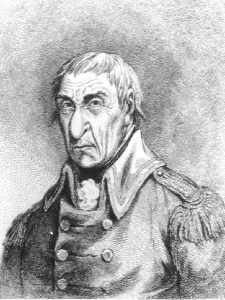
James Napper Tandy, Irish revolutionary and member of the Society of United Irishmen, dies in Bordeaux, France on August 24, 1803.

A Dublin Protestant and the son of an ironmonger, Tandy is baptised in St. Audoen’s Church on February 16, 1739. He attends the Quaker boarding school in Ballitore, County Kildare. He starts life as a small tradesman. Turning to politics, he becomes a member of Dublin Corporation and is popular for his denunciation of municipal corruption and his proposal of a boycott of English goods in Ireland in retaliation for the restrictions imposed by the government on Irish commerce.

Tandy and John Binns persuade Dublin Corporation to condemn by resolution William Pitt the Younger‘s amended commercial resolutions in 1785. He becomes a member of the Whig club founded by Henry Grattan, and he actively co-operates with Theobald Wolfe Tone in founding the Society of United Irishmen in 1791, of which he becomes the first secretary.

Sympathy with the French Revolution is rapidly spreading in Ireland. A meeting of some 6,000 people in Belfast votes a congratulatory address to the French nation in July 1791. In the following year, Tandy takes a leading part in organising a new military association in Ireland modelled after the French National Guard. Tandy also, with the purpose of bringing about a fusion between the Defenders and the United Irishmen, took the oath of the Defenders, a Roman Catholic society whose agrarian and political violence had been increasing for several years.

Tandy is about to be tried in 1793 for distributing a seditious pamphlet in County Louth when the government discovers he has taken the oath of the Defenders. Being threatened with prosecution for this step, and also for libel, he takes refuge by changing his Dublin address often until he flees to the United States in 1795, where he remains until 1798. In February 1798 he goes to Paris, where a number of Irish refugees are assembled and planning rebellion in Ireland to be supported by a French invasion but quarrelling among themselves over tactics.

Tandy accepts the offer of a corvette, the HMS Anacreon, from the French government and sails from Dunkirk accompanied by a few United Irishmen, a small force of men and a considerable quantity of arms and ammunition for distribution in Ireland. He arrives at the isle of Arranmore, off the coast of County Donegal, on September 16, 1798.

Tandy takes possession of the village of Rutland, where he hoists an Irish flag and issues a proclamation. He soon discovers that the French expedition of General Jean Joseph Amable Humbert to aid the Irish rebellion has failed. He sails his vessel around the north of Scotland to avoid the British fleet. He reaches Bergen in safety having brought with him a British ship captured along the way. Tandy then made his way with three or four companions to the free port of Hamburg but a peremptory demand from the British government to detain the fugitives was acceded to despite a counter-threat from the French Directory. In 1799 HMS Xenophon, under Commander George Sayer, brings Tandy and some of his associates back to England as state prisoners.

On February 12, 1800, Tandy is put on trial at Dublin and is acquitted. He remains in prison in Lifford Gaol in County Donegal until April 1801, when he is tried for the treasonable landing on Rutland Island. He pleads guilty and is sentenced to death although he is reprieved and allowed to go to France.

In France, where his release is regarded as a French diplomatic victory, he is received, in March 1802, as a person of distinction. When he dies on August 24, 1803, in Bordeaux, his funeral is attended by the military and an immense number of civilians. James Napper Tandy is buried in his family’s burial crypt, St. Mary’s churchyard, Julianstown, County Meath. His fame is perpetuated in the Irish ballad The Wearing of the Green.