seamus dubhghaill

Promoting Irish Culture and History from Little Rock, Arkansas, USA


Leave a comment

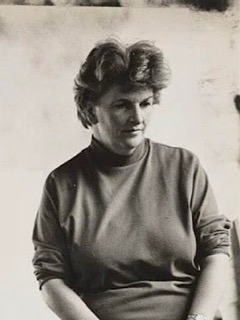
Death of Nancy Wynne-Jones, Welsh & Irish Artist

Nancy Wynne-Jones HRHA, a Welsh and Irish artist, dies in County Wicklow on November 9, 2006.

Mary Esperance (“Nancy”) Wynne-Jones is born on December 10, 1922, in Penmaenucha, Wales, to landowner Charles Llewellyn Wynne-Jones and Sybil Mary Gella Scott. The family spends half the year in Wales and half the year in Thornhill, StalbridgeDorset. She has two brothers, Andrew and Ronald (“Polly”), both of whom die in Africa during World War II.

Wynne-Jones is educated at home. Her skill in art leads to her getting lessons in Sherborne from a children’s book illustrator. Her music is encouraged by the family doctor and she begins to compose and study the violin, receiving lessons in Bournemouth with the first violinist of the symphony orchestra. After the start of World War II, she continues in Aberystwyth. She goes on to study the violin and composition at the Royal Academy of MusicLondon (1940–43). While in London she also serves as a Voluntary Aid Detachment nurse until 1943 and later as a draughtswoman at the Ordnance Survey.

After the war, Wynne-Jones purchases and manages a bookshop on the King’s Road in Chelsea, but it is not a financial success. She returns to painting, studying at the Heatherley School of Fine Art, London, from 1951 to 1952 and the Chelsea School of Art from 1952 to 1955. She travels extensively through Portugal and Italy painting landscapes. An interest in completing landscapes in an abstract manner leads her to study with Peter Lanyon in St. Ives, Cornwall.

Wynne-Jones begins study in Cornwall in 1957 and remains there for fifteen years. Her first public exhibition is in a group show in 1957 at the Pasmore Edwards Gallery, Newlyn. Other group shows are Jefferson Place Gallery, Washington, D.C. (1959) and in Falmouth, Cornwall (1960). Her solo exhibitions are at the New Vision Centre, London (1962 and 1965), Florence (1963) and Dolgellau (1964). From the 1960s through the 1990s she exhibits in Britain, Italy, Belgium, Germany, Ireland, Spain, Holland, South Africa, and the United States.

In 1962, Wynne-Jones purchases Trevaylor House near Penzance and provides accommodation for other artists including renowned Irish painter Tony O’Malley, sculptor Conor Fallon and English poet and writer W. S. ‘Sydney’ Graham. In the 1970s she exhibits in Ireland at the Project Arts Centre, Dublin (1970) and at the Emmet Gallery, Dublin (1975 and 1977). During the 1980s she exhibits at the Lincoln and Hendricks galleries in Dublin before joining the Taylor Gallery, run by John and Patrick Taylor. She is elected an honorary member of the Royal Hibernian Academy (RHA) in 1994 and becomes a member of Aosdána in 1996. Originally an abstract artist, her contact with the Irish countryside slowly transforms her work to that of a landscape artist, albeit with an influence of abstraction attached to it. She becomes well-known in Irish art circles as an eminent Irish landscape artist.

Wynne-Jones is involved with artist Derek Middleton before moving to Cornwall. There she becomes romantically involved with Graham who is in an open marriage, however, it is the death of her mentor Peter Lanyon which devastates her. She meets the sculptor Conor Fallon through their mutual friend, Tony O’Malley. Fallon had arrived in Cornwall ostensibly to meet Lanyon. They marry in 1966. Their honeymoon in Provence is immortalised in expressionist paintings done by her. The couple adopts a boy and a girl, siblings, John and Bridget. In 1972, she moves with her family to Kinsale, County Cork. It is in the area around here that a number of her paintings are created. Later she paints the mountain visible from her Wicklow home after the family moves in the late 1980s. She moves to Ballard House, near Rathdrum, County Wicklow in 1987.

Wynne-Jones dies on November 9, 2006, and is buried in Ballinatone (Church of Ireland), Rathdrum.


Leave a comment

Birth of Betty Ann Norton, Irish Drama Teacher

Betty Ann Norton, Irish drama teacher and founder of the Betty Ann Norton Theatre School and actor agency, is born on July 5, 1936.

Norton grows up in Dublin near the South Circular Road. Her mother, Frances, plays the violin and her father, Eugene, is a baritone singer. Frances is a full-time homemaker while Eugene works as manager of the Bacon Shops on Grafton Street. One of two children, her younger brother, Jim Norton, also becomes a successful actor. She attends school at St. Louis High School, Rathmines.

Norton attends the Ena Mary Burke School of Drama and Elocution on Kildare Street, Dublin, where Hollywood star Maureen O’Hara had also trained. Her acting school offers an annual Ena Mary Burke scholarship in Burke’s honour.

Norton is a Licentiate of the Guildhall School of Music and Drama (LGSM) in London and Associate of the Royal Irish Academy of Music (RIAM) in Dublin. She is a member of the Dublin Shakespeare Society.

Norton originally plans to become an actor, but her family does not approve and her mother encourages her to become a teacher. In 1959, she establishes the Betty Ann Norton Theatre School on Harcourt Street in Dublin. Her husband, Michael, is co-director of the school. According to Norton, changes to traffic by the new Luas tram system causes the business to change premises to her childhood school, St. Louis High School in Rathmines in 2006.

Norton meets her husband, Michael J. Cunneen, on the Aran Islands in 1965 and they marry in 1967. They lived in Dún Laoghaire. Michael dies in the Blackrock Clinic on May 12, 2017.

Norton dies in the Beacon Hospital in the Sandyford suburb of Dublin, on June 5, 2020, at the age of 83. She is cremated and interred at Mount Jerome Cemetery and CrematoriumPresident of IrelandMichael D. Higgins, pays tribute to Norton, describing her as a “theatre legend” and “one of our foremost theatre teachers.”


Leave a comment

Birth of Composer Ian Wilson

Irish composer Ian Wilson is born in Belfast, Northern Ireland, on December 26, 1964. He has written over one hundred and fifty works, including chamber operas, concertos, string quartets, a range of orchestral and chamber music and multi-media pieces.

Wilson studies violin and piano, graduating with a Doctor of Philosophy (DPhil) in composition from Ulster University at Jordanstown in 1990, where he is a research fellow from 2000 to 2003. He is a composer-in-residence with Leitrim County Council and is music director of the Sligo New Music Festival from 2003 to 2011. He receives the Macaulay Fellowship from the Arts Council of Ireland in 1992. In 1998, he is elected to Aosdána, Ireland’s academy of creative artists. Since 2009, he has been a post-doctoral research fellow at Dundalk Institute of Technology, investigating aspects of traditional (ethnic) Irish performance practice as basis for new works of art music.

Wilson’s compositions have been performed and broadcast on six continents, and presented at festivals including the BBC Proms, Venice Biennale, ISCM World Music Days, Frankfort Book Fair and the Ultima Oslo Contemporary Music Festival and at venues such as New York City’s Carnegie Hall, London’s Royal Albert Hall and Wigmore Hall, Amsterdam’s Royal Concertgebouw and Muziekgebouw aan ‘t IJ, Vienna’s Wiener Musikverein and Tokyo’s Suntory Hall. His music has been performed by such diverse groups as the RTÉ National Symphony Orchestra, the London Mozart Players, the Irish Chamber Orchestra (ICO), the pianist Hugh Tinney and many others.

There are commercially available recordings of over fifty of Wilson’s works on labels including Diatribe Records, Riverrun, RTÉ Lyric fm, Black Box, Timbre, Guild, Meridian and Chandos Records. His music is published by Ricordi (London) and Universal Edition.


1 Comment

Birth of Nancy Wynne-Jones, Welsh & Irish Landscape Artist

Nancy Wynne-Jones HRHA, Welsh and Irish artist, is born Mary Esperance Wynne-Jones on December 10, 1922, in Penmaenucha, Dolgellau, Wales.

Wynne-Jones is born to landowner Charles Llewellyn Wynne-Jones and Sybil Mary Gella Scott. The family spends half the year in Wales and half the year in Thornhill, Stalbridge, Dorset, England. She has two brothers, Andrew and Ronald (“Polly”), both of whom die in Africa during World War II.

Wynne-Jones is educated at home. Her skill in art leads to her getting lessons in Sherborne from a children’s book illustrator. Her music is encouraged by the family doctor, and she begins to compose and study the violin, receiving lessons in Bournemouth with the first violinist of the symphony orchestra and continues in Aberystwyth after the start of World War II. She goes on to study the violin and composition at the Royal Academy of Music, London (1940–43). While in London she also serves as a Voluntary Aid Detachment nurse until 1943 and later as a draughtswoman at the Ordnance Survey.

After the war Wynne-Jones purchases and manages a bookshop on the King’s Road in Chelsea, but it is not a financial success. She returns to painting, studying at the Heatherley School of Fine Art, London (1951-52) and the Chelsea School of Art (1952–55). She travels extensively through Portugal and Italy painting landscapes. An interest in completing landscapes in an abstract manner leads her to study with Peter Lanyon in St. Ives, Cornwall.

Wynne-Jones begins study in Cornwall in 1957 and remains there for fifteen years. Her first public exhibition is in a group show (1957) at the Pasmore Edwards Gallery, Newlyn. Other group shows are Jefferson Place Gallery, Washington, D.C., (1959), and in Falmouth, Cornwall (1960). Her solo exhibitions are at the New Vision Centre, London (1962 and 1965), Florence (1963) and Dolgellau (1964). From the 1960s through the 1990s she exhibits in Great Britain, Italy, Belgium, Germany, Ireland, Spain, Holland, South Africa, and the United States.

In 1962 Wynne-Jones purchases Trevaylor House near Penzance and provides accommodation for other artists including renowned Irish painter Tony O’Malley, sculptor Conor Fallon, and English poet and writer W. S. ‘Sydney’ Graham. In the 1970s she exhibits in Ireland at the Project Arts Centre, Dublin (1970) and at the Emmet Gallery, Dublin (1975 and 1977). During the 1980s she exhibits at the Lincoln and Hendricks galleries in Dublin before joining the Taylor Galleries, run by John and Patrick Taylor. She is elected honorary member of the Royal Hibernian Academy (RHA) in 1994 and becomes a member of Aosdána in 1996. Originally an abstract artist, her contact with the Irish countryside slowly transforms her work to that of a landscape artist, albeit with an influence of abstraction attached to it. She becomes well known in Irish art circles as an eminent Irish landscape artist.

Wynne-Jones is involved with artist Derek Middleton before moving to Cornwall. There she becomes romantically involved with Graham who is in an open marriage, however it is the death of her mentor Peter Lanyon that devastates her. She meets the sculptor Conor Fallon through their mutual friend Tony O’Malley. Fallon had arrived in Cornwall ostensibly to meet Lanyon. They marry in 1966. Their honeymoon in Provence is immortalised in expressionist paintings done by Wynne-Jones. The couple adopts a boy and a girl, siblings, John and Bridget. In 1972 she moves with her family to Kinsale, County Cork. It is in this area that a number of her paintings are created. She moves to Ballard House, near Rathdrum, County Wicklow in 1987. There she paints the mountain visible from her home.

Wynne-Jones dies at the age of 83 on November 9, 2006. She is buried in Ballinatone (Church of Ireland), Rathdrum.

(Pictured: “Klein Constantia with Table Mountain” by Nancy Wynne-Jones, acrylic on paper, 16 1/2″ x 23″)


Leave a comment

Birth of Composer Gerald Barry

Gerald Barry, Irish composer, is born in Clarehill, Clarecastle, County Clare, on April 28, 1952.

Growing up in rural County Clare, Barry has little exposure to music except through the radio: “The thing that was the lightning flash for me, in terms of Saint Paul on the road to Damascus, would have been an aria from a Handel opera, from Xerxes maybe, that I heard on the radio. I heard this woman singing this, and bang – my head went. And that was how I discovered music.” He is educated at St. Flannan’s College, Ennis, County Clare. He goes on to study music at University College Dublin, in Amsterdam with Peter Schat, in Cologne with Karlheinz Stockhausen and Mauricio Kagel, and in Vienna with Friedrich Cerha. He teaches at University College Cork from 1982 to 1986.

“Barry’s is a world of sharp edges, of precisely defined yet utterly unpredictable musical objects. His music sounds like no one else in its diamond-like hardness, its humour, and sometimes, its violence.” He often conceives of material independently of its instrumental medium, recycling ideas from piece to piece, as in the reworking of Triorchic Blues from a violin to a piano piece to an aria for countertenor in his television opera The Triumph of Beauty and Deceit:

“It seemed to me unprecedented: the combination of the ferociously objective treatment of the material and the intense passion of the working-out, and both at an extreme of brilliance. And the harmony – that there was harmony at all, and that it was so beautiful and lapidary. It functions, again, irrationally, but powerfully, to build tension and to create structure. It wasn’t just repetitive. It builds. And the virtuosity, the display of it, that combination of things seemed, to me, to be new, and a major way forward.”

Barry’s most recent opera, The Importance of Being Earnest, has become a huge success after its world premiere at Los Angeles and European premiere at the Barbican Centre, London. A critic comments:

“He writes ‘what he likes’ in the way Strindberg does, not trying to characterise his characters, but letting them perform his own specialties, a kind of platform for his own musical specialties. As in Strindberg where you feel every sentence stands for itself and the characters are sort of borrowed for the use of saying them (borrowed to flesh out the text, rather than the other way round), that they’ve been out for the day. In Gerald’s opera the whole apparatus – for that’s what it is – takes on a kind of surrealistic shape, like one person’s torso on someone else’s legs being forced to walk, half the characters in the opera and half the composer.”

It is written in The Irish Times that “no other Irish composer springs to mind who carries the same aura of excitement and originality or whose music means so much to such a wide range of listeners. Certainly, there has been no Irish premiere that has made the impression of The Conquest of Ireland since Barry’s opera The Intelligence Park was seen at the Gate Theatre in 1990.”

In a 2013 guide to Barry’s musical output, Tom Service of The Guardian praises Chevaux-de-frise (1988), The Bitter Tears of Petra von Kant (2005), Lisbon (2006), Beethoven (2008), and The Importance of Being Earnest (2012).


Leave a comment

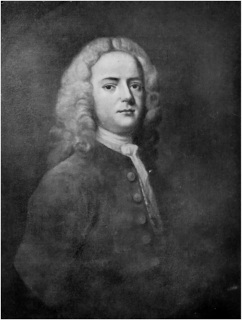
Birth of Garret Wesley, 1st Earl of Mornington

garret-wesley

Garret Colley Wesley, 1st Earl of Mornington, Anglo-Irish politician and composer best known today for fathering several distinguished military commanders and politicians of the United Kingdom of Great Britain and Ireland, is born on July 19, 1735, at the family estate of Dangan Castle, near Summerhill, County Meath.

Wesley is the son of Richard Wesley, 1st Baron Mornington, and Elizabeth Sale. He is educated at Trinity College Dublin and is elected its first Professor of Music in 1764. From early childhood he shows extraordinary talent on the violin and soon begins composing his own works. As a composer he is remembered chiefly for glees such as “Here in cool grot” and for a double Anglican chant. His son, Arthur Wellesley, 1st Duke of Wellington, is the only one of his children to inherit something of his musical talent.

Wesley represents Trim in the Irish House of Commons from 1757 until 1758, when he succeeds his father as 2nd Baron Mornington.

Wesley marries Anne Hill-Trevor, eldest daughter of banker Arthur Hill-Trevor, 1st Viscount Dungannon, and his wife Anne Stafford, on February 6, 1759. His godmother, the famous diarist Mary Delany, says the marriage is happy, despite his lack of financial sense and her “want of judgment.” They have nine children, most of whom are historically significant.

In 1759 Wesley is appointed Custos Rotulorum of Meath and in 1760, in recognition of his musical and philanthropic achievements, he is created Viscount Wellesley, of Dangan Castle in the County of Meath, and Earl of Mornington. He is elected Grandmaster of the Grand Lodge of Ireland in 1776, a post he holds until the following year.

Wesley dies at the age of 45 on May 22, 1781. Like his father, he is careless with money, and his early death leaves the family exposed to financial embarrassment, leading ultimately to the decision to sell all their Irish estates.

Four streets in Camden Town, which form part of the estate of Wesley’s son-in-law Henry FitzRoy, are named Mornington Crescent, Place, Street and Terrace after him. Of these, the first has since become famous as the name of a London Underground station.

Four of Wesley’s five sons are created peers in the Peerages of Great Britain and the United Kingdom. The Barony of Wellesley and the Barony of Maryborough are now extinct, while the Dukedom of Wellington and Barony of Cowley are extant. The Earldom of Mornington is held by the Dukes of Wellington, and the Barons Cowley has since been elevated to be Earls Cowley.


Leave a comment

Birth of Peadar Ó Dubhda, Translator & Teacher of Irish Language

peadar-o-dubhda

Peadar Ó Dubhda, novelist, playwright, musician, teacher and translator of the Irish language, is born in Dundalk, County Louth on June 29, 1881. He is the author of many plays, stories and manuscripts over the years and in his youth is a noted high jumper competing at local events.

Ó Dubhda leaves the local primary school at the age of twelve with only the most basic of an education, but when he goes to work as a delivery boy driving around the roads of North Louth on his horse and cart, he always has his O’Growney grammar book at his side, perfecting his knowledge of the Irish language. As a youth he joins the local brass band, where he is taught the cornet, but such is the depth of his intellect and his love for music he is an accomplished violinist, flautist and pianist in a very short time.

From his youth stretching into early manhood Ó Dubhda’s love of the Irish language is evident. He helps found a Gaelic League branch in Dundalk and perfects his use of the language by visiting Gaeltacht areas in the west of Ireland and Omeath. He is awarded a certificate to teach Irish by the Patrick Pearse and is a teacher in St. Mary’s College in Dundalk for over 20 years from 1915.

Ó Dubhda leaves teaching when he is offered his own children’s hour on Radio Éireann, a programme that lasts for over 30 years and through which a generation of Irish youth come to know and love his stories.

Ó Dubhda’s major work is the translation of the entire Douay version of the bible into Irish. The work takes twelve years and involves the deciphering of over three million words. The work is presented to the Irish nation in 1955 and is held in the National Museum of Ireland.

In 1950 Ó Dubhda is presented with the Papal medal, Pro Ecclessia el Pontifice by Pope Pius XII, to mark his 50th year as a member of his St. Malachy’s choir and one of his most prized possessions is a personal letter from Pope John XXIII praising him for his work for the church.

Peadar Ó Dubhda is just a month shy of his 90th birthday when he passes away in the loving care of his nieces in their Park Drive home on May 26, 1971. He is buried in Dundalk and his funeral is attended by President Éamon De Valera.


Leave a comment

Birth of William Vincent Wallace, Composer & Musician

william-vincent-wallace

William Vincent Wallace, Irish composer and musician, is born at Colbeck Street, Waterford, County Waterford on March 11, 1812. In his day, he is famous on three continents as a double virtuoso on violin and piano. Nowadays, he is mainly remembered as an opera composer of note, with key works such as Maritana (1845) and Lurline (1847/60), but he also writes a large amount of piano music that is much in vogue in the 19th century.

Wallace’s father, Spencer Wallace of County Mayo, becomes a regimental bandmaster with the North Mayo Militia based in Ballina. William is born while the regiment is stationed for one year in Waterford. The family returns to Ballina in 1816 and he spends his formative years there, taking an active part in his father’s band and already composing pieces by the age of nine for the band recitals.

Under the tuition of his father and uncle, Wallace writes pieces for the bands and orchestras of his native area. He becomes accomplished in playing various band instruments before the family leaves the Army in 1826, moving from Waterford to Dublin, and becoming active in music in the capital. He learns to play several instruments as a boy, including the violin, clarinet, organ, and piano. In 1830, at the age of 18, he becomes organist of the Roman Catholic Cathedral at Thurles, County Tipperary, and teaches music at the Ursuline Convent there. He falls in love with a pupil, Isabella Kelly, whose father consents to their marriage in 1832 on condition that Wallace become a Roman Catholic. The couple soon moves to Dublin where he is employed as a violinist at the Theatre Royal.

Economic conditions in Dublin deteriorate after the Acts of Union 1800 and the whole Wallace family decides to emigrate to Australia in 1835. Wallace’s party first lands at Hobart, Tasmania in late October, where they stay several months before moving on to Sydney in January 1836. The Wallaces open the first Australian music academy in April. Wallace has already given many celebrity concerts in Sydney, and being the first virtuoso to visit the Colony, becomes known as the “Australian Paganini.” He is also active in the business of importing pianos from London, but his main activity involves many recitals in and around Sydney under the patronage of the Governor, General Sir Richard Bourke. The most significant musical events of this period are two large oratorio concerts on behalf of the organ fund at St. Mary’s Cathedral in Sydney in 1836 and 1838, which he directs, and which utilize all the available musical talent of the Colony, including the recently formed Philharmonic [Choral] Society.

In 1838, Wallace separates from his wife and begins a roving career that takes him around the globe. In 1841, he conducts a season of Italian opera in Mexico City. Moving on to the United States, he stays in New Orleans for some years, where he is feted as a virtuoso on violin and piano, before reaching New York City, where he is equally celebrated, and publishes his first compositions (1843–44).

Wallace arrives in London in 1845 and makes various appearances as a pianist. In November of that year, his opera Maritana is performed at the Theatre Royal, Drury Lane with great success, and is later presented internationally. Maritana is followed by Matilda of Hungary (1847), Lurline (1847/60), The Amber Witch (1861), Love’s Triumph (1862) and The Desert Flower (1863). He also publishes numerous compositions for the piano.

In New York in 1843–1844, Wallace is associated with the early concert seasons of the New York Philharmonic Society, and in 1853 is elected an Honorary (Life) Member of the Society. In 1854, he becomes an American citizen after a marriage in New York to German-born pianist Hélène Stoepel, sister of composer Robert Stoepel. In later years, having returned to Europe for the premieres of his later operas, he develops a heart condition for which he receives treatment in Paris in 1864. He dies in poor circumstances at the Château de Bagen, Sauveterre-de-Comminges, in the Haute Garonne on October 12, 1865. He is buried in Kensal Green Cemetery, London.

(Pictured: William Vincent Wallace. Undated portrait by Mathew Brady, New York City, Library of Congress)


Leave a comment

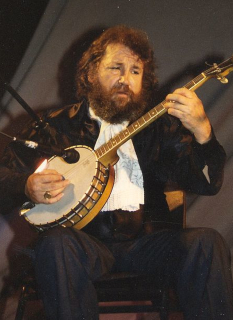
Birth of Barney McKenna, Founding Member of The Dubliners

File source: https://commons.wikimedia.org/wiki/File:Barney_001.jpg

Bernard Noël “Banjo Barney” McKenna, Irish musician and a founding member of The Dubliners, is born on December 16, 1939 in Donnycarney, Dublin. He plays the tenor banjo, violin, mandolin, and melodeon. He is most renowned as a banjo player.

McKenna plays the banjo from an early age, initially because he cannot afford to buy the instrument of his choice, a mandolin. He is a member of The Dubliners from 1962 and is the only living member of the original formation at the time of his death. Prior to joining the Dubliners, he spends a few months in The Chieftains. In addition to his work on traditional Irish music, he also plays jazz on occasion.

McKenna uses GDAE tuning on a 19-fret tenor banjo, an octave below fiddle/mandolin and, according to musician Mick Moloney, is single-handedly responsible for making the GDAE-tuned tenor banjo the standard banjo in Irish music.

McKenna remains a great favourite with live audiences, and some of the loudest and most affectionate applause follows the tunes and songs on which he is the featured performer. He is well known for his unaccompanied renditions of songs such as “South Australia” and “I Wish I Had Someone to Love Me.” His banjo solos on tunes such as “The Maid Behind the Bar,” “The High Reel” and “The Mason’s Apron,” where he is usually accompanied by Eamonn Campbell on guitar, are often performed to cries of “C’mon Barney!” from audience or band members. Another featured spot in Dubliners performances is the mandolin duet that he plays with John Sheahan, again with Eamonn Campbell providing guitar accompaniment. As he often points out to the audience, “It’s an Irish duet, so there’s three of us going to play it.”

McKenna’s tendency to relate funny, and often only marginally believable, stories is legendary amongst Dubliners fans and friends. These anecdotes become known as Barneyisms, and his friend and former Dubliners bandmate Jim McCann collects them for the book An Obstacle Confusion: The Wonderful World of Barney McKenna.

McKenna dies unexpectedly on the morning of April 5, 2012 after collapsing in the kitchen of his home in Howth, County Dublin. He is buried at St. Loman’s Cemetery in Trim, County Meath, on April 9, 2012. Initially it is unclear whether The Dubliners will continue their 50th Anniversary Tour in the wake of McKenna’s death. However they soon confirm that they would “do their best to honour all the concert dates for the rest of the year [2012].”


Leave a comment

Birth of Martin Fay of The Chieftains

martin-fay-1

Martin Joseph Fay, Irish fiddler and bones player and co-founder of the Irish traditional music ensemble The Chieftains, is born in Cabra, Dublin on September 19, 1936.

The Chieftains are credited with reviving worldwide interest in traditional Celtic music. Fay performs as the group’s fiddler and bones player for some 40 years.

Fay develops an early interest in the violin and takes music lessons at the Municipal School of Music in Dublin. He joins the orchestra of the Abbey Theatre during his teen years and is introduced to Irish folk music by the theatre’s musical director Sean O’Riada.

It was through O’Riada’s folk band, Ceoltóirí Chualann, that Fay meets the other original Chieftains members, Paddy Moloney, Seán Potts, and Michael Tubridy. The foursome releases their first album, Chieftains 1, in 1964. The Chieftains perform on local radio and television programs and in pubs throughout the British Isles, but it is not until the 1970s that they begin touring overseas.

The Chieftains gain international acclaim when their music is used in the Academy Award-winning soundtrack for the film Barry Lyndon (1975). In 1989, The Chieftains are officially designated Ireland’s musical ambassadors. Although the quartet’s membership changes over the years, Fay records more than 30 albums with The Chieftains.

In 2001, Fay decides to stop touring with The Chieftains, limiting his appearances with the group to events in Ireland. He subsequently retires in 2002. After a lengthy illness, he dies at the age of 76 in Cabra on November 14, 2012.