As a member of the Irish Confederation during the Great Famine, Reilly together with John Mitchel and James Fintan Lalor advocate the refusal to pay rents, retention of crops by small tenant farmers and labourers to feed their own families, and the breaking up of bridges and tearing up of railway lines to prevent the removal of food from the country.
Reilly is involved in the failed Young Ireland Rebellion of 1848 and is forced to flee to the United States where he becomes active in U.S. political affairs in support of Irish independence. He is reported to be the founder of The People newspaper in New York City which folds after six months in 1849.
James Connolly claims that as the editor of the Protective Union labour rights newspaper for the printers of Boston, Reilly is a pioneer of American labour journalism and that Horace Greeley believed of his series of articles in The American Review on the European situation “that if collected and published as a book, they would create a revolution in Europe.”
It is possible that Connolly confuses The United States Magazine and Democratic Review, which is known for its political activism, with The American Review, which for a time had Edgar Allan Poe as an editorial assistant. Other sources refer to Reilly as being editor of the New York Democratic Review and later the Washington Union.
Thomas Devin Reilly dies at the age of 30 on March 5, 1854. He is buried at Mount Olivet Cemetery in Washington, D.C., together with his infant child Mollie and wife Jennie Miller from Enniskillen.
Mahon, the eldest of four children, is the son of Patrick Mahon of New Park, who took part in the Irish Rebellion of 1798, and Barbara, a considerable heiress and the only daughter of James O’Gorman of Ennis. He studies at Clongowes Wood College, where he is one of the earliest pupils, and at Trinity College Dublin, where he takes his BA in 1822 and his MA in law in 1832. Following his father’s death in 1821, he inherits half the family property and becomes a magistrate for Clare.
In 1830, Mahon marries Christina, the daughter of John O’Brien of Dublin. She is an heiress and has property valued at £60,000 in her own right, which gives him the resources to seek election to parliament. The couple spends little time together, and she dies apart from him in Paris in 1877. They have one son who dies in 1883.
As a result, when Mahon is elected for Clare at the 1830 United Kingdom general election, he is entitled to take his seat. However, during the election campaign he quarrels with O’Connell, and after his election he is unseated for bribery. He is subsequently acquitted and stands again at the 1831 United Kingdom general election, but is defeated by two O’Connell-backed candidates, one of whom is his old schoolfriend Maurice O’Connell, Daniel O’Connell’s son. He gives up on politics, becomes deputy lieutenant of Clare, and captain of the local militia.
Following his defeat in the 1852 election, Mahon returns to Paris, then travels on to Saint Petersburg, where he serves in the Imperial Bodyguard. During this period, he journeys through lands from Finland to Siberia. He then travels across China, India and Arabia. His finances largely exhausted, he serves as a mercenary in the Ottoman and Austrian armies before returning to England in 1858. Late that year, he leaves for South America, where he attempts to finance the construction of a canal through Central America.
Mahon is a close associate of Charles Stewart Parnell, who he successfully nominates for the leadership of the League in 1880 but is dropped in 1885 as a party candidate because of his age and his tendency to vote with the Liberal Party in Parliament. He is also embroiled in a court case disputing the will of his son.
Mahon had served alongside William O’Shea as an MP, and the two were close friends. He introduced him and Katharine O’Shea, his wife, to Parnell. After Parnell is named in the O’Sheas’ divorce case in 1890, Mahon splits with Parnell, siding with the Irish National Federation. However, Parnell attends Mahon’s funeral in Glasnevin Cemetery a few months later.
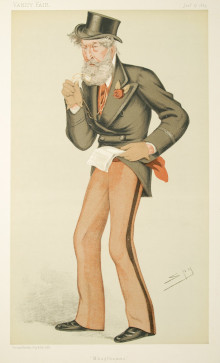
(Pictured: Caricature of James Patrick Mahon by Sir Leslie Matthew Ward under the pseudonym “Spy” published in Vanity Fair in 1885)
MacHale’s parents are Patrick and Mary Mulkieran MacHale. He is so feeble at birth that he is baptised at home by Father Andrew Conroy. By the time he is five years of age, he begins attending a hedge school. Three important events happen during his childhood: the Irish Rebellion of 1798, the landing at Killala of French troops, whom the boy, hidden in a stacked sheaf of flax, watches marching through a mountain pass to Castlebar, and a few months later the brutal hanging of Father Conroy on a false charge of high treason.
With his friend and ally, Daniel O’Connell, MacHale takes a prominent part in the important question of Catholic emancipation, impeaching in unmeasured terms the severities of the former penal code, which had branded Catholics with the stamp of inferiority. During 1826 his zeal is omnipresent. He calls on the Government to remember how the Act of Union in 1800 was carried by William Pitt the Younger on the distinct assurance and implied promise that Catholic emancipation, which had been denied by the Irish Parliament, should be granted by the Parliament of the Empire.
Oliver Kelly, Archbishop of Tuam, dies in 1834, and the clergy selects MacHale as one of three candidates, to the annoyance of the Government who despatches agents to induce Pope Gregory XVI not to nominate him to the vacant see. Disregarding their request, the pope appoints MacHale Archbishop of Tuam. He is the first prelate since the Reformation who has received his entire education in Ireland. The corrupt practices of general parliamentary elections and the Tithe War cause frequent rioting and bloodshed and are the subjects of denunciation by the new archbishop, until the passing of a Tithes bill in 1838. He also leads the opposition to the ProtestantSecond Reformation, which is being pursued by evangelical clergy in the Church of Ireland, including the Bishop of Tuam, Killala and Achonry, Thomas Plunket.
The repeal of the Acts of Union 1800, advocated by O’Connell, enlists MacHale’s ardent sympathy and he assists the Liberator in many ways, and remits subscriptions from his priests for this purpose. In his zeal for the cause of the Catholic religion and of Ireland, so long downtrodden, but not in the 1830s, he frequently incurs from his opponents the charge of intemperate language, something not altogether undeserved. In his anxiety to reform abuses and to secure the welfare of Ireland, by an uncompromising and impetuous zeal, he makes many bitter and unrelenting enemies, particularly British ministers and their supporters.
The Great Famine of 1846–47 affects his diocese more than any. In the first year he announces in a sermon that the famine is a divine punishment on his flock for their sins. Then by 1846 he warns the Government as to the state of Ireland, reproaches them for their dilatoriness, and holds up the uselessness of relief works. From England as well as other parts of the world, cargoes of food are sent to the starving Irish. Bread and soup are distributed from the archbishop’s kitchen. Donations sent to him are acknowledged, accounted for, and disbursed by his clergy among the victims.
The death of O’Connell in 1847 is a setback to MacHale as are the subsequent disagreements within the Repeal Association. He strongly advises against the violence of Young Ireland. Over the next 30 years he becomes involved in political matters, particularly those involving the church. Toward the end of his life he becomes less active in politics.
MacHale attends the First Vatican Council in 1869. He believes that the favourable moment has not arrived for an immediate definition of the dogma of papal infallibility. Better to leave it a matter of faith, not written down, and consequently he speaks and votes in the council against its promulgation. Once the dogma had been defined, he declares the dogma of infallibility “to be true Catholic doctrine, which he believed as he believed the Apostles’ Creed“. In 1877, to the disappointment of the archbishop who desires that his nephew should be his co-adjutor, Dr. John McEvilly, Bishop of Galway, is elected by the clergy of the archdiocese, and is commanded by Pope Leo XIII after some delay, to assume his post. He had opposed this election as far as possible but submits to the papal order.
Every Sunday MacHale preaches a sermon in Irish at the cathedral, and during his diocesan visitations he always addresses the people in their native tongue, which is still largely used in his diocese. On journeys he usually converses in Irish with his attendant chaplain and has to use it to address people of Tuam or the beggars who greet him whenever he goes out. He preaches his last Irish sermon after his Sunday Mass, April 1881. He dies in Tuam seven months later, on November 7, 1881.
In 1863, Stephens tells friends he is to start a newspaper. With funds through John O’Mahony, founder of the Fenian Brotherhood in the United States, he sets up an office at 12 Parliament Street. John O’Leary becomes the editor, with Thomas Luby, Charles Kickham, and Denis Mulcahy as editorial staff and Luby as a proprietor. Jeremiah O’Donovan Rossa is the business manager and James O’Connor his assistant and bookkeeper. The newspaper is printed by John Haltigan. Most of the articles are written by O’Leary and Kickham. The first issue comes out on Saturday, November 28, 1863. Its sympathies are clear. A front-page advertisement offers to ship old copies of the United Irishman and The Irish Felon to any address in the UK and editorial content is critical of the political status quo. Superintendent Daniel Ryan of G Division of the Dublin Metropolitan Police, which is largely concerned with Fenianism, notes the new publication’s birth and comments on its low circulation.
Plans for a rising in Ireland, hatched in the United States, are found at Kingstown station in July 1865 in an envelope containing a £500 New York bankers’ draft payable to Stephens’ brother-in-law. This is handed over to Dublin Castle and the link proves to be decisive for what follows. Later, a letter to the Tipperary IRB calling for a nationalist uprising is found by Pierce Nagle, a police informer working for The Irish People. Nagle had visited British officials while in New York in 1864 and offers his services after being upset by Stephens’ manner. After Nagle provides the information, the offices of The Irish People are raided on September 15. The last issue comes out the following day.
The paper is suppressed by the Lord Lieutenant of Ireland, John Wodehouse. Luby, O’Leary, O’Donovan Rossa and O’Connor are arrested and held at Richmond Bridewell prison. Stephens and Kickham join them a month later. Stephens escapes from prison on November 24. A Special Commission is opened on November 27 and forty-one people are charged are ultimately charged. Luby, O’Leary, O’Connor, O’Donovan Rossa and Kickham are charged with the most serious crime of treason felony, first used against the republicans of 1848. Evidence used for the prosecution includes the letter found by Nagel and his testimony about Fenian connections, articles from The Irish People as far back as the first issue, in which Irish Catholic judges including one of the presiding judges, the current Attorney-General for Ireland and Privy CouncillorWilliam Keogh, had been strongly criticised, and a devastating secret document from 1864 written by Stephens and entrusted to Luby granting Luby, O’Leary and Kickham executive powers over the IRB. Kickham is unaware of the document. The conflicts of interest, also with the other judge, John David FitzGerald, who is involved in the defendants’ arrest, are highlighted by the defending counsel, former ToryMPIsaac Butt. Also noted is the striking, if not unusual, jury packing, an act where in a mostly Catholic land, some of the juries involved are entirely Protestant.
Luby, O’Leary and O’Connor receive sentences of twenty years. O’Donovan Rossa is sentenced to life imprisonment because of his previous convictions. The frail Kickham, lifelong near blind and deaf, gets twelve years. Judge Keogh praises his intellect and expresses sympathy with his plight, despite having refused his request for a writ of corpus to bring Luby and Charles Underwood O’Connell to his trial concerning his ignorance of the “executive document,” as Luby had already begun his sentence in Pentonville Prison.
Mitchel is the son of a Presbyterian minister. At the age of four, he is sent to a classical school, run by an old minister named Moor, nicknamed “Gospel Moor” by the students. He reads books from a very early age. When a little over five years old, he is introduced to Latin grammar by his teacher and makes quick progress. In 1830, not yet 15 years old, he enters Trinity College, Dublin and obtains a law degree in 1834.
In the spring of 1836 Mitchel meets Jane Verner, the only daughter of Captain James Verner. Though both families are opposed to the relationship, they become engaged in the autumn and are married on February 3, 1837, by the Rev. David Babington in Drumcree Church, the parish church of Drumcree.
Mitchel works in a law office in Banbridge, County Down, where he eventually comes into conflict with the local Orange Order. He meets Thomas Davis and Charles Gavan Duffy during visits to Dublin. He joins the Young Ireland movement and begins to write for The Nation. Deeply affected by the misery and death caused by the Great Famine, he becomes convinced that nothing will ever come of the constitutional efforts to gain Irish freedom. He then forms his own paper, United Irishmen, to advocate passive resistance by Ireland’s starving masses.
In May 1848, the British tire of Mitchel’s open defiance. Ever the legal innovators in Ireland, they invent a crime especially for the Young Irelanders – felony-treason. They arrest him for violating this new law and close down his paper. A rigged jury convicts him, and he is deported first to Bermuda and then to Australia. However, in June 1853, he escapes to the United States.
Mitchel works as a journalist in New York City and then moves to the South. When the American Civil War erupts, he is a strong supporter of the Southern cause, seeing parallels with the position of the Irish. His family fully backs his commitment to the Southern cause. He loses two sons in the war, one at the Battle of Gettysburg in 1863 and another at the Battle of Fort Sumter in 1864, and another son loses an arm. His outspoken support of the Confederacy causes him to be jailed for a time at Fort Monroe, where one of his fellow prisoners is Confederate PresidentJefferson Davis.
In 1874, the British allow Mitchel to return to Ireland and in 1875 he is elected in a by-election to be a member of the Parliament of the United Kingdom representing the Tipperary constituency. However, his election is invalidated on the grounds that he is a convicted felon. He contests the seat again in the resulting by-election and is again elected, this time with an increased vote.
Unfortunately, Mitchel, one of the staunchest enemies to English rule of Ireland in history, dies in Newry on March 20, 1875, and is buried there. Thirty-eight years later, his grandson, John Purroy Mitchel, is elected Mayor of New York City.
Davis is born in Mallow, County Cork, on October 14, 1814, the son of a Welsh father, a surgeon in the Royal Artillery, and an Irish mother. Through his mother he is descended from the Gaelic noble family of O’Sullivan Beare. His father dies one month after his birth and his mother moves to Warrington Place near Mount Street bridge in Dublin. In 1830, they move to 67 Lower Baggot Street. He attends school in Lower Mount Street before studying at Trinity College, Dublin. He graduates in Law and receives an arts degree in 1836, before being called to the Irish Bar in 1838.
Davis gives a voice to the 19th-century foundational culture of modern Irish nationalism. Formerly it is based on the republicans of the 1790s and on the Catholic emancipation movement of Daniel O’Connell in the 1820s-30s, which has little in common with each other except for independence from Britain. Davis aims to create a common and more inclusive base for the future. He establishes The Nation newspaper with Charles Gavan Duffy and John Blake Dillon.
He writes some stirring nationalistic ballads, originally contributed to The Nation and afterwards republished as Spirit of the Nation, as well as a memoir of Curran, the Irish lawyer and orator, prefixed to an edition of his speeches, and a history of King James II‘s parliament of 1689. He has formed many literary plans which are unfinished at the time of his early death.
Davis supports O’Connell’s Repeal Association from 1840, hoping to recreate the old Parliament of Ireland. They split during a debate on the proposed new Queen’s University of Ireland, when Davis is reduced to tears by O’Connell’s superior debating skill. Davis is in favour of a university that would inclusively educate all Irish students. O’Connell and the Catholic hierarchy prefer a separate system for Catholic students within Ireland that would remain under church control.
O’Connell generally refers to his inexperienced allies as “Young Ireland,” initially as a dismissive term, that from the 1870s becomes the accepted term for nationalists inspired by Davis. He also prefers a federal arrangement with Britain in the 1840s while Davis seeks a greater degree of autonomy. Both agree that a gradual and non-violent process is the best way forward. Despite their differences, O’Connell is distraught at Davis’s early death.
Davis is a Protestant but preaches unity between Catholics and Protestants. To him, it is not blood that makes a person Irish, but the willingness to be part of the Irish nation. He is to the fore of Irish nationalist thinking and it has been noted by later nationalist notables, such as Patrick Pearse, that while Theobald Wolfe Tone laid out the basic premise that Ireland as a nation must be free, Davis is the one who built this idea up promoting the Irish identity.
John Dillon, a Member of Parliament (MP) for over 35 years and the last leader of the Irish Parliamentary Party in the struggle to secure Home Rule by parliamentary means, dies in a Londonnursing home on August 4, 1927. Through the 1880s he is perhaps the most important ally of the greatest 19th-century Irish nationalist, Charles Stewart Parnell, but, following Parnell’s involvement as co-respondent in a divorce case, he repudiates Parnell for reasons of political prudence.
Dillon is a member of the British House of Commons during 1880–1883 and 1885–1918. For his vigorous work in the Irish National Land League, which seeks fixed tenure, fair rents, and free sale of Irish land, he is imprisoned twice between May 1881 and May 1882. He is Parnell’s fellow inmate in Kilmainham Gaol in Dublin from October 1881. For six months in 1888 he is imprisoned for aiding William O’Brien, author of the “plan of campaign” against high rent charges by English absentee landlords in Irish farming districts.
When Parnell is named co-respondent in Captain William Henry O’Shea’s divorce suit in 1890, Dillon and O’Brien at first affirm their support of him, but they finally decide that he will thenceforth be a liability as party leader. The party then splits, the anti-Parnellite majority forming the Irish National Federation, of which Dillon serves as chairman from 1896. In 1900, however, he agrees to join a reunited party under the Parnellite John Redmond.
During the prime ministry of Arthur James Balfour (1902–1905), Dillon comes to believe that the British Conservative government intends to grant Irish reforms without independence, thereby “killing Home Rule by kindness.” In 1905 he advises Irishmen to vote for Liberal Party candidates for Parliament, and, after the Liberals had taken office that year, he supports their reform program.
Throughout World War I Dillon vehemently opposes the extension of British military conscription to Ireland, both because that measure would strengthen the agitation by the more extreme nationalistSinn Féin party and because he never accepted the view that British imperial interests necessarily coincided with those of Ireland. After the Easter Rising in Dublin in 1916, he protests against the harsh measures that ensue and, in the House of Commons, makes a passionate speech in defense of the Irish rebels.
Upon Redmond’s death on March 6, 1918, Dillon, who had broken with him over Irish support for the British war effort, succeeds him as Irish Parliamentary Party leader. By that time, however, the party has been discredited and in the 1918 Irish general election Sinn Féin wins easily. On losing his House of Commons seat to Éamon de Valera, the future president of the Republic of Ireland, he retires from politics.
Mitchel is one of the great propagandists of his day, although the causes he espouses often place him on the wrong side, he is loved and loathed in equal measure. He is one of the few Irishmen to have incurred the wrath of the British government and of the Federal administration of the United States.
Inflamed by the suffering he witnesses on a trip to Galway, it is Mitchel, more than any other writer or politician, who shapes the nationalist perception of an Gorta Mór (Great Famine):
“I could see, in front of the cottages, little children leaning against a fence when the sun shone out for they could not stand, their limbs fleshless, their bodies half-naked, their faces bloated yet wrinkled, and of a pale, greenish hue… I saw Trevelyan’s claw in the vitals of those children: his red tape would draw them to death: in his government laboratory he had prepared for them the typhus poison.”
Responding to such writing, Ireland simmers, angry and ready for rebellion. Fearful of Mitchel’s power, London’s Punch magazine emphasises his international standing by portraying him as an Irish monkey challenging the Great British Lion. The Times thunders against him. When Mitchel produces his own republican newspaper, The United Irishman, which, in its inaugural edition, claims that “the world was weary of Old Ireland and also of Young Ireland” thus attacking both Daniel O’Connell and his younger antagonists with the same broadsword. He aims to be an equal opportunities offender and succeeds admirably.
The United Irishman sells out and is shut down by the British authorities after a mere sixteen issues. In order to silence Mitchel, to rob him of his heroic status and his possible martyrdom, the British government passes the Treason Felony Act 1848, which seeks to treat treason as a common crime. He is later tried before an elegantly and efficiently packed jury, found guilty of treason-felony, and deported to Van Diemen’s Land (Tasmania). The result is one of the greatest works of Irish political history, The Jail Journal, in which Mitchel writes about his own experience of deportation and advocates a far more militaristic approach to Ireland’s “English problem” than would have been popular heretofore.
Mitchel is acclaimed by Patrick Pearse, who declares The Jail Journal to be “the last of the four gospels of the New Testament of Irish nationality, the last and the fieriest and the most sublime.” Éamon de Valera reveres Mitchel, and when in 1943 he imagines Ireland as “the home of a people who valued material wealth only as a basis for right living, of a people who, satisfied with frugal comfort, devoted their leisure to the things of the spirit,” he too is delving into The Jail Journal for his inspiration.
(From: #OTD in 1848 – John Mitchel Publishes First United Irishman, Stair na hÉireann | History of Ireland)
Duffy is born on April 12, 1816, in Dublin Street, Monaghan, County Monaghan. Both of his parents die while he is still a child and his uncle, Fr. James Duffy, who is the Catholic Parish Priest of Castleblayney, becomes his guardian for a number of years. He is educated at St. Malachy’s College in Belfast and is admitted to the Irish Bar in 1845. Duffy becomes a leading figure in Irish literary circles.
In August 1850, Duffy forms the Tenant Right League to bring about reforms in the Irish land system and protect tenants’ rights, and in 1852 is elected to the House of Commons for New Ross. By 1855, the cause of Irish tenants seems more hopeless than ever. Broken in health and spirit, Duffy publishes a farewell address to his constituency, declaring that he has resolved to retire from parliament, as it is no longer possible to accomplish the task for which he has solicited their votes.
In 1871, Duffy leads the opposition to Premier Sir James McCulloch‘s plan to introduce a land tax, on the grounds that it unfairly penalises small farmers. When McCulloch’s government is defeated on this issue, Duffy becomes Premier and Chief Secretary. The majority of the colony is Protestant, and Duffy is accused of favouring Catholics in government appointments. In June 1872, his government is defeated in the Assembly on a confidence motion allegedly motivated by sectarianism.
When Graham Berry becomes Premier in 1877, he makes Duffy Speaker of the Legislative Assembly, a post he holds without much enthusiasm until 1880, when he quits politics and retires to the south of France. He remains interested in both the politics of his adoptive country and of Ireland. He is knighted in 1873 and is made KCMG in 1877. Sir Charles Gavan Duffy dies in Nice, France, at the age of 86 in 1903.
The first issue of The Nation, an Irish nationalist weekly newspaper, is published on October 15, 1842. It is printed at 12 Trinity Street, Dublin until January 6, 1844. The paper is later published at 4 D’Olier Street from July 13, 1844, until July 28, 1848, when the issue for the following day is seized and the paper suppressed. It is published again in Middle Abbey Street on its revival in September 1849.
John Mitchel joins the staff of The Nation in the autumn of 1845. On Mitchel’s frequent trips from Banbridge, County Down to Dublin, he had come in contact with the Repeal members who gathered about The Nation office and in the spring of 1843, he becomes a member of the Repeal Association. For the next two years he writes political and historical articles and reviews for The Nation. He covers a wide range of subjects, including the Irish Potato Famine, on which he contributes some influential articles which attract significant attention.
Mitchel resigns his position as lead writer for The Nation in 1847 because he comes to regard as “absolutely necessary a more vigorous policy against the English Government than that which William Smith O’Brien, Charles Gavan Duffy and other Young Ireland leaders were willing to pursue.” Upon his resignation he starts his own paper, The United Irishman.
Women also write for The Nation and publish under pseudonyms such as Speranza (Jane Elgee, Lady Wilde, Oscar Wilde‘s mother), Eithne (Marie Thompson) and Eva (Mary Eva Kelly, who would marry Kevin Izod O’Doherty.
The role played by some of its key figures in the paper in the ill-fated Young Ireland Rebellion of 1848 cement the paper’s reputation as the voice of Irish radicalism. Dillon is a central figure in the revolt and is sentenced to death, the sentence later commuted. He flees Ireland, escaping first to France and, eventually, to the United States, where he serves the New York Bar.
The Nation continues to be published until 1900, when it merges with the Irish Weekly Independent. Later political figures associated with the paper included Timothy Daniel Sullivan and J.J. Clancy.




 seamus dubhghaill