Brownlow’s father, grandfather, and great-grandfather had been MPs, and in 1753 he wins a hotly contested by-election in which his opponents accuse him of papist and Jacobite sympathies. The unsuccessful candidate is Francis Caulfeild, brother of James, 1st Earl of Charlemont, his petition to parliament causing a furor and is defeated by only one vote in one of the most celebrated electoral struggles of the day. Brownlow represents the county for over forty years, from 1753 until his death. In 1753, he supports the government on the controversial money bill.
Brownlow marries Judith, daughter of the Rev. Charles Meredyth, Dean of Ardfert, of County Meath, on May 25, 1754. They have two sons. After her death in Lyon, France, in October 1763, he marries Catherine, daughter of Roger Hall of Newry, County Down, on November 25, 1765. They have two sons and five daughters, three who marry into the nobility. In 1758, he is one of the Wide Streets commissioners in Dublin and owns an imposing house in Merrion Square. He is a trustee of the linen board in Ulster, and makes many improvements to his estate, castle, and demesne, the local church, and the town of Lurgan. However, it is alleged that private roads in his demesne were built with public money. He is one of a few landowners in County Armagh who are believed to have misappropriated the unusually high county cess levied by the grand jury, of which he is a member. In 1758, he suggests that salaries be paid to government officials, and one official, Henry Meredyth, his first wife’s uncle, subsequently receives an annual salary of £500.
In June 1763, large numbers of Presbyterian farmers and weavers, calling themselves the Hearts of Oak, in a notable show of dissatisfaction with the privileges of landlords, march on the homes of the gentry to demand redress. Brownlow is in England and avoids a confrontation. Despite the allegations of abuse of public money, he is generally recognised as one of the more independent and reform-minded MPs of the day. He captains a Volunteer troop of dragoons which march from Lurgan to assist Belfast after the French commander François Thurot lands at Carrickfergus in 1760. As one of the supporters of Henry Grattan, he is prominent in the Volunteer movement of the 1780s. He is captain of the Lurgan Volunteer company and lieutenant-colonel of the northern battalion and backs the movement in parliament until displeased by the Volunteer national convention (November 10 – December 2, 1783), which seeks franchise reform and seems to challenge the authority of the existing parliament.
Brownlow subscribes £9,000 to help found the Bank of Ireland in 1783, and in parliament on February 7, 1785, vigorously opposes William Pitt‘s proposals on Ireland’s commercial relations with England, seeing in them the danger that Ireland would become a “tributary nation.” He is appointed a privy councilor in 1765. He organises horse races in his locality and is a talented harpsichord player. After his death on October 28, 1794, the Belfast News Letter prints an unusually long and glowing tribute, expressing admiration for his “incorruptible integrity” and patriotism, as well as two poetic elegies. He is succeeded by his son William Brownlow.
(From: “Brownlow, William” by Linde Lunney, Dictionary of Irish Biography, http://www.dib.ie, October 2009 | Pictured: Portrait of the Right Honorable William Brownlow, oil on canvas by Gilbert Stuart, circa 1790)
Kelly is raised in Ireland until he moves to England with his parents in 1969.
Kelly is an electronics student while performing part-time in the progressive/psychedelic band Chemical Alice, who releases their EPCuriouser and Curiouser in 1981. He is invited to join Marillion when they supported Chemical Alice, replacing founding keyboardist Brian Jelliman. His first performance with the band is at the Great Northern at Cambridge on December 1, 1981. He appears on every Marillion studio album. He also appears on John Wesley‘s album Under the Red and White Sky in 1994 and on Jump’s album Myth of Independence in 1995 on production and keyboards.
Kelly plays keyboards with Travis for their headlining set at the Isle of Wight Festival (June 10-12, 2005), and at T in the Park in 2005. He plays keyboards for Edison’s Children‘s new album In the Last Waking Moments…, featuring fellow Marillion member Pete Trewavas and Eric Blackwood, for the song “The ‘Other’ Other Dimension” as well as performing vocals with Steve Hogarth and Andy Ditchfield (DeeExpus) on the Edison’s Children track “The Awakening” in 2011.
Kelly is credited with inventing online crowdfunding to fund the recording of Marillion’s 2001 album Anoraknophobia, following a fan funded Marillion tour of the United States in 1997, and pioneers many of the ideas copied by other music artists since. He is made Co-CEO of the Featured Artists’ Coalition (FAC), an organization which represents the interests of music artists in the digital age. He stands down as a director of the FAC in 2018. From 2009 until 2020 he is an elected performer-director of Phonographic Performance Limited (PPL).
In 2016, Kelly is cast as a guest keyboardist in Ayreon‘s 2017 album The Source.
In September 2020, Kelly releases a single “Amelia” with his new solo band, Mark Kelly’s Marathon. The debut album is released in November 2020.
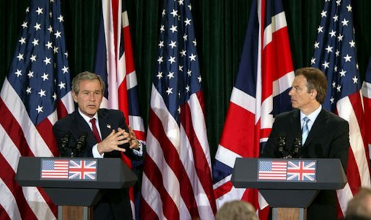
The two leaders meet at Hillsborough Castle and begin their sessions on April 7 with a half-hour walk through the gardens before dinner. The following day they hold a press conference and further talks, including a session on the Northern Ireland peace effort.
Bush and Blair, Bush’s closest ally in confronting Saddam Hussein, come together to discuss questions made increasingly urgent by the rapid military progress American and British forces have made and to plan for a postwar Iraq. They seek to bridge their differences over how much of a role to give the United Nations in rebuilding the country and putting together a new government.
Blair has been under pressure at home and from much of Europe to support giving the United Nations a strong role in stabilizing Iraq. The White House, however, has consistently signaled that it wants the United States and Britain to play the lead role in creating a new Iraqi government.
United States Secretary of StateColin L. Powell tells reporters traveling with the president that the United States is sending officials to the region to begin assembling a group of Iraqis who will constitute an interim governing authority and will be put in place alongside the American-led military and civilian authorities. In a sign of the speed with which the maneuvering for power in post-Hussein Iraq is unfolding, Ahmed Chalabi, the leader of the main Iraqi exile opposition group, the Iraqi National Congress (INC), is reported to be heading to Baghdad from southern Iraq.
“The hostilities phase is coming to a conclusion,” Powell says. “It’s time for all of us to think about the post-hostilities phase, how we create a representative government consisting of all elements of Iraqi society.”
Powell and British officials play down the magnitude of the differences between the United States and Britain over the United Nations role. The United Nations, Powell says, will have “an endorsing role to play to the interim authority to give it legitimacy,” a formulation that appears to reserve for the United States and Britain the right to select the leaders of the temporary postwar administration. A spokesman for Blair uses similar language, referring to the United Nations’ being involved “in a way that endorses that new Iraqi authority” as a step toward establishing a full-fledged Iraqi government.
Initially, primary responsibility for administering Iraq would rest with a team led by a retired United States Armylieutenant general, Jay Garner, and the interim Iraqi authority would be likely to begin assuming power after that, perhaps 90 days later, the British spokesman says.
Clearly wary of getting into another diplomatic squabble with other members of the United Nations Security Council, Powell and other administration officials have emphasized in recent days that the United States and Britain, having waged the war and paid for it with blood and money, will not be drawn into a negotiation with countries like France and Germany over the immediate postwar period.
Powell emphasizes, however, that part of his focus will now be on “healing” diplomatic wounds and granting the United Nations an important role once Iraq is stabilized.
At the United Nations, Secretary-GeneralKofi Annan says he will travel to Britain, France, Germany and Russia in the coming week to test whether the Security Council might be able to agree on a postwar plan. He announces that he has been working on post-conflict issues with a special adviser, Rafeeuddin Ahmed. He says he expects the United Nations to play an important role, whether as a political facilitator or dealing with issues like reconstruction or human rights. “Above all, the U.N. involvement does bring legitimacy, which is necessary, necessary for the country, for the region and for the peoples around the world,” Annan says.
Bush’s trip to see Blair here is the third British-American summit meeting in as many weeks. It coincides with news that American forces are attacking the presidential palaces and other symbols of the Iraqi government in the heart of Baghdad and that British soldiers have taken control of Iraq’s second-largest city, Basra.
The presence of the two leaders draws crowds of antiwar protesters and set off a local debate about whether this city, which has been trying to put behind it a history of sectarian violence, is an appropriate location for a war council.
The city authorities in Belfast have to divert traffic and clear public buildings in various locations following a series of bomb scares. The scenes are reminiscent of the conflicted time before the Northern Ireland peace agreement in 1998 put an end to organized sectarian violence that cost the lives of more than 3,600 people over three decades.
In the conversations about Iraq, Blair plays his customary role of trying to bridge trans-Atlantic differences. He hopes to placate criticism at home and ease relations with his European neighbors by pushing for a United Nations resolution authorizing an interim governing authority.
He had earlier envisaged a more prominent role for the United Nations, but he emerged from his last meeting with Bush, at Camp David on March 27, emphasizing the need for the United Nations to endorse the transition plans rather than play a central part in the plans, as he had advocated at the first summit meeting, in the Azores on March 16.
Europeans express alarm at what they see as the marginalization of the United Nations. At the same time, European critics of the war, like France, Germany and Russia, may object to Blair’s compromise proposal on grounds that it legitimizes a war they oppose. Even in Britain, the one European country where the war has majority support, there is great resistance to American domination of the postwar running of Iraq. An opinion poll in The Daily Telegraph shows that while Britons’ enthusiasm for the war has grown to a high of 60 percent and their approval of Blair’s conduct has also risen, there is only 2 percent approval of an American-controlled administration of Iraq.
Powell says the United States is only trying to lay out a plan under which military control of Iraq can give way to a mix of civilian and military control, including substantial involvement by Iraqis, and then to a full-fledged government. He says United Nations involvement might be necessary to convince banks and financial markets that they can safely and legally lend money to Iraq. Asked about peacekeeping duties, he says NATO is open to the possibility of helping to provide postwar security or assisting in the search for weapons of mass destruction.
Planning for the peace has exposed differences not only between the United States and Britain, but also within the Bush administration and between the administration and Congress.
Blair chose to hold his meeting with Bush in Northern Ireland in part so that the president can lend his support to the long-running efforts by Britain and Ireland to find a peaceful solution to the strife between Catholics and Protestants in the province. The White House, however, seems not to be paying much attention to Northern Ireland diplomacy. The schedules and credentials it distributes to reporters list the site as “Belfast, Ireland.”
(From: “Bush Meets With Blair to Discuss Postwar Iraq” by Richard W. Stevenson and Warren Hoge, The New York Times, http://www.nytimes.com, April 8, 2003)
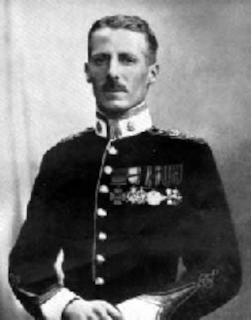
Roupell is born into a military family. His father, Francis Frederick Fyler Roupell, having served with the British Army in the 70th (Surrey) Regiment of Foot and commanded the 1st Battalion, East Surrey Regiment from 1895 to 1899, is promoted to colonel in 1901. He had married Edith Maria Bryden at Kingston in 1887.
At the outbreak of war in the summer of 1914, the 1st Battalion the East Surreys are deployed as part of the British Expeditionary Force (BEF) into northern Belgium. Roupell commands a platoon in the BEF’s first major action, the Battle of Mons, in August 1914. He keeps a diary throughout the war, which has since been a, sometimes humorous, source of insight and observation on the events that he witnessed and participated in. In the trenches at Mons, he recounts how he had to hit his men on the backside with his sword in order to gain their attention and remind them to fire low as they had been taught.
Soon after, following the retreat from Mons in September 1914, Roupell leads his platoon in the First Battle of the Aisne. Once again, he comes under heavy fire, this time while crossing the Aisne on a raft. The Surreys’ advance is pushed back with heavy casualties.
On April 20, 1915, during the continued fighting around Ypres, Roupell is commanding a company of his battalion in a front trench on “Hill 60,” which is subjected to a most severe bombardment throughout the day. Although wounded in several places, he remains at his post and leads his company in repelling a strong German assault. During a lull in the bombardment, he has his wounds hurriedly dressed, and then insists on returning to his trench, which is again being subjected to severe bombardment. Toward evening, his company being dangerously weakened, he goes back to his battalion headquarters, represents the situation to his commanding officer, and brings up reinforcements, passing back and forth over ground swept by heavy fire. With these reinforcements he holds his position throughout the night, and until his battalion is relieved next morning. For these actions he is awarded the Victoria Cross.
Roupell is presented with his VC by King George V on July 12, 1915. In addition to his Victoria Cross, he is awarded the Russian Order of St. George (4th Class) and the French Croix de guerre and is mentioned in dispatches. He is retrospectively appointed temporary captain with effect from December 29, 1914, to April 20, 1915, inclusive, and again later the same year.
Roupell is aboard TSS The Queen when it is captured and sunk in the English Channel in October 1916. He is appointed acting brigade major on December 29, 1917. On May 9, 1918, he is seconded to the general staff with the rank of temporary major.
Following the end of hostilities in Europe, Roupell, still an acting major, is promoted to acting lieutenant colonel in charge of a battalion from December 1918 to March 1919. His appointment to the general staff is confirmed on July 1, 1919. During this time, he is attached to the allied force under Edmund Ironside and sent to support Tsarist Russians as part of the Allied intervention in the Russian Civil War. On a visit to a Tsarist unit, they mutiny, and he and others are taken prisoner near Arkhangelsk, sent to Moscow, and finally repatriated in 1920.
Early in 1921, Roupell marries Doris P. Sant in Paddington. Daughter Phoebe and son Peter are born in 1922 and 1925, respectively.
Roupell’s inter-war military career continues with appointments as staff captain (1921), brigade major (1926), and promotion to substantive major (1928). During the inter-war period, he serves in Gibraltar, the Regimental Depot, India and the Sudan and he attends the Staff College, Camberley. As major (GSO2), he spends two years from 1929 at the Royal Military College of Canada, and in 1934 a year with the British troops in China. Following his return, he is promoted to lieutenant colonel in 1935.
At the outbreak of World War II, in September 1939, Roupell is promoted to colonel and made an acting brigadier, placed in command of 36th Infantry Brigade from October 7, 1939. His brigade is deployed as part of the 12th (Eastern) Division in April 1940 and becomes part of the British Expeditionary Force (BEF), taking part in the Battle of France. The German thrust near the river Somme toward Abbeville eventually cuts off the BEF, northern French and Belgian forces from the rest of France. His brigade headquarters near Doullens is attacked by enemy troops and, on being told of the threat, he exclaims, “Never mind the Germans. I’m just going to finish my cup of tea.”
When the brigade headquarters is overrun on May 20, 1940, Roupell gives the order for the survivors to split up into small groups and endeavour to re-contact Allied troops. He, with a captain and French interpreter, avoid capture, hiding by day and walking at night for over a month. They arrive at a farm near Rouen where the two officers remain for almost two years, working as labourers. With the help of the French Resistance, they are moved through unoccupied France into non-belligerent Spain, finally boarding a ship in Gibraltar and returning to the United Kingdom.
Following his return, Roupell is appointed commanding officer of the 114th Brigade, part of the 38th (Welsh) Infantry Division, on March 18, 1943, a command he holds until November 2 of that year. The brigade is not destined to see battle, however, and he is soon appointed as garrison commander at Chatham, where he remains until retirement.
In 1946, Roupell is formally retired from the army on retirement pay and granted the honorary rank of brigadier and, at the age of 58, is excused from the reserve list of officers in 1950. He is appointed a Deputy lieutenant of Surrey in 1953.
In 1954, Roupell is appointed Colonel of the East Surreys, succeeding Lieutenant General Arthur Dowler, and is to be the last Colonel of the East Surrey Regiment, relinquishing office in 1959 when amalgamation with the Queen’s Royal Regiment (West Surrey) takes place to form the Queen’s Royal Surrey Regiment. He is appointed a Companion of the Order of the Bath in 1956.
Roupell dies at the age of 81 in Shalford, Surrey, on March 4, 1974. His body is cremated at Guildford Crematorium, where his ashes are scattered.
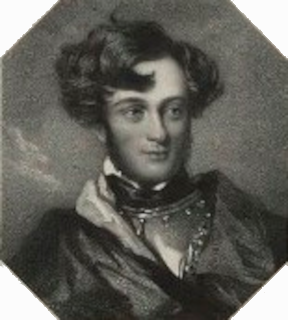
In 1838, Hill purchases land in Gweedore (Irish: Gaoth Dobhair), a “district” in northwest County Donegal in the west of Ulster, and, over the next few years, he expands his holdings to 23,000 acres. He himself describes the condition of the local population as “more deplorable than can well be conceived.” According to the schoolmaster, Patrick McKye, they are in the “most needy, hungry and naked condition of any people.” Among other improvements, he builds a port, Bunbeg Harbour, to encourage fishing, improves the roads and other infrastructure, and constructs The Gweedore Hotel to attract wealthy tourists.
However, Hill’s attempts to reform local farming practices, in particular, his suppression of the rundale system of shared landholding, proves unpopular and controversial. While his reforms may have protected Gweedore from the worst effects of the Great Famine of the 1840s, as the local population did not decrease, as it did elsewhere in Ireland, his attitude to the famine is uncompromising and unsympathetic:
“The Irish people have profited much by the Famine, the lesson was severe; but so were they rooted in old prejudices and old ways, that no teacher could have induced them to make the changes which this Visitation of Divine Providence has brought about, both in their habits of life and in their mode of agriculture.”
Hill’s book Facts from Gweedore (1845) provides an account of conditions in Gweedore and seeks to explain and justify Hill’s agricultural reforms. It runs to five editions and plays a large part in the bitter public debates about the effects of Irish landlordism. In June 1858, he gives evidence to a House of Commonsselect committee on Irish poverty. The committee is critical of his actions.
Hill is twice married, to two sisters, daughters of Edward Austen Knight, brother of Jane Austen. On October 21, 1834, he marries Cassandra Jane Knight (1806–42). They have four children:
Norah Mary Elizabeth Hill (December 12, 1835 – April 24, 1920)
Captain Arthur Blundell George Sandys Hill (May 13, 1837 – June 16, 1923)
Augustus Charles Edward Hill (March 9, 1839 – December 9, 1908)
Cassandra Jane Louisa Hill (March 12, 1842 – August 16, 1901)
On May 11, 1847, Hill marries Louisa Knight (1804–89), niece and goddaughter of Jane Austen. She had moved to Ulster after Cassandra’s death to look after the children. The marriage prompts a parliamentary investigation into the legality of a marriage between a widower and his deceased wife’s sister. They have one son:
George Marcus Wandsbeck Hill (April 9, 1849 – March 22, 1911)
Hill dies at his residence, Ballyare House, in Ramelton, County Donegal, on April 6, 1879. He is buried at Conwal Parish Church in Letterkenny, alongside his first wife.
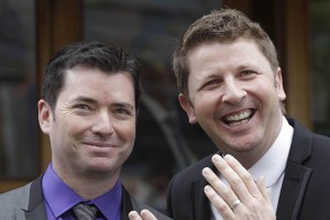
Filmmaker and lecturerBarry Dignam and his partner of seventeen years, Hugh Walsh, become the first gay couple in Irish history to enter into a civil partnership on April 5, 2011. The event takes place at the Registry Office in Dublin City Centre.
Dignam and Walsh hail their wedding as an emotional milestone. The couple says their simple civil partnership ceremony signals how far the country has come on in recent years.
Both have already set their sights on full marriage, allowing the same rights and protections afforded to heterosexual partners, as the next landmark in a struggle for equality.
“We just need that little bit more of a push now,” says a beaming Dignam alongside his partner moments after the ceremony. “Now that people realise the sky is not going to fall down, that push for civil marriage is not a far journey at all.”
Dignam and Walsh say they have been waiting seventeen years to formalise their commitment to each other in the eyes of the State.
“When we met it was illegal to be gay in Ireland,” Dignam says. “Now we are having a civil partnership, it is pretty amazing the change that’s happened. But we still have places to go yet.”
The Dubliners become the public face of same-sex weddings in the Republic of Ireland as the first in line to openly exchange vows after the mandatory three-month wait.
Six other gay couples who were granted court exemptions have already signed the partnership register, away from the spotlight, since the laws were enacted at the beginning of the year.
Ahern is urged by Paisley to ensure that criminals who flee across the Irish border are arrested. The Democratic Unionist leader makes the proposal during a cordial one-and-a-half-hour meeting at Farmleigh in Phoenix Park, where the two leaders exchange their first public handshake.
Afterwards Paisley, who receives an invitation from the taoiseach to visit the Battle of the Boyne site later in the year, says that they had also discussed the need for the new administrations in Northern Ireland and in the Republic of Ireland to work for each other’s best interests. “We can confidently state that we are making progress to ensure our two countries can develop and grow side by side in the spirit of generous cooperation,” he declares. “I trust that old barriers and threats will be removed in my day. Business opportunities are flourishing. Genuine respect for the understanding of each other’s differences and, for that matter, similarities is now developing.”
Earlier the DUP leader, who becomes the First Minister of the new power-sharing government on May 8 alongside Sinn Féin‘s Martin McGuinness as deputy First Minister, firmly shakes the hand of Ahern in public for the first time. As he arrives at Farmleigh, he quips, “I better shake the hands of this man. I’ll give him a firm handshake.”
Paisley, who is accompanied by his son, Ian Paisley, Jr., affectionately grabs the taoiseach by the shoulder. There is another handshake after the meeting at Farmleigh is finished.
Paisley says, “Mr. Ahern has come to understand me as an Ulsterman of plain speech. He didn’t ever need a dictionary to find out what I was saying. We engaged in clear and plain speech about our hopes and our aspirations for the people we both serve. The prime minister kindly congratulated me on my election victory.”
Paisley says that he had raised a number of issues crucial to unionists. “I have taken the opportunity to raise with the prime minister a number of key matters including ensuring that fugitives from justice who seek to use the border to their advantage are quickly apprehended and returned without protracted legal wrangle.” He adds, “I raised other legal issues of interests to unionists, and we discussed cooperation of an economic nature that will be to our mutual benefit.” He also says he had raised the issue of bringing Northern Ireland’s corporation tax into line with that of Ireland.
Regarding the invitation to visit the site of the Battle of the Boyne, Paisley says, “We both look forward to the visit to the battle site at the Boyne… Not to refight it, because that would be unfair, for he would have the home advantage. No Ulsterman ever gives his opponents an advantage. He adds, “Such a visit would help to demonstrate how far we have come when we can celebrate and learn from the past, so the next generation more clearly understands.”
Ahern pays tribute to the leadership shown by Paisley in helping to deliver a better future for the people of Northern Ireland. As Northern Ireland’s politicians continue at great pace to prepare for the return of power sharing, the taoiseach says that the progress has been very encouraging. “At this important time in our history, we must do our best to put behind us the terrible wounds of our past and work together to build a new relationship between our two traditions,” he says. “That new relationship can only be built on a basis of open dialogue and mutual respect. I fervently believe that we move on from here in a new spirit of friendship. The future for this island has never been brighter. I believe that this is a future of peace, reconciliation and rising prosperity for all. We stand ready to work with the new executive. We promise sincere friendship and assured cooperation. I believe that we can and will work together in the interests of everyone on this island.”
Ahern says he believes that the Battle of the Boyne site can be a symbol of the new beginning in the relationship between governments in Belfast and Dublin. “I believe that this site can become a valuable and welcome expression of our shared history and a new point of departure for an island, north and south, which is at ease with itself and respectful of its past and all its traditions,” he declared.
The Battle of the Boyne was fought in 1690 between the followers of England‘s King William of Orange, a Protestant, and the deposed King James, a Catholic, in Drogheda, eastern Ireland. Ireland was at that point under English rule. The battle is commemorated by many Northern Irish loyalists on July 12 each year.
Ministerial posts within the new devolved Stormont government have yet to be finalised. Already Sinn Féin has announced that MPs Michelle Gildernew and Conor Murphy and assembly members Gerry Kelly and Caitríona Ruane will be members of the government. However, the party has not yet indicated which of the four will take the three senior cabinet posts in education, agriculture and regional development and which one will be the junior minister in the Office of First and Deputy First Minister.
The DUP has also yet to name its ministers, but it has chosen finance, economy, environment and culture arts and leisure as the government departments it will head. The DUP’s deputy leader, Peter Robinson, and Nigel Dodds, the Belfast North MP, who both served in the last devolved government, are tipped to be the finance and economy ministers.
The Ulster Unionist Party (UUP) has yet to declare who their two ministers will be at the Departments of Health and Employment and Learning.
(From: “Upbeat Paisley shares first handshake with Irish PM” by Hélène Mulholland and agencies, The Guardian, http://www.theguardian.com, April 4, 2007)
Cuffe joins the Green Party in 1982, and campaigns with Students Against the Destruction of Dublin (SADD) in the 1980s. He is twice elected to Dublin City Council, in 1991 and 1999, for the South Inner City electoral area. In 1996, he launches a free bikes scheme in which bicycles are placed around Dublin city centre for use by the public.
In June 2003, Cuffe steps down as the Green Party’s environment spokesperson after it is revealed that he held shares worth $70,000 in a number of oil exploration companies which he had inherited when his late mother had left him $1.3 million in her will. He is re-elected at the 2007 Irish general election.
Following the 2007 election, the Green Party forms a coalition government with two other political parties and a number of independent TDs. Just after the election, on May 28, 2007, Cuffe writes in his blog: “A deal with Fianna Fáil would be a deal with the Devil. We would be spat out after 5 years and decimated as a party.” He loses his seat at the 2011 Irish general election.
While Cuffe is minister, the Oireachtas enacts the Planning and Development (Amendment) Act 2010 to address land-use planning failures and over-zoning of development land. The legislation reforms the way development plans and local area plans are made and, for the first time in Irish legislation, includes a definition of Anthropogenic Climate Change and required energy use to be taken into account in planning decisions. He publishes the Climate Change Response Bill 2010, and an update of the National Spatial Strategy. He is head of the Irish delegation at the 2010 United Nations Climate Change Conference in Cancún, Mexico.
Cuffe promotes healthy eating for children, school gardens and local markets. He publishes bills to address climate change, noise pollution, and heritage protection. In January 2011, he launches a new policy of allowing bicycles on off-peak Dublin Area Rapid Transit (DART) trains.
Cuffe resigns as Minister of State on January 23, 2011, when the Green Party withdraws from government.
At the 2014 Irish local elections, Cuffe is elected to Dublin City Council for Dublin North Inner City area, on the 13th count. He is appointed chairperson for the Dublin City Council Transportation Committee in 2014. As a member of the Central Area Committee for Dublin City Council, he works to provide a site for the Gaelscoil Choláiste Mhuire primary school on Dominick Street in 2017. He introduces 30 km/h speed limits to residential and school areas of Dublin and also advocates for a car-free College Green. He calls for an increase in affordable housing in Dublin, specifically for people with different incomes. Speaking on the Strategic Development Zone in the Dublin Docklands, he states, “We have seen a lot of cranes in the Docklands but not a lot of homes. Particularly affordable homes.” He proposes a Motion declaring a Climate Emergency which is approved at a meeting of the Council on May 13, 2019.
Cuffe is selected as the Green Party candidate for the Dublin constituency at the 2019 European Parliament elections. He tops the poll, receiving 63,849 votes and is elected as an MEP on the 13th count, with 17.54% first preference votes. He is also re-elected to Dublin City Council, but due to the prohibition on a dual mandate, this seat is co-opted to fellow Green Party member Janet Horner.
Cuffe is President of the European Forum for Renewable Energy Sources (EUFORES), a cross-party European parliamentary network gathering members of European, regional and national parliaments of the EU, and works to promote renewable energy and energy efficiency.
Warfield is raised in the Dublin suburb Inchicore, the second born in a family of four boys. Today, he and his wife June Warfield (née Radburn) reside in Blessington, County Wicklow.
Warfield is one of the founding members and lead singers of the Irish Folk band, The Wolfe Tones. He has written many songs for the band, notably “Up and Away (The Helicopter Song),” “Irish Eyes” and “My Heart is in Ireland.” “Let the People Sing” is written in dedication to those Irish ballad singers who were banned from singing Irish songs. It has been performed by many Celtic and Irish Rebel bands, including Celtic band Charlie and the Bhoys. The song is popular among fans of Celtic F.C. and a version is performed by The Malleys, omitting the second verse, at Celtic Park on match days.
Warfield’s affiliation with Celtic F.C. leads to him being asked to write a song for the club to celebrate its 100th anniversary. As a result, “Celtic Symphony” is composed. It is a song popular with many Celtic fans, but controversial due to its chorus, which features the words “ooh, ah, up the RA.” This is often seen as being a pro-Irish Republican Army (IRA) stance, but according to Warfield, the words were included in the balladic tradition of writing what is observed at the time.
As a songwriter, Warfield’s writing is typically a social commentary on Ireland and its issues. For the 2012 album, Child of Destiny, Warfield composes “Swing A Banker,” which is a comical ballad referring to Irish bankers as chickens. The music video is recorded outside the Treasury Building in Dublin.
The Wolfe Tones continue to tour but have announced that they are set to retire in 2024, after 60 years of performing together. In addition to gigs in the United States, there will be concerts at Galway Airport, Castlebar, County Mayo, and in the 3Arena in Dublin, with the band’s final gig taking place in Belfast in October 2024.
As of January 2024, Warfield has not communicated with his brother Derek Warfield since he left The Wolfe Tones in 2001.
The Battle of the Curragh (Irish: Cath an Churraigh) is a battle fought on April 1, 1234, on the Curragh plain in County Kildare. The adversaries are men loyal to King Henry III of England on one side, and on the other side Richard Marshal, 3rd Earl of Pembroke and Lord of Leinster, who loses the battle and later dies from the wounds he suffers. The battle is a small affair in the number of knights involved but is still significant because it ends the career of the popular Richard Marshal.
The conflict between Richard Marshal and Henry III goes back several years, and centres particularly on the earl’s discontent with the influence that certain foreigners hold over the king. Most prominent among these is the PoitevinPeter des Roches, bishop of Winchester. In March 1234, a truce is reached between the king and Marshal, the condition of which is the removal of Peter des Roches from court. In the meanwhile, however, conflict has broken out in Ireland between Marshal’s brothers and some of the king’s supporters. These include Maurice FitzGerald, Justiciar of Ireland, Walter de Lacy, Lord of Meath, and Hugh de Lacy, 1st Earl of Ulster. Richard Marshal crosses the Irish Sea to Ireland to assist his brothers, where he meets with the enemies at the Curragh on April 1. Here he is defeated and captured. He is taken to Kilkenny Castle, where he dies from his injuries on April 16.
Richard Marshal had become highly popular in England because of his fight against foreign influence at court, and for this reason the accounts of the battle are idealised and not necessarily reliable. According to contemporary accounts, he is tricked into meeting his enemies at the Curragh and then deserted by his own forces. Rather than flee, he remains to fight against the odds, allegedly with only fifteen knights against 140. His popularity also means that his death is mourned in England, while the Poitevins, who are rumoured to have instigated the Irish war, fall further into disregard. Henry III nevertheless rewards Marshal’s Irish opponents richly.




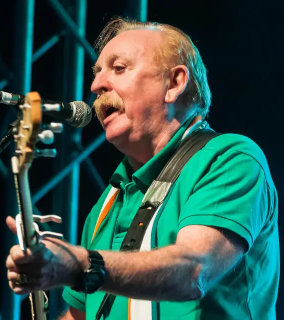

 seamus dubhghaill