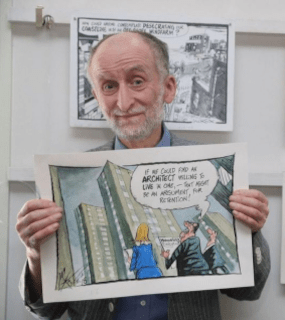
Knox trains as an architect at Edinburgh College of Art in Scotland from 1963 to 1967 and Heriot-Watt University in Edinburgh from 1967 to 1968 and works as an architect before establishing himself as a cartoonist. He works in animation from 1970 to 1975 for Halas & Batchelor in London, Potterton Productions in Montreal, and Kotopoulis Productions in Toronto. He then joins Red Weekly and Socialist Challenge as a political cartoonist, as well as contributing to various children’s comics for IPC Media from 1975 to 1988.
Knox signs much of his political work “Blotski,” and he and Republican News cartoonist Brian Moore, better known as “Cormac,” work together as “Kormski,” drawing the anti-clerical strip “Dog Collars” for Fortnight magazine. Since 1989 he has been the editorial cartoonist for The Irish News, a nationalist newspaper based in Belfast. Since 1996 he has contributed the “As I See It” feature to Hearts and Minds on BBC2 Northern Ireland. From 1997 to 1998 he is political cartoonist for Ireland on Sunday.
The oath, pledging allegiance to the Constitution and fidelity to George V as King of Ireland, is required by the Anglo-Irish Treaty signed in 1921, and has been the symbolic focus of Irish republican opposition to the Treaty in the 1922–23 Irish Civil War. When Fianna Fáil is founded in 1926 by veterans of the losing anti-Treaty side in the Civil War, abolishing the oath is a core aim. It is a main item in the manifesto for its successful 1932 Irish general election campaign, after which it forms a minority government whose first action is to introduce the Constitution (Removal of Oath) Bill 1932. Seanad Éireann has more ex-unionists and others conciliatory towards the United Kingdom and vote to reject the bill unless the Treaty can be amended by agreement. After the 1933 Irish general election, the Fianna Fáil majority government is able to override the Seanad and enact the law.
As well as amending the Constitution, the 1933 act also amends the Constitution of the Irish Free State (Saorstát Eireann) Act 1922, which had both created the Constitution in Irish law and also prohibited any Constitutional amendment incompatible with the Treaty. Since the Free State cannot unilaterally amend the Treaty, Fianna Fáil amends the 1922 act to remove the Treaty’s precedence over the Constitution. Later constitutional amendments are also incompatible with the terms of the Treaty, in particular by weakening and ultimately abolishing the office of Governor-General of the Irish Free State. There is legal controversy over whether the Oireachtas has the power to amend the 1922 act, because it had been passed by the Third Dáil sitting as a constituent assembly before the Oireachtas had come into being. In 1935 the Judicial Committee of the Privy Council (JCPC) in London rules that, in British law, the Oireachtas does have the power, under the Statute of Westminster 1931. Irish jurisprudence takes issue with many of the assumptions underlying the 1935 decision.
Orr is the eldest son of Fletcher Blakely Orr of Ballystockart, a unitarian farmer and millowner, and Elizabeth Orr, daughter of David Lowry, farmer, of Ballymacashin, County Down. He attends a local national school, spends two years at an intermediate school in Newtownards, and then attends Methodist College Belfast (MCB). He wins a Royal University of Ireland (RIU) scholarship in mathematics in 1883 and graduates in 1885 from Queen’s College Belfast, a constituent college of the RUI. He then matriculates at St. John’s College, Cambridge, where he is Senior Wrangler in 1888 and comes in first in part two of the Mathematical Tripos in 1889. Two years later he is elected to a fellowship at St. John’s, and the same year is appointed professor of applied mathematics at the Royal College of Science for Ireland in Dublin. When the Royal College is merged with University College Dublin (UCD) in October 1926, he becomes professor of pure and applied mathematics, a position he holds until his retirement in 1933.
Orr’s 1909 publication Notes on Thermodynamics for Students is seen as epitomising his style of teaching, with its emphasis on logical rigour and clear statement of underlying assumptions. Known for his generosity to staff and students who encounter difficulties, he is nonetheless a strict disciplinarian who abhors idleness and valued stoicism. He is elected Fellow of the Royal Society (FRS) in 1909 and is awarded an honorary degree of D.Sc. from Queen’s University Belfast (QUB) in 1919.
In 1892, Orr marries Elizabeth Campbell of Melbourne, Australia, whose father, Samuel Campbell, is from County Down. They live at 19 Pembroke Road, Dublin, and have three daughters. He dies at Douglas, Isle of Man on August 14, 1934, and is interred in Mount Jerome Cemetery, Dublin. He is survived by his two daughters.
(From: “Orr, William McFadden” contributed by Paul Rouse, Dictionary of Irish Biography, http://www.dib.ie)
Rolleston is the youngest child among three sons and a daughter of Charles Rolleston-Spunner, barrister and county court judge for Tipperary, and his wife Elizabeth, daughter of John Richards, judge and baron of the Court of Exchequer, Ireland. He attends St. Columba’s College, Rathfarnham, where he is head boy, and Trinity College Dublin (TCD), graduating with an MA in 1878. His literary ambitions first emerge at university, where he wins the vice-chancellor’s prize for English verse in 1876.
In 1879 Rolleston marries Edith Caroline, daughter of Rev. William de Burgh of Naas, County Kildare. She suffers from rheumatism, and this encourages the couple to live in Germany from 1879 to 1883. During this period, he develops a fascination for German philosophy and literature and begins a correspondence with the American poet Walt Whitman, whose work he knows through Edward Dowden. In 1881 he offers to translate into German, with S. K. Knortz, Whitman’s Leaves of Grass. This is published as Grashalme in 1889. In that year he also publishes a biography of the German philosopher Gotthold Lessing, and in 1892 delivers the Taylorian Lectures at the University of Oxford on this subject.
In the meantime, Rolleston has returned to Ireland and co-founds the Dublin University Review (DUR) with Charles Hubert Oldham in February 1885. In March 1885, under their stewardship the DUR is the first to publish W. B. Yeats. The poetry of Katharine Tynan and the first English translations of Ivan Turgenev also appear in the magazine. He has a fondness for clubs and at this time is associated with the Contemporary Club, where he becomes friendly with fellow member Douglas Hyde, and the Young Ireland Society, where he is vice-president and a disciple of John O’Leary. He writes the dedication to O’Leary in Poems and ballads of Young Ireland (1888) and is encouraged by the older man in his editing of The prose writing of Thomas Davis (1890). Under O’Leary’s influence he flirts with Fenianism, perhaps even joining the Irish Republican Brotherhood (IRB) for a time and is strongly critical of the prominent involvement of Catholic clergy in the home rule movement.
After the demise of the DUR in December 1886 Rolleston moves to London but remains involved in Irish literary activity. Although unenthusiastic in his assessment of The Wanderings of Oisín (1889), he is friendly with Yeats, and they instigate the Rhymers’ Club (1890). He is a much better critic and organiser than poet but contributes to The Book of the Rhymers’ Club (1892) and The Second Book of the Rhymers’ Club (1894). His work appears in a number of contemporary journals and anthologies, and he has one collection published, Sea Spray (1909).
Rolleston is first secretary of the Irish Literary Society (1892) and attends the foundation of its sister organisation in Dublin, the National Literary Society. These societies are soon riven by a dispute for control between Yeats and Charles Gavan Duffy, centred on the political and literary agenda of the movement. Rolleston at least acquiesces in, if not actively contributes to, Yeats’s defeat. They remain on reasonable terms, but Yeats is resentful. Rolleston edits the famous anthology, Treasury of Irish Poetry (1900), with the Rev. Stopford Augustus Brooke, whose daughter, Maud, he had married in October 1897. They have four children. His first marriage also produces four children, and he is godfather to Robert Graves, whose father, Alfred Perceval Graves, is a friend.
In 1894 Rolleston returns to Dublin, becoming managing director and secretary of the Irish Industries Association (1894–7) and honorary secretary of the Arts and Crafts Society of Ireland (1898–1908). A central figure in the latter as an organiser, propagandist, and critic rather than a practitioner, lecturing regularly and editing the journal of the society, he seeks to integrate the arts and crafts revival with other contemporary developments, cooperating with the Congested Districts Board for Ireland to organise classes. He is a supporter of the co-operative movement of Horace Plunkett, and a member of the Recess Committee. On the foundation of the Department of Agriculture and Technical Instruction (DATI), he is employed by Plunkett and T. P. Gill as organiser of lectures (1900–05). In this capacity he manages the Irish historic collection at the St. Louis exhibition of 1904 and publicly supports Plunkett in his dispute with the DATI in 1908. Convinced that the development of Irish industry is central to national progress, he believes that the Irish Parliamentary Party (IPP) failed to offer a clear practical programme for Irish nationalism. By 1900, however, his own nationalism is tempered by a belief in the importance of the imperial connection, and he opposes the pro-Boer stance taken by many Irish nationalists. In later years he publishes pamphlets urging economic development as a means of quelling Irish demands for home rule.
Rolleston is a sporadic member of the Gaelic League, writing the lyrics for the ‘Deirdre cantata,’ which wins first prize at the first Feis Ceoil in Dublin in 1897. At one point he suggests the foundation of a separate Gaelic League for Protestants and provokes controversy in 1896 by suggesting that scientific ideas cannot be represented in the Irish language. Later, he concedes that he is wrong. In 1909 he settles in London when offered the job of editor of the German language and literature section of The Times Literary Supplement, a position he holds until his death. He reinvolves himself in the Irish Literary Society and publishes a number of volumes based on Irish myth, including the influential Myths and Legends of the Celtic Race (1911), and Richard Wagner‘s Der Ring des Nibelungen. He is a founder of the India Society of London (1910). During the World War I he is librarian for the ministry of information and utilises his knowledge of Irish in the Obscure Languages section of the censor’s department.
Like many involved in cultural activities at this time Rolleston is satirised by George Moore in Hail and Farewell, but he remains very friendly with Moore, who dedicates the 1920 edition of Esther Waters to him. Rolleston dies suddenly on December 5, 1920, at his home in Hampstead, London. His widow donates many of his books to Cork Public Library.
(From: “Rolleston, Thomas William Hazen (T. W.)” contributed by William Murphy, Dictionary of Irish Biography, http://www.dib.ie)
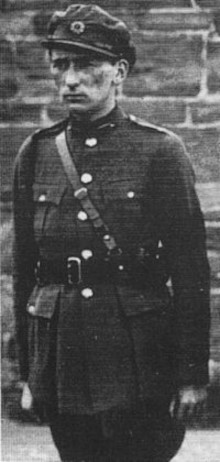
Tobin is born William Joseph Tobin at 13 Great Georges Street in Cork, County Cork, on November 15, 1895, the eldest son of Mary Agnes (nee Butler) and David Tobin, a hardware clerk. He has two younger siblings, Katherine and Nicholas Augustine Tobin, also born in Cork. His family moves to John Street in Kilkenny and then to Dublin. He goes to school in Kilkenny and is an apprentice in a hardware shop at the time of the 1916 Easter Rising. As a participant in the Rising he fights in the Four Courts garrison under Edward Daly. He is arrested, court martialed, and sentenced to death but his sentence is commuted to life imprisonment. He is a prisoner in Kilmainham, Mountjoy, Lewes, Dartmoor, Broadmoor and Pentonville prisons. He is released in June 1917.
In October 1921, Tobin travels with the Irish Treaty Delegation as part of Collins’ personal staff.
Tim Pat Coogan and James Mackay have examined Tobin’s involvement in the assassination of British Field MarshalSir Henry Wilson. Wilson’s public tirades about Collins is evidence of mutual personal dislike between the two men. In May 1922 Collins tells Tobin “We’ll kill a member of that bunch” to the news of “bloody pogroms” in Belfast. Wilson is intimately involved with the Ulster loyalist cause, including the Curragh Mutiny and the establishment of the Ulster Special Constabulary. Just before the shooting, Coogan places Tobin in London. He meets courier Peig Ni Braonain at Euston Station collecting a document that has been sent from Dublin. Returning to Dublin before the incident, he is jubilant when he tells defence ministerRichard Mulcahy about Wilson’s death. Mulcahy is appalled and threatens to resign.
In October 1922, Tobin’s brother Nicholas, a Free State captain, is accidentally shot dead by his own troops during the raid and capture of a bomb making factory at number 8 Gardiner’s Place, Dublin.
Tobin believes in the stepping stone doctrine which sees the Treaty as a stage towards full independence. With the outbreak of the Irish Civil War he remains loyal to Collins and takes the Pro-Treaty side. He leads in the fight against the Anti-Treaty IRA in the south. Disillusioned with the continuing hostilities and in the aftermath of the death of Collins, he forms an association called the IRA Organisation (IRAO) or “Old Irish Republican Army” to distinguish themselves from the anti-treaty insurgents.
Richard Mulcahy, the new Irish defence minister, proposes to reduce the army from 55,000 to 18,000 men in the immediate post- Civil-War period. Tobin knows his own position is to be affected and shares the perception that the Irish Army treats former British officers better than former IRA officers. On March 7, 1924, Tobin, together with Colonel Charlie Dalton, sends an ultimatum to President of the Executive Council of the Irish Free StateW. T. Cosgrave demanding an end to the army demobilisation. The immediate response is an order for the arrest of the two men on a charge of mutiny. The cabinet, already wary of the Irish Army, orders an inquiry and appoints Garda CommissionerEoin O’Duffy to the army command.
On March 18, the mutineers assemble with hostile intent at a Dublin pub. An order is made to arrest the mutineers and the cabinet demands the resignation of the army council. The generals resign, affirming the subservience of the military to the civilian government of the new state.
In later years, Tobin rebuilds relations with his Civil War foes and joins Éamon de Valera‘s Anti-Treaty Fianna Fáil party. He joins up with Joseph McGrath to form the Irish Hospitals’ Sweepstake in the 1930s. Many other former army comrades find work in this lottery. He leaves the Sweep in 1938. After World War II, he becomes Superintendent of the Oireachtas for the Irish Dáil.
On October 14, 1929, Tobin marries Monica “Mona” Higgins at the Church of the Holy Family, Aughrim Street, Dublin. They have two daughters, Máire and Anne Tobin. Following the death of his father, David, in 1956, Tobin’s health declines, resulting in his death in Dublin on April 30, 1963.
Moran grows up in Rialto, Dublin until his early teens, before he moves to the Long Mile Road in Walkinstown. While there, he attends James’s Street CBS and Drimnagh Castle Secondary School where Gaelic football is the dominant sport although association football proves to be the sport he plays on the streets while growing up. During the period in which he plays Gaelic football for Good Counsel GAA and association football for Rangers A.F.C., Bohemian F.C. and Pegasus A.F.C., he has divided loyalties between the two sports, as both sports are then played on Saturday.
In his native Ireland, Moran plays at senior level for the Dublin county football team. A former Dublin under-21 player, he is called up to the senior panel for the first time in 1976. He wins two All-Ireland Championship medals with Dublin in 1976 and 1977. In the 1976 final, he helps Dublin to defeat (by 3–8 to 0–10) Kerry, the winner over Dublin in the 1975 final, and again in the 1977 semi-final, aided by new tactics which manager Kevin Heffernan introduces, and which hinders Kerry’s tactic of pulling defenders forward and taking full advantage of the space behind the half-back line. The 1977 final results in a 5–12 to 3–6 victory over Armagh at Croke Park. He is awarded a GAA GPA All-Stars Award for his performance in the 1976 championship.
Moran is also part of the 1976–77 side that wins the National Football League for Dublin with a win over Derry in the final. He plays his club football for Dublin-based GAA club Good Counsel.
With Bohemian F.C. winning everything bar the FAI Cup in the 1974-75 League of Ireland season, 18-year-old Moran does not have an opportunity for much game time and only makes one League of Ireland appearance in the last game of the season on April 17, 1975. After Bohs he moves to University College Dublin A.F.C. where in December 1975 he wins the Collingwood Cup. In February 1976 he wins the Universities Championship when he scores the winner for the Irish Universities against their Scottish counterparts. He plays for Pegasus A.F.C. from 1976-78.
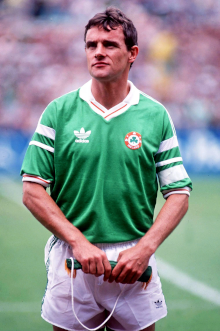
Moran is spotted by Billy Behan, a Manchester United F.C. scout, who reports to United manager Dave Sexton, and Moran signs for Manchester United in February 1978. He makes his senior debut on April 20, 1979, against Southampton F.C., and is a regular player in the first team by the time Ron Atkinson succeeds Sexton as manager in June 1981. Despite not being the tallest of defenders, he is known for his strong aerial ability and is a threat in the box from corners and set pieces. Playing as a centre-back, he wins FA Cup medals with the club in 1983 and 1985.
Moran is notable for being sent off in the 1985 FA Cup Final against Everton F.C., the first player ever to be sent off in an FA Cup final. TV cameras reveal that he had gone for the ball, and not for Peter Reid in the offending tackle. He is later presented with the winner’s medal that had at first been withheld.
After 10 years with United, Moran leaves Old Trafford as a 32-year-old in the summer of 1988, having played his final 18 months at the club under the management of Alex Ferguson. His first team opportunities are limited since the arrival of Steve Bruce in December 1987.
Moran transfers to Sporting Gijón, where he remains for two seasons, making 33 appearances without scoring. During his time at Sporting Gijón, he rooms with promising youngster and future Real Madrid CF and FC Barcelona star Luis Enrique.
In 1990, Moran returns to England to join Second DivisionBlackburn Rovers F.C. He is an automatic choice in the first team but endures a disappointing first season at Ewood Park as Rovers finishes 19th in the Second Division. The following season is a huge success, however, as playoff victory ends the club’s 26-year exile from the top division and secures their place in the new Premier League. He continues in his role as club captain as Rovers finishes fourth in 1992–93 and runners-up in 1993–94. He retires at the end of the 1993–94 season, one year before Rovers wins their first league title in 81 years. In both seasons preceding his retirement, Rovers are beaten to the title by his old club, Manchester United.
Moran makes his debut for the Republic of Ireland against Switzerland in 1980 and plays a key role in Ireland’s unsuccessful attempt to qualify for the 1982 FIFA World Cup finals in Spain. He plays 71 times for Ireland between 1980 and 1994, including UEFA Euro 1988 in Germany and the 1990 FIFA World Cup in Italy, and scores 6 goals. He is also a member of the Irish squad at the 1994 FIFA World Cup in the United States, despite being 38 years old and about to retire from playing completely but does not play due to an injury he picks up before the tournament starts.
After retiring from football, Moran makes a career in business. In 1994, he forms a football agency, Proactive Sports Management, with Paul Stretford and Jesper Olsen. His own clients include John O’Shea and Steve Finnan. He also works as a pundit on Irish television channel TV3.
Kearney is the third daughter of farmer Michael Kearney and Teresa Kearney. Three months prior to her birth, her father dies in an accident. Following his death, her mother remarries and has three more children. When she is ten years old, her mother dies. Her maternal grandmother, Grannie Grenell, then raises her in Curranstown, County Wicklow. Grannie Grenell has a profound impact on her spiritual beliefs and deep faith. When she is 17, Grannie Grenell dies.
Kearney attends the local convent school in Arklow following her mother’s death. In 1889, following her grandmother’s death, she goes to convent of Mercy at Rathdrum, to train as an assistant teacher. She does not have the finances to pay for training, and becomes a Junior Assistant Mistress. A year later, she goes to teach in a school run by the Sisters of Charity in Essex.
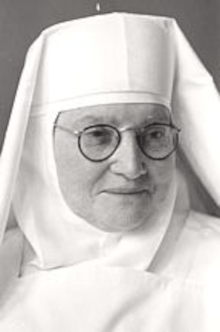
Following the death of her grandmother, Kearney turns toward thoughts of religious life. She believes that God is calling her to be a sister, and she applies for admission to the Franciscan Missionary Sisters of the Five Wounds at Mill Hill, London. In 1895, she enters the St. Mary’s Abbey, Mill Hill. On April 21, 1898 she takes the name Sister Mary Kevin of the Sacred Passion. Her motto is “For Thee, Lord.” She volunteers to work with African Americans in London. She waits three years for a posting to the American mission, but when the call from a foreign mission comes, it comes from Africa.
On December 3, 1902, Kearney and five other sisters leave London for Nsambya, Uganda. They are chosen at the request of Bishop Henry Hanlon of the Mill Hill Fathers. The sisters arrive on January 15, 1903 and establish a dispensary and school in the Buganda. Their task is to care for the women and girls and to further weaken the association of Catholicism with French missionaries and Protestantism with British missionaries in the then British Protectorate. Among the sisters are three Irish, one American, one English, and one Scottish woman.
Kearney starts her first clinic under a mango tree near the convent. The first seven years of missionary work are tough for the sisters. Various diseases, from smallpox to malaria, ravage Buganda. The infant mortality rate is also relatively high due to the high frequency of maternal deaths. In 1906, she expands the missionary and sets up a hospital in Nagalama, twenty-three miles away. She is appointed the new superior of the convent following Sister Paul’s illness and return to the United States in 1910. In 1913, three more sisters arrive, which allows her to establish a third mission station in Kamuli, Busoga. All three stations focus on medicine and education for the local population with a focus on primary and secondary education, training of nurses, and the founding of clinics, hospitals and orphanages.
During World War I, the Nsambya Hospital is used to treat the Native Carrier Corp, porters for European troops. At times, Kearney is outraged by the treatment Europeans give to the African porters. She works to uphold the rights of African people caught up in the European war. On December 25, 1918 she is awarded the Member of Order of the British Empire (MBE) for her services to the wounded during the war years.
Kearney is credited for promoting higher education in Catholic African women in her mission. In 1923, she founds the Little Sisters of St. Francis, a community of African nuns for teaching and nursing. This program starts with only eight local girls. A year later, she and Dr. Evelyn Connolly, a lay missionary, found a nursing and midwifery school in Nsambya. Their goal is to promote the education of women throughout Uganda.
In September 1928, Kearney returns to England to establish a novitiate exclusively for training sisters for African missions. The novitiate is officially opened in 1929 in Holme Hall, Yorkshire. Many women from England, Scotland and Ireland travel to Holme Hall to assist the missionary efforts. This creates a shortage for the Mill Hill Fathers, who also need sisters for their school in England and American missions. Upon realization of this divide, Kearney and the Mill Hill Fathers break off from each other. On June 9, 1952 she founds the new congregation of the Franciscan Missionary Sisters for Africa. She is appointed the first superior general. Mount Oliver, Dundalk, becomes the motherhouse for this new congregation. With the formation of the FMSA, she expands the missionary work to Uganda, Kenya, Zambia, the United States, Scotland, and South Africa.
Kearney retires in 1955 at age 80. During retirement, she is appointed Superior of a convent in Boston, Massachusetts and raises funds for African projects. She travels and talks to donors to garner support for projects in Africa.
On October 17, 1957, Kearney dies at the age of 82 in Brighton, Massachusetts. Her remains are flown to Ireland and buried at Mount Oliver. Ugandan Catholics rally to have her body flown to Uganda to be buried. On December 3, 1957, her body is buried in the cemetery at Nkokonjeru, the motherhouse of the Little Sisters of St. Francis.
Kearney’s legacy is evident today. In Uganda, the word Kevina means “hospital” or “charitable institute.” The Mother Kevin Postgraduate Medical School is named after her. The Little Sisters of St. Francis has over 500 members throughout Africa, while the Franciscan Missionary Sisters for Africa currently works in Uganda, Kenya, Zambia, Zimbabwe, and South Africa.
Mary Ward (née King), Irish naturalist, astronomer, microscopist, author, and artist, is born in Ballylin near present-day Ferbane, County Offaly, on April 27, 1827. She is killed in 1869 when she falls under the wheels of an experimental steam car built by her cousins, thereby becoming the first person known to be killed by a motor vehicle.
King is the youngest child of the Reverend Henry King and his wife Harriette. She and her sisters are educated at home, as are most girls at the time. However, her education is slightly different from the norm because she is of a renowned scientific family. She is interested in nature from an early age, and by the time she is three years old she is collecting insects.
King is a keen amateur astronomer, sharing this interest with her cousin, William Parsons, 3rd Earl of Rosse, who builds the Leviathan of Parsonstown, a reflecting telescope with a six-foot mirror which remains the world’s largest until 1917. She is a frequent visitor to Birr Castle, producing sketches of each stage of the process. Along with photographs made by Parson’s wife, Mary Rosse, her sketches are used to aid in the restoration of the telescope.
King also draws insects, and the astronomer James South observes her doing so one day. She is using a magnifying glass to see the tiny details, and her drawing so impresses him that he immediately persuades her father to buy her a microscope. A compound microscope made by Andrew Ross is purchased for £48 12s 8d. This is the beginning of a lifelong passion. She begins to read everything she can find about microscopy, and teaches herself until she has an expert knowledge. She makes her own slides from slivers of ivory, as glass is difficult to obtain, and prepares her own specimens. The physicistDavid Brewster asks her to make his microscope specimens, and uses her drawings in many of his books and articles.
Universities and most societies do not accept women at the time, but King obtains information any way she can. She writes frequently to scientists, asking them about papers they had published. During 1848, Parsons is made president of the Royal Society, and visits to his London home allows her to meet many scientists.
When Ward writes her first book, Sketches with the microscope (privately printed in 1857), she apparently believes that no one will print it because of her gender or lack of academic credentials. She publishes 250 copies of it privately, and several hundred handbills are distributed to advertise it. The printing sells during the next few weeks, which prompts a London publisher to take the risk and contract for future publication. The book is reprinted eight times between 1858 and 1880 as A World of Wonders Revealed by the Microscope. A new full-colour facsimile edition at €20 is published in September 2019 by the Offaly Historical and Archaeological Society, with accompanying essays.
Her books are A Windfall for the Microscope (1856), A World of Wonders, Revealed by the Microscope (1857), Entomology in Sport, and Entomology in Earnest (1857, with Lady Jane Mahon), Microscope Teachings (1864), Telescope Teachings (1859). She illustrates her books and articles herself, as well as many books and papers by other scientists.
Ward is the first known automobile fatality. William Parsons’ sons had built a steam-powered car and on August 31, 1869, she and her husband are traveling in it with the Parsons boys, Richard Clere Parsons and the future steam turbine pioneer Charles Algernon Parsons, and their tutor, Richard Biggs. She is thrown from the car on a bend in the road at Parsonstown (present-day Birr, County Offaly). She falls under its wheel and dies almost instantly. A doctor who lives near the scene arrives within moments, and finds her cut, bruised, and bleeding from the ears. The fatal injury is a broken neck. It is believed that the grieving family destroys the car after the crash.
Ward’s microscope, accessories, slides and books are on display in her husband’s home, Castle Ward, County Down. William Parsons’ home at Birr Castle, County Offaly, is also open to the public.
Finucane contributes humanitarian aid during the Nigerian Civil War (also known as the “Nigerian-Biafran War”), from 1967 to 1970. The Nigerian government had blocked food supplies to the successionist state of Biafra causing starvation in the country. This is reported on international television stations and receives worldwide condemnation.
In an effort to save the population from starvation, Finucane organizes food to be sent through makeshift airstrips, including one at Uli, Bafaria, and cargo trips with other Dublin-based workers. This leads to the formation of the organisation Concern Worldwide in 1968. He works with Concern for 41 years and views his mission as “love in action.”
Finucane dies of cancer at the age of 77 on October 6, 2009, in a Dublin Spiritan Fathers’ nursing home in Kimmage Manor. His funeral is held at the Church of the Holy Spirit, Kimmage and is attended by hundreds. The Minister for Foreign Affairs, Micheál Martin, and Minister for Overseas Development, Peter Power, dub him as a “tireless force for good across the globe for more than four decades.” He is buried at Dardistown Cemetery, in the Spiritan plot.
Finucane’s biography, Aengus Finucane: In the Heart of Concern, written by Deirdre Purcell is published by New Island Books in January 2015.
Some 600 people turn out on April 25, 2015 for the annual Anzac Day service at Grangegorman Military Cemetery in Dublin to mark the 100th anniversary of the landings at Gallipoli. The crowd is three times that which usually attends the service and reflects the increased interest in the Gallipoli campaign on the centenary of the military debacle.
Burton says so many people from all the nations involved in the Gallipoli campaign lost relatives there and it is important that such an event should never happen again.
Ó Ríordáin says his own great-uncle James Sheridan was killed at Gallipoli five days after the landings and now lies for eternity in V Beach Cemetery. He adds that the decade of centenaries has sought to “reawaken the dormant memories, the forgotten, the unspoken and maybe even dispel some of the shame there that might have existed. Like so many other Irish families I too have discovered in recent years to those who fought in World War I as well as those who fought for Irish freedom here”.
A wreath is laid at Grangegorman Military Cemetery on behalf of the people of Ireland by Minister for Communications White.
Among those present at Glasnevin Cemetery is Joe Day, a relation of Corporal William Cosgrove.
At the unveiling ceremony in Glasnevin Cemetery, White reveals that he had two great-uncles who were killed at the Somme. He says a “great silence” had descended on Ireland after the first World War but he hoped that silence has now ended.
Chilcott says nine million soldiers served in the British Imperial Forces during World War I and only 628 were awarded the Victoria Cross, the equivalent of less than one in 10,000 of those who fought. “Those who earn it are certainly the bravest of the brave. These men are very special. That is why we honour them,” he says.
(From: “Hundreds attend Anzac service in Dublin to remember Gallipoli dead” by Ronan McGreevy, The Irish Times, http://www.irishtimes.com, April 25, 2015. Pictured: British Ambassador to Ireland Dominick Chilcott (right) meets Joe Day from Whitegate in Cork, whose grand uncle William Cosgrove VC survived Gallipoli, at the Glasnevin Cemetery commemoration to mark the 100th Anzac anniversary. Photograph: Peter Houlihan/Fennells)





 seamus dubhghaill