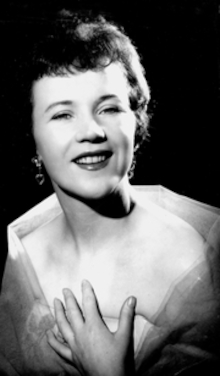
Bridget “Bridie” Gallagher, Irish singer affectionately known as “The Girl from Donegal,” reaches No. 1 in the Irish Singles Chart with “The Boys From The County Armagh” on July 2, 1957. She is widely regarded as “Ireland’s first international pop star.”
Gallagher is born on September 7, 1924 in Creeslough, County Donegal. She starts her singing in the Creeslough Hall with a local Céilí band started by Bill Gallagher. The Creeslough Hall is owned by Jim McCaffrey and Bridie makes many more visits to the Creeslough Hall in her home town throughout her long and successful career. Her talent is soon spotted in the 1950s by Billy Livingstone who is a talent scout for Decca Records. She goes to Belfast, which becomes her base, where she marries Robert (Bob) Livingstone (no relation to Billy Livingstone) and has two boys, Jim and Peter. Peter dies in a motor accident in 1976 and Jim later goes on to tour with her.
Gallagher shoots to fame in 1956 with her recording of “A Mother’s Love’s A Blessing” and achieves international acclaim with her legendary rendition of “The Boys From County Armagh.” During her career, which spans over six decades, she appears in many leading venues across the globe. She also makes songs such as “The Homes of Donegal” famous.
Gallagher holds the record for the largest number of people in attendance in the Royal Albert Hall in London, with over 7,500 people, a record that is never equaled as it goes on to become an all-seater venue. She becomes world-famous and travels all over the world, United States, Canada, Europe, Australia and is known as “The Girl from Donegal.” She plays in many of the world’s best known theatres, including London’s Royal Albert Hall, Sydney Opera House and Carnegie Hall in New York City. She sings mainly ballads or as they later became known as Country and Irish. One of her best known songs is “The Boys From The County Armagh,” which sells over 250,000 copies, the biggest-selling Irish single at that time.
Gallagher lives in Belfast for most of her life. She is honoured by the people of Creeslough on July 10, 2000 with an event to celebrate her career. Members of her family from Creeslough and Donegal attend the event along with her two sisters and their families who travel from Glasgow to be there along with an estimated crowd of 2,500 fans. A plaque paying tribute to her is unveiled. The following day she is honoured by Donegal County Council when they hold a Civic Reception for her. “Bridie blazed the trail for many artists who followed after her and I’m sure that many of them looked upon her as a role model as they started their careers in the music world,” council chairman Charlie Bennett says at the ceremony.
Gallagher dies at her home in Belfast on January 9, 2012 at the age of 87. Her burial takes place in her native Creeslough.
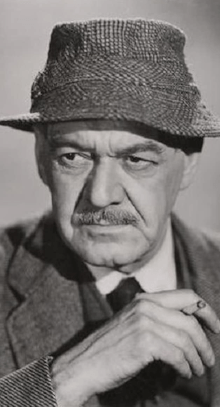
O’Rorke is born as William Francis Breffni O’Rorke at 2 Esplande Villas in Dollymount, and baptised at Clontarf Parish Church on August 1, 1889. His father, Frederick O’Rorke, is a cork merchant, and his mother, Jane Caroline O’Rorke (née Morgan), is an actress. He has an older brother, Frederick, who is twelve years older than him.
O’Rorke begins studying acting with his mother and makes his professional début in 1912 at the Gaiety Theatre, Dublin, in a production of George Bernard Shaw‘s John Bull’s Other Island. In 1916, while still living in Dublin, he meets and marries Alice Cole, a chorus-girl turned actress, who had divorced her first husband and immigrated from South Africa with her young son. Thus O’Rorke becomes the stepfather of Cyril Cusack. Other theatre roles include the title role in Finn Varra Maa (1917), a musical “pantomime” or light opera written by Thomas Henry Nally with music by Geoffrey Molyneux Palmer.
National Television starts in October 1936, initially broadcast just two hours a day. The station stops broadcasting at the start of World War II, and does not restart until 1946. Plays, like everything else, can last just one hour maximum, but some are only 25 minutes long. Also, there is no recording possible, so any repeat is really a new broadcast, as in The Advantages of Paternity.
In 1939 O’Rorke appears in several broadcasts in the new fledgling BBC television, including a play by Irish playwrightTeresa Deevy called The King of Spain’s Daughter, produced by Denis Johnston.
O’Rorke is a busy character actor up to his death on November 11, 1946, and his legacy lay not only in several memorable performances but also, to some extent, in the subsequent success of his stepson. From the late 1940s thru the 1980s, Cyril Cusack is one of the most renowned stage actors of his generation, as well as an acclaimed film actor, and he founds an acting dynasty to rival that of the Redgrave family through his actress daughters.
Béaslaí is born Percy Frederick Beazley in Liverpool, England on February 15, 1881, to Irish Catholic parents, Patrick Langford Beazley, originally from Killarney, County Kerry, and Nannie Hickey, from Newcastle West, County Limerick. During his summer holidays in his younger years, he spends time in Ireland (near Kenmare, County Kerry) with his paternal uncle, Father James Beazley, where he begins to learn the Irish language. He is educated at St. Francis Xavier’s College in Liverpool, where he develops his keen interest in Irish. By the time he is aged 17 his Irish proficiency is exceptional.
After finishing his education at St. Francis Xavier’s, Béaslaí is encouraged to begin Irish poetry by Tadhg Ó Donnchadha. He follows his father’s footsteps into journalism, initially working for the local Wallasey News. In 1906 he moves to Dublin, and within a year becomes a freelance writer for the Irish Peasant, Irish Independent, Freeman’s Journal and Express. He is offered a permanent position with Independent Newspapers, as assistant leader writer and special reporter for the Dublin Evening Telegraph. He writes regularly for the Freeman’s Journal, including a daily half-column in Irish.
After his early introduction to Irish poetry Béaslaí becomes involved in staging Irish-language amateur drama at the Oireachtas annual music festival. He begins to write both original works and adaptations from foreign languages. One of these works, Eachtra Pheadair Schlemiel (1909), is translated from German into Irish.
Later Béaslaí continues to write poetry, such as the collection “Bealtaine 1916” agus Dánta Eile (1920), and short stories such as “Earc agus Aine agus Scéalta Eile.” Between 1913 and 1939 he writes many plays, including Cliuche Cartaí (1920), An Sgaothaire agus Cúig Drámaí Eile (1929), An Danar (1929) and An Bhean Chródha (1931). He writes two books about his comrade Michael Collins: Michael Collins and the Making of a New Ireland (2 volumes, 1926) and Michael Collins: Soldier and Statesman (1937).
Béaslaí’s works revolve around the Irish language movement and the Irish Republican Army (IRA), focusing on the independence struggle of Ireland. He writes about these topics in newspapers such as the Standard and The Kerryman. His most notable work in newspapers during his later life includes his contribution to the Irish Independent, which publishes a section called ‘A Veteran Remembers’ five days a week from May 16 to June 1957, as well as a weekly section called ‘Moods and Memories’ on Wednesdays from May 24, 1961, to June 16, 1965.
One of the awards Béaslaí gains during his career is on August 14, 1928, a gold medal at the Tailteann Literary Awards. While in Dublin, he joins the Keating Branch of the Gaelic League, and after he moves to Ireland, he begins using the Irish form of his name, Piaras Béaslaí, rather than Percy Beazley.
Béaslaí is a founding member of the Irish Volunteers in 1913. In January 1916 he serves as a courier for political activist and revolutionary leader Seán Mac Diarmada. By the time of the Easter Rising that year, he is deputy commanding officer of the 1st Dublin Battalion. In an audio recording to which he contributes in 1958, he details his experience in the Rising, describing the rebels assembling before noon in Blackhall Street at battalion headquarters. After midday they march out to the Four Courts, erecting barricades as they do so. The Four Courts is his main station.
In the audio, Béaslaí recalls a green flag with a gold harp in the centre. This is the non-Sinn Féin flag at the time. He is in direct charge of the Four Courts area, and at one point during the fight he orders a complete blackout. He recalls, “things were going badly for the English soldiers” and describes the whole event as “a weird experience.” He remembers the streets being lit up with fires in the darkness as if it were bright as day. He speaks of the intensity of the firing line and then how it suddenly ceases on the Friday. He remembers falling asleep and when he awakens being presented with Patrick Pearse‘s order to surrender. The rebels are brought to Richmond Barracks. He then spends fifteen months in English prisons.
Béaslaí serves three years of penal servitude divided between a stringent HM Prison Portland and a more lenient HM Prison Lewes. He is then imprisoned two times within four months during 1919, both terms ending in celebrated escapes. After his final prison release, Michael Collins approaches him about editing An tOglach, the Irish Volunteer newspaper. This sees communication between GHQ and local volunteers drastically improve.
Later, Béaslaí becomes director of publicity for the Irish Republican Army, and at the 1918 Irish general election he is elected to the First Dáil as Sinn Féin MP for East Kerry. Sinn Féin MPs elected in the Westminster elections of 1918 refuse to recognise the Parliament of the United Kingdom, and instead assemble the following January at the Mansion House in Dublin as a revolutionary parliament, Dáil Éireann. Béaslaí is noted for his translation of the democratic programme of the First Dáil, which he reads aloud at the inaugural sitting.
Béaslaí and Con Collins share the distinction of having been elected in three Irish general elections unopposed by any other candidates.
During Béaslaí’s time in London, he gives a lot of his time to the Gaelic League. In the Keating branch of the league, in Ireland, he develops an interest in the IRB. Cathal Brugha, a branch member, asks him to join the IRB. The Keating branch is where Béaslaí meets Michael Collins, eventually introducing Collins to his cousin and fellow branch member, Elizabeth Mernin. He is also instrumental in establishing An Fáinne, an Irish-speaking league whose members vow to speak solely Irish among themselves and wear a membership badge of a circle. This coincides with his involvement in the IRB. His love of the Irish language gives him an opportunity to delve into his other hobbies. He writes for Banba, an Irish journal published by the Gaelic League. He is able to express his love for theatre, in the Gaelic League, forming a group of men called “Na hAisteoirí.”
Griffin is born in Limerick, County Limerick, on December 12, 1803, the youngest son of thirteen children of a substantial Catholic farming family. Patrick Griffin, his father, also makes a living through brewing, and he participates as one of Henry Grattan‘s Irish Volunteers (18th century). His mother comes from the ancient O’Brien dynasty and first introduces him to English literature. When he is aged seven, the family moves to Fairy Lawn, a house near Loghill, County Clare, which sits on a hill above the bank of the Shannon Estuary, about twenty-seven miles from Limerick. Here he has an idyllic childhood and receives a classical education.
In 1820 the family at Fairy Lawn is broken up. The parents with several of the children emigrate to the United States and settle in Pennsylvania. Griffin, with one brother and two sisters, is left behind under the care of his elder brother William, a practicing physician in Adare, County Limerick. He meets John Banim in Limerick. Inspired by the successful production of Banim’s play Damon and Pythias (1821), Griffin, at nineteen years of age, moves to London in 1823. After an unsuccessful attempt at becoming a playwright, he endures years of poverty in London, managing only to scrape by through writing reviews for periodicals and newspapers. At the end of two years, he obtains steady employment in the publishing house as reader and reviser of manuscripts, and in a short time becomes frequent contributor to some of the leading periodicals and magazines. His early pieces in The Literary Gazette vividly describe the rural setting of his childhood, recount Irish folklore, translate the Celtic Irish language for the English readers, and, as Robert Lee Wolff observes, “waxed richly sardonic about Irishmen who tried to be more English than the English.”
Griffin’s Holland-Tide or Munster Popular Tales is published by Simpkin & Marshall in 1827. Holland-Tide is a collection of seven short stories, all of which are told in the house of a hospitable Munster farmer during All Hallows’ Eve in Munster. Holland-Tide establishes his reputation, and he returns to Ireland, where he writes Tales of the Munster Festivals in Pallaskenry to which his brother William has moved.
Experience leads Griffin to modify his expectations in relation to literary work, and, with a view to the legal profession, he enters the University of London as a law student, but in a short time removes to Dublin for the study of ancient Irish history, preparatory to his work The Invasion, which is published in 1832. This work has a good sale and is highly praised by scholars but never becomes popular.
With the exception of a tour through Scotland and a short trip on the European continent, Griffin lives with his brother, keeping up to some extent his literary labours. By 1833, he is increasingly concerned that he is wasting his time and begins to devote himself to teaching the poor children of the neighborhood. In 1838, hes all of his unpublished manuscripts and joins the Congregation of Christian Brothers, a Catholic religious order which has as its special aim the education of children of the poor. Writing to an old friend he says he feels a great deal happier in the practice of this daily routine than he ever did while roving about the great city, absorbed in the modest project of rivaling Shakespeare and throwing Scott in the shade. In June 1839, he is transferred from Dublin to Cork, where he dies of typhus fever at the age of thirty-six on June 12, 1840.
One of Griffin’s most famous works is The Collegians, a novel based on a trial that he had reported on, involving the murder of a young Irish Catholic girl (Ellen Hanley) by a ProtestantAnglo-Irish man (John Scanlon). The novel is later adapted for the stage as The Colleen Bawn by Dion Boucicault.
Griffin has a street named after him in Limerick and another in Cork. Loughill/Ballyhahill GAA club in west Limerick plays under the name of Gerald Griffins.
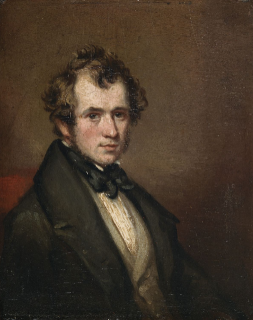
(Pictured: “Portrait of Gerald Griffin (1803-1840), Poet and Novelist,” painting by Richard Rothwell (1800-1868), National Gallery of Ireland)
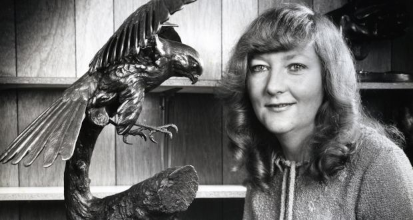
Rynhart is born Jeanne Scuffil in Dublin on March 17, 1946, to Kathleen Connolly and Frederick Scuffil, a sign writer for the Guinness Brewery. She is an apprentice to George Collie RHA for two years and then attends the National College of Art and Design, graduating in 1969 before moving to Coventry, England, where she continues her studies in fine art and sets up a studio with sculptor John Letts. She returns to Ireland in 1981, moving to Ballylickey, near Bantry in County Cork, where she establishes the Rynhart Fine Art gallery and workshop with her husband, Derek.
One of the first bronze craft studios in Ireland, the Rynhart pieces include both small figurative cold cast bronze sculptures of flower sellers, fishermen, horses, sailing boats and musical instruments as well as bronze life-size statues, smelted in a foundry. Her busts of Oscar Wilde and Jonathan Swift are in the Dublin Writers Museum and a Rynhart bust of James Joyce is in New York Public Library.
Rynhart creates the Molly Malone statue for the 1988 Dublin Millennium celebrations. The statue is controversial at the time of its unveiling due to the statue’s revealing dress. Registrar of Aosdána, Adrian Munnelly, writes to the An Bord Fáilte criticising it. The statue is defended by the Lord Mayor of DublinBen Briscoe. Rynhart herself writes in The Irish Times that the clothing and appearance are accurate for women of that era. The statue has since become one of the most popular tourist attractions in Dublin and is fondly regarded by locals.
In 1994, Rynhart’s daughter Audrey joins the business. In 2010, Audrey and her husband, Les Elliott, take over the running of the business which is now based in their studio in Glengarriff, County Cork. From then onwards, Rynhart continues to do some modelling work but has largely retired.
Rynhart dies on June 9, 2020, aged 74, in Schull Community Hospital, Cork, following a short illness. She is buried in the Abbey Cemetery, Bantry, and is survived by her husband, Derek, daughter, Audrey, son, Barry, and grandchildren, Lydia and Sophie.
In 1910 Day forms the local Irish Women’s Franchise League branch in Cork as an activist group for women’s suffrage. The following year she leaves that group and founds the non-militant Munster Women’s Franchise League. Her new interest in politics leads to her winning the election of poor law guardians the same year. Her later writings reveal that she sees the Cork workhouses as an expensive self-perpetuating evil run by amateurs. This leads to her first novel, The Amazing Philanthropists (1916). From 1913 to 1917 she writes three plays for the Abbey Theatre in collaboration with Geraldine Cummins, Broken Faith (1913), The Way of the World (1914), and Fox and Geese (1917), which is the most successful of the three.
The Battle of Verdun lasts most of 1916 and during that time Day is amongst a group from the Society of Friends who cares for the wounded. She is in France for fifteen months and uses the experience to create her 1918 book Round about Bar-le-Duc. Where the Mistral Blows is published in 1933 and describes her time in Provence in France.
Day works as a member of the fire service in London during World War II. She lives in Cork, France and London. At the time of her death she is living at 47 Argyle Road, Kensington, London. She dies in the Cromer and District Hospital on May 26, 1964.
The work of Suzanne Rouviere Day and Geraldine Cummins has been described as a mixture of paganism and melodrama and has been suggested as a precursor to John B. Keane.
(Pictured: Suzanne R. Day in the cast of the 1901 production of The Mikado, Cork, County Cork)
In 2006 Feeley completes a doctorate (Doctor of Philosophy in Music [Performance]) at Maynooth University, which involves a major thesis in three volumes with the title Classical Guitar Music by Irish Composers: Performing Editions and Critical Commentary.
Feeley is an enthusiastic champion of contemporary Irish music and in this capacity has commissioned works from many of Ireland’s leading composers including Seóirse Bodley, John Buckley, Jerome de Bromhead, Jane O’Leary, Brent Parker and Eric Sweeney. He also has a great interest in traditional Irish and Scottish music and has recorded with The Chieftains and published his own arrangements of traditional melodies.
Feeley has been described by The Washington Post as “Ireland’s leading classical guitarist” and by Michael Dervan in The Irish Times as “a trailblazer … when it comes to the guitar and guitar-playing in Ireland.”
Bill Whelan, composer and musician, is born in Limerick, County Limerick, on May 22, 1950. He is best known for composing a piece for the interval of the 1994 Eurovision Song Contest. The result, Riverdance, is a seven-minute display of traditional Irish dancing that becomes a full-length stage production and spawns a worldwide craze for Irish dancing and Celtic music. It also wins him a Grammy. Riverdance is released as a single in the UK in 1994, credited to “Bill Whelan and Anúna featuring the RTÉ Concert Orchestra.” It reaches number 9 and stays on the charts for 16 weeks. The album of the same title reaches number 31 in the album charts in 1995.
Whelan also composes a symphonic suite version of Riverdance, with its premiere performed by the Ulster Orchestra on BBC Radio 3 in August 2014.
As an arranger and composer, Whelan’s credits include:
The Seville Suite, which is inspired by the exploits of Aodh Rua Ó Dónaill from the Battle of Kinsale in 1601 until his arrival in Galicia to the welcome of The Spanish Earl of Caraçena. In addition to the orchestra, The Seville Suite includes Celtic music on uilleann pipes, accordion, bodhrán, fiddle as well as Galician harp, whistles and pipes.
The Spirit of Mayo, performed by an 85-piece orchestra in Dublin‘s National Concert Hall and featuring a powerful Celtic drum corps and a 200 strong choir and choral group Anúna.
Whelan’s Celtic/Orchestral release, The Connemara Suite, features the Irish Chamber Orchestra along with soloists Zoë Conway, Morgan Crowley, Colin Dunne (Dance Percussion) and Fionnuala Hunt.
Although born in Dublin, Tynan’s family home is in Johnstown, County Kilkenny. He is born with phocomelia, causing both of his lower legs to be underdeveloped. Although now 6’4″ tall, his legs are unusually short, his feet are splayed outward, and he has three toes on each foot. He is one of a set of twins, his twin brother Edmond dying at 11 months old. At age 20, he has his legs amputated below the knee following a back injury in a car accident. The injury to his back makes it impossible for him to continue using prosthetic legs without the amputation. Within weeks of the accident, he is climbing stairs at his college dormitory on artificial legs. Within a year, he is winning in international competitions in track and field athletics. He represents Ireland in the 1984 and 1988 Summer Paralympics, winning four golds, two silvers, and one bronze medal. Between 1981 and 1984, he wins 18 gold medals from various competitions and sets 14 world records.
In the following years, Tynan becomes the first person with a disability to be admitted to the National College of Physical Education in Limerick. He works for about two years in the prosthetics industry, then goes to Trinity College, Dublin, becomes a physician specialising in Orthopedic Sports Injuries, and graduates in 1993. Encouraged to also study voice by his father Edmund, Tynan wins a series of voice competition awards and joins The Irish Tenors.
Tynan sings for George H. W. Bush at Bush’s Houston home on the day of the president’s death on November 30, 2018. The first song is “Silent Night,” while the second is a Gaelic song. Bush’s friend and former aide James Baker says that while Tynan is singing “Silent Night,” “believe it or not, the president was mouthing the words.”
While a real estate agent and prospective buyer Dr. Gabrielle Gold-von Simson are looking at an apartment in Tynan’s building on Manhattan‘s East Side, Tynan makes what is construed to be an anti-semitic remark. Shortly after this, the New York Yankees cancel Tynan’s performance of “God Bless America” for Game 1 of the 2009 American League Championship Series on October 16, 2009 because of the incident.
According to Tynan’s version of the event, two Jewish women came to view an apartment in his building. Some time afterwards, another real estate agent shows up with a potential client. The agent jokes to Tynan “at least they’re not (Boston) Red Sox fans.” Tynan replies, “As long as they’re not Jewish,” referring to the exacting women he had met earlier. The prospective client, Jewish pediatrician Dr. Gabrielle Gold-Von Simson, takes umbrage and says, “Why would you say that?” Tynan replies, “That would be scary,” and laughs, referring to the previous incident. He subsequently apologises for his remark. The Anti-Defamation League (ADL) accepts his apology. He performs at an ADL event in Manhattan soon thereafter.
Only July 4, 2010 Tynan performs “God Bless America” for the Boston Red Sox at Fenway Park with the support of some in the local Jewish community.
Salkeld works in tempera and oil, as well as etching and wood engraving. In 1921 he travels to Germany to study under Ewald Dulberg at the Kassell Kunstschule. He attends the Union of Progressive International Artists in Düsseldorf in May 1922, and is exhibited at the Internationale Kunstausstellung. Upon his return to Dublin in 1924, he holds his first solo exhibition in the Society of Dublin Painters gallery. He becomes a member of the Dublin Painters in 1927. With Francis Stuart, he co-edits the first two issues of To-morrow in 1924. His studio is in a converted labourer’s cottage at Glencree, County Wicklow. He also exhibits with the New Irish Salon and the Radical Painters’ Group.
Salkeld wins the 1926 Royal Dublin Society‘s Taylor scholarship, and has his first exhibited work with the Royal Hibernian Academy (RHA) in 1929. He lives in Berlin for a year in 1932. He exhibits in Daniel Egan’s Gallery in Dublin in 1935. He has a wide circle of literary friends, including Samuel Beckett and Flann O’Brien. In O’Brien’s At Swim-Two-Birds, the character of Michael Byrne is designed for Salkeld, reflecting his debilitating alcoholism. He also teaches at the Dublin Metropolitan School of Art, teaching artists such as Reginald Gray.
From 1937 to 1946 Salkeld runs a private press called Gayfield Press. This is co-founded with his mother, and operates from a garden shed at their home, 43 Morehampton Road. The press is a small Adana wooden hand press. He illustrates her 1938 The Engine Left Running, as well as Ewart Milne‘s Forty North Fifty West (1938) and Liam O’Flaherty‘s Red Barbara and Other Stories (1928). In 1951, he loans the press to Liam and Josephine Miller to found the Dolmen Press.
Salkeld’s most famous public work is his 1942 three-part mural in Davy Byrne’s pub. He is a co-founder of the Irish National Ballet School in the 1940s in his capacity as a pianist. In 1946 he is appointed an associate member of the RHA. In 1953 his play Berlin Dusk is staged at 37 Theatre Club, Dublin. During the 1950s he is a broadcaster with Radio Éireann as well as a director of cultural events for An Tóstal. He dies on May 11, 1969 in St. Laurence’s Hospital, Dublin.




 seamus dubhghaill