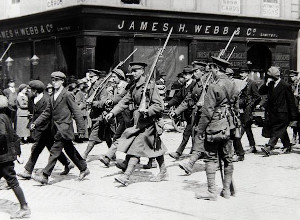
In May 1920, East Londondockers refuse to load the SS Jolly George, a ship intended to carry arms to be used against the new Bolshevik state. The Munitions Strike begins in Dublin on May 20, 1920, when dock workers follow suit and refuse to handle war material. They are soon joined by members of the Irish Transport and General Workers Union.
When news of the proposed radical action is brought to trade unionist William O’Brien’s desk on May 19, he informs Thomas Foran, General President of the union. The following day, the men standing around waiting to begin work are told that the work is not to start.
On hearing of the political action at the Dublin docks, a second ship was diverted to Dún Laoghaire. There, the military are on hand to unload its cargo, but when the cargo arrives at Westland Row station, workers there refuse to handle the goods. While the dockworkers are casual workers who can be reallocated elsewhere, the railwaymen are permanent employers and members of the separate National Union of Railwaymen.
In the following days, the action taken in Dublin and Dun Laoghaire is replicated elsewhere. To sections of the conservative press, the behaviour of dockers and railwaymen is scandalous. The ever-reliable Punch illustrated news produces a sketch in a June 1920 edition showing an IRA gunman hiding behind a rural wall, joined by a railway worker, or “the blameless accomplice.”
The brave stand that began on the docks of Dublin spreads nationwide, largely thanks to the militancy of railway workers. From arms in storage, the strike is widened to include the carrying of men holding arms representing Crown Forces.
The munitions strike is an effective tactic, proven by the infuriated responses to it from the upper echelons of the British military and political class. In November, the British Government begins closing rail lines, including the Limerick to Waterford and Limerick to Tralee lines,as well as trains into Galway, which instigate a fear among the public that the Irish railway system could be shut down in its entirety.
In the absence of sympathetic strike action in Britain, and with increasingly vicious physical assaults on railwaymen, the Irish leadership feels increasingly vulnerable in the dispute, which eventually winds down in December.
Peck’s parents divorce when he is five years old. An only child, he is sent to live with his grandmother. He never feels as though he has a stable childhood. His fondest memories are of his grandmother taking him to the movies every week and of his dog, which follows him everywhere.
At the age of ten Peck is sent to a Catholic military school, St. John’s Military Academy in Los Angeles. While he is a student there, his grandmother dies. At 14, he moves back to San Diego to live with his father and attends San Diego High School. After graduating he enrolls for one year at San Diego State Teacher’s College (now known as San Diego State University).
With a string of hits to his credit, Peck makes the decision to only work in films that interest him. He continues to appear as the heroic, larger-than-life figures in such films as Captain Horatio Hornblower R.N. (1951) and Moby Dick (1956). He works with Audrey Hepburn in her debut film, Roman Holiday (1953).
Peck finally wins the Oscar, after four nominations, for his performance as lawyer Atticus Finch in To Kill a Mockingbird (1962). In the early 1960s, he appears in two darker films than he usually makes, Cape Fear (1962) and Captain Newman, M.D. (1963), which deal with the way people live. He also gives a powerful performance as Captain Keith Mallory in The Guns of Navarone (1961), one of the biggest box-office hits of that year.
In the early 1970s, Peck produces two films, The Trial of the Catonsville Nine (1972) and The Dove (1974), when his film career stalled. He makes a comeback playing, somewhat woodenly, Robert Thorn in the horror film The Omen (1976). After that, he returns to the bigger-than-life roles he is best known for, such as MacArthur (1977) and the monstrous Nazi Dr. Josef Mengele in the huge hit The Boys from Brazil (1978). In the 1980s, he moves into television with the miniseriesThe Blue and the Gray (1982) and The Scarlet and the Black (1983). In 1991, he appears in the remake of his 1962 film, playing a different role, in Martin Scorsese‘s Cape Fear (1991). He is also cast as the progressive-thinking owner of a wire and cable business in Other People’s Money (1991).
In 1967, Peck receives the Academy’s Jean Hersholt Humanitarian Award. He has also been awarded the Presidential Medal of Freedom. Always politically progressive, he is active in such causes as anti-war protests, workers’ rights and civil rights. In 2003, Peck’s portrayal of Atticus Finch is named the greatest film hero of the past 100 years by the American Film Institute.
Gregory Peck dies in his sleep at his home in Los Angeles, California from bronchopneumonia at the age of 87 on June 12, 2003. He is entombed in the Cathedral of Our Lady of the Angels mausoleum in Los Angeles. His eulogy is read by Brock Peters, whose character, Tom Robinson, was defended by Peck’s Atticus Finch in To Kill a Mockingbird.
Cumann na mBan is an Irish republican women’s paramilitary organisation formed in Dublin on April 2, 1914, merging with and dissolving Inghinidhe na hÉireann and, in 1916, it becomes an auxiliary of the Irish Volunteers. Although it is otherwise an independent organisation, its executive is subordinate to that of the Volunteers.
On January 7, 1922 the Anglo-Irish Treaty is approved by the Second Dáil by a close vote of 64–57. On February 5 a convention is held to discuss this, and 419 Cumann na mBan members vote against as opposed to 63 in favour. In the ensuing Civil War, its members largely support the anti-Treaty Republican forces. Over 400 of its members are imprisoned by the forces of the Provisional government which becomes in December 1922 the Irish Free State. Some of those who support the Treaty change the name of their branches to Cumann na Saoirse, while others retain their name but give allegiance to the Free State Government.
Cumann na mBan continues to exist after the Treaty, forming (alongside Sinn Féin, the Irish Republican Army, Fianna Éireann and other groups) part of the Irish republican milieu. The government of the Irish Free State bans the organisation in January 1923 and opens up Kilmainham Gaol as a detention prison for suspect women.
Its membership strength is adversely affected by the many splits in Irish republicanism, with sections of the membership resigning to join Fianna Fáil, Clann na Poblachta and other parties. Máire Comerford, a lifelong member from 1914, reflects in later years that it became a “greatly weakened organisation” that “gathered speed downhill” from the founding of Fianna Fáil in 1926.
In 1920, the family moves from Dromore to Omagh. After living for a short time in Castle Street and Drumragh, the family finally settles in St. Patrick’s Terrace in the Gallows Hill area of Omagh. This area is to be a lasting inspiration for Kiely.
Kiely begins to feel the urge to become a writer during his teenage years. He has a keen interest in the work of George Bernard Shaw, H. G. Wells and Jonathan Swift. In 1936, after completing his education at Mount St. Columba Christian Brothers School in Omagh, he goes to work as a sorting clerk in the Omagh Post Office.
However, Kiely soon realises that the post office will not provide him with the life of the scholar which he so desires. In the spring of 1937, he leaves Omagh and begins a new life in Emo Park, Portarlington, County Laois, where he decides to train as a Jesuit priest. His life as a Jesuit is not meant to be for, exactly a year later, in the spring of 1938, he suffers a serious spinal injury, which results in a lengthy stay in Cappagh National Orthopaedic Hospital in Finglas, Dublin. During his hospitalisation, he is given plenty of time to think about the course his life has already taken, and about a course it might take. He also realises that he lacks a vocation to the priesthood and abandons his training as a Jesuit.
When Kiely gets out of hospital in 1939, he returns to Omagh to recover from his back problem. The following year, he begins working as a part-time journalist in the weekly Catholic Standard newspaper. In 1943, he graduates from National University of Ireland with a B.A. in History and Letters.
In 1945, Kiely begins working for the Irish Independent, where he is employed as a journalist and critic. In 1950, he joins The Irish Press as a literary editor. In 1964, he moves to the United States where, over a period of four years, he is a Writer-in-Residence at Emory University, visiting professor at the University of Oregon, and Writer-in-Residence at Hollins College (Virginia). In 1968, he returns to Ireland. In the spring of 1976, he is Distinguished Visiting Professor at the University of Delaware. He continues to receive acclaim for his writing and journalism, a career which spans over six decades, receiving the Award for Literature from the Irish Academy of Letters. By now, he is one of Ireland’s best-known writers. In 1996, he is named Saoi of Aosdána, the highest honour given by the Arts Council of Ireland.
Kiely visits Omagh in 2001 which is marked by the unveiling of a plaque outside his childhood home on Gallows Hill by Omagh’s Plain Speaking Community Arts group. Every September an event is held in Omagh called The Benedict Kiely Literary Weekend to celebrate his many achievements.
McCaughey is born on July 1, 1835, at Tullynewey, near Ballymena, County Antrim, the son of Francis McCaughey, farmer and merchant, and his wife Eliza, née Wilson.
McCaughey comes to Australia with an uncle, Charles Wilson, a brother of Sir Samuel Wilson, and lands at Melbourne in April 1856. He immediately goes to the country and begins working as a jackaroo. Within three months he is appointed an overseer and two years later becomes manager of Kewell station while his uncle is on a visit to England.
In 1860, after his uncle’s return, McCaughey acquires an interest in Coonong station near Urana with two partners. His brother John who comes out later becomes a partner in other stations.
During the early days of Coonong station McCaughey suffers greatly from drought conditions but overcomes these by sinking wells for artesian water and constructing large tanks, making him a pioneer of water conservation in Australia.
In 1871 McCaughey is away from Australia for two years on holiday, and on his return does much experimenting in sheep farming. At first, he seeks the strains that can produce the best wool in the Riverina district. Afterwards, when the mutton trade develops, he considers the question from that angle.
In 1880 Sir Samuel Wilson goes to England and McCaughey purchases two of his stations, Toorale and Dunlop Stations, during his absence. He then owns about 3,000,000 acres. In 1886 he again visits the old world and imports a considerable number of Vermont sheep from the United States and also introduces fresh strains from Tasmania. He ultimately owns several million sheep, earning the nickname of “The Sheep King.”
In 1900 McCaughey purchases North Yanco and, at great cost, constructs about 200 miles of channels and irrigates 40,000 acres. The success of this scheme is believed to have encouraged the New South Wales government to proceed with the dam at Burrinjuck.
Todd spends a few of his childhood years in India, where his father, an officer in the British Army, serves as a physician. Later his family moves to Devon, and he attends Shrewsbury School. Upon leaving school, he trains for a potential military career at Royal Military Academy Sandhurst before beginning his acting training at the Italia Conti Academy of Theatre Arts in London. This change in career leads to estrangement from his mother. When he learns at age 19 that she has committed suicide, he does not grieve long for her, he admits in later life.
After the war, Todd is unsure what direction to take in his career. His former agent, Robert Lennard, has become a casting agent for Associated British Picture Corporation and advises him to try out for the Dundee Repertory Company. He does so, performing in plays such as Claudia, where he appears with Claudia Grant-Bogle. Lennard arranges for a screen test and Associated British offers him a long-term contract in 1948. He is cast in the lead in For Them That Trespass (1949), directed by Alberto Cavalcanti. The film is a minor hit and his career is launched.
Having portrayed the role of Yank in the Dundee Repertory stage version of John Patrick‘s play The Hasty Heart, Todd is subsequently chosen to appear in the 1948 London stage version of the play, this time in the leading role of Cpl. Lachlan McLachlan. This leads to his being cast in that role in the Warner Bros. film adaptation of the play, which is filmed in the United Kingdom, alongside Ronald Reagan and Patricia Neal. He is nominated for the Academy Award for Best Actor for the role in 1949.
Todd’s career in films rapidly declines in the 1960s as the counter-culture movement in the Arts becomes fashionable in England, with social-realist dramas commercially replacing the more middle-class orientated dramatic productions that Todd’s performance character-type had previously excelled in.
In retirement, Todd lives in the village of Little Ponton and later in Little Humby, eight miles from Grantham, Lincolnshire. Suffering from cancer, he dies at his home on December 3, 2009. He is buried between his two sons, Seamus and Peter, at St. Guthlac’s Church in Little Ponton, Lincolnshire, England.
Dennis Day, American singer, radio, television and film personality and comedian of Irish descent, is born Owen Patrick Eugene McNulty on May 21, 1916 in The Bronx borough of New York City.
Mary Livingstone, wife of comedian Jack Benny, brings Day to Benny’s attention after hearing him on the radio during a visit to New York. She takes a recording of Day’s singing to Benny, who then goes to New York to audition Day. The audition results in Day’s role on the Benny program.
Day appears for the first time on Benny’s radio show on October 8, 1939, taking the place of another famed tenor, Kenny Baker. He remains associated with Benny’s radio and television programs until Benny’s death in 1974. He is introduced as a young, naive boy singer, a character he keeps through his whole career.
From 1944 through 1946 Day serves in the United States Navy as a Lieutenant. While in service he is temporarily replaced on the Benny radio program by fellow tenor Larry Stevens. On his return to civilian life, he continues to work with Benny while also starring on his own NBC show, A Day in the Life of Dennis Day (1946–1951). His last radio series is a comedy/variety show that airs on NBC’s Sunday afternoon schedule during the 1954–55 season.
An attempt is made to adapt A Day in the Life Of Dennis Day as an NBC filmed series, produced by Jerry Fairbanks for Dennis’ sponsor, Colgate-Palmolive, featuring the original radio cast, but gets no farther than an unaired 1949 pilot episode. Eventually, his own TV series, The Dennis Day Show, is first telecast on NBC on February 8, 1952, and then in the 1953–1954 season. Between 1952 and 1978, he makes numerous TV appearances as a singer, actor and voice for animation, such as the Walt Disney feature Johnny Appleseed, handling multiple characters. His last televised work with Benny is in 1970, when they both appear in a public service announcement together to promote savings and loans.
McCarthy is born in Cork, County Cork on November 22, 1830, and is educated there. He begins his career as a journalist at the age of 18 in Cork. From 1853 to 1859 he is in Liverpool, on the staff of the Northern Daily Times. In March 1855, he marries Charlotte Ailman. In 1860 he moves to London, as parliamentary reporter to the Morning Star, of which he becomes editor in 1864. He gives up his post in 1868 and, after a lecturing tour in the United States, joins the staff of The Daily News as leader-writer in 1870. In this capacity he becomes one of the most useful and respected upholders of the liberal politics of the time. He lectures again in America in 1870–71 and in 1886–87.
McCarthy is first elected to Parliament at a by-election on April 4, 1879, when he is returned unopposed as a Home Rule League MP for County Longford. He is re-elected unopposed as a Parnellite Home Ruler in 1880, and when the two-seat Longford constituency is split into two divisions under the Redistribution of Seats Act 1885, he is elected as an Irish Parliamentary Party member for the new single-seat Northern division of Longford. His sole opponent, a Conservative, wins only 6% of the votes.
At the 1886 general election, he is returned unopposed in North Longford, but also stands in Londonderry City, where he is declared the loser to the Irish Unionist Alliance candidate by the narrow margin of 1778 votes to 1781. However, the result is later overturned on petition and McCarthy opts to sit for Derry City. During the divorce controversy surrounding Charles Stewart Parnell in November 1890, the British Prime MinisterWilliam Ewart Gladstone expresses a warning, given to McCarthy as intermediary, that if Parnell retains leadership of the Irish Parliamentary Party it will mean the loss of the next election, the end of their alliance and Home Rule. When the annual party leadership election meeting is called later that month, the threat is somehow not conveyed to the members, who re-elect Parnell leader of the Party.
After a further historical meeting of the Irish Party MPs in early December, Parnell refuses to retire and the Party divides. McCarthy becomes chairman of the Anti-Parnellite group, the Irish National Federation, for a year in 1891–1892. His nationalism is of a temperate and orderly kind, and though his personal distinction singles him out for the chairmanship during the party dissensions of this period, he is in no active sense the political leader.
At the 1892 general election, McCarthy again stands both in North Longford and in Derry City. In each seat there is a two-way contest between the Anti-Parnellite McCarthy and a Unionist candidate, but the narrow Unionist victory in Derry is not overturned, and McCarthy sits for North Longford, where he wins over 93% of the votes. He is returned unopposed for North Longford in 1895 United Kingdom general election in Ireland and stands down from Parliament at the 1900 United Kingdom general election in Ireland.
It is claimed that McCarthy’s true vocation is literature. His earliest publications are novels, some of which, such as A Fair Saxon (1873), Dear Lady Disdain (1875), Miss Misanthrope (1878), and Donna Quixote (1879), attain considerable popularity. His most important work is his History of Our Own Times, which treats of the period between Queen Victoria‘s accession and her Diamond Jubilee. He begins a History of the Four Georges (1884–1901) and the latter half is written by his son, Justin Huntly McCarthy.
Justin McCarthy dies at the age of 81 in Folkestone, Kent, England on April 24, 1912.
Seven senators serve on the subcommittee, with three Republicans and three Democrats in addition to Smith as chair. The other six senators are Jonathan Bourne (R-Oregon), Theodore E. Burton (R-Ohio), Duncan U. Fletcher (D-Florida), Francis G. Newlands (D-Nevada), George Clement Perkins (R-California), and Furnifold McLendel Simmons (D-North Carolina). The composition of the subcommittee is carefully chosen to represent the conservative, moderate and liberal wings of the two parties.
During 18 days of official investigations, punctuated by recesses, testimony is recorded from over 80 witnesses. These include surviving passengers and crew members, as well as captains and crew members of other ships in the vicinity, expert witnesses, and various officials and others involved in receiving and transmitting the news of the disaster. The evidence submitted varies from spoken testimony and questioning, to the deposition of correspondence and affidavits. Subjects covered include the ice warnings received, the inadequate (but legal) number of lifeboats, the handling of the ship and its speed, RMS Titanic‘s distress calls, and the handling of the evacuation of the ship.
The final report is presented to the United States Senate on May 28, 1912. It is nineteen pages long and includes 44 pages of exhibits, and summarises 1,145 pages of testimony and affidavits. Its recommendations, along with those of the British inquiry that concludes on July 3, 1912, lead to many changes in safety practices following the disaster.
The report is strongly critical of established seafaring practices and the roles that RMS Titanic‘s builders, owners, officers and crew had played in contributing to the disaster. It highlights the arrogance and complacency that had been prevalent aboard the ship and more generally in the shipping industry and the British Board of Trade. However, it does not find the International Mercantile Marine Company, an American consortium, or the White Star Line negligent under existing maritime laws, as they had merely followed standard practice, and the disaster could thus only be categorised as an “act of God.”
The inquiry is heavily criticised in Britain, both for its conduct and for Smith’s style of questioning. Many newspapers publish scathing editorial cartoons depicting Smith in unflattering terms. The British government is also hostile towards the inquiry. The British Ambassador to the United States, James Bryce, demands that President William Howard Taft dissolve the committee and refuses to recognise its jurisdiction.
Some British writers, however, applaud the inquiry. G. K. Chesterton contrasts the American objective of maximum openness with what he calls Britain’s “national evil,” which he describes as being to “hush everything up; it is to damp everything down; it is to leave the great affair unfinished, to leave every enormous question unanswered.” The American reaction is also generally positive. The American press welcomes Smith’s findings and accepts his recommendations, commending the senator for establishing the key facts of the disaster.
(Pictured: U.S. Senator William Alden Smith, chairman of the Senate inquiry into the RMS Titanic disaster)
Sheridan is born in Bohola, County Mayo on March 28, 1881. At 6’3″ and 194 lbs., Sheridan is the best all-around athlete of the Irish American Athletic Club, and like many of his teammates, serves with the New York City Police Department from 1906 until his death. He is so well respected in the NYPD, that he serves as the Governor’s personal bodyguard when the governor is in New York City.
A five-time Olympic gold medalist, with a total of nine Olympic medals, Sheridan is called “one of the greatest figures that ever represented this country in international sport, as well as being one of the most popular who ever attained the championship honor.” He wins the discus throw event at the 1904, 1906, and 1908 Summer Olympic Games as well as the shot put at the 1906 Olympics and the Greek discus in 1908. At the 1906 Intercalated Games in Athens, Greece he also wins silver medals in the standing high jump, standing long jump and the stone throw.
In 1907, Sheridan wins the National Amateur Athletic Union discus championship and the Canadian championship, and in 1908 he wins the Metropolitan, National and Canadian championships as well as two gold medals in the discus throw and bronze in the standing long jump at the 1908 Olympic Games.
There are claims that Sheridan fuels a controversy in London in 1908, when flagbearer Ralph Rose refuses to dip the flag to King Edward VII. Sheridan supports Rose by explaining “This flag dips to no earthly king,” and it is claimed that his statement exemplifies both Irish and American defiance of the British monarchy. However, careful research has shown that this is first reported in 1952. Sheridan himself makes no mention of it in his published reports on the Games and neither does his obituary.
Martin Sheridan dies in Manhattan, New York City on March 27, 1918, a very early casualty of the 1918 flu pandemic. He is buried in Calvary Cemetery, Queens, New York. The inscription on the granite Celtic Cross monument marking his grave says in part: “Devoted to the Institutions of his Country, and the Ideals and Aspirations of his Race. Athlete. Patriot.” He is part of a group of Irish American athletes known as the “Irish Whales.”