Ryan is born in Dublin c. 1901, the son of Joseph Ryan and Anne Ryan, née Plummer. Affectionately known as Bertie, he is recorded with his widowed mother and his two sisters, Katie and Sarah, in Quarry Lane, Glasnevin, Dublin in the 1911 Census of Ireland. He also has a foster brother, Paddy. He attends St. Gabriel’s National School in Cowper Street. By trade he is an apprentice tailor and is only 20 years old when he wis hanged.
Ryan, together with Patrick Doyle, Thomas Bryan, and Frank Flood, are tried by court-martial on February 24, 1921, and convicted of high treason and ‘levying war against the King,’ following an attempted ambush at Drumcondra, Dublin on January 21, 1921. The four of them, along with Thomas Whelan and Patrick Moran, are hanged at Mountjoy Prison by executioner John Ellis on March 14, 1921, while a crowd of over 20,000 people protest outside. They are hanged in pairs with Whelan and Moran hanged at 6:00 a.m., Doyle and Ryan at 7:00 a.m., and Bryan and Flood at 8:00 a.m.
Ryan is one of a group of men hanged in Mountjoy Prison in the period 1920-1921 commonly referred to as the Forgotten Ten. In 2001 he and the other nine, including Kevin Barry, are exhumed from their graves in the prison and given a full State Funeral. He is now buried in Glasnevin Cemetery, Dublin.
Yeats spends her first three years between Ballylee, County Galway, and Oxford before her family moves to 82 Merrion Square, Dublin in 1922. She is very sick as a child and spends three years in two different hospitals, St. Margaret’s Hall, 50 Mespil Road, and Nightingale Hall, Morehampton Road, Dublin. She then goes to the Pension Henriette, a boarding school in Villars-sur-Bex, Switzerland from 1928–30. In 1923 her Aunt Elizabeth “Lolly” gives her brush drawing lessons which aid her in winning first prize in the Royal Dublin Society (RDS) National Art competition for children under eight years old in 1925 and 1926.
Yeats trains in the Royal Hibernian Academy school from 1933 to 1936 and works as a stage designer with the Abbey Theatre in Dublin. In 1936, at the age of 16, she is hired by the Abbey Theatre as assistant to Tanya Moiseiwitsch. She studies for four months at the School of Theatrical Design in Paris with Paul Colin in 1937. At 18, she begins her costume career on sets with Ria Mooney‘s company. At the Abbey, she designs the sets and costumes for revivals of W.B. Yeats’ plays The Resurrection and On Baile’s Strand (1938).
In 1938 Yeats designs the first production of W.B. Yeats’ play Purgatory. The designs for Purgatory are her most successful achievement. Purgatory is the last play that W.B Yeats sees on stage, and when it is performed it is a full house. When working on Purgatory, Hugh Hunt wants to have a moon on the back cloth of the production, but she refuses. “If she does not win, she is going to say that she doesn’t wish to have her name on the programme as a designer of the setting.” This could be the main reason why her name is not on many productions that she worked on. She also designs the first play of her uncle Jack Yeats to receive professional production, Harlequin’s Positions.
In 1939 Yeats is promoted to head of design at the Abbey until her departure in May 1941. In 1939 it is commented that her designs are “getting arty” and not in keeping with style of the Abbey. One of her last designs is her father’s last play, The Death of Cuchulain, for the Lyric Theatre on the Abbey stage in 1949. She designs and stage-manages for the Peacock Theatre, the Cork Opera House, the Olympia Theatre, the Gaiety Theatre, the Lyric Theatre, the Abbey Theatre and the Players Theatre.
Among the work Yeats is credited with in the Abbey Theatre, she also works on five productions in the Peacock Theatre with the Theatre Company: Alarm Among the Clerks (1937), The Phoenix (1937), Harlequin’s Positions (1939), The Wild Cat (1940), and Cavaliero (The Life of a Hawk) (1948).
Yeats chooses to move towards painting full-time beginning a brief study at the Dublin Metropolitan School of Art in 1941. She experiments with watercolour and wax. She has a touching naive expressionist style and is interested in representing domestic humanity. She designs many of the covers for the books of Irish language publisher Sáirséal agus Dill over a twenty-year period from 1958. She does illustrations for books by Denis Devlin, Thomas Kinsella and Louis MacNeice, and works with many young designers, such as Louis le Brocquy.
Yeats dies at the age of 82 on July 4, 2001, and is buried in Shanganagh Cemetery, south Dublin.
The Royal Hibernian Academy holds a retrospective of her work in 1995, as does the National Gallery of Ireland in 2002. She donates her collection of Jack B. Yeats’ sketch books to the National Gallery of Ireland, leading to the creation of the Yeats Museum within the Gallery. Her brother, Michael, in turn, donates her sketchbooks to the Museum.
(Pictured: “Coole Park,” oil on board by Anne Butler Yeats, Duke Street Gallery, Dublin)
According to a study of the region, Cork is “by far the most violent county in Ireland” during the War of Independence and has several active guerrilla brigades. Of these, the 3rd Cork Brigade is one of the most effective and it is a unit from this Brigade that carries out the Upton ambush.
Up until the end of 1920, the British had been unable to move troops by train, due to a nationwide boycott by railway workers of trains carrying the British military. However, the strike is lifted in December 1920. While this helps the British military’s mobility, it also gives the IRA a new target: trains carrying soldiers. A week before the Upton ambush, the local IRA had made a successful attack on a train travelling from Killarney to Millstreet near Drishanbeg, killing one sergeant and wounding five more soldiers.
Five days after the Drishanbeg ambush, plans are made for an attack at Upton and Innishannon railway station on a train traveling between Cork city and Bandon. The ambushers, led by Charlie Hurley, are thirteen strong. Seven are armed with rifles and the remainder with revolvers or semi-automatic pistols. They take up position at the station ten minutes before the train pulls in, imprisoning the station master, clearing the station and taking cover behind sacks of grain and flour taken from a store.
The train is carrying approximately 50 British soldiers of the Essex Regiment, who are mingled with civilian passengers throughout the train’s carriages. The IRA party is therefore quite heavily outnumbered and out-gunned, but are unaware of this, as two IRA scouts, who were supposed to have been on the train and signaled to them the British numbers, never turn up. They also wrongly believe that the British troops are all in the central carriage. As a result, when the IRA opens fire on the train, there are heavy civilian casualties, including two commercial travelers killed by the first volley. The New York Times reports that “a shower of bullets was rained on the train, practically every compartment being swept.”
The firefight lasts only ten minutes, but in that time six civilian passengers are killed and ten wounded. Six British soldiers are injured, three of them seriously. Two IRA volunteers are killed outright and another is fatally wounded. Two more are badly wounded but survive. Charlie Hurley, who had led the ambush, is struck in the face by a bullet. IRA leader Tom Barry later writes, “Through some miracle, the nine unwounded and two wounded got away across country, in small parties, with the British following close behind.” Three civilian passengers, one unwounded and two wounded, are detained by the British on suspicion of belonging to the ambush party.
The Upton ambush is part of what Tom Barry describes as “twelve dark days” for the 3rd Cork Brigade of the IRA. Between February 4 and February 16, eleven members of the Brigade are killed. One is shot dead by British troops when they raid a safehouse on February 4, another dies in an accidental shooting on February 7, two more (brothers James and Timothy Coffey) are assassinated in their beds on February 14 by Black and Tans or Auxiliaries, three die at Upton on February 15 and four are killed on February 16 when they are arrested by the Essex Regiment in Kilbrittain while digging a trench and shot dead. Of the eleven dead, only those at Upton are killed in combat.
The Upton attack also highlights the dangers, and particularly the risk to civilians, of attacking trains carrying troops. Only a month later at the Headford Ambush in neighbouring County Kerry, an IRA column successfully attacks a train-load of troops, but again, there are civilian casualties alongside the IRA and British Army losses. One of the three men captured by the British at Upton is reported to give information leading to the 3rd Cork Brigade’s main column of over 100 fighters almost being encircled at the Crossbarry Ambush. Hurley is killed in this action.
The Upton ambush is later made famous in a popular 1960s Irish ballad titled “The Lonely Woods of Upton.”
(Pictured: A portion of the cover of an Italian magazine from 1921 that reported on the Upton ambush)
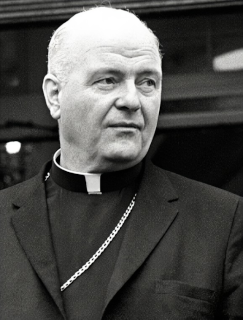
Conway is the eldest of four sons and five daughters of Patrick Joseph Conway and Annie Conway (née Donnelly). His father, a self-employed housepainter, also has a paint shop in Kent Street off Royal Avenue. His mother, who survives her son, is born in Carlingford, County Louth. He attends Boundary Street Primary School, St. Mary’s CBS (now St. Mary’s CBGS Belfast). His academic successes are crowned by a scholarship to Queen’s University Belfast. He decides to study for the diocesan priesthood. In 1933 he is conferred with an honours BA in English literature and goes on to read a distinguished course in theology at St. Patrick’s College, Maynooth.
Conway is ordained on June 20, 1937, and awarded a DD (1938). On November 12, 1938, he enters the Pontifical Irish College in Rome, and in 1941 he receives the DCL degree at the Pontifical Gregorian University. When Italy enters World War II in June 1940, he returns to Belfast to take up duty in the Diocese of Down and Connor. He is appointed to teach English and Latin in St. Malachy’s College in Belfast, but after one year he is named professor of moral theology and canon law in Maynooth. He contributes regular ‘Canon law replies’ to the Irish Ecclesiastical Record, which are later collected as Problems in canon law (1950), the only book published by him.
In 1957 Conway becomes vice-president of Maynooth, and in 1958, he is named Ireland’s youngest bishop, Titular Bishop of Neve, and auxiliary bishop to Cardinal John D’Alton, Archbishop of Armagh and Primate of All Ireland. He is consecrated in St. Patrick’s Cathedral, Armagh on July 27, 1958. He serves as administrator of St. Patrick’s Church, Dundalk, for the next five years, gaining valuable pastoral experience, and also uses these years to familiarise himself with his new diocese, especially its geography. On the death of D’Alton, he is chosen to succeed him in September 1963, and is enthroned on September 25 in St. Patrick’s Cathedral, Armagh by the apostolic nuncio, Archbishop Sensi. At the end of 1964, Pope Paul VI chooses him as Ireland’s seventh residential cardinal, and he receives the red hat in the public consistory of February 22, 1965.
The thirteen-odd years of Conway’s ministry as primate are dominated firstly by the Second Vatican Council and secondly by the Troubles in Northern Ireland. His primary concern is the church, to steer it through testing times. He is a very active bishop in a diocese of 160,000 Catholics, with fifty-seven parishes and some 167 priests. He carries the burden alone until 1974 when he is given an auxiliary in the person of his secretary, Fr. Francis Lenny (1928–78). Two new parishes are created, five new churches are built, and many others are renovated to meet the requirements of liturgical reform. Twenty new schools are also provided. He attends all four sessions of the Vatican council (1962–65), as auxiliary bishop and as primate. On October 9, 1963, he addresses the assembly, making a plea that the council might not be so concerned with weightier matters as to neglect to speak about priests. He also makes contributions on the topics of mixed marriages, Catholic schools, and the laity. On the topic of education, he is convinced that integrated schools will not solve Northern Ireland’s problems.
Conway represents the Irish Catholic Bishops’ Conference at each assembly of the Synod of Bishops in Rome, at first with Bishop Michael Browne of the Diocese of Galway and Kilmacduagh, his former professor in Maynooth, and later with the Archbishop of Dublin, Dermot Ryan. With Cardinals Jean-Marie Villot and Pericle Felici, he is chairman of the first synod in 1969, a signal honour conferred on him by Pope Paul VI. He addresses the assembly, opposing the ordination of married men as a move that would release a flood of applications from around the world for dispensations from priestly celibacy. His experience of violence in Northern Ireland is reflected in contributions he makes to later synod assemblies, especially in 1971 and 1974.
Apart from the synod, Conway travels a few times each year to Rome for meetings of the three Roman congregations on which he is called to serve (those of bishops, catholic education, and the evangelisation of peoples) and the commission for the revision of the code of canon law. He also travels further afield in a representative capacity to the International Eucharistic Congress at Bogotá, also attended by Pope Paul VI, and to Madras (1972), where he acts as papal legate for the centenary celebrations in honour of St. Thomas. In 1966 he is invited by the bishops of Poland to join in celebrations for the millennium of Catholicism in that country but is refused an entry visa by the Polish government. In January 1973 he feels obliged to forgo participation in the Melbourne eucharistic congress because of the troubled situation at home. Within Ireland he accepts invitations to become a freeman of Cork and Galway (1965) and of Wexford (1966). In 1976 the National University of Ireland (NUI) confers on him an honorary LL.D.
Conway is acknowledged as an able and diligent chairman of the Irish Catholic Bishops’ Conference. The core problem in the early years is how to lead the Irish church into the difficult new era that follows the council. He shows exceptional leadership qualities in the manner in which he promotes firm but gentle progress, avoiding sudden trauma and divisions. A major event in his term as Archbishop of Armagh, and one that gives him much satisfaction, is the canonization of Oliver Plunkett, his martyred predecessor, in the holy year 1975. He follows with great interest the final stages of the cause from 1968 and is greatly disappointed when grounded by his doctors six weeks before the event. He does however take part, concelebrating with Pope Paul VI at the ceremony on October 12, 1975. He also presides the following evening at the first mass of thanksgiving in the Lateran Basilica, receiving a tumultuous applause from the thousands of Irish present.
More than anything else, the Troubles in Northern Ireland occupy Conway during the second half of his term as archbishop and primate. He is the leading spokesman of the Catholic cause but never fails to condemn atrocities wherever the responsibility lay. He brands as ‘monsters’ the terrorist bombers on both sides. In 1971 he denounces internment without trial, and the following year he is mainly responsible for highlighting the ill-treatment and even torture of prisoners in Northern Ireland. He repudiates the idea that the conflict is religious in nature, emphasising its social and political dimensions, and is openly critical of the British government over conditions in Long Kesh Detention Centre, and of ‘the cloak of almost total silence’ surrounding violence against the Catholic community.
In January 1977 Conway undergoes surgery in a Dublin hospital, and almost immediately comes to know that he is terminally ill. It is the best-kept secret in Ireland until close to the end. On March 29, he writes to his fellow bishops informing them that the prognosis regarding his health is ‘not good, in fact . . . very bad,’ and that he is perfectly reconciled to God’s will. He is still able to work at his desk until Good Friday, April 8, 1977.
Conway dies in Armagh on Low Sunday night, April 17, 1977. Seven countries are represented at his funeral by six cardinals and many bishops. The apostolic nuncio, the bishops of Ireland, the president and Taoiseach, six Irish government ministers, and the Secretary of State for Northern Ireland are also among the mourners. The cardinal is laid to rest in St. Patrick’s Cathedral Cemetery, Armagh. The red hat received from Pope Paul VI is suspended from the ceiling of the Lady chapel, joining those of his four immediate predecessors.
(From: “Conway, John William,” Dictionary of Irish Biography, http://www.dib.ie, contributed by J. J. Hanley)
In April 1916, during World War I, Irish republicans launch an uprising against British rule in Ireland, called the Easter Rising. They proclaim an Irish Republic. After a week of heavy fighting, mostly in Dublin, the rising is put down by British forces. About 3,500 people are taken prisoner by the British, many of whom had played no part in the Rising. Most of the Rising’s leaders are executed. The rising, the British response, and the British attempt to introduce conscription in Ireland, leads to an even greater public support for Irish republicanism.
In the 1918 Irish general election, the Irish republican party Sinn Féin wins a landslide victory in Ireland, gaining 73 out of 105 seats in the British Parliament. However, in its election manifesto, the party has vowed to set up a separate government in Ireland rather than sit in the British Parliament. At a meeting in Dublin on January 21, 1919, Sinn Féin establishes an independent parliament called Dáil Éireann and declares independence from the United Kingdom.
That same day, an ambush is carried out by Irish Volunteers from the 3rd Tipperary Brigade. It involves Seán Treacy, Dan Breen, Seán Hogan, Séumas Robinson, Tadhg Crowe, Patrick McCormack, Patrick O’Dwyer and Michael Ryan. Robinson is the commander of the group that carries out the attack and Treacy coordinates the planning of the attack. The unit involved acts on its own initiative as had they had to wait for a response, even if it is affirmative, it might come too late.
In December 1918, they receive information that there are plans to move a consignment of gelignite from TipperaryBritish Army barracks to the Soloheadbeg quarry. They begin plans to intercept the consignment and Dan Breen’s brother Lars, who works at the quarry, receives information that the consignment is to be moved around January 16, 1919. They anticipate that there would be between two and six armed escorts, and they discuss different plans. If the escort is small, they believe they can overpower the RIC officers without firing a shot. Gags and ropes are hidden in the quarry, so that should officers surrender they can be bound and gagged. The planning for the ambush takes place in the ‘Tin Hut,’ a deserted semi-derelict house at Greenane.
Each day from January 16 to 21, the men chosen for the ambush take up their positions from early in the morning to late afternoon and then spend the night at the deserted house. Seven of the Volunteers are armed with revolvers while Treacy is armed with a small automatic rifle. On a rainy January 21, around noon, Patrick O’Dwyer sees the transport leaving the barracks. The consignment of 160 lbs. of gelignite is on a horse-drawn cart, led by two council men and guarded by two RIC officers armed with carbine rifles. O’Dwyer cycles quickly to where the ambush party is waiting and informs them. Robinson and O’Dwyer hide about 20 yards in front of the main ambush party of six, in case they rush through the main ambush position.
When the transport reaches the position where the main ambush party is hiding, masked Volunteers step out in front of them with their guns drawn and call on the RIC to surrender. The officers can see at least three of the ambushers. One officer gets down behind the cart and the other apparently fumbles with his rifle. According to the Volunteers, the officers raise their rifles to fire at them, but the rifles do not fire. The Volunteers immediately fire at the officers, and it is believed that Treacy fires the first shot. Both officers, James McDonnell and Patrick O’Connell, native Roman Catholics, are killed. MacDonnell (50) of Belmullet, County Mayo, is a widower with five children. O’Connell is unmarried and a native of Coachford, County Cork.
As planned, Hogan, Breen and Treacy take the horse and cart with the explosives and speed off. Tadhg Crowe and Patrick O’Dwyer take the guns and ammunition from the dead officers, while Robinson, McCormack and Ryan guard the two council workers, Ned Godfrey and Patrick Flynn, before releasing them once the gelignite is far enough away. Initially the explosives are hidden in a field in Greenane. They are moved several times and are later divided up between the battalions of the brigade.
The ambush is later seen as the beginning of the Irish War of Independence. The British government declares South Tipperary a Special Military Area under the Defence of the Realm Act two days later. There is strong condemnation from the Catholic Church in Ireland. The parish priest of Tipperary calls the dead officers “martyrs to duty.”
A meeting of the Executive of the Irish Volunteers takes place shortly thereafter. On January 31, An t-Óglach, the official publication of the Irish Volunteers, states that the formation of Dáil Éireann “justifies Irish Volunteers in treating the armed forces of the enemy – whether soldiers or policemen – exactly as a National Army would treat the members of an invading army.”
In February 1919 at a Brigade meeting in Nodstown, Tipperary, Brigade officers draft a proclamation, signed by Séumas Robinson as OC, ordering all British military and police forces out of South Tipperary and, should they stay, they will be held to have “forfeited their lives.” GHQ refuses to sanction the proclamation and demands it not be publicly displayed. Despite this it is still posted in several places in Tipperary.
In order to avoid capture, Breen, Treacy, Hogan and the other participants are forced to stay on the move for the following months, often hiding in the barns and attics of sympathisers.
A monument (pictured) has been erected at the site of the ambush, and each year a ceremony of remembrance is held there.
Martha Nowlan, a cashier in a local restaurant, and James Brennan, a 10-year-old boy of Mary Street, are killed and five others are wounded when soldiers open fire on O’Connell Bridge, where they have been mounting checks for motor vehicle permits and licences. An English journalist who observes the incident says he saw a soldier on a lorry put his rifle to his shoulder and fire. Nowlan, 22, from Phibsborough, is shot through the left lung and is pronounced dead on arrival at Jervis Street Hospital. Brennan is shot through the centre of the forehead with the bullet coming through the top of his skull.
The incident follows an attack on a lorry carrying six Auxiliary cadets the day before on nearby Bachelor’s Walk. According to an official account, four bombs and a number of revolver shots were directed at the lorry, which was heading in the direction of the Phoenix Park. None of the cadets were killed and only one suffered minor injuries. Onlookers view the police officers’ escape as something of a miracle as the attack extended over a distance of 100 yards and involved two separate groups.
Women and men are seen throwing themselves on the path to avoid the bullets and splinters. A tram conductor named J. Doyle is also slightly wounded in the incident.
An attack is made on the RIC barracks in the town, and the British military garrison in Waterford quickly dispatches forty troops in four Crossley tenders. However the ambush has been badly planned with the result that the British troops are able to make a determined counterattack. Two IRA volunteers, Thomas O’Brien and Michael McGrath, are reportedly taken away and shot by members of the Devon Regiment. Two other volunteers are wounded. One British soldier and one Black and Tan are wounded.
A memorial is later erected on the ambush site. In later years, local Gaelic Athletic Association (GAA) fields are named after the two dead IRA men.
(Pictured: Members of the Irish Republican Army East Waterford Brigade)
On the morning of the December 16, 1920 during the Irish War of Independence, an eight man Royal Irish Constabulary (RIC) foot patrol under the command of Sergeant Thomas Bray, leaves the barracks at Kilcommon Cross, County Tipperary, to retrieve mail from the Post Office in Kilcommon village, a mile away.
As they approach the crest of a hill on the narrow road between the Cross and the village, approximately twenty men of the Irish Republican Army (IRA) 1st Tipperary Brigade open fire on them. The object of the attack is apparently quite simple – to kill members of the police, and in particular Sergeant Bray.
The ambush, although triggered early, is successful, with the deaths of four of the constables and the serious wounding of one other. The remaining three policemen are able to take cover and return to the barracks, including the Sergeant. Two RIC rifles are lost and there are no casualties on the IRA side.
The dead constables are Patrick Joseph Halford (27) of Meath, Ernest Frederick Harden (21) of Essex, Albert Holman Palmer (24) of Surrey, and Arthur Smith (22) of London. Constable Alfred Edwin Bundy of Gloucestershire is seriously wounded and requires hospital care. He is pensioned out early, in June 1921, as a result of his injuries.
There is some suggestion that the local IRA units are not at all keen on an ambush in their area, for fear of retribution. The brigade commanders push ahead with it however, and the inevitable ‘unofficial reprisals’ are carried out, with the killing of some livestock and the burning of some dwellings, including the home of one of the IRA volunteers.
The total strength in Kilcommon RIC Barracks at this time was around 16 police. Most of them are British recruits – Black and Tans – and under the control of only one Sergeant. Immediately after the ambush a further six men are drafted in as replacements.
Two of the eight police involved in the incident that day remain to be identified. But present in Kilcommon barracks during the period are two constables who are later to have careers in the Palestine Gendarmerie, Arthur Charles Howard and Arthur Fisher. Fisher becomes an officer in the Arab Section of the Palestine Gendarmerie and later the Transjordan Frontier Force (TJFF).
(From: “The Kilcommon Ambush, 16 December 1920” by Peter Mc, The Royal Irish Constabulary Forum, irishconstabulary.com | Pictured: The vicinity of the ambush site)
Fermanagh County Council is formed under orders issued in accordance with the Local Government (Ireland) Act 1898 which comes into effect on April 18, 1899. Elections are held using proportional representation until 1922 when it is abolished in favour of first-past-the-post voting. On December 15, 1921, shortly before the partition of Ireland and transfer of power from the Dublin Castle administration, Fermanagh County Council passes a resolution on a 13–10 majority not to recognise the newly formed Parliament of Northern Ireland and pledges their allegiance to the unrecognised republicanSecond Dáil of the self-proclaimed Irish Republic in Southern Ireland before the ratification of the Anglo-Irish Treaty. The resolution states, “We, the County Council of Fermanagh, in view of the expressed desire of a large majority of people in this county, do not recognise the partition parliament in Belfast and do hereby direct our Secretary to hold no further communications with either Belfast or British Local Government Departments, and we pledge our allegiance to Dáil Éireann.” In response, the Royal Irish Constabulary evict them from their council offices and confiscate official documents. As a result, the council is temporarily dissolved. The council are replaced by Commissioners appointed by Sir Dawson Bates.
The council is reformed by the time of the 1924 Northern Ireland local elections. As a protest against the abolition of proportional representation nationalist parties boycott the election, allowing unionist parties to take control of the council uncontested. Due to the abolition of proportional representation and gerrymandering, the council always has a unionist majority of councillors elected up until abolition. In 1967, the Government of Northern Ireland passes the County Fermanagh (Transfer of Functions) Order 1967. This makes Fermanagh County Council amalgamate with the smaller Enniskillen Borough Council and the rural district councils in Enniskillen, Irvinestown and Lisnaskea to turn Fermanagh County Council into a unitary authority.
In 1969, the Fermanagh Civil Rights Association publishes a booklet criticising the council and accusing them of favouring the Protestant community over the Catholic community. Some of the accusations include that the council deliberately hires Protestants for skilled local government and school jobs and that they propose to build a new village for Catholics in a gerrymandered district that already has a Catholic majority. The council is abolished in accordance with the Local Government Act (Northern Ireland) 1972 on October 1, 1973 and replaced by Fermanagh District Council.
(Pictured: Coat of arms of Fermanagh County Council, Northern Ireland)
The Northern state consists of the six northeastern counties of Ulster with a unionist majority. They are Antrim, Down, Armagh, Derry, Tyrone, and Fermanagh. Belfast is to be the seat of a government and hold limited devolved powers. The counties of Donegal, Cavan, and Monaghan are to be absorbed within the Irish Free State controlled from parliament in Dublin.
Irish nationalists are dismayed with the plan. Protestant Unionists, particularly those living within the boundaries of the new state, accept and start to implement the Act. Sectarian attacks are launched upon Catholic homes in Belfast, Derry, Banbridge, Lisburn, and Dromore. Catholics are driven from Belfast shipyards and from various engineering works in the city. Supposedly these attacks are in revenge for Irish Republican Army (IRA) assassinations.
The IRA continues the campaign to establish a republic with the Irish War of Independence. By the middle of 1921, both sides are exhausted, and a truce is called on June 9.
In July 1921, Éamon DeValera, the president of Dáil Éireann, goes to London to meet with Prime Minister Lloyd George. They agree an Irish delegation will come to London to discuss terms in the autumn.
During the debate, Lloyd George insists Ireland remain part of the Commonwealth and Dáil Éireann members take the oath of allegiance to the British throne. After a delay of two months, Lloyd George delivers the ultimatum on December 5, sign a treaty within three days or there will be war.
The Anglo-Irish Treaty is to give Ireland a 26 county Free State with Dominion status. The right to raise taxes, regulate foreign trade, independence in internal affairs, own an army, and the oath of allegiance is changed to one of fidelity.
The British are to retain three naval bases within the jurisdiction of the Free State, at Cobh, Lough Swilly, and Berehaven. The Northern Ireland boundary is to be determined by a commission. This gives false hope to large tracts of Tyrone, Fermanagh, Down, Armagh, and Derry City would be given to the Free State as they have Catholic majorities.
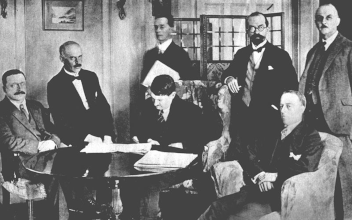
Just after 2:00 AM on December 6, 1921, the Irish delegation, without consulting the Dáil, finally sign a treaty with the British. Collins writes, prophetically, later on the day of the signing, “early this morning I signed my death warrant.”
The Treaty displeases the Catholics in the north and the unionists in the south. Meanwhile, many of those involved in the conflict are abhorred at the fact that not all of Ireland is to leave the United Kingdom.
(From: “The Anglo-Irish Treaty (1921)” by Brian O’Neill, Your Irish Culture, http://www.yourirish.com, May 20, 2020)