Francis Stevenson, Private Secretary to Lloyd George recalls, “I have never seen David so excited as he was before de Valera arrived at 4:30. He kept walking in and out of my room… As I told him afterwards, he was bringing up all his guns! He had a big map of the British Empire hung up on the wall in the Cabinet room, with its great blotches of red all over it. This was to impress de Valera with the greatness of the British Empire and to get him to recognise it, and the King.” De Valera apparently is not impressed.
When de Valera, Richard Barton and Art O’Brien arrive at Downing Street, “cheers were raised, Sinn Féin flags were displayed, and the crowd sang Irish airs.” As the meeting goes on, a “large crowd of Irish sympathisers knelt in the rain at Whitehall, at the end of Downing Street, recited the Rosary, and sang several hymns. Before the prayers started, they sang “Ireland a Nation.” According to a reporter covering the event, the singing of Irish songs and the praying never ceases.
Six days later, Britain makes its first formal proposal. The main negotiations take place in December culminating with the signing of the Anglo-Irish Treaty on December 6, 1921.
(From: Stair na hÉireann | History of Ireland, http://www.stairnaheireann.net, July 14, 2016 | Photo credit: National Library of Ireland collection, dated Thursday, July 14, 1921 (at approximately 5:30 PM), outside Downing Street as de Valera meets Lloyd George, at the first of four meetings held between the two in July 1921.)
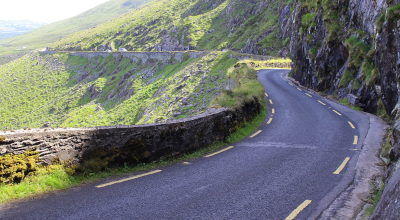
District Inspector Michael Fallon, accompanied by three other police in a motor car, are ambushed on the Conor Pass between Cloghane and Dingle, County Kerry. The D.I. is returning from an inspection of the barracks at Cloghane when the party is ambushed by members of the Irish Republican Army (IRA) West Kerry No.1 Brigade who are billetted at Fibough, in the Slieve Mish Mountains. The IRA volunteers include J. Dowling, Paddy Paul Fitzgerald, Dan Jeffers and Mick McMahon among their number.
Constables George Roach 62449 and Michael Linehan 63592 are killed outright. D.I. Fallon and Constable Joseph Campbell 67905, the driver, are both wounded. The IRA removes the bodies from the car and takes away the rifles and revolvers of the police. They then take Constable Campbell prisoner, dropping him off about three miles down the road.
Constable Linehan is 34 years old and single, and is originally from Cork. He has twelve years police service. His funeral takes place at St. Mary’s Catholic Church, Limerick, with burial in Mount St. Lawrence Cemetery. A hearse cannot be obtained so the constabulary, in relays, carry the coffin from the church to the cemetery.
Constable Roach has thirteen years service and is from County Clare. He is also a single man.
Compensation awards for gunshot injuries are later made to D.I. Fallon of £850 and to Constable Campbell of £600.
(From: “Constables George Roach and Michael Linehan, killed on the Connor Pass 1920” by Peter Mc, The Royal Irish Constabulary Forum (www.irishconstabulary.com), March 7, 2011)
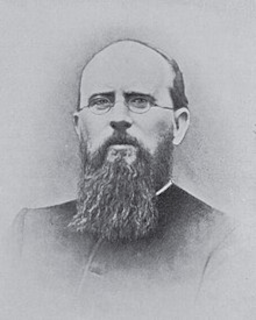
O’Reily is born John O’Reilly on November 19, 1846, in Kilkenny, County Kilkenny, the son of Michael, a military officer, and Anne, née Gallagher. He completes his primary education at the parochial school of St. John’s Parish, and spends six and a half years at St. Kieran’s College. Due to poor health, he decides against pursuing a military career, and in 1864 he enters All Hallows College in Dublin to study for the priesthood. He learns the Irish language and studies mental philosophy, mathematics and ecclesiastical studies, achieving first prize in each of his classes.
After being ordained on June 21, 1869, O’Reily leaves Ireland for Western Australia in October, arriving in January 1870. Having served briefly in Newcastle (present day Toodyay) and Northam, he becomes a parish priest in Fremantle, establishing the West Australian Catholic Record in 1874 and serving as its publisher, editor and printer from 1883.
When the Diocese of Port Augusta is established in 1887, Pope Leo XIII names O’Reily as its first bishop. Concerned about the financial position of the diocese, which had inherited significant debt from the Diocese of Adelaide, he accepts the posting reluctantly. As bishop, he greatly improves the financial position of the new diocese, reducing its debt by half and earning a reputation as a competent administrator.
In 1894, O’Reily is appointed to replace the deceased Christopher Reynolds as Archbishop of Adelaide. The archdiocese he inherits is burdened with substantial debt, again left over from the old Diocese of Adelaide. Through the sale of church assets and a fundraising campaign, he is able to eliminate most of the Archdiocese’s liabilities while still investing in church infrastructure. He also actively participates in public discussions relating to education policy at a time when the role of the state in supporting religious education is topical. He publicly advocates government assistance for religious schools, stating that it is unfair Catholics pay taxes to support state schools, but receive no funding for their own.
In the later years of his life, poor health forces O’Reily to spend less time attending to his episcopal duties, and from 1905, he keeps to himself in his house in Glen Osmond, leading to the local press referring to him as the “Recluse of Glen Osmond.” Increasingly, his episcopal duties are fulfilled by Bishop of Port Augusta John Norton, who has to visit the more remote parts of O’Reily’s see on his behalf.
As he becomes more frail, O’Reily asks certain priests to accompany him when he travels, among whom is the DominicanpriorRobert Spence. When O’Reily requests a coadjutor in 1913, he chooses Spence as his first preference for the role. Despite the reluctance of some clergy to the appointment of a religious as Archbishop, Spence is consecrated as coadjutor, with right of succession, in August 1914.
O’Reily dies at his house in Adelaide on July 6, 1915 and is buried under a large Celtic cross at the West Terrace Cemetery in Adelaide. He is highly regarded by many in South Australian society, with Adelaide’s daily newspapers praising his character, administrative ability and positive relations with non-Catholics.
In April 1913 London‘s Daily Mail offers a prize of £10,000 to the aviator who first crosses the Atlantic Ocean in an airplane from any point in the United States, Canada or Newfoundland to any point in Great Britain or Ireland in 72 continuous hours. The competition is suspended with the outbreak of war in 1914 but reopens after Armistice is declared in 1918.
Several teams enter the competition and, when Alcock and Brown arrive in St. John’s, the Handley Page team are in the final stages of testing their aircraft for the flight, but their leader, AdmiralMark Kerr, is determined not to take off until the plane is in perfect condition. The Vickers team quickly assembles their plane and while the Handley Page team are conducting yet another test, the Vickers plane takes off from Lester’s Field.
It is not an easy flight. The overloaded aircraft has difficulty taking off the rough field and barely misses the tops of the trees. At 5:20 PM the wind-driven electrical generator fails, depriving them of radio contact, their intercom and heating. An exhaust pipe bursts shortly afterwards, causing a frightening noise which makes conversation impossible without the failed intercom.
Alcock and Brown also have to contend with thick fog, which prevents Brown from being able to navigate using his sextant. Alcock twice loses control of the aircraft in the fog and nearly crashes into the sea. He also has to deal with a broken trim control that makes the plane become very nose heavy as fuel is consumed. Their electric heating suits fail, making them very cold in the open cockpit.
At 3:00 AM they fly into a large snowstorm. They are drenched by rain, their instruments ice up, and the plane is in danger of icing and becoming unflyable. The carburetors also ice up.
They make landfall in County Galway at 8:40 AM on June 15, 1919, not far from their intended landing place, after less than sixteen hours of flying time. The aircraft is damaged upon arrival because they land on what appears from the air to be a suitable green field, but which turns out to be Derrygilmlagh Bog, near Clifden. This causes the aircraft to nose-over, although neither of the airmen is hurt. Brown says that had the weather been favorable they could have pressed on to London. Their first interview is given to Tom ‘Cork’ Kenny of the Connacht Tribune.
Alcock and Brown are treated as heroes on the completion of their flight. The Secretary of State for Air, Winston Churchill, presents them with the Daily Mail prize. In addition to a share of the Daily Mail award, Alcock receives 2,000 guineas (£2,100) from the State Express Cigarette Company and £1,000 from Laurence R. Philipps for being the first Briton to fly the Atlantic Ocean. Both men are knighted a week later by King George V at Windsor Castle.
(Pictured: Statue of Alcock and Brown formerly located at London Heathrow Airport. Relocated to Clifden, Connemara, County Galway, Ireland to celebrate centenary in 2019.)
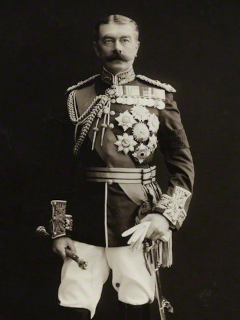
Kitchener is credited in 1898 for winning the Battle of Omdurman and securing control of the Sudan for which he is made Baron Kitchener of Khartoum. As Chief of Staff (1900–1902) in the Second Boer War he plays a key role in Lord Roberts’ conquest of the Boer Republics, then succeeds Roberts as commander-in-chief, by which time Boer forces have taken to guerrilla warfare and British forces imprison Boer civilians in concentration camps. His term as Commander-in-Chief (1902–09) of the Army in India sees him quarrel with another eminent proconsul, the Viceroy Lord Curzon, who eventually resigns. He then returns to Egypt as British Agent and Consul General.
In 1914, at the start of World War I, Kitchener becomes Secretary of State for War, a Cabinet Minister. One of the few to foresee a long war, lasting for at least three years, and with the authority to act effectively on that perception, he organises the largest volunteer army that Britain had ever seen, and oversees a significant expansion of materials production to fight on the Western Front. Despite having warned of the difficulty of provisioning for a long war, he is blamed for the shortage of shells in the spring of 1915, one of the events leading to the formation of a coalition government and is stripped of his control over munitions and strategy.
On June 5, 1916, Kitchener is making his way to Russia on HMS Hampshire to attend negotiations with Tsar Nicholas II. At the last minute, Admiral Sir John Jellicoe changes the HMS Hampshire‘s route on the basis of a misreading of the weather forecast and ignoring (or not being aware of) recent intelligence and sightings of GermanU-boat activity in the vicinity of the amended route. Shortly before 7:30 PM the same day, steaming for the Russian port of Arkhangelsk during a Force 9 gale, HMS Hampshire strikes a mine laid by the newly launched German U-boat U-75 and sinks 1.5 miles west of the Orkney. Only twelve men survive. Amongst the dead are Kitchener and all ten members of his entourage. He is seen standing on the quarterdeck during the approximately twenty minutes that it takes the ship to sink. His body is never recovered.
Kennedy meets his future wife, Jacqueline Lee “Jackie” Bouvier (1929–1994), while he is a congressman. Charles L. Bartlett, a journalist, introduces the pair at a dinner party. They are married a year after he is elected senator, on September 12, 1953. Following a miscarriage in 1955 and a stillbirth in 1956, they produce three children, Caroline, John, Jr., and Patrick, who dies of complications two days after birth.
In the 1960 presidential election, Kennedy narrowly defeats Republican opponent Richard Nixon, who is the incumbent vice president. His humor, charm, and youth in addition to his father’s money and contacts are great assets in the campaign. His campaign gains momentum after the first televised presidential debates in American history. He is the first Catholic elected president of the United States.
Kennedy’s administration includes high tensions with communist states in the Cold War. As a result, he increases the number of American military advisors in South Vietnam. The Strategic Hamlet Program begins in Vietnam during his presidency. In April 1961, he authorizes an attempt to overthrow the Cuban government of Fidel Castro in the failed Bay of Pigs Invasion. He authorizes the Cuban Project, also known as Operation Mongoose, in November 1961. He rejects Operation Northwoods, plans for false flag attacks to gain approval for a war against Cuba, in March 1962. However, his administration continues to plan for an invasion of Cuba in the summer of 1962.
In October 1962, U.S. spy planes discover Soviet missile bases have been deployed in Cuba. The resulting period of tensions, termed the Cuban Missile Crisis, nearly results in the breakout of a global thermonuclear conflict. He also signs the first nuclear weapons treaty in October 1963.
After Kennedy’s death, Congress enacts many of his proposals, including the Civil Rights Act of 1964 and the Revenue Act of 1964. Despite his truncated presidency, he ranks highly in polls of U.S. presidents with historians and the general public. His personal life has also been the focus of considerable sustained interest following public revelations in the 1970s of his chronic health ailments and extramarital affairs. He is the last U.S. President to have been assassinated as well as the last U.S. president to die in office.
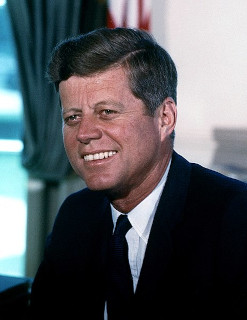
(Pictured: John F. Kennedy, photograph in the Oval Office, July 11, 1963)
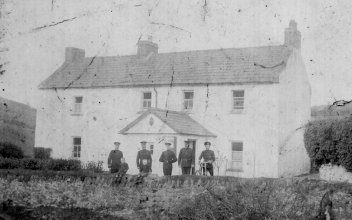
In 1920 twelve RIC Constables, or Peelers as they are called, are stationed in the barracks in Hollyford. They are regarded as the eyes and ears of the British establishment and therefore a thorn in the side of the local IRA. Since the previous year, the IRA has developed a policy of attacking police barracks throughout the country and forcing their closure thereby reducing the flow of information to Dublin Castle.
On the night of May 11, 1920, it is the turn of Hollyford Barracks. The local IRA with its leaders assembles at Phil Shanahan’s house on the Glenough road. At this time Shanahan is a member of the First Dáil, elected from a Dublin constituency as he is living and running a public house there. He fought in the Jacob’s Biscuit Factory under Thomas MacDonagh during the 1916 Easter Rising. It is decided the attack will be led by Ernie O’Malley, an organiser for the IRA who moves around to various Brigades throughout the country. His second in command is Séumas Robinson, commanding officer of the 3rd Tipperary Brigade. Other officers are Seán Treacy, whose mother Bridget Allis is from Lacknacreena, Dan Breen who is quartermaster general (QMG) of the Brigade, Comdt. Tadgh O’Dwyer, Captain Paddy O’Dwyer and Lt. Jim O’Gorman.
Roads are blocked in the vicinity and telephone lines are cut. Robinson and O’Malley, with the help of ladders, get on the roof and with lump hammers break holes in the slates. They then drop hand grenades and petrol in through the holes. They also ignite turf sods soaked in petrol and drop them through the holes. The fire on the upper floor escalates. While all this is happening, Seán Treacy, with his covering party, concentrate their fire on the port holes which keeps the occupants pinned down. The battle goes on all night and, as daylight approaches on the morning of May 12, the attackers have to withdraw without dislodging the police. While they do not achieve their aim to capture guns and ammunition, they do enough damage to ensure the RIC leaves Hollyford immediately never to return.
The next occupants, following the Anglo-Irish Treaty, are the Gárda Síochána in 1948. Various changes in personnel take place in the 1950s until Gárda Maurice Slattery is the only Gárda left in Hollyford. In 1965, after a lifetime in the Gárdí, he retires, and he and his family move to Limerick. He is the last Gárda to serve in Hollyford.
(From: “The Burning of Hollyford Barracks,” Third Tipperary Brigade Memorial (www.thirdtippbrigade.ie), July 12, 2018)
A farmer’s son, Kelly is raised amid the horror of the Irish Civil War. The family is burned out when he is five and, penniless, goes north to take a worker’s house near the Harland & Wolff shipyard in Belfast. Even though they are Protestant the Kellys are met with a cold welcome. To counter that, his mother starts a bakery while he and his father sell the hot rolls to the area pubs.
Kelly initially attends a shipyard workers’ school, sometimes without shoes, and then goes on to Methodist College Belfast, where only boys prepared to work hard are welcome. His mother, who had taught him to play the piano by marking out the keyboard on the kitchen table, is so cross when she hears that he has been playing football in the street that she tells the headmaster that he does not have enough homework.
On a visit to an elder sister at Trinity College, Dublin, Kelly is so impressed by her smoking and her painted nails that he decides to follow her to the university, where he reads legal science. After being called to the Bar of Northern Ireland in 1944, he has the usual slow start, traveling up to 100 miles to earn a five-guinea fee. However, aided by a photographic memory and the patronage of Catholicsolicitors, he gradually builds up a large practice, concentrating on crime and workers’ compensation while earning a reputation as the finest cross-examiner in the province.
Kelly first makes a mark by his successful defence of an aircraftman accused of killing a judge’s daughter. The man is found guilty but insane, though the complications involved bring it back to court 20 years later. After appointment as Queen’s Counsel in 1958 he skillfully conducts two cases which go to the House of Lords. One involves the liability of a drunken psychopath, the other the question of automatism where a person, acting like a sleepwalker, does not know what he is doing.
In 1973, Kelly is appointed as a judge of the High Court of Northern Ireland, and then as a Lord Justice of Appeal of Northern Ireland in 1984, when he is also knighted and appointed to the Privy Council of the United Kingdom. On the bench he proves a model of fairness and courtesy with a mastery of facts, but his role often puts him in danger.
A Provisional Irish Republican Army (IRA) gang once targets him with a bomb-laden milk van, intending to drive it through his gates. But the police are alerted and immediately take him to Stormont, where he lives for the next two months.
For a year Kelly presides alone over a non-jury Diplock court, protected by armed police and wearing a bulletproof vest before writing his judgment under Special Air Service (SAS) guard in England. He convicts dozens of people on “supergrass” evidence, though there are subsequently doubts about the informant and some of his judgments are overturned.
One of the accused, Kevin Mulgrew, is sentenced to 963 years in prison, with Kelly telling him, “I do not expect that any words of mine will ever raise in you a twinge of remorse.” While the IRA grumbles about the jail terms he dispenses, and he is often portrayed as an unthinking legal hardliner by Sinn Féin, he is a more subtle figure and is often merciful towards those caught up in events or those whom he considers too young for prison.
Kelly retires in 1995 and moves to England, where he dies at the age of 88 at his home in Berkshire on December 5, 2008, following a short illness. He is survived by his wife, Pamela Colmer.
(From: “Basil Kelly,” Independent.ie (www.independent.ie), January 4, 2009)
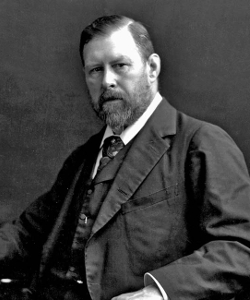
Stoker is born on November 8, 1847, in Clontarf, Dublin. During his lifetime, he is better known as the personal assistant of actor Henry Irving and business manager of the Lyceum Theatre, London, which Irving owns.
Stoker’s father, Abraham Stoker, is a civil servant and his mother, Charlotte Mathilda Blake Thornley, is a charity worker and writer. Stoker is a sickly child and is bedridden with an unknown illness until he starts school at the age of seven, when he makes a complete recovery. Growing up his mother tells him a lot of horror stories which may have influence on his later writings.
In 1864 Stoker enters Trinity College, Dublin. While attending college he begins working as an Irish civil servant. He also works part time as a free lance journalist and drama critic. In 1876 he meets Henry Irving, a famous actor, and they soon become friends. Not long after that, Stoker meets and falls in love with an aspiring actress named Florence Balcombe whom he marries on December 4, 1878 at St. Anne’s Parish Church, Dublin. In 1878 he accepts a job working in London as Irving’s personal secretary.
On December 9, Stoker and his new wife move to England to join Irving. His first book The Duties of Clerks of Petty Sessions in Ireland, though written while he is still in Dublin, is published in 1879. On December 30, 1879 Stoker and his wife have their only child, a son Noel. While in England Stoker also writes several novels and short stories. His first book of fiction, Under the Sunset, is published in 1881.
Stoker visits the English coastal town of Whitby in 1890, a visit that is said to be part of the inspiration for Dracula. Before writing Dracula, he meets Ármin Vámbéry, a Hungarian writer and traveler. Dracula likely emerges from Vámbéry’s dark stories of the Carpathian Mountains. Stoker then spends several years researching European folklore and mythological stories of vampires.
Dracula is an epistolary novel, written as a collection of realistic but completely fictional diary entries, telegrams, letters, ship’s logs, and newspaper clippings, all of which add a level of detailed realism to the story, a skill which Stoker develops as a newspaper writer. At the time of its publication, Dracula is considered a “straightforward horror novel” based on imaginary creations of supernatural life.
The original 541-page typescript of Dracula is believed to have been lost until it is found in a barn in northwestern Pennsylvania in the early 1980s. It consists of typed sheets with many emendations, plus handwritten on the title page is “THE UN-DEAD.” The author’s name is shown at the bottom as Bram Stoker. The typescript is purchased by Microsoft co-founder Paul Allen.
After suffering a number of strokes, Abraham “Bram” Stoker dies at No. 26 St. George’s Square, London on April 20, 1912. Some biographers attribute the cause of death to tertiary syphilis, others to overwork. He is cremated and his ashes are placed in a display urn at Golders Green Crematorium in north London.
As a minority party after 1910 elections, the Liberal Party depends on the Irish vote, controlled by John Redmond. To gain Irish support for the budget and the parliament bill, Asquith promises Redmond that Irish Home Rule will be the highest priority. It proves much more complex and time-consuming than expected. Support for self-government for Ireland had been a tenet of the Liberal Party since 1886, but Asquith has not been as enthusiastic, stating in 1903 (while in opposition) that the party should never take office if that government would be dependent for survival on the support of the Irish Nationalist Party. After 1910, though, Irish Nationalist votes are essential to stay in power. Retaining Ireland in the Union is the declared intent of all parties, and the Nationalists, as part of the majority that keep Asquith in office, are entitled to seek enactment of their plans for Home Rule, and to expect Liberal and Labour support. The Conservatives, with die-hard support from the ProtestantOrange Order of Ulster, are strongly opposed to Home Rule. The desire to retain a veto for the House of Lords on such bills has been an unbridgeable gap between the parties in the constitutional talks prior to the December 1910 United Kingdom general election.
The cabinet committee (excluding Asquith) that in 1911 plans the Third Home Rule Bill opposes any special status for Protestant Ulster within majority-Catholic Ireland. In 1913, Asquith writes to Winston Churchill, stating that the Prime Minister has always believed and stated that the price of Home Rule should be a special status for Ulster. In spite of this, the bill as introduced in April 1912 contains no such provision and is meant to apply to all Ireland. Neither partition nor a special status for Ulster is likely to satisfy either side. The self-government offered by the bill is very limited, but Irish Nationalists, expecting Home Rule to come by gradual parliamentary steps, favours it. The Conservatives and Irish Unionists oppose it. Unionists begin preparing to get their way by force if necessary, prompting nationalist emulation. Though very much a minority, Irish Unionists are generally better financed and more organised.
Since the Parliament Act the Unionists can no longer block Home Rule in the House of Lords, but only delay Royal Assent by two years. Asquith decides to postpone any concessions to the Unionists until the bill’s third passage through the House of Commons, when he believes the Unionists will be desperate for a compromise. Biographer Roy Jenkins concludes that had Asquith tried for an earlier agreement, he would have had no luck, as many of his opponents wanted a fight and the opportunity to smash his government. Sir Edward Carson, MP for the University of Dublin and leader of the Irish Unionists in Parliament, threatens a revolt if Home Rule is enacted. The new Conservative leader, Bonar Law, campaigns in Parliament and in Northern Ireland, warning Ulstermen against “Rome Rule,” that is, domination by the island’s Catholic majority. Many who oppose Home Rule feel that the Liberals have violated the Constitution by pushing through major constitutional change without a clear electoral mandate, with the House of Lords, formerly the “watchdog of the constitution,” not reformed as had been promised in the preamble of the 1911 Act and thus justified actions that in other circumstances might be treason.
The passions generated by the Irish question contrast with Asquith’s cool detachment, and he writes about the prospective partition of the county of Tyrone, which has a mixed population, deeming it “an impasse, with unspeakable consequences, upon a matter which to English eyes seems inconceivably small, and to Irish eyes immeasurably big.” As the House of Commons debate the Home Rule bill in late 1912 and early 1913, unionists in the north of Ireland mobilise, with talk of Carson declaring a Provisional Government and Ulster Volunteer Forces (UVF) built around the Orange Lodges, but in the cabinet, only Churchill views this with alarm.
These forces, insisting on their loyalty to the British Crown but increasingly well-armed with smuggled German weapons, prepare to do battle with the British Army, but Unionist leaders are confident that the army will not aid in forcing Home Rule on Ulster. As the Home Rule bill awaits its third passage through the House of Commons, the so-called Curragh incident occurs in March 1914. With deployment of troops into Ulster imminent and threatening language by Churchill and the Secretary of State for War, John Seely, around sixty army officers, led by Brigadier GeneralHubert Gough, announce that they would rather be dismissed from the service than obey. With unrest spreading to army officers in England, the Cabinet acts to placate the officers with a statement written by Asquith reiterating the duty of officers to obey lawful orders but claiming that the incident had been a misunderstanding. Seely then adds an unauthorised assurance, countersigned by Sir John French, the professional head of the army, that the government has no intention of using force against Ulster. Asquith repudiates the addition, and requires Seely and French to resign, taking on the War Office himself, retaining the additional responsibility until hostilities against Germany begin.
Within a month of the start of Asquith’s tenure at the War Office, the UVF lands a large cargo of guns and ammunition at Larne, but the Cabinet does not deem it prudent to arrest their leaders. On May 12, Asquith announces that he will secure Home Rule’s third passage through the House of Commons (accomplished on May 25), but that there will be an amending bill with it, making special provision for Ulster. But the House of Lords make changes to the amending bill unacceptable to Asquith, and with no way to invoke the Parliament Act on the amending bill, Asquith agrees to meet other leaders at an all-party conference on July 21 at Buckingham Palace, chaired by King George V. When no solution can be found, Asquith and his cabinet plans further concessions to the Unionists, but this does not occur as the crisis in Europe erupts into war.
In September 1914, after the outbreak of the conflict, Asquith announces that the Home Rule bill will go on the statute book as the Government of Ireland Act 1914 but will not go into force until after the war. He adds that in the interim a bill granting special status to Ulster will be considered. This solution satisfies neither side.
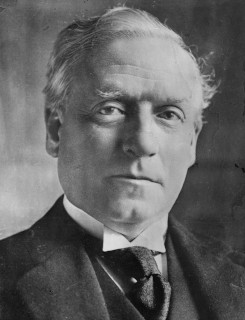
(Pictured: H.H. Asquith, former Prime Minister of the United Kingdom)